CYP1A1 gene polymorphisms as a risk factor for pterygium
Chi-Hsien Young,1,2 Yu-Lun Lo,3,4 Yi-Yu Tsai,5 Tung-Sheng Shih,2,6 Huei Lee,7 Ya-Wen Cheng1,8 (The first two authors contributed equally to this work)1Institute of Medicine, Chung Shan Medical University, Taichung, Taiwan; 2Institute of Occupational Safety & Health, Taipei, Taiwan; 3Graduate Institute of Clinical Medical Science, China Medical University, Taichung, Taiwan; 4Department of
Ophthalmology, China Medical University Beigang Hospital, Taichung, Taiwan; 5Department of Ophthalmology, China Medical University Hospital, Taichung, Taiwan; 6Graduate Institute of Environmental Health, College of Public Health, China Medical University and Hospital, Taichung, Taiwan; 7Institute of Medical Molecular Toxicology, Chung Shan Medical University, Taichung, Taiwan; 8Department of Medical Research, Chung Shan Medical University Hospital, Taichung, Taiwan
Purpose: Both cytochrome P4501A1 (CYP1A1) and glutathione S-transferase M1 (GSTM1) have been demonstrated to
be involved in the metabolism of polycyclic aromatic hydrocarbons (PAHs). BaP 7,8-diol 9,10-epoxide (BPDE), an ultimate metabolite of benzo(a)pyrene (BaP), attacks deoxyguanosine to form a BPDE-N2-dG adduct resulting in p53 gene mutations. Our previous report indicated that BPDE-like DNA adduct levels in pterygium were associated with CYP1A1 gene polymorphisms. Therefore, we hypothesize that the genetic polymorphisms of CYP1A1 and GSTM1 increase the risk for pterygium.
Methods: Two hundred-five pterygial specimens and 206 normal controls were collected in this study. For the analysis of CYP1A1 and GSTM1 gene polymorphisms, DNA samples were extracted from blood cells and then subjected to restriction fragment length polymorphism and polymerase chain reaction for the determination of mutation and genotype of CYP1A1 and GSTM1.
Results: There was a significant difference between the case and control groups in the CYP1A1 genotype (p=0.0161) but
not in GSTM1 (p=1.000). The odds ratio of the CYP1A1 m1/m2 polymorphism was 1.327 (95% CI=0.906–2.079, p=0.135) and the m2/m2 polymorphism was 1.647 (95% CI=1.154–2.350, p=0.006), compared to the m1/m1 wild-type genotype. The GSTM1 polymorphisms did not have an increased odds ratio compared with the wild type.
Conclusions: In conclusion, a CYP1A1 polymorphism is correlated with pterygium and might become a marker for the
prediction of pterygium susceptibility.
The environmental pollutant, benzo[a]pyrene (BaP), which is one of the polycyclic aromatic hydrocarbons (PAHs), has been found to cause p53 gene mutations and then lung tumorigenesis. The levels of PAHs in airborne particulates in Taiwan are higher than levels found in other countries, especially levels of BaP, benzo[b]fluoranthrene and benzo[g,h,i]perylene [1,2]. BaP 7,8-diol 9,10-epoxide (BPDE), an ultimate metabolite of BaP, attacks deoxyguanosine to form a BPDE-N2-dG adduct which results in p53 mutations [3]. The p53 tumor suppressor gene is one of the most commonly mutated genes observed in human tumors. Our previous study indicated that mutations within
p53 were detected in 15.7% of the pterygial samples and
deletion mutations were found in the same samples with p53 negative staining and substitution mutations were found in samples with p53 positive staining [4]. However, the cause of
p53 mutations in pterygium is still unclear.
Correspondence to: Ya-Wen Cheng, Ph.D., Institute of Medicine, Chung Shan Medical University, Chien-Kuo N. Rd., Taichung 402, Taiwan, ROC; Phone: 886-4-24730022 ext.11605; FAX: 886-4-24723229; email: [email protected]
BaP is oxidized by a series of well characterized enzymes such as cytochrome p450 1A1, 2C9 and 3A4 [5,6]. A thymine/ cytosine point mutation in the MSPI restriction site of
CYP1A1 has been reported to result in increased enzyme
activity [7]. The CYP1A1 MspI polymorphism has been linked to the susceptibility for smoking-related cancers, such as oral, colon, breast, and lung cancers [8-10]. Not only cytochrome P450 but other enzymes, such as glutathion s-transferase M1 (GSTM1) have been shown to be involved in BaP metabolism [11-13]. GSTM1 has also been shown to be polymorphic. A deletion is responsible for the existence of a null allele associated with the lack of expression of a functional protein [14,15]. The polymorphic GSTM1 null genotype has been found in 20%–50% of populations of various ethnic origins, and this genotype has been correlated with the risk for various tobacco-related cancers [16-19]. Therefore, the genetic polymorphisms of CYP1A1 and GSTM1 may contribute to BPDE-like DNA adduct formation and pterygium progression.
Our previous report indicated that BPDE-like DNA adducts were detected in pterygium samples and the DNA adduct levels were associated with the genetic polymorphisms of CYP1A1 [20]. Additionally, the risk of BPDE-like DNA Received 12 April 2010 | Accepted 2 June 2010 | Published 9 June 2010
adduct formation for patients with CYP1A1 m2/m2 and m1/ m2 was 9.675 fold higher than that of patients with m1/m1 types. Therefore, we hypothesize that that the genetic polymorphisms of CYP1A1 and GSTM1 increase the risk of pterygium.
In this study, we try to analyze the CYP1A1 and GSTM1 gene polymorphisms using PCR-RFLP (Polymorphism Chain Reaction-Restriction Fragment Length Polymorphism) and PCR (Polymorphism Chain Reaction) methods in 205 pterygium specimens and 206 controls to understand how
CYP1A1 and GSTM1 polymorphisms increase the risk of
pterygium.
METHODS
Patients: Pterygial samples were harvested from 205 patients
(136 males and 69 females) undergoing pterygium surgery at China Medical University Hospital (Taichung, Taiwan). All of the samples were from patients who had primary pterygium. The age range was 52 to 85 and the average age was 72.4 years old. The control blood samples were collected from patients without pterygium and pinguecula including 126 males and 80 females in the control group (age range from 55 to 75 years, mean of 62 years). There were no significant differences between both groups in age and sex. This study was performed with the approval of the Human Study Committee at China Medical University Hospital.
Polymorphisms of CYP1A1 and GSTM1: DNA was extracted
from the paraffin-embedded pterygium tissues for genetic polymorphism analysis [4]. DNA lysis buffer was applied to lyse the epithelial cells on the slide and then the DNA solution was transferred into eppendorf tubes for traditional proteinase K digestion and phenol-chloroform extraction. Finally, the DNA was precipitated by ethanol with the addition of linear polyacrylamide to increase DNA amounts [21]. Genotyping of the MspI polymorphism of CYP1A1 was performed by PCR amplification using the primer set of 5′-TAG GAG TCT TGT CTC AGT CCT-3′ and 5′-CAG TGA AGA GGT GTA GCC GCT-3′ [22]. The amplified products were digested with MspI and analyzed by electrophoresis on a 1.5% agarose gel. The MspI restriction site polymorphism resulted in three genotypes: a predominant homozygous m1 allele without the MspI site (genotype m1/m1; C/C), the heterozygote (genotype
m1/m2; C/T) and a rare homozygous m2 allele with the MspI site (genotype m2/m2; T/T). Detailed information of the PCR assays used in this study has been described previously [23]. Genotypes of GSTM1 were determined by the presence or absence of PCR product, according to the method of Groppi et al. [23]. The genotypes of GSTM1 are defined as present and null type. Two primers, 5′-GAA GGT GGC CTC CTC CTT GG-3′ and 5′-AAT TCT GGA TTG TAG CAG AT-3′, were used for PCR. If samples had no PCR product, the PCR experiment was repeated by adding a set of β-actin (ACTB) primers together with GSTM1 primers, to confirm that the absence of GSTM1 PCR product represented the null genotype.
Statistical analysis: Statistical analysis of frequency
distributions was done by the χ2-test, and the correlations
between various genotypes of CYP1A1 and GSTM1 from the case and control groups were analyzed by statistical software SPSS 10.0 (SPSS, Chicago, IL). Adjusted odd ratios (ORs) and a 95% confidence interval (95% CI) for various factors of pterygium were evaluated using a multiple logistic regression model.
RESULTS
Relationship of CYP1A1 and GSTM1 gene polymorphisms and pterygium: To verify the association of risk and the
genetic change in the metabolic genes in pterygium development, polymorphisms of CYP1A1 and GSTM1 in the pterygium and control groups were analyzed. The results of the genotypes of CYP1A1 and GSTM1 in the pterygium and control groups are shown in Table 1. The analysis of the
CYP1A1 polymorphisms in pterygium showed that 68
(33.2%) were homozygous for the m1/m1 genotype, 29 (14.1%) were homozygous for the m2/m2 genotype, and 108 (52.7%) were heterozygous for the m1/m2 genotype. There was a significant difference between the case and control groups in the CYP1A1 genotype (p=0.016). However, no clear patterns were observed between the pterygium and control groups for significant associations with GSTM1 polymorphisms.
The CYP1A1 gene polymorphism but not GSTM1 is a risk factor for pterygium: To understand whether polymorphisms
of CYP1A1 and GSTM1 increased the risk of pterygium TABLE 1. GENOTYPEDISTRIBUTIONOF CYP1A1 AND GSTM1 GENESAMONGPTERYGIUMPATIENTSANDCONTROLGROUP.
Gene Pterygium group (%) [n=205] Control group (%) [n=206] p-value
CYP1A1 m1/m1 68 (33.2) 89 (43.2) m1/m2 108 (52.7) 103 (50.0) m2/m2 29 (14.1) 14 (6.8) 0.016 GSTM1 Null 83 (40.5) 84 (40.8) Present 122 (59.5) 122 (59.2) 1.000
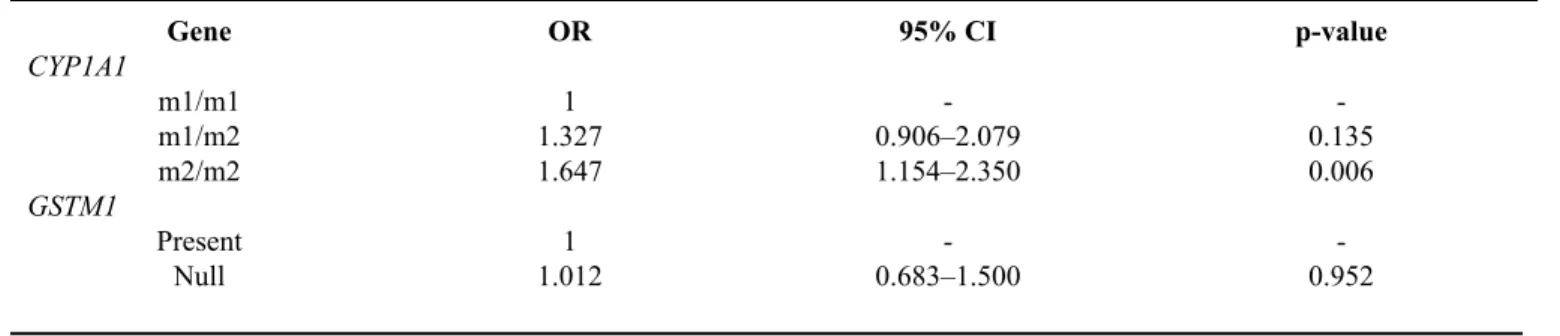
development, the different genotypes and the risk of pterygium were compared. The odds ratio of the CYP1A1 (m1/ m2) polymorphism was 1.327 (95% CI=0.906–2.079, p=0.135) and the m2/m2 polymorphism was 1.647 (95% CI=1.154–2.350, p=0.006), compared to the m1/m1 wild-type genotype (Table 2). The GSTM1 polymorphisms did not increase the odds ratio compared with the wild type (Table 2). The multiple logistic regression analysis showed that the
CYP1A1 genotype is related to the risk of pterygium after an
adjustment with GSTM1 polymorphisms. Subjects who were heterozygous (m1/m2) or homozygous (m2/m2) for the
CYP1A1 polymorphisms appeared to experience a higher risk
of pterygium than those who were homozygous for the wild-type allele (m1/m1; OR: 1.553; 95% CI: 1.07–2.290, p=0.037; Table 3). No significance was found in GSTM1 polymorphisms.
DISCUSSION
Our previous study indicated that BPDE-like DNA adducts were detected in pterygium paraffin sections [24]. We also found that CYP1A1 polymorphisms correlated with the BPDE-like DNA adduct formation in pterygium [20]. Therefore, we considered that not only UV radiation, but also environmental exposure is involved in pterygium pathogenesis. In this study, we analyzed the PAHs metabolic enzymes, CYP1A1 and GSTM1, and their gene polymorphisms in pterygium and compared them with control groups. Our data indicated that the CYP1A1 polymorphism is a risk factor for pterygium. To our knowledge, this is the first study to analyze the correlation of genetic polymorphisms of
CYP1A1 and GSTM1 with the risk of pterygium. GST is one
of the antioxidant defense enzymes which contributes to the protection against ROS [25,26]. The GSTM1 null type has been reported to be associated with cutaneous photosensitivity [27,28], so the GSTM1 null may be associated with
photosensitivity of corneal limbal cells. Our previous report indicated that lack of GSTM1 (GSTM1 null type) contributes to susceptibility of pterygium formation in early onset pterygium but is not associated with late onset pterygium [29]. In this study, we did not find an association between the
GSTM1 polymorphism and the risk of pterygium. Therefore,
we suggest that the role of GSTM1 in pterygium formation is more important in antioxidant defense than in PAH metabolism.
PAH compounds are the products of incomplete combustion of organic material and are thus ubiquitous in the environment (International Agency for Research on Cancer [IARC] World health Organization, 1983). Occupational exposure to PAH-compounds increases the risk of lung, and putatively, other cancers, and is the highest in coke oven workers, other workers in the steel industry, asphalt and bitumen workers, and those exposed to exhaust and working with gasoline. BaP, the well known carcinogen in cigarette smoke, induces G:C-T:A transversions experimentally [30] which are the main mutation types in smoking-related lung cancer [31].
Our previous study showed that BPDE-like DNA adduct levels correlate with CYP1A1 gene polymorphism in pterygium [20]. An evaluation of DNA adducts induced by BaP and other PAHs is suitable as a risk marker of p53 mutation. The mutation of the p53 gene has been noted in more than 50% of all human cancers [32-34]. Additionally, our previous study showed that BPDE-like DNA adducts are indeed detected in pterygium samples and they are minor contributors to the abnormal p53 gene [24]. In this study, we found that CYP1A1 with the m1/m2 and m2/m2 genotype has a 1.553 fold risk for pterygium compared with the m1/m1 genotypes. Therefore, we hypothesize that after exposure to environmental PAHs, the CYP1A1 gene polymorphism may result in high levels of BPDE-like DNA adduct formation
TABLE 2. RISKOFPTERYGIUMINRELATIONTOPOLYMORPHISMSINGENESINVOLVEDIN BAP METABOLITESINAPOPULATION-BASED SAMPLE. Gene OR 95% CI p-value CYP1A1 m1/m1 1 - -m1/m2 1.327 0.906–2.079 0.135 m2/m2 1.647 1.154–2.350 0.006 GSTM1 Present 1 - -Null 1.012 0.683–1.500 0.952
TABLE 3. MULTIPLELOGISTICREGRESSIONANALYSISOF CYP1A1 AND GSTM1 GENOTYPESANDTHERISKOFPTERYGIUM. Variable Groups unfavorable/ favorable OR (95% CI) p-value
CYP1A1 Polymorphism/wild type 1.553 (1.027–2.290) 0.037
contributing to the risk of pterygium formation. The CYP1A1 MspI polymorphism may be used as a risk factor for pterygium.
ACKNOWLEDGMENTS
This work was supported by grants from the National Science Council (NSC96–2314-B-039–009-MY2).
REFERENCES
1. Lee H, Su SY, Liu KS, Chou MC. Correlation between meteorological conditions and mutagenicity of airborne particulate samples in a tropical monsoon climate area from Kaohsiung city, Taiwan. Environ Mol Mutagen 1994; 23:200-7. [PMID: 8162895]
2. Kuo CY, Cheng YW, Chen CY, Lee H. Correlation between the amounts of polycyclic aromatic hydrocarbons and mutagenicity of airborne particulate samples from Taichung city, Taiwan. Environ Res 1998; 78:43-9. [PMID: 9630444]
3. Hussain SP, Amstad P, Raja K, Sawyer M, Hofseth L, Shields PG, Hewer A, Phillips DH, Ryberg D, Haugen A, Harris CC. Mutability of p53 hotspot codons to benzo(a)pyrene diol epoxide (BPDE) and the frequency of p53 mutations in nontumorous human lung. Cancer Res 2001; 61:6350-5.
[PMID: 11522624]
4. Tsai YY, Cheng YW, Lee H, Tsai FJ, Tseng SH, Chang KC. P53 gene mutation spectrum and the relationship between gene mutation and protein expression in pterygium. Mol Vis 2005; 11:50-5. [PMID: 15682042]
5. Shimada T, Yun CH, Yamasaki H, Gautier C, Beaune PH, Guengerich P. Characterization of human lung microsomal cytochrome P450 1A1 and its role in the oxidation of chemical carcinogens. Mol Pharmacol 1992; 41:856-64. [PMID: 1588920]
6. London SJ, Daly AK, Leathart JBS, Navidi WC, Idle JR. Lung cancer risk in relation to the CYP2C9*1/CYP2CP*2 genetic polymorphism among Africa-Americans and Caucasians in Los Angeles County, California. Pharmacogenetics 1996; 6:527-33. [PMID: 9014202]
7. Bartsch H, Nair U, Risch A, Rojas M, Wilkman H, Alexandrov K. Genetic polymorphism of CYP genes, alone or in combination, as a risk modifier of tobacco-related cancers. Cancer Epidemiol Biomarkers Prev 2000; 9:3-28. [PMID: 10667460]
8. Kawajiri K, Nakachi K, Imai K, Yoshii A, Shinoda N, Watanabe J. Identification of genetically high risk individuals to lung cancer by DNA polymorphisms of the cytochrome P450IA1 gene. FEBS Lett 1990; 263:131-3. [PMID: 1691986]
9. Hayashi S, Watanabe J, Kawajiri K. High susceptibility to lung cancer analyzed in terms of combined genotypes of P450IA1 and Mu-class glutathione S-transferase genes. Jpn J Cancer Res 1992; 83:866-70. [PMID: 1399823]
10. Kao SY, Wu CH, Lin SC, Yap SK, Chang CS, Wong YK, Chi LY, Liu TY. Genetic polymorphism of cytochrome P4501A1 and susceptibility to oral squamous cell carcinoma and oral precancer lesions associated with smoking/betel use. J Oral Pathol Med 2002; 31:505-11. [PMID: 12269988]
11. Ketterer B, Harris JM, Talaska G, Meyer DJ, Pemble SE, Taylor JB, Lang NP, Kadlubar FF. The human glutathioneS-transferase supergene family, its polymorphism, and its
effects on susceptibility to lung cancer. Environ Health Perspect 1992; 98:87-94. [PMID: 1486868]
12. Sundberg K, Seidel A, Mannervik B, Jernstrom B. Detoxification of carcinogenic fjord-region diol epoxides of polycyclic aromatic hydrocarbons by glutathione transferase P1–1 variants and glutathione. FEBS Lett 1998; 438:206-10. [PMID: 9827546]
13. Coles B, Ketterer B. The role of glutathione and glutathione transferases in chemical carcinogenesis. Crit Rev Biochem Mol Biol 1990; 25:47-70. [PMID: 2182291]
14. Seidegard J, Pero RW, Markowitz MM, Roush G, Miller DG, Beattie EJ. Isoenzyme(s) of glutathione transferase (class A) as a marker for the susceptibility to lung cancer: a follow up study. Carcinogenesis 1990; 11:33-6. [PMID: 2295125]
15. Pemble S, Schroeder KR, Spencer SR, Meyer DJ, Hallier E, Bolt HM, Ketterer B, Taylor JB. Human glutathione S-transferase (GSTT1): cDNA cloning and the characterization of a genetic polymorphism. Biochem J 1994; 15:271-6.
[PMID: 8198545]
16. McWilliams JE, Sanderson BJ, Harris EL, Richert-Boe KE, Henner WD. Glutathione S-transferase M1 (GSTM1) deficiency and lung cancer risk. Cancer Epidemiol Biomarkers Prev 1995; 4:589-94. [PMID: 8547824]
17. Sato M, Sato T, Izumo T, Amagasa T. Genetic polymorphism of drug-metabolizing enzymes and susceptibility to oral cancer. Carcinogenesis 1999; 20:1927-31. [PMID: 10506106]
18. Katoh T, Kaneko S, Kohshi K, Munaka M, Kitagawa K, Kunugita N, Kunugita N, Ikemura K, Kawamoto T. Genetic polymorphisms of tobacco- and alcohol-related metabolizing enzymes and oral cavity cancer. Int J Cancer 1999; 83:606-9. [PMID: 10521794]
19. Bell DA, Taylor JA, Paulson DF, Robertson CN, Mohler JL, Lucier GW. Genetic risk and carcinogen exposure: a common inherited defect of the carcinogen-metabolism gene glutathione S-transferase M1 (GSTM1) that increases susceptibility to bladder cancer. J Natl Cancer Inst 1993; 85:1159-64. [PMID: 8320745]
20. Tung JN, Wu HH, Chiang CC, Tsai YY, Chou MC, Lee H, Cheng YW. An association between BPDE-like DNA adduct levels and CYP1A1 and GSTM1 polymorphisma in pterygium. Mol Vis 2010; 16:623-9.
21. Gaillard C, Strauss F. Ethanol precipitation of DNA with linear polyacrylamide as carrier. Nucleic Acids Res 1990; 18:378.
[PMID: 2326177]
22. Hayashi S, Watanabe J, Nakachi K, Kawajiri K. Genetic linkage of lung cancer-associated MspI polymorphisms with amino acid replacement in the heme binding region of the human cytochrome P4501A1 gene. J Biochem 1991; 110:407-11.
[PMID: 1722803]
23. Groppi A, Couttele C, Fleury B, Iron A, Beugeret J, Couzigous P. Glutathione S-transferase class mu in French alcoholic cirrhotic patients. Hum Genet 1991; 87:628-30. [PMID: 1916767]
24. Lai TJ, Tsai YY, Cheng YW, Chiang CC, Lee H, Chou MC, Chang JH. An association between BPDE-like DNA adducts levels and P53 gene mutation in pterygium. Mol Vis 2006; 12:1687-91. [PMID: 17213797]
25. Kerb R, Brockmoller J, Reum T, Roots I. Deficiency of glutathione S-transferases T1 and M1 as heritable factors of
increased cutaneous UV sensitivity. J Invest Dermatol 1997; 108:229-32. [PMID: 9008240]
26. Halliwell B, Gutteridge JMC. Antioxidant defences. In: Halliwell B, Gutteridge JMC, editors. Free Radicals in Biology and Medicine. 3rd ed. Oxford: Clarendon Press; 1999. p. 105–245.
27. Strange RC, Lear JT, Fryer AA. Polymorphism in glutathione Stransferase loci as a risk factor for common cancers. Arch Toxicol Suppl 1998; 20:419-28. [PMID: 9442313]
28. Ollier W, Davies E, Snowden N, Alldersea J, Fryer A, Jones P, Strange R. Association of homozygosity for glutathione-S-transferase GSTM1 null alleles with the Ro+/La-autoantibody profile in patients with systemic lupus erythematosus. Arthritis Rheum 1996; 39:1763-4. [PMID: 8843871]
29. Tsai YY, Lee H, Tseng SH, Cheng YW, Tsai CH, Wu YH, Tsai FJ. Null type of glutathione S-transferase M1 polymorphism is associated with early onset pterygium. Mol Vis 2004; 10:458-61. [PMID: 15273656]
30. Hainaut P, Va¨ha¨kangas K. p53 as a sensor of carcinogenic exposures: mechanisms of p53 protein induction and lessons from p53 gene mutations. Pathol Biol (Paris) 1997; 45:833-44. [PMID: 9769947]
31. Wei M, Wanibuchi H, Morimura K, Iwai S, Yoshida K, Endo G, Nakae D, Fukushima S. Carcinogenicity of dimethylarsinic acid in male F344 rats and genetic alterations in induced urinary bladder tumors. Carcinogenesis 2002; 23:1387-97. [PMID: 12151359]
32. Hollstein M, Sidransky D, Vogelstein B. at al. p53 mutations in human cancers. Science 1991; 253:49-53. [PMID: 1905840]
33. Greenblatt MS, Bennett WP, Hollstein M, Harris CC. Mutations in the p53 tumor suppressor gene: clues to cancer etiology and molecular pathogenesis. Cancer Res 1994; 54:4855-78.
[PMID: 8069852]
34. Hussain SP, Harris CC. Molecular epidemiology of human cancer: contribution of mutation spectra studies of tumor suppressor genes. Cancer Res 1998; 58:4023-37. [PMID: 9751603]
The print version of this article was created on 4 June 2010. This reflects all typographical corrections and errata to the article through that date. Details of any changes may be found in the online version of the article.