Simple Colorless WDM-PON With Rayleigh
Backscattering Noise Circumvention Employing
-QAM OFDM Downstream and Remodulated
OOK Upstream Signals
C. H. Yeh, Member, IEEE, C. W. Chow, Member, IEEE, and H. Y. Chen
Abstract—We propose and experimentally demonstrate a new
colorless wavelength-division-multiplexed passive optical network (WDM-PON) architecture with the Rayleigh backscattering (RB) interferometric beat noise mitigation by using cross-remodulation architecture. The proposed WDM-PON has a simply configu-ration by combining two WDM-PONs at two wavelength bands to support twice the number of users. We experiment different -quadrature amplitude modulation (QAM) ( and 64) orthogonal frequency division multiplexing (OFDM) down-stream signal and the remodulated on-off keying (OOK) updown-stream signal by using the 2.5 GHz directly modulated laser (DML) and 1.2 GHz reflective semiconductor optical amplifier (RSOA) respectively. Hence, the total data rate achieved for the down-stream signals are 10 Gb/s, 12.5 Gb/s, and 15 Gb/s respectively for different -QAM. For the upstream signal, we over-drive the RSOA and 2.5 Gb/s OOK upstream traffic can be achieved. In addition, the proposed PON can also be upgraded to support more wavelength bands to meet the increase demand of capacity.
Index Terms—Optical OFDM, PON architecture, Rayleigh
backscattering, WDM access.
I. INTRODUCTION
D
UE to the rapid increase in the demand of broadband ser-vices, passive optical network (PON) will be a promising solution for next generation fiber-to-the-home (FTTH) access system [1]–[3]. Wavelength-division-multiplexed passive op-tical networks (WDM-PONs), employing directly modulated laser (DML) at the central office (CO) and reflective semicon-ductor optical amplifier (RSOA) for signal reuse and remodula-tion at each optical network unit (ONU) are attractive network architectures for the future high-speed and high-capacity PON [4], [5]. However, Rayleigh backscattering (RB) interferometric beat noises generated by the downstream signal in the color-less WDM-PON could result in impairment of network perfor-mance [6]. To mitigate the RB interferometric beat noise, sev-Manuscript received December 19, 2011; revised February 22, 2012; accepted March 19, 2012. Date of publication April 03, 2012; date of current version May 07, 2012.C. H. Yeh and H. Y. Chen are with the Information and Communications Re-search Laboratories, Industrial Technology ReRe-search Institute (ITRI), Hsinchu 31040, Taiwan.
C. W. Chow and S. P. Huang are with Department of Photonics and Insti-tute of Electro-Optical Engineering, National Chiao Tung University, Hsinchu 30010, Taiwan (e-mail: [email protected]).
Color versions of one or more of the figures in this paper are available online at http://ieeexplore.ieee.org.
Digital Object Identifier 10.1109/JLT.2012.2192258
eral techniques have been proposed, such as using the phase and bias-current dithering, employing wavelength shifting tech-nique, utilizing advanced modulation formats, or using double laser bands source etc. [1], [7]–[9] However, these proposed methods would increase the complexity and the cost of PON. Furthermore, to enhance the spectral efficiency and reduce the cost of high speed transmitter (Tx) and receiver (Rx), optical orthogonal frequency division multiplexing-quadrature ampli-tude modulation (OFDM-QAM) has been proposed and is be-lieved to be a promising candidate for the future WDM-PON [10]–[13].
In this work, we propose and experimentally demonstrate a new and simple colorless WDM-PON architecture providing twice the WDM-PON capacity when compared with the individual PON, also mitigating the RB interferometric beat noise by using cross-remodulation architecture. A new design of remote node (RN) is proposed for the cross-remodulation when compared with [4] by removing the thin-film filters and optical circulators (OCs). As the downstream and upstream signals are at different wavelength bands when traveling in the same fiber path; hence RB interferometric beat noise can be circumvented.
The proposed WDM-PON has a simply configuration by combining two WDM-PONs at two wavelength bands. We experiment different -QAM ( and 64) OFDM downstream signal and the remodulated on-off keying (OOK) upstream signal by using the 2.5 GHz DML and 1.2 GHz RSOA respectively. Hence, the total data rate achieved for the downstream signals are 10 Gb/s, 12.5 Gb/s, and 15 Gb/s re-spectively for different -QAM. By considering the overhead, the effective data rates are 9.2, 11.5 and 13.8 Gb/s, respectively. For the upstream signal, we over-drive the RSOA and 2.5 Gb/s OOK upstream traffic can be achieved. We also analyze that the RSOA can suppress the OFDM signal by observing the electrical spectra at the output of the RSOA. In addition, the proposed PON can also be upgraded to support more wave-length bands to meet the increase demand of capacity in the future.
The paper is organized as follow: The introduction is given in Section I and the proposed architecture of the cross-remodula-tion WDM-PON with RB circumvencross-remodula-tion and the operacross-remodula-tion prin-ciple will be given in Section II. The experiments, results and discussions for the OFDM downstream signal and the cross-re-modulated OOK upstream signal will be given in Sections III 0733-8724/$31.00 © 2012 IEEE
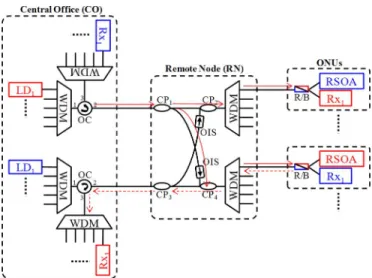
Fig. 1. Proposed colorless WDM-PON system to provide twice PON capacity with the mitigation of RB interferometric beat noise.
and IV respectively. Finally, a conclusion will be given in Sec-tion V.
II. ARCHITECTUREDESIGN
Fig. 1 shows the proposed colorless WDM-PON with cross-remodulation architecture to mitigate the RB beat noise and also provide twice the network capacity. This combined two parallel networks to form one PON system. A new design of RN is pro-posed as shown in Fig. 1 for the cross-remodulation. And the RN consists of four 1 2 and 50:50 optical couplers (CPs), two optical isolator (OIS) and two cyclic WDM multiplexers. DMLs in two wavelength bands [the red (R)- and blue (B)-bands] are employed in the central office (CO) to generate the downstream signals. In each ONU, a RSOA is used to remodulate the down-stream signal and to generate the updown-stream signal.
In this proposed scheme, we employ the R- and B-bands to state the operating principle. For the upper fiber path, the R-band downstream wavelength is transmitted to the RN from the CO. Then the downstream wavelength is power divided by the . One part of the downstream signal transmits through the , a WDM multiplexer, a R/B-band filter and finally is received by an optical Rx of the upper ONU. And the other part of the downstream signal transmits through the OIS, the , a WDM multiplexer, a R/B-band filter and then into the RSOA of the lower ONU for upstream signal remodulation. It is important to note that by using the wavelength-cyclic property of the WDM multiplexer [14], both red and blue signals can be transmitted at the same output port of the WDM multiplexer.
The remodulated R-band upstream signal from the lower ONU transmits through the lower fiber path and then back to the CO as shown in Fig. 1. The OIS inside the RN is used to prevent the R-band upstream signal to travel in the upper fiber path. Similarly, the B-band downstream signal is received and remodulated by the same mechanism. As a result, the downstream and upstream signals are at different wavelength bands when traveling in the same fiber path. Hence, RB in-terferometric beat noise can be mitigated. Compared with the previous WDM-PON [4], the additional cost of thin-film filters and optical circulators (OCs) in the RN can be removed.
Fig. 2. Experimental setup of the proposed colorless WDM-PON system. The inset was wavelength plan, which has 40 channels at 100 GHz channel spacing.
However, the proposed scheme has an inherent loss of 6 dB due to the use of fiber couplers which is a limitation.
It is worth to mention that the proposed architecture can also support operations at the S- to C-band, C- to L-bands and S- to L-bands; and also with the capability of RB mitigation. III. EXPERIMENT ANDDISCUSSION FOROFDM DOWNSTREAM
SIGNAL
To verify the transmission performance of proposed WDM-PON, an experiment as shown in Fig. 2 was performed. In the experiment, we divided the C-band into two sub-bands, which were the R- and B-bands, as illustrated in the inset of Fig. 2. Our wavelength plan includes 40 channels at 100 GHz channel spacing. Two 2.5 GHz bandwidth DMLs ( and ) with same output power of 7.5 dBm at the wavelengths of 1541.6 and 1550.4 nm, respectively were used to serve as the R- and B-band downstream signals in the CO. The and were directly modulated by optical OFDM-QAM format with proper biases ( V) to avoid clipping of the OFDM signal. The OFDM signal was produced by Matlab® program, and was applied to the DMLs using an arbitrary waveform generator (AWG). The signal processing of the OFDM consisted of serial-to-parallel conversion, QAM symbol encoding, inverse fast Fourier trans-form (IFFT), cyclic prefix insertion, and digital-to-analog con-version (DAC). The sampling rate and DAC resolution of AWG (Tektronix® AWG 7122) were 12 GS/s and 8 bits. The FFT size and IFFT size are both 512, and cyclic prefix (CP) length is 1/64. The V applied to the DML was 0.6 V. Besides, 107 subcar-riers of -QAM ( and 64) OFDM modulation for-mats only occupied about 2.5 GHz bandwidth (from 1.95 MHz to 2.50 GHz). And 10 Gb/s, 12.5 Gb/s and 15 Gb/s downstream signals were achieved using a 2.5 GHz DML.
The feeder and distribution fibers were 15 and 5 km respec-tively. The R- and B-band downstream signals passed through the upper and lower fibers respectively to the RN as shown in Fig. 2. Then the R-band downstream signal was injected into RSOA via the lower 5 km distribution fiber and a 100 GHz band-pass filter (BF) for signal remodulation. The downstream signal will be remodulated to generate the 2.5 Gb/s OOK upstream signal.
We first discuss the performance of downstream OFDM signal. The B-band OFDM downstream signal (1550.4 nm)
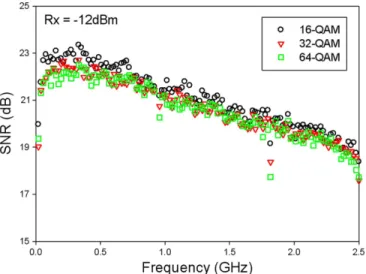
Fig. 3. Measured SNR of each OFDM subcarrier in the frequency bandwidth of 0.0195 to 2.50 GHz after 20 km SMF transmissions without dispersion com-pensation.
was transmitted through the 100 GHz bandwidth BF and was directly detected by a 2.5 GHz PIN Rx at the ONU. The received downstream OFDM signal was captured by a digital oscilloscope (Tektronix, DPO 71254) with the 50 GS/s sam-pling rate and 3 dB bandwidth of 12.5 GHz for OFDM signal demodulation. To demodulate the vector signal, the off-line DSP program was employed. And the demodulation process included the synchronization, FFT, one-tap equalization, and QAM symbol decoding. The FFT size was 512. Finally the bit error rate (BER) was calculated based on the measured signal-to-noise ratio (SNR).
Higher SNR would result in better BER performance. The SNR required to achieve the forward error correction (FEC) threshold (BER of [15]) are 15.2 dB, 18.2 dB and 21.2 dB when 16-, 32- and 64-QAM OFDM are used respec-tively. Fig. 3 shows our measured SNRs of all the OFDM sub-carriers in the frequency from 1.95 MHz to 2.50 GHz after 20 km SMF transmission without dispersion compensation. The optical received power was dBm for all cases. As shown in our later analysis, the average BER including all the OFDM subcarriers is still within the FEC threshold. Hence, we do not sacrifice any bandwidth in the proposed network. It is worth to mention that we can improve the BER performance by ne-glecting the high frequency OFDM subcarriers (having lower SNR); however, the effective bit-rate will be reduced [16]. We can observe there is a decrease in SNR at low frequency carriers. The decrease of SNR at the low frequency OFDM sub-carriers is due to the signal-signal beat interference (SSBI) [17]. After the square-law detection by the PD, the desired data can be obtained from the beating between the carrier and the sub-carriers, while the SSBI is created from the beating among the subcarriers and this decrease the SNR at lower frequency.
Fig. 4 shows the BER measurements of 1550.4 nm down-stream signal using optical 16-, 32- and 64-QAM OFDM at back-to-back (B2B) and after 20 km SMF transmission, respec-tively. By considering the 7% FEC overhead and the CP of the OFDM, the effective data rates are 9.2, 11.5 and 13.8 Gb/s, re-spectively. We can obtain the Rx sensitivities of
Fig. 4. BER measurements of 1550.4 nm downstream traffic using optical 16-, 32- and 64-QAM OFDM modulations at the B2B and 20 km SMF transmission, respectively, in the proposed PON system. Insets are the corresponding constel-lation diagrams.
and dBm at the BER of , respectively, when using the 16-, 32- and 64-QAM OFDM at B2B. After 20 km SMF transmission without dispersion compensation, the power penalties of 1.0, 1.1 and 1.4 dB were measured at the BER of for the 16-, 32- and 64-QAM OFDM respectively. We can also observe that the average BER can still achieve FEC threshold even 64-QAM OFDM was used. The insets of Fig. 4 show the corresponding constellation diagrams of 16-, 32- and 64-QAM OFDM signals at the B2B and after 20 km SMF trans-mission, respectively, at the BER of . As we can see that the Rx sensitivity difference of 4.1 dB between the 16-QAM and 64-QAM OFDM signals in this measurement, the order of -QAM can be adaptively adjusted depending on the various power budgets in PON. As mentioned before, the average BER shown in Fig. 4 includes all the OFDM subcarriers. It is worth to mention that we can improve the BER performance by ne-glecting the high frequency OFDM subcarriers (having lower SNR), but the effective bit-rate will be reduced [16].
IV. EXPERIMENT ANDDISCUSSION FORCROSS-REMODULATED UPSTREAMSIGNAL
Then we discuss the signal remodulation using the RSOA. As shown in Fig. 2, the 1541.6 nm OFDM downstream would inject into the RSOA via the lower fiber. The operating current of the 1.2 GHz bandwidth RSOA (manufactured by CIP) was set at 65 mA. The RSOA can be directly over-modulated to produce a 2.5 Gb/s, pseudorandom binary sequence (PRBS) of
OOK upstream signal. The injection power into the RSOA was about dBm. In order to increase the power budget of the system, optical amplifiers, such as EDFA, could be included in the RN to improve the dynamic range of the system.
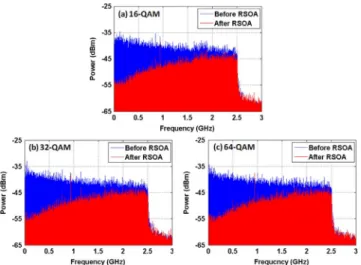
Figs. 5(a) to (c) show the measured electrical spectra of the optical OFDM signal before and after launching into the RSOA using 16-, 32- and 64-QAM OFDM signals, respectively. And the RSOA is dc-based. We can observe that the electrical spectra are nearly independent of QAM levels. This implies that using the RSOA to remove the downstream OFDM signal is indepen-dent of the level of QAM in the OFDM signal. We can also
Fig. 5. Experimental measured electrical spectra of 1541.6 nm OFDM down-stream signal within the frequency of 2.5 GHz before and after injecting into the RSOA after 20 km SMF transmission, when the modulation formats are (a) 16-, (b) 32- and (c) 64-QAM OFDM.
Fig. 6. BER performance of upstream traffic at the B2B and 20 km fiber trans-mission, when the RSOA is directly modulated at 2.5 Gb/s OOK format, under the 16-, 32- and 64-QAM OFDM modulations of downstream injection light-wave, respectively. Insets are the corresponding eye diagrams.
observe the high-pass filtering effect of the RSOA and the low frequency OFDM components are suppressed. The high-pass filtering effect of the RSOA is due to the presence of self-gain modulation (SGM) of a saturated RSOA [18].
When the downstream OFDM signal was launched into the RSOA, it acts as a data eraser to suppress the downstream optical signal for the successful remodulation of the upstream signal by using the gain saturation effect [19]. And the condi-tions of using the RSOA as data eraser can be found in [20]. In addition, as the upstream PIN Rx has a 3-dB bandwidth of 2 GHz (responsivity of 0.85 A/W @ 1550 nm; dark current about 1 nA), the high frequency OFDM components could be removed and this could improve the integrity of the upstream OOK signal.
For the upstream transmission, the output power from the RSOA was 7.4 dBm. And, the upstream signal was directly detected by a PIN Rx at the CO. Fig. 6 shows the measured BER performance of upstream traffic at the B2B and 20 km
fiber transmission, when the RSOA is directly modulated at 2.5 Gb/s OOK, under the signal remodulation of 16-, 32- and 64-QAM OFDM downstream signals respectively. No optical pre-amplifier was used in the detection. Here, the Rx sensitivi-ties at BER of for the upstream signals were
and dBm, respectively, under the 16-, 32- and 64-QAM OFDM remodulations. And the power penalties of about 3 dB were measured after the 20 km SMF transmission, as also shown in Fig. 6. The power penalty is due to the additional frequency chirp produced by the gain saturated RSOA [21]. The level of chirp produced is related to the amount of gain compression of the RSOA as described in [21]. The insets of Fig. 6 are the corre-sponding eye diagrams at the BER of . And these measured eyes are clear and widely open.
As commercial available RSOA only has the modulation bandwidth of about 2 GHz. In order to increase the upstream data rate, we can first use a gain saturated SOA to suppress the downstream OFDM signal and use an external modulator to generate the upstream signal.
V. CONCLUSION
We proposed and experimentally demonstrated a new and simple colorless WDM-PON architecture to circumvent the RB interferometric beat noise by using cross-remodulation archi-tecture. A new design of RN was proposed for the cross-remod-ulation by removing the thin-film filters and optical circulators (OCs) in previous design; hence it could be more cost-effec-tive. As the downstream and upstream signals were at different wavelength bands when traveling in the same fiber path; hence RB interferometric beat noise can be circumvented.
The proposed WDM-PON had a simply configuration by combining two WDM-PONs at two wavelength bands. We experimented different -QAM ( and 64) OFDM downstream signal and the cross-remodulated on-off keying (OOK) upstream signal by using the 2.5 GHz DML and 1.2 GHz RSOA respectively. Hence, the total data rate achieved for the downstream signals are 10 Gb/s, 12.5 Gb/s, and 15 Gb/s respectively for different -QAM. By considering the 7% FEC overhead and the CP of the OFDM, the effective data rates are 9.2, 11.5 and 13.8 Gb/s, respectively. We obtained the Rx sensitivities of and dBm at the BER of , respectively, when using the 16-, 32-and 64-QAM OFDM at B2B. After 20 km SMF transmission without dispersion compensation, the power penalties of 1.0, 1.1 and 1.4 dB were measured at the BER of for the 16-, 32- and 64-QAM OFDM respectively. We also observed that the average BER can still achieve FEC threshold even 64-QAM OFDM was used.
For the upstream signal, we over-drove the RSOA and 2.5 Gb/s OOK upstream traffic can be achieved. We also analyzed that the RSOA can suppress the OFDM signal by observing the electrical spectra at the output of the RSOA. The experi-mental results showed that using RSOA to remove the down-stream OFDM signal is independent of the level of QAM in the OFDM signal. No optical pre-amplifier was used in the detec-tion. Here, the Rx sensitivities at BER of for the upstream signals were and dBm, respectively, under the 16-, 32- and 64-QAM OFDM remodulations. And the power
penalties of 3dB were measured after the 20 km SMF trans-mission. Besides, the proposed architecture can support opera-tions at the S- to C-band, C- to L-bands and S- to L-bands.
REFERENCES
[1] C. W. Chow and C. H. Yeh, “Mitigation of Rayleigh backscattering in 10-Gb/s downstream and 2.5-Gb/s upstream DWDM 100-km long-reach PONs,” Opt. Exp., vol. 19, pp. 4970–4976, 2011.
[2] C. Arshad, H.-C. Chien, S.-H. Fan, C. Liu, C. Su, and G.-K. Chang, “A survivable protection and restoration scheme using wavelength switching of integrated tunable optical transmitter for high throughput WDM-PON system,” in Proc. OFC, 2011, Paper OThK6.
[3] C. H. Yeh, C. W. Chow, Y. F. Wu, F. Y. Shih, and S. Chi, “Experimental demonstration of CW light injection effect in upstream traffic TDM-PON,” Opt. Fiber Technol., vol. 16, pp. 178–181, 2010.
[4] H.-H. Lin, C.-Y. Lee, S.-C. Lin, S.-L. Lee, and G. Keiser, “WDM-PON systems using cross-remodulation to double network capacity with Rayleigh scattering effects,” in Proc. OFC, 2008, Paper OTuH6. [5] C.-H. Yeh, C.-W. Chow, C.-H. Wang, F.-Y. Shih, H.-C. Chien, and S.
Chi, “A self-protected colorless WDM-PON with 2.5 Gb/s upstream signal based on RSOA,” Opt. Exp., vol. 16, pp. 12296–12301, 2008. [6] P. J. Urban, A. M. J. Koonen, G. D. Khoe, and H. de Waardt, “Rayleigh
backscattering-suppression in a WDM access network employing a re-flective semiconductor optical amplifier,” in Proc. Symp. IEEE/LEOS Benelux Chapter, 2007, pp. 147–150.
[7] C. W. Chow, G. Talli, and P. D. Townsend, “Rayleigh noise reduction in 10-Gb/s DWDM-PONs by wavelength detuning and phase-modu-lation-induced spectral broadening,” IEEE Photon. Technol. Lett., vol. 19, no. 6, pp. 423–425, Mar. 2007.
[8] Z. Li, Y. Dong, Y. Wang, and C. Lu, “A novel PSK Manchester mod-ulation format in 10-Gb/s passive optical network system with high tolerance to beat interference noise,” IEEE Photon. Technol. Lett., vol. 17, no. 5, pp. 1118–1120, May 2005.
[9] S.-M. Lee, K.-M. Choi, S.-G. Mun, J.-H. Moon, and C.-H. Lee, “Dense WDM-PON based on wavelength locked Fabry–Perot lasers,” in Proc. OFC, 2005, Paper JWA55.
[10] Y.-T. Hsueh, M.-F. Huang, S.-H. Fan, and G.-K. Chang, “Demon-stration of converged bidirectional OFDM-m-QAM RoF and WDM-OFDM-PON access networks,” in Proc. OFC, 2011, Paper OWK5.
[11] J. Yu, M.-F. Huang, D. Qian, L. Chen, and G.-K. Chang, “Centralized lightwave WDM-PON employing 16-QAM intensity modulated OFDM downstream and OOK modulated upstream signals,” IEEE Photon. Technol. Lett., vol. 20, no. 18, pp. 1545–1547, Sep. 2008. [12] W. Lee, M. Y. Park, S. H. Cho, J. Lee, C. Kim, G. Jeong, and B.
W. Kim, “Bidirectional WDM-PON based on gain-saturated reflective semiconductor optical amplifiers,” IEEE Photon. Technol. Lett., vol. 17, no. 11, pp. 2460–2462, Nov. 2005.
[13] C. W. Chow, C. H. Yeh, C. H. Wang, F. Y. Shih, and S. Chi, “Signal remodulation of OFDM-QAM for long reach carrier distributed passive optical networks,” IEEE Photon. Technol. Lett., vol. 21, no. 11, pp. 715–717, Jun. 2009.
[14] E. S. Son, K. H. Han, J. H. Lee, and Y. C. Chung, “Survivable network architectures for WDM PON,” in Proc. OFC, 2005, Paper OFI4. [15] , ITU-T Rec. G.975.1, Appendix I.9, 2004.
[16] C. W. Chow, C. H. Yeh, Y. F. Wu, H. Y. Chen, Y. H. Lin, J. Y. Sung, Y. Liu, and C.-L. Pan, “13-Gb/s WDM-OFDM PON using RSOA-based colorless ONU with seeding light source in the local exchange,” Elec-tron. Lett., vol. 47, no. 22, pp. 1235–1236, 2011.
[17] W.-R. Peng, K.-M. Feng, A. E. Willner, and S. Chi, “Estimation of the bit error rate for direct-detected OFDM signals with optically pream-plified receivers,” J. Lightw. Technol., vol. 27, no. 10, pp. 1340–1346, May 2009.
[18] K. L. Lee and E. Wong, “Directly-modulated self-seeding reflective SOAs in WDM-PONs: Performance dependence on seeding power and modulation effects,” in Proc. ECOC, 2006, Paper Tu4.5.2.
[19] Y.-Y. Won, H.-C. Kwon, and S.-K. Han, “Reduction of optical beat in-terference using gain-saturated RSOA in upstream WDM/SCM optical links,” Optoelectronics, IET, vol. 1, pp. 61–64, 2007.
[20] J. L. Wei, E. Hugues-Salas, R. P. Giddings, X. Q. Jin, X. Zheng, S. Mansoor, and J. M. Tang, “Wavelength reused bidirectional transmis-sion of adaptively modulated optical OFDM signals in WDM-PONs incorporating SOA and RSOA intensity modulators,” Opt. Exp., vol. 18, pp. 9791–9808, 2010.
[21] Semiconductor Optical Amplifiers (SOAs) as Power Boosters, Kamelian Applications Note No. 0001.
Author biographies not included at authors’ request due to space constraints.