行政院國家科學委員會專題研究計畫 成果報告
大腦多巴胺的認知功能:以動物的風險選擇行為模式(第 2
年)
研究成果報告(完整版)
計 畫 類 別 : 個別型 計 畫 編 號 : NSC 99-2410-H-004-090-MY2 執 行 期 間 : 100 年 08 月 01 日至 101 年 07 月 31 日 執 行 單 位 : 國立政治大學心理學系 計 畫 主 持 人 : 廖瑞銘 共 同 主 持 人 : 楊立行 計畫參與人員: 碩士級-專任助理人員:田欣華 碩士級-專任助理人員:楊幼屏 報 告 附 件 : 出席國際會議研究心得報告及發表論文 公 開 資 訊 : 本計畫涉及專利或其他智慧財產權,2 年後可公開查詢中 華 民 國 101 年 12 月 07 日
中 文 摘 要 : 探討決策認知行為的神經基礎,是最近神經科學研究的重點 之一。決策選擇背後的動機因素,是多種認知行為內含的核 心歷程。神經科學研究大腦內多巴胺主導行為發展與建構初 等級之酬賞動機議題的工作雖然都是持續的在推展,但是對 於與酬賞相關的較高等認知學習功能的議題研究則仍有許多 不明之處,例如:以成本利益為分析導向的決策。雖然與這 個例子有關的延宕酬賞減扣的研究已於近期開始受到注意, 但對於另一類由不等機率況下獲得酬賞影響的減扣效果所致 之行為反應(又稱風險選擇),則尚有更多待釐清其行為神 經機制之處。已有漸增的文獻指出大腦多巴胺有參與注意力 歷程,或以成本利益分析行為增強的歷程,或甚至預測失誤 之心智監控反應。本研究循此進一步假設大腦多巴胺的行為 功能與風險選擇是有關的,特別是其神經行為神經機制。據 此,本項兩年的研究計劃,以動物實驗檢視大腦多巴胺是如 何參與支配風險選擇行為。本計劃報告共有三大部分的實 驗。第一部份的實驗首先建立大白鼠在不同期望值情境的 T-迷津風險選擇行為,結果發現期望值對風險選擇行為有影 響,另外的實驗周邊注射安非它命會使受試轉向選擇風險較 高的選項。第二部份的實驗探測大腦多巴胺相關腦區遭神經 毒素破壞後對此行為的影響,實驗結果發現依核破壞會使受 試轉向選擇風險較低的選項,這結果未見於背外側紋狀體破 壞的受試。第三部分的實驗採操作式行為並設置機率遞減形 成的風險選擇作業,藉此作業探討多巴胺回收孔道拮抗劑 (GBR12959)的影響效果,結果發現 GBR12959 會使受試形成 風險偏好的選擇取向,而這項藥效是可被多巴胺受器拮抗劑 減抑的。以上的實驗結果進一步澄清多巴胺所支配風險選擇 行為的神經機制,這可以提供吾等對大腦多巴胺影響認知功 能所瞭解的內涵。 中文關鍵詞: 風險選擇、大腦多巴胺系統、酬賞動機、神經毒素破壞、藥 理檢測
英 文 摘 要 : To study the neural mechanisms for cognitive behavior such as decision making is now a major mission in contemporary neuroscience. It remains uncertain about how brain dopamine DA systems mediate the higher order cognitive function such as decision making or choice behavior. For all kinds of animals including human, there is no perfect certainty that will (not) lead to a certain end. This type of behavioral phenomena has been studied as the risky choice in the decision science, but not in
neuroscience until recently. A growing body of evidence shows that brain DA systems are involved in attention processing, the cost/benefit analysis of behavioral reinforcement, or prediction error. Thus, it is posited that behavioral function of
mesocorticolimbic DA systems could be sub-serving for risky choice. However, there is still short of well-controlled empirical data collected from the rodent animal to deal with the neural mechanisms of risky choice. Accordingly, this 2-year project aimed to study how the brain DA systems could be involved in risky choice behavior in the rat. This report covers three parts of data. The first part covers the
establishment of an animal model of risky choice behavior in a T-maze by systemically manipulating the probabilities with different expected values (EV). And, the results of amphetamine producing a risk-prone effect on this risky behavior are mainly
focused. Second, with the application of neurotoxin lesion techniques in the striatal subareas, the
subject with accumbal lesion gained responding toward risk-aversion. Such an effect was not seen in the lesion of dorsolateral striatum. Third, the effects of DA reuptake transporter (DAT) inhibitor (GBR12959) were evaluated to elucidate the role of DAT in an operant risky behavior. The results showed GBR12959 dose dependently producing a risk-seeking response pattern, such an effect could be attenuated by selective DA.D1 or D2 antagonist in a different
pharmacological manner. Together, the data collected from this project by manipulating brain dopamine via neuropharmacological approaches and the risky choice behavior from adjusting the EV. These data provides further elaboration of neurobehavioral behavioral mechanisms of risky choice behavior which are
heuristic and informative for further understanding the cognitive function of brain dopamine.
英文關鍵詞: risky choice, brain dopamine systems, reward motivation, excitotoxic lesion, pharmacological evaluation
國家科學委員會 專題研究計劃 結案報告 (NSC 99-2410-H-004-MY2)
計劃名稱:大腦多巴胺的認知功能:以動物的風險選擇行為模式 Cognitive function of brain dopamine: animal behavior model of risky choice
計劃主持人:廖瑞銘
計劃執行單位:國立政治大學 心理系
中文摘要 探討決策認知行為的神經基礎,是最近神經科學研究的重點之一。決策選擇 背後的動機因素,是多種認知行為內含的核心歷程。神經科學研究大腦內多巴胺 主導行為發展與建構初等級之酬賞動機議題的工作雖然都是持續的在推展,但是 對於與酬賞相關的較高等認知學習功能的議題研究則仍有許多不明之處,例如: 以成本利益為分析導向的決策。雖然與這個例子有關的延宕酬賞減扣的研究已於 近期開始受到注意,但對於另一類由不等機率況下獲得酬賞影響的減扣效果所致 之行為反應(又稱風險選擇),則尚有更多待釐清其行為神經機制之處。已有漸 增的文獻指出大腦多巴胺有參與注意力歷程,或以成本利益分析行為增強的歷 程,或甚至預測失誤之心智監控反應。本研究循此進一步假設大腦多巴胺的行為 功能與風險選擇是有關的,特別是其神經行為神經機制。據此,本項兩年的研究 計劃,以動物實驗檢視大腦多巴胺是如何參與支配風險選擇行為。本計劃報告共 有三大部分的實驗。第一部份的實驗首先建立大白鼠在不同期望值情境的 T-迷 津風險選擇行為,結果發現期望值對風險選擇行為有影響,另外的實驗周邊注射 安非它命會使受試轉向選擇風險較高的選項。第二部份的實驗探測大腦多巴胺相 關腦區遭神經毒素破壞後對此行為的影響,實驗結果發現依核破壞會使受試轉向 選擇風險較低的選項,這結果未見於背外側紋狀體破壞的受試。第三部分的實驗 採操作式行為並設置機率遞減形成的風險選擇作業,藉此作業探討多巴胺回收孔 道拮抗劑(GBR12959)的影響效果,結果發現 GBR12959 會使受試形成風險偏好 的選擇取向,而這項藥效是可被多巴胺受器拮抗劑減抑的。以上的實驗結果進一 步澄清多巴胺所支配風險選擇行為的神經機制,這可以提供吾等對大腦多巴胺影 響認知功能所瞭解的內涵。 關鍵字:風險選擇、大腦多巴胺系統、酬賞動機、神經毒素破壞、藥理檢測
Abstract
To study the neural mechanisms for cognitive behavior such as decision making is now a major mission in contemporary neuroscience. It remains uncertain about how brain dopamine DA systems mediate the higher order cognitive function such as decision making or choice behavior. For all kinds of animals including human, there is no perfect certainty that will (not) lead to a certain end. This type of behavioral phenomena has been studied as the risky choice in the decision science, but not in neuroscience until recently. A growing body of evidence shows that brain DA systems are involved in attention processing, the cost/benefit analysis of behavioral reinforcement, or prediction error. Thus, it is posited that behavioral function of mesocorticolimbic DA systems could be sub-serving for risky choice. However, there is still short of well-controlled empirical data collected from the rodent animal to deal with the neural mechanisms of risky choice. Accordingly, this 2-year project aimed to study how the brain DA systems could be involved in risky choice behavior in the rat. This report covers three parts of data. The first part covers the
establishment of an animal model of risky choice behavior in a T-maze by
systemically manipulating the probabilities with different expected values (EV). And, the results of amphetamine producing a risk-prone effect on this risky behavior are mainly focused. Second, with the application of neurotoxin lesion techniques in the striatal subareas, the subject with accumbal lesion gained responding toward risk-aversion. Such an effect was not seen in the lesion of dorsolateral striatum. Third, the effects of DA reuptake transporter (DAT) inhibitor (GBR12959) were evaluated to elucidate the role of DAT in an operant risky behavior. The results showed GBR12959 dose dependently producing a risk-seeking response pattern, such an effect could be attenuated by selective DA.D1 or D2 antagonist in a different pharmacological manner. Together, the data collected from this project by manipulating brain dopamine via neuropharmacological approaches and the risky choice behavior from adjusting the EV. These data provides further elaboration of neurobehavioral behavioral mechanisms of risky choice behavior which are heuristic and informative for further understanding the cognitive function of brain dopamine.
Key words: risky choice, brain dopamine systems, reward motivation, excitotoxic
Background
To study the neural mechanisms for cognitive behavior such as decision making is now a major mission in contemporary neuroscience. The motivation involved in decision making or choice is the core of many kinds of cognitive behavior, which could serve as the basis of economical activity in humans and/or other animal species. The progress of investigating the neural mechanisms of brain dopamine (DA)
underlying the primary reward motivation to drive the organization and development of behavior has been continuing in neuroscience. However, it remains uncertain about how brain DA systems mediate the higher order cognitive function such as decision making or choice behavior. Despite the issue of delay reward discounting is getting focused in recent years, a similar but in different domain of reward
discounting so-called probabilistic reward discounting remains obscure for its underlying neurobehavioral mechanisms. In real life, for all kinds of animals including human, there is no perfect certainty that will (not) lead to a certain end. This type of behavioral phenomena has been studied as the risky choice in the
decision science, but not in neuroscience until recently. A growing body of evidence shows that brain DA systems are involved in attention processing, the cost/benefit analysis of behavioral reinforcement, or prediction error. Thus, it is posited that behavioral function of mesocorticolimbic DA systems could be sub-serving for risky choice. However, there is still short of well-controlled empirical data collected from the rodent animal to deal with the neural mechanisms of risky choice. Accordingly, this two-year project aimed to study how the brain DA systems could be involved in risky choice behavior in the rat.
This report covers three parts of data collected in this project. The first part covers those experiments established an animal model of risky choice behavior in a T-maze by systemically manipulating the probabilities with different expected values. And, the results of amphetamine producing a risk-prone effect on this risky behavior are mainly focused. Second, with the application of neurotoxin lesion techniques in the striatal and pre-frontal subareas, the subject was changed toward risk-aversion after the lesion of nucleolus accumbens but not the dorsolateral striatum. In the third part, with the use of operant risky choice behavior set in the probabilistic discounting task, the effects of DA reuptake transporter (DAT) inhibitor (GBR12959) was
evaluated to elucidate the role of DAT in this behavior. The results showed GBR12959 dose dependently producing a risk-seeking response pattern, such an effect could be attenuated by selective DA.D1 or D2 antagonist in a different pharmacological manner. Together, the data collected from this project by manipulating brain dopamine via neuropharmacological approaches and the risky choice behavior from adjusting the EV. The results provides further elaboration of
neurobehavioral behavioral mechanisms of risky choice behavior which are heuristic and informative for further understanding the cognitive function of brain dopamine. The three parts of results are sequentially presented in the Data Collection below.
Data Collection
I: Probabilistic risky choice behavior in T-maze: Effects of amphetamine
Although risky choice behavior is common in human, its underlying neurobehavioral mechanisms are more complicated than previously thought. A growing body of evidence indicates that the mesolimbic dopamine systems are involved in this type of behavior. In a T-maze used in this study, a goal arm was designated as certain low reward (CLR) arm providing 1 pellet of chocolate for every entry, whereas the other one was designated as probabilistic high reward (PHR) arm providing 2, 4, or 8 pellets of chocolate to obtain correspondingly based on a
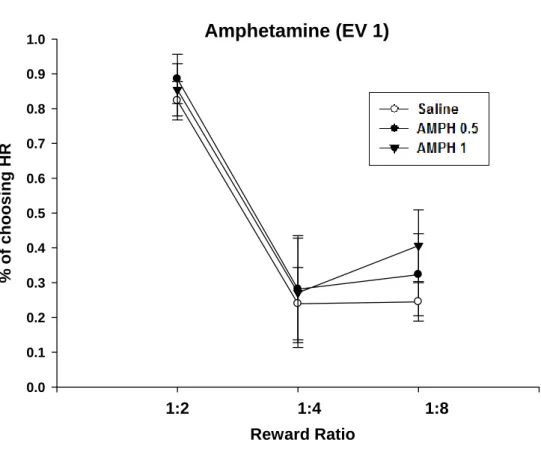
probability of 50%, 25%, or 12.5% as the probabilistic risk manipulated. The food-deprived rat was firstly forced to enter each arm set with a distinct amount of reinforcer(s) and followed by ten daily sessions of free choice, for each of three probabilistic risky conditions. The results show that the rat chose more PHR in the lower risky condition (2 pellets given at 50%), but shifted to choose more CLR than PHR in the higher risky condition. Notice that these results were in the condition of expected value (EV) set in 1 equally for choice made in either arm. All behavioral data collected in the conditions of EV set in 0.5 and 2.0 are presented in Figure 1 (shown in the end of the text below). In these three conditions with different EV’s, the subjects performed in a linear gradient manner on reducing the choice of PHR as the risk increased. Such a effect was not true for that in EV set in 0,5 or 2.0. Accordingly, the doses effects of d-amphetamine (0, 0.5, and 1 mg/kg) were tested in the condition of EV set on 1. Amphetamine of 1 mg/kg significantly increased the choice of PHR at the high risk condition (Figure 2). Together, this study
demonstrates that the choice behavior made by the rat can be risk dependent. The rat performs risk seeking in the low risky condition, but becomes risk aversion in the high risky condition on the present task. Psychostimulant drug affect the latter part of behavior performance by reversing risk aversion into risk seeking.
II: The lesion effects of the nucleus accumbens and the dorsolateral striatum on risky choice behavior (of T-maze)
Although the risky choice behavior is common in human, its underlying neurobehavioral mechanisms are more complicated than previously thought. A growing body of evidence indicates that the mesolimbic dopamine systems are involved in this type of behavior. An animal model of risky choice behavior has
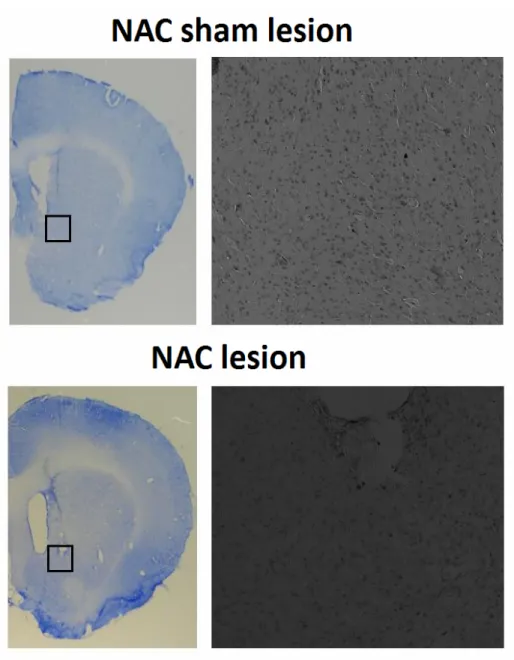
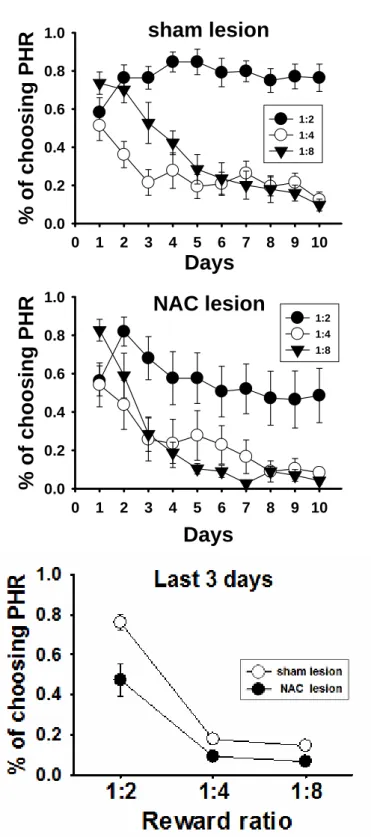
been recently developed in this laboratory by the use of the rat. In a T-maze, a goal arm was designated as certain low reward (CLR) arm providing 1 pellet of chocolate for every entry, whereas the other one was designated as probabilistic high reward (PHR) arm providing 2, 4, or 8 pellets of chocolate to obtain based on a probability of 50%, 25%, or 12.5%, respectively. The rat was randomly assigned to receive the neurotoxic lesion in wither the nucleus accumbens or the dorsolateral striatum before encounter the risky choice behavior task. The behavioral task was similar to that reported in the first part of data collection. In brief, the subject was firstly exposed to the condition of the forced choice of entering each arm set with a distinct amount of reinforcer(s), which is followed by ten daily sessions of free choice conducted for a certain probabilistic high reward. The subject, after the surgical recovery from the lesion, was exposed to the task with three sets of probability in q quasi-random counterbalanced manner. Histological examination was conducted after the end of behavioral tests. The lesion areas in the nucleus accumbens is presented in Figure 3, whereas that of the dorsolateral striatum is shown in Figure 4 (both in the end of text). Our data showed that the normal rat chose more PHR in the lower risky condition, but shifted to choose more CLR than PHR in the higher risky condition. As compared to the sham lesion controls (in top panel of Figure 5), the rats with excitotoxic lesion in the nucleus accumbens became risk-avoiding on this behavioral task, choosing less PHR even in the lower risk condition (in middle panel of Figure 5). Such a
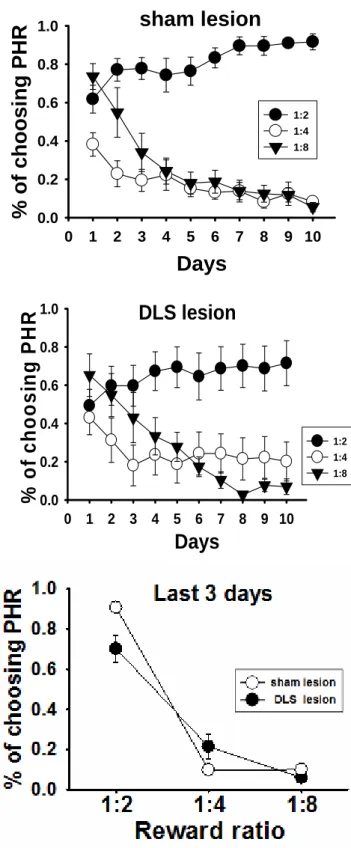
behavioral alteration produced by the lesion of nucleus accumbens was not secondary to the impairment of either motor or discriminative behavioral function, as revealed by post-operational tests on locomotor activity and discriminative choice (1 vs. 2 chocolate pellets; data not shown). Moreover, given as an anatomical control, the lesion made in the dorsolateral striatum did not significantly alter the present risky choice behavior (Figure 6). Taken together, these data indicate that the nucleus accumbens is highly involved in behavioral performance on the probabilistic-based risky choice.
III. The involvement of DA transporter in the operant risky choice behavior
Aberration of brain DA transmission has been shown to affect the decision making under the condition of uncertainty. Previous studies using a probability based risky choice task demonstrated that DA receptor agonists and amphetamine consistently produce a preference to risky choice for a larger reward. These effects are resulted from the drug increases DA transmission. It is still unknown whether drug(s) blocking DA reuptake transporter (DAT) to enhance DA transmission would produce the same effects on this behavior task as aforementioned drugs. Therefore, this study was designed to examine the effects of GBR12909, a DAT inhibitor, on a probabilistic
discounting task and to evaluate DA D1 and D2 receptors potentially involved in it. In contrast to T-maze used in the aforementioned two parts of experimentation, the apparatus used in this study was conducted in four operant chambers
(Med-Associates), each enclosed in a sound-attenuating box, which behavioral program and data collection were controlled by a microcomputer. The risky behavior task used in the present study was similar to those used in St. Onge and Floresco (2009). In brief, the rat received a session that consisted 5 blocks of 18 trials per day. And, different probabilities, 100%, 50%, 25%, 12.5% and 6.25%, respectively, set for the rat to get food pellets on large/risky lever. The other lever was set as for the small/certain response. The rat was trained to choose either lever within 10 seconds and following by the lever retraction lever. Each block, set for a specific probability, contained 8 force choice trials and 10 free choice trials.
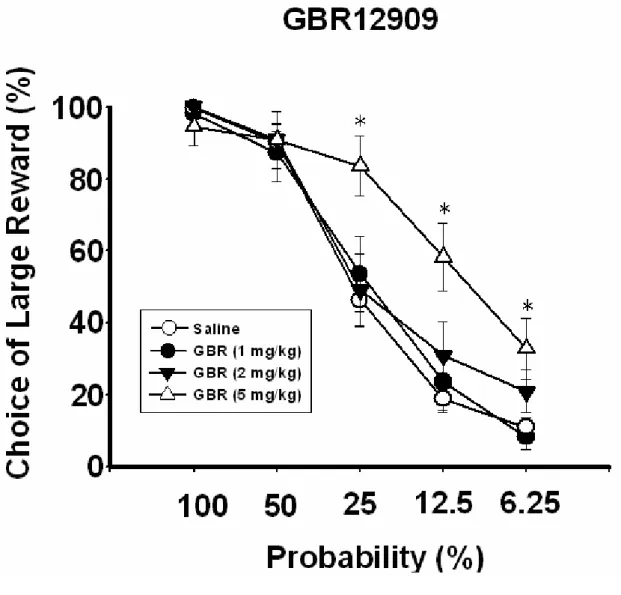
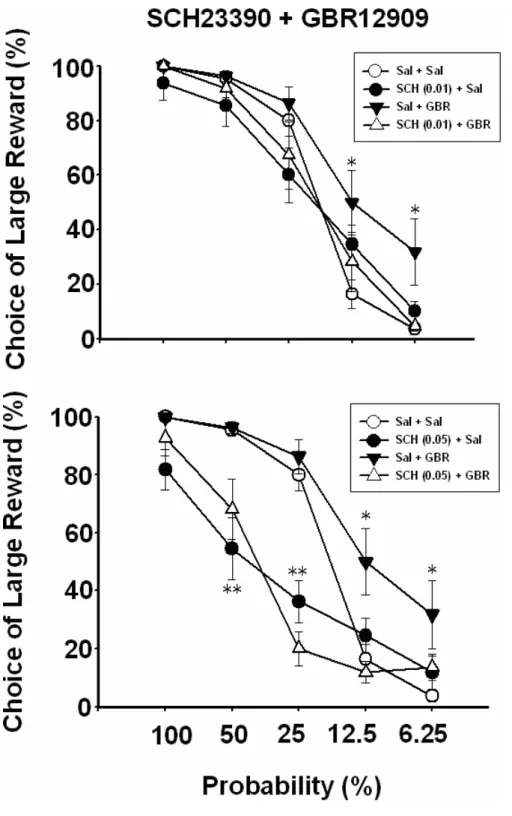
Regarding the drug treatments, the dose effects of GBR12909 (1, 2, & 5 mg/kg) on this task were determined and followed by pharmacological tests of DA antagonism using SCH23390 (0.01 & 0.05 mg/kg) and eticlopride (0.01 & 0.03 mg/kg). All drugs were injected IP; GBR12909 was given at 10 min before the test, while SCH23390 and eticlopride were injected at 20 min prior to the test. The results showed that GBR12909 significantly produced a dose-dependent effect on the probabilistic discounting task by increasing the proportion of choosing larger reward (Figure 7). Behavioral effects altered by GBR12909 (5 mg/kg) were reversed by SCH23390 or eticolopride, but in different profiles (Figure 8 and Figure 9). This “risk-prone” responding under DAT blockade could be attributed to the enhancement of synaptic DA level produced by GBR12909. The reversal effects induced by SCH23390 and elticlopride suggest that DA D1 and D2 receptors are involved in the
behavioral changes on probability based risky choice under DAT blockade. To secure the argument made here about the DAT involved in the performance of risky choice behavior, an additional experiment was conducted for evaluating the dose effects of desipramine, a norepinephrine reuptake transporter (NET) inhibitor, on the same behavioral task. In contrast to GBR12909, desipramine did not affect this risky choice behavior at the doses tested (data not shown).
Summary
This project has been carefully executed in the past two years. In which, those conducted experiments were much following the proposal being granted. However, due to the grant was only approved for two year rather than three years as initially proposed for this project. It was then affected what might be conducted by this shrinkage of grant budget. Nevertheless, with some inevitable adjustment, the critical part of the issues as proposed in this project was tackled with the completion
of those three series of studies with necessary experiments as addressed above. Some of the data shown in this report have been submitted to international conferences for presentation in the last two years. Based on these data, the
preparation of at least two manuscripts for submitting to journal for the publication is currently undergoing. Together, this project has been well executed and the
scientific findings are novel and intriguing for further understanding the
neurobehavioral mechanisms of risky choice behavior, which is also informative for elaborating the cognitive behavioral function of brain DA.
Expected Value Reward Ratio % of HR ch oi ce s 0.0 0.1 0.2 0.3 0.4 0.5 0.6 0.7 0.8 0.9 1.0 EV 0.5 EV 1 EV 2 1:2 1:4 1:8
Figure 1 Probabilistic risky choice behavior on three conditions with expected
Amphetamine (EV 1) % of ch oos in g HR 0.0 0.1 0.2 0.3 0.4 0.5 0.6 0.7 0.8 0.9 1.0 1:2 1:4 1:8 Reward Ratio
Figure 2 Dose effects of amphetamine on probabilistic risky choice behavior (in the
Figure 3. Photographs of coronal sections with black rectangle (with higher
Figure 4. Photographs of coronal sections with black rectangle (with higher
sham lesion
Days
0 1 2 3 4 5 6 7 8 9 10% of choosing PHR
0.0 0.2 0.4 0.6 0.8 1.0 1:2 1:4 1:8NAC lesion
Days
0 1 2 3 4 5 6 7 8 9 10% of choosing PHR
0.0 0.2 0.4 0.6 0.8 1.0 1:2 1:4 1:8Figure 5. Lesion effects of nucleus accumbens (NAC) on percentage of choosing
probabilistic high reward (PHR) on three conditions of reward ratio in the
probabilistic risky choice task. The rats with excitotoxic lesion in the NAC became risk-avoiding on this behavioral task choosing less PHR even in the lower risk condition.
sham lesion
Days
0 1 2 3 4 5 6 7 8 9 10% of choosi
ng PHR
0.0 0.2 0.4 0.6 0.8 1.0 1:2 1:4 1:8DLS lesion
0 1 2 3 4 5 6 7 8 9 10 0.0 0.2 0.4 0.6 0.8 1.0 1:2 1:4 1:8%
of
c
h
oos
ing P
H
R
Days
Figure 6. Lesion effects of dorsolateral striatum (DLS) on percentage of choosing
probabilistic high reward (PHR) on three conditions of reward ratio in the
probabilistic risky choice task. The lesion made in the dorsolateral striatum did not significantly alter the present risky choice behavior.
Figure 7 The effects induced by GBR12909 (GBR) on mean percentage of
choosing large reward. Asterisk represents the significant difference from the treatment with saline (*p<0.05 and **p<0.01 compared to saline treatment).
Figure 8 The effects induced by co-administration GBR12909 and SCH23390 on
mean percentage of choosing large reward. The top panel of figure 2 showed effects of low dose of D1 antagonist (0.01 mg/kg) on GBR12909 induced effects. The
bottom panel of figure 2 showed effects of high dose of D1 antagonist (0.05 mg/kg) on
GBR12909 induced effects. Asterisk represents the significant difference from the treatment with saline (*p<0.05 and **p<0.01 compared to saline treatment).
Figure 9 The effects induced by co-administration GBR12909 and Eticlopride on
mean percentage of choosing large reward. The top panel of figure 3 showed effects of low dose of D2 antagonist (0.01 mg/kg) on GBR12909 induced effects. The
bottom panel of figure 3 showed effects of high dose of D2 antagonist (0.03 mg/kg) on
GBR12909 induced effects. Asterisk represents the significant difference from the treatment with saline (*p<0.05 and **p<0.01 compared to saline treatment).
出席國際會議報告 歐盟神經科學學會:第八屆神經科學論壇 (8th FENS, Forum of Neuroscience) 廖瑞銘 教授 國立政治大學 心理系 2012/12/7 一、前言 歐盟神經科學學會(Federation of European Neuroscience Societies: FENS),係 由歐洲地區的國家之神經科學相關研究學者與群體所組成,在 1998 年於德國柏 林,承昔原有歐洲神經科學協會(European Neuroscience Association)。當年亦是這 個 FENS 成立後所舉行的第一屆神經科學論壇(1st FENS, Forums of Neuroscience), 於會這項在歐洲地區舉行的神經科學會議,每逢兩年舉行一次,迄今便是第八屆 會議,於 2012 年 7 月 13 至 18 日,在西班牙的巴塞隆納市(Barcelona, Spain)的國 際會議中心舉行。目前 FENS 與另外兩個國際級的神經科學學會,及北美地區為 主的 Society of Neuroscience(SfN)與新興地區為主的 International Brain Research Organization(IBRO),皆有共同的目標引領全球的神經科學研究及相關的教育推 廣,以讓神經科學在本世紀能夠再突破腦及神經系統對人類心智奧秘的解析;由 於神經科學深具跨領域的研究價值,這個學科已和諸多其他自然科學與社會科學 學門有整合的研究推展,故神經科學研究或許可以更進一步地促成我們對生命起 源或物種演化之瞭解,這是神經科學從上個世紀迄今本世紀以來,深受科學研究 群的重視以及普世的關注。FENS、SfN 與 IBRO 的相繼成立不過是最近 40 餘年的 事件,但這些學術組織所吸引的成員,都是逐年增加,而且愈近期愈成驟增的現 象,這正反映上述神經科學研究的前瞻發展性。這三個神經科學學術團體,分別 由不同地區所組織,各有其代表意義及特色目標。身為神經科學研究者,實值得 參與這三個國際性學術團體的活動。筆者多年來已有參加 SfN 及 IBRO 的國際會 議,卻一直未有機會參加 FENS 兩年一次的神經科學論壇會議,因之,筆者特別 於本年七月參加這次的大會。 二、與會心得: 藉由第一次參加 FENS 的會議,從與會事前的準備致參與全程會議,除了更 理解歐洲地區的神經科學發展現況外,對於 FENS 這個組織的了解亦有新的認 識。FENS 目前有 32 個在歐洲地區的國別之分支組織(national societies),也含有 9 個歐洲地區與神經科學相關的學科組織(monodisciplinary societies;例如:歐洲 神經化學學會)。除此之外,FENS 也接受特定基金會加入其附屬組織成員。這種 跨國與跨學科領域的聯盟組織,自有其擴展性及深具推廣科學研究與教育的特 性,有容乃大或許說明這類學術團體得以成功運作的原因之一,實值本國與鄰近
區域的國家學習參考。每一個成功發展的學術團體,都會有其官方發行的學術期 刊,一如 SfN 的 Journal of Neuroscience,與 IBRO 的 Neuroscience,FENS 所發行 的 European Journal of Neuroscience,也是一本具有影響力的學術期刊。 一個大型的學術會議,其內容之豐富及分類之廣泛當可輕易的了解。筆者在 全力與會及全天候進駐會場,要參與所有的議程是不可能之況下,僅能竭儘所能 出席各場次與本人研究主題或相關問題較接近者。因之,筆者出席大部份與行為 神經科學(behavioral neuroscience)有關之專題研討會、特別演講、及壁報論文。 相關專題研討會及特別演講部份,所有主講者均是目前各種研究問題領域的一時 之選,其所報告的內容也是該主題的最新發展及發現,對包含筆者在內的與會者 都能提供自己一個再充電或再整合思考的機會,這種知識經驗的習得對個人的研 究有莫大的衝擊。以下僅先列工作坊研討會及特別專題演講,從中可見當前的研 究重點與新趨,再續接本人壁報式論文部份參與相關議程活動所得之心得簡述。 (1)四個工作坊 W01: Neuro‐optoelectronics: a new approach in basic and applied neuroscience W02: Technical aspects of large scale in vivo and in vitro recording from neurons W03: Mapping the brain using fMRI decoding techniques W04: Advanced optical methods for patterned optogenetics (2)特別專題演講 PL01‐a: Reward‐guided learning and decision making in the frontal lobe by Matthew Rushworth, Oxford, UK PL01‐b: Cooking with the brain‐introduced by the Spanish Neuroscience Society (SENC) by Carme Ruscalleda, Sant Paul de Mar, Spain PL02: Gene, environment, and context: using fixed circuits to generate flexible behaviors by Cori Bargmann, New York, NY, USA SL01‐a: Brain rhythms: chronocircuits in the cerebral cortex by Peter Somogyi, Oxford, UK SL01‐b: Neural syntax: coordination of cell assemblies by brain rhythms by Gyorgy Buzsaki, New York, NY, USA SL01‐c: Brain rhythms: endocannabinoid signaling, anxiety and epilepsy by Tamas Freund, Budapest, Hungary SL02: Neural and neurochemical substrates of impulsivity and compulsivity; neuropsychiatric implications by Trevor W. Robbins Cambridge, UK PL03: Dendritic computation by Michael Hausser, London, UK PL04: Control of synaptic function by endogenous cannabinoids by Masanobu Kano, Tokyo, Japan SL03: Learning as a function state of the brain: studies in wild type and transgenic animals by Jose M. Delgado Gaicia, Sevilla, Spain SL04: Modulatory neurotransmission by neuropeptides exemplified by oxytocin by
Peter H. Seeburg, Heidelberg, Germany SL05: Research Award unraveling neural circuits with optogenetics in rodents and primates by Ilka Diester, Frankfurt, Germany PL05: Simulation based brain research: the next evolution in neuroscience by Henry Markram, Lausanne, Switzerland SL06‐a: Chromatin and neuronal life span by Catherine Dulac, Cambridge, MA, USA SL06‐b: Parental regulation of the structure and the offspring: implications function of the genome in for familial transmission by Michael Meaney, Montreal, QC, Canada SL06‐c: Epigenetic mechanisms in memory formation by David Sweatt, USA SL07: Space, memory and the hippocampus by Eleanor A Maguire, London, UK SL08: Neurotrophin‐dependent synaptic plasticity by Mu Ming Poo, Berkeley, USA PL07: Learning to learn with action video games by Daphne Bavelier, Geneva, Switzerland PL08: Synapse function and organization at the nanoscale by Daniel Choquet SL09‐a: Dynamically shifting neural circuitries underlie addictive behavior by Barry Everitt, Cambridge, UK SL09‐b: New vistas for neuronal migration by Oscar Marin, Alicante, Spain SL10‐a: Origin of new glial cells in intact and injured adult spinal cord by Fanie Barnabe‐Heider, Stockholm, Sweden SL10‐b: Synaptic plasticity associated with the transition to cocaine addiction by Fernando Kasanetz, Bordeaux, France PL09: Wired for sex: the neurobiology of drosophila courtship behavior by Barry Dickson, Vienna, Austria 筆者今年與會的論文是有關酬賞動機與學習 (reward motivation and learning) 的研究,酬賞動機在行為制約歷程中扮演重要的角色,過去研究發現大腦多巴胺 (dopamine) 系統參與多種形式的制約學習。這種多巴胺相關的制約學習的神經 機制,近年來也被認為與認知歷程有關的較高階行為功能有關,包括:行為轉換 彈性(behavioral flexibility)、行為抑制(behavioral inhibition)、乃至決策決定(decision making)。如果某一個(項)神經機制對特定行為與認知功能有關,則深入探討之舊 有其意義。筆者實驗室近年來利用一些鼠類動物的制約行為模式,推展至區辨學 習與風險選擇行為,接著重於持續探討大腦多巴胺的影響角色。這次與會的論文 數這一系列的一段成果,即就要等先前已知大腦多巴胺相關區域的文獻基礎,進 一步利用分子神經科學研究取向,就大腦神經滋養因子 (Brain‐derived neurotropic factor; BDNF),探測其是否存在多巴胺有關的腦區以調節參與藥物引 發的場地制約行為。這個研究藉由筆者實驗室以前發表過的興奮劑引發場地制約 偏好 (conditioned place preference; CPP),引進即時聚合酶連鎖反應(qPCR)技術測
量 BDNF。這是一種結合行為神經科學與分子生物學的跨領域研究,對筆者實驗 而言,是第一次的嘗試,也因此開啟筆者另一個跨實驗的研究合作計畫。我們的 實驗結果,除了再次證實 CPP 的行為外,也發現 BDNF 在這個行為的習得 (acquisition)、表現 (performance)、消除後的再現 (reinstatement after extinction) 等三個階段有不同的參與效果,BDNF 對前二個階段沒有明顯的一角色,而是對 第三階段扮演影響角色,因為我們的實驗資料顯示 BDNF 的量在這個階段有明顯 的增加,特別是在大腦的前額皮質區。這個發現可被解釋成,CPP 再現的行為表 徵需要較多的認知歷程或徵召個體的先前經驗,BDNF 在負責高階認知功能的前 額葉皮質區出現,應屬支配前述的大腦神經機制運作。這個結論未來可以在其他 制約層級的行為模式進行驗證,也可以提升至較高階的認知作業進行測試。 三、建議: 筆者非常感謝國科會的補助以出席這項國際性學術會議,此舉對筆者本身的 研究水準提升有絕對的正面效益,因為親身參與所得的各種新知學習及經驗交流 是其它類型的學術活動所無法提供的。根據主辦此項會議的官方的資料顯示其正 式會員人口逐年攀升,相對的每次與會的人數及提報的論文都是質量並增,如此 可見這個會議是目前神經科學的重要會議之一。會中來自很多亞洲地區的神經科 學研究學者,尤其是來自大陸地區的學者很明顯逐年在增加,可見神經科學研究 在亞太地區也是日趨競爭,值得國內學者重視這項國際性學術會議。 另外,這項會議的所有議程均已數位化,配合歐盟的綠能政策,落實無紙張 (paperless) 會議,此環保措施亦值得國內學界及公私部門舉辦會議參考。
Expressions of BDNF in medial prefrontal cortex and the reinstatement of amphetamine induced conditioned place preference in the rat
Ying-Ling Shena, Tin-Yuan Changb, Hsin-Hua Tiena, Fang-Chi Yanga, Chi-Wen Changb, Pei-Yu Wangb, and Ruey-Ming Liaoa, b, *
Department of Psychology a and Institute of neuroscience b, National Cheng-Chi University, Taipei, Taiwan
Conditioned place preference (CPP) is widely used as an
experimental behavioral model in the study of drug addiction and reward learning. Brain dopamine systems play an important role to drive the acquisition and performance of CPP. Accumulative data indicate that brain-derived neurotrophic factor (BDNF) is involved in the reward learning and motivation. Taking BDNF as the target molecule, this study conducted a series of experiments to delve into the neural mechanism of CPP. Dose effects of amphetamine (0, 0.5, and 1 mg/kg) on the CPP behavior were assessed in Experiment 1A, and BDNF mRNA was tested after CPP test. The results show that 1 mg/kg amphetamine significantly induced CPP, but no significant effect on BDNF mRNA under this
dosage in comparing to the control was detected in any of five brain areas assayed, including medial prefrontal cortex, striatum, nucleus accumbens, dorsal hippocampus and amygdala. The results of
Experiment 1A were further confirmed by Experiment 1B, by showing no significant change on BDNF mRNA in five brain areas of rats with
significant amphetamine-induced CPP. Experiment 2 examined the effects of CPP reinstatement and tested BDNF mRNA in the
aforementioned five brain areas. The results show that 0.75 mg/kg amphetamine significantly reinstated CPP and also increased BDNF mRNA level in medial prefrontal cortex. Such an increase of BDNF mRNA was not observed in any other four areas. Single acute injection of amphetamine on BDNF mRNA was tested in Experiment 3. No
detected. These data indicate that BDNF is involved in psychostimulant drug induced reinstatement. BDNF may not be critical for either a single stimulant drug injection or its drug effect paired the environmental context in place conditioning task.
Key words: amphetamine, conditioned place preference, relapse, BDNF, rat
(This paper was presented in the 8th FENS Forum of neuroscience, held in Barcelona, Spain, July 13-18, 2012)
Ruey-Ming Liao
寄件者: "Ruey-Ming Liao" <[email protected]>
收件者: "FENS Forum 2012" <[email protected]> 傳送日期: 2012年2月29日 上午 08:09
主旨: Re: FENS Forum 2012 - Abstract Presentation Notification A-471-0214-03274 b頁 1 - 1(B)
--- Original Message --- From: FENS Forum 2012 To: [email protected]
Sent: Tuesday, February 28, 2012 7:28 PM
Subject: FENS Forum 2012 - Abstract Presentation Notification A-471-0214-03274 Abstract Presentation Notification
The 8th FENS Forum of Neuroscience Barcelona, Spain, 14 - 18 July, 2012 Dear R-M Ruey-Ming Liao,
On behalf of the Scientific Programme Committee, we are pleased to inform you that your abstract A-471-0214-03274 entitled "EXPRESSIONS OF BDNF IN MEDIAL
PREFRONTAL CORTEX AND THE REINSTATEMENT OF AMPHETAMINE INDUCED CONDITIONED PLACE PREFERENCE IN THE RAT" has been accepted as a POSTER PRESENTATION at the The 8th FENS Forum of Neuroscience.
Detailed guidelines for the preparation of your poster are available on the congress website at http://www2.kenes.com/fens/Pages/Abstract_instructions.aspx
Your poster allocation and scheduling will be sent to you in the near future. Please refer to the FENS Forum 2012 scientific programme on
http://fens2012.neurosciences.asso.fr/pages/index2.php?sub=10&left=105 for updates or changes from time to time.
1. If you have not already paid your registration fees you are requested to do so online via the link: https://www.kenes.com/fens2012/reg/reg.asp
Only abstracts of participants who have paid their fees by April 15, 2012 will be included in the programme.
2. We also encourage you to book your accommodation promptly, as availability may be limited in some hotels. Click on
http://www2.kenes.com/fens/Pages/Hotel_Accommodation.aspx for more information on available hotels for the Meeting.
3. Please do visit the congress website on
http://fens2012.neurosciences.asso.fr/index.php regularly for any updates or changes to the Scientific Programme.
FURTHER INFORMATION
For technical questions regarding your abstract submission please contact
[email protected]. For all other queries, please do contact the secretariat at [email protected]
Yours sincerely,
國科會補助計畫衍生研發成果推廣資料表
日期:2012/12/07國科會補助計畫
計畫名稱: 大腦多巴胺的認知功能:以動物的風險選擇行為模式 計畫主持人: 廖瑞銘 計畫編號: 99-2410-H-004-090-MY2 學門領域: 生物心理學無研發成果推廣資料
99 年度專題研究計畫研究成果彙整表
計畫主持人:廖瑞銘 計畫編號:99-2410-H-004-090-MY2 計畫名稱:大腦多巴胺的認知功能:以動物的風險選擇行為模式 量化 成果項目 實際已達成 數(被接受 或已發表) 預期總達成 數(含實際已 達成數) 本計畫實 際貢獻百 分比 單位 備 註 ( 質 化 說 明:如 數 個 計 畫 共 同 成 果、成 果 列 為 該 期 刊 之 封 面 故 事 ... 等) 期刊論文 0 0 100% 研究報告/技術報告 0 0 100% 研討會論文 1 1 100% 篇 論文著作 專書 0 0 100% 申請中件數 0 0 100% 專利 已獲得件數 0 0 100% 件 件數 0 0 100% 件 技術移轉 權利金 0 0 100% 千元 碩士生 0 0 100% 博士生 0 0 100% 博士後研究員 0 0 100% 國內 參與計畫人力 (本國籍) 專任助理 0 0 100% 人次 期刊論文 2 4 100% 研究報告/技術報告 0 0 100% 研討會論文 3 3 100% 篇 論文著作 專書 0 0 100% 章/本 申請中件數 0 0 100% 專利 已獲得件數 0 0 100% 件 件數 0 0 100% 件 技術移轉 權利金 0 0 100% 千元 碩士生 0 0 100% 博士生 0 0 100% 博士後研究員 0 0 100% 國外 參與計畫人力 (外國籍) 專任助理 0 0 100% 人次其他成果
(
無法以量化表達之成 果如辦理學術活動、獲 得獎項、重要國際合 作、研究成果國際影響 力及其他協助產業技 術發展之具體效益事 項等,請以文字敘述填 列。) 無 成果項目 量化 名稱或內容性質簡述 測驗工具(含質性與量性) 0 課程/模組 0 電腦及網路系統或工具 0 教材 0 舉辦之活動/競賽 0 研討會/工作坊 0 電子報、網站 0 科 教 處 計 畫 加 填 項 目 計畫成果推廣之參與(閱聽)人數 0國科會補助專題研究計畫成果報告自評表
請就研究內容與原計畫相符程度、達成預期目標情況、研究成果之學術或應用價
值(簡要敘述成果所代表之意義、價值、影響或進一步發展之可能性)
、是否適
合在學術期刊發表或申請專利、主要發現或其他有關價值等,作一綜合評估。
1. 請就研究內容與原計畫相符程度、達成預期目標情況作一綜合評估
■達成目標
□未達成目標(請說明,以 100 字為限)
□實驗失敗
□因故實驗中斷
□其他原因
說明:
2. 研究成果在學術期刊發表或申請專利等情形:
論文:□已發表 □未發表之文稿 ■撰寫中 □無
專利:□已獲得 □申請中 ■無
技轉:□已技轉 □洽談中 ■無
其他:(以 100 字為限)
This project, due to the grant was only approved for 2 year rather than 3 years as initially proposed, it was then affected what might be conducted by this shrinkage of grant budget. Nevertheless, with some inevitable adjustmet, this project has tackled by completing necessary experiments.
3. 請依學術成就、技術創新、社會影響等方面,評估研究成果之學術或應用價
值(簡要敘述成果所代表之意義、價值、影響或進一步發展之可能性)(以
500 字為限)
This project has been well executed and the scientific findings are novel and intriguing for further understanding the neurobehavioral mechanisms of risky choice behavior, which is also informative for elaborating the cognitive behavioral function of brain DA.