Ground state of electron gases at negative compressibility
Adriaan M. J. SchakelNational Chiao Tung University, Department of Electrophysics, Hsinchu, 30050, Taiwan, Republic of China 共Received 31 July 2001; published 28 November 2001兲
Two- and three-dimensional electron gases with a uniform neutralizing background are studied at negative compressibility. Parametrized expressions for the dielectric function are used to access this strong-coupling regime, where the screened Coulomb potential becomes overall attractive for like charges. Closely examining these expressions reveals that the ground state with a periodic modulation of the charge density, albeit expo-nentially damped, replaces the homogeneous one at positive compressibility. The wave vector characterizing the new ground state depends on the density and is complex, having a positive imaginary part, as does the homogeneous ground state, and real part, as does the genuine charge density wave.
DOI: 10.1103/PhysRevB.64.245101 PACS number共s兲: 71.45.Lr, 05.30.Fk, 73.50.⫺h, 71.10.Ay
I. INTRODUCTION
The nature of the metallic state of a dilute two-dimensional electron gas 共2DEG兲 in high-mobility silicon MOSFET’s, first observed by Kravchenko et al.1 nearly a decade ago, has still not been established. Various scenarios have been proposed to explain the new conducting state, ranging from superconducting, to non-Fermi liquid, to per-colation, to classical共see Refs. 2,3 for overviews and refer-ences to the original literature兲. The unique character of this state is reflected by its thermodynamic signatures of both negative pressure and compressibility.4
Although recognized as a theoretical possibility for quite some time—at least in three dimensions,5 an electron gas with a uniform neutralizing background was expected to be unstable at negative compressibility, and the model meaning-less. Later theoretical6and also numerical7studies neverthe-less considered both the region with positive and negative compressibility without encountering conceptual difficulties. Eisenstein, Pfeiffer, and West4 more recently concluded that the global features of their 2DEG compressibility data to very low densities, where the system appears to undergo a quantum phase transition to an insulating state,3 could be explained simply using the Hartree-Fock approximation, which consists of including the exchange contribution to the ground-state energy of a free fermion gas. Their analysis does not account for impurities, which are of paramount im-portance at and beyond the metal-insulating共MI兲 transition. Ilani et al.8 reached similar conclusions based on their compressibility data of a dilute two-dimensional hole gas 共2DHG兲. By placing several single electron transistors di-rectly above the 2DHG, they could in addition determine possible spatial variations in the system. They concluded that the metallic state at negative compressibility is homogeneous in space and well described by the Hartree-Fock approxima-tion. As the system crosses to the insulating state and the Hartree-Fock approximation ceases to be applicable, they found the system to become spatially inhomogeneous. They interpreted this observation as supporting scenarios in which the MI transition is described as a percolation process.9–11
Using density functional theory in the local density ap-proximation, Shi and Xie12 recently investigated the spatial distribution of the electron number density of a 2DEG in the
presence of impurities. As usual, impurities were included by coupling the particle number density to a fluctuating poten-tial with a random distribution. The parameter characterizing the Gaussian distribution, which we will refer to as the im-purity strength, determines the roughness of the imim-purity landscape. Their numerical study incorporates the Monte Carlo data on the ground-state energy of a clean system by Tanatar and Ceperly.7For given impurity strength, the study shows that at some average density n islands of very low densities form in a metallic sea of high densities. At higher average densities, the sea level is high enough to fill all of the valleys of the impurity landscape, and the system is ho-mogeneous. With decreasing n, the sea level drops and the insulating islands grow. At a critical value, the islands per-colate the system, which at this percolation threshold be-comes insulating. The sea level now dropped to the extent that the electrons are confined to the valleys of the impurity landscape. According to this picture, the transition to the insulating state takes place at lower densities for cleaner sys-tems. This is in accord with experiments, where the lowest critical density nc⫽7.7⫾0.4⫻109 cm⫺2was observed in an exceptionally clean 2DHS.13 Shi and Xie12 also studied the importance of the Coulomb interaction by comparing with the case where this interaction is turned off. They found that at an average density where the interacting system was still metallic, the free electron gas, which is insulating, had formed a few isolated lakes of high density at valleys of the impurity landscape.
In this paper, we postulate on the nature of the ground state of electron gases at negative compressibility. In doing so, we ignore impurities, as justified by the experimental findings that this metallic state is homogeneous in space and that the compressibility data is already well described by the Hartree-Fock approximation of a clean electron gas. The study emphasizes the three-dimensional electron gas共3DEG兲 as much more information from theoretical studies is avail-able than for the 2DEG. Most of the 3D conclusions, how-ever, also apply to the 2D case discussed in Sec. VI. The following two sections focus on the changes brought about when going from positive to negative compressibility. One of the most surprising changes is that a test particle acquires a screening cloud in its immediate vicinity which overcompen-sates the test charge, so that the Coulomb interaction
be-comes attractive for like charges. The changes are also dis-cussed from the perspective of Fermi liquid theory, describing the electron gas after the screening mechanism has taken effect and resulted in only short-range interactions. The main result of this paper is contained in Sec. IV, where it is argued that the ground state of an electron gas at negative compressibility is a charge density wave 共CDW兲, although exponentially damped. The phenomena considered here are by no means specific to an electron gas, but also appear in a charged Bose gas as discussed in Sec. V.
II. SCREENING vs OVERSCREENING
A 3DEG is characterized by the screening of charges. When a test particle of charge Z is placed at the origin, (x)⫽Z␦(x), the system responds by rearranging its charge distribution to screen the external charge. The charge density indthus induced,
ind共x兲⫽Z
冕
d3q 共2兲3冋
1
⑀共q,0兲⫺1
册
eiq•x, 共1兲 is determined by the dielectric function ⑀(q,0) at zero fre-quency, which encodes the static screening effects of the 3DEG. The total induced chargeQind⫽
冕
d3xind共x兲⫽ind共q⫽0兲⫽⫺Z 共2兲 cancels the charge of the test particle since the screening factor 1/⑀(q,0) vanishes at zero wave vector q⫽兩q兩. The test charge is therefore always perfectly screened. However, the induced charge density differs in how it is distributed, de-pending on the electron number density n or, equivalently, the ratio rs⫽a/a0 of the average interparticle distance a ⫽(3/4n)1/3 to the Bohr radius a0⫽ប2/me2. 共For valence electrons in 3D metals, rs, characterizing the strength of theCoulomb interaction, ranges from 1.8 to 5.6.5兲
At weak coupling (rs⬍1), corresponding to high electron number densities, a screening cloud of opposite charge sur-rounds the test charge, and the screened Coulomb potential decreases exponentially with increasing distance. On its tail, far away from the test charge, the potential has superimposed a small oscillatory modulation of wave vector q⫽2kF, with
kF the Fermi wave vector. These Friedel oscillations, leading
to a periodic change in sign of the Coulomb potential, origi-nate from a singularity in the dielectric function at q ⫽2kF, where electron-hole excitations start to develop an
energy gap.5
A 3DEG’s response to a test charge fundamentally changes at larger values of the coupling constant rs because
of a qualitative change in the dielectric function. Namely, at some value rs⫽r¯s, the dielectric function becomes negative
for small wave vectors.14 Rather than surrounded by a screening cloud of opposite charge in its immediate vicinity, the test charge now becomes overscreened. The Coulomb potential rapidly drops below zero with increasing distance and becomes attractive for like charges. Further away from the test charge, the potential exhibits an exponentially
damped oscillatory behavior and periodically changes sign similar to Friedel oscillations. The initial drop of the Cou-lomb potential to negative values and the resulting over-screening is, however, unrelated to Friedel oscillations.15 Overscreening in a plasma was first noted in a 2D Bose gas with a 1/x Coulomb potential.16
The fundamental change in the screening behavior of a 3DEG is paralleled by a modification of its ground state. At the critical electron number density, where the dielectric function becomes negative for small wave vectors and a test charge overscreened, the compressibility changes sign as well. As argued in the following, the homogeneous ground state of the regime with positive compressibility then gives way to a ground state with a periodic modulation of the charge density, which is, however, exponentially damped.
III. NEGATIVE COMPRESSIBILITY
At weak coupling, the dielectric function can be written for small wave vectors as5
lim
q→0
⑀共q,0兲⫽1⫺v共q兲sc共0,0兲, 共3兲 withv(q)⫽4e2/q2the Fourier transform of the 共unscreen-ed兲 Coulomb potential, and sc(0,0) the screened density-density response function at zero wave vector and frequency. The screened response function, a theoretic construct to be distinguished from the physical one, measures the response to a screened external field rather that the external field itself. Physically, this function describes a fictitious system with only short-range interactions that are remnants of the long-range Coulomb interaction after the screening mechanism of the 3DEG has taken effect.5Derived from the Coulomb in-teraction, the short-range interactions of the fictitious system vanish in the limit rs→0.
In writing Eq.共3兲, the O(q2) term in the Taylor expansion of sc(q,0) is assumed to be substantially smaller than 1. This is true only at weak coupling. For example, when rs
⫽1, the value of the constant term in Eq. 共3兲 is reduced already by about 6%.
The compressibility sum rule relates the screened re-sponse function to the compressibility of the 3DEG via5
lim
q→0
sc共q,0兲⫽⫺ n
⫽⫺n2, 共4兲 withthe chemical potential. If positive, the compressibility can be expressed in terms of the speed of sound c in the fictitious system with only short-range interactions as
n⫽1/mc2. 共5兲
Equation共3兲 can then be cast in the equivalent form lim
q→0
⑀共q,0兲⫽1⫹ pl 2
c2q2, 共6兲
corresponding to the spectrum2⫽pl
2⫹c2q2of the plasma mode, where pl denotes the plasma frequency pl 2 ⫽4ne2/m. The plasmon spectrum differs from the gapless
spectrum2⫽c2q2 of the sound mode of the fictitious sys-tem in that, due to the long range of the Coulomb interaction, the former has an energy gap. At short wavelengths (cq ⬎pl), the difference is negligible, thereby allowing use of the plasmon to access, via c, the screened interaction as a function of the coupling constant—at least for rs⬍1.
In the limit rs→0, the screened response function reduces
to共minus兲 the density of states 0⫽mបkF/2 at the Fermi surface. Simultaneously, c2→c 0 2⫽v F 2/3, with vF⫽បkF/m
the Fermi velocity, and the Thomas-Fermi approximation for the dielectric function is recovered.
Owing to its short-range interactions, the fictitious system can be described by Fermi liquid theory.5 The elementary excitations are fermionic quasiparticles of mass m*, with an interaction characterized by spin symmetric共s兲 and spin an-tisymmetric共a兲 Landau parameters Fls,a, where l denotes the angular momentum channel. The Landau parameters depend on rs and vanish in the limit rs→0, where also m*→m. The
speed of sound in the fictitious system can be expressed in these parameters as follows:
c2⫽共1⫹F0s兲共m/m*兲c02. 共7兲 Due to the Pauli exclusion principle, even with an attractive interaction, a Fermi liquid can still support a sound mode, provided that F0
s⬎⫺1.
Approximate calculations5,17 indicate that the effective mass is comparable to the free electron mass, while the Lan-dau parameter F0s is negative. The latter implies an attractive quasiparticle interaction in the spin-symmetric l⫽0 channel, although it derives from the Coulomb interaction, which re-pulses like charges. This unexpected finding has the same origin as the overscreening of a test charge.
At the level of the first-order correction to the ground-state energy of a free Fermi gas, which itself is a one-loop result, the origin can be understood as follows.5Two Feyn-man diagrams contribute to the two-loop, or Hartree-Fock correction: the direct, or Hartree term containing two mion loops, and the exchange term containing only one fer-mion loop. Owing to overall charge neutrality, the direct term does not contribute to the ground-state energy, so that only the exchange term remains. Containing an odd number of fermion loops, this term comes with a minus sign, thus reversing the sign of the Coulomb interaction. Consequently, the ground-state energy per electron and also the pressure decrease with increasing coupling constant for rs⬍1, even-tually becoming negative.
The inverse compressibility of the 3DEG and therefore the speed of sound c in the fictitious system also decrease with increasing rs. At a certain value rs⫽r¯s, with r¯s
⬇5.25 according to estimates,6 the inverse compressibility becomes negative and the speed of sound drops to zero, im-plying that the factor (1⫹F0
s
)/m* should vanish. The ap-proximate calculations5,17indicate that the quasiparticle mass increases only slightly with increasing rs, while the values
of F0s for rs⫽2,3,4 show a tendency towards ⫺1 around
rs⫽r¯s. We conjecture that precisely at this point, F0
s⫽⫺1.
In Fermi liquid theory,5 this value of the Landau parameter F0
s
, wheresc(0,0) diverges, signifies the onset of instabil-ity, with the homogeneous ground state becoming unstable towards density fluctuations.
IV. EXPONENTIALLY DAMPED CDW
The vanishing of the sound mode of the fictitious system affects the plasmon spectrum. The general condition for plasma oscillations at a frequency is5⑀(q,)⫽0. At zero frequency, or energy, the condition reduces to
q2⑀共q,0兲⫽0, 共8兲
where an additional factor q2 is included for convenience. A physical solution q(rs) of this condition with a positive real part denotes a time-independent, i.e., frozen-in modulation of the charge density.
Consider condition 共8兲 first at weak coupling, where the dielectric function reduces to the form共6兲 in the limit of long wavelengths. This gives q2(r
s)⫽⫺pl
2/c2, leading to a purely imaginary wave vector as a solution, and a screening length ⫽c/pl. In the limit rs→0, this formula reduces to
the Thomas-Fermi result
/a⫽共␣/4rs兲1/2, ␣⫽共4/9兲1/3. 共9兲
Being proportional to the inverse square root of the coupling constant, the screening length 共9兲 measured in units of the interparticle distance a becomes infinite as rs approaches
zero.
At rs⫽r¯s, where the dielectric function becomes negative
for small wave vectors, resulting in the overscreening of a test charge, the solution of the condition 共8兲 changes quali-tatively. In the region rs⬎r¯s, the plasmon spectrum initially decreases with increasing wave vector, until reaching a 共posi-tive兲 minimum after which it increases.18
The unique character of the point rs⫽r¯scan also be noted
when considering the spatial average of the electrostatic po-tential generated by the static test charge at the origin
冕
d3x共x兲⫽共q⫽0兲⫽ Ze2n2, 共10兲 where (q)⫽4Z/⑀(q,0)q2. When the inverse compress-ibility becomes negative, the overall potential changes sign as well.
To investigate the strong-coupling regime, we use a pa-rametrized expression for the local-field correction G(q) as it appears in the generalized random phase approximation of the screened response function
sc共q,0兲⫽
0共q,0兲
1⫹v共q兲G共q兲0共q,0兲 共11兲 proposed by Ichimaru and Utsumi.19 Here, 0(q,0) denotes the response function of a free Fermi gas at zero frequency. The random phase approximation is recovered by setting G(q) to unity. Since only the zero-frequency response func-tion is required to study the condifunc-tion 共8兲, we can sidestep the difficulties which arise when the frequency dependence is
included in G(q) to arrive at the dynamic correction. The parametrized expression, which applies to the range 0⬍rs
⬍15, incorporates Monte Carlo data on the ground-state energy20as well as the ladder diagram calculation of the pair distribution function at zero separation.21Importantly, the re-sulting dielectric function satisfies a number of exact bound-ary conditions and sum rules, including the compressibility sum rule 共4兲. As noted in the overview,22 these features and its simplicity makes the parametrized expression proposed in Ref. 19 convenient for applications.
The compressibility sum rule determines the behavior of the local-field correction at long wavelengths. With the defi-nition
lim
q→0
G共q兲⫽␥0共rs兲qˆ2, 共12兲
where qˆ⫽q/kF, it follows from Eq.共4兲 and a similar
expres-sion for the noninteracting system with compressibility 0, that the coefficient ␥0(rs) is related to the compressibility
via
0 ⫽1⫺
4␣
␥0共rs兲rs. 共13兲
The compressibility of a 3DEG can be extracted from the Monte Carlo data of Ceperly and Alder20 thus fixing␥0(rs).
In particular, when the inverse compressibility changes sign it becomes ␥0共r¯s兲⫽ 4␣ 1 r ¯ s . 共14兲
Because the compressibility sum rule is satisfied, the param-etrized expression for the dielectric function
⑀共q,0兲⫽1⫺v共q兲sc共q,0兲, 共15兲 withscgiven by Eq.共11兲, becomes negative for small wave vectors also at rs⫽r¯s, as it should.
With the expression共15兲 substituted and the left hand ex-panded in a Taylor series to order q4, Eq. 共8兲 leads to the condition
a0⫹a2qˆ2⫹a4qˆ4⫽0, 共16兲 valid at long wavelengths. The quartic term is included be-cause the first term in the expansion
a0⫽
共4␣/兲rs 1⫺共4␣/兲␥0共rs兲rs
, 共17兲
changes sign at rs⫽r¯s. The coefficients a2 and a4 have no simple analytic representation, depending on the specific pa-rametrization of the local-field correction G(q). They are best represented simply by their numerical values for each rs. The coefficients diverge at rs⫽r¯s. As a result of which,
a small region just below r¯s is numerically inaccessible.
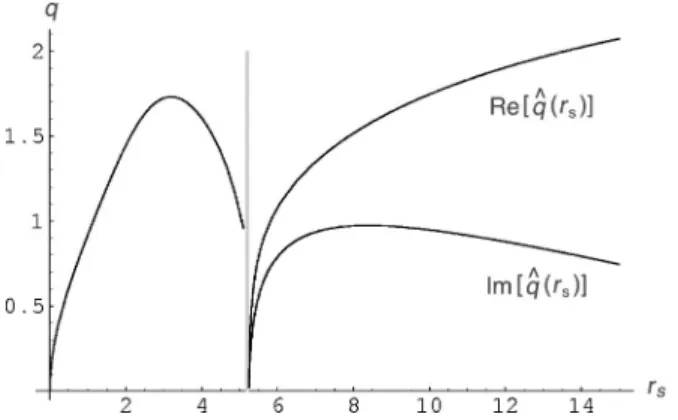
The physical solution q(rs) of the condition共16兲, which
is a quadratic equation in q2, remains purely imaginary in the entire regime where 1/⬎0, as it is at weak coupling 共see
Fig. 1兲. The corresponding screening length ⫽i/q(rs),
be-ing infinite at rs⫽0, decreases with increasing coupling
con-stant until it reaches a minimum/a⬇0.30 at rs⬇3.2.
Fur-ther increasing rs surprisingly increases /a again until it
becomes infinite once more at rs⫽r¯s⬇5.25, where the
in-verse compressibility changes sign and the sound mode of the fictitious system vanishes. The wave vector solving the condition at long wavelengths is zero and the Coulomb in-teraction unscreened, as it was at rs⫽0, according to this
definition of the screening length.
Remarkably, plotting the inverse dielectric function at this value of rs, indicates, to within numerical accuracy, no
dis-persion for wave vectors smaller than the Fermi wave vector and 1/⑀(q,0)⫽0 in this range 0⭐q⭐kF.
For rs⬎r¯s, the physical solution q(rs) becomes
genu-inely complex, having an imaginary and a positive real part as well. The latter implies the onset of instability, where the homogeneous ground state becomes unstable towards a peri-odic spatial modulation of the charge density. Owing to the imaginary part, fluctuations are, however, still exponentially screened. The ground state at negative compressibility is re-ferred to in this paper as an exponentially damped CDW since it combines a homogeneous ground state with expo-nential screening and a CDW. The real part of the wave-length of the exponentially damped CDW is infinite at rs
⫽r¯sand decreases with increasing rs in the remaining range
where the parametrized expression for⑀(q,0) on which our analysis is based applies, i.e., rs⬍15. The screening length
also starts at infinity and initially decreases with increasing rs. But, after reaching a minimum/a⬇0.54 at rs⬇8.37, it
increases again.
Apart from being exponentially damped, a CDW in a 3DEG differs from a CDW appearing in solids also in that its wave vector is not necessarily given by q⫽2kF, but varies
with rs 共see Fig. 1兲. In a solid, the CDW arises due to electron-phonon interactions, and the charge modulation is accompanied by a periodic lattice distortion both of wave vector q⫽2kF.23
The screening length determined by the imaginary part of the wave vector solving condition共16兲 does not
monotoni-FIG. 1. Real共Re兲 and imaginary 共Im兲 part of the wave vector
qˆ(rs) solving the condition 共16兲. The gray region just below rs ⫽r¯s⬇5.25 could not be accessed because of numerical instabilities
cally decrease with increasing coupling constant. Since the screening mechanism is expected to become more effective at stronger coupling to minimize the effect of the increasing Coulomb interaction, fails to provide a proper measure for this mechanism. A more relevant length scale is the short-range screening length s, in which the deviation of the
screened from the unscreened Coulomb potential is mea-sured at short distances from a test charge.24It is defined by writing the electrostatic potential generated by a static test charge at the origin 关see below Eq. 共10兲兴 as
共x兲⫽Zx
冋
1⫹2 冕
0 ⬁ dq冉
1 ⑀共q,0兲⫺1冊
sin共qx兲 q册
共18兲and expanding the right side in a Taylor series for small x,
共x兲⫽Zx
冉
1⫺ x s⫹•••冊
, 共19兲 with a s⫽冉
18 2冊
1/3冕
0 ⬁ dqˆ冋
1⫺ 1 ⑀共qˆ,0兲册
. 共20兲 Since 1/⑀(qˆ,0)⬍1, s is always positive. The short-rangescreening length coincides with the Thomas-Fermi screening length in the limit rs→0. As expected for a system coping with an interaction that becomes increasingly stronger, s
monotonically decreases 共roughly as rs⫺1/2) with increasing coupling constant in the entire range 0⬍rs⬍15 where the
parametrized expression for⑀(q,0) applies. The ratios/a is unity around rs⫽0.78. Whereas at rs⫽r¯s, its value is
re-duced to s/a⬇0.39.
The exponentially damped CDW in a 3DEG arises in the nonperturbative, strong-coupling regime. It is worth consid-ering an example where a similar ground state arises at weak coupling, to access it in perturbation theory. Such an ex-ample is provided by a charged Bose gas.
V. CHARGED BOSE GAS
A free Bose and Fermi gas differ in that, owing to the Pauli exclusion principle, the latter can support a sound mode at zero temperature, whereas the former cannot. The single-particle excitation with the spectrum ⫽បq2/2m is therefore the only gapless mode available. By repeating the argument leading to the plasmon spectrum of a 3DEG at weak coupling, we obtain the spectrum 2⫽pl 2 ⫹ប2q4/4m2 of a charged Bose gas in the limit r
s→0, with
the same expressions for the plasma frequency, pl2 ⫽4ne2/m, and rsas for a 3DEG. The plasmon spectrum of
the charged Bose gas at weak coupling corresponds to the dielectric function lim q→0 ⑀共q,0兲⫽1⫹ pl 2 ប2q4/4m2. 共21兲
These formulas agree with the perturbative results first ob-tained in Ref. 25 and Ref. 26, respectively, using Bogoli-ubov’s method.
A solution of the condition共8兲 with the dielectric function 共21兲 is given by
q共rs兲⫽共1⫹i兲共mpl/ប兲1/2. 共22兲 The resulting ground state is an exponentially damped CDW with both the wavelength and screening length expressed as /a⫽1/共3rs兲1/4, 共23兲
see the analogous expression 共9兲 for a 3DEG.
As for a 3DEG, the exponentially damped CDW of a charged Bose gas in 3D has a negative compressibility as well. Specifically, the energy per particle given by25
E N⫽⫺A e2 2a0 1 rs3/4 共24兲
to the lowest order in the loop expansion leads to 1 ⫽⫺ 5A 16 e2 2a0 n rs3/4, 共25兲
with A⬇0.8031. A negative compressibility is possibly a ge-neric characteristic of an exponentially damped CDW.
VI. 2DEG
Next, 2DEG’s with a 1/x Coulomb potential and average interparticle distance a⫽(/n)1/2 are considered. The shift to 2D is facilitated by replacing the 3D Fourier transform 4e2/q2of the 1/x potential with 2e2/q in the above equa-tions. Doing so leads to a plasma frequency
pl
2⫽2ne2q/m, 共26兲 which depends on q and tends to zero for vanishing wave vectors. That is, although harder than the gapless modes of the corresponding fictitious fermionic and bosonic systems, the resulting plasma modes are, unlike their 3D counterparts, gapless. Most of the striking features of the 3D systems, such as negative compressibility,7the Landau parameter F0s taking the value⫺1 at the point where the inverse compressibility changes sign,27 and overscreening14,16 are nevertheless also found in 2D.
One noteworthy difference is that the condition共8兲 in 2D with the weak-coupling expression for the dielectric function 共6兲 and the plasma frequency 共26兲,
q2⫹2ne2q/mc2⫽0, 共27兲 has no physical solution. In accordance with the gapless plasmon spectrum, this implies the absence of Thomas-Fermi screening.
The 2DEG’s dielectric function ⑀(q,0) has not been de-termined to the extent the 3DEG’s function has. However, the local-field correction proposed in Ref. 28, incorporating the variational Monte Carlo data on the ground-state energy and the compressibility by Tanatar and Ceperley,7serves our
purposes as the corresponding dielectric function satisfies the compressibility sum rule. Specifically, with the definition
lim
q→0
G共q兲⫽␥0共rs兲qˆ 共28兲
appropriate for 2D, it follows from the compressibility sum rule共4兲, withsc(q,0) given by Eq.共11兲, that the coefficient ␥0(rs) is fixed by the compressibility via
0 ⫽1⫺
冑
2 ␥0共rs兲rs. 共29兲
The local-field correction was determined in Ref. 28 only at discrete values of rs. We use a simple interpolating
proce-dure to obtain G(q) for arbitrary values of rs in the entire
interval 0⭐rs⭐40.
At the value rs⫽r¯s where the inverse compressibility changes sign, with rs⬇2.03 according to the Monte Carlo
data,7 the dielectric function becomes negative for small
wave vectors. As for a 3DEG, the long-wavelength solution of the condition 共8兲, with a factor q included instead of q2, changes here qualitatively. The resulting equation is qua-dratic in q rather than q2,
a0⫹a1qˆ⫹a2qˆ2⫽0, 共30兲 with a0⫽ 共
冑
2/兲rs 1⫺共冑
2/兲␥0共rs兲rs , 共31兲while the two remaining coefficients are again best repre-sented by their numerical values.
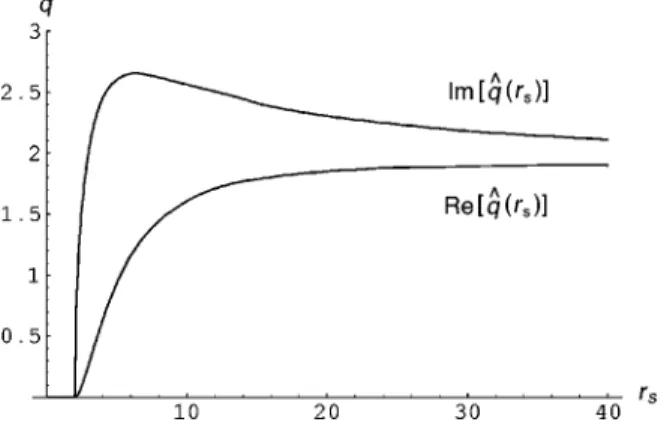
For rs⬍r¯s, no physical solution is found, implying that in
this entire regime screening is absent and the plasmon mode gapless, as in the weak-coupling limit 关see below Eq. 共27兲兴. For rs⬎r¯s, a complex solution with positive real and
imagi-nary parts emerges, signalling an exponentially damped CDW in a 2DEG 共see Fig. 2兲. Contrary to the 3D case, the imaginary part of the solution is larger than the real part in the entire regime where the parametrization applies.
In conclusion, 2DEG’s and 3DEG’s at negative compress-ibility, where test charges are overscreened, were argued to have an exponentially damped CDW as ground state. The wave vector characterizing this state is complex and varies with the electron number density. The real part vanishes above the critical density, where the inverse compressibility changes sign and the system becomes homogeneous.
ACKNOWLEDGMENTS
I wish to thank B. Rosenstein for the kind hospitality at NCTU and acknowledge helpful discussions with him and P. Phillips. This work was funded by the National Science Council 共NCS兲 of Taiwan, R.O.C.
1
S. V. Kravchenko, G. V. Kravchenko, J. E. Furneaux, V. M. Pu-dalov, and M. D’lorio, Phys. Rev. B 50, 8039共1994兲.
2P. Phillips, S. Sachdev, S. Kravchenko, and A. Yazdani, Proc.
Natl. Acad. Sci. U.S.A. 96, 9983共1999兲.
3E. Abrahams, S. V. Kravchenko, and M. P. Sarachik, Rev. Mod.
Phys. 73, 251共2001兲.
4J. P. Eisenstein, L. N. Pfeiffer, and K. W. West, Phys. Rev. Lett.
68, 674共1992兲; Phys. Rev. B 50, 1760 共1994兲.
5D. Pines and P. Nozie`res, The Theory of Quantum Liquids
共Ben-jamin, New York, 1966兲, Vol. 1.
6S. Ichimaru, Rev. Mod. Phys. 54, 1017共1982兲.
7B. Tanatar and D. M. Ceperley, Phys. Rev. B 39, 5005共1989兲. 8S. Ilani, A. Yacoby, D. Mahalu, and H. Shtrikman, Phys. Rev.
Lett. 84, 3133共2000兲.
9A. L. Efros, Solid State Commun. 70, 253共1989兲. 10S. He and X. C. Xie, Phys. Rev. Lett. 80, 3324共1998兲. 11Y. Meir, Phys. Rev. Lett. 83, 3506共1999兲.
12J. Shi and X. C. Xie, cond-mat/0103541共unpublished兲.
13J. Yoon, C. C. Li, D. Shahar, D. C. Tsui, and M. Shayegan, Phys.
Rev. Lett. 82, 1744共1999兲.
14A. Gold, Philos. Mag. Lett. 70, 141共1994兲.
15L. Calmels and A. Gold, Phys. Rev. B 51, 8426共1995兲.
16
D. F. Hines and N. E. Frankel, Phys. Rev. B 20, 972共1979兲.
17M. Rice, Ann. Phys.共N.Y.兲 31, 100 共1965兲.
18K. S. Singwi, M. P. Tosi, R. H. Land, and A. Sjo¨lander, Phys. Rev.
176, 589共1968兲.
19S. Ichimaru and K. Utsumi, Phys. Rev. B 24, 7385共1981兲. 20D. M. Ceperly and B. J. Alder, Phys. Rev. Lett. 45, 566共1980兲. 21H. Yashuhara, Solid State Commun. 11, 1481共1972兲.
22V. D. Gorobchenko, V. N. Kohn, and E. G. Maksimov, in The
Dielectric Function of Condensed Systems, edited by L. V.
Keldysh, D. A. Krizhnitz, and A. A. Maradudin共Elsevier, Am-sterdam, 1989兲.
23G. Gru¨ner, Density Waves in Solids共Addison-Wesley, Reading,
1994兲.
24S. Ichimaru, Statistical Plasma Physics 共Addison-Wesley,
Red-wood City, 1992兲.
25L. L. Foldy, Phys. Rev. 124, 649 共1961兲; ibid. 125, 2208共E兲
共1962兲.
26S. R. Hore and N. E. Frankel, Phys. Rev. B 12, 2619共1975兲. 27Y. Kwon, D. M. Ceperley, and R. M. Martin, Phys. Rev. B 50,
1684共1994兲.
28N. Iwamoto, Phys. Rev. B 43, 2174共1991兲.
FIG. 2. Real共Re兲 and imaginary 共Im兲 part of the wave vector