Hiding Digital Information
Using a Novel System Scheme
Wen-Hung Yeh
1,
2, and Jing-Jang Hwang
21,2Telecommunication Laboratories, Chunghwa Telecom Co., Ltd1,Yang-Mei,Taoyuan,Taiwan 326, ROC
2 Institute of Information Management, National Chiao Tung University2, Hsinchu,Taiwan 30050, ROC
This work builds on Lin and Lee’s document protection scheme, termed as Confused Document Encrypting Scheme (CDES), to present a novel strategy that could hide digital information and pro-vide secret communication between two communication parties. Lin and Lee invented a document protection scheme to transmit large quantities of secret information. However, their design strategy is only suitable for single-byte character-based text document. The proposed scheme presents a novel strategy that modifies the restric-tions in Lin and Lee’s work. Any kind of digital data, not only the plain text, can be employed as a carrier or as a secret in the proposed system. The proposed method utilizes the hexadecimal representa-tion of digital data in a manner that ensures it will have many prac-tical applications. In addition, the procedure is easy to implement and capable of transmitting large quantities of secret information.
Keywords Cryptography, Confused Document Encrypting Scheme
(CDES), Cheating File Database (CFD), Hexadecimal Code Index Table (HexCIT), Secret Content Index File (SCIF), Steganography
Introduction
Cryptography and steganography have recently become two significant branches of computer securi-ty. Cryptography scrambles a message (encryption) to make it meaningless to humans so eavesdroppers can-not recover the original message (decryption) without the key. However, the scrambled message always incurs suspicion. Steganography, derived from a Greek word that literally means “covered writing”[5], is distinct from cryptography since it tries to hide the message. The “invisible” message generated with steganography
will not arise suspicious as an eavesdropper can view the message without realizing it contains an “invisible” message in it.
A German spy sent the following message during WWII [5]:
Apparently neutral’s protest is thoroughly discounted and ignored. Isman hard hit. Blockade issue affects pretext for embargo on by-products, ejecting susets and vegetable oils.
The message can be decoded by extracting the second letter in each word to produce the hidden message:
Pershing sails from NY June 1.
Bender et al. [8], proved people can embed data to dig-ital media for identification, annotation and copyright. Digital media includes text, image, audio, or anything that can be represented as bit streams. Three methods are considered when embedding data into plain text document: open space, syntactic and semantic meth-ods. Open space methods embed bit stream by utiliz-ing the space characters in a plain text document; syn-tactic methods manipulate punctuation to embed bit stream; while semantic methods substitute the words themselves for embedding private information. For example, open space methods can be employed to
interpret one space character between words as a bit value “0”, and two space characters as “1”, then a secret character “A”, with binary representation 01000001, can be embedded in the following message [8]:
A meat without wine is like a day without sunshine
The least significant bit (LSB) insertion [3] is a com-mon, simple approach for hiding a secret in an image. For example, the least significant bits of a color image can be utilized to store your own bit streams.Although this will change the source image data, it is “invisible” to eyes. Hiding information in images has become a popular research topic recently and has developed into a new branch referred as “digital watermark” [2][4][5] because of its copyright protection applications. None of the systems examined above can process large amounts of secret information. However, Lin and Lee’s Confused Document Encrypting Scheme [1] can transmit large quantities of secret information. Their method sends a meaningful cheating text that does not incur suspicion along with an encrypted spe-cial index file.The receiver can reconstruct the secret information as soon as he receives the cheating text and the index file. Nevertheless, Lin and Lee’s method has one restriction: the cheating text cannot have fewer characters than the characters used by the secret text. For example, if the secret text is: “I love you”, then the cheating text must include these eight kinds of ASCII code characters: “I”, “l”, “o”, “v”, “e”, “y”, “u”, and “space.” Moreover, although their method is easily implemented for single byte character-based text documents such as English, it is not suitable for double-byte character-based language, such as Chinese, Japanese, and Korean.To generate the mean-ingful cheating text for the double-byte character-based secret information is hard by employing their method. In addition, their implementation is limited to plain-text cheating text because it cannot use an image file, an audio file, or other kinds of digital files. This work presents a novel system scheme that mod-ifies the restrictions in Lin and Lee’s method.The pro-posed scheme can utilize kinds of digital files, not only the plain text, to cheat eavesdroppers. The procedure is easy to implement and capable of transmitting large
amounts of secret information. The rest of this paper is organized as follows. Section 2 describes the pro-posed system in detail. The security and performance issues are discussed in Section 3 and 4 respectively. Conclusions are finally made in Section 5.
System Architecture
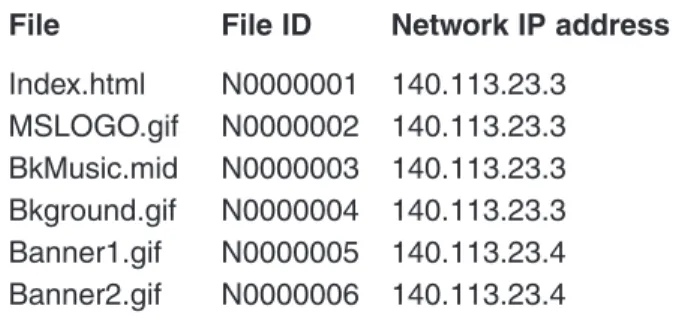
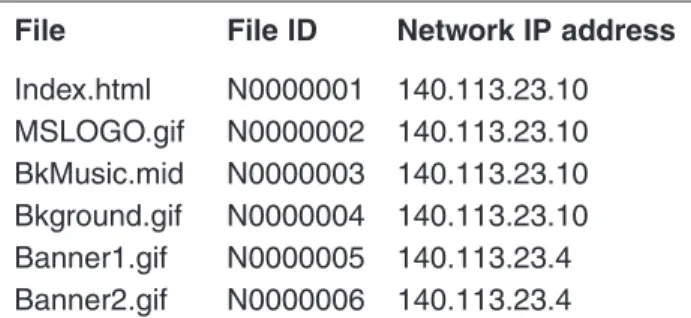
A cheating file database (CFD) is employed to provide confidential communication.The CFD must be man-ually or automatically established before starting any confidential communication between communication parties. Any file in the database can be used as the cheating content for any size of secret information to be transferred from one party to the other.The sender chooses one file from CFD and generates a corre-sponding index file for each transmission. The index file is then sent to the receiver instead of the original secret information to prevent interception.The sender may use different cheating file at each transmission ses-sion. The particular cheating file used for a particular transfer will be indicated to the receiver by embedding file identifier of the cheating file into the transmission. Each record in CFD consists of a cheating file, a file identifier, and a network IP address that indicate the negotiation results with the peer site. The network IP address at the sender site verifies the receiver’s IP address whereas the network IP address is the sender’s address at the receiver’s site.The content of the CFD could be changed each day, each week, each month, or any other period agreed to by the two communicating parties. The simplest approach to manage CFD is to directly configure CFD by keying all the contents into the
File File ID Network IP address
Index.html N0000001 140.113.23.3 MSLOGO.gif N0000002 140.113.23.3 BkMusic.mid N0000003 140.113.23.3 Bkground.gif N0000004 140.113.23.3 Banner1.gif N0000005 140.113.23.4 Banner2.gif N0000006 140.113.23.4
Table 1: Sample of Cheating File Database at the sender site (140.113.23.10)
database. However, the automatic configuration must be supported for widespread deployment.Thus, the sender must negotiate with the receiver to complete the CFD. All the files chosen in the CFD must remain in both the sender’s and the receiver’s site. One simple way to achieve this is to visit some specified web pages and to employ the web page files as the necessary cheating files. For example, the sender could provide the web pages and request the receiver visit these web pages. Thus, the pages’ html files, the background music files, and the image files used in these web pages are down-loaded to the receiver’s computer. Certain FTP (File Transfer Protocol) tools can also help obtain these files. After both the sender and the receiver have received all the necessary files, the sender must bind a unique identifier to each file that will play as a cheating file in the confidential communication and send the binding results to the receiver to complete the CFD.
The sender must select a cheating file from the CFD and generate a Hexadecimal Code Index Table (HexCIT) according to this selected file to start the confidential communication.Two hexadecimal codes, from 0x00 to 0xFF, are applied to represent each byte of the cheating file. A HexCIT stores the positions where the hexadecimal characters (‘0’-’9’, ‘A’-’F’) appear in the file’s hexadecimal representation. The scheme employs the position to indirectly indicate the hexadecimal character for information hiding. Different positions may be used to indicate the same hexadecimal character because each hexadecimal character may appear at many places in the file’s hex-adecimal representation. Therefore, the character set has only sixteen elements from ‘0’ to ‘9’, and ‘A’ to ‘F’.
For example, assuming that the sender selects “MSLO-GO.gif ” from the CFD (Table 1), the image of “MSL-OGO.gif ” is displayed in Fig. 1 while Table 3 illustrates the hexadecimal representation of the first 512 bytes. Table 4 presents a HexCIT generated by the system according to the hexadecimal representation in Table 3.
File File ID Network IP address
Index.html N0000001 140.113.23.10 MSLOGO.gif N0000002 140.113.23.10 BkMusic.mid N0000003 140.113.23.10 Bkground.gif N0000004 140.113.23.10 Banner1.gif N0000005 140.113.23.4 Banner2.gif N0000006 140.113.23.4
Table 2: Sample of Cheating File Database at the receiver site (140.113.23.3)
Table 3: Hex Representation of the first 512 bytes of Fig. 1 Fig. 1: MSLOGO.gif 47 49 46 38 39 61 A7 00 24 00 E6 FF 00 08 08 08 10 10 10 18 18 18 18 21 21 10 18 18 08 10 10 00 08 08 39 42 4A 5A 6B 7B 52 63 73 18 21 29 42 4A 52 63 73 84 29 31 39 21 29 31 31 39 42 C0 C0 C0 73 84 9C 7B 8C A5 8C 9C B5 84 94 AD 6B 7B 94 63 73 8C 5A 63 73 39 42 52 63 6B 7B A5 B5 D6 9C AD CE 94 A5 C6 8C 9C BD 42 4A 5A 84 94 B5 7B 8C AD 52 5A 6B 4A 52 63 31 39 4A 9C AD D6 94 A5 CE 7B 84 9C 5A 63 7B 73 7B 94 6B 73 8C 63 6B 84 52 5A 73 4A 52 6B 7B 84 A5 94 9C BD 8C 94 B5 84 8C AD 9C A5 CE 73 7B 9C 94 9C C6 31 31 39 29 29 31 4A 4A 5A 21 21 29 42 42 52 39 39 4A 31 31 42 18 18 21 29 29 39 10 10 18 08 08 10 00 00 08 00 00 00 00 00 00 00 00 00 00 00 00 00 00 00 00 00 00 00 00 00 00 00 00 00 00 00 00 00 00 00 00 00 00 00 00 00 00 00 00 00 00 00 00 00 00 00 00 00 00 00 00 00 00 00 00 00 00 00 00 00 00 00 00 00 00 00 00 00 00 00 00 00 00 00 00 00 00 00 00 00 00 00 00 00 00 00 00 00 00 00 00 00 00 00 00 00 00 00 00 00 00 00 00 00 00 00 00 00 00 00 00 00 00 00 00 00 00 00 00 00 00 00 00 00 00 00 00 00 00 00 00 00 00 00 00 00 00 00 00 00 00 00 00 00 00 00 00 00 00 00 00 00 00 00 00 00 00 00 00 00 00 00 00 00 00 00 00 00 00 00 00 00 00 00 00 00 00 00 00 00 00 00 00 00 00 00 00 00 00 00 00 21 F9 04 01 00 00 10 00 2C 00 00 00 00 A7 00 24 00 40 07 FF 80 10 82 83 84 85 86 87 88 89 8A 8B 8C 8D 8E 8F 90 91 92 83 1C 0A 40 97 98 98 3C 1C 84 21 99 9F 40 15 1B 03 9F 05 9C 93 A8 A9 AA 8B 22 A0 40 18 10 17 9F 37 A7 8D 1A 0D AE 99 3D 2E 15 B9 99 1E 10 0F 9F 06 12 1A 96 C3 21 29 B8 9F 01 1B 12 00 BE B9 01 29 1A 24 3A A0 22 10 36 A0 28 83 B2
Next, the sender will generate a Secret Content Index File (SCIF) for the secret information according to the HexCIT.The SCIF is employed to encrypt the origi-nal secret information with a sequence of numbers and is sent over the network during transmission process. Thus, the eavesdropper cannot decrypt the secret information without knowing the HexCIT the SCIF referred to.To demonstrate the process of constructing the SCIF, the secret information is assumed to be:
“This is secret information.”
Table 5 summarizes the hexadecimal representation of the secret information. Each hexadecimal representa-tional character of the secret information is compared with the entry in the specified HexCIT, and a posi-tion number is randomly chosen to represent this hexadecimal character if it matches. Thus, a sequence of numbers is obtained to construct the SCIF.
Table 6 illustrates a feasible number sequence according to Tables 4 and 5. Finally, the sender transmits both the selected file identifier and the resultant SCIF, instead of the original secret information, to the receiver.
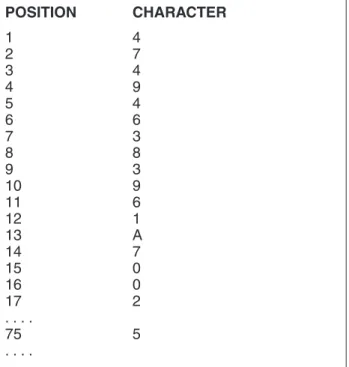
The receiver searches the CFD for the specified cheating file after receiving both the file identifier and the SCIF.The receiver can then generate the HexCIT of the cheating file by the same process employed at the sender’s site. Furthermore, the receiver produces a Reversed Index Table (RIT) according to the HexCIT. The HexCIT, indexed by the hexadecimal characters, binds position information to each charac-ter as illustrated in Table 4 while the RIT employs the position information as the index to translate a num-ber to a hexadecimal character. Table 7 illustrates the results of the reversed index of Table 4.
POSITION CHARACTER 1 4 2 7 3 4 4 9 5 4 6 6 7 3 8 8 9 3 10 9 11 6 12 1 13 A 14 7 15 0 16 0 17 2 . . . . 75 5 . . . .
Character Position Character Position
0 15,16,19,20, … 8 8,28,30,32, … 1 12,33,35,37,39, … 9 4,10,70,92, … 2 17,47,49, … A 13,74,76,96, … 3 7,9,69,84,86, … B 78,80,136,145, … 4 1,3,5,18, … C 123,125,127,136, … 5 75,81,97,140, … D 152,187,192,206, … 6 6,11,22,77, … E 21,194,254,326, … 7 2,14,79,85, … F 23,24,797,833,834, …
Table 4: Part of the HexCIT of Fig. 1
54 68 69 73 20 69 73 20 73 65 63 72 65 74 20 69 6E 66 6F 72 6D 61 74 69 6F 6E
Table 5, Hexadecimal Representation of Secret Content
75, 1, 6, 8, 7, 10, 2, 9, 17, 15, 22, 4, 85, 86, 47, 15, 79, 9, 77, 75, 11, 86, 79, 17, 22, 97, 2, 5, 47, 16, 22, 4, 6, 21, 11, 22, 77, 24, 14, 49, 6, 152, 6, 35, 85, 5, 77, 70, 6, 833, 11, 326
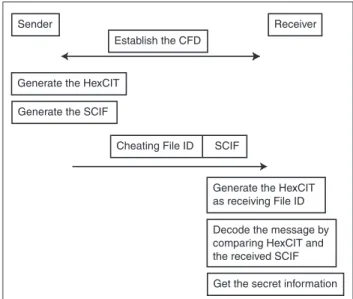
The receiver can obtain each number from the SCIF and search the RIT to translate the number to a hex-adecimal character because the SCIF is composed of a sequence of numbers. For example, the first two numbers, 75 and 1, can be mapped to two hexadeci-mal characters ‘54’ and indicate a ASCII character ‘T’ by searching the RIT. Thus, the hexadecimal repre-sentation of the original secret information could be reconstructed. Fig. 2 demonstrates the entire process.
The secret information does not have to be limited to text message in the proposed scheme. Anything that can be digitized can be processed. Indeed, both the secret information and the cheating file can appear as an image, an audio or video, a Microsoft Word docu-ment, or as some other digital format.
Security Issues
The proposed system is most vulnerable when it automatically runs the CFD setup process because all of the communications are exposed to the hackers. However, a hacker may intuitively chose to ignore meaningful information (cheating files) when receiv-ing it as he or she may not desire such information. The CFD can be distributed by some public key cryp-tosystem, such as an RSA [6] public key crypcryp-tosystem,
to enhance the strength of the automatic CFD setup process. Those cryptosystems are proved to be very secure and are typically used to distribute session keys. Thus, the eavesdropper must spend a lot of time to steal the CFD with current technology. Obtaining the secret information is nearly impossible for the eaves-dropper because the two communication parties can negotiate to change the content of CFD periodically. [7] discusses these cryptosystems and their associated risks and advantages.
The manual CFD setup process appears to be very secure since no third party could understand the real contents of the CFD. Moreover, the sender transmits only the file identifier and the SCIF after the CFD setup process. So it is impossible for the eavesdropper to obtain the original secret information even if he or she captured all the data during transmission since he or she does not know the meaningful cheating con-tents in advance.
In addition, the position number must be randomly determined during the process of generating the SCIF in order to generate two distinct SCIF even if the same secret information is sent twice.This proce-dure could help strengthen the security of the pro-posed system.
Performance Issues
Two hexadecimal characters are employed to repre-sent each byte of the cheating file and the position’s information is employed to indirectly indicate the hexadecimal character in the developed system. The meaningful cheating content cannot exceed two-giga bytes (232/2) since the position’s information is stored by a 32-bit integer. Although the size of the meaningful cheating content must be limited, two giga-bytes are more than adequate for any kind of meaningful cheating content.
Furthermore, The generated SCIF is eight times the size of the original secret information since each byte of the original secret information must be represent-ed by two integers. Several well-known compression tools can, if necessary, compress the SCIF to lighten the network traffic before sending it to the receiver.
Generate the HexCIT as receiving File ID Decode the message by comparing HexCIT and the received SCIF Get the secret information Cheating File ID SCIF
Generate the HexCIT Generate the SCIF
Establish the CFD
Sender Receiver
Conclusion
This work present a novel system scheme that can transmit large quantities of secret information and provide secure communication between two commu-nication parties without the restrictions in Lin and Lee’s document protection system. Any kind of digi-tal data can be employed as secrets or as cheating files to transmit digital secret information. The size of the secret is unlimited while the size of the cheating file is limited to two-giga bytes. However, two-giga bytes are more than adequate for any kind of cheating file. Both steganography and cryptography are woven into the proposed scheme. The meaningful cheating con-tent employing the concept of steganography is sent over the network without incurring suspicion while the SCIF using the position to indirectly indicate the original information is like to encrypt the secret mes-sage. In addition, the proposed procedures are simple and easy to implement.Also, the developed system has many practical personal and militaristic applications for both point-to-point and point-to-multi-point communications.
Reference
[1] Chu-Hsing Lin, Tien-Chi Lee, “A Confused Document Encrypting Scheme and its Implementation”, Computers & Security,Vol. 17, No. 6, pp543-551, 1998
[2] Fred Mintzer, Gordon W. Braudaway, and Alan E. Bell, “Opportunities for Watermarking Standards”, Communication of the ACM,Vol. 41, No. 7, pp.57-64, July. 1998.
[3] I. Cox et al., “A Secure, Robust Watermark for Multimedia”, Proc. First Int’l Workshop Information Hiding, Lecture Notes in Computer Science No. 1, 174, Springer-Verlag, Berlin, pp.185-206, 1996.
[4] Nasir Memon and Ping Wah Wong, “Protecting Digital Media Content”, Communication of the ACM,Vol. 41, No. 7, pp.35-43, July. 1998. [5] Neil F. Johnson, Sushil Jajodia, “Exploring
Steganography : Seeing the Unseen”, IEEE Computer pp.26-34, Feb. 1998.
[6] Rivest, R. L., Shamir, A., and Adleman, L. M., “A Method for Obtaining Digital Signatures and Public Key Cryptosystems”, Communication of the ACM,Vol. 21, No. 2, pp.120-126, Feb. 1978. [7] Schneier, B., “Applied Cryptography”, 2nd
Edition, John Wiley & Sons Inc, 1996
[8] W. Bender, D. Gruhl, N. Morimoto, A. Lu, “Techniques for Data Hiding”, IBM Systems Journal,Vol. 35, No. 3&4, pp.313-335, 1996