Scripta Materialia, Vol. 34, No. 1, pp. 83-87, 1996 Elsevier Science Ltd
Pergam on
0956-716X(95)00486-6
Copyright 0 1995 Acta Metallurgica Inc. Printed in the USA. All rights merved
1359~646W96 $12.00 + .OO
AS-QUENCHED MICROSTRUCTURE OF A
Cu-24.8Mn-30.OAl ALLOY
K.C. Chu, S.C. Jeng and T.F. Liu
Institute of Materials Science and Engineering National Chiao Tung University
Hsinchu, Taiwan, R.O.C. (Received February 1,1995)
Introduction
Effects of manganese addition on the microstructural changes of Cu-Al binary alloys have been extensively studied by many workers[ 1 - 181. Based on these studies, M. Bouchard and G. Thomas have established the Cu-Mn-Al metastable phase diagram[ 11. In this phase diagram, it is seen that when the Cu&n&l alloy with 0.2 s x 5 0.8 was solution heat-treated at a point in the p phase region and then quenched rapidly, a p - & - DO, + L2, phase transition would occur during quenching. It means that the as-quenched microstructure of the Cu~.&Ir@ alloy with 0.2 <=x 2 0.8 was a mixture of (DO, + L2,) phases. When the manganese content in the Cu,_.Mr@l alloy was increased to 25 at pet (x = 1). the as-quenched microstructure became a single L2, phase[ l-51. The crystal structure of the L2, phase is similar to the DO, structure of Cu,Al, and the only difference between them is that Mn replaces the Cu at a specific lattice site with the eight nearest Cu atoms in the DO, structure so as to form a stoichiometric composition of Cu&fnAl[l].
Recently, we made transmission electron microscopy observations on the phase transformations of a Cu&An,,&l alloy[ 181. Based on this study, it is found that the microstructure of the alloy in the as-quenched condition or aged at 300°C was a mixture of (DO, + L2, + L-J) phases, where the L-J phase is a new phase having an orthorhombic structure with lattice parameters a = 0.413 nm, b = 0.254 nm and c = 0.728 nm. This result is quite di&rent from that reported by other workers[ 11. However, to date, all of examinations were focused on the Cu,&In./d alloy with varying manganese content. Little information concerning the Cu-Mn-Al alloy with higher aluminum content has been provided. Therefore, the purpose of the present study is to inves- tigate the as-quenched microstructure of the Cu-24.8Mn-3O.OAl alloy.
Exuerimental Procedure
The alloy was prepared by using 99.99% copper, 99.9% manganese and 99.99% ahrminum in an induction furnace under a protective argon atmosphere. The melt was chill cast into a 30 x 50 x 200~mm copper mold. After being homogenized at 850°C for 72 hours, the ingot was sectioned into 2-mm slices in thickness. These slices were subsequently heat-treated at 850°C for 1 hour and then rapidly quenched into iced brine.
Electron microscopy specimens were prepared by means of a double-jet electropolisher with an electrolyte of 70 percent methanol and 30 percent nitric acid. The polishing temperature was kept in the range from -40 to -30°C and the current density was kept in the range from 3.0 x lo4 to 4.0 x 10’ A/m’. Electron microscopy was pe&amed on a JEOL 2000FX scanning transmission electron microscope (STEM) operating at 200 kV
MICROSTRUCTURE IN Cu-Mn-Al ALLOY Vol. 34, No. 1
0 1 2 3 4 5 6 7 8 9 10
Energy
(keV)
Figure 1. A typical EDS spectrum ofthe asquenched Cu-24.8hh3O.OAl alloy.
This microscope was equipped with a LINK-AN 10000 energy-dispersive X-ray spectrometer (EDS) for chemical analysis. Quantitative analyses of elemental concentrations for Cu, Mn and Al were made with the aid of a ZAF-corrected program on the LINK system ( where Z = backscatter coefficient; A = absorption coefficient, and F = fluorescence coefficient).
Results and Discussion
Figure 1 is a typical EDS spectrum of the as-quenched specimen. The quantitative analyses of ten di&rent spectra indicated that the average chemical composition was Cu-(27.0 f 0.6)w-t pet Mn(16.0 f 0.4)wt pet Al (C~(24.8 f 0.6)at pet Mn(30.0 f 0.7)at pet Al).
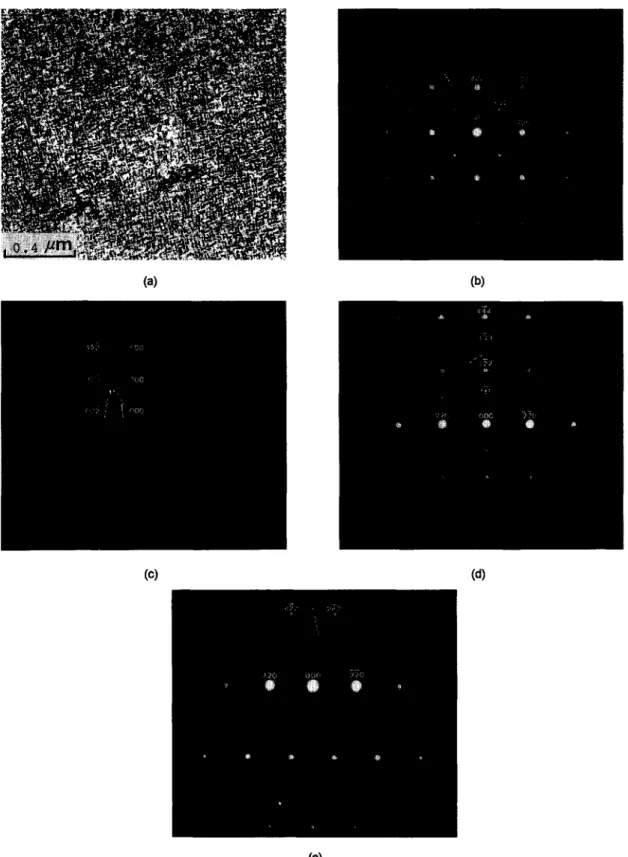
Figure 2(a) is a bright-field electron micrograph of the as-quenched specimen, clearly exhibiting a modu- lated structure. Figures 2(b) through (e) show four d&rent selected-area dilhaction patterns (SADPs) of the as-quenched specimen. These SADPs consist of two sets of reflection reciprocal lattices: one derived from the matrix (brighter and well-arranged reflection spots) and another derived horn fine precipitates (extra re- flection spots indicated by arrows). Compared to our previous study in a Cu&In,,& alloy[l8], it is found that these extra spots are of the L-J phase with two variants. The orientation relationship between the L-J phase and the matrix is (lOO),,//(OTl),,,, (OlO),.J/(lrr>, and (001),,//(21 I),. It is worthy to note here that the L-J phase has never been found by other workers in the Cu-Al, Cu-Mn and Cu-Mn-Al alloy systems before. In addition to the spots unmsponding to the L-J phase, all of the reflection spots in Figures 2(b) through (e) can be indexed as either the DO, or L2, phase, since both of these two phases possess the same arrangement of the reflection spots[ I], and the dilfcrence between their lattice parameters is only about two percent[20-211. How- ever, the chemical composition of the present alloy approximates to Cu&nAl. Therefore, these reflection
Vol. 34, No. 1 h4ICROSTRUCTURE IN Cu-Mn-Al ALLOY 85
(4
(e)
Figure 2. Electron micrographs of the asquenched Cu-24.8Mn-3O.OAl alloy. (a) Bright-field (b)-(e) Four selectedarea difihhn patterns (SADPs). The zone axes ofthe L2, phase are @) [OOl], (c) [Oil], (d) [i12] and(e) [T13], respectively. (hkl = L2, phase).
86 MICROSTRUCTURE IN Cu-Ivin-Al ALLOY Vol. 34, No. 1
(a) (W
Figure 3. (a)-(b) 111 and 200 L2, dark-field electron microg~aphs, (c) A dark-field micrograph taken with the reflection spot marked as 1 in Fig. 2(e).
spots are considered to be of the L2, phase, rather than the DO, phase. Although these reflection spots could be analyzed as L2, phase, the L2, reciprocal lattices contain all the B2-type reflections[ 19-221. Therefore, in order to decide whether the ordered B2-type phase coexists with the L2, phase, both electron diEaction method and dark-field technique. were used. Intensity of reflection spot is proportional to IF]‘, where the F is shucmre fa&r[23]. The structure factors F,,,, F,, and F,,, of the Cu.$&%l L2, can be expressed as follows ~241: F,,, = 4f,-4f,, F,, = 8&,-4fti-4fAL and F, = 8&-4f,-4f,. Using the atomic scattering factors off,, f,,,,
~G,Wl, the wdues
oflF,,,12,
i&J ad
IF2,,12 were calculated to be 29.72, 12.91 and 19.78, respectively. This indicates that the 111 reflection spot should be stronger than the 200 and 222 reflection spots. However, the reverse result can be observed in Figures 2(c) and (d). Accordingly, it is suggested that the 200 and 222 L2, reflection spots derived from not only L2, phase but also B2 phase, since the 111 reflection spot comesVol. 34, No. 1 MICROSTRUCTURE IN Cu-hh-Al ALLOY 87
from the L2, phase only; while the 200 and 222 reflection spots can come from both the L2, and B2 phases (the 200 snd 222 L2, retlection spots are equal to the 100 and 111 B2 reflection spots, respectively). Figures 3(a) and (b) are 1 :I 1 and 200 L2, dark-field electron micrographs of the same area in the as-quenched speci- men It is clearly ,seen that the bright region in 200 dark-field image is much more than that in the 111 dark- field image. This demonstrates that both B2 and L2, phases are present, rather than single L2, phase; other- wise these two dark-field images should be morphologically identical. Shown in Figure 3(c) is a dark-field electron micrograph taken with the reflection spot marked as 1 in Figure 2(e), revealing the presence of ex- tremely fine L-J precipitates. By comparing with our previous study[ 181, it is found that the amount of the L-J precipitate is much more than that observed in the as-quenched Cu&Qr,,~ alloy.
In summary, the as-quenched microstructure of the Cu-24.8Mn-3O.OAl alloy is a mixture of (L.2, + B2 + L-J) phases. The increase of aluminum content in the Cu-Mn-Al alloy will enhance the formation of the L-J precipitate.
Acknowledgement
The authors am p:leased to acknowledge the financial support of this research by the National Science Council, Republic of Chinaunder Grant NSC83-0405-E-009-001. They are also grateful to Miss M.H.Lin for typing.
References 1. 2. 3. 4. 5. 6. 7. 8. 9. 10. 11. 12. 13. 14. 15. 16. 17. 18. 19. 20. 21. 22. 23. 24. 25.
MBouchard and G.Thomas: Acta Met., 23,1485. (1975)
Ye.G.Nesterenko, I.ACkipenko and S.AFirstov: Fiz. Metal. Metalloved, 27,135. (1969) Ye.G.Nesterenko, LAOsipenko and S.AFiiov: Fiz. Metal. Metalloved., 28,987. (1969) Ye.G.Neaterenko, IAGsipenko and S.AFirstov: Fii. Metal MetaUoved, 36,702. (1973) V.P.Zalutakiy, Ye.G.Neaterenko and LAOsipenko: Fii. Metal. Metalloved., 28,627. (1970) Ye.G.Nesterenko and LAGsipenko: Fii. Metal Metalloved., 36,1212. (1973)
R.Kozubski and JSoltys: J. Mater. Sci. lett, 2,141. (1983) BDubois and DChevereau: J. Mater. Sci., 14,2296. (1979) RKozubski and J.Soltys: J. Mater. Sci., 17, 1441. (1982) RKozubski and J.Soltys: J. Mater. Sci., 18,1689. (1983)
T.Yamane, H.Okamotoand J.Takabaahi: Z. Metallkde., 71,813. (1980) RKozubski, J.Soltys and RKuziak: J. Mater. Sci., 18,3079. (1983)
RKozubski, J.Soltys, J.Dutkiewicz and J.Morgiel: J. Mater. Sci., 22,3843. (1987) J.Soltys, M.St&niak and J.Holti Phil. Mag., 49B, 151. (1984)
D.RF.West and D.Lloyd Thomas: J. Inst. Metals, 85,97. (1956-1957)
C.Lopez de1 Qstillo, J.Hemaze and B.G.Mellor: J. Mater. Sci., 21,4043. (1986)
CLopez de1 Castillo, M.L.Blazouez, CGomez, B.G.Mellor, N.de Diego and J.&l Rio: J. Mater. Sci., 23,3379. (1988) S.C.Jeng and T.F.Liu, “LJ Phase in a Cu2.2MnO.8Al Alloy”, accepted and to be published in Metall. Trans. A (1995) S.M.Allenand J.W.Cahm ActaMetall., 24,425. (1976)
Y.J.Chang: A&a Metall., 30, 1185. (1982)
C.C.Wu, JXChou and T.F.Liu: Metall. Trans. A, 22A 2265. (1991)
T.F.Liu, G.C.lJen, C.Y.Chao, Y.L.LmandC.C.Wu: Metall. Trans. A, 22A 1407. (1991)
J.W.Edington: The Operation and Calibration ofthe Electron Microscope, Volume 2, p.6, MacMillan Press, London. (1975) G.B.Johnston.mdE.O.Halk J.Phys.Chem. Solids,29,193.(1968)
J.W.Edmgton The Operation and Calibration of the Electron Microscope, Volume 2, p.113, MacMillan Press, London (1975)