PHYSICAL REVIEWA VOLUME 47, NUMBER 5 MAY 1993
Analytic functions
for
atomic
momentum-density
distributions
and Compton
profiles
of
K
and
L
shells
Y.
F.
Chen andC. M.
KweiDepartment
of
Electronics Engineering, National Chiao Tung Uniuersity, Hsinchu, Taiwan, Republicof
ChinaC.
J.
TungInstitute
of
Nuclear Science, National Tsing Hua University, Hsinchu, Taiwan, Republic ofChina (Received 11 September 1992;revised manuscript received 29 December 1992)An analytical expression involving three parameters was proposed for atomic momentum-density dis-tributions ofKand Lshells. This expression was based on the superposition ofhydrogenic closed-shell momentum densities. Parameters in the expression were determined by requiring four ofits moments to be equal to the corresponding Hartree-Fock results. An analytical function for the Cornpton profiles was then derived using the impulse approximation. Excellent agreement was found between the present results and detailed theoretical computations.
PACS number(s): 31.20.Sy,31.15.
+
qI.
INTRODUCTIONII.
THEORYThe atomic electron-density distribution in momentum
space plays an important role in many applications.
For
instance, this distribution is directly related to Compton profiles, which represent the Doppler broadening
of
Compton lines due to moving electrons
[1].
Moreover,this distribution is needed for the calculation
of
stoppingcross sections, shell corrections, and ionization cross sec-tions by the binary-encounter theory [2,
3].
Thus, a studyof
the momentum-density distribution isimportant.In all these applications, a simple analytical function
for atomic momentum densities for each shell is desired. This function will help the manipulation
of
such densi-ties, usually calculated by the Hartree-Fock (HF)ap-proach with data presented in tabulated form, in a very
simple way. Although an analytical expression for
momentum-space wave functions in the configurational Slater-type orbitals was reported [4] and hence an atomic
momentum-density distribution could be derived, this ex-pression involved too many terms and parameters to be
of
useful applications.In this work, we propose a simple analytical form in-volving three parameters for atomic momentum-density distributions
of
K
andL
shells. This form is based on the superpositionof
hydrogenic closed-shell momentumden-sities. Parameters in the form are determined by
requir-ing the zeroth, first, second, and third moments
of
these distributions tobe equal to the correspondingHF
results.The hydrogenic model was previously applied to
calcu-late ionization-generalized oscillator strengths using the sum-rule constrained classical-binary-collision model
[5,
6].
The present work concerns the constructionof
analytical functions for the momentum-density distribu-tions and Compton profiles for each shell.
To
the bestof
our knowledge, no such function for Compton profiles is available except forthe helium atom
[7].
where
R„&(r)
is the radial partof
P(r),
j
t(pr) is thespheri-cal Bessel function, n is the principal quantum number, and l is the angular-momentum quantum number. The
momentum-density distribution for each shell can then be developed using
P„i(p).
The momentum-density distribution for a closed-shell hydrogenic atom is given by [8]
5 2
I(p)
=47tp p(p)=
(g2+
2)4 (3)where p(p) isthe normalized momentum-density
distribu-tion,
i.e.
,f
47rp p(p)dp=1,
and g/2=E
is the averagekinetic energy
of
electrons in that shell. Note that atomicunits are used throughout this paper. Comparing the average kinetic energy
of
electrons,i.
e., the second mo-mentof
the momentum-density distribution, obtained us-ing Slater's rules [9] for the hydrogenic closed shell with correspondingHF
data[10],
we find that the error is within 2%%uo for theK
shell and 6%%uo for theL
shell for allatoms. Toimprove the accuracy
of
Eq. (3),we proposeI,
(p)=47rp p,(p)=
.g
2 .2 4 (i
=K,
L)
~,
=i
(0';,+p')'
(4) The momentum-space atomic wave functions are defined as the Fourier transform
of
coordinate-space atomic wave functions,i.e.
,P(p)
=
1 7tr(r)exp(—
ipr)dr
. (27r)'~In the central-field approximation, Eq. (1) reduces to
1/2
2
r
R„t(r)ji(pr
)dr,
0
47
BRIEF
REPORTS 4503for the ith-she11 momentum-density distribution. Here we take A;J and g;J as parameters
to
be determined by re-quiring several momentsof
I,
(p)inEq.
(4)to be equal tothe corresponding
HF
results.The mth moment
of
the ith-she11 momentum-density distribution is defined by(p
);
=
f
"p
I;(p)dp
.
Letting m
=0,
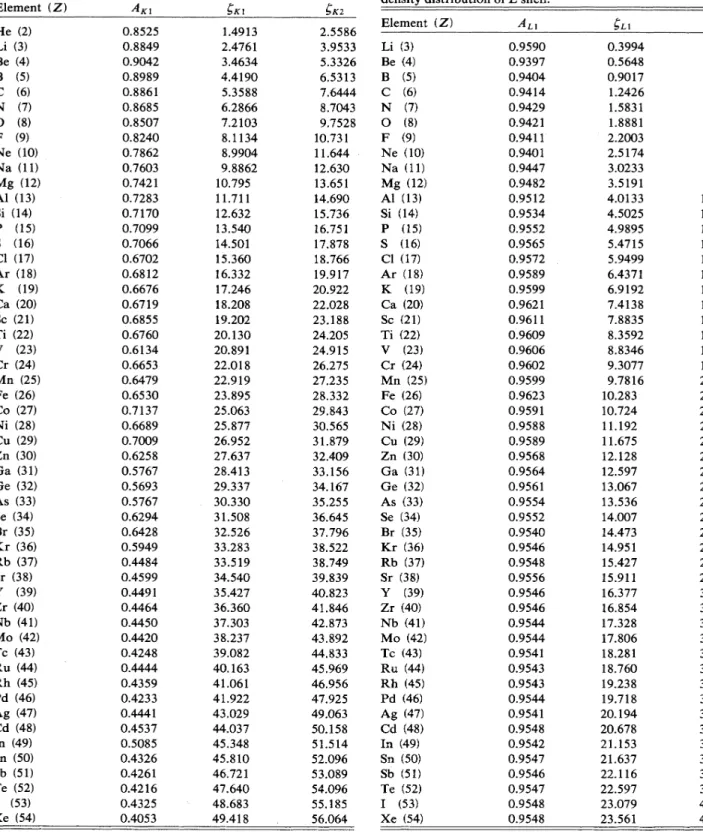
1, 2, 3in Eqs. (4)and (5), we getTABLE
I.
Parameters in Eq. (4)density distribution of
E
shell. Element{Z)
for atomic
momentum-CKI
TABLE
II.
Parameters in Eq. (4)density distribution of
I.
shell.for atomic
momentum-He (2) Li (3) Be (4) (5) C (6) N (7) O (8) (9) Ne (10) Na (11) Mg {12) Al (13) Si (14) P {15) S (16) Cl (17) Ar {18) K (19) Ca (20) Sc(21) Ti (22) V (23) Cr (24) Mn (25) Fe (26) Co (27) Ni (28) CU (29) Zn (30) Ga (31) Ge (32) As (33) Se (34) Br (35) Kr (36) Rb (37) Sr (38) Y (39) Zr (40) Nb (41) Mo (42) Tc (43) Ru (44) Rh (45) Pd (46) Ag (47) Cd (48) In (49) Sn (50) Sb (51) Te (52) (53) Xe (54) 0.8525 0.8849 0.9042 0.8989 0.8861 0.8685 0.8507 0.8240 0.7862 0.7603 0.7421 0.7283 0.7170 0.7099 0.7066 0.6702 0.6812 0.6676 0.6719 0.6855 0.6760 0.6134 0.6653 0.6479 0.6530 0.7137 0.6689 0.7009 0.6258 0.5767 O.S693 0.5767 0.6294 0.6428 0.5949 0.4484 0.4599 0.4491 0.4464 0.4450 0.4420 0.4248 0.4444 0.4359 0.4233 0.4441 0.4537 0.5085 0.4326 0.4261 0.4216 0.4325 0.4053 1.4913 2.4761 3.4634 4.4190 5.3588 6.2866 7.2103 8.1134 8.9904 9.8862 10.795 11.711 12.632 13.540 14.501 15.360 16.332 17.246 18.208 19.202 20.130 20.891 22.018 22.919 23.895 25.063 25.877 26.952 27.637 28.413 29.337 30.330 31.508 32.526 33.283 33.519 34.540 35.427 36.360 37.303 38.237 39.082 40.163 41.061 41.922 43.029 44.037 45.348 45.810 46.721 47.640 48.683 49.418 2.5586 3.9533 5.3326 6.5313 7.6444 8.7043 9.7528 10.731 11.644 12.630 13.651 14.690 15.736 16.751 17.878 18.766 19.917 20.922 22.028 23.188 24.205 24.915 26.275 27.235 28.332 29.843 30.565 31.879 32.409 33.156 34.167 35.255 36.645 37.796 38~522 38.749 39.839 40.823 41.846 42.873 43.892 44.833 45.969 46.956 47.925 49.063 50.158 51.514 52.096 53.089 54.096 55.185 56.064 Element (Z) Li (3) Be (4) B (5) C (6) N (7) O (8)
F
(9) Ne (10) Na (11) Mg (12) Al (13) Si (14) P (15) S (16) Cl (17) Ar (18) K (19) Ca (20) Sc (21) Ti (22) V (23) Cr (24) Mn (25) Fe (26) Co (27) Ni (28) Cu {29) Zn (30) Ga (31) Ge (32) As (33) Se (34) Br {35) Kr (36) Rb (37) Sr (38) Y (39) Zr (40) Nb (41) Mo (42) Tc (43) Ru (44) Rh (45) Pd (46) Ag (47) Cd (48) In (49) Sn (50) Sb (51) Te (52}I
(53) Xe (S4) 0.9590 0.9397 0.9404 0.9414 0.9429 0.9421 0.9411 0.9401 0.9447 0.9482 0.9512 0.9534 0.9552 0.9565 0.9572 0.9589 0.9599 0.9621 0.9611 0.9609 0.9606 0.9602 0.9599 0.9623 0.9591 0.9588 0.9589 0.9568 0.9564 0.9561 0.9554 0.9552 0.9540 0.9546 0.9548 0.9556 0.9546 0.9546 0.9544 0.9544 0.9541 0.9543 0.9543 0.9544 0.9541 0.9548 0.9542 0.9547 0.9546 0.9547 0.9548 0.9548 CL1 0.3994 0.5648 0.9017 1.2426 1.5831 1.8881 2.2003 2.5174 3.0233 3.5191 4.0133 4.5025 4.9895 5.4715 5.9499 6.4371 6.9192 7.4138 7.8835 8.3592 8.8346 9.3077 9.7816 10.283 10.724 11.192 11.675 12.128 12.597 13.067 13.536 14.007 14.473 14.951 15.427 15.911 16.377 16.854 17.328 17.806 18.281 18.760 19.238 19.718 20.194 20.678 21.153 21.637 22. 116 22.597 23.079 23.561 1.2 2.5381 3.4130 4.1177 4.7817 5.4258 6.0270 6.5902 7.1266 8.0953 9.0622 10.023 10.958 11.884 12.778 13.638 14.573 15.457 16.458 17.167 17.933 18.694 19.435 20.181 21.878 21.647 22.289 23.142 23.665 24.379 25.088 25.758 26.461 27.033 27.860 28.629 29.487 30.060 30.783 31.473 32.200 32.868 33.619 34.331 35.054 35.718 36.534 37.127 37.921 38.605 39.324 40.036 40.7464504 BRIEFREPORTS 47 2
3;
g;=a
(p
);
(m=0,
1, 2,3),
j=1
(6) 0..5 I I I I I I I I I I I I I I I I I I I I I I I 1I;(p)
J;(q)
=
f
dp,
2 q p (7) wherea0=1,
a&=3m/8,
a2=1,
anda3=3~/16.
Thisprocedure guarantees the zeroth, first, second, and third moments
of
Eq. (4) to be equal to thoseof
theHF
momentum-density distribution. Note that the zeroth moment in Eq. (6)is simply the normalization condition,
i.
e.
,3;&+A,
2=1.
This condition leaves the numberof
free parameters in
Eq.
(4)equal to three. The simultane-ous equationsof Eq.
(6)can be solved for A;~ and g;.us-ing
HF
data for(p
);.
ApplyingHF
data for available atoms withZ
up to 54[10],
we have solved these equa-tions for the ground-stateX
andL
shells. Solutions are given in TablesI
andII.
Under the impulse approximation
[11],
the isotropicCompton profile
of
the ith shell,J,
.(q), is relatedto
the momentum-density distribution asp4
0.302
0.1 0.0 0 10 15 p(a.
u.)
20 25where Z, isthe occupation number
of
electrons per atom in the ith shell and q isthe projectionof
electron momen-tum before the collision on the directionof
momentumtransfer. Substituting Eq. (4) into Eq. (7), we find the
analytical expression forCompton profiles as 8Z,
J;(q)=
g
(i=K,
l.
).
3~
(f2~~+
q 2 )3III.
RESULTSUsing
Eq.
(4) with parameters listed in TablesI
andII,
we have calculated atomic momentum-density distribu-tionsof
K
andL
shells. Figure 1 shows a comparisonof
0..20 I I I 1
( I I I t
I I I I ~
I I I I I
I I I I I
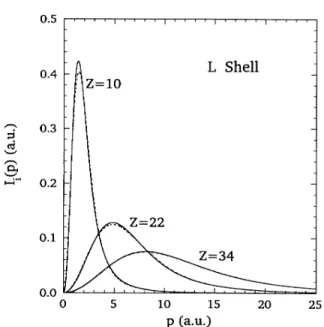
FIG.
2. Plot ofthe L-shell electron momentum-density distri-bution for several atoms. Present results (solid curves) are com-pared toHFdata (dashed curves) [10].Atomic units are used.our results with the corresponding
HF
data[10]
fortheK
shell
of
several atoms. Excellent agreement is found forall atoms. The present results (solid curves) and the
HF
data (dashed curves, but merging into solid curves within graphic scales) agree so closely with each other that one cannot see any difference from the figure. A similar plot
for the
L
shell is shown in Fig.2.
Again, the agreement isso close that only minute differences can be seen.Fig-p4
0.3 ell 0.15 0.20.
10 C4 0.1 0.05 0.0 0 10 20 Z 30 40 50 0.00 0 10 20 30 p(a.
u.)
40 50FIG.
1.. Plot ofthe K-shell electron momentum-densitydis-tribution for several atoms. Present results (solid curves) are compared to HFdata (dashed curves, but coinciding with solid curves within graphic scales) [10].Atomic units are used.
FIG.
3. Plot ofthe E-shell Compton profile as a function of atomic number for three momentum values. Present results (solid circles) are compared to data calculated using HF wave functions (open circles, but coinciding with solid circles within graphic scales) [12].The curves are interpolating results show-ing the dependence ofthe Compton profile on atomic number. Atomic units are used.47
BRIEF
REPORTS 45053.
02.5
2.
0—
hell
merging into solid circles within graphic scales)
[12].
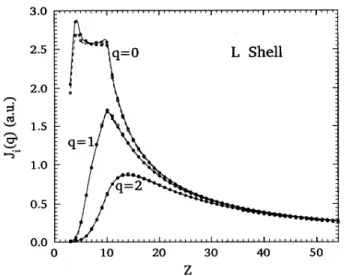
Note that all calculated results are plotted as discretepoints; interpolating curves serve only to indicate the dependence
of
these results on atomic number. A similar plotof
the L-shell Compton profile is shown inFig. 4.
Still, only minute differences can be seen.
1.
51.
00.
50.0
0 10 20 30 40 50
FIG.
4. Plot ofthe L-shell Compton profile as a function of atomic number for three momentum values. Present results (solid circles) are compared to data calculated using HF wave functions (open circles) [12]. The curves are interpolating re-sults showing the dependence ofthe Compton profile on atomic number. Atomic units are used.IV. CONCLUSION
In this work, we have constructed simple analytical
ex-pressions for the atomic momentum-density distribution and Compton profile
of
E
andL
shells. Although it wasnot discussed, we have calculated the stopping cross
sec-tion
of
IC andL
shells for protons using Eq. (4) and the stopping-power formula[13].
In all these calculations, we found excellent agreement between the present results and detailed theoretical computations.An extension
of
this work to other shells seemsplausi-ble. Ekowever, the superposition
of
hydrogenic closed-shell momentum densities inEq.
(4) should include moreterms.
It
requires then additional moments inEq.
(5)tobe applied.
If
electrons in theM
and higher shells belongto the valence band, a solid-state rather than atomic
theory must be employed.
ure 3 is a plot
of
the X-shell Compton profile as afunc-tion
of
atomic number for several momentum values. Nodifference can be seen from the figure between the present results (solid circles) and the
HF
data (open circles, butACKNOWLEDGMENT
This research was supported by the National Science
Council
of
the Republicof
China.[1]
B.
G. Williams, Compton Scattering (McGraw-Hill, New York, 1977).[2]
J.
H. McGuire andK.
Omidvar, Phys. Rev. A 10, 182 (1974).[3]
J.
R.
Sabin andJ.
Oddershede, Phys. Rev. A 26, 3209 (1982).[4]
F. F.
Komarov and M. M. Temkin,J.
Phys. B9, L255 (1976).[5]C.
J.
Tung, Phys. Rev. A 22,2550 (1980).[6] C. M.Kwei, Y.
F.
Chen, and C.J.
Tung, Phys. Rev.A 45, 4421(1992).[7]
T.
Kogaand H.Matsuyama, Phys. Rev.A45,5266(1992). [8] V. Fock, Z.Phys. 98,145(1935).[9]
B. B.
Robinson, Phys. Rev. 140, A764 (1965).[10]
E.
Clementi and C. Roetti, At. Data Nucl. Data Tables 14, 177(1974).[11]L.Mendelsohn and V. H. Smith, in Compton Scattering, edited by
B. G.
Williams (McGraw-Hill, New York, 1977), p. 102.[12]