Effect of Pozzolanic Materials and Poling Field on Electromechanical
Coupling Coefficient of Cement-Based Piezoelectric Composites
Dung-Hung Lin
1, a, Huang Hsing Pan
1,b, Chang-Geng Jiang
1,cand Hui-Chuan Hung
2,d1
Department of Civil Engineering, Kaohsiung University of Applied Sciences, Kaohsiung, Taiwan
2
Wanchi Steel Industrial Co. Ltd., Kaohsiung, Taiwan
a
[email protected], [email protected], [email protected],
d
Keywords: Electromechanical coupling, Cement, Pozzolana, Polarization, Impedance.
Abstract. Electromechanical coupling coefficient of cement-based piezoelectric composites affected by pozzolanic materials and poling field are investigated. Specimens, through a pressure approach, are manufactured by combining PZT powders and cement-based binder with the same volume fraction. Pozzolanic materials including fly ash, slag and silica fume replace 20% cement in the binder. Three poling fields are considered to induce piezoelectricity of 0-3 cement-based composites. Results show that electromechanical coupling coefficients do not have many fluctuations in terms of material ages for any cement-pozzolanic piezoelectric composites. With the same volumetric substitutes of pozzolanic materials, the electromechanical coupling coefficient with pozzolanic materials except fly ash is lower than that with plain cement, especially for silica fume having a 7.9% decrease. Raising poling field can increase electromechanical coupling coefficients. Polarization of cement-based piezoelectric composites containing silica fume in low poling fields such as 0.5kV/mm and 1kV/mm is not easy to complete.
Introduction
Piezoelectric composites consisting of piezoelectric ceramics and cement have been attracted considerable attention more than ten years [1-6]. For applications of sensors and actuators in civil engineering structure, 0-3 cement-based piezoelectric composites developed to overcome the matching problem that traditional piezoelectric ceramics or polymers do not contact synchronously with concrete [7-9].
For 0-3 cement-based piezoelectric composites, most literatures have discussed the piezoelectric and dielectric properties affected by volume fraction and particle size of piezoelectric ceramics, poling time, poling temperature, poling field, curing time, the thickness and the forming of specimens [1,3,4,7-14]. For the properties of piezoelectricity, the thickness electromechanical coupling coefficient Kt on cement-based piezoelectric composites has less concerned.
Electromechanical coupling coefficient is a measure of the conversion efficiency between electrical and acoustic energy in piezoelectric materials. To enhance the electromechanical coupling coefficient of cement-based piezoelectric composites is important for the applications of engineering and energy. Researches [6,11] indicated that increasing volume fraction of piezoelectric ceramics in cement-based piezoelectric composites, such as lead zirconate titanate (PZT), can raise Kt.
Electromechanical coupling coefficient also depends on forming pressure of specimens. While the applied forming pressure increases on the specimen, Kt will decrease [12]. In the polarization, high
poling voltage, temperature and time applied to the composites are beneficial for Kt [8]. Chaipanich
and Jaitanong [13] found that Kt approached to the optimum state at poling time of 45 minutes, and
became lower for exceeding 45 minutes. Gong et al [15] pointed out that adding 0.4 vol % carbon black into 0-3 cement-based composites can obtain the maximum value of Kt.
Advanced Materials Research Vols. 512-515 (2012) pp 2867-2872 Online available since 2012/May/14 at www.scientific.net
© (2012) Trans Tech Publications, Switzerland doi:10.4028/www.scientific.net/AMR.512-515.2867
All rights reserved. No part of contents of this paper may be reproduced or transmitted in any form or by any means without the written permission of TTP, www.ttp.net. (ID: 140.127.116.30-08/06/12,02:28:46)
Pozzolantic materials, such as silica fume, slag and fly ash, are commonly used in concrete to enhance the strength and durability. The dielectric and piezoelectric properties of cement-based piezoelectric composites containing pozzolantic materials are seldom studied [16]. It is interesting to investigate the effect of pozzolantic materials and poling voltage on electromechanical coupling coefficient of cement-based piezoelectric composites here. In this work, four cement-based binders of the composites containing 100% cement (PC), 20% replaced by silica fume (SF), 20% replaced by blast furnace slag (SL) and 20% replaced by fly ash (FA) in volume were investigated.
Experiments
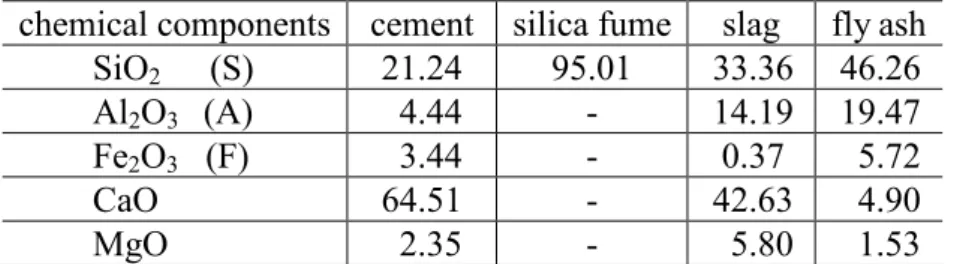
The 0-3 cement-based piezoelectric composites consists of 50% PZT and 50% cement-based binder in volume. The particle diameter of PZT is 75~150 µm with specific gravity of 7.9. Cement is type I Portland cement with the fineness of 349m2/kg and specific gravity of 3.16. The specific gravity, particle diameter and the fineness of silica fume are 2.2, 0.15 µm and 20,000m2/kg, in turn. Blast furnace slag was produced from CHC Resources Corporation (Taiwan), where the fineness is 572m2/kg and the specific gravity is 2.87, respectively. F type fly ash produced by Hsinta thermal power plant was also used, where the fineness is 326m2/kg and the specific gravity is 2.11. The main chemical components are shown in Table 1.
Table 1. Main chemical components of materials. chemical components cement silica fume slag fly ash
SiO2 (S) 21.24 95.01 33.36 46.26
Al2O3 (A) 4.44 - 14.19 19.47
Fe2O3 (F) 3.44 - 0.37 5.72
CaO 64.51 - 42.63 4.90
MgO 2.35 - 5.80 1.53
PZT power was drily mixed with four binders to produce mixed materials. Then the mixed materials were pressed into disks of 15mm diameter and 10mm thickness under 80 MPa for 3minutes. The specimens were put in a curing room with a temperature of 90˚C and relative humidity of 100% for 7 days before polarizations. After curing, the surfaces of the disks were polished to 2mm ± 0.05mm thickness, and coated with silver paint baked 30 minutes at 150˚C. The poling was carried out three poling voltages of 0.5, 1 and 1.5kV/mm each, in a stirred silicone oil bath. The poling temperature and time are 150˚C and 45 minutes respectively. During the polarization, voltage increase was applied stably to prevent from current breakdown of the specimens.
After poling, the composites were aged for 24 h prior to the measurements. We use impedance analyzer to measure frequency at minimum impedance fm and frequency at maximum impedance fn,
and follow [11]
)
2
tan(
2
2 n m n n m tf
f
f
f
f
K
=
π
π
-
(1)to calculate the thickness electromechanical coupling coefficient Kt.
Results and Discussion
Material Age Effect. We measured the impedance spectra of the composites subjected to 1.5kV/mm at the 0 day, 10th, 14th and 28th days for four kinds of composites, shown in Figs. 1 ~ 4. The results on the impedance of four cement-based piezoelectric composites show that the measured values of impedance decrease with the material ages. Obviously, the impedances after 10 days become stable because the hydration products gradually complete filling the pore in the composites.
Renewable and Sustainable Energy II
10.4028/www.scientific.net/AMR.512-515
Effect of Pozzolanic Materials and Poling Field on Electromechanical Coupling Coefficient of Cement-Based Piezoelectric Composites