行政院國家科學委員會專題研究計畫 成果報告
拜香燃燒煙污染物的控制(2/2)
計畫類別: 個別型計畫 計畫編號: NSC93-2320-B-002-051- 執行期間: 93 年 08 月 01 日至 94 年 07 月 31 日 執行單位: 國立臺灣大學公共衛生學院環境衛生研究所 計畫主持人: 林嘉明 共同主持人: 陳志傑,馬一中 計畫參與人員: 楊慈定,黃明豐 報告類型: 完整報告 處理方式: 本計畫可公開查詢中 華 民 國 94 年 10 月 31 日
.行政院國家科學委員會補助專題研究計畫
; 成 果 報 告
□期中進度報告
拜香燃燒煙污染物的控制
Control for Incense Smoke Pollutant
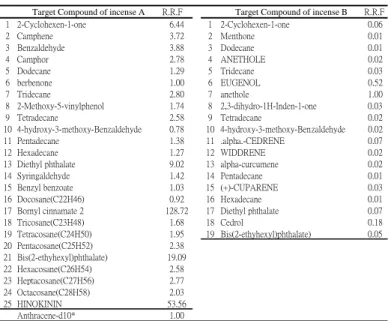
計畫類別:; 個別型計畫 □ 整合型計畫
計畫編號:NSC 93-2320 -B -002 -051-
執行期間: 93 年 08 月 01 日至 94 年 07 月 31 日
計畫主持人:
林嘉明 台灣大學環境衛生研究所
共同主持人:
陳志傑 台灣大學職業與工業衛生研究所
馬一中 台灣大學環境衛生研究所
計畫參與人員:
楊慈定 台灣大學環境衛生研究所
黃明豐 台灣大學環境衛生研究所
成果報告類型(依經費核定清單規定繳交):□精簡報告 ;完整報告
處理方式:除產學合作研究計畫、提升產業技術及人才培育研究計畫、
列管計畫及下列情形者外,得立即公開查詢
□涉及專利或其他智慧財產權,□一年□二年後可公開查詢
執行單位:
國立台灣大學公共衛生學院環境衛生研究所
中 華 民 國 94 年 10 月 31 日
摘要
本研究探討拜香熱值(A,B,C,D種拜香熱值 3936-5060 Kcal/Kg)、化學組成(碳 45-65% 及揮發份 20-80%)、拜香粗細(3-5mm)及燃燒環境條件(流量率與含氧量)等對氣相和微粒 相燃燒生成物排放的影響,以利低污染拜香的研發。研究在可控制燃燒環境的試驗腔進行, 控制試驗腔的流量率(1~20 L/min)與含氧量(20%-45%),令拜香處於悶燒至明火燃燒的 狀態,在各次試驗(trial)時分別以直讀式儀器測量燃燒點的表面溫度以及測試腔內微粒的 粒數濃度、體積濃度、粒徑分佈、CO、CO2與TVOCs,另外並使用閉口式濾紙夾搭配 37 mm 石英濾紙採取總懸浮微粒後稱重分析和使用活性碳吸附管採取揮發性有機污染物,藉氣相 層析質譜儀定性和定量有機化學物質;計算拜香的燃燒率(g/hr)與燃燒效率(=[CO2/(CO+CO2)]),以及各類氣相物質及微粒相物質的排放(速)率(mg/hr 或particle
number/hr)與排放因(數)子 (mg/g 或particle number/g)。
無煙香原料含揮發份較低,有煙香原料含揮發份相對高,但後者熱值(kcal/g)略低。原 物料熱值愈高,拜香轉為火焰燃燒的所需含氧量越低,但無論何種拜香,當溫度超過大約 650 ℃時瞬即轉為有火焰燃燒,之前悶燒的溫度介於自 400 升到 650 ℃。當拜香悶燒時, 在相同的環境因素(空氣含氧量及流量率)下,高熱值拜香的燃燒點表面溫度較高,粗的 拜香燃燒點表面溫度亦較高;燃燒點溫度,也會分別隨著補充空氣的含氧量與流量率的增 加而升高,但流量率超過 15 L/min時開始有明顯的冷卻至溫度持恆(210 ℃)的效應。同 一種拜香當燃燒點溫度升高時,燃燒率以及CO、CO2、TVOCs及微粒的排放率與排放因子 亦遞升,燃燒率以及氣體及微粒的排放率之自然對數值分別與燃燒點絕對溫度的倒數成良 好的線性關係;至於兩種拜香比較,無煙香原料含揮發份較低,熱值(kcal/g)相對高,燃 燒點表面溫度亦較高,CO、CO2的排放因數子(mg/g)相對的高,TVOCs排放因數子相對 的低,產生較低的微粒濃度(質量濃度與粒數濃度),而粒徑中位數亦相對的較小。至於同 種拜香,粗的產生較多的粒數濃度,而且同種拜香在流率為 15 L/min以下時,隨著流率增 加粒徑變小而數目增加,但無論如何粒徑份佈均在次微米下。 未經燃燒的 A(檀香)、B(無煙香)與 C(檜香) 等拜香溶劑萃取液分別被鑑定出 25、19 與 84 種有機化學物質。大量的是天然植物性香料貢獻的烷、烯、醇、酚及其衍生物、醛、酮、 及酯類,亦含少量可能是由動物性香料貢獻的如出現於拜香 C 之麝香 (musk)。當作塑化劑 用的 diethyl phthalate 和 bis(2-ethylhexyl)phthalate 也出現在拜香的溶劑萃取液。拜香燃燒所 產生的微粒相有機污染物,部分源自於原物料中的原形(低揮發性有機物)蒸發後再凝結 在微粒表面,部分為真正燃燒的產物。悶燒拜香所產生微粒相高碳分子量有機物,隨燃燒 時含氧量的增加而上升,但轉為火焰時,被高溫破壞而迅速下降。另外,悶燒拜香低碳數 烷類有機污染物,隨含氧量的增加,呈現下降的趨勢,因為低溫下產生較多量低碳數的烷 類,隨溫度的升高,低碳數的烷類量的減少可能是被高溫進一步破壞。在氣相所見的有機
揮發物,其狀況亦十分相近。結論認為低含碳量及揮發物的原料所製成的細拜香,在較低 的氣體流量率之下使用,會產生相對低的 TVOCs、微粒及微粒像有機化合物。
Abstract
To develop a less polluting incense, this study characterized the gaseous and particulate emission from burning four types of Chinese incenses (A, B, C, D) with different heat values (3936-5060 Kcal/Kg), chemical compositions (carbon content 45-65% and volatile component 20-80%) at the controlled atmospheric conditions (air flow rate and oxygen content of air). The experimental trials were conducted in a test chamber where air flow rate (1-20 L/min) as well as oxygen content (20-45%) was regulated to keep incense smoldering up to burst of flame burning . The direct reading instruments were employed to measure the surface temperature at tip of a burning incense, characteristics of particulates (number concentration, volume concentration and
size distribution), and concentrations of CO2, CO and total volatile compounds (TVOCs),
respectively. The 37 mm quatz filter in a three pieces holder for sampling total particulates and the activated charcoal tube for sampling gaseous volatile organic compounds were applied to collect incense smoke for GC/MS analysis. The combustion rate (g/hr) and combustion efficiency
(=[CO2/(CO+CO2)]) of an incense, and the emission rates (mg/hr or particle number /hr) as well
as the emission factors (mg/g incense consumed or particle number /g incense consumed) for gaseous and particulate pollutants were calculated.
The so-called “less smoke incense” had greater amount of carbon, less volatile component and greater heat value in comparison to the “smoke incense”. The incense with greater heat value required less oxygen content to shift it from smoldering state to flame burning state. The temperatures at tip of a burning incense during smoldering ranged from 400 ℃to 650℃. The incense soon shifted to flame burning at temperature beyond 650℃. At atmosphere with fixed air flow rate and oxygen content, the smoldering incense with greater heat value had relatively high surface temperature at burning tip and the incense with greater diameter did as well. The surface temperature also raised with the increase of oxygen content and air flow rate, respectively. However, the cooling effect due to high flow rate beyond 15 L/min tended to keep the temperature around 210℃. The burning rate of an incense and the emission rates as well as
emission factors for particulate, CO2, CO and TVOCs increase with the increase of the surface
temperature at burning tip. The linear regression was fitted well for the rate or the factor versus the inversely temperature in Kelvin. In comparison with the “smoke incenses” (types A, C and E), the “less smoke incense”(types B and D) with greater carbon content, greater heat value but less
volatile component had relatively greater emission rates and emission factors of CO2 and CO ,
less emission of TVOCs, less particulate concentration and smaller size of particulate. Within a group of incenses prepared by the identical raw materials, burning the coarse incense yielded greater number concentration of submicron particulates. The number concentration increased but the size of particulates decreased as the air flow rate increased from 1L/min up to 15 L/min. GC/MS analysis identified 25, 19 and 84 species of chemicals in the solvent extracts of incenses A, B and C, respectively. Most chemicals such as alkanes, alkenes, alcohols, aldehydes,
ketones, esters and phenols are likely attributed to the vegetarian raw materials of an incense while a few of chemicals like musk found in the extract of the Incense C may be from animal source. Plasticizers such as diethyl phthalate and bis(2-ethylhexyl)phathalate were also found in the extracts of the incenses. Particulate–bound chemicals found in incense smoke mainly were heat decomposed organic compounds although parts of the particulate-bound chemicals with low volatility were identical to the chemicals found in the extract of the incenses. The
particulate-bound chemical species with greater carbon number increased along with the increase of oxygen content during smoldering of incenses but soon decreased as the incenses turned to flame burning. On contrary, the particulate-bound chemicals with less carbon number decreased with the increase of oxygen content in the supply air. The similar trends happened in gaseous phase of incense smoke. We concluded that the incense with low carbon content and less volatile component burning in atmosphere with low air flow rate yields less amount of pollutants in terms of TVOCs, particulates and particulate-bound chemicals.
Keywords: Incense, Smoldering combustion, Submicron particle, Particulate-bound chemicals
目 錄
摘要 --- I
表目錄 ---VI
圖目錄 ---VII
一、緣起與目的 --- 1
二、材料與方法 --- 3
1、選擇拜香--- 3 2、自製拜香--- 3 3、分析拜香的元素組成與熱值 --- 3 4、分析拜香原物料萃取的有機化合物 --- 3 5、建置燃燒測試系統 --- 3 6、量測燃燒生成的總揮發性有機氣體、CO、CO2等濃度--- 4 7、量測燃燒生成的微粒粒徑分佈 --- 4 8、採樣分析微粒相上的有機化合物 --- 4 9、採樣分析燃燒生成的氣相有機化合物 --- 5 10、有機化合物物種鑑別與定量 --- 5 11、拍攝燃燒點特色 --- 6 12、計算與數據處理分析 --- 6三、結果與討論 --- 7
1、拜香的元素組成與熱值 --- 7 2、流量率影響拜香燃燒點的溫度 --- 7 3、含氧量改變燃燒點溫度與燃燒速率 --- 7 4、拜香原物料及製成品粗細改變燃燒點的溫度與燃燒速率 --- 7 5、微粒的排放特性--- 8 6、 CO、CO2與TVOC等的排放與燃燒效率 --- 9 7、氣流影響氣體和微粒的排放 --- 9 8、拜香原物料萃取液的有機化學物種 --- 10 9、微粒相有機化合物的鑑定 --- 10 10、鑑定氣相揮發性有機污染物 ---11四、結論與建議 --- 12
五、參考文獻 --- 13
六、已發表及擬發表之著作 --- 17
附錄 --- 錯誤! 尚未定義書籤。
表目錄
Table 1 Compositions and heating values of incenses A、B、C and D --- Table 2 Identification and Quantification of the organic compounds from the
material of incense A and B--- Table 3 Identification and Quantification of the organic compounds from the
material of incense C --- Table 4 Identification and Quantification of the organic compounds of particulate
matter using GC/MS from burning incense A--- Table 5 Identification and quantification of the organic compounds of particulate
matter using GC/MS from burning incense C--- Table 6 Identification and quantification of the volatile organic compounds from
burning incense A --- Table 7 Identification and Quantification of the volatile organic compounds from
burning incense B --- Table 8 Identification and Quantification of the volatile organic compounds from
圖目錄
Figure 1 Schematic diagram of incense combustion system set-up in various
oxygen fractions --- Figure 2. Burning rate and maximum temperature of burning tip at various
air flow rates (Bar: mean ± standard deviation). --- Figure 3 Comparison of burning rates of incenses A、B and C --- Figure 4. Profiles of burning fire cones of incenses with various diameters
and compositions of volatile component --- Figure 5. Change of burning rate along with type of incense, its diameter
and temperature at the burning tip in smoldering condition.--- Figure 6. Aerosol number concentrations, emission rates and factors versus
size of particles from burning the incenses A and B at various
oxygen contents while the supplied air flow rate was kept at 5 L/min.--- Figure 7. Aerosol number concentrations, emission rates and factors versus
size of particles from the burning incense C at various oxygen
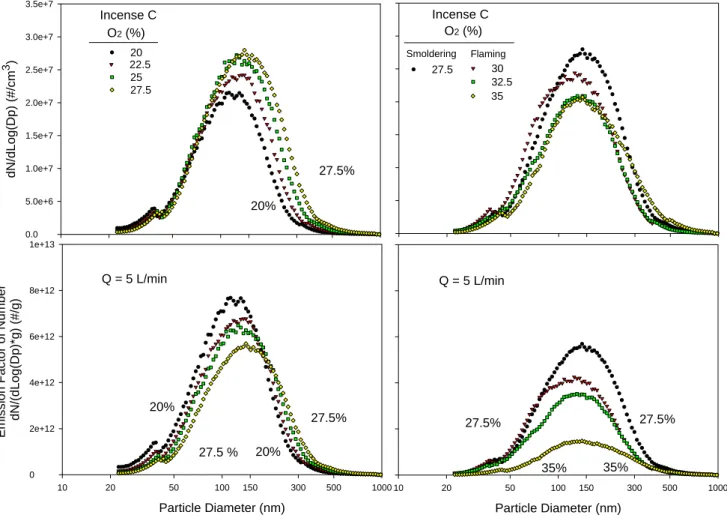
contents while the supplied air flow rate was kept at 5 L/min. --- Figure 8. Submicron aerosol number and mass concentrations and their
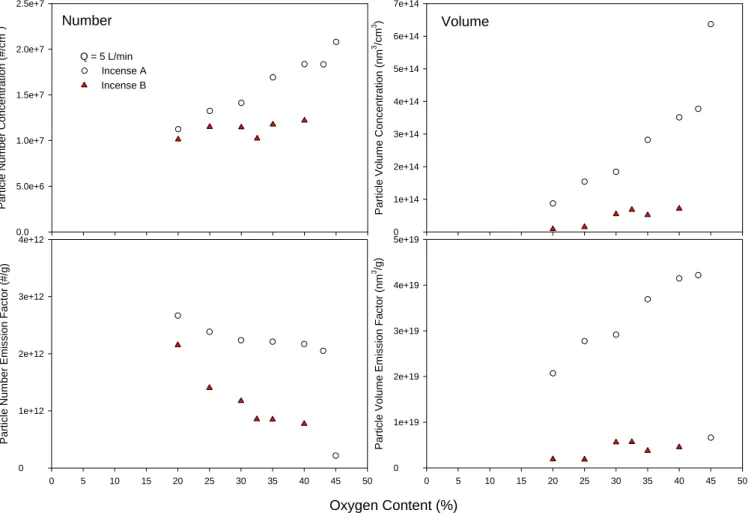
corresponding emission rates and factors versus oxygen contents
at air flow rate of 5L/min for burning incenses A and B, respectively --- Figure 9. Submicron aerosol number and mass concentrations and their
corresponding emission rates and factors versus oxygen contents
at air flow rate of 5L/min for burning incenses C --- Figure10 Aerosol mass concentrations and emission factors from burning
incense A、B and C under various combustion conditions---
Figure 11 Comparison of CO2 and CO emission concentrations, and corresponding
emission factors from burning incenses A and B in various oxygen
fractions--- Figure 12 Comparison of VOCs emission concentrations, and corresponding
emission factors from burning incenses A and B in various oxygen
fractions --- Figure 13 Comparison of combustion efficiency indices of incenses A and
一、緣起與目的
50%以上的台灣家庭有經常燃燒拜香習俗,暴露拜香燃燒煙的族群幾乎涵蓋所有的年 齡層,尤其是居家時間相對較長的病人、老少、婦女等。拜香燃燒所產生的煙霧為複雜的 混合物,包含氣相的化合物以及載有化合物的高數目濃度的細粒徑微粒,容易深入人體呼 吸道系統之肺泡區,倘若拜香燃燒煙是健康的危害,則它將是與其他燃燒行為如抽煙一樣, 成為受關心的公共衛生問題。 拜香因使用的目的與場合不同,而有不同形式與種類的商品:立香、環香、盤香、臥香、 錐香、貢香、燻香粉等等。市面最常使用的立香(檀香)和單一香材原料所組成的臥香。立 香主要分為香材粉末、染料、竹材、黏粉和也許會添加少許的精油所組成。貢香為立香的 放大製品,環香、盤香、臥香、錐香與燻香粉則為原香材粉末製作成不同形狀的商品(不含 中心竹材)。目前市售的環保拜香號稱完全使用天然原物料且過程不添加任何化學製品。 點燃拜香屬於固體表面燃燒的一種。當固態物質於空氣中燃燒時,氮或氧等助燃劑吸附 於燃燒點表面,形成可燃物與助燃性分子的混合系。但是,一般固體的熱傳導率甚大,燃 燒產生的熱急易散失,若非持續供給熱能不易發火,而成悶燒(smoldering),此時氧氣分 子須穿透燃燒固體表面所產生的燃燒生成物層,始能持續供給助燃物於固體燃燒點表面, 該燃燒生成物層的狀態,會干擾固體的燃燒速度。Moallemi 等人(1993)以二維數學模式解 析木炭的 smoldering,顯示質量含氧率低於 13.5 %無法燃燒,含氧率介於 13.5~55 %發生 smoldering,且燃燒速率隨含氧量升高而加快,當含氧率超過 73 %會有火焰發生。不同之 質量含氧率會影響燃燒點圓錐形之形狀,圓錐中心溫度最高離中心越遠溫度越低,中心含 氧量最低,離中心越遠含氧量越高。 拜香長時間燜燒會產生煙霧狀的污染物,已知有氣相的一氧化碳、二氧化碳、氮氧化物、 甲醛、多種揮發性與半揮發性有機化合物(多環芳香烴化合物)及其它等;以及固相的細粒 徑懸浮微粒、其上吸附化學物質(Schoentol, 1967; Huynh, 1991; Lin and Wang, 1994; Lin and Tang, 1994: Lin and Lee, 1998; Chang et al., 1997)。其中微粒的粒徑分佈會因燃燒條件及環境 因素而異,並且隨著在大氣滯留的時間及稀釋程度的變化有膠結變大趨勢,目前文獻所見 大抵為粒徑介於 0.08-0.6 µm 的次微米的細微粒(Chen,1990; Fine,1999; Kleeman,1999; Kleeman, 2000)(Li et al., 1992; Li et al., 1993; Yaun et al., 1993; Cheng et al.,1995; 張 et al., 1999; 張 et al., 2000) ,是屬於可呼吸性的微粒有較高的機會到達人體肺泡區,並有較高的 粒數濃度和表面積可以附著較多的有害物質。這些氣狀及粒狀污染物主要經由呼吸途徑進 入人體,在肺的高濕環境下,其中的粒狀物可能吸濕長大而成微米以上的細微粒,提高其 在肺的滯留率,如 Robinson 等人研究香煙燃燒煙之所見,0.1~0.4 µm 的香煙微粒,在肺的 滯留率為 10~35 %,而當吸濕成長至 2~10 µm 時,滯留率提高為 47~97 %[Robinson et al., 1998]。按 Li 及 Hopke 所發展的預測模式,微粒粒徑在高濕環境成長的倍數,除環境的溫 度與濕度之外,與組成微粒的可溶部分關係密切,可溶部分的比值高、水解離度大、平均 分子量小等有利於粒徑的成長[Li and Hopke, 1993]。1987)、搔癢性去色素斑點(Hayakawa, 1987b)的。癌症流行病學研究中,暴露拜香煙霧被懷 疑可能和肺癌(MacLennan et al., 1977)、白血病(Lowengart et al., 1987)及腦瘤(Preston-Martin et al., 1982)的發生有所關聯,但亦有少數研究無法支持這個相關 (Chen et al., 1990; Ger et al., 1993)。。至於細胞毒理實驗則顯示:拜香燃放物中的多環芳香烴化合物(PAHs)及甲醛具 有致突變性和細胞染色體變異的效應[Sato et al,1980; Rasmussen et al,1987; Löfroth et al, 1991; Chen and Lee, 1996; Chang, Kuo and Lin, 1997]。
過去對拜香煙霧特性的研究皆是在燃燒條件未控制下進行,而相關的人類暴露資訊則 常以問卷取代實測,燃燒環境條件和原料的組成對拜香燃燒特性生成物及暴露影響則鮮少 探討,至於減少暴露的控制技術則更少。因此本研究群於 90 年度的相關研究計畫完成可以 控制燃燒環境的測試系統,初步掌控燃燒環境與拜香燃燒生成物之間的關係,認為健康拜 香的研發似乎應朝向低熱值、低碳含量、低揮發物的原料著手,但是必須進一步瞭解有機 污染物生成的的資訊,另外為降低使用拜香的微粒危害有必要研發去除微粒的控制技術故 本計畫案預定探討拜香燃燒物中揮發性有機物的生成及其在氣固相(微粒上)的分佈,累 積拜香燃燒物的特性資料,以利進一步研發拜香污染的控制技術。具體的探討:(1) 氣流、 拜香種類、拜香的粗細、氧氣含量、燃燒點表面溫度對拜香燃燒生成微粒與氣態污染物之 影響 (2) 拜香原物料有機成分及其燃燒後釋放至空氣產物的變化 (3) 微粒相有機化學物 質與氣相揮發性有機物的生成及其在氣固相的分佈 (4) 由悶燒轉折至火焰燃燒的機制及 生成物變化。
二、材料與方法
1、選擇拜香
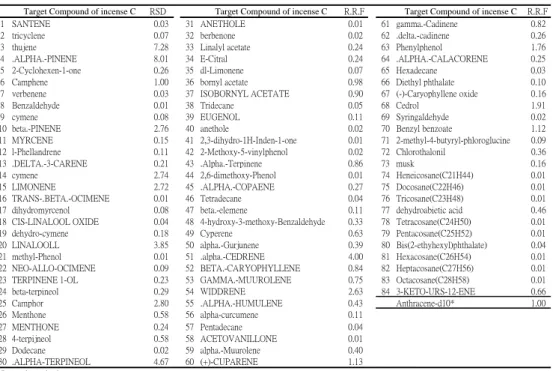
選取同一品牌拜香 A(檀香)、B(無煙香)與 C(檜香)三種拜香進行研究,拜香 A 與 B 為含 有中心竹材的線香,拜香 C 為不含中心竹材的臥香,拜香 A 的粉末由三種植物所組成分別 為 Santalum album L., Machilus nanmu Hemsl, 和 Pine oleoresin,拜香 B 並不知道組成的植 物粉末原料,拜香 C 為檜木粉末所構成。 2、自製拜香 為探討不同粗細拜香對氣相和微粒相燃燒產物的影響,使用上述無煙香 B 和檀香 A 的原 物料粉末分別製造拜香 D 和拜香 E。拜香 D 和拜香 E 不含中心竹材,分別有三種粗細不同 的規格。製造拜香之步驟:以天平秤取黏粉和新山柴 1:4 之重量比,以杓子均勻混合之並 平舖於乾淨之桌面,沾水壓實捏成長約 35 公分、直徑相當(粗約 5mm、中約 4mm、細約 3mm)的線相,移到陽光底下晾乾而成粗細不同的拜香。自製拜香並未加入染料改變拜香 之外觀顏色。 3、分析拜香的元素組成與熱值 對所選用的拜香,使用元素分析儀進行 C、H 及 N 元素分析,並使用熱卡計進行熱值分 析。另外,亦對拜香組成燃材進行工業分析測試,測試項目包括灰份、水份、揮發份及固 定碳。 4、分析拜香原物料萃取的有機化合物 將 A、B 與 C 拜香,以乾淨的剪刀,剪成細小的數段,經秤重量分別為 0.4876、0.3456 與 0.4510 g,分別放到 8 ml 茶色樣品瓶中,加入 5 ml 二氯甲烷,振盪 60 min,取出 1 ml 置於 1.8 ml 茶色樣品瓶,再加入 2 ng Anthracene-d10 當作內標,隨即以氣相層析質譜儀分 析。所有樣本在採樣後一星期內分析完畢。氣相層析質譜儀分析的分析條件如下所述:分 析管柱:Rtx-5MS,60 m × 0.32 mm × 1.5 µm。載送氣體流量為 1.0 ml/min。升溫程式:40 ℃, 1.5 minÆ10 ℃/minÆ300 ℃,10 min。注射口溫度:300℃。GC/MS 介面溫度:300℃。不 分流模式。質譜儀操作模式為掃瞄模式(scan mode),掃瞄範圍在 30~550 之間,溶劑延 遲(solvent delay)時間為 5.2 min,Anthracene-d10 定量的離子 188。
5、建置燃燒測試系統
可控制燃燒條件的測試系統可供燃燒生成物的採樣分析。如圖 1,測試系統構造包括、 拜香燃燒污染物產生單元、採樣測試腔。以下簡單說明此系統中的各單元結構:(1)拜香燃
燒物的產生單元:點燃的拜香置於內徑 2 cm、高度 15 cm的圓管內,調整拜香燃燒點的流 率及含氧比率,令產生的氣態和微粒污染物測試腔中。拜香燃燒點的流率及含氧比率的調 整,使用兩瓶高純度N2和O2的鋼瓶,分別經由調壓閥和HEPA去除微粒,再經由質量流量控 制器分別控制不同N2和O2的流量進入氣體混合腔,讓N2和O2混和均勻,拜香燃燒點溫度的 量測,使用鎳鉻和鎳鋁所製成的K-type Thermocouple,此時因為拜香燃燒時香枝會隨時間 縮短,必須隨時調整拜香燃燒點高度,以維持拜香燃燒點位置。(2)採樣測試腔:拜香燃燒 產生的氣態和微粒污染物進入採樣測試腔中,供採樣分析。採樣測試腔內徑 20 cm、高度 60 cm,可以在距離採樣測試腔底部 41 cm處進行微粒相污染物的採樣。另外,在不同氣流 量的燃燒條件的測試系統的構造唯一改變為高壓空氣經HEPA去除微粒,經由質量流量控制 器調控不同流量,導入拜香燃燒室中。 6、量測燃燒生成的總揮發性有機氣體、CO、CO2等濃度
總揮發性有機氣體濃度之量測使用Mini-Rare 2000 (RAE SYSTEMS Inc., U.S.A.)。另外,
設計小型稀釋腔導入拜香煙經過濾微粒,然後藉由高純度的氮氣將拜香燃燒所生的CO、CO2
稀釋,再使用Q-TrakTM IAQ Monitor (Model 8550/8551, TSI Inc., U.S.A.) 量測,因為拜香燃
燒所產生的CO、CO2濃度高於儀器偵測上限。
7、量測燃燒生成的微粒粒徑分佈
使用包括靜電分徑儀(Electrostatic Classifier Model 3071A, TSI Inc., St. Paul, MN)和凝結 核微粒計數器(Condensation Particle Counter Model 3025, TSI Inc., St. Paul, MN)兩個部分 串接形成的 Scanning Mobility Particle Sizer (SMPS),量測拜香燃燒所產生的微粒粒數濃 度。SMPS 微粒粒徑量測範圍介於 17.2~1000 nm。 8、採樣分析微粒相上的有機化合物 針對拜香燃燒煙的微粒相進行採樣分析。採樣使用閉口式濾紙夾,搭配直徑 37 mm,含 碳成分低,且較玻璃纖維濾紙不易吸附有機蒸氣之石英濾紙,採樣前,置入 900 ℃之高溫 爐中烘烤八小時,去除濾紙上有機物質,待濾紙冷卻後保存於乾燥箱內(R.H.=45~50 %), 以備使用。採樣流量為 2 L/min,採樣流量藉由質量流量控制器控制,每次採樣前使用皂泡 計進行校正。採樣時間為 10 min。 濾紙所採得的樣品使用二氯甲烷(CH2Cl2)進行溶劑萃取。處理程序包括:(1)萃取:將所 採得之濾紙樣本分別置於 8 ml之棕色樣本瓶中,加入 5 ml的CH2Cl2,以鋁箔紙封住瓶口, 置入超音波中,以超音波震盪 60 分鐘,取 1ml 萃取液置於 1.8 ml 茶色樣品中,並加入 2 ng (拜香A)或 20 ng (拜香B) 的Anthracene-D10 作為內標,避光貯存於-18℃,等待分析。使用 氣相層析/質譜儀進行微粒相有機物種的定性與定量。氣相層析/質譜分析條件如下所示:(1)
毛細管柱:RTX RTX-5MS、I.D. 0.32 mm、length 60 m、film thickness 1.50 µm;(2)烘箱升 溫梯度:保持 40 ℃初溫 1.5 分鐘,以每分鐘 10 ℃升溫速率加熱到 300 ℃,維持 300 ℃ 末溫 10 分鐘,總共 40.5 分鐘;(3)注射口溫度:300 ℃; (4)GC/MS介面溫度:32.00 ℃; 質譜採用Scan mode掃描,掃描m/z範圍為 30-550;(5)載流氣體與流率:He,1.3 ml/min;(6) 樣品注射體積:1 µl;(7)注射採非分流(splitless)方式。 9、採樣分析燃燒生成的氣相有機化合物 針對空氣中揮發性有機物(VOC)進行採樣,採用石英濾紙搭配活性碳吸附管,石英濾紙 用以去除拜香燃燒所產生的微粒相物質,採樣流量率為 0.22 L/min,採樣時間為 15 min。 將吸附管前後段取出分別放到 1.8 ml 茶色樣品瓶中,加入 1 ml 二硫化碳,振盪 60 min, 再加入 2 ng 的 ethyl benzene-d10 當作內標,隨即以氣相層析/質譜儀進行微粒相有機物種的 定性與定量分析。所有樣本在採樣後一星期內分析完畢。氣相層析/質譜分析條件如下所 示:分析管柱:Rtx- Volatile,60 m × 0.32 mm × 1.5 µm。載送氣體流量為 0.8 ml/min。升溫 程式:40 ℃,8 分Æ5 ℃/minÆ220℃,10 min。注射口溫度:220℃。GC/MS 介面溫度: 260℃。分流比 1.1。質譜儀操作模式為掃瞄模式(scan mode),掃瞄範圍在 25~300 之間,
6.80 至 9.5 分時設定 MS detector off 以避免大量的萃取溶劑對儀器的傷害;ethyl benzene-d10 定量的離子 98。 10、有機化合物物種鑑別與定量 完整可靠的定性分析要使用每個物質的標準品,經由分析樣品比對由氣相層析分離得到 滯留時間與由質譜得到的圖譜後才能確認。但在缺乏標準品的情況下,直接由氣相層析質 譜進行有機物的定性分析,通常是使用內見的電腦軟體來協助判斷,由電腦內儲存的已知 物質的質譜圖譜,經自動收尋的功能比對後將最可能的物質列出,並將比對用相似指數表 示(match quality)。 為較準確的判定由拜香燃燒產生的有機污染物成分,本研究利用下列原則進行定性分 析:(1)對所有在總離子強度明顯高於背景離子強度的波峰積分,然後先進行背景離子扣除 步驟。(2)質譜圖譜與 library 比對結果高的相似性指數大於,仔細比較 Library 的圖譜與分 析得到的圖譜,了解是否其中明顯含有其它的物質。(3)對於比對後相似性小於 80 的物質, 利用 RIC 了解是否各波峰中含有兩種或兩種以上的物質。(4)針對(3)過程中判斷有其他物質 存在造成複合質譜譜圖者,利用背景離子扣除的功能取得更具代表性的質譜譜圖。(5)利用 Library search 再次比對(4)得到的譜圖,以獲得新的 match quality。(6)由(5)中得到大於 80 的 match quality 者,在根據對質譜圖譜的解釋,來判斷比對的正確性。
一旦有機化合物被鑑別出來,每個鑑別出來的有機勿選取 2~4 各特定離子(Target Ion)作 為往後定性的依據,並以 response 最大的特定離子作為定量離子,將個別有機化合物和內
標的定量離子的強度相對比值定義為相對強度因子(relative response factor )藉以量化有機 化合物。
11、拍攝燃燒點特色
點燃的拜香置於內徑 2 cm、高度 15 cm 的透明玻璃圓管內,圓管外壁貼有刻度紙,用以 記錄拜香燃燒點的高度,使用高階數位相機(COOLPIX995, NiKon, Japan),調整適當的焦 距,拍攝拜香燃燒點的燃燒狀態。 12、計算與數據處理分析 12-1 拜香燃燒速率的計算 拜香燃燒前與燃燒後重量差值除以燃燒時間即為燃燒速率。 12-2 氣態與微粒態污染物排放率與排放因子 依質量平衡原理氣態或微粒態污染物污染物排放率與排放因子是根據公式(1)導出: Ci Q E R dt dCi V× = × f − × (1) 式中V為測試腔體積(m3 );Ci為氣態或微粒態污染物濃度(mg/m3或particles/cm3);R為拜香燃 燒速率(g/min);Ef為氣態或微粒態污染物排放因子(mg/g或particles/g);Q為氣體流量(0.005 m3/min)。在拜香被點然後,拜香所產生的污染物濃度在短時間達到動態平衡,此時公式(1) 中的 dCi/dt = 0,則(1)式可被改寫為下式: R C Q Ef = × (2) 式中,C為測試腔內平衡時的氣態或微粒態的污染物濃度(mg/m3或particles/cm3 )。如果上式 應用於總揮發性有機化合物,因為總揮發性有機化合物(TVOCs)之量測,儀器讀出濃度以 ppm表示,當轉換成mg/m3時則假設總揮發性有機化合物的分子量為100 g。
三、結果與討論
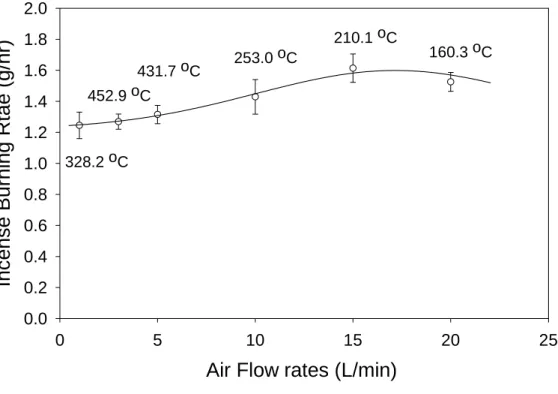
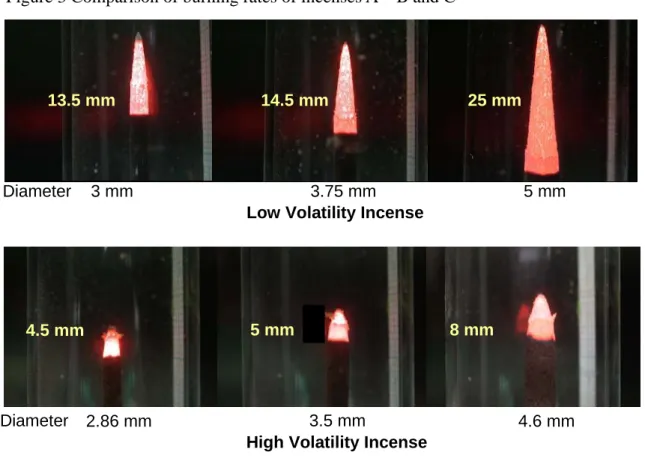
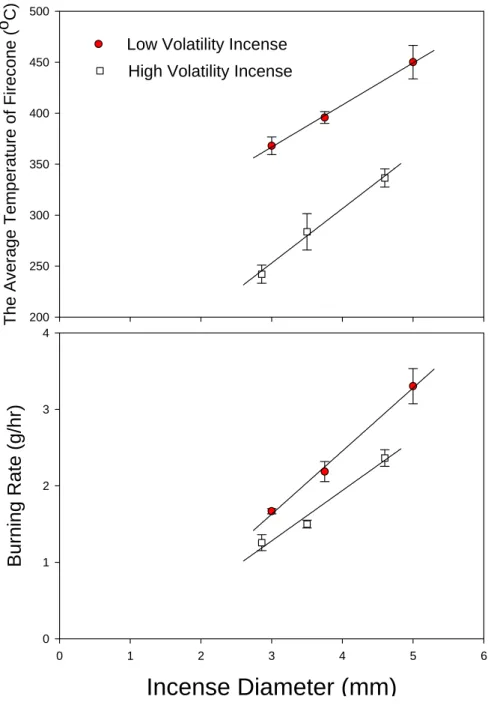
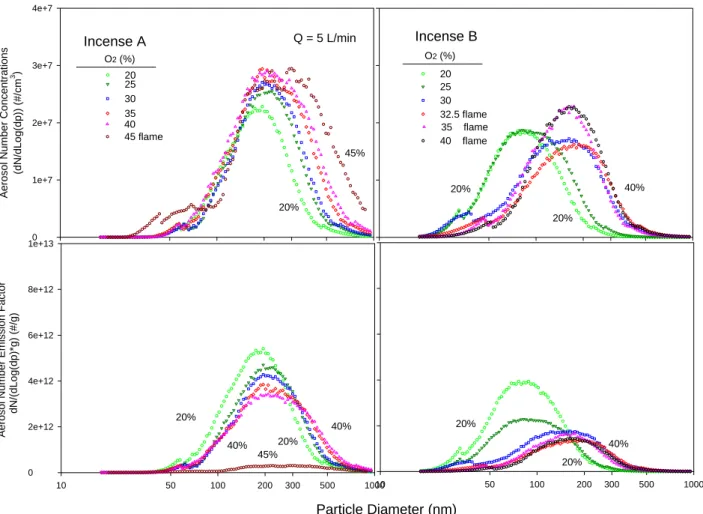
1、拜香的元素組成與熱值 拜香 A、B、C、D 和 E 原料的熱值分別為 3936、4619、4756、5060 和 4171Kcal/Kg。碳、 氫、氮、灰燼及水份的組成分別為拜香 A(檀香)的 43.59、5.40、0.61、7.72 和 7.39 %;拜 香 B(無煙香)的 55.24、3.96、0.57、10.30 及 6.16 %;拜香 C(檜香)的 53.38、4.71、0.51、 12.55 及 9.56 %;拜香 D 的 61.96、2.62、0.70 和 21.62 %;拜香 E 的 48.4、4.93、0.79 及 40.42 %。另外,拜香 D 和 E 原物料的水份、揮發份、灰燼與固定碳分別為 5.86、34.70、 12.28 與 47.16 % 和 8.94、54.4、4.74 與 31.92 %。此外,因拜香原物料揮發物含量的高低, 將拜香 D 和 E 分別命名為低與高揮發物拜香。(表 1) 2、流量率影響拜香燃燒點的溫度 拜香 A 點燃後維持在悶燒狀態,燃燒點之最高溫度隨流量率變化如圖 2。 ,在流量率在 1 ~ 5 L/min 時,最高溫度的溫度範圍為 328.2 ℃ (n=3, CV=0.03) ~ 452.9 ℃ (n=3, CV=0.02);流量率介於 10 ~ 20 L/min 時,最高溫度的溫度範圍自 253.0 ℃ (n=3, CV=0.04) 降到 160.3 ℃ (n=3, CV=0.06)。拜香燃燒速率(g/hr) 隨流量率逐漸升高直到流 量率達 15 L/min 而溫度為 210.3 ℃ (n=3, CV=0.01) 之後,燃燒速率才緩勢下降,這種觀 察與 Wang (2003)等觀察海綿的燃燒速率和內部燃燒點溫度之關係略有不同,Wang 氏等發 現海綿內部達最高溫度時其燃燒速率最大,而本研究結果在流量率 15 L/min 時,拜香燃燒 速率最高但表面溫度不是最高,可能高流量率冷卻熱偶式感測器造成溫度判讀之誤差。 3、含氧量改變燃燒點溫度與燃燒速率 固定流量率(5 L/min)下,空氣含氧量決定燃燒狀態(悶燒或有火焰燃燒)與燃燒點的 溫度。當含氧量分別在 19-45 %、18 -32.5 %的範圍變動時,A 與 B 兩種拜香分別處於悶燒 狀態,低於該範圍則熄滅,高於該範圍則轉成有火焰燃燒。悶燒時燃燒點溫度自 400 升到 650℃,當溫度超過大約 650℃時瞬即轉為有火焰燃燒,其溫度範圍 760 升到 1200℃。燃燒 速率隨著燃燒點溫度的升高成比例的增加。(圖 3)在相同燃燒條件下,拜香 B 的燃燒速率與 燃燒點溫度高於拜香 A,可能因為拜香 B 原料熱值高於拜香 A 所造成。 4、拜香原物料及製成品粗細改變燃燒點的溫度與燃燒速率 固定流量率(5 L/min)下,正常空氣含氧量悶燒不同粗細的拜香 D(無煙)與拜香 E(有 煙),三種粗細的無煙拜香(直徑為 3、3.75 和 5 mm),燃燒點皆成圓錐型,長度從 13.5 升 到 25 mm,三種粗細的有煙拜香(直徑為 2.86、3.5 和 4.6 mm),燃燒點亦成圓錐型,長度從 4.5 升到 8 mm (圖 4),因為隨直徑的增加,拜香燃燒點的溫度亦隨之升高,則在燃燒底部對於未進入燃燒狀態的部分拜香進行去除水分和熱分解亦加快,但在燃燒點上方隨直徑增 加而延長燃燒時間,兩者促成隨直徑增加燃燒點的長度亦增長;此外,在約相同直徑下, 拜香 D 燃燒點長度為拜香 E 的 3 倍長,也許因熱值和拜香原物料組成的密度不同所造成。 另外,肉眼觀察兩種拜香燃燒點的亮度,隨著拜香的直徑增加而加亮,亦因為隨直徑的增 加,拜香燃燒點的溫度隨之升高的關係。 悶燒三種細到粗的無煙拜香,平均溫度 (CVpooled=0.03, n total=3×3) 從 368 ℃ (n=3, CV=0.04) 升到 450 ℃ (n=3, CV=0.04),燃燒速率 (CVpooled=0.054, n total=3×3) 從 1.67 g/hr (n=2, CV=0.02) 升 到 3.3 g/hr (n=2, CV=0.07) ; 三 種 細 到 粗 的 有 煙 拜 香 , 平 均 溫 度 (CVpooled=0.05, n total=3×3) 從 242 ℃ (n=3, CV=0.04) 升到 336 ℃ (n=3, CV=0.03),燃燒速 率 (CVpooled=0.06, n total=3×3) 從 1.26 g/hr (n=3, CV=0.08) 升到 2.36 g/hr (n=3, CV=0.05)。這 兩種分別由不同原料所製成的拜香,悶燒時的燃燒速率及燃燒點溫度皆隨拜香的直徑增加 呈現比例的增加,這是因為隨拜香直徑的增加,燃燒點的表面積亦隨之增加,氧分子接觸 燃燒點的機率亦增加,造成愈多的炭被氧化釋放出大量的熱,熱促成拜香燃燒速率的加快 和表面溫度的升高。(圖 5) 5、微粒的排放特性 在正常大氣含氧下,悶燒拜香 A 產生的微粒大於拜香 B 與 C 所產生者,其微粒的數目粒 徑中位數約為 200、80 和 100 nm (圖 6 與 7)。在相同的燃燒條件下悶燒拜香 A 產生的微粒 大於拜香 B 及拜香 C 所產生者。 在悶燒拜香 A、B 與 C,隨氣體含氧量升高,燃燒點表面溫度升高,數目及體積粒徑中 位數亦隨著變大,數目濃度及體積濃度亦增加,每克拜香所產生的體積排放因子增加,但 數目排放因子不升反降 (圖 8 與 9)。以氣膠的觀點解釋,隨含氧量的增加,低揮發物濃度 亦隨著增加,造成少部份的低揮發物發生同質成核作用產生新的小微粒,增加微粒的數目 濃度,但大部份的低揮發物發生異質凝結作用(凝結在大微粒的表面積上)與微粒彼此亦會 發生相膠作用共同促使微粒長大,此膠結作用會降低微粒的數目濃度。此外,在悶燒與火 焰燃燒的狀況,質量濃度隨含氧量增加,質量排放因子亦呈現增加現象。在大氣含氧量為 20%的狀況下,燃燒拜香 A 所產生的微粒質量濃度排放率及排放因子分別為 33.4 mg/hr 與 29.0 mg/g。燃燒拜香 B 分別為 5.7 mg/hr 與 4.21 mg/g。燃燒拜香 C 分別為 13.5 mg/hr 與 16.0 mg/g (圖 10)。 Fine等(1999)在 0.64 m3 容積系統中,研究在三種不同燃燒狀況下,燃燒一支蠟燭其所產 生微粒之粒徑分佈,使用DMA連結CNC測量微粒直徑小於 200 nm其數目濃度,對於大粒 徑範圍之微粒OPC進行測量,結果顯示(1)在’’Normal burning’’狀況下,燃燒蠟燭火焰小但 穩定,無可見微粒產生,此時微粒質量排放率低且微粒直徑小於 100 nm;(2)在’’Soot’’狀況 下,燃燒蠟燭有大而閃爍性火焰且有黑色可見微粒產生,此時高元素碳微粒排放;(3)
在’’Smoldering’’狀況下,出現在燃燒蠟燭火焰熄滅後時有白色可見微粒產生,此時微粒直 徑在 400~800 nm。 Sooting flame 和smoldering wick蠟燭燃燒方式比normal burning燃燒方 式會產生較高的細粒徑微粒排放率,藉由控制Sooting flame和smoldering wick蠟燭燃燒方式 將可降低細粒徑微粒之排放,故作者等建議改變空氣氣流供給量和控制較好的蠟燭芯位置 將可有效控制微粒之排放。
當拜香 A 與 B 從悶燒轉為火焰時,火焰燃燒所產生的微粒粒徑、數目、體積與質量排放 率大於悶燒(圖 8),可能因為此時火焰燃燒狀態為 Fine 等(1999)稱的 Sooting flame。另外, 火焰燃燒拜香 C 時,當含氧量為 30 與 32.5 %時,火焰燃燒所產生的微粒粒徑、數目、體 積與質量排放率皆低於悶燒最劇烈點(含氧量 27.5 %),且隨含氧量的增加呈現下降趨勢, 當含氧量為 35 %時,火焰燃燒所產生的微粒粒徑大於悶燒最劇烈點,且數目、體積與質量 排放率轉為略微上升,可能因為火焰燃燒狀態從正常轉為 Sooting 的火焰燃燒(圖 9)。以氣 膠的觀點解釋,在從悶燒轉為正常火焰時,隨著含氧量的增加,低揮發物濃度亦隨著減少, 則同質成核作用形成新的小微粒降低,異質凝結作用亦降低,促使微粒粒徑變小,但當燃 燒轉為 Sooting 火焰時,可能為拜香本身燃燒過於劇烈,促使有較大微粒排放。 綜合上述供給不同氧氣含量悶燒不同香種的微粒污染物的排放特性資料發現在低氧氣含 量 20 %下,悶燒拜香會產生最低的微粒態(數目、體積和質量)污染物的排放率與排放因子 6、 CO、CO2與TVOC等的排放與燃燒效率 悶燒拜香A與B時,氣相CO、CO2與TVOC的濃度隨者供應氣體含氧量升高,檀香A 所產 生的CO、CO2濃度小於無煙拜香B所產生者,TVOC的產生則檀香A大於無煙拜香B。將濃 度以拜香燃燒的克數歸一化成”排放因子”後,檀香A 所產生的CO、CO2排放因子小於無煙 拜香B所產生者,TVOC的排放則檀香A大於無煙拜香B。排放因子隨著供應氣體含氧量增 加而變化, CO的排放因子上升, CO2、TVOC的排放因子則緩勢下降。當達到火焰燃燒 之際, CO、TVOC的濃度及排放因子迅速下降而且低於悶燒時之所見, CO2則較特殊, 除檀香A的排放因子下掉外其餘的濃度與排放因子均陡升。(圖 11 與 12)。 拜香從悶燒到有火焰燃燒時,燃燒效率範圍從 60~75 %轉到高於 90 %,當悶燒拜香時, 檀香A與無煙拜香B的燃燒效率沒有隨著氣體含氧量的增加而有顯著的變化,兩種拜香的燃 燒效率亦無顯著的差異。暗示悶燒拜香時其燃燒機制以熱烈解為主,有火焰時才真正的完 全燃燒,促使CO氧化為CO2和進一步的破壞有機化學物質(圖 13)。 7、氣流影響氣體和微粒的排放 當氣流流量率從 1 L/min 增加到 15 L/min時,拜香的燃燒速率隨流量率增加,因為隨氣 流上升可增加氧分子傳輸到燃燒點表面,當流量率超過 15 L/min時,氣流有意義的帶走燃 燒表面所產生的熱,燃燒速率逐漸下降。此時CO、CO2、TVOC及微粒等的排放率與排放
因子的增加亦趨於平坦,但CO2/(CO+CO2)的比值反而下降,表示燃燒愈不完全。又隨著氣 流的流量率上升微粒粒數及體積中位數粒徑有下降趨勢,因高流量率下快速稀釋高濃度微 粒,致膠結效應減愈弱。總之,流量率為 1 L/min時,氣相和微粒相的排放率與排放因子最 低,且燃燒效率愈完全。 8、拜香原物料萃取液的有機化學物種 A(檀香)、B(無煙香)與 C(檜香) 等拜香溶劑萃取液分別被鑑定出 25、19 與 84 種有機化 學物質。大量的是天然植物性香料貢獻的烷、烯、醇、酚、醛、酮類;拜香 C 可能含動物 性香料 Musk(麝香);拜香 A 與 C 含有 Camphene(樟腦精);皆含有當作塑化劑的 Diethyl
phthalate 和 Bis(2-ethylhexyl)phthalate。(表 2~3)
9、微粒相有機化合物的鑑定
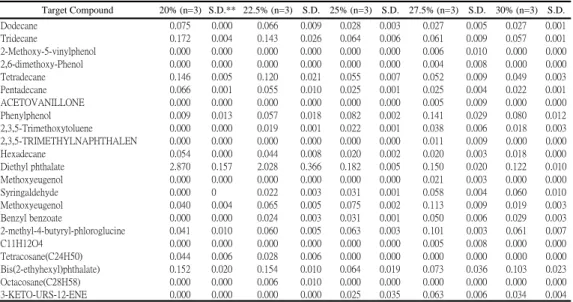
表 4 與 5 鑑定悶燒與火焰燃燒拜香 A 與 C 所排放的微粒相有機化合物。悶燒燒拜香 A, 質譜圖譜經由資料庫比對結果,相似性指數大於 80 的的微粒相有機污染物包括: (1) phenol 類 (2)Guaiacol 類 (3) Syringol 類 (4) PAH 類 (5)醛類(6)酯類,以及 (7).
2,3,5-Trimethoxytoluene。其中 2-methoxy-5-vinylphenol、4-hydroxy-3-methoxy-benzaldehyde、 syringaldehyde、Bornyl cinnamate 2 和 Bis(2-ethylhexyl)phthalate 在原物料分析時已被鑑別出 來。拜香 A 轉成火焰燃燒時,微粒相有機污染物果主要為碳數 21 到 29 的正烷類,可能係 苯環類有機物裂解為高碳數的直鏈正烷類。
被稱為無煙拜香的 B,悶燒時,微粒相未發現任何的有機化合物,也許因為拜香的原料 已經被經過熱處理且含有較高的熱值。
悶燒與火焰燃燒拜香 C,微粒相有機化合物包括:(1)烷類 (2).酚類 (3)Guaiacol 類 (4) Syringol 類 (5)PAH 類 (7)酯類 ,以及 2,3,5-Trimethoxytoluene、
2-methyl-4-butyryl-phloroglucine 和 3-KETO-URS-12-ENE。除 2,3,5-Trimethoxytoluene、 2-methyl-4-butyryl-phloroglucine 和 3-KETO-URS-12-ENE、sinapyl aldehyde 和
2,3,5-Trimethylnaphthalen 等五項有機化合物外,其餘各有機污染物被懷疑為存在原物料中 的原形凝結在微粒表面,未經熱裂解,因為在原物料萃取液時皆已被鑑別出來。 悶燒拜香 C 所排放的酚、Guaiacol、Syringol、PAH 與醛類、2,3,5-Trimethoxytoluene、 2-methyl-4-butyryl-phloroglucine 和 3-KETO-URS-12-ENE 等微粒相有機物,隨燃燒時含氧 量的增加而上升,但轉為火焰時,上述的有機物迅速下降,因為被高溫破壞。另外,悶燒 火焰燃燒拜香 C 所排放的微粒相低碳數烷類有機污染物,隨含氧量的增加,呈現下降的趨 勢,因為低溫下產生較多量低碳數的烷類,隨溫度的升高,低碳數的烷類量的減少可能是 被高溫進一步破壞。
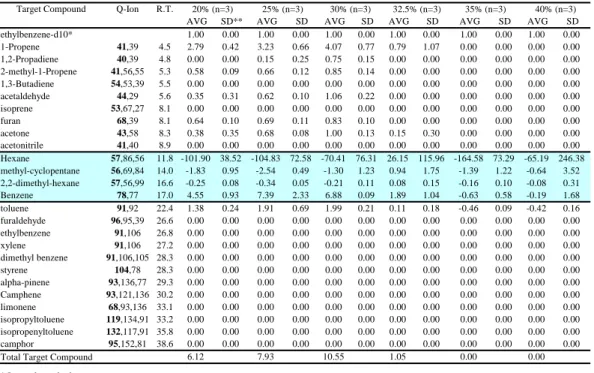
來自於多醣體的熱解(Edye, et al, 1991)。另外,Ohlemiller, et al, (1995)發現悶燒燃料會產 生比火焰燃燒燃料產生更多的毒性有機污染物。本研究燃燒拜香 A 與 C 的無火焰有機污染 物釋放量相較於有火焰燃燒高和 Ohlemiller, et al, (1995)研究結果一致。 最後,若單一微粒相所含有機污染物對健康的影響,拜香 B 相較於拜香 A 與 B 可被視為 較健康的拜香,因為有較低的微粒相有機污染物的釋放。 10、鑑定氣相揮發性有機污染物 表 6~8 鑑定悶燒與火焰燃燒拜香 A、B 與 C 所排放的氣相揮發性有機污染物。在悶燒拜 香 A,鑑別十七種揮發性有機污染物屬於烷、烯、醛、酮、夫喃等類及苯環衍生物。當拜 香燃燒轉為火焰時,僅存 1-propene 被發現。 在悶燒拜香 B,鑑別十種揮發性有機污染物屬於烷、烯、醛、酮、夫喃等類及苯環衍生 物。當轉為火焰時,僅存 1-propene 與 toluene 被發現。 在悶燒拜香 C,鑑別二十三種揮發性有機污染物屬於烷、烯、醛、酮、夫喃等類及苯環 衍生物外,尚包括 camphene, limonene, 與 camphor。當轉為火焰時,大部分有機揮發物依 然存在,也許因為燃燒點溫度不夠高,無法將之進一步分解破壞。除 camphene, limonene, 與 camphor 可能為拜香原物料中存在的揮發物,其餘鑑別出的揮發性有機物為燃燒的真正產 物。
此外,在上述鑑別出的 hexane, methyl-cyclopentane, 2,2-dimethyl-hexane, benzene 也存在 活性碳吸附管中,在計算總揮發性有機物的量時有扣除背景值。 在悶燒 A、B 與 C 拜香階段,隨含氧量的增加,鑑別出的總揮發性有機化合物的相對強 度因子皆呈現上升趨勢,相對強度因子範圍分別為 A(21.6~48.8)、B(6.12~10.55)與 C(9.99~20.67)。當拜香燃燒剛開始轉為火焰時,總揮發性有機化合物的相對強度因子隨之 下降,相對強度因子分別為 A(0.05)、B(1.05)與 C(12.9)。另外,將上述結果和使用直讀式 總有機碳分析結果互相比較,呈現一致性的趨勢。
四、結論與建議
無煙香原料含揮發份較低,有煙香原料含揮發份相對高,但後者熱值(kcal/g)略低。原 物料熱值愈高,拜香轉為火焰燃燒的所需含氧量越低,但無論何種拜香,當溫度超過大約 650 ℃時瞬即轉為有火焰燃燒,之前悶燒的溫度介於自 400 升到 650 ℃。當拜香悶燒時, 在相同的環境因素(空氣含氧量及流量率)下,高熱值拜香的燃燒點表面溫度較高,粗的 拜香燃燒點表面溫度亦較高;燃燒點溫度,也會分別隨著補充空氣的含氧量與流量率的增 加而升高,但流量率超過 15 L/min時開始有明顯的冷卻至溫度持恆(約 210℃)的效應。 同一種拜香當燃燒點溫度升高時,燃燒率以及CO、CO2、TVOCs及微粒的排放率與排放因 子亦遞升,燃燒率以及氣體及微粒的排放率之自然對數值分別與燃燒點絕對溫度的倒數成 良好的線性關係;至於兩種拜香比較,無煙香原料含揮發份較低,熱值(kcal/g)相對高, 燃燒點表面溫度亦較高,CO、CO2的排放因子(mg/g)相對的高,TVOCs排放因子相對的 低,產生較低的微粒濃度(質量濃度與粒數濃度),而粒徑中位數亦相對的較小。至於同種 拜香,粗的產生較多的粒數濃度,而且同種拜香在流率為 15 L/min以下時,隨著流率增加 粒徑變小而數目增加,但無論如何粒徑份佈均在次微米下。 未經燃燒的 A(檀香)、B(無煙香)與 C(檜香) 等拜香溶劑萃取液分別被鑑定出 25、19 與 84 種有機化學物質。大量的是天然植物性香料貢獻的烷、烯、醇、酚、醛、酮及酯類,亦 含少量可能是由動物性香料貢獻的如出現於拜香 C 之麝香 (musk)。當作塑化劑用的 diethyl phthalate 和 bis(2-ethylhexyl)phthalate 也出現在拜香的溶劑萃取液。拜香燃燒所產生的微粒 相有機污染物,部分源自於原物料中的原形(低揮發性有機物)蒸發後再凝結在微粒表面, 部分為真正燃燒的產物。悶燒拜香所產生微粒相高碳分子量有機物,隨燃燒時含氧量的增 加而上升,但轉為火焰時,被高溫破壞而迅速下降。另外,悶燒拜香低碳數烷類有機污染 物,隨含氧量的增加,呈現下降的趨勢,因為低溫下產生較多量低碳數的烷類,隨溫度的 升高,低碳數的烷類量的減少可能是被高溫進一步破壞。在氣相所見的有機揮發物,其狀 況亦十分相近。 含揮發份較低,熱值(kcal/g)高的無煙香或稱環保香, TVOCs 排放因子相對的低,產 生較低的微粒濃度(質量濃度與粒數濃度),對於污染的預防似乎是正面的,但是粒徑中位 數亦相對的較小,小於 1 µm 的微粒,甚至產生小於 100 nm 的超細粒徑微粒,可能因粒數 增加、粒徑縮小至整體表面積提生,可以負載著較多的有害物,改變了微粒物理和化學特 性而提升微粒的生物毒性(氧化壓力和發炎反應)亦未可知,故未來需要對拜香燃燒所產生 的細微粒進行細胞毒理學的探討。五、參考文獻
Chang, H.L., Kuo. M.L. and Lin, J.M., "Mutagenic activity of incense smoke in comparison to formaldehyde and acetaldehyde in Salmonella typhimurium TA102," Bull Environ Contam Toxicol., 58, pp. 394-401 (1997)
Chang, Y.C., Tseng, H.H., Hong, G.I., Wang, K.T. and Lee, S.W., "Comparison of smoke
properties of incense made in India, China, and Japan," 2000 年氣膠科技國際研討會,國立 中央大學 (2000)。
Chen, B.T., Namenyi, J., Yeh, H.C., Mauderly, J.L. and Guddihy, R.G., "Physical characterization of cigarette smoke aerosol generated a Walton smoke machine," Aerosol Sci Technol., 12, pp. 364-375 (1990)
Chen, C.C. and Lee, H., "Genotoxicity and DNA addust formation of incense smoke
condensates-comparison with environmental tobacco smoke condensates," Mut Res., 367, pp. 105-114 (1996)
Chen, C.J., Wu, H.Y., Wu, Chuang, Y.C., Chang, A.S., Luh, K.T., Chao, H.H., Chen, K.Y., Chen, S.G., Lai, G.M., Huang, H.H. and Lee H.H. "Epidemiologic characteristics and multiple risk factors of lung cancer in Taiwan," Anticancer Res., 10(4), pp. 971-976 (1990)
Cheng, Y.S., Bechtold, W.E., Yu, C.C. and Hung, I.F., "Incense smoke: characterization and dynamics in indoor environment," Aerosol Sci Technol., 23, pp. 271-281 (1995)
Dossing, M., Khan, J. and Al-Rabiah F., "Risk factors for chronic obstructive lung disease in Saudi Arabia," Respiratory Medicine., 88, pp. 519-522 (1994)
Edye, L.A. and Richards G.N., "Analysis of condensates from wood smoke: component derived from polysaccharides and lignins," Environ Sci Technol., 25, pp. 1133-1137 (1991)
Fine, P.M., Cass, G.R. and Simoneit, B.R.T., "Characterization of fine particle emissions from burning church candles," Environ Sci Technol., 33, pp. 2352-2362 (1999)
Ger L.P., Hsu, W.L., Chen, K.T. and Chen C.J. "Risk factors of lung cancer by histological category in Taiwan," Anticancer Res., 13, pp. 1491-1500 (1993)
Hayakawa, R., Mataunaga, K., and Arima, Y., "Airborne pigmented contact dermatitis due to must ambrette in incense," Contact Dermatitis, 16, pp. 96-98 (1987)
Hayakawa, R., Mataunaga, K., and Arima,Y., "Depigmented contact dermatitis due to incense," Contact Dermatitis, 16, pp. 272-274 (1987)
Hopke, P.K., Montassier, N., and Wasiolek, P., "Evaluation of the effectiveness of several air cleaners for reducing the hazard from indoor radon progency," Aerosol Sci Technol., 23, pp. 271-281 (1995)
proofing of a church on its indoor air quality: The combustion of candles and incense as a source of pollution," Sci Tot Environ, 102, pp. 241-251 (1991)
Jetter J.J., Guo Z., Mcbrian J.A. and Flynn M.R., "Characterization of emissions from burning incense," Sci Tot Environ., 295, pp. 51-67 (2002)
Kleeman, M.J., Schauer, J.J. and Cass, G.R., "Size and composition distribution of fine
particulate matter emitted from wood burning, meat charbroiling and cigarettes," Environ Sci Technol., 33, pp. 3516-3523 (1999)
Kleeman, M.J., Schauer, J.J. and Cass, G.R., "Size and composition distribution of fine particulate matter emitted from motor vehicles," Environ Sci Technol., 34, pp. 1132-1142 (2000)
Lee R.S. and Lin, J.M., "Gaseous aliphatic aldehydes in smoke from burning raw materials of Chinese joss stick" Bull Environ Contam Toxicol., 57, pp. 361-366 (1996)
Lee S.C. and Wang B., "Characteristics of incense of air pollutants from burning of incense in a large environmental chamber," Atmos Environ., pp. 941-951 (2004)
Li, W. and Hopke, P. K., "Initial size distributions and hygroscopicity of indoor combustion aerosol particles," Aerosol Sci Technol., 19, pp. 305-316 (1993)
Li, W., Montassier, N. and Hopke, P. K., "A System to Measure the hygroscopicity of aerosol particles," Aerosol Sci Technol., 17, pp. 25-35 (1992)
Lin, J.M. and Lee, J.K., "Vaporous and particulate-bound polycyclic aromatic hydrocarbons in Chinese incense smoke," Toxicol Environ Chem., 67, pp. 105-113 (1998)
Lin, J.M. and Tang, C.S., "Characterization and aldehyde content of particulates in Chinese incense smoke," Bull Environ Contam Toxicol., 53, pp. 895-901 (1994)
Lin, J.M. and Wang, L.H., "Gaseous aliphatic aldehydes in Chinese incense smoke," Bull Environ Contam Toxicol., 58, pp. 374-381 (1994)
Löfroth, G., Stensman, C., and Margareta, B.S., "Indoor sources of mutagenic aerosol particulate matter: Smoking, cooking and incense burning," Mut Res., 261, pp. 21-28 (1991)
Lowengard, R.A., Peters, J.M., Cinioni, C., Buckley, J., Bernstein, L., Preston-Martin, S. and Edward, R., "Childhood leukemia and parent’s occupation and home exposure," J Natl Cancer Inst., 79, pp.39-45 (1987)
Maclennan, R., Costa, J.D., Day, N.E., Law, C.H., Ng, Y.K. and Shanmugaratnam, K., "Risk factors for lung cancer in Singapore Chinese, A population with high female incidence rate," Int J Cancer., 20, pp. 854-860 (1977)
Moallemi, M.K., Zhang, H. and Kumar, S., "Numerical model of two-dimensional smoldering processes," Combust Flame., 95, pp. 170-182 (1993)
Ng, T.P. and Tan, W.C., "Epidemiology of allergic rhinitis and its associated risk factors in Singapore," International Journal of Epidemiology., 23, pp. 553-558 (1994)
Ohlemiller, T.J., "Smoldering combustion SPFE Handbook of Fire," Ed. DiNenno, P.M.,et al. 2 eds, 171-179 (1995)
Preston-Martin, S., Yu, M.C., Benten, B. and Henderson, B.E., "N-nitroso compounds and childhood brain tumors: A case-control study," Cancer Res., 42, pp.5240-5245 (1982) Rasmussen, R.E. "Mutagenic activity of incense smoke in Salmonella typhimurium," Bull
Environ Contam Toxicol., 38, pp. 827-833 (1987)
Robinson, R.J. and Yu, C.P., “Theoretical analysis of hygroscopic growth rate of mainstream and sidestream cigarette smoke particles in the human respiratory tract,” Aerosol Sci Technol., 28, pp. 21-32 (1998)
Sato, S., Makino, R., Takahashi, Y., Sugimura, T. and Miyazaki T., "Mutagenicity of smoke condensates from joss sticks," Mut Res., 77, pp. 31-36 (1980)
Schoental, R. and Gibbard, S., "Carcinogens in Chinese incense smoke," Nature., pp. 216-612 (1967)
Wang J.H., Chao C.Y.H. and Kong W., "Experimental study and asymptotic analysis of horizontally forced forward smoldering combustion," Combust Flame., 135, pp. 405-419 (2003)
Yaun, C.H. and Chen, C.M., "Characterization and dispersion of particulate matter emitted from smoking, incensing, mosquito incensing in a control environment," International Conference on Aerosol Science and Technology., pp. 313-322 (1993)
王俊龍(1998),拜香燃煙中多環芳香徑化合物組成受螢光燈照射之影響,國立台灣大學公 共衛生研究所碩士論文,台北。 王玲紅(1993),拜香燃煙中脂族醛氣體之探討,國立台灣大學公共衛生研究所碩士論文, 台北。 李如訓(1994),拜香原料燃煙中脂族醛氣體之探討,國立台灣大學公共衛生研究所碩士論 文,台北。 張筱玲(1995),拜香燃煙中氣狀物水溶液之製突變性研究,國立台灣大學公共衛生研究所 碩士論文,台北。 李建坤(1996),拜香及蚊香燃燒產生之多環芳香徑化合物,國立台灣大學公共衛生研究所 碩士論文,台北。 胡淑娟、高玫鐘及龍世俊:寺廟燒香中懸浮微粒相多環芳香烴之曝露量與風險評估,2000 年氣膠科技國際研討會,國立交通大學。 胡淑娟及龍世俊:兩種線香燃燒之懸浮微粒及多環芳香烴產生率之探討,2000 年氣膠科技
國際研討會,國立交通大學。 高玫鐘及龍世俊:寺廟內燒香產生 PM10 濃度之探討,1999 年氣膠科技國際研討會,國立 台灣大學。 高玫鐘及龍世俊:燒香對居家室內 PM10 濃度影響之研究,1999 年氣膠科技國際研討會, 國立台灣大學。 張幼珍及李繡偉:兩種拜香燃煙微粒粒徑分佈動態變化與增溼成長特性,1999 年氣膠科技 國際研討會,國立台灣大學。 陳弘毅(1998),火災學,鼎茂圖書。 楊慈定(2005),健康拜香之研發:拜香燃燒煙生成微粒與氣態污染物排放特性,國立台灣 大學公共衛生研究所博士論文,台北。
六、已發表及擬發表之著作
1. Tzu-Ting Yang1, Chih-Chieh Chen2 and Jia-Ming Lin*, Effect of air flow on emission of
smoldering incense. Bulletin of Environmental Contamination and Toxicology 74: 456-463(2005)
2. Tzu-Ting Yang1, Jia-Ming Lin2 and Chih-Chieh Chen*, Characterization of aerosol emission
from smoldering incenses. (Submitted to Journal of Aerosol Science and Technology, in revision)
3. Tzu-Ting Yang, Ming-Heng Huang,Yee-Chung Ma, Jia-Ming Lin*, Characterization of
organic compounds in gas phase and particulate phase from smoldering and flaming incense. (In preparation)
Table 1. Compositions and heating values of incenses A、B、C and D A B C D E C 43.59 55.24 53.38 61.96 48.4 H 5.40 3.96 4.71 2.62 4.93 N 0.61 0.57 0.51 0.70 0.79 O 39.61 28.82 28.75 21.62 40.42 Unit is % Incense Element A B C D E Water 7.39 6.16 9.56 5.86 8.94 Volatile 75.8 49.79 27.84 34.7 54.4 Ash 7.15 10.53 11.35 12.28 4.74 Fix. Carbon 9.66 33.52 51.25 47.16 31.92
Heatig value (Kcal/Kg) 3936 4619 4756 5060 4171
Unit is %
Incense Composition
Table 2 Identification and Quantification of the organic compounds from the material of incense A and B
Target Compound of incense A R.R.F Target Compound of incense B R.R.F
1 2-Cyclohexen-1-one 6.44 1 2-Cyclohexen-1-one 0.06 2 Camphene 3.72 2 Menthone 0.01 3 Benzaldehyde 3.88 3 Dodecane 0.01 4 Camphor 2.78 4 ANETHOLE 0.02 5 Dodecane 1.29 5 Tridecane 0.03 6 berbenone 1.00 6 EUGENOL 0.52 7 Tridecane 2.80 7 anethole 1.00 8 2-Methoxy-5-vinylphenol 1.74 8 2,3-dihydro-1H-Inden-1-one 0.03 9 Tetradecane 2.58 9 Tetradecane 0.02 10 4-hydroxy-3-methoxy-Benzaldehyde 0.78 10 4-hydroxy-3-methoxy-Benzaldehyde 0.02 11 Pentadecane 1.38 11 .alpha.-CEDRENE 0.07 12 Hexadecane 1.27 12 WIDDRENE 0.02
13 Diethyl phthalate 9.02 13 alpha-curcumene 0.02
14 Syringaldehyde 1.42 14 Pentadecane 0.01
15 Benzyl benzoate 1.03 15 (+)-CUPARENE 0.03
16 Docosane(C22H46) 0.92 16 Hexadecane 0.01
17 Bornyl cinnamate 2 128.72 17 Diethyl phthalate 0.07
18 Tricosane(C23H48) 1.68 18 Cedrol 0.18 19 Tetracosane(C24H50) 1.95 19 Bis(2-ethyhexyl)phthalate) 0.05 20 Pentacosane(C25H52) 2.38 21 Bis(2-ethyhexyl)phthalate) 19.09 22 Hexacosane(C26H54) 2.58 23 Heptacosane(C27H56) 2.77 24 Octacosane(C28H58) 2.03 25 HINOKININ 53.56 Anthracene-d10* 1.00 * Internal standard R.R.F is relative response factor
Table 3 Identification and Quantification of the organic compounds from the material of incense C
Target Compound of incense C RSD Target Compound of incense C R.R.F Target Compound of incense C R.R.F
1 SANTENE 0.03 31 ANETHOLE 0.01 61 gamma.-Cadinene 0.82
2 tricyclene 0.07 32 berbenone 0.02 62 .delta.-cadinene 0.26
3 thujene 7.28 33 Linalyl acetate 0.24 63 Phenylphenol 1.76
4 .ALPHA.-PINENE 8.01 34 E-Citral 0.24 64 .ALPHA.-CALACORENE 0.25
5 2-Cyclohexen-1-one 0.26 35 dl-Limonene 0.07 65 Hexadecane 0.03
6 Camphene 1.00 36 bornyl acetate 0.98 66 Diethyl phthalate 0.10
7 verbenene 0.03 37 ISOBORNYL ACETATE 0.90 67 (-)-Caryophyllene oxide 0.16
8 Benzaldehyde 0.01 38 Tridecane 0.05 68 Cedrol 1.91
9 cymene 0.08 39 EUGENOL 0.11 69 Syringaldehyde 0.02
10 beta.-PINENE 2.76 40 anethole 0.02 70 Benzyl benzoate 1.12
11 MYRCENE 0.15 41 2,3-dihydro-1H-Inden-1-one 0.01 71 2-methyl-4-butyryl-phloroglucine 0.09
12 l-Phellandrene 0.11 42 2-Methoxy-5-vinylphenol 0.02 72 Chlorothalonil 0.36
13 .DELTA.-3-CARENE 0.21 43 .Alpha.-Terpinene 0.86 73 musk 0.16
14 cymene 2.74 44 2,6-dimethoxy-Phenol 0.01 74 Heneicosane(C21H44) 0.01
15 LIMONENE 2.72 45 .ALPHA.-COPAENE 0.27 75 Docosane(C22H46) 0.01
16 TRANS-.BETA.-OCIMENE 0.01 46 Tetradecane 0.04 76 Tricosane(C23H48) 0.01
17 dihydromyrcenol 0.08 47 beta.-elemene 0.11 77 dehydroabietic acid 0.46
18 CIS-LINALOOL OXIDE 0.04 48 4-hydroxy-3-methoxy-Benzaldehyde 0.33 78 Tetracosane(C24H50) 0.01
19 dehydro-cymene 0.18 49 Cyperene 0.63 79 Pentacosane(C25H52) 0.01
20 LINALOOLL 3.85 50 alpha.-Gurjunene 0.39 80 Bis(2-ethyhexyl)phthalate) 0.04
21 methyl-Phenol 0.01 51 .alpha.-CEDRENE 4.00 81 Hexacosane(C26H54) 0.01
22 NEO-ALLO-OCIMENE 0.09 52 BETA.-CARYOPHYLLENE 0.84 82 Heptacosane(C27H56) 0.01
23 TERPINENE 1-OL 0.23 53 GAMMA.-MUUROLENE 0.75 83 Octacosane(C28H58) 0.01
24 beta-terpineol 0.29 54 WIDDRENE 2.63 84 3-KETO-URS-12-ENE 0.66
25 Camphor 2.80 55 .ALPHA.-HUMULENE 0.43 Anthracene-d10* 1.00
26 Menthone 0.58 56 alpha-curcumene 0.11 27 MENTHONE 0.24 57 Pentadecane 0.04 28 4-terpijneol 0.58 58 ACETOVANILLONE 0.01 29 Dodecane 0.02 59 alpha.-Muurolene 0.40 30 .ALPHA-TERPINEOL 4.67 60 (+)-CUPARENE 1.13 * Internal standard R.R.F is relative response factor
Table 4 Identification and Quantification of the organic compounds of particulate matter using GC/MS from burning incense A
Target Compound R.T. Q-Ion Q-value 20% (n=4) S.D.** 30% (n=4) S.D. 40% (n=5) S.D. 45% (n=1)
Anthracene-D10 * 20.81 188,94,160,189 94 1.00 0.00 1.00 0.00 1.00 0.00 N.D. methyl-Phenol 11.08 108,107,79 80 N.D.*** N.D. 0.04 0.02 0.10 0.02 N.D. methyl-Phenol 11.42 108,107,80 80 N.D. N.D. 0.24 0.09 0.52 0.14 N.D. methoxy-Phenol 11.61 124,109,91 81 N.D. N.D. 0.11 0.05 0.17 0.10 N.D. 4-vinylphenol 13.53 120,91,39 87 0.17 0.12 2.85 1.25 3.14 0.91 N.D. cinnamic aldehyde 13.67 131,103,78 82 0.07 0.01 0.25 0.04 0.37 0.06 N.D. 1-INDANONE 14.57 132,104,78 90 0.06 0.02 0.17 0.05 0.25 0.06 N.D. 2-Methoxy-5-vinylphenol 14.92 150,135,107,77 87 0.32 0.05 1.82 0.40 1.84 0.43 N.D. 2-Methylindanone 15.06 146, 131, 117 80 0.00 N.D. 0.06 0.02 0.09 0.02 N.D. 2,6-dimethoxy-Phenol 15.41 154, 139, 111 95 1.23 0.12 3.99 0.86 3.38 0.74 N.D. 4-hydroxy-3-methoxy-Benzaldehyde 16.17 152, 151, 123 90 0.10 0.10 0.83 0.14 0.97 0.19 N.D. EUGENOL 16.19 164, 149, 131 93 0.04 0.04 0.25 0.05 0.24 0.06 N.D. ACETOVANILLONE 17.28 151, 123 90 0.03 0.05 0.47 0.08 0.48 0.07 N.D. 2,3,5-Trimethoxytoluene 17.64 182, 167 86 0.53 0.05 0.98 0.17 0.77 0.16 N.D. Methoxyeugenol 18.56 194, 119, 91 87 0.18 0.01 0.49 0.09 0.45 0.10 N.D. Methoxyeugenol 19.14 194, 119, 91 87 0.14 0.02 0.35 0.07 0.26 0.07 N.D. Syringaldehyde 19.32 182, 181, 167 91 0.08 0.09 0.87 0.16 0.96 0.21 N.D. Methoxyeugenol 19.69 194, 119, 91 94 0.68 0.03 1.52 0.34 1.15 0.33 N.D. 3-(3',5'-dimethoxy-4'-hydroxyphenyl)-E-2-propenal 22.71 208, 165, 137 80 N.D. N.D. N.D. N.D. 0.03 0.07 N.D. Bornyl cinnamate 2 24.91 284, 131, 109 93 0.22 0.05 0.45 0.04 0.51 0.10 N.D. Bis(2-ethylhexyl)phthalate 27.33 279, 167, 149 80 0.07 0.05 0.11 0.01 0.13 0.02 N.D. Docosane 24.55 57, 43 96 N.D. N.D. N.D. N.D. N.D. N.D. 0.02 Tricosane 25.38 57, 43 95 N.D. N.D. N.D. N.D. N.D. N.D. 0.07 Tetracosane 26.23 57, 43 94 N.D. N.D. N.D. N.D. N.D. N.D. 0.12 Pentacosane 27.02 57, 43 91 N.D. N.D. N.D. N.D. N.D. N.D. 0.18 Hexacosane 27.77 57, 43 99 N.D. N.D. N.D. N.D. N.D. N.D. 0.18 Heptacosane 28.56 57, 43 98 N.D. N.D. N.D. N.D. N.D. N.D. 0.17 Octocosane 29.40 57, 43 97 N.D. N.D. N.D. N.D. N.D. N.D. 0.11 * Internal standard ** Standard deviation
Table 5 Identification and quantification of the organic compounds of particulate matter using GC/MS from burning incense C
Target Compound 20% (n=3) S.D.** 22.5% (n=3) S.D. 25% (n=3) S.D. 27.5% (n=3) S.D. 30% (n=3) S.D. Dodecane 0.075 0.000 0.066 0.009 0.028 0.003 0.027 0.005 0.027 0.001 Tridecane 0.172 0.004 0.143 0.026 0.064 0.006 0.061 0.009 0.057 0.001 2-Methoxy-5-vinylphenol 0.000 0.000 0.000 0.000 0.000 0.000 0.006 0.010 0.000 0.000 2,6-dimethoxy-Phenol 0.000 0.000 0.000 0.000 0.000 0.000 0.004 0.008 0.000 0.000 Tetradecane 0.146 0.005 0.120 0.021 0.055 0.007 0.052 0.009 0.049 0.003 Pentadecane 0.066 0.001 0.055 0.010 0.025 0.001 0.025 0.004 0.022 0.001 ACETOVANILLONE 0.000 0.000 0.000 0.000 0.000 0.000 0.005 0.009 0.000 0.000 Phenylphenol 0.009 0.013 0.057 0.018 0.082 0.002 0.141 0.029 0.080 0.012 2,3,5-Trimethoxytoluene 0.000 0.000 0.019 0.001 0.022 0.001 0.038 0.006 0.018 0.003 2,3,5-TRIMETHYLNAPHTHALEN 0.000 0.000 0.000 0.000 0.000 0.000 0.011 0.009 0.000 0.000 Hexadecane 0.054 0.000 0.044 0.008 0.020 0.002 0.020 0.003 0.018 0.000 Diethyl phthalate 2.870 0.157 2.028 0.366 0.182 0.005 0.150 0.020 0.122 0.010 Methoxyeugenol 0.000 0.000 0.000 0.000 0.000 0.000 0.021 0.003 0.000 0.000 Syringaldehyde 0.000 0 0.022 0.003 0.031 0.001 0.058 0.004 0.060 0.010 Methoxyeugenol 0.040 0.004 0.065 0.005 0.075 0.002 0.113 0.009 0.019 0.003 Benzyl benzoate 0.000 0.000 0.024 0.003 0.031 0.001 0.050 0.006 0.029 0.003 2-methyl-4-butyryl-phloroglucine 0.041 0.010 0.060 0.005 0.063 0.003 0.101 0.003 0.061 0.007 C11H12O4 0.000 0.000 0.000 0.000 0.000 0.000 0.005 0.008 0.000 0.000 Tetracosane(C24H50) 0.044 0.006 0.028 0.006 0.000 0.000 0.000 0.000 0.000 0.000 Bis(2-ethyhexyl)phthalate) 0.152 0.020 0.154 0.010 0.064 0.019 0.073 0.036 0.103 0.023 Octacosane(C28H58) 0.000 0.000 0.006 0.010 0.000 0.000 0.000 0.000 0.000 0.000 3-KETO-URS-12-ENE 0.000 0.000 0.000 0.000 0.025 0.035 0.063 0.006 0.034 0.004 Internal standard is Anthracene-D10
** Standard deviation
*** 0. not determined, possible at low level
Table 6 Identification and quantification of the volatile organic compounds from burning incense A
Target Compound Q-Ion R.T.
AVG SD** AVG SD AVG SD AVG SD AVG SD
ethylbenzene-d10* 1.00 0.00 1.00 0.00 1.00 0.00 1.00 0.00 1.00 0.00 1-Propene 41,39 4.5 5.57 0.97 8.48 0.65 7.07 0.43 9.43 2.13 0.05 0.05 1,2-Propadiene 40,39 4.8 1.29 0.21 1.74 0.23 1.94 0.11 3.36 0.81 0.00 0.00 2-methyl-1-Propene 41,56,55 5.3 2.25 0.41 2.98 0.25 2.86 0.26 4.04 0.93 0.00 0.00 1,3-Butadiene 54,53,39 5.5 1.42 0.43 2.60 0.23 2.07 0.05 3.34 0.74 0.00 0.00 acetaldehyde 44,29 5.6 2.17 0.27 2.96 0.49 4.16 0.43 7.10 2.16 0.00 0.00 furan 68,39 8.1 2.13 0.33 2.37 0.21 2.34 0.19 3.41 0.75 0.00 0.00 acetone 43,58 8.3 2.09 0.29 2.89 0.41 3.55 0.37 5.32 1.37 0.00 0.00 acetonitrile 41,40 8.9 0.70 0.10 0.94 0.12 0.99 0.10 1.59 0.41 0.00 0.00 Hexane 57,86,56 11.8 9.41 59.45 52.27 11.30 190.78 363.08 10.90 74.43 83.09 78.68 methyl-cyclopentane 56,69,84 14.0 0.05 0.63 0.00 0.16 3.12 6.35 -0.24 0.70 0.51 0.72 2,2-dimethyl-hexane 57,56,99 16.6 -0.03 0.07 -0.05 0.02 0.37 0.78 -0.35 0.64 0.04 0.07 Benzene 78,77 17.0 5.41 2.46 13.37 2.48 13.28 2.32 20.49 2.87 0.44 0.21 toluene 91,92 22.4 2.95 1.16 4.74 0.62 4.18 0.41 6.71 0.92 0.00 0.00 furaldehyde 96,95,39 26.6 0.00 0.00 0.00 0.00 0.33 0.08 0.62 0.10 0.00 0.00 ethylbenzene 91,106 26.8 0.24 0.42 0.84 0.10 0.89 0.09 1.45 0.15 0.00 0.00 xylene 91,106 27.2 0.24 0.42 0.71 0.05 0.67 0.07 0.99 0.14 0.00 0.00 styrene 104,78 28.3 0.02 0.03 0.84 0.17 0.79 0.14 1.48 0.20 0.00 0.00
Total Target Compound 21.06 32.10 31.82 48.84 0.05
* Internal standard ** Standard deviation
0.00 Not determined, possible at low level
45% (n=1) 20% (n=3) 25% (n=3) 30% (n=3) 40% (n=3)
Table 7 Identification and Quantification of the volatile organic compounds from burning incense B
Target Compound Q-Ion R.T.
AVG SD** AVG SD AVG SD AVG SD AVG SD AVG SD
ethylbenzene-d10* 1.00 0.00 1.00 0.00 1.00 0.00 1.00 0.00 1.00 0.00 1.00 0.00 1-Propene 41,39 4.5 2.79 0.42 3.23 0.66 4.07 0.77 0.79 1.07 0.00 0.00 0.00 0.00 1,2-Propadiene 40,39 4.8 0.00 0.00 0.15 0.25 0.75 0.15 0.00 0.00 0.00 0.00 0.00 0.00 2-methyl-1-Propene 41,56,55 5.3 0.58 0.09 0.66 0.12 0.85 0.14 0.00 0.00 0.00 0.00 0.00 0.00 1,3-Butadiene 54,53,39 5.5 0.00 0.00 0.00 0.00 0.00 0.00 0.00 0.00 0.00 0.00 0.00 0.00 acetaldehyde 44,29 5.6 0.35 0.31 0.62 0.10 1.06 0.22 0.00 0.00 0.00 0.00 0.00 0.00 isoprene 53,67,27 8.1 0.00 0.00 0.00 0.00 0.00 0.00 0.00 0.00 0.00 0.00 0.00 0.00 furan 68,39 8.1 0.64 0.10 0.69 0.11 0.83 0.10 0.00 0.00 0.00 0.00 0.00 0.00 acetone 43,58 8.3 0.38 0.35 0.68 0.08 1.00 0.13 0.15 0.30 0.00 0.00 0.00 0.00 acetonitrile 41,40 8.9 0.00 0.00 0.00 0.00 0.00 0.00 0.00 0.00 0.00 0.00 0.00 0.00 Hexane 57,86,56 11.8 -101.90 38.52 -104.83 72.58 -70.41 76.31 26.15 115.96 -164.58 73.29 -65.19 246.38 methyl-cyclopentane 56,69,84 14.0 -1.83 0.95 -2.54 0.49 -1.30 1.23 0.94 1.75 -1.39 1.22 -0.64 3.52 2,2-dimethyl-hexane 57,56,99 16.6 -0.25 0.08 -0.34 0.05 -0.21 0.11 0.08 0.15 -0.16 0.10 -0.08 0.31 Benzene 78,77 17.0 4.55 0.93 7.39 2.33 6.88 0.09 1.89 1.04 -0.63 0.58 -0.19 1.68 toluene 91,92 22.4 1.38 0.24 1.91 0.69 1.99 0.21 0.11 0.18 -0.46 0.09 -0.42 0.16 furaldehyde 96,95,39 26.6 0.00 0.00 0.00 0.00 0.00 0.00 0.00 0.00 0.00 0.00 0.00 0.00 ethylbenzene 91,106 26.8 0.00 0.00 0.00 0.00 0.00 0.00 0.00 0.00 0.00 0.00 0.00 0.00 xylene 91,106 27.2 0.00 0.00 0.00 0.00 0.00 0.00 0.00 0.00 0.00 0.00 0.00 0.00 dimethyl benzene 91,106,105 28.3 0.00 0.00 0.00 0.00 0.00 0.00 0.00 0.00 0.00 0.00 0.00 0.00 styrene 104,78 28.3 0.00 0.00 0.00 0.00 0.00 0.00 0.00 0.00 0.00 0.00 0.00 0.00 alpha-pinene 93,136,77 29.3 0.00 0.00 0.00 0.00 0.00 0.00 0.00 0.00 0.00 0.00 0.00 0.00 Camphene 93,121,136 30.2 0.00 0.00 0.00 0.00 0.00 0.00 0.00 0.00 0.00 0.00 0.00 0.00 limonene 68,93,136 33.1 0.00 0.00 0.00 0.00 0.00 0.00 0.00 0.00 0.00 0.00 0.00 0.00 isopropyltoluene 119,134,91 33.2 0.00 0.00 0.00 0.00 0.00 0.00 0.00 0.00 0.00 0.00 0.00 0.00 isopropenyltoluene 132,117,91 35.8 0.00 0.00 0.00 0.00 0.00 0.00 0.00 0.00 0.00 0.00 0.00 0.00 camphor 95,152,81 38.6 0.00 0.00 0.00 0.00 0.00 0.00 0.00 0.00 0.00 0.00 0.00 0.00
Total Target Compound 6.12 7.93 10.55 1.05 0.00 0.00
* Internal standard ** Standard deviation
0.00 Not determined, possible at low level
30% (n=3) 25% (n=3)
20% (n=3) 32.5% (n=3) 35% (n=3) 40% (n=3)
Table 8 Identification and Quantification of the volatile organic compounds from burning incense C
Target Compound Q-Ion R.T.
AVG SD** AVG SD AVG SD AVG SD AVG SD
ethylbenzene-d10* 1.00 0.00 1.00 0.00 1.00 0.00 1.00 0.00 1.00 0.00 1-Propene 41,39 4.5 1.85 0.09 2.10 0.06 3.47 0.28 3.05 0.41 2.29 0.41 1,2-Propadiene 40,39 4.8 0.00 0.00 0.19 0.16 0.57 0.03 0.54 0.07 0.51 0.08 2-methyl-1-Propene 41,56,55 5.3 0.74 0.02 0.84 0.02 1.34 0.10 1.18 0.14 0.91 0.15 1,3-Butadiene 54,53,39 5.5 0.00 0.00 0.10 0.17 0.71 0.06 0.61 0.08 0.31 0.28 acetaldehyde 44,29 5.6 0.57 0.03 0.58 0.01 1.06 0.07 0.93 0.11 0.99 0.09 isoprene 53,67,27 8.1 0.00 0.00 0.19 0.16 0.67 0.04 0.55 0.06 0.25 0.23 furan 68,39 8.1 0.90 0.05 0.95 0.05 1.61 0.12 1.38 0.16 0.66 0.59 acetone 43,58 8.3 0.93 0.02 1.01 0.05 1.51 0.13 1.38 0.13 1.36 0.13 acetonitrile 41,40 8.9 0.00 0.00 0.00 0.00 0.00 0.00 0.00 0.00 0.00 0.00 Hexane 57,86,56 11.8 -444.29 2.75 -448.62 12.35 -447.28 5.54 -454.88 9.64 -438.50 4.44 methyl-cyclopentane 56,69,84 14.0 -11.09 0.03 -11.13 0.10 -11.15 0.05 -11.16 0.07 -11.05 0.06 2,2-dimethyl-hexane 57,56,99 16.6 -1.59 0.00 -1.59 0.00 -1.59 0.00 -1.59 0.00 -1.59 0.00 Benzene 78,77 17.0 -1.66 0.31 -1.22 0.70 0.13 0.57 0.46 0.58 -0.02 0.37 toluene 91,92 22.4 0.82 0.12 1.42 0.23 2.48 0.41 2.89 0.25 1.62 0.48 furaldehyde 96,95,39 26.6 0.00 0.00 0.00 0.00 0.00 0.00 0.00 0.00 0.00 0.00 ethylbenzene 91,106 26.8 0.00 0.00 0.00 0.00 0.48 0.56 0.34 0.03 0.11 0.19 xylene 91,106 27.2 0.52 0.07 0.69 0.02 1.03 0.13 1.12 0.02 0.66 0.13 dimethyl benzene 91,106,105 28.3 0.00 0.00 0.00 0.00 0.00 0.00 0.19 0.16 0.00 0.00 styrene 104,78 28.3 0.00 0.00 0.00 0.00 0.00 0.00 0.08 0.15 0.00 0.00 alpha-pinene 93,136,77 29.3 0.72 0.02 0.75 0.07 0.92 0.10 0.96 0.02 0.63 0.08 Camphene 93,121,136 30.2 0.10 0.17 0.19 0.17 0.39 0.03 0.39 0.01 0.00 0.00 limonene 68,93,136 33.1 0.67 0.05 0.77 0.05 1.03 0.06 1.06 0.04 0.61 0.11 isopropyltoluene 119,134,91 33.2 2.17 0.11 2.44 0.07 3.24 0.28 3.24 0.08 1.98 0.33 isopropenyltoluene 132,117,91 35.8 0.00 0.00 0.10 0.17 0.48 0.05 0.50 0.04 0.00 0.00 camphor 95,152,81 38.6 0.00 0.00 0.00 0.00 0.34 0.03 0.28 0.24 0.00 0.00
Total Target Compound 9.99 12.34 21.32 20.67 12.90
* Internal standard ** Standard deviation
0.00 Not determined, possible at low level
27.5% (n=3) 30% (n=3) 20% (n=3) 22.5% (n=3) 25% (n=3)
N2 Vacuum Pump PID and SMPS Q-Trak CO, CO2 Thermocouple Exhaust Mix Chamber Incense Stainless steel tube for better control
O2
Multiwarn 2
O2
N2
N2
Figure 1 Schematic diagram of incense combustion system set-up in various oxygen fractions
Air Flow rates (L/min)
0 5 10 15 20 25 0.0 0.2 0.4 0.6 0.8 1.0 1.2 1.4 1.6 1.8 2.0 328.2 oC 452.9 oC 431.7 oC 253.0 oC 160.3 oC 210.1 oC
In
c
e
n
s
e
B
u
rn
in
g
R
ta
e
(
g
/h
r)
Figure 2. Burning rate and maximum temperature of burning tip at various air flow rates (Bar: mean ± standard deviation).
Oxygen Content (%) 0 5 10 15 20 25 30 35 40 45 50 Bur n ing R a te (g /hr ) 0 1 2 3 4 5 26 28 30 32 Incense B Incense A Q = 5 L/min Incense C
Figure 3 Comparison of burning rates of incenses A、B and C
3 mm 3.75 mm 5 mm
13.5 mm 14.5 mm 25 mm
4.5 mm 5 mm 8 mm
2.86 mm 3.5 mm 4.6 mm
Low Volatility Incense
High Volatility Incense
Diameter
Diameter
Figure 4. Profiles of burning fire cones of incenses with various diameters and compositions of volatile component