Second-harmonic green generation from two-dimensional
„2…nonlinear
photonic crystal with orthorhombic lattice structure
L.-H. Peng,a)C.-C. Hsu, and Y.-C. Shih
Department of Electrical Engineering and Institute of Electro-Optical Engineering, National Taiwan University, Taipei, Taiwan, Republic of China
共Received 20 March 2003; accepted 2 September 2003兲
We report the synthesis of nonlinear photonic crystals 共NPCs兲 with a periodical distribution of inverted (2) nonlinearity having an orthorhombic lattice structure on Z-cut congruent-grown lithium niobate (LiNbO3) substrate. The quasiphase-matching 共QPM兲 mechanism of nonlinear wave interaction is examined by monitoring the far-field emission pattern of second-harmonic generation 共SHG兲 as the NPC is pumped by a Nd:yttritium–aluminum–garnet laser beam. We observe共i兲 a series distribution of green SHG in a direction transverse to the fundamental beam, and
共ii兲 an increase of phase-matching temperature in the SHG peak signal with the azimuth rotation
angle in the x – y plane. These observations are ascribed to the high-order reciprocal lattice vectors assisted QPM–SHG process in a NPC that has a distribution of (2) nonlinearity with an orthorhombic crystal symmetry. © 2003 American Institute of Physics.
关DOI: 10.1063/1.1622786兴
Photonic crystals共PCs兲 are known for their capability to manipulate the light localization and emission properties such that optical function of switch1and laser,2and enhanced nonlinearity for solitary wave3 and frequency conversion4 can be resultant. These phenomena can be ascribed to a unique dispersion of photonic subbands in the crystal.5 Cur-rent technology has shown that linear or nonlinear PCs can be constructed by maximizing the index contrast in a peri-odical modulation of either or both(1) and(2) in the con-stituent materials6or via Kerr nonlinearity7at a lattice spac-ing on the order of optical wavelength (/n). To reduce the stringent requirement of size control in the unite cell con-struction, another class of nonlinear photonic crystals
共NPCs兲 has been proposed. In such NPC one maintains a
constant dielectric function in space but periodically reverses the sign of (2) nonlinear tensor at every coherent length lc
⫽/4(n2⫺n).8The reciprocal lattice vector G of a NPC can further support a momentum conservation mechanism, i.e., via quasiphase-matching 共QPM兲 of k1⫹k2⫽k3⫹G to ensure energy conversion among the interacting waves of vectors k1, k2, and k3when the corresponding Fourier com-ponent of (2)(G) has a nonzero value.9,10
Here we report the synthesis, characterization, and analysis of QPM–NPCs with orthorhombic lattice site on lithium niobate (LiNbO3) substrate. We note a series of green second-harmonic generation共SHG兲 can be excited in a direction transverse to the fundamental Nd:yttritium–
aluminum–garnet 共YAG兲 laser pump beam. The
phase-matching temperature (T) of the peak SHG signal is found to increase with the azimuth rotation angle 共兲 of the crystal but decrease with the lattice spacing. These observations can be ascribed to a unique dispersion of Gmn(T,) in the QPM–NPCs and suggestive of promising nonlinear optical
applications for two-dimensional 共2D兲 wave front
engineering11and coherent light deflection.12
The including of a QPM scheme on NPC can further enable a direct access to the largest tensor component in
(2).13This mechanism differs from that of conventional bi-refringent phase matching by allowing the interacting waves to polarize in the same direction and thus lead to a maximum use of the nonlinearity effect due to the enhanced overlap of optical field in space.14A physical mechanism that can cause a periodical sign reversal of(2) in crystal can also render a polarity change in Ps as well.15This effect suggests that one can take advantage of the reversible polarization status of Ps in the ferroelectric domains, i.e., via domain reversal, to re-alize a QPM–NPC.16 To initiate such a polarization switch-ing process, one can conveniently apply an electric field to overcome the crystal’s coercive field (Ec) and to nucleate an inverted domain on the polar surface.17With additional sup-ply of switching current of 2Ad Ps/dt via an external circuit, one can further compensate the depolarization field in bulk crystal and result in the stabilization of inverted crystallite with area A.18
Albeit electrical poling has been regarded as a mature technique to produce bulk single domain ferroelectric crystals,19 an extension of this method to make an arrange-ment of rod- or grid-like(2)crystallites and register them in a two- or three-dimensional lattice structure to form a QPM– NPC still remains a great challenge. One such difficulty arises from the existence of large internal field (Eint) due to the nonstoichiometric defects for crystals grown from the melt. The Eint value amounts to 15%–25% of Ec in the widely used lithium niobate (LiNbO3)20 and lithium tanta-late (LiTaO3)21nonlinear crystals of congruent composition. Such a giant internal field can cause a serious back switching of inverted domains as one terminates the poling field.18The most troublesome, however, is the loss of(2)patterning and therefore the destruction of nonlinear photonic structure due to the incontrollable merging of inverted domains. Such an unwelcome domain motion is caused by an inherent fringing field effect when the corrugated ferroelectric surface covered a兲Electronic mail: [email protected]
APPLIED PHYSICS LETTERS VOLUME 83, NUMBER 17 27 OCTOBER 2003
3447
with a photo-resist pattern is subject to a field action (Ez).22 We have recently shown that an electrostatic compensa-tion mechanism to counteract the aforemencompensa-tioned tangential field effect can be effectively realized by surrounding the
(2) lattice site with a sheet of positive charge prior to ini-tiate the electrical poling.23Our device processing steps be-gin by letting an aluminum 共Al兲-patterned LiNbO3 substrate undergone a heat treatment at 1050 °C for 5 h. The microfis-sure formed in the oxidized Al2O3 pattern during the heat treatment can further provide an electric contact path to the underlying LiNbO3 and therefore can initiate the nucleation of inverted domain at the designated lattice site. The capa-bility of 共i兲 selectively nucleating the inverted domain, and
共ii兲 restricting the transverse motion of inverted domain
con-stitutes the major advantages in our construction of (2) QPM–NPCs.
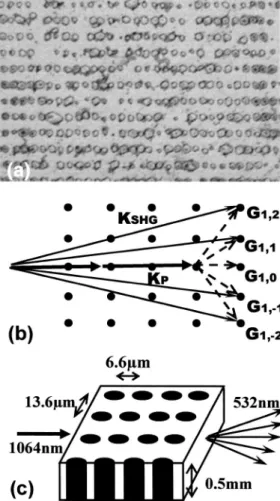
Illustrated in Fig. 1共a兲 is a ⫺Z face micrograph of a NPC showing a rod-like distribution of (2) nonlinearity with a 2D periodicity of 6.6⫻13.6m2. A close examina-tion of the etched micrograph indicates that such rods, with an inverted area as small as 3.3⫻3.3m2, indeed are re-sided on the rectangular共i.e., orthorhombic兲 lattice site and periodically distributed in the x – y plane. The observation of periodically poled inverted domains with a high aspect ratio over 150 on a 500-m-thick substrate has proven the use of the two-step poling process in the synthesis of(2) NPCs.
We further note the spatial distribution of(2) nonlinear-ity in the NPC of Fig. 1共a兲 has a structure symmetry (C2v) different from that of C3v in the host crystal of LiNbO3. This would affect the generation and propagation of nonlin-ear interacting waves in the QPM process as shown in Figs. 1共b兲 and 1共c兲, respectively. In order to examine such effects, we use the SHG technique to monitor the intensity distribu-tion in the far-field emission pattern as the incident angle of the pump laser and the crystal temperature of NPC are changed. A fundamental pump beam of Nd:YAG laser with
⬃10 ns pulse width 共New Wave Technology, USA兲 was
lightly focused onto the end-facet polished sample. An in-house temperature controller unit was attached to a rotation stage which allows a variation of crystal temperature from 5 to 240 °C and a change of incident angle to ⫾15°.
First shown in Fig. 2 are the 共a兲 charge coupled device
共CCD兲 images, and 共b兲 corresponding far-field intensity
dis-tribution of the SHG signals taken from the 6.6⫻13.2m2 period sample and at a crystal temperature of 152, 165, and 214 °C, respectively. The data were measured at a normal incident configuration with the pump Nd:YAG laser beam
共of a peak intensity⬃2 MW/cm2) propagating along the short period共i.e., 6.6m兲 side of the NPC sample. Albeit the green SHG resembles that in the conventional one-dimensional 共1D兲–QPM PPLN,22 the appearance of a series of SHG signals with unequal intensity signifies the partici-pation of transverse reciprocal lattice vectors, as shown in Fig. 1共b兲, that are absent in the 1D case. Moreover, as one increases the crystal temperature, an interesting shift of the SHG peak intensity to a larger far-field angle, i.e., from 0° to 4.5°, can be clearly resolved. These phenomena suggest that the high-order transverse reciprocal lattice vector becomes dominant in the nonlinear interaction of QPM–SHG process as one increases the crystal temperature.
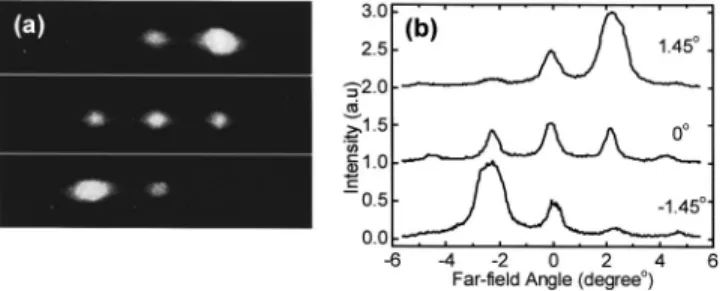
In order to grant a further understanding of the earlier mechanism, we slightly rotate the crystal in the x – y plane such that various reciprocal lattice vectors and their nonlin-ear activities can be addressed. Illustrated in Fig. 3 are the共a兲 CCD images, and 共b兲 far-field intensity of the SHG signals taken from another QPM–NPC sample having a larger pe-riod of 6.9⫻13.6m2. The data were measured at a crystal temperature of 10 °C and an azimuth rotation angle of
⫽0° and ⫾1.45°, respectively. Note the SHG patterns in the
⫽⫾1.45° measurements take a mirror image to each other.
This leads to an observation of peak SHG signal at a far-field angle of ⫾2.3° but overlaid with discrete weak green spots that appear not phase matched. In the normal incident con-dition (⫽0°), however, only weak SHG signals can be FIG. 1.共a兲 Etched-Z face micrograph showing a rod-like distribution of(2)
NPC on 500-m-thick LiNbO3with a 2D periodicity of 6.6⫻13.6m2.共b兲 QPM–SHG process in the reciprocal space of NPC having an orthorhombic lattice structure.共c兲 Schematic draw of wave propagation and generation in the(2)NPC of共a兲.
FIG. 2. 共a兲 CCD image, and 共b兲 far-field intensity pattern of a 6.6
⫻13.6m2 QPM–SHG NPC pumped by a Nd:YAG at 152, 165, and 214 °C, respectively, and at normal incidence configuration.
resolved, indicating a loss of phase-matching condition. For a quantitative analysis of the earlier observations, we consider a ray tracing method in geometrical optics to re-solve the reciprocal lattice vector effects on the spatial dis-tribution of the QPM–SHG process. This is equivalent to solving a problem of Gmn(T,), where the phase-matching temperature T becomes an index of the reciprocal lattice vec-tor Gmnand the azimuth rotation angle in the x – y plane. Here the material dispersion in the refractive index n(,T) is taken from Ref. 24 and a QPM condition of k2⫺2k
⫺Gmn⫽0 is used to evaluate the structure effect. Shown in Fig. 4 are the derived dispersion curves revealing the depen-dence of phase-matching temperature on the azimuth rotation angle. A general trend inferred from Fig. 4共a兲 of the 6.6
⫻13.6m2period sample is a monotonic increase of phase-matching temperature with rotation angle. This finding agrees with most of the experimental observations except for the G10(T,) assisted QPM–SHG process which is less sen-sitive to the variation of incident angle. On the other hand, we also have an increase of phase-matching temperature with
the magnitude of Gmn involved in the nonlinear wave inter-action. This effect can further translate into an increase of far-field emission angle of the peak QPM–SHG signal in a direction transverse to the fundamental Nd:YAG pump beam. By increasing the lattice spacing in the structured(2) nonlinearity, we note a linear dispersion relation on
Gmn(T,) can be maintained over the 6.9⫻13.6m2period sample of Fig. 4共b兲. The corresponding phase-matching tem-perature, however, is roughly lowered by a factor of 2 com-pared with that of the 6.6⫻13.6m2 period sample of Fig. 4共a兲. Last but not least, we note the Gm⫾n(T,) dispersion curves do reveal an axial symmetry as one varies the rotation angle in the x – y plane. This can be related to the fact that the(2)nonlinearity in the QPM–NPC has an orthorhombic lattice structure of C2v symmetry.
In summary, we have demonstrated a promising route of constructing the(2)QPM–NPCs by using the two-step pol-ing technique. From the SHG measurement and geometric optics analysis, it is shown that the dispersion relation of
Gmn(T,) in the nonlinear wave generation process can be engineered by a suitable design of the lattice structure and periodicity of (2) nonlinearity in the NPCs.
This research was supported by the National Science Council, Grant Nos. 91-2215-E-002-026 and 92-2215-E-002-013.
1M. Soljacˇic´, M. Ibanescu, S. G. Johnson, Y. Fink, and J. D. Joannpoulos, Phys. Rev. E 66, 055601共R兲 共2002兲.
2O. Painter, R. K. Lee, A. Scherer, A. Yariv, J. D. O’Brien, P. D. Dapkus, and I. Kim, Science 284, 1819共1999兲.
3C. B. Clausen, P. L. Christiansen, L. Torner, and Y. B. Gaidiei, Phys. Rev. E 60, R5064共1999兲.
4K. Sakoda and K. Ohtaka, Phys. Rev. B 54, 5742共1996兲.
5J. D. Joannopoulos, R. D. Meade, and J. N. Winn, Photonic Crystals, Molding the Flow of Light共Princeton University Press, Princeton, 1995兲. 6A. R. Cowan and J. F. Young, Phys. Rev. B 65, 085106共2002兲. 7A. Huttunen and P. To¨rma¨, J. Appl. Phys. 91, 3988共2002兲. 8V. Berger, Phys. Rev. Lett. 81, 4136共1998兲.
9
N. G. R. Broderick, G. W. Ross, H. L. Offerhaus, D. J. Richardson, and D. C. Hanna, Phys. Rev. Lett. 84, 4345共2000兲.
10A. Chowdhury, C. Status, B. F. Boland, T. F. Kuech, and L. McCaughan, Opt. Lett. 26, 1353共2001兲.
11J. R. Kurz, A. M. Schober, D. S. Hum, A. J. Saltzman, and M. M. Fejer, IEEE J. Sel. Top. Quantum Electron. 8, 660共2002兲.
12S. M. Saltiel and Y. S. Kivshar, Opt. Lett. 27, 921共2002兲. 13S.-N. Zhu, Y.-Y. Zhu, and N.-B. Ming, Science 278, 843共1997兲. 14J. A. Armstrong, N. Bloembergen, J. Ducuing, and P. S. Pershan, Phys.
Rev. 127, 1918共1963兲. 15
J. F. Nye, Physical Properties of Crystals共Oxford University Press, New York, 1989兲.
16For a recent review, please see in Ferroelectric and Dielectric Thin Films Handbook of Thin Film Materials vol. 3, edited by H. S. Nalwa 共Aca-demic, New York, 2002兲.
17R. C. Miller and G. Weinreich, Phys. Rev. 117, 1460共1960兲.
18R. G. Batchko, V. Y. Shur, M. M. Fejer, and R. L. Byer, Appl. Phys. Lett. 75, 1673共1999兲.
19
K. Nassau, H. J. Levinstein, and G. M. Loiacono, J. Phys. Chem. Solids 27, 989共1966兲.
20L.-H. Peng, Y.-C. Fang, and Y.-C. Lin, Appl. Phys. Lett. 74, 2070共1999兲. 21K. Kitamura, Y. Furukawa, K. Niwa, V. Gopalan, and T. E. Mitchell, Appl.
Phys. Lett. 73, 3073共1998兲. 22
L.-H. Peng, Y.-J. Shih, and Y.-C. Zhang, Appl. Phys. Lett. 81, 1666
共2002兲.
23L.-H. Peng, Y.-C. Shih, S.-M. Tsan, and C.-C. Hsu, Appl. Phys. Lett. 81, 5210共2002兲.
24D. H. Jundt, Opt. Lett. 22, 1553共1997兲. FIG. 3. 共a兲 CCD image, and 共b兲 far-field intensity pattern of a 6.9
⫻13.6m2QPM–SHG NPC pumped by a Nd:YAG at an incident angle of 1.45°, 0°, ⫺1.45°, respectively, and at a crystal temperature of 10 °C.
FIG. 4. Dispersion curves of Gmn(T,) illustrating the phase-matching temperature dependence on the azimuth rotation angle for the reciprocal lattice vector Gmn involved QPM–SHG process on NPC samples of 共a兲
6.6⫻13.6 and 共b兲 6.9⫻13.6m2period.
3449