4056 IEEE TRANSACTIONS ON MAGNETICS, VOL. 30, NO. 6, NOVEMBER 1994
Fabrication and Magnetic Studies of
(CO, 2n)-doped
y-Fe2O3 Thin
Films
P. C. Kuol, Y. D. Yao2, J. W. Chen3, C. H. Lin4, Y. Y. Lo', J. H. Huangl
1. Institute of Materials Science and Engineering, National Taiwan University, Taiwan, ROC. 2. Institute of Physics, Academia Sinica, Taipei 115, Taiwan, ROC.
3. Department of Physics, National Taiwan University, Taipei 107 Taiwan, ROC.
4. Department of Materials Science, National Tsing Hua University, Hsinchu 300, Taiwan, ROC.
Abstract-A fabrication process for the sputtered (CO, Zn> doped y-Fe20, Thin films with quite a short reduction time (10 minutes) at temperature between 350-370°C and with oxidation time about 20 minutes at temperature between 310-330°C has been established. It has been observed that, with a few percent of CO 62 Zn content, the Zn dopant has the effect of producing higher saturation magnetization and better thermal stability of coercivity, as well as better suppressing grain growth effect during the heat treatments when these films are compared to y-Fe203 thin films doped with CO only.
I. INTRODUCTION
Both Co-based metal films [1,2] and Fe-based oxide films [3-6] are attractive as a high density magnetic recording disk media. However, the oxide films have the advantage of better corrosion and wear resistance. The physical properties of oxide films depend sigruficantly on the amount and kind of dopants as well as their preparation conditions. Various techniques have been used to prepare the iron oxide films; such as the reactive evaporation[3], the reactive sputtering [4] and the chemical vapor deposition [ 51 techniques. Most of the iron oxide thin films studied before have been doped with a certain amount of impurities (i.e. dopants); for example, the addition of CO can increase the coercivity [6]; Ti has been employed as a dopant to improve the squareness of the films [4]; and Cu, Os, and Al dopants have the effect of suppressing grain growth during heat treatments[6].
11. EXPERTMENTAL
The (CO, Zn)-doped y-Fe,03 thin films about 2000 %, thick on silicon wafer or glass substrates were prepared by reactive rf sputtering from Fe targets which contained proper amount of CO and Zn in an atmosphere of a mixed gas of
Ar
and 0,. The substrate temperature Ts during sputter deposition was kept at 120 "C. The as -deposited cL-Fe203 films were then reduced to Fe304 films under wet hydrogen atmosphere at temperatures varied between 300 and 400 "C and for times varied from 5 to 60 minutes. Oxidation from Fe304 films to y-Fe203 films was performed by heating films in air for temperatures between 310 and 330 "C for 20 minutes. The film thicknesses were measured with stylus profilometer. The CO and Zn contents, defined as the amount of CO and Zn substituted for Fe in the films, were determined by x-ray photoelectron spectroscopy (ESCA) and electronThis work was supported by the National Science Council of the ROC through Grant No. NSC83-0208-M-001-082.
0018-9464/94$4
probe microanalysis (EPMA). The grain size were determined by means of a transmission electron microscope (TEM). The crystal structure of the films was confirmed by means of a x-ray diffractometer. The magnetic properties of the films were measured with both vibration sample magnetometer (VSM) and superconducting quantum interference device (SQUID).
111. RESULTS AND DISCUSSION
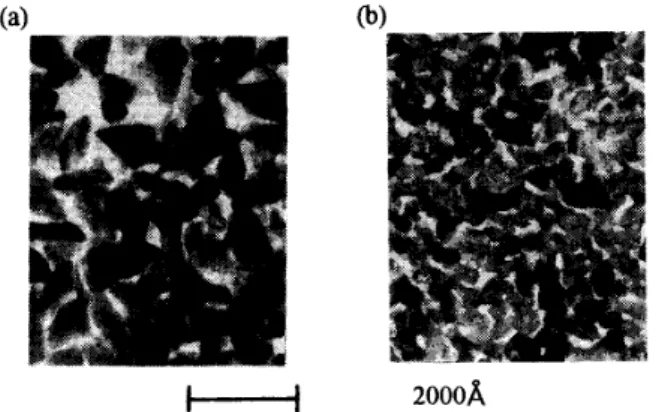
The crystal grain size of each of the samples was investigated by TEM. The films with pure or Codoped y- Fe203, have an average grain size about 700 %, as shown in Fig.1 (a). However, with the doping of roughly above 2 wt.
% of Zn, the average grain size decreased sigruficantly. Fig.1 @) shows the transmission electron micrographs of
(CO, Zn)-doped y-Fe20, films containing 5 wt. %CO & 4wt.%Zn. The average grain size (-3OOA) of the (CO, Zn)- doped y-Fe203 films was much smaller than that of the pure films. This means that the grain growth during the heat treatment is suppressed by the Zn addition.
From the measurement of the saturation magnetization Ms and the coercivity Hc of all the y-Fe20, films as function of the reduction temperature T, between 300 and 400 "C , and the reduction time tR between 5 and 60 minutes . We observed several general behaviors: (1) All the film samples deposited on silicon wafer (100) have a little higher Hc and squareness ratio S; but roughly the same Ms as that on glasses. (2) The maximum values of both Ms vs T, and Hc vs T, for all the samples occur between 350 and
H
2000AFig. 1 The TEM micrographs of (a) pure y-Fe2O3 films, and (b)
(CO, Zn)-doped y-Fe2O3 films containing 5wt.% CO & 4wt.% Zn.
.OO Q 1994 IEEE
4057
200p ' . . ' ' . . . 1
400
T
( c )
300
Fig.2 The Ms and Hc as functions of TR at tR=lo minutes for two
(CO, Zn)doped y-Fe2O3 films with 5wt.% CO, and with both
5wt.% CO and 4wt.% Zn. 3
I
02
o
o
.
-;
,
0 wt.%ZnFig.3 The Ms and Hc of (CO, %)doped y-Fe;?03 f h s as
functions of tR at TR ~ 3 6 0 ° C for two (CO, %)doped y-Fe2O3
films with 5 wt.% CO, and with both 5wt.% CO and 4wt.% Zn.
370 OC, if the tR is kept at 10 minutes. (3) For all the Zn- doped film samples, 4he Hc decreases and Ms increases, when they are compared with the undoped samples. (4) The higher value of both Ms vs tR and Hc vs tR for all the samples occur at roughly 10 minutes if the TR is kept at 360 "C. As an example, The Ms and Hc as functions of both TR and tR for two y-Fe,O, thin films (one is doped with 5wt.% CO and the other is doped with both 5wt.% CO and 4W.% Zn) are plotted in Fig.2 for T R varyig between 300 and 400°C and keeping tR at 10 minutes, and in Fig.3 for tR varying
C O
wt.%
Fig.4 The Ms and Hc of Co-doped y-Fe2O3 films as function of CO content. 2 I n h
%
?
YI
I 0 10Zn
wt.%
Fig.5 The Ms and Hc of (CO, Zn)-doped y-FqO3 films containing 5wt.% CO as functions of Zn content.
between 5 and 60 minutes and keeping T, at 360 OC. We observed that for Ms vs T R and Hc vs TR, curves show maximum around 360°C; for Ms vs tR and Hc vs tR, Ms shows maximum at tR=10 minutes, and Hc shows slowly decreasing after tR roughly above 20 minutes. Why Hc decreases much slower
than
Ms for tR higher than 20 minutes? We consider this is due to the formation of a small amount of pure Fe on surface during the reduction process for tR longer than 10 minutes. After oxidation, a layer of4058
nonmagnetic F e 0 or a-Fe203 forms at the film surface; this will decrease Ms. However, the nonmagnetic layer and inner core of magnetic y-Fe,O, will produce an induced stress due to lattice mismatch, and this stress anisotropy may slow down the decreasing of Hc.
For studying the effect of CO and Zn dopants in y-
Fe,O, thin films, the heat treatment conditions for all the samples were with reduction temperature roughly at 360°C for 10 minutes, and with oxidation temperature roughly at 32OOC for 20 minutes.
The magnetic properties of CO-doped y-Fe20, films as functions of CO content were plotted in Fig. 4. We found that doping of CO into y-Fe20, , results in enhancement of Hc of the undoped samples. Fig. 4 shows that Hc increases monotonically from roughly 200 Oe for undoped y-Fe,O, films to roughly 2500 Oe for y-Fe,O, films doped with
9wt.%co. However, the Ms decreases monotonically from roughly 315 emu/c.c. for undoped y-Fe20, films to roughly 200 emu/c.c. for 9.0wt.%Co-doped y-Fe203 films. Therefore, we can vary the CO content below 9.0wt.% for get either higher Ms with lower Hc or vice versa for y-Fe20, films.
For studying the effect of both Zn and CO dopants, we chose to fix the CO content of the films as 5.0 wt.%; and to vary the Zn content from 0 to 13.0 wt.%. The magnetic properties of the films as functions of Zn content are shown in Fig. 5. It is obvious that the Hc decreases monotonically with increasing the Zn content. Hc varies from 1800 Oe for Swt.%Co-doped y-Fe203 films to 740 Oe for Swt.%Co-doped y-Fe,O, films with 13.0wt.%Zn. The increases of Ms with increasing Zn content roughly below 4wt.%Zn can be understood owing to the increase of the magnetic moment of the spinel lattice. We know that both the substitution of Fe3+ ions and vacancies by Zn2+ ions in the y-Fe203 lattice, and the Fe,+ ions forced from tetrahedral A sites to octahedral B sites by the Zn2+ ions located at A sites can increases the magnetic moment of the y-Fe,03 system. The decrease of Hc with increasing Zn content can be also understood owing to the decrease of the magnetocrystalline anisotropy [7].
For (CO, Zn)-doped y-Fe203 film samples with 5wt.%Co and with Zn content larger than 4wt.%, the decrease of Ms is due to the substitution of large amount of Zn+, into the spinel structure of A sites, therefore the moments at A sites will be too weak to affect the B site moments, so that the net moments decrease [SI. It was found that the squareness of the (CO, Zn)-doped y-Fe20, films
5
0
-
XU1
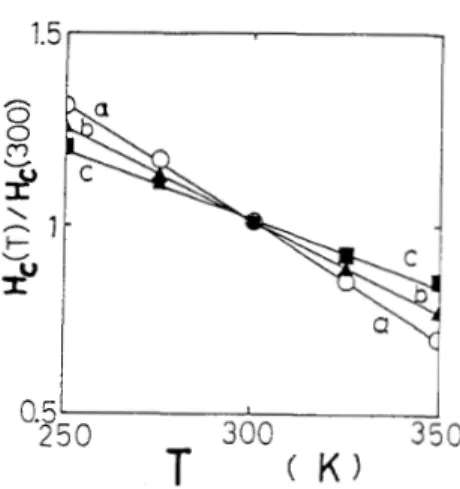
Fig.6 The normalezed coercivity as functions of temperature between 250 and 350 K for three (CO, Zn)-doped y-Fe203 film samples containing 5wt.%Co and with (a) Owt.%Zn, (b) 6wt.%Zn, and (c) 13wt.%zn
Fig. 6 shows the temperature dependence of the normalized coercivity Hc(T)/Hc(300) of three (CO, Zn)- doped y-Fe20, film samples containing 5wt.%co and with (a) Owt.%Zn, @) 6wt.%Zn, and (c) 13wt.%Zn as functions of temperatures near room temperature (250-350 K). From this Fig. we find that the temperature dependence of Wc is decreased with increasing Zn content.
REFEBENCES
[ l ] R. D. Fisher, J. C. Allan and J. L. Presseky, Magnetic properties and longitudinal recording performance of corrosion- resistant alloy films, IEEE Trans. Magn. vol. 22, 352-354 (1 986).
[2] P. Glijer, J. M. Sivertsen and J. H. Judy, Effects of platinum content and substrate bias on the structure and magnetic properties of CoCrWCr thin films, J. Appl. Phys. 73, 5563- 5565 (1993).
[3] K. Nishimoto and M. Aoyama, Preparation of y-Fe203 thin film disks by reactive evaporation and their readwite characteristics, Proc. Int. C o d . Femtes, P. 588 (1980). [4] S. Hattori, Y. Ishii, M. Shinohara, and T. Nakagawa, Magnetic
recording characteristics of sputtered ?-Fe203 thin films disks, IEEE Trans. Magn. vol. 15, 1549-1551 (1979).
[5] M. Langlet and J. C. Joubert, Influence of stress on high coercive force of y-Fe2O3 -Fe304 thin films, J. Appl. Phys.
64,
[6] 0.Ishii and I. Hataheyama, Os-doped y-Fe203 thin films having 780-786 (1 988).
was lower than that of the CO doped y-Fe203 films. For example, it decreases from 0.85 for 9.0wt.%Co-doped y-
13.0wt.%Zn. However, the exact mechanism Of these [8] B. D. Cullity, Introduction to magnetic materials, (Addison-
behaviors is not clear at present. Further research is Wesley), 1972, P. 189.
underway, and will be reported later.
high coercivity and high coercive squareness, J. Appl. Phys.
2,
2269-2271 (lgS4).P.142.
Fe2&), film samples to 0.65 for samples with 9.Owt.%Co & [7i