
An Efficient Web Mining Algorithm For Session Path Patterns
7
0
0
全文
(2) path pattern influenced by web structure will be reduced. We will illustrate it in Section 3. We propose a new algorithm SP to mine path patterns based on the idea of inclination. The rest of the paper is organized as follows. Data preparation is described in Section 2. The inclination definition is presented in Section 3. Our SP algorithm and its implementation are shown in Section 4. Section 5 discusses the characteristics of path patterns. Section 6 is the conclusion of the paper. 2.. DATA PREPARATION. A web log records information when users access web pages. The recorded information includes the IP address, the access time, and the pages accessed. The data of web server logs are in rows. A user session expresses a path of how a user browses the web site. Each path may have a different beginning page. Although every web site has a homepage, some users may start browsing from bookmarks or hyperlinks. To mine path patterns, user sessions must be extracted from web server logs. [2] discusses the methods of extracting a user session from the web log. Data can tie in different algorithms, so some special methods are used in the data preparation phase. A user session may be separated into several transactions. For example, a user session of ABCDCEF (each letter of the alphabet represents a web page) can be decomposed into two transactions ABCD and ABCEF based on the “maximum forward reference” [1]. Another method of “reference length” [2] separates the session according to the length of time users spend on the pages. A user session can also be regarded as a transaction directly [21]. Each different method of producing a transaction has different algorithms to mine path patterns. Our method treats a user session as a transaction. Unlike other methods, user sessions are sorted to increase the efficiency of our algorithm. 3.. improved in order to find more useful information. The confidence cannot be adopted on a web hyperlink structure. Using traditional methods to calculate confidence is not suitable for path patterns. For example, there is a frequent path pattern A?B. The page A that has less hyperlinks to other pages will have a higher confidence for A? B. If A is a homepage and has only one hyperlink to page B, the confidence for A? B should be higher. The reason is that after visiting page A, browsers have no choice to link to other pages except page B. This kind of confidence may throw off the user behavior analysis. 3.2 Our Path Patterns To overcome the problem of confidence value related to the number of hyperlinks for a path, we propose a different path pattern that Figure 1 illustrates. Figure 1 shows an aggregating tree [20]. It is not the hyperlink structure of a web site. The aggregating tree is constructed by using user sessions. The page of level one is the starting page for user sessions. The page M, for example, was accessed after page C 130 times in the last level. This indicates the number of user sessions containing A ?C?D?C?M.. Number of times being accessed. Link Rate. INCLINATION DEFINITION. 3.1 Web Hyperlink Structure In a web environment, the probability of each page accessed is not fairly distributed. Page access time relates to its distance from the starting pages (like homepages) of browsers. Browsing transactions are different from traditional transactions. In traditional business transactions, customers may choose any goods arbitrarily. Each choice may influence, but cannot limit, the kind of good to be chosen next. Web browsers start to view a web site from its homepage unless they input the page address directly. To give a simple examp le, we use a tree structure for the web pages. The pages closer to the top have better access time generally. This problem of imbalance needs to be. Figure 1. A simple aggregating tree After browsing page A, one has pages B and C to choose from. Comparing the number of times pages B and C are accessed will show which page is more interesting to users after browsing page A. The example in Figure 1 shows that page C was accessed 675 times which is more than page B’s 225 times. This information is useful for analyzing user behaviors. We propose a new term called inclination to express the information by using a measurable value..
(3) A page is denoted by Si , and S1 is the starting page. Let L be a set of user sessions that have the same subset S1 S2 S3 … Sn . The set L has m kinds of S1 S2 S3 … Sn Sn+1 (i.e., m kinds of Sn+1 ), which are denoted as S1 S2 … Sn (Sn+1 )1 , S1 S2 … Sn (Sn+1 )2 ,… , S1 S2 … Sn (Sn+1 )m. For each S1 S2 … Sn (Sn+1 )k in the set L, the inclination of S1 S2 S3 … Sn => (Sn+1 )k is:. Nk / ((. i? m ? i? 1. Ni ) / m ). Ni is the number of times S1 S2 … Sn (Sn+1 )i is accessed.. The SP algorithm reads sorted user sessions sequentially. After the first user session is retrieved, it is stored in a candidate string. The string is compared to the rest of the user sessions one by one. After each comparison, the counter of the candidate string is used to record the support value, as shown in Figure 2. Initially, the counters are set to one. Each counter is incremented after comparison until a match fails. The process repeats until all user sessions are read. We define a user session as {S1 ,S2 ,S3 , … ,Sn }, and a candidate string as {C1 ,C2 ,C3 … ,Cm}. Each Si and Cj represents a page (i=1,2,..,n; j=1,2,..,m). Every Cj has an associated counter to record its occurrences. If the counter of C3 is 5, it means that {C1 C2 C3 } occurred 5 times.. We explain the formula with an example. In Figure 1 the inclination of A=>C is:. A 7. C3. 675/((225+675)/2)=1.5 If users have no special inclination between A=>B and A=>C, the frequencies of A=>B and A=>C should be the same: (225+675)/2=450. The inclination value of 1 means that there is no special inclination between A=>B and A=>C. Here the inclination value of A=>C is 1.5. A value larger than 1 shows that A=>C may be more interesting to users than A=>B. Our goal is to find the path patterns in which each hyperlink exceeds the specified inclination and support values. As a confidence value, the inclination value can be set arbitrarily. If both A=>C and AC=>D exceed the inclination and support values, they can merge to A=>C=>D. We are interested more in the inclination than the support. The support value confirms that the frequency of the path pattern is large enough. A long path pattern with a high inclination may express an interesting browser behavior. 4.. USE SP ALGORITHM TO MINE PATH PATTERNS. 4.1 Sorting User Sessions We use aggregating trees to calculate the inclination value and mine path patterns. Using the sorted user sessions in our algorithm we need to scan the database only once. The sorting is based on the ordering sequence of the k-th page in each user session, where k starts from 1. For example, assume we have three user sessions: ADE, BCF, and ABC. Alphabetically, the result of sorting is: (1) ABC (2) ADE (3) BCF. The sorted user sessions can reduce the time to scan the database. Sorting is completed when user sessions are extracted from the web log file at the same time. 4.2 SP Algorithm 4.2.1 Comparing Sorted User Sessions. B 7. D 5. G 3. D 1. H J 1 1 {ABD}=5. Ci Counter. Figure 2. Data structure of a candidate string.. At each comparison step between a user session and a candidate string, Si is compared with Cj starting from S1 and C1 . Values i and j are equal at each comparison. Each comparison observes three rules: 1.. If Cj equals Si , the counter of Cj is increased by one.. 2.. If Cj is not equal to Si , or Si is non-existent, then Cj is moved from the string to a stack (Figure 7). Si becomes Cj if Si exists. When Cj is not equal to Si , the other Cj that does not comp are is regarded as unequal (i.e., AB≠AC => ABD≠ACD). The Cj that has the largest j value is removed first. This simple action does the match process for the stack.. 3.. If Si exists but Cj does not, Si becomes Cj (counter =1).. The removed Ci means that the counter of C1 C2 ..Ci is known. For example, the counter of ABC is 11. The next comparing user session is ABDE. This means that the remain ing user sessions that are not accessed yet have ABC(C1 C2 C3 ). The reason is because the user session is sorted. The removed Ci (C) will be pushed into the stack. Path patterns that exceed inclination and support values will be found from the stack. When all user sessions are read, all large sessions are found. Figure 3 shows an example of string comparison. The algorithm for comparing strings is shown in Figure 4..
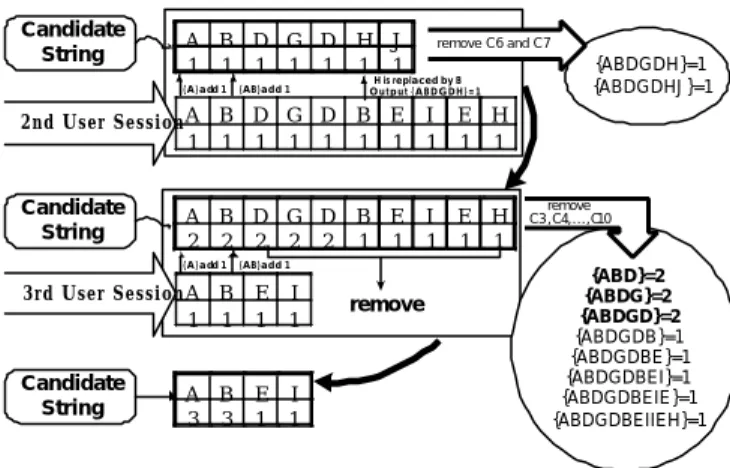
(4) Candidate String. A B D G D 1 1 1 1 1 {A}add 1. {AB}add 1. H 1. J 1. remove C6 and C7. {ABDGDH}=1 {ABDGDHJ}=1. H is replaced by B Output {ABDGDH}=1. 2nd User Session A B D G D 1 1 1 1 1. B E 1 1. I 1. E 1. H 1. Candidate String. B E 1 1. I 1. E 1. H 1. A B D G D 2 2 2 2 2 {A}add 1. 3rd User Session A B 1 1 Candidate String. A B 3 3. remove C3 ,C4,...,C10. {AB}add 1. E 1. I 1. E 1. I 1. remove. {ABD}=2 {ABDG}=2 {ABDGD}=2 {ABDGDB}=1 {ABDGDBE}=1 {ABDGDBEI}=1 {ABDGDBEIE}=1 {ABDGDBEIIEH}=1. After a successful calculation, B, E, D, and F pop out and C (AC) is pushed in. Then the process continues to read the next user session and compares strings. We use an example to illustrate our algorithm for the stack. In Section 4.2.1 we move Ci to the stack. The data being pushed into the stack for Ci is: 1) the name of Ci ; 2) the order of Ci ; 3) the counter of Ci . For example, ABD was removed (C3 is D). The order of D is three, and the counter of D is 1. Those data will be pushed into the stack. The data structure is shown in Figure 5.. Figure 3. An example of string comparison. Figure 5. The stack. candidate = the first user session; while(1) Read a new user session; if (new user session is NULL) then remove all Cj and exit while loop; for each C j and S i compare a candidate string with the user session /* the rules of comparison are in Section 4.2.1 */ if (Ci is removed) call function Stack (C i , order of C i , counter of C i ). We use a simple example to illustrate how path patterns can be found from the stack. A set of sorted user sessions was listed in Figure 6. The inclination value must exceed one, and the support value must exceed two (counter value).. Figure 4. Comparing strings. 4.2.2 Finding Path Patterns from the Stack Figure 6. Example user sessions In Section 3.2 we described how to calculate inclination. A problem must be overcome. As shown in Figure 1, to calculate the inclination of AC=>B of the aggregating tree, the children node of AC must be known. They are B, E, D, and F nodes. The counter values of ACB, ACE, ACD, and ACF also must be known. A simple solution is to scan the database once to get this information for calculating each inclination. Database scanning requires lots of I/O time. We use a stack to record necessary information and to avoid scanning the database too many times. In fact, we scan the database only once. The stack records all brother nodes, B, E, D, and F. Before confirming how many brother nodes there are for AC, the brother nodes that are recorded will not pop out. When AC is also moved to a stack, all brother nodes are known. Since the user sessions are sorted, it is impossible to read a user session that is AC* after removing AC. If AC is moved to the stack, the inclinations of ACB, ACE, ACD, and ACF can be calculated. The stack also records each counter value. The path patterns will be filtered out if they pass the inclination and support values that are set by users.. First, we read the sorted user sessions sequentially and compare strings. In Step 3 “D” is removed from the string and pushed into the stack (Figure 7). In Step 5 both “B” and “E” are moved to the stack. Since the order of “E” is larger than “B”, “E” is placed in the stack before “B”. This is a very important key for the stack operation. The elements on top of the stack must keep a status that the order of each element cannot be smaller than all the elements which are in the stack. In Figure 5, Step 5, “B” is moved to the stack. The order of “B” is two, and the element of “D” and “E” is three. It means the parent of “D” and “E” is “B”, and “B” has been removed. The children node for AB is known: “D” and “E”. The elements that are ordered smaller than “B” pop out. The elements, which have popped out in the same order, are brother nodes. The inclination value of AB? D and AB? E can be calculated: AB?D is 0.67 (support is two) and AB? E is 1.33(support is one). Each path is evaluated to become a rule if it passes the support and inclination values. AB?E is the rule and AB? D is forsaken. After.
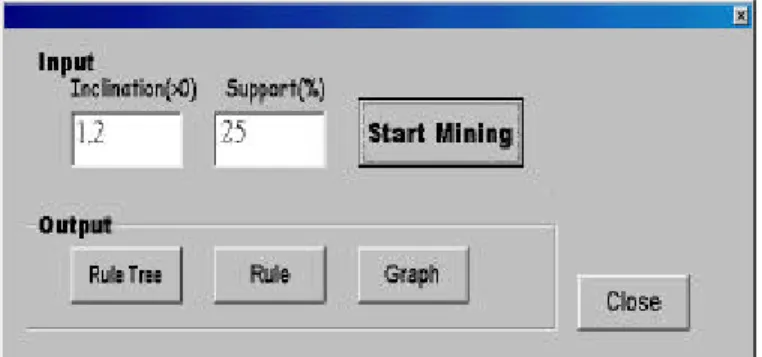
(5) popping, “B” is pushed back in the stack. In Step 6 all user sessions are read, and all the Ci ’s are moved to the stack: C and A. When “A” is pushed into the stack, “B” and “C” pop out to be calculated: A?B is 1.6, and A?C is 0.4. Finally, we get that the inclination value of “A” is one. The algorithm for processing elements on the stack is described in Figure 8.. Internet-based learning sites. Using large sessions to analyze the association between students’ learning behaviors and test scores can really help both teachers and students. If more of user profiles are available, such as sex, age, and education, one can track different levels of users with different large sessions. This information is very valuable to E-commerce services as well.. Time(sec). 25 20. S=5. 15. S=10 S=15. 10 5 0 200k. Figure 8. The stack process. 4.3 Experiments and Discussion The experiments were performed on an Ultra Enterprise 10000 running the Solaris. The clock speed of the processor is 250Mhz and the memory size is 4G bytes. A simulated Web-page tree based on a real Web site structure was created [1]. Each node represents a page. When a user stays at any one node, the probabilities that the user moves to a child node, backtracks to its parent node, or jump s to some other node in the tree are given just like in a real situation. A large number of user sessions were produced from the tree. Figure 9 shows the relationship between data size and execution time. The variable S is the average size of the sessions produced from a tree whose average height is ten. We get a linear relationship between the number of user sessions and execution time. Large sessions can show how most users browse among Web pages. To illustrate, we use a large session {ABACDCE} produced according to the tree. The large session shows that after visiting page B, users backtrack to page A and then visit page C. Adding a link from B to C maybe a good way to improve the site structure. Large sessions can also provide useful information at. 600k. 800k. 1000k. Number of transactions. Figure 7. Stack operations Stack (C i , order of Ci , counter of C i ) If the order of C i >= the order of element on the top Push C i into the stack top element-> C i else pop out the elements whose order is larger than C i ’s calculate inclination and output rules. 400k. Figure 9. Execution time 5.. VISUALIZATION OF PATH PATTERNS. We designed a prototype that can be used to visualize mining results. Figure 10 shows the prototype. The prototype includes three components: Rule, Rule Tree and Rule Graph. The Rule shows path patterns. Each rule expresses a path with its hyperlinks between nodes, passing inclination and support values. The Rule Tree describes the rule’s position in the pruned aggregating tree. Each sub path where the target node links to leaf nodes of the aggregating tree having no rule is pruned. From the integral rule of distributing over the aggregating tree, we can analyze each rule for browsers more accurately. In order to distinguish the important rules more easily, we adopt the Rule Graph to show the rules.. Figure 10. A prototype of mining path patterns.
(6) means a larger inclination value. The visualization interface helps us find interesting information from the mined rules [13] 6.. Figure 11. Rule Tree Figure 11 expresses three rule trees. Each rule tree indicates a link that has larger inclination and support values than we specify. The path of the link is also shown. For example, [1]-[2]-[3]-[6]--->[7]=30%;1.50 means that the [6]--->[7] has 1.50 inclination value and 30% support value. After the browsing path [1]-[2]-[3]-[6], it will show this result.. Figure 12. Rules. CONCLUSION. In this paper, we propose an efficient algorithm for mining session path patterns. We use inclination values with support values to find frequent path patterns. The other methods of mining path patterns, which only concern support values, could lead to controversial results because of web structure. Their methods of mining paths only account for how the web site is browsed by users. They only provide information about what users do. Our method is further concerned about how users select their ways to browse the web site. We can analyze what users want to do. In order to find path patterns efficiently, we propose a new algorithm SP. It scans databases only once and uses a small amount of memory. Our future works are to continue with further experiments using real user sessions. We will also try to improve the performance and capabilities of SP. We will use SP to mine students’study behaviors on Internet-based learning. Large sessions will be used to find what subjects students like to learn first and what study behaviors occur more frequently. These information can help improve the effectiveness of Internet-based learning. REFERENCE. Figure 12 shows the Rule interface. A rule expresses a path pattern. Each link of a rule has larger inclination and support values than we specify.. [1]. [2]. [3]. [4]. [5]. [6] Figure 13. Graph Figure 13 shows two rules using the Graph. We use the size of the circle and the width of the line to express different inclination and support values. The thicker line. [7]. M.S. Chen, J.S. Park, and P.S. Yu, “Efficient Data Mining for Path Traversal Patterns,” IEEE Tran. on Knowledge and Data Engineering, Vol. 10, No. 2, pp. 209-221, March/April 1998. B. Mobasher, and J. Srivastava, “Data Preparation for Mining World Wide Web Browsing Patterns,” Knowledge and Information Systems V1(1), February 1999. R. Agrawal, R. Srikant, “Fast Algorithms for Mining Association Rules,” In Proc. of the 20th VLDB Conference, pages 487-499, Santiago, Chile, 1994. R. Agrawal, T. Imielinski, and A. Swami, “Mining Association Rules between Sets of Items in Large Database,” Proc. ACM SIGMOD, pp. 207-216, May 1993. J.S. Park, M.S. Chen, and P. S. Yu, “Using A Hash-Based Method with Transaction Trimming for Mining Association Rules,” IEEE Trans. On Knowledge and Data Eng., Vol. 9, no. 5, pp. 813-825, Sept./Oct. 1997. M.S. Chen, J.S. Park, and P. S. Yu, “Data Mining for Path Traversal Patterns in a Web Environment,” Proc. of 16th Int’l Conf. on Distributed Computing Systems, 1996. J. Han and Y. Fu, “Discovery of Multiple-Level Association Rules from Large Databases,” Proc. 21th Int’l Conf. Very large Data Bases, pp. 420-431,.
(7) Sept. 1995. Ellen Spertus, “ParaSite: Mining Structural Information on the Web,” 6th Int’l World Wide Web Conference. http://atlanta.cs.nchu.edu.tw/ www/PAPER206.html, Apr., 1997. [9] N.D. Sweany, T.F. McManus, D.C. Williams, and K.D. Tothero, “The Use of Cognitive and Metacognitive Strategies in a Hypermedia Environment,” 1996. [10] R. Cooley, B. Mobasher, and J. srivastava, “Web Mining: Information and Pattern Discovery on the World Wide Web,” Proc. of Int’l Conf. on Tools with Artificial Intelligence, pp. 558-567, Newport Beach, CA, 1997. [11] B. Mobasher, N. Jain, E. Han, and J. Srivastava, “Web mining: Pattern discovery from world wide web transactions,” Technical Report TR 96-050, University of Minnesota, Dept. of Computer Science, Minneapolis, 1996. [12] T.W. Yan, Matthew Jacobsen, G.M. Hector, and Umeshwar Dayal, “From User Access Patterns to Dynamic Hypertext Linking,” In Fifth World-Wide Web Conference, 1996. [13] M. Klemettinen, H. Mannila, P. Ronkainen, H. Toivonen, A. I. Verkamo, “Finding Interesting Rules from Large Sets of Discovered Association Rules,” The Third International Conference on Information and Knowledge Management, Ed. Nabil R. Adam, Bharat K. Bhargava and Yelena Yesha,, Gaithersburg, Maryland. ACM Press pp. 404-407. Nov.,, 1994. [14] L. D. Catledge and J.E. Pitkow, “Characterizing Browsing Strategies in the World-Wide Web,” Proc. Third WWW Conf., Apr., 1995. [15] O. R. Zaiane, M. Xin, J. Han, “Discovering Web Access Patterns and Trends by Applying OLAP and Data Mining Technology on Web Logs,” Proc. Advances in Digital Libraries Conf. (ADL'98), Santa Barbara, CA, pp. 19-29, Apr., 1998. [16] Hiroyuki Kawano, Toshiharu Hasegawa, “Mondou: Interface with Text Data Mining for Web Search Engine,” Proc. 31st Hawaii International Conference on System Sciences, 1998. [17] A. Luotonen, “The common log file format,” http://www.w3.org/pub/WWW/ 1995 [18] Cyrus Shahabi, Amir Zarkesh, Jafar Adibi, and Vishal Shah, “Knowledge Discovery from Users Web-page Navigation,” Proceedings of Research Issues in Data Engineering (RIDE) Conference, Apr., 1997. [19] Robert Cooley, Bamshad Mobasher, and Jaideep Srivastava, “Grouping Web Page References into Transactions for Mining World Wide Web Browsing Patterns,” In Proceedings of the 1997 IEEE Knowledge and Data Engineering Exchange Workshop (KDEX-97), Nov., 1997. [20] Myra Spiliopoulou, Lukas Faulstich, C., and Karsten Winkler, “A Data Miner analyzing the [8]. [21]. Navigational Behaviour of Web Users,” In Proc. of the Workshop on Machine Learning in User Modelling of the ACAI'99 Int. Conf., Creta, Greece, July, 1999. X. Lin, L. Liu, Y. Zhang and X. Zhou, “Efficiently Computing Frequent Tree-Like Topology Patterns in a Web Environment,” Proceedings of the 31th international Conference on Technology of Object-Oriented..
(8)
數據

相關文件
The path to a healthy workplace, a critical review linking healthy workplace practices, employee well-being, and organiztion improvements.. Confirmatory factor analysis of the
For the proposed algorithm, we establish a global convergence estimate in terms of the objective value, and moreover present a dual application to the standard SCLP, which leads to
Given a connected graph G together with a coloring f from the edge set of G to a set of colors, where adjacent edges may be colored the same, a u-v path P in G is said to be a
Through despair and hope Through faith and love Till we find our place On the path unwinding In the circle. The circle
• Uses a nested structure to accumulate path data as the simulation is running. • Uses a multiple branch structure to choose the
n The information contained in the Record-Route: header is used in the subsequent requests related to the same call. n The Route: header is used to record the path that the request
• By Lemma 2, for any vertex v, the longest path start on one side of the midpoint edge and go to the opposite end of the diameter... Group the Swap
Maintain an unvisited vertice set (intially, ) Maintain an array , where stores the current. known shortest path from the source
