國立交通大學
資訊科學與工程研究所
碩士論文
線條化藝術畫之自動產生與其在資訊隱藏上之應用
A Study on Automatic Generations of Line-based
Computer Art Images and Their Applications for
Information Hiding
研 究 生:劉珊君
指導教授:蔡文祥 教授
線條化藝術畫之自動產生與其在資訊隱藏上之應用
A Study on Automatic Generations of Line-based Computer Art Images
and Their Applications for Information Hiding
研 究 生:劉珊君
Student: Shan-Chun Liu
指導教授:蔡文祥
Advisor: Prof. Wen-Hsiang Tsai
國 立 交 通 大 學
資 訊 科 學 與 工 程 研 究 所 碩 士 論 文
A Thesis
Submitted to Institute of Computer Science and Engineering College of Computer Science
National Chiao Tung University In partial Fulfillment of the Requirements
For the Degree of Master
In
Computer Science June 2011
Hsinchu, Taiwan, Republic of China
i
線條化藝術畫之自動產生與其在資訊隱藏上之應用
研究生: 劉珊君
指導教授: 蔡文祥 博士
國立交通大學資訊科學與工程研究所
摘要
本論文研究探討了三種藝術影像的自動產生與資訊隱藏技術。這三種不同類 型的藝術影像分別是「線條化類立體主義畫作」,「條狀化類未來主義畫作」,與 「方塊化類新造型主義畫作」。除了建立一套自動產生這三種藝術畫的系統外, 並利用其在影像處理上的特性,各提出了一種資訊隱藏的技術,以達到秘密傳輸 之應用。第一種藝術畫─線條化類立體主義畫作的產生方式,是將一張原始影像 用霍夫轉換方式找到影像中主要的線條,再用這些線條重新組合出立體單色形塊 的新藝術。進而根據人類視覺對平均區塊顏色的敏感度較低這項特性,在維持區 塊的顏色平均下,決定各個像素重新填色的方式,來達到藏入秘密訊息的效果。 第二種藝術畫─條狀化類未來主義畫作的產生方式,是先將一張原始影像分割成 許多單色大區塊,並依其方向特徵加以切割成條狀。另利用此藝術畫留白畫風的 特性來產生不同填色的順序,達到藏入秘密訊息的效果。最後一種藝術畫─方塊 化類新造型主義畫作的產生方式,是將一張原始影像用二元空間切割方式及相互 信息(mutual information)進行遞迴式水平或垂直切割。本論文提出了兩個方法來 利用此藝術畫來進行秘密傳輸:第一種是在二元空間分割過程中產生此影像的二 元分割樹,利用微調葉節點的區塊平均色方式來達到藏入秘密訊息的效果;第二 種是在區塊填色的時候,用二元空間切割方式逐步填色,用不同填色方向來達到 藏入秘密訊息的效果。 除了上述的方法外,我們還提出了幾個增加安全性的方法,確保藏入的秘密 資訊不被駭客發現。這些方法皆有實驗結果證明它們在視覺方面達到預期效果, 以及在資訊隱藏技術上的可行性。ii
A Study on Automatic Generations of Line-based
Computer Art Images and Their Applications for
Information Hiding
Student: Shan-Chun Liu
Advisor: Wen-Hsiang Tsai
Institute of Computer Science and Engineering
National Chiao Tung University
ABSTRACT
In this study, three kinds of line-type computer art images are created, called line-based Cubism-like image, strip-based Futurism-like image, and rectangle-based Neo-Plasticism-like image. Also proposed are three data hiding techniques for covert communication via these types of art images, respectively.
In the creation of line-based Cubism-like images, the longer line segments in a source image are detected and rearranged to form a new 3D-like shape for each color component in the image. In a process of re-coloring the regions in the new image, a data hiding technique is designed skillfully to embed a secret message into the image by keeping the average color of the region unchanged.
In the strip-based Futurism-like image creation process, the boundary chain codes of each region yielded by image segmentation are utilized to analyze the region characteristics such as corner points and region directions. By drawing the edges formed by the found corner points, an effect of polygon approximation of the prominent regions in the source image is obtained. Then, each region is partitioned into strips in accordance with the extracted region direction, and a given secret message is hidden into the resulting image by coloring the strips with the white color or the region’s average color in a random fashion.
iii
To generate a rectangle-based Neo-Plasticism-like image, a binary space-partition scheme is used to partition a given image into multiple rectangles with the maximum mutual information. Furthermore, two methods are proposed to hide a secret message into the generated art image. One is to limit the image partitioning directions (horizontal and vertical) to follow an alternative order and hide the secret messages into the leaf nodes of a partition tree yielded by the binary space-partition scheme. The other method does not limit the partitioning direction order, and fills the regions with horizontal or vertical color lines to embed the secret message.
In addition, for each art image, the user is allowed to select some parameters to create his/her favorite art images. Various security enhancement measures are also proposed to make the embedded data more random to prevent hackers’ attacks. Experimental results showing the feasibility of the proposed methods for art image creation and data hiding applications are also included.
iv
ACKNOWLEDGEMENTS
The author is in hearty appreciation of the continuous guidance, discussions, support, and encouragement received from her advisor, Dr. Wen-Hsiang Tsai, not only in the development of this thesis, but also in every aspect of her personal growth.
Appreciation is also given to the colleagues of the Computer Vision Laboratory in the Institute of Computer Science and Engineering at National Chiao Tung University for their suggestions and help during her thesis study.
Finally, the author also extends her profound thanks to her dear family and boyfriend for their lasting love, care, and encouragement.
v
CONTENTS
ABSTRACT (in Chinese)………..i
ABSTRACT (in English)……….ii
ACKNOWLEDGEMMENTS………iv
CONTENTS………..v
LIST OF FIGURES………...viii
LIST OF TABLES……….xiii
Chapter 1 Introduction ... 1
1.1 Motivation and Background ... 1
1.1.1 Motivation of Study ... 1
1.1.2 Introduction to Western Art ... 2
1.2 General Review of Related Works ... 5
1.3 Overview of Proposed Methods ... 5
1.3.1 Definitions of Terms ... 5
1.3.2 Brief Descriptions of Proposed Methods for Creation of and Hiding Information in Line-based Cubism-like Images ... 7
1.3.3 Brief Descriptions of Proposed Methods for Creation of and Hiding Information In Strip-based Futurism-like Images ... 8
1.3.4 Brief Descriptions of Proposed Methods for Creation of and Hiding Information in Rectangle-based Neo-Plasticism-like Images... 9
1.4 Contributions ... 11
1.5 Thesis Organization ... 12
Chapter 2 Review of Related Works ... 13
2.1 Previous Studies on Creations and Applications of Computer Art Images ... 13
2.2 General Review on Information Hiding Techniques ... 16
2.3 Previous Studies on Information Hiding Techniques via Art Images .. 18
Chapter 3 Line-based Cubism-like Image --- A New Type of Image
and Its Application to Data Hiding by Invisible
Reversible Pixel Re-Coloring ... 22
3.1 Overview of Proposed Method... 22
vi
3.2.1 Idea of Proposed Creation Technique ... 23
3.2.2 Proposed Art Image Creation Process ... 24
3.2.3 Experimental Results ... 28
3.3 Proposed Technique for Data Hiding in Line-based Cubism-like Images by Invisible Reversible Pixel Re-Coloring ... 33
3.3.1 Idea of Proposed Data Hiding Technique ... 33
3.3.2 Proposed Data Hiding Process ... 37
3.3.3 Proposed Secret Message Extraction Process ... 41
3.3.4 Security Consideration ... 43
3.3.5 Experimental Results ... 44
3.4 Summary ... 45
Chapter 4 Strip-based Futurism-like Image --- A New Type of Image
and Its Application to Data Hiding by Variable
Sub-Region Coloring ... 50
4.1 Overview of Proposed Method... 50
4.2 Proposed Strip-based Futurism-like Image Creation Process ... 51
4.2.1 Idea of Proposed Creation Technique ... 51
4.2.2 Proposed Art Image Creation Process ... 52
4.2.3 Experimental Results ... 60
4.3 Proposed Technique for Data Hiding in Strip-based Futurism-like Images by Variable Sub-Region Coloring ... 64
4.3.1 Idea of Proposed Data Hiding Technique ... 64
4.3.2 Proposed Data Hiding Process ... 64
4.3.3 Proposed Secret Message Extraction Process ... 68
4.3.4 Security Consideration ... 70
4.3.5 Experimental Results ... 70
4.4 Summary ... 71
Chapter 5 Rectangle-based Neo-Plasticism-like Image --- A New
Type of Image and Its Application to Data Hiding by
Binary Space Partitioning ... 76
5.1 Overview of Proposed Methods ... 76
5.2 Proposed Rectangle-based Neo-Plasticism-like Image Creation Process ... 77
5.2.1 Idea of Proposed Creation Technique ... 77
5.2.2 Proposed Art Image Creation Process ... 81
5.2.3 Experimental Results ... 83 5.3 Proposed Technique for Data Hiding in Rectangle-based
vii
Neo-Plasticism-like by Binary Space Partitioning ... 86
5.3.1 Idea of Proposed Data Hiding Technique ... 86
5.3.2 Proposed Data Hiding Process ... 88
5.3.3 Proposed Secret Message Extraction Process ... 94
5.3.4 Security Consideration ... 97
5.3.5 Experimental Results ... 98
5.4 Summary ... 99
Chapter 6 Conclusions and Suggestions for Future Works ... 108
6.1 Conclusions ... 108
6.2 Suggestions for Future Works ... 109
viii
LIST OF FIGURES
Figure 1.1 Paintings of Cubism. (A) Les Demoiselles D'avignon (―The young ladies of Avignon‖), Pablo Picasso, 1907. (B) Oberweimar, Lyonel Feininger,
1921. ... 3
Figure 1.2 Paintings of Futurism. (A) The traveler, Lyubov Sergeyevna Popova, 1915. (B) In the hold, David Garshen Bomberg, 1914. ... 4
Figure 1.3 Neo-Plasticism paintings of Piet Mondrian. (A) Composition A, 1920. (B) Composition with gray and light brown, 1918. ... 4
Figure 1.4 Proposed creation process of line-based Cubism-like image. ... 7
Figure 1.5 Proposed data hiding process by invisible reversible pixel re-coloring. .. 8
Figure 1.6 Proposed creation process of strip-based Futurism-like image. ... 9
Figure 1.7 Proposed data hiding process by variable sub-region coloring. ... 10
Figure 1.8 Proposed creation process of rectangle-based Neo-Plasticism-like image. ... 10
Figure 1.9 Proposed data hiding process by the use of a binary partition tree. ... 11
Figure 2.1 The images created by Hertzmann [2] and Hertzmann [3]. (A) An image with the effect of watercolor painting. (B) An image with the effect of oil painting. ... 14
Figure 2.2 Other types of art images. (A) A pen-and-ink drawing from Salisbury [4]. (B) A stipple image from Mould [5]. (C) A stained glass image from Mould [6]. ... 14
Figure 2.3 Some tile mosaic images created by Hausner [7]. ... 15
Figure 2.4 Images created by Haeberli’S method [8]. ... 15
Figure 2.5 Images created by Song, et al. [9]. ... 16
Figure 2.6 Image mosaics. (A) An image mosaic created from Lin and Tsai [15]. (B) An image mosaic created from Wang and Tsai [16]. ... 19
Figure 2.7 A secret-fragment-visible mosaic image created with Lai and Tsai’ method [17]. (A) Original image. (B) Generated secret-fragment-visible mosaic image. ... 19
Figure 2.8 Art images created by Hsu and Tsai [18]. (A) A digital puzzle image. (B) A digital pointillistic image. (C) A digital circular-dotted image. ... 20
Figure 2.9 Two examples of art images. (A) A stained glass image from Hung and Tsai [19]. (B) A tetromino-based mosaic from Chang and Tsai [20]. .... 21
Figure 3.1 Process of crossing-image line creation. ... 26 Figure 3.2 An experimental result of varying the threshold values of Dmin and Lmin.
ix
created from (A) With initial Dmin = 102 and initial Lmin = 102. (C) A
Cubism-like image created from (A) with Dmin = 20 and Lmin = 102. (D)
A Cubism-like image created from (A) with Dmin = 102 and Lmin = 20. (E)
A Cubism-like image created from (A) with Dmin = 200 and Lmin = 102.
(F) A Cubism-like image created from (A) with Dmin = 102 and Lmin =
200. ... 27 Figure 3.3 Experimental images. (A) A source image with size 1024768. (B) Initial Dmin = 102 and initial Lmin = 102. (C) (Dmin, Lmin) = (51, 51). (D)
(Dmin, Lmin) = (51, 102). (E) (Dmin, Lmin) = (51, 204). (F) (Dmin, Lmin) =
(102, 51). (G) (Dmin, Lmin) = (102, 102). (H) (Dmin, Lmin) = (102, 204). (I)
(Dmin, Lmin) = (204, 51). (J) (Dmin, Lmin) = (204, 102). (K) (Dmin, Lmin) =
(204, 204). (L) A better choice of 9 images to fit the abstract style of Figure 3.3(A) is Dmin=102 and Lmin=51. ... 29
Figure 3.4 Experimental images. (A) A source image with size 1024768. (B) Initial Dmin = 102 and initial Lmin = 102. (C) (Dmin, Lmin) = (51, 51). (D)
(Dmin, Lmin) = (51, 102). (E) (Dmin, Lmin) = (51, 204). (F) (Dmin, Lmin) =
(102, 51). (G) (Dmin, Lmin) = (102, 102). (H) (Dmin, Lmin) = (102, 204). (I)
(Dmin, Lmin) = (204, 51). (J) (Dmin, Lmin) = (204, 102). (K) (Dmin, Lmin) =
(204, 204). (L) A better choice of 9 images to fit the abstract style of Figure 3.4(A) is Dmin=102 and Lmin=51. ... 30
Figure 3.5 Experimental images. (A) A source image with size 7681024. (B) Initial Dmin = 102 and initial Lmin = 102. (C) (Dmin, Lmin) = (51, 51). (D)
(Dmin, Lmin) = (51, 102). (E) (Dmin, Lmin) = (51, 204). (F) (Dmin, Lmin) =
(102, 51). (G) (Dmin, Lmin) = (102, 102). (H) (Dmin, Lmin) = (102, 204). (I)
(Dmin, Lmin) = (204, 51). (J) (Dmin, Lmin) = (204, 102). (K) (Dmin, Lmin) =
(204, 204). (L) A better choice of 9 images to fit the abstract style of Figure 3.5(A) is Dmin=102 and Lmin=102. ... 32
Figure 3.6 The process of transforming M into M with a length of a multiple of three by appending an ending pattern. ... 38 Figure 3.7 An experimental result. (A) A source image (cover image). (B) A Cubism-like image without secret message embedding. (C) A stego-image of (A) by embedding the secret message ―Hi, I am Helen. Nice to meet you!‖ with the secret key ―door.‖ ... 46 Figure 3.8 Extracting the secret message with the right secret key ―door.‖ ... 47 Figure 3.9 Extracted erroneous secret message with a wrong key ―doo.‖ ... 47 Figure 3.10 An experimental result. (A) A source image (cover image). (B) A Cubism-like image without secret message embedding. (C) A stego-image of (A) by embedding the secret message ―Meet me at 21:30.
x
See you.‖ with the secret key ―test.‖ ... 48 Figure 3.11 Extracting the secret message with the right secret key ―test.‖ ... 49 Figure 3.12 Extracted erroneous secret message with a wrong key ―tete.‖ ... 49 Figure 4.1 Chain codes. (A) The eight directions given by Freeman chain codes [23]. (B) The new eight directions used in this study. ... 53 Figure 4.2 An example of looping error of chain codes. (A) A case of chain codes which yields a looping error. the pink grid is the start pixel of chain code tracing. (B) An erosion result of (A). (C) A dilation result of (B). ... 54 Figure 4.3 An example of finding corner points. (A) An example of chain codes. (B) The direction changes in X coordinate. (C) The direction changes in Y coordinate. (D) The result of connecting all corner points. ... 56 Figure 4.4 An example of polygon approximation by using the chain codes. (A) A source image. (B) The result of image segmentation by region merging of (A). (C) The result of polygon approximation by connecting the corner points of each region of (B). ... 61
Figure 4.5 Experimental images. (A) A source image. (B) A Futurism-like image created by (A) with strip width as small. (C) A Futurism-like image created by (A) with strip width as middle. (D) A Futurism-like image created by (A) with strip width as large. ... 61 Figure 4.6 Experimental images. (A) A source image. (B) A Futurism-like image created by (A) with strip width as small. (C) A Futurism-like image created by (A) with strip width as middle. (D) A Futurism-like image created by (A) with strip width as large. ... 62 Figure 4.7 Experimental images. (A) A source image. (B) A Futurism-like image created by (A) with strip width as small. (C) A Futurism-like image created by (A) with strip width as middle. (D) A Futurism-like image created by (A) with strip width as large. ... 63 Figure 4.8 Experimental results of drawing strips in another way. (A) Three source images. (B) The experimental results. ... 63 Figure 4.9 An experimental result. (A) A source image (cover image). (B) A Futurism-like image without secret message embedding. (C) A stego-image of (A) by embedding the secret message ―Make hay while the sun shines.‖ with the secret key ―Sun.‖ ... 72 Figure 4.10 Extracting the secret message with the right secret key ―Sun.‖ ... 73 Figure 4.11 Extracted erroneous secret messages with a wrong key ―SunSun.‖ ... 73 Figure 4.12 An experimental result with strip width as middle. (A) A source image (cover image). (B) A Futurism-like image without secret message embedding. (C) A stego-image of (A) by embedding the secret message
xi
―Learning makes life sweet.‖ with the secret key ―tower.‖ ... 74 Figure 4.13 Extracting the secret message with the right secret key ―tower.‖ ... 75 Figure 4.14 Extracted erroneous secret messages with a wrong key ―tower321.‖ .... 75 Figure 5.1 An example of partitioning. ... 79 Figure 5.2 An example about the similarity measure. (A) A source image (B) The result of (A) with the partition iteration to be 30. (C) The result of (A) with the partition iteration to be 30 by using 0.05 as the lower bound of similarity measure. ... 80 Figure 5.3 Experimental images. (A) A source image. (B) A Neo-Plasticism-like image created by (A) with partition iteration to be 5. (C) A Neo-Plasticism-like image created by (A) with partition iteration to be 10. (D) A Neo-Plasticism-like image created by (A) with partition iteration to be 15. ... 84 Figure 5.4 Experimental images. (A) A source image. (B) A Neo-Plasticism-like image created by (A) with partition iteration to be 5. (C) A Neo-Plasticism-like Image created by (A) with partition iteration to be 10. (D) A Neo-Plasticism-like image created by (A) with partition iteration to be 15. ... 85 Figure 5.5 Experimental images. (A) A source image. (B) A Neo-Plasticism-like image created by (A) with partition iteration to be 5. (C) A Neo-Plasticism-like image created by (A) with partition iteration to be 10. (D) A Neo-Plasticism-like image created by (A) with partition iteration to be 15. ... 85 Figure 5.6 An example of building a partition tree. (A) A partitioned region with the red line as the first partition line. (B) A partition tree which is built according to (A). (C) A partitioned region with alternate order of horizontal and vertical direction. (D) A partition tree which is built according to (C). ... 87 Figure 5.7 An example of coloring by binary space partition order. ... 88 Figure 5.8 An experimental result by using the first data hiding method with partition iteration as 10. (A) A source image (cover image). (B) A Neo-Plasticism-like image without secret message embedding. (C) A stego-image of (A) by embedding the secret message ―Enjoy your own life without comparing it with that of another.‖ with the secret key ―life.‖ ... 100 Figure 5.9 Extracting the secret message with the right secret key ―life.‖ ... 101 Figure 5.10 Extracted erroneous secret message with a wrong key ―live.‖ ... 101 Figure 5.11 An experimental result by using the first data hiding method with
xii
partition iteration as 15. (A) A source image (cover image). (B) A Neo-Plasticism-like image without secret message embedding. (C) A stego-image of (A) by embedding the secret message ―Life is not an exact science, it is an art.‖ with the secret key ―flower.‖... 102 Figure 5.12 Extracting the secret message with the right secret key ―flower.‖ ... 103 Figure 5.13 Extracted erroneous secret message with a wrong key ―flowes.‖ ... 103 Figure 5.14 An experimental result by using the second data hiding method with partition iteration as 8. (A) A source image (cover image). (B) A Neo-Plasticism-like image without secret message embedding. (C) A stego-image of (A) by embedding the secret message ―Everybody is a moon, and has a dark side which he never shows to anybody.‖ with the secret key ―moon.‖ ... 104 Figure 5.15 Extracting the secret message with the right secret key ―moon.‖ ... 105 Figure 5.16 Extracted erroneous secret message with a wrong key ―moo.‖ ... 105 Figure 5.17 An experimental result by using the second data hiding method with partition iteration as 10. (A) A source image (cover image). (B) A Neo-Plasticism-like image without secret message embedding. (C) A stego-image of (A) by embedding the secret message ―No beauty is like the beauty of mind.‖ with the secret key ―woman.‖ ... 106 Figure 5.18 Extracting the secret message with the right secret key ―woman.‖ ... 107 Figure 5.19 Extracted erroneous secret message with a wrong key ―womal.‖ ... 107
xiii
LIST OF TABLES
Table 4.1 A table between the direction of chain code and the change of X and Y coordinate. ... 55 Table 4.2 A mapping table between two bits of original data and three bits of new
1
Chapter 1
Introduction
1.1 Motivation and Background
1.1.1 Motivation of Study
With the development of the computer technology, the Internet is used widely in people’s daily life nowadays. Through the Internet, many social network services have been built, including communication, information sharing, etc. For example, many people share their life photos on web albums through websites like Flickr and Picasa. However, the convenient network technologies also bring some drawbacks in communication security. Malicious hackers might steal or tamper with the data contents on the Internet. Besides, certain important information, such as bank account passwords, intelligence data, and so on, is extremely private and should be protected cautiously. In order to avoid divulging secret data, how to protect such information has become an important issue in people’s daily life.
On the other hand, the evolution of human civilization is often accompanied with the development of art. For example, in the history of Western art, different periods and different thoughts affect the creation of different art schools. In recent years, unlike the artificial art, some visual arts are produced by computers, creating a new type of art, called computer art. An example is mosaic image which is composed of small pieces with the form of rectangular blocks or irregular shapes.
2
approaches to data hiding and art image creation for information protection in this study. Using art images as disguises of secret data, people may be attracted to appreciate their artistic contents, and thus ignore other non-artistic properties of the image yielded by information hiding. Therefore, it is advantageous to integrate data hiding techniques into art image creation to hide information.
Specifically, we try to design new techniques for creating new types of computer art. In the Western art history, the characteristics of different art schools have been influenced by one another, so common features exist in some art styles of the schools. For example, one of the common ideas of the Neo-Plasticism, Cubism, and Futurism is the use of the line feature. This idea emphasizes creating line artworks for different reasons like speed, space partitioning, or spatial reorganization. Accordingly, we propose in this study three different kinds of line-based computer art named
line-based Cubism-like image, strip-based Futurism-like image, and rectangle-based Neo-Plasticism-like image, respectively. For each type of computer art we design, we
propose also a new technique of data hiding to embed secret messages into images of the type during the creation process of them. By using such art images as camouflages, people will tend to believe that an art image of these kinds is only an artistic production and so ignore the secret data embedded in it. Additionally, all the proposed data hiding methods should take advantages of the characteristics of the new types of images.
1.1.2 Introduction to Western Art
The Western art coming mainly from European countries exist for thousands of years. Different art schools were created in different periods with different thoughts, and the features of different art types have been influenced by one another. In the 20th
3
century, modern art threw the traditions of the past and began to develop in its own way. Modern artists created their artworks with new viewpoints and fresh ideas about the nature of materials. In general, the trend toward abstraction is the main characteristic of the modern art.
For example, Cubism artists break up, analyze, and re-assemble objects in abstract forms. Main artists of Cubism include Pablo Picasso and Lyonel Feininger. Instead of depicting objects from one viewpoint, Cubism describes the subject from multiple viewpoints and represents it in different spaces. By intersecting at random angles of objects, each painting of Cubism seems to be composed of intersecting lines and fragmented shapes. A main characteristic of Cubism is to constitute a new three-dimensional shape of a certain identity by combining lines and objects after destructing its natural form. Some examples of Cubism artworks are shown in Figure 1.1.
(a) (b)
Figure 1.1 Paintings of Cubism. (a) Les Demoiselles d'Avignon (―The Young Ladies of Avignon‖), Pablo Picasso, 1907. (b) Oberweimar, Lyonel Feininger, 1921.
Secondly, Futurism creates essentially artworks of a synthetic style, with more emphasis on technology, movement, and action. Like Cubism, Futurism transforms concrete shapes into abstraction with multiple viewpoints. Moreover, the direction of movement is regarded important in the artwork and is formed by sharp lines. Artists
4
such as Natalia Goncharova, Lyubov Popova, and David Bomberg are major artisits who created pictures of Futurism. Two of their works are shown in Figure 1.2.
(a) (b)
Figure 1.2 Paintings of Futurism. (a) The Traveler, Lyubov Sergeyevna Popova, 1915. (b) In the hold, David Garshen Bomberg, 1914.
By Neo-Plasticism, the painters of the school focused on simplicity and abstraction, and reduced the image content to geometric shapes by using only straight horizontal and vertical lines and rectangular shapes. More than this, their formal composition was limited to three primary colors red, yellow, and blue, and three non-primary ones black, white, and grey. Overall, Neo-Plasticism is the art composed of plane, lines, rectangles, and a limited number of colors. The principal artist of this group is Piet Mondrian. Two artworks of his are shown in Figure 1.3.
(a) (b)
Figure 1.3 Neo-Plasticism paintings of Piet Mondrian. (a) Composition A, 1920. (b) Composition with Gray and Light Brown, 1918.
5
1.2 General Review of Related Works
In the past decade, many information hiding techniques have been proposed for various purposes, such as copyright protection, covert communication, authentication, etc. The main idea of data hiding is to embed secret messages imperceptibly into given media, so that in most cases people will not notice the existence of the hidden data. Some of the data hiding techniques were implemented via the use of images. As the art is closely related to human life, the topics of the automatic creation of art images often arouse interests of people. Many techniques, which have been proposed for the creation of computer art, will be reviewed in detail in Chapter 2. In addition, art images can be used for the purpose of data hiding as carriers of information. Some methods combining information hiding with art image creation have been developed in recent years, which will also be reviewed in Chapter 2.
1.3 Overview of Proposed Methods
In this study, we propose methods for creating three new kinds of art images. They are line-based Cubism-like image, strip-based Futurism-like image, and rectangle-based Neo-Plasticism-like image. First of all, a scheme for creation of each type is presented. And for each type, an information hiding method for covert communication is proposed using the specific characteristics of the image creation process. Brief descriptions of these methods are described as follows after some terms are defined.
1.3.1 Definitions of Terms
6
following.
1. Source image: a source image is an image chosen to produce a line-based
Cubism-like image, a strip-based Futurism-like image, or a rectangle-based Neo-Plasticism-like image.
2. Computer art image: a computer art image is a non-photorealistic image
created from a source image.
3. Cubism-like image: a Cubism-like image is obtained by rearranging the
lines yielded by the Hough transform.
4. Futurism-like image: a Futurism-like image is an image created by
re-partitioning the source image in accordance with the region directions (horizontal, vertical, or diagonal).
5. Neo-Plasticism-like image: a Neo-Plasticism-like image is an image
composed of rectangular tiles obtained by binary space partitioning.
6. Cover image: a cover image is a medium into which a secret message for
covert communication is to be embedded.
7. Stego-image: A stego-image is produced by embedding a secret message
into a cover image.
8. Creation process: a creation process produces a Cubism-like image, a
Futurism-like image, or a Neo-Plasticism-like image from a secret image. 9. Embedding process: an embedding process hides a secret message into a
cover image.
10. Extraction process: an extraction process retrieves a secret message from a stego-image.
7
1.3.2 Brief Descriptions of Proposed Methods for
Creation of and Hiding Information in
Line-based Cubism-like Images
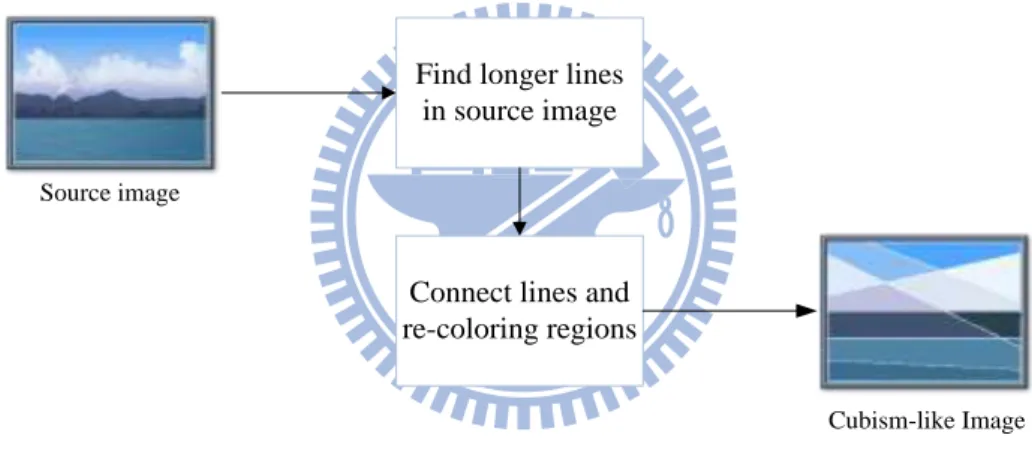
The proposed process for creation of line-based Cubism-like images is illustrated in Figure 1.4. As shown, we find longer line segments in the source image by the Hough transform. Then, we connect the line segments and extend them to the image boundaries. A line-based Cubism-like image is generated after re-coloring the regions which are produced by line rearrangement.
Find longer lines in source image
Connect lines and re-coloring regions
Source image
Cubism-like Image
Figure 1.4 Proposed creation process of line-based Cubism-like image.
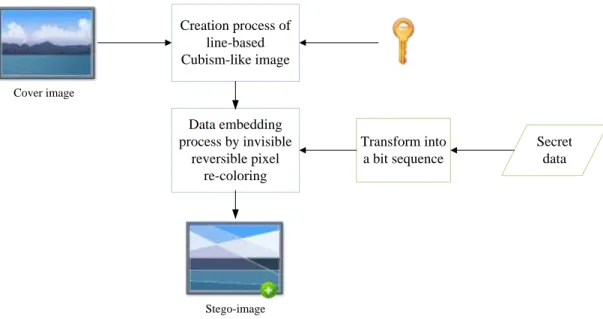
Based on the above-described creation process, we propose a data hiding technique via line-based Cubism-like images by using an invisible reversible pixel re-coloring technique. The data hiding process is shown in Figure 1.5. First, we transform a secret message to be hidden into a bit string. Secondly, in the re-coloring process, we compute the new color of each pixel to keep the average of the region color unchanged, and re-color the pixel imperceptibly. In this way of invisible reversible pixel re-coloring, a stego-image with the embedded secret message is created. Detailed descriptions of the above processes will be given in Chapter 3.
8 Transform into a bit sequence Creation process of line-based Cubism-like image Cover image Stego-image Data embedding process by invisible reversible pixel re-coloring Secret data
Figure 1.5 Proposed data hiding process by invisible reversible pixel re-coloring.
1.3.3 Brief Descriptions of Proposed Methods for
Creation of and Hiding Information in
Strip-based Futurism-like Images
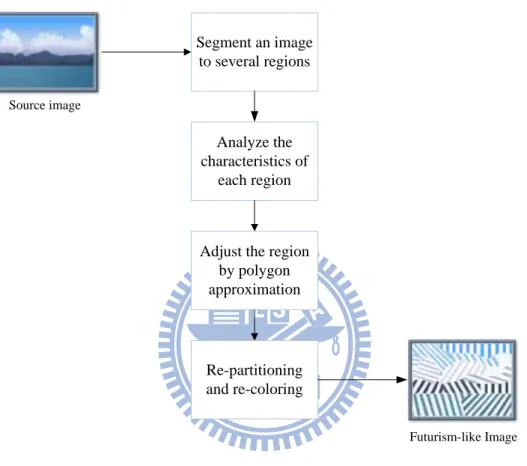
The proposed creation process of strip-based Futurism-like images is illustrated in Figure 1.6. First of all, we utilize a region merging scheme for image segmentation. Then, for each region produced, we extract some region characteristics such as the corner points and the region direction by analyzing the chain codes of the region boundary. With the corner points of each region, we obtain a polygon approximation of the region by adjusting the region edge. Finally, we partition each region into strips based on the extracted region direction.
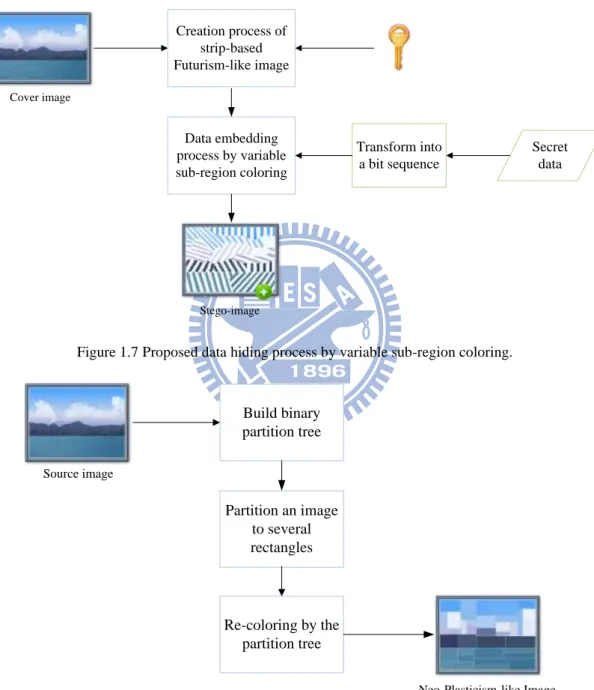
In addition, data hiding into the created Futurism-like art image is achieved in the process of creating the strips in the image. As illustrated in Figure 1.7, the process is similar to the one for hiding data into a line-based Cubism-like image. After partitioning each region into several strips, we hide a given secret message by
9
coloring the sub-region with white color or the original color. Furthermore, a user key is used to strengthen the security of hidden data by randomizing the processing order of the regions. In Chapter 4, the details of the above processes will be introduced.
Segment an image to several regions
Analyze the characteristics of
each region
Adjust the region by polygon approximation Re-partitioning and re-coloring Source image Futurism-like Image
Figure 1.6 Proposed creation process of strip-based Futurism-like image.
1.3.4 Brief Descriptions of Proposed Methods for
Creation of and Hiding Information in
Rectangle-based Neo-Plasticism-like Images
A method to create rectangle-based Neo-Plasticism image is proposed in this study. It is based on an algorithm of binary space partitioning. As illustrated by Figure 1.8, a binary partition tree is built first by finding the maximum of the mutual information (MI) which is a measure about the intensities and the spatial positions of
10
the rectangles resulting from the partitioning result of a given image. Each leaf node of the tree is a rectangular region, and a rectangle-based Neo-Plasticism image is created accordingly after coloring the regions. Besides, by different numbers of iterations of partitioning, we can create art images with different abstract levels.
Stego-image Transform into a bit sequence Creation process of strip-based Futurism-like image Cover image Data embedding process by variable sub-region coloring Secret data
Figure 1.7 Proposed data hiding process by variable sub-region coloring.
Build binary partition tree Partition an image to several rectangles Re-coloring by the partition tree Source image Neo-Plasticism-like Image
Figure 1.8 Proposed creation process of rectangle-based Neo-Plasticism-like image.
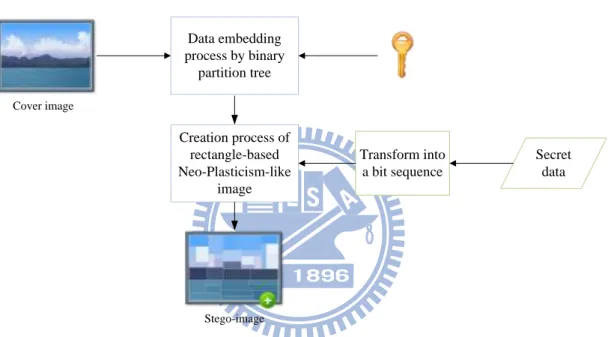
In this art image, we propose two methods to hide the secret messages. The first method of information hiding is described in Figure 1.9. The timing of using a secret
11
key is different from those in the generation of the above-mentioned two new types of art images. In the generation process of the binary partition tree, we use the key to decide the priority of the growing direction of the tree. Then, we hide the secret message in the leaf nodes of the partition tree in the process of art creation. The second method is to embed secret messages by filling the regions with horizontal or vertical color lines. The detailed algorithms of the above processes will be stated in Chapter 5. Stego-image Transform into a bit sequence Data embedding process by binary partition tree Cover image Creation process of rectangle-based Neo-Plasticism-like image Secret data
Figure 1.9 Proposed data hiding process by the use of a binary partition tree.
1.4 Contributions
Some major contributions of this study are listed in the following.
1. A method for creation of a new type of art image, called line-based Cubism-like image, is proposed.
2. A method is proposed to create a new type of art image, called strip-based Futurism-like image.
3. A method to create rectangle-based Neo-Plasticism-like images is proposed. 4. A method is proposed to hide data in line-based Cubism-like images by
12
invisible reversible pixel re-coloring.
5. A method for hiding data in strip-based Futurism-like images by variable sub-region coloring is proposed.
6. A method to embed secret data in rectangle-based Neo-Plasticism-like images by building a limited binary partition tree is proposed.
7. A method is proposed to embed secret data in rectangle-based Neo-Plasticism-like images by coloring the regions with horizontal or vertical direction.
8. A method to enhance the security of the hiding process by randomizing the processing order of the regions is proposed.
9. A method to enhance the security of the hiding process by randomizing the growing direction of the above-mentioned binary partition tree is proposed.
1.5 Thesis Organization
The remainder of this thesis is organized as follows. In Chapter 2, we review the related works about the techniques of data hiding and the creation of art images. In Chapter 3, the proposed method for creation of line-based Cubism-like images and the application of it to covert communication by invisible reversible pixel re-coloring are described. Similarly, we introduce the proposed method for creation of strip-based Futurism-like images and covert communication by variable sub-region coloring via such images in Chapter 4. In Chapter 5, the proposed method for creation of rectangle-based Neo-Plasticism-like images and the technique of information hiding via such images by building the binary partition tree and re-coloring the rectangular regions are described. Finally, conclusions of our study and suggestions for future works are given in Chapter 6.
13
Chapter 2
Review of Related Works
2.1 Previous Studies on Creations and
Applications of Computer Art
Images
In recent years, the topic of creating art images via the use of computers often arouses interests of people. More and more researchers investigate the problem of how to combine the computer technology and the art image creation for various applications, from semi-automatically to automatically. With the increasing maturation of computer technologies, creating art image automatically is the main development goal nowadays. Hertzmann [1] surveys many ideas of creating art images by stroke-based rendering (SBR) which is defined to be an automatic approach to creating non-photorealistic imagery by placing discrete elements like paint strokes and stipples. He also surveyed several SBR algorithms and styles such as painting, pen-and-ink drawing, tile mosaics, and so on. The common goal of these image styles is to make art images look like some other types of images. For example, two images created by watercolor painting and oil painting in Hertzmann [2] and Hertzmann [3], respectively, are shown in Figure 2.1. Some other types of art images are shown in Figure 2.2, where Figure 2.2(a) is an image created by pen-and-ink illustration proposed by Salisbury [4], Figure 2.2(b) is a stipple image via a stipple placement method proposed by Mould [5], and Figure 2.3(c) shows a stain-glass
14
image created by an image filter presented in Mould [6].
(a)
(b)
Figure 2.1 The images created by Hertzmann [2] and Hertzmann [3]. (a) An image with the effect of watercolor painting. (b) An image with the effect of oil painting.
(a) (b) (c)
Figure 2.2 Other types of art images. (a) A pen-and-ink drawing from Salisbury [4]. (b) A stipple image from Mould [5]. (c) A stained glass image from Mould [6].
Moreover, another type of art images is mosaic image. Mosaic images are the art of creating works, each being composed of small shapes, such as squares, circles,
15
triangles, and so on. Different from the fixed direction of mosaic arrangement, Hausner [7] creates a tile mosaic image by placing tiles to follow the edges to make the image smoother. Figure 2.3 shows some examples from Hausner [7].
Another important criterion for art image creation is to limit the number of strokes so that the resulting image looks like an abstract painting, such as the images shown in Figure 2.4 which come from Haeberli [8]. Besides, Song, et al. [9] produces an abstract synthetic art by fitting shapes like triangles or rectangles to regions in segmented images, as shown in Figure 2.5.
Figure 2.3 Some tile mosaic images created by Hausner [7].
16
In this study, we will focus on creating abstract-type images. An abstract-type image does not show a good match to the source image; however, it emphasizes the global trend or distribution of the image. The result will not look like a painting, but keep some properties of the original image. Furthermore, we try to combine some styles of Western art to create our computer art, like the use of the line feature in the Cubism, Futurism, and Neo-Plasticism schools. As a result, three different abstract-type line-dominated art images are generated in this study, namely, line-based Cubism-like image, strip-based Futurism-like image, and rectangle-based Neo-Plasticism-like image. The detailed descriptions of the creation processes for these types of images will be described in subsequent chapters.
2.2 General Review on Information
Hiding Techniques
Information hiding is a technique which embeds data imperceptibly into cover images, so that people will not perceive the existence of the hidden data. Many
17
information hiding techniques have been proposed for various purposes such as covert communication, authentication, or steganography. Moreover, information hiding techniques often utilize the weaknesses of human visual system. A well-known method is least significant bit (LSB) modification which changes the LSBs of the pixels of an image to embed information. For instance, Chan and Cheng [10] presented a data hiding method by simple LSB substitution, and Wu and Tsai [11] proposed an information hiding method according to a human vision model. They hid the secret messages in the smooth areas of an image based on the characteristics of human vision, so that the image can arouse no notice from observers.
On the other hand, the topic of data hiding via images can be classified into three groups, namely, the spatial-domain method, the frequency-domain method, and the combination of them [12]. Generally, a method in the spatial domain is sensitive against attacks like compression, but its implementation is simple. In the frequency domain, a hiding technique overcomes the problem related to robustness found in the spatial domain, but sometimes produces more distortion. For example, Ni, et al. [13] presented a reversible data hiding algorithm for embedding data in the spatial domain by using the zero or the minimum point of the histogram and slightly modifying the pixel values. Xuan, et al. [14] proposed an approach to hiding secret data into one (or more) middle bitplane(s) of the integer wavelet transform coefficients in the middle and high subbands of the frequency domain. No matter what types they belong to, most of these researches are based on pixel-wise or block-wise operations and make use of few image features.
In this study, data hiding methods using individual features of art images will be proposed. Unlike the traditional methods of data hiding via images, we will hide data in the creation process of art images by modifying the average RGB value of each region of an image or by building the structure of a partition tree. More than this, we
18
will also implement some schemes to enhance the security of hiding by randomizing the direction of tree building or the order of coloring. In the following chapters, the details will be described.
2.3 Previous Studies on Information
Hiding Techniques via Art Images
The combination of information hiding techniques and art image creation is a new idea of information security technology. Techniques based on this idea utilize the characteristics of the creation process of the art image to embed extra information in the generated images. Due to this way of camouflage, secret data can so be kept or transmitted covertly and securely. In addition, hackers will also tend to get unaware of the secret embedded in such images and this reduces the danger of being stolen or being tampered with.
Specifically, Lin and Tsai [15] proposed algorithms to embed secret messages in image mosaics by adding visible boundary regions to the four sides of tiles and modifying the histogram of tile images. Wang and Tsai [16] presented a data hiding technique for image mosaics as well. By varying the overlapping degrees of adjacent tile images, the method can create a new-style mosaic image in which bits of the message data are embedded. Some resulting images created via these two methods are shown in Figure 2.6. Different from the intuitive idea of image mosaics, Lai and Tsai [17] created a new type of mosaic image, called secret-fragment-visible mosaic, which is reconstituted with rectangle fragments yielded by partitioning of the original image. A method to embed secret messages is proposed by switching the relative positions of tile images which have similar colors in an identical bin of the histogram. The resulting mosaic image is still a meaningful image like another one, as shown in
19
Figure 2.7.
In addition to previous methods, numerous researches on combining other types of art images and data hiding have been given. Hsu and Tsai [18] presented three new types of art images and three methods to hide secret information in art images by using the features of the creation process. The first type of image, digital puzzle image, is generated to embed data by modifying the orientations, sizes, and angles of the
(a) (b)
Figure 2.6 Image mosaics. (a) An image mosaic created from Lin and Tsai [15]. (b) An image mosaic created from Wang and Tsai [16].
(a) (b)
Figure 2.7 A Secret-fragment-visible mosaic image created with Lai and Tsai’ method [17]. (a) Original image. (b) Generated secret-fragment-visible mosaic image.
20
puzzle pieces. Second, in the new type of pointillistic image, palette colors are used for data hiding by varying the RGB values of each color dot of the pointillistic image. And the last, a new art image called circular-dotted image is created to embed secret messages by using the drawing order of the circular dots and a circular dot overlapping scheme. Some examples of the art images created by Hsu and Tsai [18] are shown in Figure 2.8.
Additionally, an information hiding approach was proposed through the use of stained glass images by Hung and Tsai [19]. The secret data can be hidden in stained glass images by modifying the tree structure used in the creation process. A result generated by the method is shown in Figure 2.9(a). Chang and Tsai [20] created a new type of art image, called tetromino-based mosaic, which is composed of tetrominoes of the Tetris game. A tetromino is a geometric shape composed of four squares which is connected orthogonally. By the composition of geometric forms, tetrominoes can be combined to fit into a fixed shape (rectangles mostly) to form blocks which then are used to fill an image plane. A data hiding method is proposed by using distinct
(a) (b) (c)
Figure 2.8 Art images created by Hsu and Tsai [18]. (a) A digital puzzle image. (b) A digital pointillistic image. (c) A digital circular-dotted image.
21
combinations and color shifting of the tetromino elements. An image yielded by Chang and Tsai [20] is shown in Figure 2.9(b).
In this study, we also propose new methods which combine information hiding techniques and art image creation to achieve covert communication. By utilizing the characteristics of the creation processes of three art images, which are line-based Cubism-like image, strip-based Futurism-like image, and rectangle-based Neo-Plasticism-like image, the images can be transmitted or kept with the secret data embedded without arousing attention from other people.
(a) (b)
Figure 2.9 Two examples of art images. (a) A stained glass image from Hung and Tsai [19]. (b) A tetromino-based mosaic from Chang and Tsai [20].
22
Chapter 3
Line-based Cubism-like Image --- A
New Type of Image and Its
Application to Data Hiding by
Invisible Reversible Pixel
Re-coloring
3.1 Overview of Proposed Method
In this chapter, we describe how we create a type of art image like Cubism paintings automatically via the use of a computer, and we name this kind of art image
line-based Cubism-like image. By this type of art image, we try to keep a
characteristic of the Cubism art multiple viewpoints by the use of the line feature. By rearranging lines in a given image, which are yielded by applying the Hough transform to the image, a line-based Cubism-like image is created, which includes a new three-dimensional shape of each identity in the given image. In Section 3.2, the proposed method for automatic creation of line-based Cubism-like images will be described in detail.
In order to achieve the purpose of hiding information in this type of art image, we propose also a data hiding technique in this study. A given message is embedded into a line-based Cubism-like image during the stage of region coloring in the creation process of the image. We assign a new color to each image pixel by keeping unchanged the average of the color in the region which includes the pixel, and
23
re-coloring the pixel without causing a perceptible change. Furthermore, a technique is proposed to enhance the security of the hidden data by randomizing the processing order of the regions.
3.2 Proposed Line-based Cubism-like
Image Creation Process
3.2.1 Idea of Proposed Creation Technique
Cubism artists transform a natural scene into geometric forms by breaking up, analyzing, and re-assembling objects in the scene. In addition, with the scene objects rearranged to intersect at random angles, each painting of Cubism seems to be composed of intersecting lines and fragmented shapes in an abstract style. The idea of the proposed art image creation method is inspired by this concept of Cubism, as mentioned previously.
In the creation process of a line-based Cubism-like image from a given image, at first we find the longer line segments in the source image by the Hough transform. Then, we connect the line segments and extend them to reach the image boundaries. Finally, we generate the desired art image via the operations of line segment merging and region re-coloring. This process accomplishes the goal of transforming the input image into an abstract form since the lines of the created Cubism-like image tend to constitute the skeleton of the objects in the source image as observed from according to our experimental results. The detailed algorithms of the above-mentioned processes are described in the following sections.
24
3.2.2 Proposed Art Image Creation Process
In this section, we present an algorithm which implements the idea of proposed Cubism-like image creation. Basically, in the process of line detection, we find edges of the source image by utilizing the Canny edge detection technique [21], and then perform the Hough transform on the edge detection result to obtain longer line segments in the source image. By extending and recombining these longer line segments, a desired Cubism-like image is created. The detailed algorithm is given as follows.
Algorithm 3.1: line-based Cubism-like image creation.
Input: a source image S, and two threshold values the minimum length Lmin of a
line segment, and the minimum distance Dmin between two lines.
Output: a line-based Cubism-like image C.
Steps.
Stage 1 --- creating crossing-image lines.
Step 1. Perform Canny edge detection to find the edges E1, E2, …, En in source
image S, resulting in a new image S′.
Step 2. Implement the following steps to find out longer line segments in S′.
2.1 Find the line segments L1, L2, …, Lm, in S′ by applying the Hough
transform on S′, yielding a second new image S′′ of the line type. 2.2 Select those line segments in S′′ with their lengths larger than the
threshold Lmin.
2.3 Compare every line pair Li and Lj with i j in S′′ in the following way:
if the distance Dij between Li and Lj is smaller than Dmin, then delete Li
25
Step 3. Extend each of the remaining line segments in S′′ to the boundaries of S′′, and regard the source image S as being partitioned by the extended lines into regions.
Stage 2 --- re-coloring image regions.
Step 4. Create a binary image T with the same size as that of S with the initial pixel values all set to be 0.
Step 5. Fill the value of 1 into those pixels in T which correspond to those lying on each of the extended line segments in S′′.
Step 6. Implement following steps to recolor the regions in S.
6.1 Perform region growing in the binary image T in a raster-scan order, and segment out 0-valued regions, R1, R2, …, Rk, each of which is
enclosed by a group of 1-valued line segments in S′′.
6.2 Compute the area Ai of each segmented region Ri in T and the average
RGB color values (Cir, Cig, Cib) of the corresponding region Ri′ in S
using Ai, and re-color each pixel in Ri′ of S by the color values (Cir, Cig, Cib), i = 1, 2, …, k.
6.3 Re-color all lines in S corresponding to the 1-valued extended lines in
T by the white color.
Step 7. Take the final S as the desired line-based Cubism-like image C.
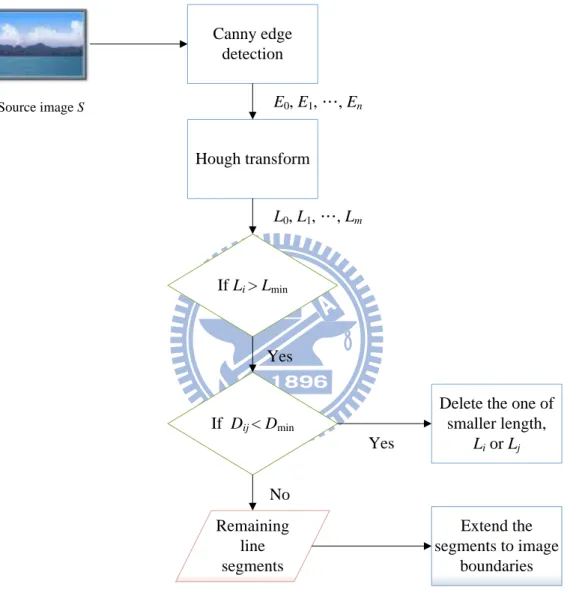
The above algorithm of line-based Cubism-like image creation, as illustrated in Figure 3.1, is composed of two stages. In Stage 1, we perform line detection to obtain the longer lines in a source image S. By Canny edge detection, we get a group of edge points. For the purpose of finding prominent line features in S, we use two thresholds to select the longer and sufficiently-separate lines from those line segments yielded by applying the Hough transform to the group of edge points. The first threshold Lmin is
26
used to filter out short line segments. The other threshold Dmin is used to filter out
extended lines which are too close to other longer lines. The final step in this stage is to extend each of the remaining line segments to cross the image, with the two line ends reaching the image boundaries.
Canny edge detection Hough transform If Li> Lmin E0, E1, …, En L0, L1, …, Lm If Dij < Dmin Yes Yes
Delete the one of smaller length, Li or Lj Source image S No Remaining line segments Extend the segments to image boundaries
Figure 3.1 Process of crossing-image line creation.
In this study, after considering the mutual influence between the image size and the line length, we use one-tenth of the longer boundary length of the image as the initial value of Lmin and Dmin. A series of experiments about the effects of varying the
values of Lmin and Dmin have been conducted, and an experimental result is shown in
27
of Lmin, the number of extracted lines will increase. With more lines, the complexity
of the created Cubism-like image also increases, giving an impression closer to the original image content. On the other hand, fewer lines make the Cubism-like image simpler and more abstract. The effect of changing the initial value of Dmin is similar to
that of Lmin.
(a) (b)
(c) (d)
(e) (f)
Figure 3.2 An experimental result of varying the threshold values of Dmin and Lmin. (a) A source image
with size 1024768. (b) A Cubism-like image created from (a) with initial Dmin = 102 and initial Lmin =
102. (c) A Cubism-like image created from (a) with Dmin = 20 and Lmin = 102. (d) A Cubism-like image
created from (a) with Dmin = 102 and Lmin = 20. (e) A Cubism-like image created from (a) with Dmin =
28
In Stage 2, with the extended line segments, the source image S is regarded as being partitioned into regions. By region growing, we segment out these regions and calculate the area and the average RGB color of each of them. Finally, a line-based Cubism-like image C is created by re-coloring these regions with the average color and all the lines with the white color.
3.2.3 Experimental Results
According to the above discussions, we see that different selections of the two threshold values Lmin and Dmin will result in totally different effects. However, it is
difficult to decide which result is better than the others because the decision is obviously dependent on the different feelings of people for art. Therefore, in this study we just offer a series of results yielded by the use of different sets of thresholds for the user to choose. Specifically, we use the normalized initial thresholds of 1/10 of the length of the longer image boundary as the center, and vary each threshold to be twice and half of its initial value, in addition to the initial one. As a result, each threshold has three choices, resulting in nine choices of the two threshold values.
Then, we generate nine art images, each corresponding to one of the nine threshold combinations, for the user to choose his/her favorite one among them. Besides, we also provide the option of choosing normalized thresholds for users, and then we produce the nine sets of threshold combinations as described above based on the choice of the user. Some Cubism-like images created by the above-proposed algorithms with nine results yielded by the use of different threshold combinations for each input source image are given in Figures 3.3 through 3.5. For simplification, we use the expression (Dmin, Lmin) to show a combination of the two thresholds in the
29
shown by the created lines and regions.
(a) (b)
(c) (d) (e)
(f) (g) (h)
(i) (j) (k)
Figure 3.3 Experimental results. (a) A source image with size 1024768. (b) Initial Dmin = 102 and
initial Lmin = 102. (c) (Dmin, Lmin) = (51, 51). (d) (Dmin, Lmin) = (51, 102). (e) (Dmin, Lmin) = (51, 204). (f)
(Dmin, Lmin) = (102, 51). (g) (Dmin, Lmin) = (102, 102). (h) (Dmin, Lmin) = (102, 204). (i) (Dmin, Lmin) =
(204, 51). (j) (Dmin, Lmin) = (204, 102). (k) (Dmin, Lmin) = (204, 204). (l) A better choice of 9 images to fit
30
(l)
Figure 3.3 Experimental results. (a) A source image with size 1024768. (b) Initial Dmin = 102 and
initial Lmin = 102. (c) (Dmin, Lmin) = (51, 51). (d) (Dmin, Lmin) = (51, 102). (e) (Dmin, Lmin) = (51, 204). (f)
(Dmin, Lmin) = (102, 51). (g) (Dmin, Lmin) = (102, 102). (h) (Dmin, Lmin) = (102, 204). (i) (Dmin, Lmin) =
(204, 51). (j) (Dmin, Lmin) = (204, 102). (k) (Dmin, Lmin) = (204, 204). (l) A better choice of 9 images to fit
the abstract style of Figure 3.3(a) is Dmin=102 and Lmin=51. (Continued.)
(a) (b)
(c) (d) (e)
Figure 3.4 Experimental results. (a) A source image with size 1024768. (b) Initial Dmin = 102 and
initial Lmin = 102. (c) (Dmin, Lmin) = (51, 51). (d) (Dmin, Lmin) = (51, 102). (e) (Dmin, Lmin) = (51, 204). (f)
(Dmin, Lmin) = (102, 51). (g) (Dmin, Lmin) = (102, 102). (h) (Dmin, Lmin) = (102, 204). (i) (Dmin, Lmin) =
(204, 51). (j) (Dmin, Lmin) = (204, 102). (k) (Dmin, Lmin) = (204, 204). (l) A better choice of 9 images to fit
31
(f) (g) (h)
(i) (j) (k)
(l)
Figure 3.4 Experimental results. (a) A source image with size 1024768. (b) Initial Dmin = 102 and
initial Lmin = 102. (c) (Dmin, Lmin) = (51, 51). (d) (Dmin, Lmin) = (51, 102). (e) (Dmin, Lmin) = (51, 204). (f)
(Dmin, Lmin) = (102, 51). (g) (Dmin, Lmin) = (102, 102). (h) (Dmin, Lmin) = (102, 204). (i) (Dmin, Lmin) =
(204, 51). (j) (Dmin, Lmin) = (204, 102). (k) (Dmin, Lmin) = (204, 204). (l) A better choice of 9 images to fit
the abstract style of Figure 3.4(a) is Dmin=102 and Lmin=51. (Continued.)
In Figures 3.3 through 3.5, Figure 3.3(a), 3.4(a), and 3.5(a) are the source images, and Figures 3.3(b), 3.4(b), and 3.5(b) show the results generated with initial thresholds. Figures 3.3(c) through (k), 3.4(c) through (k), and 3.5(c) through (k) are the experimental results with nine combinations of the thresholds. Finally, Figures 3.3(l), 3.4(l), and 3.5(l) are better choices from the respective nine results.
32
(a) (b)
(c) (d) (e)
(f) (g) (h)
Figure 3.5 Experimental results. (a) A source image with size 7681024. (b) Initial Dmin = 102 and
initial Lmin = 102. (c) (Dmin, Lmin) = (51, 51). (d) (Dmin, Lmin) = (51, 102). (e) (Dmin, Lmin) = (51, 204). (f)
(Dmin, Lmin) = (102, 51). (g) (Dmin, Lmin) = (102, 102). (h) (Dmin, Lmin) = (102, 204). (i) (Dmin, Lmin) =
(204, 51). (j) (Dmin, Lmin) = (204, 102). (k) (Dmin, Lmin) = (204, 204). (l) A better choice of 9 images to fit
33
(i) (j) (k)
(l)
Figure 3.5 Experimental results. (a) A source image with size 7681024. (b) Initial Dmin = 102 and
initial Lmin = 102. (c) (Dmin, Lmin) = (51, 51). (d) (Dmin, Lmin) = (51, 102). (e) (Dmin, Lmin) = (51, 204). (f)
(Dmin, Lmin) = (102, 51). (g) (Dmin, Lmin) = (102, 102). (h) (Dmin, Lmin) = (102, 204). (i) (Dmin, Lmin) =
(204, 51). (j) (Dmin, Lmin) = (204, 102). (k) (Dmin, Lmin) = (204, 204). (l) A better choice of 9 images to fit
the abstract style of Figure 3.5(a) is Dmin=102 and Lmin=102. (Continued.)
3.3 Proposed Technique for Data Hiding
in Line-based Cubism-like Images
by Invisible Reversible Pixel
Re-coloring
3.3.1 Idea of Proposed Data Hiding Technique
34
described in this section. In the proposed Cubism-like image creation process as presented by Algorithm 3.1 above, we re-color image regions with the respective average colors of the regions. Due to the nature of the human visual system, people cannot sense small changes in the appearance of a color image, such as color alternations or edge shiftings. Accordingly, we implement a method to hide secret a message in a cover image (a cubism-like color stego-image generated by the proposed method described previously) by slightly changing the RGB color values of the pixels in each region of the cover image. As a result, people will not be able to distinguish between the cover image and a stego-one. It is in this way that we achieve the goal of data hiding in the proposed line-based Cubism-like art image.
Besides, for the reason of reversibility in the hidden data extraction process, a region re-coloring technique is proposed, which keeps the average color of each region unchanged. Consequently, we can restore the color information of the pixels of the stego-image, and extract the secret messages embedded in them. In the following sections, these mentioned techniques used in the proposed method for data hiding in the line-based Cubism-like image will be described in detail.
More specifically, in the proposed data hiding process, after the step of hiding the message bits into a color channel, the pixel colors in a region will be changed via color shifting, and the average color of the region will also be influenced. In order to keep the average color unchanged, we must limit the number of embedded message bits. For this purpose, it is found in the study that the property of rounding-off may be utilized. Specifically, when computing the average color C of a region, all the computed results in the range between C 0.5 and C + 0.5 will be rounded to be an identical value since RGB color values used in this study are integer numbers. Accordingly, we can acquire the maximum number of embedded message bits in a region R by an equation derived as follows.

![Figure 2.1 The images created by Hertzmann [2] and Hertzmann [3]. (a) An image with the effect of watercolor painting](https://thumb-ap.123doks.com/thumbv2/9libinfo/8644655.193433/29.892.139.753.196.972/figure-images-created-hertzmann-hertzmann-effect-watercolor-painting.webp)
![Figure 2.8 Art images created by Hsu and Tsai [18]. (a) A digital puzzle image](https://thumb-ap.123doks.com/thumbv2/9libinfo/8644655.193433/35.892.149.749.401.691/figure-art-images-created-tsai-digital-puzzle-image.webp)
![Figure 2.9 Two examples of art images. (a) A stained glass image from Hung and Tsai [19]](https://thumb-ap.123doks.com/thumbv2/9libinfo/8644655.193433/36.892.187.718.226.649/figure-examples-images-stained-glass-image-hung-tsai.webp)