經 Photo-fries’重排的新高分子型光安定劑之研究(II)
計畫類別: 個別型計畫 計畫編號: NSC92-2216-E-009-017- 執行期間: 92 年 08 月 01 日至 93 年 07 月 31 日 執行單位: 國立交通大學應用化學研究所 計畫主持人: 林木獅 報告類型: 精簡報告 處理方式: 本計畫可公開查詢中 華 民 國 93 年 10 月 8 日
Kinetics and Mechanism of Photo-Fries' Rearrangement of
Aromatic Polyester, Copolyesters and Copolyester-amides (I)
Shin-Tien Lee, Ming-Wei Wang, Cheng-Tzu Lee, Ruenn-Wen Chung, and Mu-Shih Lin* Department of Applied Chemistry, National Chiao-Tung University, Hsinchu, 300 Taiwan
ABSTRACT
Three aromatic polyesters and two aromatic polyester-amides were synthesized and characterized. They are: poly(bisphenol-A terephthalate) (PBAT), poly(bisphenol-A terephthalate-alt-ethylene terephthalate) (PBATAPET), poly(bisphenol-A terephthalate-co-ethylene terephthalate) (PBATCPET), poly(bisphenol-A terephthalate-alt-hexamethylene terephthalamide) (PBATAPHMTA)
and poly(bisphenol-A terephthalate-co-hexamethylene terephthalamide)
(PBATCPHMTA). Upon irradiation of ultraviolet light ranging from 275 to 360 nm, these polymers underwent intra-molecular Photo-Fries rearrangement, leading to the formation of o-hydroxybenzophenone moiety at the pendant group, which is believed to be powerful photostabilizer. Kinetic studies of these polymers were investigated using FTIR to monitor the functional group changes. Experimental results revealed a continuous α-cleavage of the ester group, leading to decreases of ir absorptions at
νC=O 1742 cm-1 and at νC-O-C 1210 cm-1, and an increase of νC=O absorption at 1632
cm-1 for the formation of o-hydroxybenzophenone moiety. The kinetic data fitted a first-order of reaction, with rate constants of 5.67 x 10⁻³ hr-1 for PBAT > 4.02 x 10⁻³ hr-1 for PBATCPET > 3.92 x 10⁻³ hr-1 for PBATAPET> 3.90x 10⁻³ hr-1 for PBATCPHMTA > 2.78 x 10⁻³ hr-1 for PBATAPHMTA, respectively. Of all these polymers, poly(bisphenol-A terephthalate) indicated the highest rate constant and was expected to be the best photostabilizer.
INTRODUCTION
That o-hydroxybenzophenone and its derivatives are effective photostabilizers have been well known in literarure [1,2,3]. This study deals with the photo-fries’ rearrangement on aromatic polyesters, copolyesters and aromatic copolyester-amides. Photo-fries’ rearrangements of these polymers produce o-hydroxybenzophenone moiety at the pendant group which serves as a uv absorber, and therefore, these polymers are considered as effective polymeric type of photostabilizers. A comparison of the rate constants of photo-fries’ rearrangement reveals their relative photostabilization capabilities. Protection of PET by these polymeric type of
photostabilizers will be evaluated in the next chapter.
EXPERIMENTAL
Synthesis of 4-(1-{4-[(4-chlorocarbonylbenzoyl)oxy]-phenyl}-1-methyl-ethyl)phenyl 4-chlorocarbonyl-benzoate (TBT adduct)
Terephthaloyl chloride (0.02 mole) and (n-hexane/ethyl acetate 4/6 v/v, 67 ml) were charged into a 250 ml three-necked flask, equipped with a thermometer , a CaCl2
dry tube, and a magnetic stirrer. The mixture was kept at 65℃, then the solution containing Bisphenol A (0.01 mole), triethylamine (0.02 mole) and 33ml of solvent was added dropwise. The reaction proceeded for 6 hours. The reaction mixture was filtered to remove any precipitate, and coagulated in n-hexane. The TBT adduct was filtered and dried in a vacuum oven at RT for 12 hours.
Purification of TBT adduct
The first stage, TBT was dissolved in dichloroethane with small amount of activated carbon, and was refluxed for hours and then was filtered and coagulated from n-hexane. The purified TBT adduct was filtered and dried in a vacuum oven at room temperature for 12 hours. The second stage, TBT was dissolved in anhydrous acetone with small amount of activated carbon. The solution was refluxed for hours and filtered, then concentrated to supersaturated solution. Stored and kept at 4℃ overnight, then was filtered and rinsed with n-hexane to get the white crystal of TBT adduct. This adduct was identified with IR and 1H NMR to confirm its chemical structure.
Sytheses of Poly(bisphenol A terephthalate-alt-ethylene terephthalate) (PBATAPET) The above TBT adduct thus obtained was dissolved in dichloroethane to make a 0.3M solution (75ml), and was added to a 500ml three-necked flask, equipped with a mechanical stirrer and a thermometer. A solution containing triethylamine (0.045mole), ethylene glycol (0.0225mole) in 75ml of dichloroethane , capped with a CaCl2 dry tube was added dropwise, keeping at 75℃. Reaction was continued for 24
hours. Then the reaction mixture was coagulated from n-hexane. Polymer thus obtained was filtered and rinsed with deionized water and ethanol, then dried in a
vacuum oven at RT overnight then was characterized.
Syntheses of Poly(bisphenol A terephthalate-co-ethylene terephthalate) (PBATCPET) Terephthaloyl chloride was dissolved in dichloroethane to make a 0.3M solution (50ml), and was added to a 500ml three-necked flask, equipped with a mechanical stirrer and a thermometer. The solution of bisphenol A (0.0075mole), ethylene glycol (0.0075mole) and triethylamine (0.03mole) in 100ml of dichloroethane was capped with CaCl2 dry tube and was added dropwise to the above solution, keeping at 75℃.
Reaction proceeded for 24 hours, then was coagulated and dried in vacuum oven and characterized.
Syntheses of Poly(bisphenol A terephthalate) (PBAT)
bisphenol A (0.0125mole) and NaOH (0.025 mole) was dissolved in 72.5 ml of deionized water. Tetra-butylammonium bromide (0.00165 mole) in 10ml deionized water was added, and placed to a 1200 ml-autoclave. Then a solution of terephthaloyl chloride (0.0125 mole) in 35 ml of dichloroethane was added quickly under vigorously stirring for 2.5min. Another batch of solution containing terephthaloyl chloride (0.0025 mole) in 7 ml of dichloroethane was added again. Virgorous stirring was continued for another 2 mins. Then the reaction mixture was coagulated from n-hexane, filtered and rinsed with deionized water and acetone, and dried in a vacuum oven at 60℃ overnight and characterized.
Syntheses of Poly(bisphenol A terephthalate-alt-hexamethylene terephthalamide)
(PBATAPHMTA)
Similar procedure in preparing PBATAPET was employed to make
PBATAPHMTA, except using hexamethylene diamine in place of ethylene glycol.
PBATAPHMTA thus obtained was dried and characterized.
Syntheses of Poly(bisphenol A terephthalate-co-hexamethylene terephthalamide)
(PBATCPHMTA)
The syntheses method was similar to that of PBATCPET, except using hexamethylene diamine in place of ethylene glycol. PBATCPHMTA thus obtained was dried and characterized.
Chemical structure identifications were done with a Brucker AM-300 1H-NMR and a Nicolet 520 FTIR with a resolution of 1 cm-1. Solution viscosity was measured with a Ubbelohde capillary viscometer at 25 oC. Glass transition temperatures were obtained with Seiko SSC 5200 DSC. Thermal decomposition was tested with SEIKO TGA/DAT 200
Photo-Fries Rearrangement
Commercial UV lamps (UVB-313), emitting UV ranging from 275 to 360 nm with a maximum intensity at 313 nm were selected for this study. The polymer films was spin-coated on Al plates and dried, and were irradiated in a QUV accelerated wearthering tester [4] with eight UVB-313 fluorescent UV lamps (with 40 watts of each lamp). The functional group changes at various time were monitored with FTIR by placing the sample in a reflecting type sample cell (Buck Scientific). The conversion, α, is defined by α = (A0 – At) / (Ao - A∞) (1) considering: A → B (1744 cm-1) (1632 cm-1) at time t0 A0 0 at time t At = A0(1-α) Bt = αB∞ = αA0
for first –order of reaction, the rate expression can be written as - ln (1 – α) = kt
Where Ao, At are the absorbances of νC=O before irradiation, at irradiation time t.
Bo, Bt and B∞ are the corresponding concentrations of the specific group. k is the
rate constant. The difference spectra A0 – At were obtained by subtracting
absorbances before irradiation from that at time t, using benzene absorption at 1588 cm-1 as internal standard. [5]
RESULTS AND DISCUSSIONS
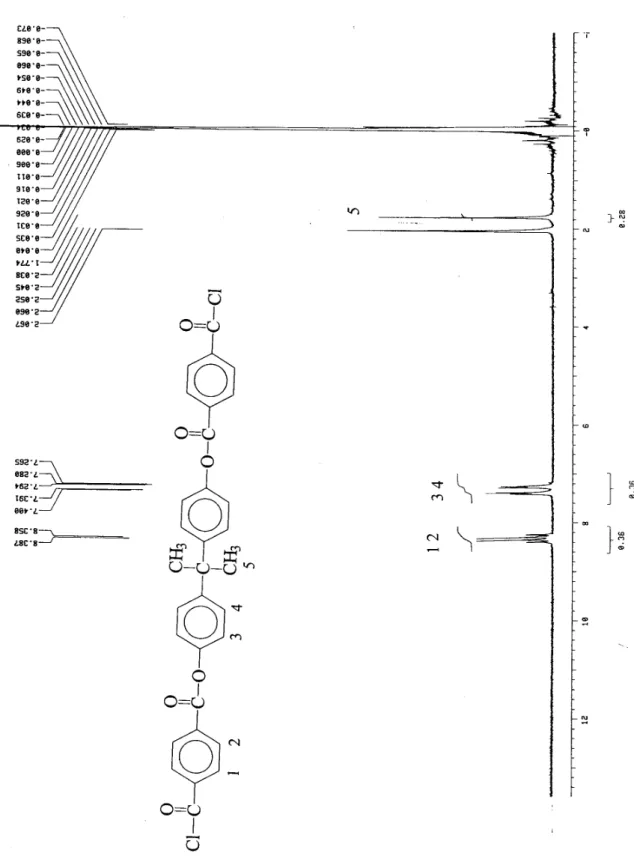
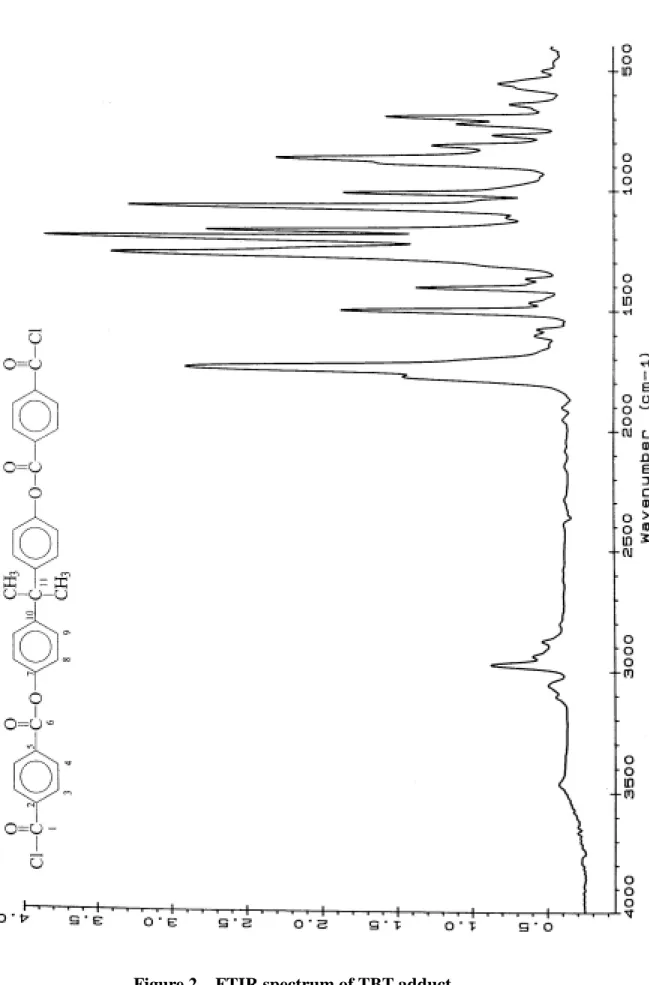
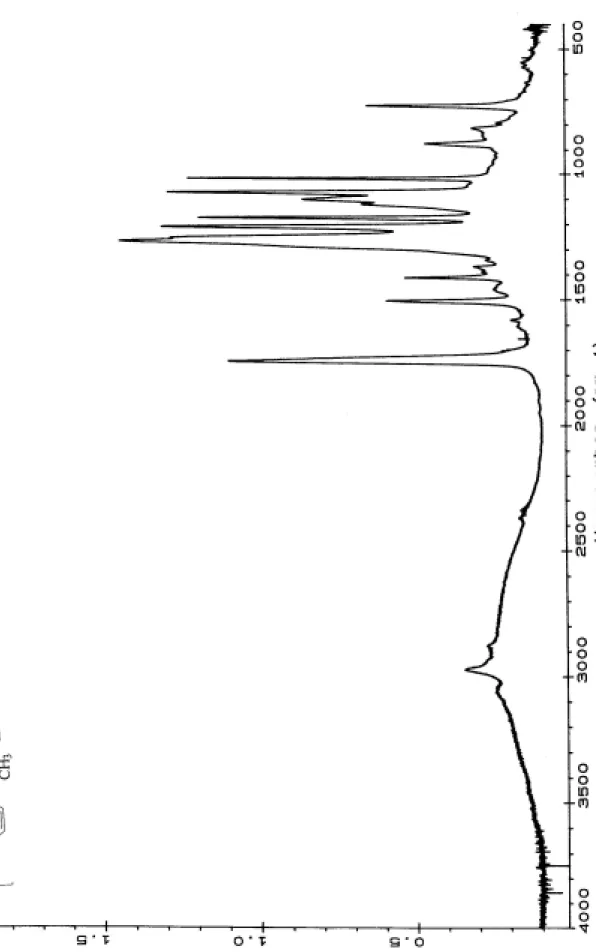
Integration of peaks at δ8.358 to 8.387 (quartet) shows four protons on the chlorocarbonyl benzoyl phenyl ring. The peaks at δ7.265 to 7.4 (doublet) is attributed to eight protons on the bisphol A ring. The peaks at δ1.774 (singlet) is attributed to six protons on the alkyl group. Figure 2 shows its FTIR spectrum. The chlorocarbonyl group occurs at 1778 cm-1, the other carbonyl group occurs at 1735 cm-1, and C-O-C stretching occurs at 1200 cm-1. The absorption of 1,4-disubstituted benzene ring occurs at 1014 cm-1. Figure 3 shows the FITR spectrum of poly(bisphenol A terephthalate). Absorptions of νC=O and νC-O-C . occur at 1742 cm-1 and 1208 cm-1,
respectively. The absorption of 1,4-disubstituted benzene ring occurs at 1014 cm-1. Missing absorption at 1735 cm-1 indicates the disappearance of νC=0 of chlorocarbonyl
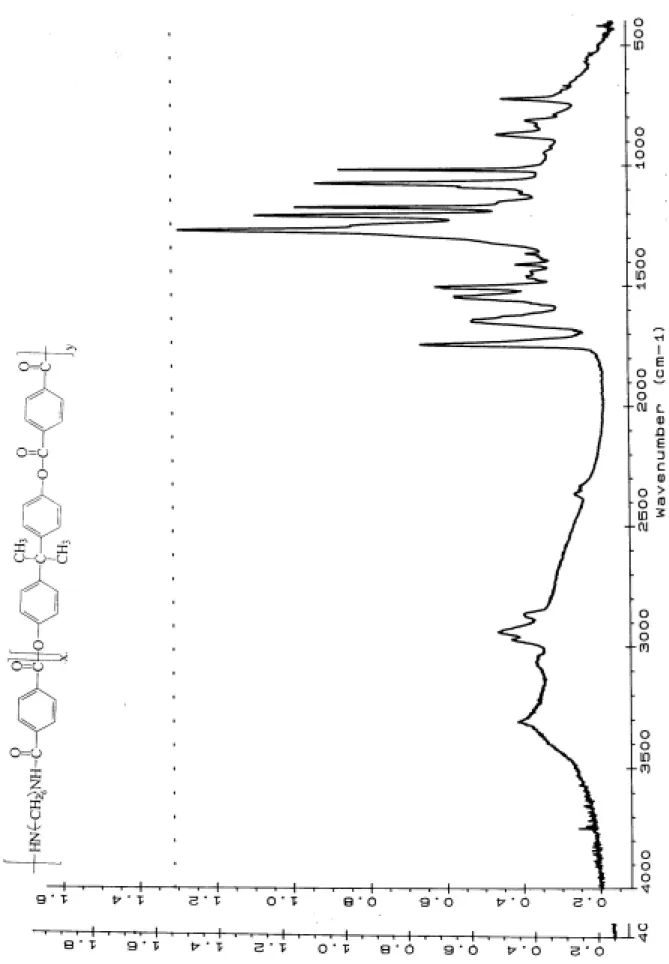
group by forming polymer. The structures of poly(bisphenol A terephthalate-alt-ethylene terephthate), poly(bisphenol A terephthalate-co-ethylene terephthalate), poly(bisphol A terephthalate) and poly(bisphenol A terephthalate-alt-hexamethylene terephthalamide) were confirmed by similar spectroscopic analyses. Broad band absorption of νN-H occurs at 3,200 to 3,500
cm-1,confirmed the existence of N-H bond in the polyester-amides, and absorptions of νC=0 at 1743 cm-1 and 1652 cm-1 are attributed to carbonyl adjacent to ester and
amide group, respectively. Absorption of νC-O-C occurs at 1211 cm-1 and
1,4-disubstituted benzene ring occurs at 1014 cm-1. Missing absorption at 1735 cm-1 indicates the disappearance of νC=0 of chlorocarbonyl group by forming polymer.
Figure 4 shows the FTIR spectrum of poly(bisphenol A
terephthalate-co-hexamethylene terephthalamide), again, a similar absorption to poly(bisphenol A terephthalate-alt-hexamethylene terephthalamide) is noted. The inherent viscosities of these polymers are given in table 1, while their thermal characterization data are given in Tables 2 and 3.
Table 1 Inherent viscosities of polymers prepared.
Polymer ηr Solvent
Poly(bisphenol-A
terephthalate) Poly(bisphenol-A
terephthalate-co-ethylene terephthalate)
1.21 1,1,2,2-tetrachloro ethane
Poly(bisphenol A terephthalate) 1.34 1,1,2,2-tetrachloro ethane Poly(bisphenol A terephthalate-alt-hexamethylen e terephthalamide) 1.18 m-Cresol Poly(bisphenol A terephthalate-co-hexamethylene terephthalamide) 1.15 m-Cresol
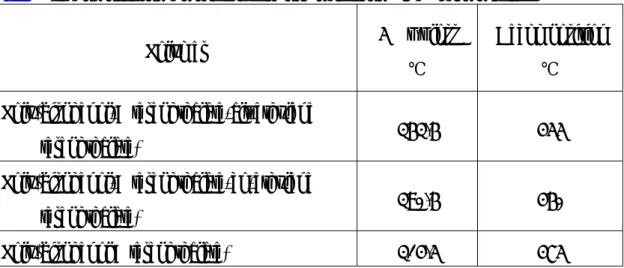
Table 2 Glass transitions temperatures of polymers from DSC thermograms
Polymer Tg℃
Poly(bisphenol-A terephthalate-alt-ethylene terephthalate) 115.5 Poly(bisphenol-A terephthalate-co-ethylene terephthalate) 110.6
Poly(bisphenol A terephthalate) 154.5 Poly(bisphenol A terephthalate-alt-hexamethylene terephthalamide) 134.9
Poly(bisphenol A terephthalate-co-hexamethylene terephthalamide) 144.5
Poly(ethylene terephthalate) 73.5~74.9
Table 3 Decomposition temperatures of polymers from TGA thermograms
Polymer 5% wt loss ℃ Decomposition ℃ Poly(bisphenol-A terephthalate-alt-ethylene terephthalate) 363.6 455 Poly(bisphenol-A terephthalate-co-ethylene terephthalate) 390.6 460 Poly(bisphenol A terephthalate) 314.5 475
Poly(bisphenol A terephthalate-alt-hexamethylene terephthalamide) 371.0 410 Poly(bisphenol A terephthalate-co-hexamethylene terephthalamide) 380.3 410 Poly(ethylene terephthalate) 410.8 431.3
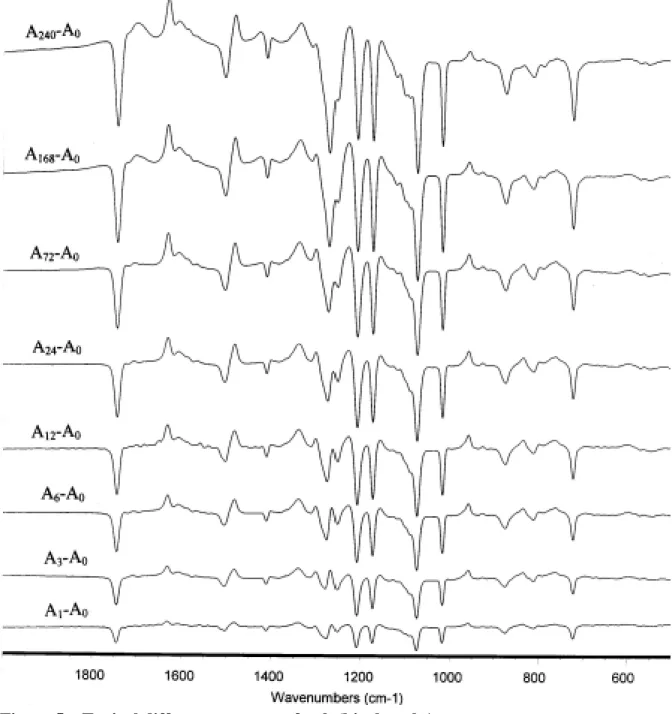
During irradiation of ultraviolet ranging 275 to 360 nm, the intra-molecular photo-fries’ rearrangement were evidenced from the continuous decreasing absorbances of νC=O at 1742 cm-1 and νC-O-C at 1210 and 1014 cm-1 for these
polymers (Figure 5). It is noted that a newly increasing absorption of νC=O at 1632
cm-1, due to the formation of o-hydroxybenzophenone moiety, is observed. Absorbance at 1632 cm-1 of o-hydroxybenzophenone was selected for the kinetic analyses. Integration of At – A0 divided by A∞-A0 gives the conversion, α,
according to equation (1). In general, the kinetic data fit a first-order of reaction, up to a conversion of 60%, according to
-ln (1-α) = kt (2)
where k and t represent the rate constant and irradiation time. A typical plot of - ln(1-α) versus t for these copolymers is given in Figure 6, from which the rate constants of photo-fries’s rearrangement, k’s, for these copolymers can be obtained and were given in the following order:
PBAT ( k = 5.67×10⁻³hr-1) > PBATCPET ( k = 4.02×10⁻³hr-1) > PBATAPET ( k = 3.92×10⁻³hr-1) > PBATCPHMTA ( k = 3.90×10⁻³hr-1) > PBATAPHMTA (k = 2.78×10⁻³hr-1).
It is noted that Poly(bisphenol A terephthalate) shows the highest value of rate constant, presumably because it contains larger portion of bisphenol-A terephthalate group which underwent photo-fries’ rearrangement, leading to the formation of o-hydroxybenzophenone moiety. It is also noted that PBATCPET and PBATAPET (random and alternating copolymers of bisphenol-A terephthalate and ethylene
terephthalate) show higher rate constants than PBATCPHMTA and PBATAPHMTA
(random and alternating copolymers of bisphenol-A terephthalate and hexamethylene terephthalamide), probably because the hydrogen bonding in copolyester-amides increased the activation energy of the solid phase photo-fries’ rearrangement. Lower rate constants for alternating copolyesters and alternating copolyester-amides than the corresponding radom copolyesters and random copolyester-amides are also noted, presumably, because the alternating copolymers have more regular chain package and higher crystallinity than random copolymers, and also have higher activation energy of reaction in the solid phase photo-fries’ rearrangement.
The mechanism of photo-fires’ rearrangement of these copolymer are given in the following scheme: [6-9] It is believed that the only product of photo-fries’
rearrangement [1,2,3] in these polymers is o-hydroxybenzophenone moiety, which is an effective uv absorber. These copolymers can be used as photostabilizer for polymers, like poly(ethylene terephthalate),…,etc. The stabilization capability is expected to increase with the rate constant of the photo-fries’ rearrangement. Therefore, as the bisphenol-A terephthalate proportion increases its stabilization effect would be increase, with the PBAT possessing the most stabilization effect for all these polyesters and polyester-amides in this study.
CONCLUSIONS
Upon irradiation of ultraviolet light ranging from 275 to 360 nm, all these copolymers underwent intramolecular Photo-Fries rearrangement, leading to the formation of o-hydroxybenzophenone moiety in the pendant group. This result was evidenced from the continuously increasing absorbance of υC=O at 1632 cm-1, due to
the formation of o-hydroxybenzophenone moiety. Plots of - ln (1-α) versus time revealed a first-order reaction. Poly(bisphol-A terephthalate) showed the highest value of rate constant because it contains the largest portion of bispheno-A terephthalate. Copolyester-amides generally showed lower rate constants than the corresponding copolyesters because copolyester-amides contain intermolecular hydrogen bonding and increased the activation energy in the solid phase photo-fries’ rearrangement. Alternating copolyester and alternating copolyester-amide indicated lower rate constants than the corresponding random copolyester and random copolyester-amide because the alternating copolymers have more regular molecular array in the solid state, and hence contain higher crystallinity, therefore, leading to increase of the activation energy of reaction.
ACKNOWLEDGEMENT
The authors would like to express their appreciation to National Science Council of Taiwan for financial support under contract no. NSC 92-2216-E-009-017
REFERENCES
1 W. Schnabel, “Polymer Degradation”, Hanser International, distributed in USA by Macmillan Publishing, 1981, Ch. 4, pp.117-120.
2 W. L. Howkins (ed.), “Polymer Stabilization”, John Wiley & Sons, New York, 1972, p. 197.
3 M. S. Lin, M. W. Wang and L. A. Chang, “Photostabilization of Epoxy by Forming IPNs with Bisphenol-A Diacrylate”, Polym. Degrad. & Stab., 66, 343 (1999).
4 QUV accelerated weathering tester, Q-Panel Co., with UVB 313 fluorescent UV
lamps, 40 watts x 8. 5 L. Konig, Appl. Spectr., 29, 293 (1975).
6 Agnès Rivaton, Laurent Moreau & Jean-Luc Gardette, Polym. Degrad. Stabil., 58, 333-339 (1997).
7 P. G. Kelleher and B. D. Gesner, J. Appl. Polym. Sci., 13, 9-15(1969). 8 Agnès Rivaton, Polym. Degrad. Stabil., 49, 163-169 (1995).
9. Surapol Pankusem, Joseph Kuczynski, and J. Kerry Thomas, Macromolecules, 27, 3773-3781 (1994).
Figure 4 FTIR spectra of poly(bisphenol A terephthalate-co-hexamethylene terephthalamide.
Figure 5 Typical difference spectra of poly(bisphenol-A
terephthalate-co-ethylene terephthalate), At –Ao (t in hours), using
Fig. 6 Typical plot of – ln(1 – α) versus time t during photo-fries’ rearrangement. 0 0.1 0.2 0.3 0.4 0.5 0.6 0.7 0 50 100 150 200 250 300 Time (hr) -ln(1-α)