Poly(2,3-diphenylphenylene vinylene) Derivatives
Having Liquid Crystalline Side Groups
An-Kuo Li, Sheng-Shinng Yang, We-Yi Jean, and Chain-Shu Hsu*
Department of Applied Chemistry, National Chiao Tung University, Hsinchu, Taiwan 30050
Bing R. Hsieh
Xerox Corporation, 800 Philips Road, Webster, New York 14580 Received April 11, 2000. Revised Manuscript Received June 12, 2000
Poly(2,3-diphenylphenylene vinylene) (DP-PPV) derivatives with pendant mesogene groups were synthesized. A biphenyoxyl or cyclohexylphenoxy moiety serves as the rigid mesogen core, a methylene chain as the spacer, and a alkyl or alkoxy group as the flexible terminal group. The optical properties of the polymers were investigated by UV-vis and photolumi-nescent spectroscopies. The polymer films emitted green-blue photoluminescence and electroluminescence. The phase transition behaviors of the polymers were characterized by a polarized optical microscope and a differential scanning calorimeter. The monomers did not show mesophases, while the polymers exhibited a nematic phase around 170-190 °C. The aligned films exhibited dichroism in absorption and emission spectra, implying that the polymers have potential for linearly polarized LED application.
Poly(p-phenylene vinylene) (PPV) and its derivatives have attracted a great deal of attention owing to their potential application in organic light emitting diodes (OLEDs).1Solvent processability and anisotropic prop-erties are two desirable propprop-erties for such polymers. Soluble polymers can be used for both single-layer and multilayer OLEDs by a spin coating process.2,3Light emitting polymers with anisotropic properties can pro-vide linearly polarized emission, which is needed for liquid crystal display (LCD) backlight applications. This will simplify LCD manufacturing and reduce cost. A wide range of soluble PPV derivatives have been re-ported.4,5Polarized light emission has been reported for stretch aligned conjugated polymers6,7 and rubbing aligned functionalized liquid crystal polymers.8,9 Con-jugated polymers with liquid crystalline properties10or
conjugated polymers having liquid crystal side groups have been reported for polarized OLED application.11,12 This paper reports two novel poly(2,3-diphenylphenyl-ene vinylpoly(2,3-diphenylphenyl-ene) (DP-PPV) derivatives with liquid crystal-line side groups, namely biphenyoxy and cyclohexylphen-oxy groups. The polymers were highly soluble, had high molecular weights, and showed liquid crystal behaviors. Scheme 1 outlines the overall pathway of preparing the LC substituted monomers and polymers. The mono-mer synthesis starts with the Diels-Alder reaction * Author for correspondence: Chain-Shu Hsu.
(1) Burroughes, J. H.; Bradley, D. D. C.; Brown, A. R.; Marks, R. N.; Mackay, K.; Friend, R. H.; Burn, P. L.; Holms, A. B. Nature 1990, 347, 539.
(2) Heeger, A. J.; Braun, D. (UNIAX). WO-B 92/16023, 1992 [Chem. Abstr. 1993, 118, 157401j].
(3) Braun, D.; Heeger, A. J. Appl. Phys. Lett. 1991, 58, 1982. (4) Hsieh, B. R.; Yu, Y.; VanLaeken, A. C.; Lee, H. Macromolecules 1997, 30, 8094.
(5) Hsieh, B. R.; Yu, Y.; Forsythe, E. W.; Schaaf, G. M.; Feld, W. A. J. Am. Chem. Soc. 1998, 120, 231.
(6) Hagler, T. W.; Pakbaz, K.; Voss, K. F.; Heeger, A. J. Phys. Rev. B 1991, 44, 8652.
(7) Dyreklev, P.; Berrggren, M.; Inganas, O.; Andersson, M. R.; Wennestrom, O.; Hjertberg, T. Adv. Mater. 1995, 7, 43.
(8) Hamaguchi, M.; Yoshino, K. Jpn. J. Appl. Phys. 1995, 34, L712. (9) Grell, M.; Bradley, D. D. C.; Inbasekaran, M.; Woo, E. P. Adv. Mater. 1997, 9, 798.
(10) Lussem, G.; Festag, R.; Greiner, A.; Schmidt, C.; Unterlechner, C.; Heitz, W.; Wendorff, J. H.; Hopmeier, M.; Feldmann, J. Adv. Mater. 1995, 7, 923. (b) Lussem, G.; Geffarth, F.; Greiner, A.; Heitz, W.; Hopmeier, M.; Oberski, M.; Unterlechner, C.; Wendorff, J. H. Liq. Cryst. 1996, 21, 903.
(11) Kijima, M.; Akagi, K.; Shirakawa, H. Synth. Met. 1997, 84, 237. (b) Akagi, K.; Oguma, J.; Shibata, S.; Toyoshima, R.; Osaka, I.; Shirakawa, H. Synth. Met. 1999, 102, 1287.
(12) Watanabe, Y.; Mihara, T.; Koide, N. Macromolecules 1997, 30, 1857.
Scheme 1
2741 Chem. Mater. 2000, 12, 2741-2744
10.1021/cm000295f CCC: $19.00 © 2000 American Chemical Society Published on Web 08/11/2000
of 2,5-bis(ethoxycarbonyl)-3,4-diphenylcyclopentadienone (1) with 4-(n-heptyloxy)-4-(4-pentynloxy)biphenyl and 1-(4-pentylcyclohexyl)-4-(4-pentynyloxy)benzene13to give 2a and 2b, respectively. These are reduced by LiAlH4 to give the corresponding dialcohol 3a and 3b. Chlorina-tion of 3a and 3b with SOCl2in methylene chloride gave monomers 4a and 4b, respectively. Polymerization of
4a and 4b with a large excess of potassium tert-butoxide
in the absence of chain terminating agents gave the corresponding soluble 5a and 5b without gelation.4,5 Monomers 4a and 4b were initially polymerized with 8 equiv of base. The resulting polymer from 4a contained unconverted chlorine. Fully converted 5a was obtained using 16 equiv of base.14
Both DP-PPV derivatives 5a and 5b exhibited strong photoluminescence (PL) and were quite soluble in common organic solvents. The respective weight average molecular weights for 5a and 5b obtained by gel permeation chromatography in THF were 225 K (PD ) 1.53) and 925 K (PD ) 7.69). Both 5a and 5b contained cis (Z) and trans (E) vinylene groups, as revealed by proton NMR (with the signal for the Z form at 6.06 and that for the E form at 6.46 ppm) and IR (with trans-vinylene out-of-plane bending at 960 cm-1and the cis at 868 cm-1).
The optical spectra of thin films of 5a and 5b are shown in Figure 1. The LC groups caused small blue shifts in both the absorption edges and the emission peaks. The absorption edges at about 2.0 eV for both polymers were at higher energies than 1.73 eV for DP-PPV.15The PL peaks are at 2.0 and 2.05 eV for 5a and 5b, respectively. These are similar to those observed for
5-alkyl DP-PPV derivatives.5 Figure 2 shows the ab-sorption spectra of 5a in various solvents and in the solid state. The absorption band of 5a in a poor solvent such as toluene agreed well with that for the polymer film. The absorption band blue shifts in polar solvents such as THF and chloroform. Figure 3 shows a similar shift can also be seen in the PL spectra of 5a in solution and in films. These results can be explained by different conformations and packing of the polymer chains under different conditions, similar to those reported for poly(2-methoxy-5-(2′
-ethylhexyloxy)-1,4-phenylenevinyl-ene) (MEH-PPV).16 In a good solvent, the polymer chains are extended with little chain aggregation. In a poor solvent or in the solid state, chain aggregates are formed. This is similar to the well-known solvato-chromism phenomenon. Similar results have been ob-served for 5b. Electroluminescence (EL) for 5a and 5b has also been observed in single-layer devices using Al as cathodes. It is possible that one can “design” a chain conformation of a DP-PPV derivative in the solid state by using different casting solvents. This may lead to achieving different colors of EL (green and blue) from a single DP-PPV derivative.
The thermotropic liquid crystalline phases of 5a and
5b were investigated by differential scanning
calorim-etry (DSC) and a polarized optical microscope (POM). Typical mesophase textures of the polymers are shown in Figure 4. A stable mesophase with a threaded texture and large domains was observed for 5a at 170 °C. The nematic-isotropic transition was observed above 270 °C. The optical texture of the sample was almost unchanged after it was quenched to room temperature. Similarly, a mesophase with a very fine treaded texture was observed for 5b at 190 °C.
We aligned 5a and 5b by a rubbing treatment at a LC state to give polarized optical properties.17The UV
(13) Oh, S. Y.; Ezaki, R.; Akagi, K.; Shirakawa, H. J. Polym. Sci., Part A: Polym. Chem. 1993, 31, 2977. (b) Oh, S. Y.; Akagi, K.; Shirakawa, H.; Araya, K. Macromolecules 1993, 26, 6203.
(14) Synthesis of materials is given in Supporting Information. (15) Wan, W. C.; Antoniadis, H.; Choong, V. E.; Razafitrimo, H.; Gao, Y.; Feld, W. A.; Hsieh, B. R. Macromolecules 1997, 30, 6567.
(16) Shi, Y.; Liu, J.; Yang, Y. J. Appl. Phys. 2000, 87, 4254. (17) We use a Sigma Koki RM-50 rubbing machine consisting of a rotating roller on top of a moving sample stage. The polymers were spin cast on ITO glass, placed on the stage, and then heated to the thermotropic liquid crystalline phase (190 °C) before rubbing treat-ment. Rubbing treatment was performed for four times while the roller is moving at 500 rpm.
Figure 1. Absorption and photoluminescence spectra of
polymer 5a and 5b. Figure 2. UV-vis absorption spectra of 5a in various solvents
and in the solid state.
Figure 3. PL emission spectra of polymer 5a in various
solvents and in the solid state.
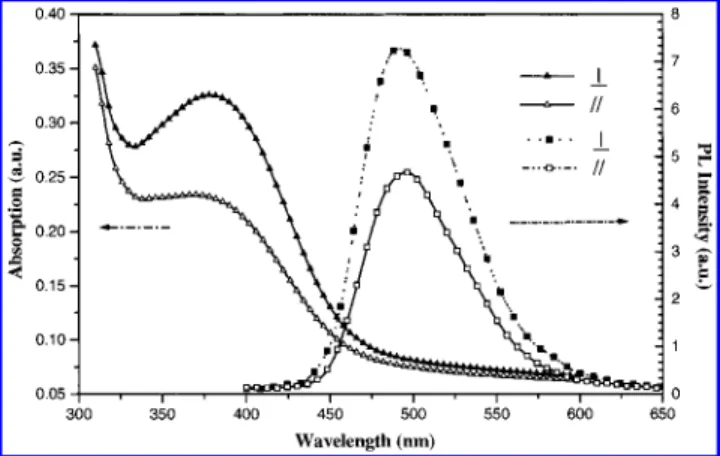
dichroism measurement was performed in the presence of a polarizer inserted between the sample and the light source parallel or perpendicular to the rubbing direction. As shown in Figure 5, a significantly larger absorption
ascribed to a π-π* transition can be seen at the perpendicular polarized direction for 5a. Rubbing in-duced chain alignment of 5a was also detected by a polarized PL measurement. The dichroic PL spectra of Figure 4. Optical textures of polymer 5a at 175 °C (top) and polymer 5b at 195 °C (bottom).
5a are shown in Figure 5, indicating that the light
emitted from the rubbed film was preferentially polar-ized perpendicular to the rubbing direction. This is because rubbing at the thermotropic liquid crystalline phase induces alignment of the LC side groups along the rubbing direction and alignment of the polymer backbones perpendicular to the rubbing direction (Figure 6). As a result, relatively large absorption and emission are observed in the orthogonal direction with respect to the rubbing direction. The dichroic ratio, defined as the perpendicular to parallel fluorescence intensity, was 2.1, which was better than those for dialkoxy side chain liquid crystalline PPVs (1.2-1.4).11
However, we did not see a large difference in peak intensity between rubbed and unrubbed films, suggest-ing that alignment may occur only at the surface.
In summary, two DP-PPV derivatives with mesogenic side groups were synthesized and characterized. The polymers showed green-blue PL and EL. We showed clear evidence of nematic LC phases in these polymers. The polymers can be aligned by traditional rubbing treatment to give linearly dichroic PL with a dichroic ratio of 2.1. Polarized absorption and emission spectra for the rubbed polymers suggest their potential for polarized EL device applications.
Supporting Information Available: Text describing the
details of the syntheses (3 pages). This material is available free of charge via the Internet at http://pubs.acs.org.
CM000295F
Figure 5. Polarized optical absorption spectra and PL spectra
of polymer 5a.
Figure 6. Alignment of LC side groups and polymer
back-bones due to rubbing treatment.