This content has been downloaded from IOPscience. Please scroll down to see the full text.
Download details:
IP Address: 140.113.38.11
This content was downloaded on 28/04/2014 at 19:50
Please note that terms and conditions apply.
Optical second harmonic generation from low-lying excited states in potassium vapour
View the table of contents for this issue, or go to the journal homepage for more 1990 J. Phys. B: At. Mol. Opt. Phys. 23 921
(http://iopscience.iop.org/0953-4075/23/5/014)
J. Phys. B: At. Mol. Opt. Phys. 23 (1990) 921-935. Printed in the U K
Optical second harmonic generation from low-lying excited
states in potassium vapour
Mao-hong Lu and Juin-huei Tsai
Institute of Electro-optical Engineering, National Chiao-Tung University, Hsinchu, Taiwan
30050, Republic of China
Received 24 October 1989
Abstract. Optical second harmonic generation has been observed on or near the 4s 6s 2 S , / , , 4s 'S,,,-np 2Pl,2,312 ( n = 5,6) and 4s 2S,,2-nd 2D5/2,3/2 ( n = 3,4) two-photon res- onances in potassium vapour, as laser scanning in the 660-940 nm wavelength range. The second harmonic intensities and ionisation currents have been measured as a function of pumping laser detuning from the two-photon resonances. On or near the two-photon resonances, the intensity and vapour-density dependence of second harmonic generation have also been investigated. The saturation of second harmonic generation has been observed. Some calculations and analyses have been made with the x ' ~ ' model. The results have been compared with the measurements. Based on these analyses, the mechanisms for second harmonic generation in isotropic vapours are discussed.
1. Introduction
Optical second harmonic generation ( S H G ) in isotropic vapours is of great interest
theoretically and experimentally because it is strictly forbidden by symmetry under the electric dipole approximation. In the last ten years many experiments on S H G in several metal vapours have been reported. Two mechanisms were put forward to explain the S H G in the isotropic vapours. One (Mossberg et a1 1978, Okada e? a1 1981, Bethune 1981) attributes the S H G to the contribution of the third order susceptibility
x ' ~ ) ,
where a laser-induced static electric field is involved. The other (Dinev et a1 1983) attributes the S H G to collisional 1 mixing of states. Recently Elci et a1 (1988) proposed a theory to explain the S H G with collision complexes. However, according to Gallagher et a1 (1977), the collisional 1 mixing only occurs for highly excited states with 1 2. They found that the sodium d states with the principal quantum number n 2 5 were mixed with the nearly degenerate higher I states of the same n, but the s and p statesdid not exhibit this effect. If the collisional 1 mixing mechanism is responsible for the
SHG by two-photon excitations of ns or nd states, the n s or nd state should be mixed
with some p states. However, for low-lying excited s (or d ) states, this is energetically difficult because the energy gap between p states and the s (or d ) state is much larger than thermal energy. Therefore, it is interesting to observe the S H G from low-lying excited states.
More recently, the S H G in potassium vapour by two-photon resonances of high-lying
s, p, and d states ( n = 7-34) was measured by Dinev (1988a, b). The S H G in potassium
vapour from ns ' S ( n = 7-9), n p 'P ( n = 7,8), and nd 'D ( n = 5-7) states by two-photon resonances was also measured by Lu et a1 (1989). In this paper, we present some new
922 M-H Lu and J-H Tsai
results on SHG from the ns 'S ( n = 6), n p 'P ( n = 5,6), and nd 'D ( n = 3,4) low-lying states in potassium vapour. The conversion efficiencies of SHG on the two-photon resonances have been evaluated. We measured the S H intensities and ionisation currents as a function of pumping laser detuning from the two-photon resonances. We also measured the intensity dependence and the vapour-density dependence of S H G on or near the two-photon resonances. A strong saturation in the intensity dependence of SHG has been observed. Some calculations and analyses have been made with the
x ( ~ '
model to explain the observed results. Based on these analyses, the mechanisms for SHG in isotropic vapours are discussed.2. Experiment
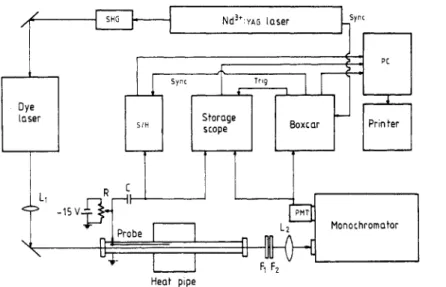
The apparatus is shown schematically in figure 1. A tunable pulsed dye laser (Quanta- Ray, PDL-l) pumped by a frequency-doubled Nd3+ : YAG laser was used as light source. Typical operating parameters for the dye laser were: 20 ns pulse duration, 3-5 mJ pulse energy, 0.2 cm-' linewidth and 10 Hz repetition rate. The dyes LDS 698, 751, 821, and 867 (Exciton Inc) were used to cover the wavelength ranges 658-738,714-792,785-851 and 840-940 nm, respectively. According to the energy level diagram of potassium, shown in figure 2, the dye-laser scanning in these wavelength ranges can reach the two-photon resonances of the 6s 2S, 5p
'P, 6p
2P, 3d 2D and 4d 'D states of potassium. In this experiment, the pumping waves were linearly polarised.Nd3' Y A G laser
n
laser0
Sync Trig 5 1 1--
Printer Storage stope Boxcar S i H Storage Printer stope Boxcar Monochromator Probe Fl Fz Heat pipeFigure 1. Experimental set-up.
Potassium vapour was enclosed in a heat pipe (Vidal and Cooper 1969) and heated to temperatures of 300-350 "C with a 30 cm heated zone. The vapour density was about 1014-10'6 ~ m - ~ . Argon gas at one mbar was used as a buffer gas. The laser beam was focused by an 80 cm focal length lens to a spot with a diameter of 0.25 mm at the centre of the heat pipe. The output radiation was first filtered against the strong pumping light and some parametric emissions with a combination of two filters (Melles Griot, U G l l and BG3 or U G l l and BG23), and then detected by a photomultiplier
Optical S H G from low-lying excited states in K
(x103) ns 2~ np 'P nd
2o
160
35
923
Figure 2. Energy level diagram of potassium.
tube in (PMT) (Hamamasu 1P28A and R928) after a 1 m monochromator (Spex 1704)
with 50 p m entrance and exit slits. The wavelength accuracy measured in this experi- ment is about 0.04 nm. The monochromator was calibrated by the emission lines of a Cd-Hg lamp and a He-Ne laser. The signal from the PMT was fed into a boxcar ( N F
BX531). All the data were stored in a microcomputer and processed. The spectral response of the measurement system was corrected.
A stainless steel wire of about 2 mm diameter was used as a probe, to measure the ionisation current. A potential of - 1 5 V was applied to the probe relative to the heat pipe wall during the ionisation current measurement. The signal from the probe was transferred to a microcomputer through a sample-and-hold ( s / H).
3. Results and discussion
3.1. S H G on the two-photon resonances
When the laser wavelength was tuned to the 4s 'S-6s * S , 4s 2S-np 'P ( n = 5 , 6 ) , and
4s *S-nd 'D ( n = 3 , 4 ) two-photon resonances, we measured the S H spectral lines, as shown in figure 3. It is found that the S H intensities on these two-photon resonances
are quite different. In order to explain these large differences, we use the four wave mixing model, i.e.
x ' ~ '
model to calculate the ratios of the S H intensities. Accordingto this model, assuming the fundamental field to be undepleted over the interaction length, indeed often in practice, the S H G in the plane-wave approximation can be expressed (Hanna et a1 1979) as
924
M-H
Lu and J-H Tsai I 305n < 20 5 h / iA
464.31 L64.32 404.03 404.53 365.01 364.99 362.29 324.83 34L.13Second harmonic wavelength Inm)
Figure3. Spectra O f S H radiation at the laser wavelengths tuned to the 4s *S-nd *D ( n = 3 , 4 ) ,
4s 'S-np * P (n = 5 , 6 ) and 4s *S-6s *S two-photon resonances.
where Z2, I , and Io are the intensities of S H , fundamental wave and laser-induced DC
electric field, respectively, n 2 , n , , and no are the refractive indices for these three fields,
w is the fundamental angular frequency, L is the interaction length, Ak = k2-2k, is the phase mismatch and ~ ' ~ ' ( - 2 w ; 0, w , 0 ) is the third-order susceptibility. For two-
photon resonance, the
x ' ~ '
is given bywhere the la) and lb) states must be p levels ( I = 1) in this case as intermediate states, the ig) and
if)
states are the ground state and the two-photon excited state, respectively,C l , are the atomic transition frequencies in wavenumber and 6 = w / 2 q A-il- is the
resonant denominator in which A = O on exact two-photon resonances, and
r
is a damping parameter,#
is equal to N [ p ( g ) - p ( f ) ] representing the population difference of the transition where N is the density of atoms and p ( j ) is the probability for an atom in the j state. In equation ( 2 ) we assume all the electric fields to be linearly polarised in the z direction. But this assumption is not true for the SH and DC fields.Actually, the DC field (Bethune 1981) and some S H fields (Dinev 1988a) are not polarised
in the z direction. This assumption is only for simplifying the calculation. For a
Optical S H G from low-lying excited states in K 925 length, as in our case, the plane-wave approximation is a good approximation. We follow the procedure of Eicher (1975) to calculate
x ' ~ '
using equation (2) for the 4s *SIl2-nd 'D3/2,5/2 ( n = 3,4), 4s 'SlI2-np 2P,/r,3/2 ( n = 5,6), and 4s *S,/*-6s *S1/* two- photon resonances. In this calculation, the oscillator strengthsf(
n, 1 + n', 1+
1) are taken from Lindgared and Nielsen (1977) and the energy levels are taken from Bashkin and Stoner (1975). The calculated results are listed in table 1. The ratio of the S H intensities produced by the different two-photon resonances, a and b, can approximatelybe evaluated from equations (1) and (2):
here, for simplicity, the phase mismatch factors in (2) are assumed to be equivalent for both the two-photon resonances.
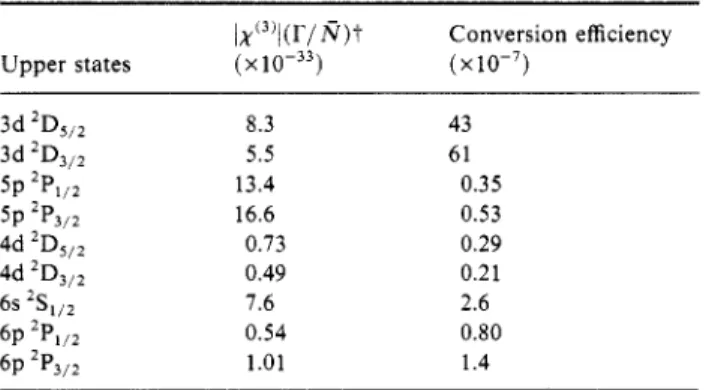
Table 1. The calculated third-order susceptibilities (m V-I) and measured conversion efficiencies for S H G . The ground state is 4s 2S,,2.
I X ( ~ ) I ( ~ / N ) t Conversion efficiency Upper states ( ~ 1 0 - 3 3 ) ( x ~ o - ~ ) 3d 2D3,2 5P 2 p , / 2 4d 2D,,2 6s 2 s 1 / 2 6P 2 p 1 / 2 5P 2p3/2 4d 2 D 3 / 2 8.3 5.5 13.4 16.6 0.73 0.49 7.6 0.54 1.01 43 61 0.35 0.53 0.29 0.21 2.6 0.80 1.4
t
r
is a damping parameter andN
is ( N s - N , ) representing the population difference between the ground state and the upper state.For the 4s 'S1,,-3d *D5/2 and 4s 'SIl2-4d 'Dslr two-photon resonances, the ratio of
SH intensities is
If the terms in the square brackets are assumed to be one, the ratio is about 79 compared with the measured value 120, see figure 3. Considering so many approximations made above, the agreement between the calculated and the measured values is not bad.
for the 4s *S1,,-3d *D5/2 two-photon resonance and 7 . 6 ( N / r ) x for the 4s 'S,/2-6~ 'SI/* two-photon reson- ance. We take
r-'
= CT3d = 1.24 x lo3 cm for the 3d 'D5/* andr-'
= C T ~ ~ = 2.63 x lo3 cmfor the 6s *SI/*, where c is the velocity of light and 7 3 d and T~~ are the lifetimes of the
3 d 2 D and 6s 'S states respectively (Lindgared and Nielsen 1977), we have
/ x ' ~ ' I
= 1.0 x [fi(4S-3D5,,)] for the 4s *S1/2-3d 2D5,2 two-photon resonance andI x ' ~ ' ~
=2.0 x [ N(4S-6S)I for the 4s2SI,z-6s2S1,2 two-photon resonance. With equation (3), the ratio of the S H intensities for both the two-photon resonances is given by
Similarly, according to table 1, the
I x ' ~ ' /
is 8 . 3 ( N / r ) x12(4S-3D5/2) 1 2 ( 4 s
-
6 S 1 21
= o.15[
N(4S-3D,,2)I2[ N(4S-6SlI2)926 M - H Lu and J-H Tsai
If the population difference
fi
and laser induced DC field were the same in both cases,the SH intensity from the 4s 'SIl2-6s two-photon resonance would be larger than
that from the 4s 'S1,,-3d 'DsI2 two-photon resonance. In fact, the measurement shows that the S H intensity from the 4s *S1/'-3d 2Ds,2 two-photon resonance is one order of magnitude larger than that from the 4s 'S1/2-6~ resonance (see figure 3). In order to understand this result, we measured the peak value of ionisation current at each step of laser scanning, as shown in figure 4. We found that the measured ionisation current for the 4s 'S-6s 'S two-photon resonance was almost twice as large as that for the 4s 'S-3d 'D two-photon resonance. As expected, the ionisation cross section should be much larger on the 4s'S-6s2S two-photon resonance than on the 4s'S-3d'D two-photon resonance because the former is due to three-photon ionisation, but the latter is due to four-photon ionisation. The ionisation reduces the population of the ground state much more severely on the 4s 'S-6s 'S two-photon resonance than on the 4s 'S-3d 'D two-photon resonance. The population reduction of the ground state causes the reduction of
x ( ~ ) ,
which is proportional to the population difference, i.e, the reduction of SH intensity in thex ' ~ '
model. That is why the SH intensity is muchsmaller on the 4s 'S-6s 'S two-photon resonance than on the 4s 'S-3d 'D two-photon resonance. Although more ionisation can produce a larger laser-induced DC field,
which contributes to SHG, the effect of the population reduction of the ground state is considered to be predominant. 5p312 5512
A
405 0 4 0 4 . 5 l l / t 345.0)!IL
344.6 405,o 404.5 365.0 364 5 364 0 345.0-
344.6Second harmonic wavelength Inml
Figure4. S H intensities and corresponding ionisation currents as a function of laser detuning from the 4s 'S-nd 'D ( n = 3 , 4 ) , 4s 'S-np 'P ( n = 5 , 6 ) , and 4s 'S-6s 'S two-photon reson- ances. Here the potassium vapour density is N o = 1 . 4 ~ 10'' c K 3 and the laser power intensity is I , = 1.7 x 10' W cm-'.
The effect of ionisation on SHG is even clearer if we look at the fine structures for
the 4s *S-3d 'D and 4s 'S-4d 'D two-photon resonances in figure 4. We find that the 4s 'SIl2-3d 2D5,,2 two-photon resonance, compared with the 4s 'S1,'-3d 'D3/' two- photon resonance, relates to a larger ionisation current, but a smaller SH intensity. For
Optical S H G from low-lying excited states in K 927
the 4s 'SIl2-4d 2D3/2 and 4s 2Sl/2-4d 'D5/2 two-photon resonances, however, the 4s 'SIl2-4d 2D5/2 two-photon resonance, compared with the 4s 'S1/2-4d 'D3/2 two- photon resonance, corresponds to a smaller ionisation current, but a larger SH intensity.
6p 2 ~ 3 / 2 ) is 16.4
(r6p/r5p)
= 16.4 ( 7 5 p / 7 6 p ) = 6.6, where 75p = 121 ns and 76p = 299 ns are the lifetimes of the 5p 2 P and 6p 2P states respectively, taken from Lindgared and Nielsen (1977), and the in both cases are assumed to be equivalent because the measured ionisation currents are almost the same, as shown in figure 4. The larger value ofxi3'
for the 4s 2Sl/2-5p 2P3/2 two-photon resonance, compared with thex ' ~ '
for the 4s 2Sl/2-6p 'P3/2, is due to the near-resonant enhancement by the 4p 2 P level, of which the energy difference from the single photon is only about -625 cm-'. From equation (3), we haveFrom table 1 we find that the ratio of the
xi3'
(4s 2Sl/2-5p 2P3/2) to the ~ ' ~ ' ( 4 sIf we ignore the Io terms in equation (6), the SH intensity on the 4s2Sl/2-5p2P3/2
two-photon resonance should be more than one order of magnitude larger than that on the 4s 'S1/2-6~ ,P3/2 two-photon resonance. The measurement, however, shows that the SH intensity o n the 4s 2S1/2-5p 2P3,2 resonance is smaller than that on the 4s 6p 2P3/2 resonance, as shown in figure 4. In order to explain this result, we consider the effect of the laser-induced DC field in (6). In the model this DC field, produced
by multiphoton ionisation and free-electron expansion, is proportional to the square of the electron velocity (Okada et al 1981 and Bethune 1981), i.e., the kinetic energy
of the electron after ionisation, which can be calculated as the energy difference between the three photons which induce the ionisation and the ionisation limit of potassium (Bashkin et a1 1975). In equation ( 6 ) , the ratio of the DC electric fields equals to the ratio of the electron kinetic energies g k corresponding to the 4s2Sl/2-5p2P3/2 and
4s 2Sl/2-6p 2P3/2 two-photon resonance ionisations. In addition, equation (6) has to be corrected by considering the single-photon absorption of the generated wave, which can make the 4s ZSl/2-np 'P3/' ( n = 5,6) one-photon transition. The S H intensity is
inversely proportional to a(') (see equation (32)), Le., f(4s 2S1/2-np 'P3/'), where U")
is the one-photon absorption cross-section and f(4s 'Sll2-np 2P3,2) is the absorption oscillator strength for the 4s 2S,/2-np 2P3/2 transition, taken from Lindgared and Nielsen (1977). So we have
which agrees well with the experimental result, 0.3.
For the 4s 'SlIz-np 2Pl/2,3/2 ( n = 5,6) two-photon resonances, the peaks correspond- ing to the fine structures are well separated, see figure 4. For the 4s 2Sl/2-5p 2P3/2 and 4s 2s1/2-5p two-photon resonances, the ratio of SH intensities corresponding to
the two resonances can be considered to be determined only by the ratio of their
xi3'
values because these two resonances are so close to each other that all the conditions can be assumed to be same. From table 1, we have928 M-H Lu and J-H Tsai
When compared with the experimental value of 1.6, see figure 4, the agreement is very good. Similarly for the 4s 2S,,2-6p 'P3,' and 4s 2Sl,2-6p two-photon resonances, we have
12(4S-6P,,J = 3.5
1 2 (4s- 6 PI 1 2 )
which is large compared with the experimental value of 1.8. Here we d o not consider the effect of the population reduction caused by ionisation because no enhancement in the ionisation current is observed as the laser is tuned to the 4s 'S-np 'P two-photon resonances, which are quite different from the 4s 'S-ns 2S and 4s 'S-nd 'D two-photon resonances, where the ionisation is strongly enhanced by the two-photon resonance (see figure 4). The 4s'S-np'P two-photon transitions are strictly forbidden in the dipole approximation. Though the generated S H radiation can make the 4s 'S-np 'P one-photon transition, it has no observable effect on the ionisation because this process becomes higher order.
The conversion efficiency V S H = I,/ I, was measured on each two-photon resonance. The input energy was kept at 3 mJ during this measurement. The results are listed in table 1. For the 4s *S-5p 'P and 4s 'S-6p 'P two-photon resonances, the conversion efficiencies are within an order of magnitude in agreement with the results of Dinev (1988b) for the 4s 2S-np 'P ( n = 12-21) two-photon resonances.
3.2. S H G as laser detuning from the two-photon resonances
The SH intensities and corresponding ionisation currents, as a function of the laser detuning from the two-photon resonance, were measured, as shown in figure 4. A 'three dimensional' diagram of S H spectra for laser scanning near the 4s 'S-5p 'P two-photon resonance is shown in figure 5. The wavelengths corresponding to the peak values of SHG are in agreement with the energy level data from Bashkin and
Stoner (1975) within this experimental accuracy. No shift has been observed. It is interesting to notice that the SHG can appear continuously when the laser wavelength is scanned from the 4s 2S-4d 'D to the 4s 'S 'S-6s 'S two-photon resonance. From the
404.2 405.0
Output SH wavelength (nml
Figure 5. A 'three-dimensional' diagram of S H spectra as the laser wavelength scans near the 4s 'S-Sp 'P two-photon resonances.
Optical S H G from low-lying excited states in K 929
SH spectra in figure 4, we find that there exists a shoulder at one side of each resonance
peak. These shoulders are considered to be due to the phase matching, which becomes very important as the laser is detuned from the resonances and makes the SH spectra asymmetric to the resonant peaks.
3.3. Intensity and density dependence of S H G
The intensity dependence of S H G on or near the two-photon resonances was measured
for the laser intensity in the range 2 x 10'-3 x lo8 W cm-'. Some typical log-log depen- dence curves are shown in figure 6(a-c). A slope of 2 is found when the laser is detuned from the 4s 'S-ns 'S(d 'D) two-photon resonances. The intensity-dependence curves for the laser detuning A V = -5.56 cm-' from the 4s 2S1/2-6s two-photon resonance and AV = -2.1 cm-' from the 4s 'S1/2-3d 'DsIz two-photon resonance are shown in figure 6(a, c). However, a slope of 1 is found when the laser is detuned
A V = -2.1 cm-' from the 4s 'S1/2-6p two-photon resonances, as shown in figure 6(b). From figure 6(c), we also notice that near the 4 ~ ' S ~ / ~ - 3 d ' D 5 / ~ two-photon resonance ( A V = -2.1 cm-') a variation of slope from 6 to 2 is found as the input
intensity increases. However, as the laser is tuned to the 4s'S-6s2S, 4s'S-np'P (n = 5,6), and 4s 'S-nd 'D ( n = 3,4) two-photon resonances, a slope of
-4
is found, which is quite different from values given in previously published papers, where a slope of 2 was reported. The measured intensity-dependence curves on the 4s 'Si/'- 6s 4s 'S1/2-6p 'P3/2 and 4s 'SIl2-3d 'D5/2 two-photon resonances are shown in figure 6( a-
c).Filtering is necessary because there is a high level of background radiation from the laser and other parametric emissions, which usually are so strong and close to the
SH in wavelength that it is difficult to measure the S H G on the 4s'S-ns2S(d2D)
resonances without proper filtering. In this experiment two filters were used to exclude the strong background radiation almost completely, which made the accurate measure- ment of S H G on the 4s 'S-ns 'S(d 'D) two-photon resonances possible. For the 4s 'S-
n p 'P two-photon resonances, the S H G measurements become very simple because no
other parametric emissions close to S H G co-exist. For the same reason, it is easy to
measure the S H G as laser detuning from the 4s 'S-ns 'S(d *D) two-photon resonances.
On the 4s 'S-ns 'S(d 'D) two-photon resonances, the Z:'2 dependence of the SHG
is considered to be due to saturation effects. A similar saturation effect was observed in third harmonic generation ( T H G ) by Wang and Davis (1975) and Ward and Smith
(1975). For comparison, we also measured the intensity dependence of THG on the
4 ~ ' S , / ~ - 3 d ' D 5 / ~ two-photon resonance. The results are shown in figure 6 ( c ) and a similar saturation effect is observed. In fact, in the
x ( ~ )
model, the S H G is almost thesame process as the THG. Both consist completely of four-wave mixing through the
third-order susceptibility
x ' ~ ' .
It is expected that the saturation is caused by similar mechanisms in both cases. In the above papers, the saturation was attributed to the two-photon absorption of the fundamental wave or single-photon absorption of the generated wave, which reduces the population difference, and the multi-photon ionisa- tion, which reduces the particle number in the ground state.In this experiment, on the 4s 'S-ns 'S(d 'D) two-photon resonances, the saturation could be caused by both the population depletion in the ground state due to the resonance-enhanced multiphoton ionisation and the reduction of population difference R ( g - + f ) due to the two-photon transition. On the 4s 'S-np 'P two-photon resonances, the saturation could be caused by both the population depletion in the ground state
930
M-H
Lu andJ-H
Tsaic
/ ,i
Slope -1/2k
Slope = 2rd
d
I , , , , I I , , , , 10' 1 o8 1 o9 Input intensity ( W cm-? 0 0.011 I / , , , I I , , , 107 108 I n p u t intensity ( W c m - * ~ A Slope = 6Ip
F i i i t ~ i i p l 1 , $ 1 1 107 108 I n p u t intensity ( W cm-'] 19Figure 6. Intensity dependence of S H C : ( a ) on ( 0 ) and near (0, A V = -5.6 cm-I) the 4s 2S,,2-6s two-photon resonance; ( b ) on the 4s 'S,,,-6p 'P,,, two-photon resonance
( 0 ) and near the 4s 2Sl/z-6p 'PI/, two-photon resonance (0, A V = -2.1 cm-'); ( c ) on ( 0 ) and near (0, A V = -2.1 cm-') the 4s 'S,,,-3d 'D,/, two-photon resonance-here, for comparison, the intensity dependence of T H G on the 4s 'S,,,-3d 'D,,, two-photon reson- ance is included (+).
due to multiphoton ionisation without resonant enhancement and the reduction of population difference due to the single-photon absorption of the generated SH. Near
the 4s ' S - n s 'S(d 'D) two-photon resonances, the 1: dependence of S H G still comes from some saturation because the intensity dependence should be
I:
if a laser-induced DC electric field and a three-photon ionisation are considered. In this case the ionisation is still enhanced by the near-resonances and causes the saturation of S H G to some extent. Near the 4s 'S-np 'P two-photon resonances, the linear intensity dependence of S H G means that single-photon absorption of the generated S H wave has much stronger effect on the S H G .Optical S H G from low-lying excited states in K 93 1 In order to understand the effect of the ionisation on the SHG, we first consider the
k-photon ionisation near two-photon resonances. The particle number in the ground state at time t is given by a rate equation:
where
d k ’
is the cross section for the k-photon ionisation. Here the lifetime of ions is assumed to be much longer than the laser pulse duration (20 ns). If we assume that I, is a constant during the pulse duration, equation ( 7 ) can be solved asand
Ni(r) = N,[I - e x p ( - c ~ ( ~ ’ ~ : t ) ] (9) where No is the initial atom density and Ni is the ion density. Let us evaluate the laser induced DC field Eo in the limit case where the time for the ionised electrons to sweep out of the laser interaction region is very short (smaller than 1 ns) as compared with the laser pulse duration 20ns. The DC field produced by the ions in the radial direction is given by the Gauss law as:
Eo,=-
-
No [ l - e ~ p ( - a ‘ ~ ’ I : t ) ] r ’ d r ‘ . (10)E o r
J:
Here I , should have a Gaussian profile at the radial direction. If the escape time of electrons is not so short as we assumed, it will only change the radial profile of the induced DC field, but not influence its power dependence. For simplicity, the intensity of the laser beam is approximated by a constant, then equation (10) gives
E,,= N~ = N,[I - e ~ p ( - a ‘ ~ ’ ~ : t ) ] or
Iora N ; [ I -exp(-aik’~:t)]’.
With equation (2) we have
X ‘ ~ ) C C
N =
N,, exp(-a‘k’I:t).For the sinc(fAkL) function in equation ( l ) , we have
sinc(iAkl) = sin(fAkL) a sin(iAkl) sin(fAkl) (fAkL) n(2w)
-
n ( o ) Nga [ N o e~p(-a‘~’Z:t)]-’ sin(fAkl).
So from equation ( l ) , we have
N’I:N;
1 2 E / X ( ~ ’ ~ ’ I : I ~ sinc2(fAkL) K sin2(
f
AkL)N :
-
-
[ N o exp(-aik’Z:t)]’1:N;(1 - e ~ p ( - a ‘ ~ ’ I : t ) ] ’ sin2(fAkl) [ N , exp (-
a( k )f
t ) ] ~932 M-H Lu and J-H
Tsai
which gives a quadratic density dependence for S H G and also a quadratic intensity dependence for SHG as (a(k’Z:t) becomes large. If ( a ‘ k ’ Z f t ) is small, [ l -
e x p ( - ~ ‘ ~ ’ Z : t ) ] ~ can be approximated by ( W‘k’Zft)2 and Z , K Z : ~ + ~ . So a slope of 10 is expected at low intensity
ZI
near the 4s 2Sl,2-3d 2D5,2 two-photon resonance, in which the four-photon ionisation occurs. Actually, in this experiment a slope of 6 was observed at the laser intensity -10’ W cm-2, as shown in figure 6(c). Here a smooth change of the factor sin2(1AkL) is assumed. As ( a ‘ k ’ l : t ) becomes so large that all the atoms are ionised, then sinc’(4AkL) -+ 1 because AkK Ng + 0. The SH intensity becomesZ ~ K N ~ Z : e ~ p ( - 2 u ‘ ~ ’ ~ f t ) (15)
which exponentially decays to zero.
Under the 4s 2 S - n s 2S(d 2D) two-photon resonances, we have to consider the two- photon absorption. The rate equation for the particle number in the ground state should be written as
where
d2)
is the cross section of two-photon absorption. Here the lifetimes of the excited states due to the two-photon transitions are assumed to be much longer than the laser pulse duration, so we ignore the fact that the excited states caused by the two-photon absorption return to the ground state. From equation (16), the particle number in ground state isThe ion number Ni( t ) and the particle number in the two-photon excited state
Nf(
t ) can be expressed, respectively, byand
Similar to the analysis for the non-resonances, we have
~ ( ~
N
1= 0N ~ ( ~ t ) - N,( t )and
Optical S H G from low-lying excited states in K 933 So the S H intensity becomes
12a lx(3J12ZfZi sinc2($Akl)
x sin2(iAkl). (23)
When ( a ( k ) I : + a ( 2 ) Z : ) t is small, the term in the last set of two line parentheses can be approximated by
Then I2 becomes
x (1 - e x p [ - ( a ( k ) I : + a ( ' J I ~ ) t ] } 2 sin' (iAkL) (24) which reflects the saturation effect. That is why the 1:'' dependence of SHG was
observed on the 4s ' S - n s 'S(d 'D) two-photon resonances. In general, the cross section of two-photon absorption is many orders of magnitude larger than that of multiphoton ionisation. However, the ionisation cross section on the two-photon resonances could be enhanced by many orders of magnitude. At high laser intensity the a i k ' Z : can be larger than a ( 2 J l : . So the saturation effect is more obvious and stronger on the 4s 2S-ns 2S(d 'D) two-photon resonances. When the laser intensity becomes so large that all particles are excited or ionised, the sinc(iAkL) approaches 1 because Akoc Ng +
0 and the S H intensity becomes
~ ' a N:Z; e x p ( - 2 d k ' ~ : t ) (25)
which will decay exponentially to zero.
On the 4s 'S-np 'P two-photon resonances no enhancement of ionisation has been observed, see figure 4. Therefore, in these cases the ion density should be the same as that for the non-resonances, given by equation ( 9 ) ,
N , ( t ) = N,[I - e x p ( - c ~ ' ~ ' ~ f t ) ] . (26)
d N g ( t ) / d t = - a ' k J Z ; N g ( t ) - ~ ( ' ~ Z 2 i V ~ ( t ) . (27) Considering the single-photon absorption, the rate equation for the particle number in the ground state on the 4s 'S-np2P two-photon resonances should be
The particle number in the one-photon excited state (the n p 'P state) is given by
With the same procedure as we use for the 4s 'S-ns 'S(nd 'D) two-photon resonances we have
(30)
N f ( t ) = No -
N,
- N
=N
[ 1 - e x p ( - a " ' ~ ~ t ) ] exp(-dk'z:t). Z 2 K NiI:[2-
exp(c+"'Z2r)l2[1 - e ~ p ( - a ' ~ ' Z : f ) ] ~ sin2(iAkl).9 3 4 M-H Lu and J-H Tsai
As ( d ' ' Z 2 f ) is small (<< l ) , the factor [ 2 - e ~ p ( a " ' I , t ) ] ~ can be expanded in series. If we take only the first-order term in the series, equation (30) becomes
1
' = AN;Z:[l - 2 d 1 ' I 2 t ] [ l - e x p ( - c ~ ' ~ ' 1 f t ) ] ~ sin2(iAkL) (31) where A is a constant. Then Z2 can be solved as
AN;Z:[ 1
-
exp( - d k ) Z : t ) 1 2 sin*(iAkL) 1 +2AN;a"'tZ:[ 1 -exp(-dk)Z:t)12 sin'(4AkL)1' =
which gives the saturation when the second term in the denominator becomes larger. Since the single-photon absorption cross section is usually many orders of magnitude larger than the two-photon absorption cross section, it is expected that the saturation effect for the 4s 2S-np 2P two-photon resonances is much more obvious even though the laser is detuned from the two-photon resonances, where linear intensity dependence is observed, in contrast with the detuning from the 4s 'S-ns 'S(d 'D) two-photon resonances where quadratic dependence is observed.
The density dependence of S H G on the 4s 2S,,2-6s 'SI/, and 4s 'S-5p 2P3j2 two- photon resonances and near the 4s 2S1/2-6~ *SI,' two-photon resonance ( A Y = -5.65 cm-') were measured, as shown in figure 7 . A quadratic dependence is observed, as given by equations (14) and (24). It is interesting to notice that for the 4s2S1,'- 5p 'P3/2 two-photon resonance, the density-independence of SHG has been observed at high density (shown in figure 7 ) . This result can be exactly predicted by equation (32), in which I2 becomes independent of the density No as No increases.
,' A : A A A A A ,'* 0 ' A A 0 IO" 10'5 Potassium density i ~ r n - ~ ) 16
Figure 7. Vapour density dependence of S H G on ( 0 ) and near (0, A V = -5.6 cm-') the 4s-6s two-photon resonance and on the 4S-5P3,, two-photon resonance (A). Here the laser intensity is I , = 1.7 x lo* W cm-*.
4. Conclusion
We have measured the S H spectra and the corresponding ionisation currents on or near the 4s ' s - 6 ~ 'S, 4s 'S-np ,P ( n = 5 , 6 ) , and 4s 'S-nd 'D ( n = 3 , 4 ) two-photon res- onances in potassium vapour. Some ratios of the SH intensities related to different
Optical S H G from low-lying excited states in K 93 5 two-photon resonances have been calculated using the
x ' ~ '
model and comparisons with the measurements have been made. The intensity and density dependence of S H Ghas also been analysed with this model. The results show that most of the characteristics of S H G in our experiment can be explained using the
x ' ~ '
model, i.e. the four-wavemixing which includes a laser-induced DC electric field.
The multiphoton ionisation, on the one hand, produces the DC electric field, which
is necessary for S H G in the
x C 3 )
model. On the other hand, the ionisation causes thepopulation depletion of the ground state, which reduces the SHG. For the 4s'S-
n s 2S(d *D) two-photon resonances, the multiphoton ionisation enhanced by the two- photon resonances and the two-photon transition are responsible to the saturation in the intensity dependence of SHG. However, for the 4s 'S-np 'P two-photon resonances, the multiphoton ionisation without any observable resonant enhancement and the single-photon absorption of the generated S H wave are responsible to the saturation
effects. The saturation in SHG is much like that in THG, which is a typical parametric
process-four-wave mixing. So the similarity between the S H G and THG seems to
indicate the same mechanism for both processes.
In the collision model for S H G (Elci and Depatie 1988) a collision complex composed
of two atoms is assumed to exist. The energy levels of the complex should have some shifts to those of the free atoms. We notice that in this case, where only low-lying excited states are involved, the p states and the s (or d ) states are separated by so far that the 1 mixing by collision is almost impossible without a remarkable energy shift. These shifts should be observed when the SH wavelengths corresponding to the
two-photon resonances are measured. No shifts have been observed in this experiment.
Acknowledgment
This project was supported by the National Science Council of the Republic of China.
References
Bashkin S and Stoner J 0 1975 Atomic Energy Levels and Grotrian Diagrams (Amsterdam: North-Holland) Bethune D S 1981 Phys. Rev. A 23 3139
Dinev S G 1988a J. Phys. B: A t . Mol. Opt. Phys. 21 1681
-
1988b Opt. Quantum Electron. 20 113Dinev S G , Guzman de Carcia A, Meystre P, Salomaa R and Walther H 1983 Laser Spectroscopy VI ed
Eicher H 1975 IEEE J. Quantum Electron QE-11 121
Elci A and Depatie D 1988 Phys. Rev. Lett. 60 688
Gallagher T F, Edelstein S A and Hill R M 1977 Phys. Reu. A 15 1945
Hanna D C, Yuratich M A and Kotter D 1979 Nonlinear Optics ofFree Atoms and Molecules (Berlin: Springer) Lindgared A and Nielsen S E 1977 At. Data Nucl. Data Tables 19
Lu M H and Tsai J H 1989 Chinese J. Phys. 27 14
Mossberg T, Flusberg A and Hartmann S P 1978 Opt. Commun. 25 121 Okada J , Fukuda Y and Matsuoka M 1981 J. Phys. Soc. Japan 50 1301
Vidal C R and Cooper J 1969 J. Appl. Phys. 40 3370 Wang C C and Davis L I J r 1975 Phys. Rev. Lett 35 650
Ward J F and Smith A V 1975 Phys. Rev. Lett. 35 653