2005Conference on Lasers & Electro-Optics (CLEO)
CThH5
Anticompetition
of Laser modes in
Quantum
Dot Lasers
Yi-ShinSu and Ching-Fuh Lin* Graduate Instituteof Electro-Optical Engineering
*also withDepartment ofElectrical Engineering and Graduate Institute ofElectronics Engineering National TaiwanUniversiAt
Taipei 106, Taiwan ROC
Emnail:[email protected]
Abstract: Laser-mode anticompetitionisobserved inaquantum-dotlaser.The laserisoperatedat
1168.5nm and 1262.3nm wavelength simultaneously using a grating-controlled external cavity.
Increasingthepowerof1168.5nm,thepowerof 1262.3nm also increases.
02005Optical Societyof America
OCISCodes:(140.3600) Lasers,tunable; (140. 5960)Semiconductor lasers
1. Introduction
Thegain bandwidthof semiconductor laserscanbe increasedto over200nmbyseveralways likecombining first
and secondquantized statesofa single QW [1,2], combiningquantum wellsof differentcomposition andwidth[3]
aswellasutilizingthe first and secondquantizedstatesofquantumdots [4].Thegain competition between different
lasingmodesisconsidered as aninevitablephenomenonfor almost all kinds oflasers. However, experiments show
that anticompetition behaviours can be observed in devices, which combine quantum dot of different sizes or
quantumwells of differentcompositionand width[5].
2.Experiment
The devices have InAsQDs asthe activelayerand isgrown on GaAs substrate. The fabricated device has double
channel ridge waveguide, PECVD SiO2 passivation layer, TiIPt/Au p-metal contact and AuGe/Ni/Au n-metal
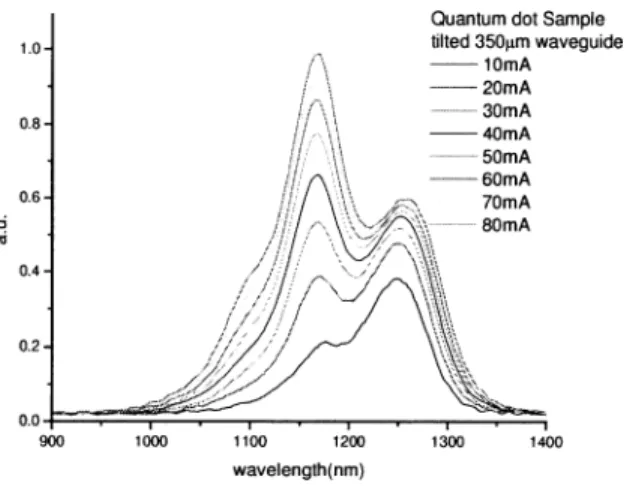
contact. Figure 1 shows the emission spectra of the QD semiconductor optical amplifier (SOA) with a tilted
waveguide. The peak emission intensity offirst quantized states is at 1.25gm. The peak emission intensity of
secondquantized states is at 1.17gm. Due toinhomogeneous broadening caused by dot size distribution, theEL
emission spectrumcovers morethan 200nm wavelength.
Quantum dotSample
1.0- tilted350gmwaveguide lOmA -- 2OmA ...3OmA 0.8- X_=34OmA ":..E 5OmA A '-6OmA 0.6- 7OmA ~~~~~~~~8OmA Cu 1100 1200 wavelength(nm)
Fig.I TheELspectrumofa QD device with tilted waveguide.
2005Conference on Lasers &Electro-Optics(CLEO)
CThH5
The anticompetition behavior isobservedinanexternalcavitylasercontrolledbythegrating, showninFigure 2,
tooscillate at two differentwavelengths.Theoperating wavelengthis tuned to 1262.3nm forfirstquantizedstates,
and 1168.5 for secondquantizedstates.Thisexternal-cavitylaseruses aFabry-Perotlaser diode(LD) fabirctaedon
the QD substrate with alengthof 613
gLm.
A single layerSiO2 is coated at onefacet foranti-reflection (AR) toprevent the device fromoscillating atthe firstquantizedstate. InFigure 2, gray line is the optical path of 1262.3nm light, while black line is theopticalpathof 1168.5nmlight. Lights of thetwowavelengthsareseparatedby grating1
and reflectedback to the devicebytwo mirrors. Thefeedbackefficiencyof 1262.3nm light is fixed at optimum. Tilting the mirror in vertical direction varies the feedbackefficiency of 1168.5nmlight,and theopticalpower of 1168.5nm light is varied. Output power of the two wavelengths are separated by grating 2 and collected bytwo
InGaAs photodiodes simultaneously. Thelight-output power curveisrecorded with different feedback amount of the 1168.5nmlight.
grating1 LD with onefacet AR-coated
mirror InGaAs PD
mirror
Fig. 2 Twowavelength external-cavity configuration and setup for monitoring the power of both wavelengths..
Figure 3 shows the recorded 1262.3nm wavelength power vs. the 1168.5nm wavelength power. With 65mA injection current, the output power of 1168.5nm wavelength increases by 1.7mW, when feedback amount of 1168.5nm wavelengthis increased. The output power of 1262.3nm wavelength also increases by 0.3mW. At this
currentlevel,anticompetition behavior is observed foralarge range of1168.5nm wavelength power.
2.6- 2.4-2.2 - 2.0-g 1.8-- 1.6-(D B 1.4-0 Q 1.2-E ( 1.0-c'J CD 0.8-0.6 -0.4 -0.2 -0.0 .1:
HUE.|
*8 *Wm * 0 4'.. A Is v ',*1A I I 1.0 2.0 3.0 4.0 1168.5nmPower (mW) * LP8OmA * LP75mA A LP7OmA v LP65mA LP6OmA 5.0 6.0Fig. 3 1262.3nm wavelength power vs.I168.5nm wavelength power
2005Conference on Lasers & Electro-Optics (CLEO)
CThH5
When the injected current is increased to7OmA, theincrease of 1262.3nmwavelengthpowerwith 1168.5nm wavelength power is faster. However,anticompetition behavioris notobserved when 1168.5nmwavelength power exceeds 1mW. Comparing the datapointsof7OmA, 75mAand 80mA, we can observethe followingtwotrends. First, anticompetition occurs at higher 1168.5nm wavelength power for increased current. Second, competition behavior, whichoccurs athigh 1168.5nmwavelengthpower, isincreasinglyseverewithincreasedcurrent.Thedata points with 65mA and 60mA injection currents show that anticompetition strength increases with the increased injectioncurrent and nocompetition behavior is observed.
3. Results and discussions
In conclusion, anticompetition effect is observed in a quantum-dot laser. The laser is operated at 1168.5nm and 1262.3nmwavelength simultaneously. Increasingexternal feedback increases the power of 1168.5nm wavelength. The power of 1262.3nm will also increase. The phenomenon ofanticompetition occurs when the quantum dots which contribute to 1262.3nm light is able to absorb the 1168.5nm light. Because thecarrier density of quantum dots which contributeto 1262.3nmlightissuppressedby laseroscillation,it's secondquantized state doesnothave population inversion.Thus, these quantum dotsareabsorber for1168.5nmlight. The gain ofI168.5nm oscillationis
contributed by quantum dots, which do not contribute to 1262.3nm oscillation. Thus, the laser oscillation at
1168.5nmhelps carriers transfer from quantumdots that donotcontributeto 1262.3nmoscillationtoquantumdots
thatcontributeto1262.3nmoscillation.The detailwillbe discussed inthe presentation. References:
[I]A. T.Semenov, V. R.Shidlovski, and S. A.Safin, "Wide spectrum single quantum wellsuperluminescentdiodes at 0.8gm withbent optical waveguide," Electron.Lent.,vol.29, pp.854-857, 1993.
[2]T. R.Chen,L. Eng, Y. H.Zhuang, and A. Yariv,"Quantumwellsuperluminescent diode with very wide emission spectrum,"Appl.Phys. Lett., vol. 56,pp. 1345-1346, 1990.
[3]C.-F.Lin, B.-R.Wu, L.-W.Laih,andT.-T.Shih,"Sequenceinfluence ofnonidenticalInGaAsP quantum wellsonbroadband characteristics ofsemiconductoroptical amplifiers/superluminescent diodes," Opt. Lett., vol. 26, pp.1099-1101,2001.
[4]P. M.Varangis, H. Li, G. T. Liu, T. C. Newell, A. Stintz, B.Fuchs, K. J. Malloy, and L. F. Lester,"Low-thresholdquantumdot lasers with 201nmtuningrange,"Electron. Lett., vol. 36, pp.529-530,2000.
[5] Ching-Fuh Lin, Chi-ChiaHuang,Fei-HungChu,andYi-ShinSu,"Anticompetitionof lasermodes," Appl.Phys. Lett., 82,3611-3613(2003)