Effects of various soya protein hydrolysates on lipid profile, blood
pressure and renal function in five-sixths nephrectomized rats
Shu-Tzu Chen
1, Hsin-Yi Yang
1, Hui-Yu Huang
2, Sheng-Jeng Peng
3and Jiun-Rong Chen
1*
1Department of Nutrition and Health Sciences, Taipei Medical University, Taipei 110, Taiwan2Graduate Institute of Food Science, Nutrition, and Nutraceutical Biotechnology, Shih Chien University, Taipei 104, Taiwan 3Division of Nephrology, Cathay General Hospital, Taipei 106, Taiwan
(Received 31 October 2005 – Revised 17 January 2006 – Accepted 17 January 2006)
Studies have demonstrated that isolated soya protein (ISP) can slow the progression of renal injury, reduce blood pressure and improve the serum lipid profile in experimental animals and human subjects. The mechanisms and components of soya responsible have not been fully established. The present study was designed to evaluate the effects of the hydrophilic supernatant fraction (SF) and the hydrophobic precipitate fraction (PF) isolated from soya protein hydrolysate on renal function, lipid metabolism and blood pressure in five-sixths nephrectomized rats. Experimental animals were subjected to a nephrectomy and allocated to four groups (180 g casein/kg, 180 g ISP/kg, 100 g casein/kg with 80 g SF/kg, and 100 g casein/kg with 80 g PF/kg). The SF group had the most significant decreases in blood pressure and total cholesterol, as well as a significantly retarded progression of the experimentally induced renal disease, compared with the other groups. The PF group exhibited a significantly increased faecal excretion of total steroids. The serum creatinine, level of proteinuria, total cholesterol and LDL-cholesterol concentrations, and blood press-ure were significantly reduced, and HDL-cholesterol was significantly increased, in the ISP and PF groups compared with the casein group, but no significant differences were observed between the ISP and PF groups. These results suggest that both soya protein hydrolysate fractions favourably affected chronic renal failure induced by a five-sixths nephrectomy, and the hydrophilic fraction of soya protein hydrolysate had the most pronounced effect on attenuating hypertension and slowing the progression of renal disease.
Soya protein hydrolysate: Renal failure: Cholesterol: Blood pressure
Chronic kidney disease is a public health problem and affects a substantial portion of the world’s population. Several thera-peutic strategies to slow the progression of chronic kidney disease have been reported, including dietary protein restric-tion, the control of systemic hypertension, angiotensin-con-verting enzyme therapy, the reduction of proteinuria and the treatment of hyperlipidaemia (Taal & Brenner, 2001). Soya protein has been investigated for its potential health benefits in preventing and treating hypercholesterolaemia (Anderson et al. 1995) and hypertension (He et al. 2005; Yang et al. 2005). Studies have also shown that soya protein substitution is effective in reducing proteinuria in nephrotic syndrome (D’Amico et al. 1992) and in ameliorating the pro-gression of diabetic nephropathy (Azadbakht et al. 2003;
Teixeira et al. 2004) and polycystic kidney disease
(Tomobe et al. 1998; Aukema et al. 1999). Our previous study demonstrated that soya protein can reduce proteinuria, hypercholesterolaemia and systolic blood pressure, and retard the progression of chronic kidney disease in five-sixths nephrectomized rats (Chen ST et al. 2003).
The constituents of soya protein that possess renal protec-tive effects remain to be identified. Research has shown that the hydrophobic precipitate fraction (PF) of soya protein
hydrolysate has a hypocholesterolaemic effect (Sugano et al. 1990; Gatchalian-Yee et al. 1997), and that the hydrophilic supernatant fraction (SF) can attenuate the development of hypertension in spontaneously hypertensive rats (Yang et al. 2004). The objectives of this study were to investigate the effect of the two fractions of soya protein hydrolysate on renal function, blood pressure and lipid metabolism in rats with chronic renal failure induced by a five-sixths nephrect-omy, and to examine the active components of soya protein hydrolysate on ameliorating disease progression.
Materials and methods
Preparation of soya protein hydrolysate
Isolated soya protein (ISP; Fujipro WR, Fujioil Co., Tokyo, Japan) was exhaustively hydrolysated with 3 % pepsin (w/w) (Sigma Chemical, St Louis, MO, USA) at pH 2·0 and 378C for 24 h. The hydrolysate solution from pepsin digestion was heated to 1008C for 10 min and centrifuged at 7500 g for 20 min after being neutralized. The SF and PF were respect-ively collected and lyophilized, ground to a powder and stored at 48C.
* Corresponding author: Dr Jiun-Rong Chen, fax þ 886 2 2737 3112, email [email protected] Abbreviations:ISP, isolated soya protein; PF, precipitate fraction; SF, supernatant fraction. qThe Authors 2006
Animals and diets
Fifty male Wistar rats (weight 250 – 280 g) were obtained from the National Laboratory Animal Breeding and Research Center (Taipei, Taiwan). The animals were housed in individ-ual cages that were kept in a room under controlled lighting from 08.00 to 20.00 hours at 24 ^ 18C and a relative humidity of 55 % ^ 5 %. All rats were fed a standard diet and had free access to tap water for 1 week. After 1 week’s adaptation, forty rats underwent a five-sixths nephrectomy (experimental animals), and ten rats underwent a sham operation (control animals), as previously described (Chen ST et al. 2003).
After the operation, the experimental animals were ran-domly assigned to one of four groups and received a different diet for 14 weeks: group A (casein) was fed a standard diet containing 180 g casein/kg as the protein source; group B (ISP) was fed a diet containing 180 g ISP/kg; group C (SF) was fed a diet containing 100 g casein/kg and 80 g SF of soya protein hydrolysate/kg; group D (PF) was fed a diet con-taining 100 g casein/kg and 80 g PF of soya protein hydroly-sate/100 g. Control animals were assigned to two groups that were fed either the 180 g casein/kg or the 180 g ISP/kg diet. The diets were isoenergetic and contained equal amounts of fat, minerals and vitamin supplements (AIN-93; ICN Bio-chemicals, Aurora, OH, USA). The compositions of the diets are shown in Table 1.
During the experimental period, food intake was recorded daily. The animals were weighed each week. All animals were treated in accordance with the National Institutes of Health’s Guide for the Care and Use of Laboratory Animals (National Research Council, 1985).
Data collection
Blood, urine and faecal sampling. The animals were placed in metabolic cages for 3 d for 24 h urine and faecal collections. After overnight fasting, tail venous blood was collected at the beginning of the study and at 0, 6 and 12 weeks after the operation. Plasma samples were analysed for albumin, total
cholesterol, triacylglycerol, creatinine and blood urea N; urine was analysed for creatinine, urea N and protein. All ana-lyses were carried out on a Hitachi 7170 Autoanalyser (Tokyo, Japan). The creatinine clearance rate was calculated by the fol-lowing equation:
ðurine creatinine concentrationðmg=dlÞ
£ urine outputðmlÞÞ=ðplasma creatinine concentrationðmg=dlÞ £ 1440ðminÞÞ:
Liver lipids and faecal steroids. At the end of the feeding period, the rats were killed by exsanguination from the abdominal aorta under diethyl ether anaesthesia. The liver was excised and weighed. Liver lipids were extracted by the method of Folch et al. (1957). Cholesterol and triacylglycerol concentration in the liver were determined with diagnostic kits (Randox, Antrim, UK). Faeces were collected at 0 and 12 weeks after the operation and lyophilized until analysed. Bile acids and steroids were separated from the faeces accord-ing to the method of Folch et al. (1957) and were measured with commercial kits (Randox).
Blood pressure. The systolic blood pressure and mean blood pressure were measured at the beginning of the experi-ment and at 7 and 14 weeks after the operation by the tail-cuff method using an electro-sphygmomanometer (blood pressure analyser, model 179; IITC Life Science, Woodland Hill, CA, USA). Rats were kept in a dark, warm and quiet environment during the measurements. At least five readings were recorded. The maximum and minimum values were dis-carded, and the average blood pressure values were calculated from the remaining three values. The diastolic blood pressure was calculated by the following equation: ð3 £ mean blood pressure 2 systolic blood pressureÞ=2:
Statistical analysis
Statistical analyses were performed using SAS software (version 8.2; SAS Institute, Cary, NC, USA). Data were ana-lysed by one-way ANOVA and Fisher’s least significant difference test. Results are expressed as means and standard deviations. Significance for all analyses was set at P, 0·05. Any animal that needed to be killed prematurely was excluded from these comparisons.
Results
Body weight and feeding efficiency
The daily food intake of the experimental and control groups did not differ (Table 2). At the end of study, the weight gain, feeding efficiency and serum albumin level of the control groups were significantly higher than those of the experimen-tal groups (Table 2, Fig. 1(A)). Of the experimenexperimen-tal animals, the casein group gained significantly less weight and had a lower feeding efficiency than other groups (Table 2). There were no differences in weight gain and food efficiency among the ISP, SF and PF groups (Table 2). No significant difference was found in serum albumin level between the experimental groups (Fig. 1(A)).
Table 1. Composition of the experimental diets (g/kg) Diet group
Ingredient Standard Casein ISP SF PF
Maize starch 550 550 550 550 550 Casein 180 180 0 100 100 ISP 0 0 180 0 0 SF 0 0 0 80 0 PF 0 0 0 0 80 Sucrose 60 60 60 60 60 Soyabean oil 60 60 60 60 60 Cellulose 70 70 70 70 70 Mineral mixture 60 60 60 60 60 Vitamin mixture 20 20 20 20 20 L-Methionine 3 3 3 3 3
ISP, isolated soy protein; SF, supernatant fraction of soy protein hydrolysate; PF, precipitate fraction of soy protein hydrolysate.
Casein (high-N), sucrose (food-grade), soyabean oil, cellulose (non-nutritive bulk), mineral mixture (AIN-93M mineral mixture) and vitamin mixture (AIN-93M vitamin mixture) were obtained from ICN Biochemicals (Aurora, OH, USA). Maize starch was purchased from Samyang Genex (Seoul, Korea). Methionine was obtained from Wako Pure Chemical (Osaka, Japan). ISP was obtained from Fujipro WR, Fujioil Co. (Tokyo, Japan).
Plasma lipids and lipoproteins
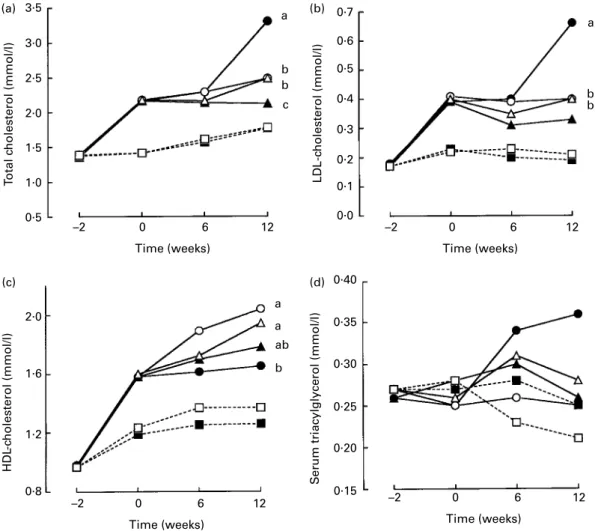
Plasma total cholesterol and lipoproteins were significantly increased in the experimental groups after nephrectomy, and no significant difference was found in plasma triacylglycerol concentration between all the groups (Fig. 2).
In the experimental animals, the concentration of total cholesterol in the casein group was significantly increased compared with that of the other groups. The SF group had lower total cholesterol levels than the ISP and PF groups (Fig. 2(A)). The LDL-cholesterol concentration also signifi-cantly increased in the casein group of experimental animals (0·66 (SD 0·07) mmol/l). There was no difference in LDL-cholesterol between the ISP, SF and PF groups (0·40 (SD
0·06), 0·33 (SD 0·08) and 0·40 (SD0·07) mmol/l, respectively;
Fig. 2(B)). The HDL-cholesterol levels in the ISP and PF groups were significantly higher than those in the casein group, and there was no difference between the SF and casein groups. No differences were found in HDL-cholesterol between the ISP, SF and PF groups (Fig. 2(C)). The ratios of HDL-cholesterol to total cholesterol in the ISP, SF and PF groups were significantly higher than those in the casein group (0·83 (SD 0·10), 0·84 (SD 0·10), 0·79 (SD 0·12) and 0·50 (SD 0·08), respectively), and there were no differences
between the ISP, SF and PF groups.
Liver lipid and faecal total steroids
Results for liver weight, liver total cholesterol concentration and faecal total steroid excretion are shown in Table 2. There was no difference in liver weight between the exper-imental groups. The liver total cholesterol concentrations of the SF and PF groups were significantly lower than those of the casein group, and no differences were found between the ISP, SF and PF groups or between the ISP and casein groups.
The faecal cholesterol excretion of the PF group was the highest among the four groups. The casein group had lower faecal cholesterol excretion, but there was no significant difference compared with the ISP and SF groups. The ISP group exhibited significantly increased faecal bile acid excretion compared with the other groups. The faecal bile acid excretion of the PF group was significantly higher than that of the SF and casein groups. There was no differ-ence in faecal bile acid excretion between the SF and casein groups.
Blood pressure
The blood pressures at the end of study are shown in Table 2. Blood pressures significantly increased in the experimental groups after nephrectomy. Of the four experimental groups, the SF group had the lowest mean blood pressure and dias-tolic blood pressure. The sysdias-tolic blood pressure of the SF group was lower than that of the ISP and casein groups, whereas systolic blood pressure was lower in the ISP and the PF groups than the casein group. There was no difference in systolic blood pressure between the SF and PF groups. No difference in blood pressure was found between the ISP and PF groups. Table 2 . Food intake, b ody weight, liver lipids, faecal steroids a nd blood pressure of five-sixths nephrectomized rats and s ham-operated rats fed different p rotein diets (Mean v alues a nd standard d eviations) Five-sixths nephrectomy S ham o peration Casein (n 6) ISP (n 5) SF (n 6) PF (n 6) Casein (n 5) ISP (n 4) Mean SD Mean SD Mean SD Mean SD Mean SD Mean SD Weight gain (g/rat) 138 ·3 a 14 ·8 148 ·4 b 21·9 145 ·6 b 17 ·1 145 ·2 b 16 ·7 188 ·3 c 19·4 184 ·6 c 7· 5 Food intake (g/rat per d) 24·7 1 ·0 2 4 ·5 0 ·9 24 ·9 1 ·7 2 4 ·1 2 ·4 24 ·8 0·5 2 4·5 0 ·0 Feeding efficiency (%)* 4 ·67 a 1· 2 5 ·1 b 0· 6 5 ·0 b 0· 9 5 ·3 b 1· 4 6 ·3 c 0·5 6 ·2 c 0· 6 Liver Liver weight (g/rat) 9 ·5 0 ·2 9 ·3 0 ·8 9 ·3 0 ·5 8 ·8 0 ·6 9 ·8 1 ·6 9 ·1 0 ·8 Total cholesterol (m mol/g liver) 26·4 a 0· 7 2 3· 9 ab 4· 1 2 0· 6 b 1· 7 1 9· 0 b 7· 6 2 1· 7 b 5·5 1 3·1 c 0· 5 Faeces (m mol/g faeces) Total cholesterol 1 ·95 a 0 ·36 2 ·27 a 1· 4 5 2· 1 3 a 1 ·23 9 ·76 b 2 ·20 11 ·72 c 0·50 16·33 d 0· 5 1 Total bile acid 804 a 247 3 663 b 689 1009 a 635 2 360 c 1210 1 041 a 212 3 220 b 623 Systolic blood pressure (mmHg) 1 55 ·2 a 8· 9 1 4 4 ·8 b 5· 9 1 3 5 ·0 cd 9 ·8 1 40 ·0 bc 9· 9 1 2 6 ·9 d 5·6 112 ·2 e 4· 5 ISP, isolated soya protein; SF, supernatant fraction o f s o y a p rotei n hydro lysate; PF, precipitate fraction o f soya protein hydrolysate. C asein g roup (180 g casein/kg); ISP group (180 g isol ated soya protein/kg); S F g roup (100 g casein a n d 80 g supernatant fraction o f soya protein hydro ly sate/kg); PF grou p (100 g casein a nd 80 g p recipitate fraction o f soya protein h ydrolysate/k g ). a,b,c,d,e Mean values within a row with unlike superscript letters were s ignificantly different (P , 0·05). * Feeding efficiency (%) ¼ (daily weight gain/daily food intake) £ 100 % .
Renal function
Serum creatinine, blood urea N and urinary protein excretion were significantly increased in the experimental animals after
the nephrectomy, and were significantly higher in the casein group than in the other experimental groups. There were no differences in serum creatinine (Fig. 1(B)), blood urea N (Fig. 1(C)) or urinary protein excretion (Fig. 3(A)) between the ISP, SF and PF groups.
The value of urinary urea N excretion for the ISP group was significantly higher than for the other groups, whereas values for the SF and PF groups were significantly lower than for the casein group in the experimental animals. No difference was found in urinary urea excretion between the SF and PF groups (Fig. 3(B)).
There was a significantly decreased creatinine clearance rate in the casein group of experimental animals compared with the other groups. The creatinine clearance rate of the SF group was significantly higher than that of the other experi-mental groups, and there were no differences between the ISP and PF groups (Fig. 3(C)).
Discussion
The results from this study showed that both the hydrophilic and the hydrophobic fraction of soya protein hydrolysate had a beneficial effect on slowing disease progression, redu-cing blood pressure and improving serum lipid profile, the hydrophilic fraction having the most pronounced renoprotec-tive effects in five-sixths nephrectomized rats. Replacing 80 g SF/kg with casein in the standard diet of nephrectomized rats for 14 weeks produced significantly lower blood pressures and serum total cholesterol concentrations compared with those of rats fed PF. Furthermore, the creatinine clearance rate was significantly higher in the SF than in the PF group.
When rats are subjected to surgical ablation of five-sixths of their renal mass, they develop hypertension, proteinuria and a progressive fall in glomerular filtration rate, features similar to those of human chronic kidney disease. The SF of soya protein hydrolysate has been shown to prevent the development of hypertension in spontaneously hypertensive rats and to have angiotensin-converting enzyme inhibitory activity (Chen et al. 2002; Yang et al. 2004). The results of the present study showed that the SF group had the lowest blood pressure among the four experimental groups. Studies have found that hypertension is important in the pathogenesis of the pro-gression of chronic renal disease (Peterson et al. 1995; Klag et al. 1996), and antihypertensive therapy has a major role in slowing the progression of renal disease (Wright et al. 2002). Significant decreases in blood pressure and increases in creatinine clearance rate in the SF group may indicate sub-stantial protection from progressive renal injury.
A number of studies have demonstrated that the PF of soya protein hydrolysate is more hypocholesterolaemic than soya protein itself (Sugano et al. 1990; Gatchalian-Yee et al. 1997), and SF from soya protein hydrolysate had no hypocho-lesterolaemic effect in rats fed a cholesterol-enriched diet (Sugano et al. 1988). In the present study, SF had a greater cholesterol-lowing effect than PF, which may have been due to the different animal model we used.
Mechanisms responsible for the hypocholesterolaemic effects of soya protein include increasing bile acid excretion, decreasing steroid absorption and changing hepatic lipid metabolism (Potter, 1995). Enhanced faecal steroid excretion with PF has been shown by several studies, and this may be 46 (a) (b) (c) 44 42 40 38 S erum albumin (g/l) S erum creatinine ( m mol/l)
Blood urea N (mmol/l)
36 34 140 120 100 80 60 40 20 20 15 10 5 0 0 –2 0 6 12 b b a a a a a a b b b c c b b b c c Time (weeks) –2 0 6 12 Time (weeks) –2 0 6 12 Time (weeks)
Fig. 1. Serum biochemical results of five-sixths nephrectomized rats and sham-operated rats fed different protein diets. Mean values with unlike super-script letters were significantly different (P, 0·05). X, Casein group (nephrec-tomized rats with 180 g casein/kg); W, ISP group (nephrec(nephrec-tomized rats with 180 g isolated soya protein/kg); O, SF group (nephrectomized rats with 100 g casein and 80 g supernatant fraction of soya protein hydrolysate/kg); K, PF group (nephrectomized rats with 100 g casein and 80 g precipitate fraction of soya protein hydrolysate/kg); B, sCasein group (sham-operated rats with 180 g casein/kg); A, sISP group (sham-operated rats with 180 g isolated soya protein/kg).
the major mechanism for the hypocholesterolaemic effect of PF (Sugano et al. 1988; Gatchalian-Yee et al. 1997; Chen JR et al. 2003). The results of the present study showed that the faecal cholesterol and bile acid excretion increased signifi-cantly in the PF group compared with the SF group; thus, another mechanism must be responsible for the cholesterol-lowering effect of SF. Chronic renal disease is associated with abnormal lipid metabolism (Appel, 1991). The mechan-ism of hypercholesterolaemia in nephrectomized rats may contribute to renal injury. Serum total cholesterol and lipopro-tein concentrations were significantly elevated in the experi-mental animals after nephrectomy, and were positively associated with serum creatinine level in the present study. These data suggest that the attenuation of renal injury may have resulted from the reduction in hyperlipidaemia. There-fore, the greater hypocholesterolaemic effect in SF-fed rats than PF-fed rats can possibly be attributed to the antihyperten-sive effect and slowing of disease progression.
Urinary protein excretion is reduced with soya protein con-sumption in several models of chronic kidney disease (Aukema et al. 1999; Tovar et al. 2002; Chen ST et al. 2003) and in human studies (D’Amico et al. 1992; Azadbakht
et al. 2003; Teixeira et al. 2004). The results of the present study showed that both soya protein hydrolysate fractions sig-nificantly reduced proteinuria. There were no significant differences in serum albumin level between the groups at the end of the study, and there were significantly decreased blood urea N levels in all soya protein and soya protein hydro-lysate groups compared with the casein group, indicating that both the SF and the PF of soya protein hydrolysate may be quite effective in ameliorating uraemic symptoms while main-taining an adequate nutritional status.
Despite these observations, our findings have the following limitations. First, the glomerular filtration rate was estimated from the creatinine clearance rate, and there is day-to-day variability in 24 h creatinine clearance (Walser, 1990). Second, mean blood pressure was measured by the tail-cuff method, but it is controversial whether the technique is reliable for mean blood pressure measurements (Ikeda et al. 1991; Kramer & Remie, 2004).
Few data are, however, available for defining the mechanism and constituents of soya protein responsible for its renoprotec-tive effects. This study showed that serum creatinine, blood pressure, plasma lipids and proteinuria in nephrectomized rats 3.5 (a) (b) (c) (d) a a b b a a b ab b b c 0.7 0.6 0.5 0.4 0.3 0.2 0.1 0.0 0.40 0.35 0.30 0.25 0.20 0.15 3.0 2.5 2.0 1.5 1.0 0.5 –2 0 6 12 Time (weeks) –2 0 6 12 Time (weeks) –2 0 6 12 Time (weeks) –2 0 6 12 Time (weeks) 2.0 1.6 1.2 HDL -c holesterol (mmol/l) 0.8 T otal c holesterol (mmol/l) LDL-c holesterol (mmol/l) S
erum triacylglycerol (mmol/l)
Fig. 2. Plasma lipid and lipoprotein levels of five-sixths nephrectomized rats and sham-operated rats fed different protein diets. Mean values with unlike super-script letters were significantly different (P, 0·05). X, Casein group (nephrectomized rats with 180 g casein/kg); W, ISP group (nephrectomized rats with 180 g iso-lated soya protein/kg); O, SF group (nephrectomized rats with 100 g casein and 80 g supernatant fraction of soya protein hydrolysate/kg); K, PF group (nephrectomized rats with 100 g casein and 80 g precipitate fraction of soya protein hydrolysate/kg); B, sCasein group (sham-operated rats with 180 g casein/kg); A, sISP group (sham-operated rats with 180 g isolated soya protein/kg).
decreased significantly, and there was a significantly increased creatinine clearance rate, with the administration of both soya protein hydrolysates. The renoprotective effects of SF and PF appear to be due to different mechanisms. Current therapeutic strategies for achieving maximal renal protection include con-trol of hypertension, angiotensin-converting enzyme therapy, reduction of proteinuria, treatment of hyperlipidaemia and
dietary protein restriction (Taal & Brenner, 2001). The PF group exhibited significantly increased faecal steroid excretion, and liver cholesterol level tended to be lower than in the other groups. Clinical studies have shown that renal function declines more rapidly among patients with renal disease who have hyper-lipidaemia (Maschio et al. 1991). These data suggest that the hypocholesterolaemic effect of PF may be one of possible effects underlying the slowing of disease progression. The crea-tinine clearance rate was, however, significantly greater in rats fed SF compared with those fed the other diets. Furthermore, blood pressure was significantly lower in the SF group than in the other groups. These results indicate that the antihypertensive effect of SF may play an important role in the renoprotective effects of soya protein.
In conclusion, by comparing the effects of the two fractions isolated from soya protein hydrolysate prepared by peptic hydrolysis, our findings demonstrate that the hydrophilic SF was more effective in modulating blood pressure and had the most pronounced effect on slowing the progression of renal disease. Further studies are needed to clarify how the hydrophilic fraction of soya protein hydrolysate affects blood pressure, and the results of those studies may possibly then be used in dietary management to prevent the progression of renal disease.
Acknowledgements
This work was supported by a grant from the National Science Council in Taiwan (NSC 93-2320-B-038-031).
References
Anderson JW, Johnstone BM & Cook-Newell ME (1995) Meta-anal-ysis of the effects of soy protein intake on serum lipids. N Engl J Med 333, 276 – 282.
Appel G (1991) Lipid abnormalities in renal disease. Kidney Int 39, 169 – 183.
Aukema HM, Housini I & Rawling JM (1999) Dietary soy protein effects on inherited polycystic kidney disease are influenced by gender and protein level. J Am Soc Nephrol 10, 300 – 308. Azadbakht L, Shakerhosseini R, Atabak S, Jamshidian M, Mehrabi Y &
Esmaill-Zadeh A (2003) Beneficiary effect of dietary soy protein on lowering plasma levels of lipid and improving kidney function in type II diabetes with nephropathy. Eur J Clin Nutr 57, 1292 – 1294. Chen JR, Chiou SF, Suetsuna K, Yang HY & Yang SC (2003) Lipid
metabolism in hypercholesterolemic rats affected by feeding cholesterol-free diets containing different amounts of non-dialyzed soybean protein fraction. Nutrition 19, 676 – 680.
Chen JR, Okada OT, Muramoto K, Suetsuna K & Yang SC (2002) Identification of angiotensin I converting enzyme inhibitory pep-tides derived from the peptic digest of soybean protein. J Food Biochem 26, 543 – 544.
Chen ST, Peng SJ & Chen JR (2003) Effects of dietary protein on renal function and lipid metabolism in five-sixths nephrectomized rats. Br J Nutr 89, 491 – 497.
D’Amico G, Gentile MG, Manna G, Fellin G, Ciceri R, Cofano F, Petrini C, Lavarda F, Perolini S & Porrini M (1992) Effect of veg-etarian soy diet on hyperlipidaemia in nephrotic syndrome. Lancet 339, 1131 – 1134.
Folch J, Lees M & Sloane-Stanley GH (1957) A simple method for the isolation and purification of total lipids from animal tissues. J Biol Chem 226, 497 – 509. 15 (a) (b) (c) a a d a a b b b b a d c c c c b b c Urinary protein (mg/d) 10 5 0 –2 0 6 12 Time (weeks) –2 0 6 12 Time (weeks) –2 0 6 12 Time (weeks) 100
Urine urea N (mmol/d)
Creatinine clearance rate (ml/min)
80 60 40 20 0 4 3 2 1 0
Fig. 3. Urine biochemical results and creatinine clearance rate of five-sixths nephrectomized rats and sham-operated rats fed different protein diets. Mean values with unlike superscript letters were significantly different (P, 0·05). X, Casein group (nephrectomized rats with 180 g casein/kg); W, ISP group (nephrectomized rats with 180 g isolated soya protein/kg); O, SF group (nephrectomized rats with 100 g casein and 80 g supernatant fraction of soya protein hydrolysate/kg); K, PF group (nephrectomized rats with 100 g casein and 80 g precipitate fraction of soya protein hydrolysate/kg); B, sCasein group (sham-operated rats with 180 g casein/kg); A, sISP group (sham-operated rats with 180 g isolated soya protein/kg).
Gatchalian-Yee M, Arimura Y, Ochiai E, Yamada K & Sugano M (1997) Soybean protein lowers serum cholesterol levels in hamsters: effect of debittered undigested fraction. Nutrition 13, 633 – 639. He J, Gu D, Wu X, Chen J, Duan X & Whelton PK (2005) Effect of
soybean protein on blood pressure: a randomized, controlled trial. Ann Intern Med 143, 1 – 9.
Ikeda K, Nara Y & Yamori Y (1991) Indirect systolic and mean blood pressure determination by a new tail cuff method in spontaneously hypertensive rats. Lab Anim 25, 26 – 29.
Klag MJ, Whelton PK, Randall BL, Neaton JD, Brancati FL, Ford CE, Shulman NB & Stamler J (1996) Blood pressure and end-stage renal disease in men. N Engl J Med 334, 13 – 18.
Kramer K & Remie R (2004) Measuring blood pressure in small labo-ratory animals. Methods Mol Med 108, 51 – 62.
Maschio G, Oldrizzi L, Rugiu C, De Biase V & Loschiavo C (1991) Effect of dietary manipulation on the lipid abnormalities in patients with chronic renal failure. Kidney Int Suppl 31, S70 – S72. National Research Council (1985) Guide for the Care and Use of
Labora-tory Animals. Bethesda, MD: NRC, National Institutes of Health. Peterson JC, Adler S, Burkart JM, Greene T, Hebert LA, Hunsicker LG,
King AJ, Klahr S, Massry SG & Seifter JL (1995) Blood pressure control, proteinuria, and the progression of renal disease. The modification of diet in renal disease study. Ann Intern Med 123, 754 – 762.
Potter SM (1995) Overview of proposed mechanisms for the hypo-cholesterolemic effect of soy. J Nutr 125, 606S – 611S.
Sugano M, Goto S, Yamada Y, Yoshida K, Hashimoto Y, Matsuo T & Kimoto M (1990) Cholesterol-lowering activity of various undi-gested fractions of soybean protein in rats. J Nutr 120, 977 – 985. Sugano M, Yamada Y, Yoshida K, Hashimoto Y, Matsuo T &
Kimoto M (1988) The hypocholesterolemic action of the undigested fraction of soybean protein in rats. Atherosclerosis 72, 115 – 122.
Taal MW & Brenner BM (2001) Achieving maximal renal protection in nondiabetic chronic renal disease. Am J Kidney Dis 38, 1365 – 1371.
Teixeira SR, Tappenden KA, Carson L, Jones R, Prabhudesai M, Marshall WP & Erdman JW Jr (2004) Isolated soy protein con-sumption reduces urinary albumin excretion and improves the serum lipid profile in men with type 2 diabetes mellitus and nephropathy. J Nutr 134, 1874 – 1880.
Tomobe K, Philbrick DJ, Ogborn MR, Takahashi H & Holub BJ (1998) Effect of dietary soy protein and genistein on disease pro-gression in mice with polycystic kidney disease. Am J Kidney Dis 31, 55 – 61.
Tovar AR, Murguia F, Cruz C, Hernandez-Pando R, Aguilar-Salinas CA, Pedraza-Chaverri J, Correa-Rotter R & Torres N (2002) A soy protein diet alters hepatic lipid metabolism gene expression and reduces serum lipids and renal fibrogenic cytokines in rats with chronic nephrotic syndrome. J Nutr 132, 2562 – 2569.
Walser M (1990) Progression of chronic renal failure in man. Kidney Int 37, 1195 – 1210.
Wright JT Jr, Bakris G, Greene T, et al. (2002) Effect of blood press-ure lowering and antihypertensive drug class on progression of hypertensive kidney disease: results from the AASK trial. Blood pressure control, proteinuria, and the progression of renal disease. The Modification of Diet in Renal Disease Study. JAMA 288, 2421 – 2431.
Yang G, Shu XO, Jin F, Zhang X, Li HL, Li Q, Gao YT & Zheng W (2005) Longitudinal study of soy food intake and blood pressure among middle-aged and elderly Chinese women. Am J Clin Nutr 81, 1012 – 1017.
Yang HY, Yang SC, Chen JR, Tzeng YH & Han BC (2004) Soyabean protein hydrolysate prevents the development of hypertension in spontaneously hypertensive rats. Br J Nutr 92, 507 – 512.