
J . C H E M . SOC. DALTON TRANS.
1993
2939
Luminescent Heterobi metal
I ic Complexes. Electronic
Structure and Spectroscopy
of
[MPt(dppm),(C=CPh),]PF,
(M
=
Au or
Ag)
and Crystal Structure of
[AuPt(dppm),(C-CPh),]PF,
(dppm
=
Ph,PCH,PPh,)
t
Hon-Kay Yip,a Hsui-Mei Lin,b Yu Wangb and Chi-Ming Che"aapb
a Department of Chemistry, The University of Hong Kong, Pokfulam Road, Hong Kong
Department of Chemistry, National Taiwan University, Taipei, Taiwan
The crystal structure of [AuPt(dppm),(C=CPh),] PF,*H,O (dppm = Ph,PCH,PPh,) has been determined: triclinic, space group P i , Z = 2, a = 1 1
.I
46(4), b = 14.51 2(2),c
= 20.322(3)A,
C( =81.55(1),
p
= 101.27(2), y = 109.35(2)". The complex cation consists of a square-planar P-Pt- (C=CPh),-P and a linear P-Au-P moiety and the measured intramolecular Pt-Au separation is 2.91 0(1)A.
The absorption and emission spectra of the complex and of [AgPt(dppm),(C=CPh),] PF, and trans-[Pt(dppm),(C=CPh),] have been measured. Both dinuclear complexes possess low-energy intense electronic absorption bands {[AuPt(dppm),(C=CPh),] PF,,
A,,,
= 387 nm, E,,, = 1.1 1 x 1 O4 dm3 mol'
cm-l; [AgPt(dppm),(C=CPh),]PF,,A,,,
= 368, E,,, = 1.63 xlo4
dm3 molP cm-'} which are red-shifted from that of trans-[Pt(dppm),(C-CPh),]. In solid form, all three complexes exhibit photoluminescence at room temperature. Extended-Huckel molecular orbital calculations have been performed on the model complexes [AuPt(dmpm),(C=CPh),] + andtrans-
[Pt(dmpm),(C=CPh),](dmpm = Me,PCH,PMe,).
The spectroscopy and photochemistry of metal-acetylide complexes have attracted attention recently. The intriguing photophysical and photochemical properties of platinum(1r)- phenylacetylide complexes are highlighted by the photo- luminescence studies on trans- [Pt(PR J ,(C-CPh) ,] (R=alk yl or Ph) l a and the photochemical studies on [Pt,(PEt,),(p-
C=CHPh)(C=CPh)] l b the excited state of which was found to
react with methyl iodide, propan-2-01 and diphenylacetylene. In the course of our study on luminescent heterobimetallic d '"4' complexes we investigated [MPt(dppm),(C=CPh),] +
(M = Au or Ag, dppm = Ph,PCH,PPh,) which were synthesised by Shaw and co-workers. Their spectroscopic properties were found to be interesting, being different from those of [MPt(dppm),(CN),]
+.,
Experimental
Materials.-The ligand dppm (Aldrich, 98%), K[AuCl,] (Aldrich, 980{), PPh, (Merck, 98%), K,[PtCl,] (Aldrich, 9973, AgPF, (BDH, LR), phenylacetylene (Aldrich, 98%), and Hg(O,CMe), (BDH, 98%) were used as received.
Svn theses. -T he complexes trans- [Pt(dppm) (C=CPh),] and [MPt(dppm),(C=CPh),]PF, (M = Au or were synthesised by the methods reported by Shaw and co-workers.
Instrumentation.-The UV/VIS absorption spectra were
recorded on a Milton Roy Spectronic 3000 diode-array spectrophotometer, room-temperature and 77 K solid-state and glass emission spectra on a Spex Fluorolog-2 spectro- fluorometer, infrared spectra as Nujol mulls on a Nicolet 20SX FT-IR spectrometer and 'H NMR spectra on a JEOL GSX 270
t
Supplementary data available: see Instructions for Authors, J. Chem.Soc., Dalton Trans., 1993, Issue 1 , pp. xxiii-xxviii.
Non-SZ unit employed: eV z 1.60 x J.
MHz spectrometer with SiMe, used as standard. Emission lifetimes were recorded with the laser photolysis set-up described elsewhere.,
Molecular Orbital Calculations.-Extended-Huckel molecu- lar orbital (EHMO) calculations were made on [AuPt(dmpm),- (CKPh),] + and trans-[Pt(dmpm),)(C=CPh),] (dmpm =
Me,PCH,PMe,). The geometry of the former species was taken from X-ray diffraction data with all phenyl groups on P replaced by methyl groups. The geometry of the latter is the same as the former with the Au atom removed. The calculations were carried out using the ICON program5 and the Hii and
5
values for Au and Pt were taken from the literature.6Crystal Structure Determination of[AuPt(dppm>,(C-CPh),I- PF,*H,O.-A suitable crystal of [AuPt(dppm),(CrCPh),]- PF,-H,O (dimensions 0.50 x 0.60 x 0.60 mm) was chosen for X-ray analysis.
Crystal data. C,,H,,ALlF,OP,Pt, M = 1524.05, trlCliniC, s ace group
Pi,
a = 11.146(4), b = 14.512(2), c = 20.322(3)K
a = 81.55(1),p
= 101.27(2), y = 109.35(2)", D, = 1.65g cm-,, U = 3030(1)
A3,
Z = 2, p(Mo-Kx) = 48.7 cm-',F(000) = 3048.
Intensity data were measured on a CAD-4 diffractometer with Mo-Ka (A = 0.7093
A)
radiation using a 8-28 scan technique. A total of 7884 unique reflections was measured, of which 6265 were observed [ I 3 20(1)] and were based on the least-squares refinement. Intensities were corrected for absorption based on experimentalw
curves for three chosen reflections. Three standard reflections were monitored throughout the intensity measurement, but their intensity variations were less than ?2%. During the least-squares refinement all the phenyl ring groups were considered to be rigid, i.e. all the C-C bonds were fixed at 1.395A,
C-H at 1 .OA,
and C-C-C angles at 120". For each, anisotropic group thermal motion plus individual atomic isotropic thermal motion were considered. A secondary isotropic extinction correction was applied, 1.19(4) x lop4. One water molecule of solvation is2940
J. CHEM. SOC. DALTON TRANS.1993
Atomic coordinates of [AuPt(dppm),(C=CPh),]PF6-H20 Y 0.443 12(5) 0.566 62(5) 0.589 l(3) 0.649 4(3) 0.281 l(3) 0.472 O(3) 0.710 9(10) 0.713 7(10) 0.813 3(11) 0.426 3( 1 1) 0.335 4(12) 0.033 8(4) 0.174 5(8) 0.026 l(9) 0.045 O(8) 0.092 3(8) 0.52 l(3) 0.934 5(6) 1.016 6(9) 1.137 3(8) 1.175 9(7) 1.093 7( 10) 0.973 O(9) 0.225 7( 10) 0.102 2(14) 0.012 8(12) 0.136 3(16) 0.242 8( 10) 0.51 1 4(8) 0.384 7(8) 0.322 6(7) 0.387 2(9) 0.5 13 9(9) 0.576 O(6) 0.684 O( 10) 0.765 6(12) 0.306 l(10) - -0.105 O(7) -0.022 8(9) -0.004 3(9) Y 0.222 59(3) 0.175 91(3) 0.378 37(22) 0.343 84(21) 0.074 28(22) 0.010 47(21) 0.404 3(7) 0.187 2(7) 0.199 6(8) 0.168 l(7) 0.165 6(8) 0.678 4(3) 0.639 5(5) 0.718 6(6) 0.571 8 ( 5 ) 0.785 8(5) 0.662 5(6) 0.693 3(6) 0.585 O( 16) 0.212 7(8) 0.306 9(6) 0.319 7(5) 0.238 2(8) 0.144 O(6) 0.131 3(5) 0.169 6(10) 0.129 8(9) 0.136 9(10) 0.183 9(10) 0.223 7( 10) 0.216 6(10) 0.472 8(5) 0.448 6(5) 0.520 O(7) 0.615 5(6) 0.639 7(4) 0.568 3(6) 0.397 6(8) 0.491 5(6) -0.009 l(8) Z 0.300 16(3) 0.201 52(3) 0.313 23(17) 0.181 56(16) 0.287 95( 17) 0.224 81(16) 0.259 6(5) 0.236 l(6) 0.274 l(6) 0.315 4(6) 0.125 8(6) 0.079 9(6) 0.274 58( 19) 0.232 6(4) 0.3 14 5(4) 0.304 9(4) 0.242 6(4) 0.213 O(4) 0.335 7(4) 0.486 O( 1 5 ) 0.359 7(4) 0.371 5(4) 0.411 l(5) 0.438 8(4) 0.427 O ( 5 ) 0.387 4(5) 0.029 3(6) 0.046 2(4) -0.001 O(7) -0.065 l(6) -0.081 9(5) -0.034 7(8) 0.292 7(4) 0.304 l(4) 0.292 l(5) 0.268 7(5) 0.257 3(5) 0.269 3(5) 0.395 5(4) 0.408 5 ( 5 ) Atom C( 13B) C( 14B) C( 15B) C( 16B) C(21A) C(22A) C(23A) C(24A) C(25A) C(26A) C(21B) C(22B) C(23B) C(24B) C(25B) C(26B) C(3 1 A) C(32A) C(33A) C(34A) C(35A) C( 3 6A) C(3 1 B) C(32B) C(33B) C(34B) C(35B) C(36B) C(4 1 A) C(42A) C(43A) C(44A) C(45A) C(46A) C(4 1 B) C(42B) C(43B) C(44B) C(45B) C(46B) X 0.838 7(10) 0.830 l(11) 0.748 5( 13) 0.675 4( 10) 0.544 O(7) 0.41 3 7(8) 0.332 8(6) 0.382 2(9) 0.512 4(10) 0.593 3(6) 0.784 9(7) 0.901 9(9) 1.001 4(6) 0.984 O(7) 0.867 l(9) 0.767 5(6) 0.13 1 9(6) 0.033 8(8) -0.078 5(7) - 0.092 8(7) 0.005 3(10) 0.1176(8) 0.256 3(9) 0.348 4(7) 0.332 4(9) 0.224 2(11) 0.132 l(8) 0.148 2(8) 0.545 l(8) 0.671 4(8) 0.728 5(7) 0.659 4(11) 0.533 l(11) 0.476 O(7) 0.453 6(8) 0.535 6(7) 0.532 4(9) 0.447 2( 1 1) 0.365 2(9) 0.368 4(7) Y 0.508 4(6) 0.431 4(10) 0.337 5(8) 0.320 6(5) 0.410 9(6) 0.375 9(4) 0.431 4(7) 0.521 9(6) 0.556 9(5) 0.501 4(6) 0.374 l(6) 0.446 4(6) 0.464 7(5) 0,410 8(7) 0.338 5(6) 0.320 l(5) 0.091 7(6) 0.01 5 7(4) 0.032 6(5) 0.125 3(7) 0.201 2(5) 0.184 4(5) 0.007 l(6) 0.037 9(5) -0.012 9(7) - 0.094 5(7) -0.125 3(5) - 0.074 5(7) - 0.056 2(5) - 0.052 6(5) -0.1 12 l(7) - 0.175 4(6) - 0.179 O(6) -0.1 19 5(7) - 0.062 4(5) - 0.026 6(5) - 0.086 2(8) -0.181 5(7) - 0.21 7 3(4) - 0.157 7(6) Z 0.472 2(6) 0.522 8(4) 0.509 7(5) 0.446 l(6) 0.135 7(4) 0.141 9(4) 0.1 12 6(5) 0.077 O(4) 0.070 8(4) 0.100 l(5) 0.137 2(4) 0.154 5(3) 0.1 17 3(5) 0.062 8(4) 0.045 5(3) 0.082 7(4) 0.245 l(4) 0.21 3 9(4) 0.178 4(4) 0.174 O(4) 0.205 2(5) 0.240 7(4) 0.369 3(3) 0.425 6(5) 0.488 7(4) 0.495 6(4) 0.439 4(6) 0.376 3(4) 0.294 l(4) 0.293 l(4) 0.339 9(5) 0.387 8(4) 0.388 9(4) 0.342 O ( 5 ) 0.156 4(3) 0.059 6(4) 0.059 O(4) 0.107 l(5) 0.155 8(4) 0.108 3(5)
Table 2 Selected bond distances
(A)
and angles (") of[AuPt(dppm),(C=CPh),]PF6-H20 Au-Pt 2.9 1 O( 1) Pt-C(3) 1.958(1 I ) Au-P( 1 ) 2.323( 3) Pt-C(5) 1.954(1 I ) Au-P(3) 2.3 15(3) C(3tC(4) 1.23(2) Pt-P(2) 2.307(3) C(5tC(6> 1.23(2) Pt-P(4) 2.299( 3) C(4FC( 1 1) I.#( 1) P( I)-Au-P(3) I74.0( 1) C(3)-Pt-C(5) 177.0(4) P(2)-Pt-P(4) 175.7( 1) Pt-C(3)-C(4) 174.0(9) P(2)-Pt-C(3) 85.9(3) Pt-C(5)-C(6) 177(1) P(2)-Pt-C( 5) 92.4( 3) C(3kC(4)-C(11) 176( 1)
present in the crystal. All the crystallographic computations were made on a Micro VAX computer using the NRCVAX program.7 Convergence of 6265 observed data and 717 parameters was reached at
R
= 0.044, R' = 0.039 and S = 3.90 with weighting scheme w = [02(F,)]-'. The final Fourier difference map showed residual extrema in the range+
1.59 to - 1.27 ek3.
Atomic coordinates for non-hydrogen atoms are listed in Table 1, bond distances and angles in Table 2.Additional material available from the Cambridge Crystal- lographic Data Centre comprises H-atom coordinates, thermal parameters and remaining bond lengths and angles.
Results and Discussion
The synthesis and characterization of the d'O-d* heterobi- metallic complexes [MPt(dppm),(C=CPh),] + (M = Ag, Cu,
Au or HgC1,) were previously reported by Shaw and co- workers. This work presents the first spectroscopic investi- gation of the complexes.
Fig. 1 shows a perspective view of the [AuPt(dppm),- (C=CPh,)]+ cation. The structure is similar to that of [AuPt(dppm),(CN),] + , having a pseudo-square-planar Pt-
(C=CPh),P, unit and a closely linear P-Au-P moiety bridged by two trans-dppm ligands. The intramolecular Pt-Au distance is 2.910(1) 8, which is shorter than the value of 3.046(2) 8, in [AuPt(dppm),(CN),] + (ref. 2) and the Pt-Ag distance of
3.146(3)
A
in[AgPt(dppm)2(C=CPh),I].8
While the other bond distances in [AuPt(dpprn),(C=CPh),]+ and [AuPt(dppm),- (CN),]+ are normal, the short Pt-Au separation may have an electronic origin.Electronic Spectroscopy of [MPt(dppm),(C=CPh),]PF6 (M = Au or Ag).-It is rewarding to examine first the absorption spectrum of trans-[Pt(dppm),(CrCPh),]. Fig. 2 shows the spectrum measured in acetonitrile at room temperature. It exhibits an intense absorption band at 345 nm
( E = ~9.24 ~ x ~lo3 dm3 mol-' cm-'), which is unsymmetric and is overlapped by a moderately intense absorption ( E
=
700- 2000 dm3 mol-' cm-') between 365 and 420 nm. Apart from these bands, there is also an intense band at 259 nm (E,,~ = 2.10 x lo4 dm3 mol-' cm-') accompanied by a shoulder at about 293 nm ( E=
1 x lo4 dm3 mol-' cm-l).The electronic structure and absorption spectra of the related complexes
trans-[Pt(PR,),(CzCPh),]
(R = alkyl, H or Ph)J . CHEM. SOC. DALTON TRANS.
1993
294 1
Fig. 1 Perspective view of [AuPt(dppm),(C=CPh),]
'
and co-workers l o reported the absorption and emission spectra
of similar complexes. The absorption spectrum of trans- [Pt(PEt3)2(C=CPh),] shows bands at 328, 288 and 264 nm,9 similar to those of
trans-[Pt(dppm),(C=CPh),]
studied in this work. The band of 328 nm oftrans-[Pt(PEt,),(C=CPh),]
has been assigned to the 'm.1.c.t. (metal to ligand charge transfer) transition Pt(Sd)+CsCPh.' It seems that the band of trans- [Pt(dppm),(C=CPh),] at 345 nm may be due to a similar transition. However, the E,,, values of these two bands aremuch larger than those of 'm.1.c.t. transitions of square- planar platinum( 11)-a-diimine complexes such as [Pt(bipy)Cl,] (bipy = 2,2'-bipyridine; h,,, = 394 nm, E,,, = 3.29 x lo3 dm3 mol
'
cm'
in butyronitrile) l o and the corresponding 3,3'-dicarboxy derivative (h,,, = 444 nm, E,,, = 3.03 x lo3 dm3 mol cm
'
in CH,CI,).l'Extended-Hiickel molecular orbital calculations were per- formed on the model complex
trans-[Pt(dmpm),(C=CPh),].
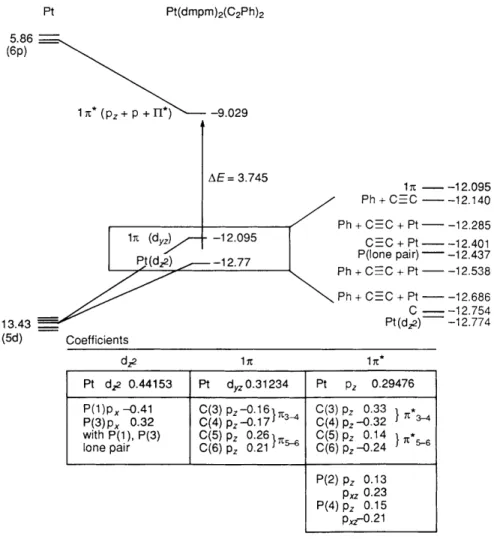
The axes were chosen such that the phenylacetylides are lying along the y axis and the P-Pt-P vector is designated as the xaxis. The results show that there is substantial mixing of the n* orbital of phenylacetylide with the 6p, orbital of Pt (see In* orbital in Fig. 3) and of the 5d,, orbital of Pt with n orbitals of
the phenylacetylide (see 1n orbital in Fig. 3). This is consistent with the calculations performed by Masai et al.' on trans- [Pt(PEt,),(C=CPh),] in that n-bond interaction between the 5dYZ orbital of Pt and n orbitals of the phenylacetylide would lead to an antibonding orbital having both platinum and phenylacetylide character. Thus the band of trans-[Pt(dppm),- (C-CPh),] at 345 nm is assigned to the spin-allowed In-
ln* transition, which may also be regarded as a hybrid of the conventional m.1.c.t. [Pt(Sd)-C=CPh] and intraligand n
-
n* transitions. Its large E,,, value may be accounted for by the mixing of the Pt(5d) orbitals with the n orbitals of phenylacetylide.
Upon ph o t oexci t a t ion, trans- [ Pt(d ppm) (C=CPh) ,] exhibits intense emission in the solid state but no emission was detected in fluid solution at room temperature. Fig. 4 shows the emis- sion spectrum of the complex upon excitation at 350 nm in a MeOH ~ EtOH (1 :
4,
v/v) glass at 77 K. The spectrum is richin vibronic structure and very similar to that of trans- [Pt(PEt,),(C=CPh),] reported by Demas and co-workers.'" The solid-state emission lifetime is 0.3 ps measured at room temperature. The vibrational progressions of 2065 and 21 26
0.00
200 300 400
h/nm
Fig. 2 The UV/VIS absorption spectrum of trans-[Pt(dppm),- ( W P h ) , ] in acetonitrile solution
cm-' (Fig. 4) compare favourably with the ground state v(C=C) stretch (2105 cm-') of trans-[Pt(dppm),(CrCPh),l. The
Huang-Rhys factor l 2 of the progression, defined as I(01)(448
nm)/1(00)(493 nm), is estimated to be 0.3. The spectrum also exhibits another vibronic progression of
=
650 cm-' and this is assigned to the phenyl-ring skeletal vibration (620-639 cm-').The absorption spectrum of [AuPt(dppm),(CKPh),] + is
significantly different from that of trans-[Pt(dppm),(C=CPh),]. As shown in Fig. 5 , [AuPt(dpprn),(C=CPh),] + shows an
intense absorption band (A) at 387 nm (E,,, = 1.1 1 x lo4 dm3 mol-' cm-') and an unsymmetric absorption at 329 nm (band B,
E,,, = 1.64 x lo4 dm3 mol-' cm-'). From previous spectro- scopic studies of dinuclear d 8 d 8 (ref. 13), d"-d" (ref. 14) and dsd'O (refs. 2 and 15) complexes, the distinct difference between the absorption spectra of dinuclear complexes and their mononuclear counterparts is the appearance of a '(do*
-
p,) transition, which is red-shifted from the absorption spectrum of the mononuclear metal complexes.Although assigning band A to the conventional '(do*- p,) transition seems to be appealing, the difference between [AuPt(dppm),(C=CPh),] + and a conventional dinuclear d 8 d s
complex such as [Pt2(H2P205)4]4- [ref. 13(a)] should not be overlooked. The result of the EHMO calculation on the electronic structure of the model complex [AuPt(dmpm),- (C=CPh),]+ is shown in Fig. 6. The lowest unoccupied molecular orbital (LUMO) (also labelled as 1n*) is almost the same as that of
trans-[Pt(dmpm),(C~CPh),].
However, the previous 5 d , ~ orbital of trans-[Pt(dmpm),(C=CPh),] changes to the d,, orbital which is composed of significant portions of metal-localized 5d,z orbitals of Au and Pt. Thus, the band of [AuPt(dmpm),(C-CPh),] + at 387 nm, which is red-shiftedfrom that of trans-[Pt(dppm),(C~CPh),], is tentatively assigned to ' ( d o * d 1 n
*
). However, it can also be regarded as a m.m.1.c.t. (metal-metal bond-to-ligand charge transfer) transition since the l n * orbital here mainly arises from the phenylacetylide. The notion of a m.m.1.c. t. transition was first devised by Balch16 in 1976 to assign the lowest- energy transition of several dinuclear rhodium(1) complexes, [Rh,(dppm),(CNR),l2+ (R = aryl or alkyl). However, it remains to be explained why the '(do*-
1n*) transition is the lowest energy allowed transition in [AuPt(dppm),(C=CPh),] +despite the fact that the Pt-Au(d,,) orbital is not the highest occupied molecular orbital in the EHMO calculation.
The [AuPt(dppm),(C=CPh),] + complex also exhibits two
poorly resolved absorption peaks at 329 and ~ 3 5 2 nm which are close in energy to the band of trans-[Pt(dppm),(C=CPh),] at 345 nm. Accordingly we assign these to the In
-
1n* transition (where In is a hybrid of the 5d,, of Pt and n orbital of phenylacetylide). This assignment is further supported by a similar band in the spectrum of [AgPt(dppm),(CzCPh),] + .2942
-1 2.095 Pt
C=C + Pt
-
-12.401 P(lone pair)-
-1 2.437J. CHEM. SOC. DALTON TRANS.
1993
2065 cm-' t I C(3) pz 0.33 C(5) pz 0.14 C(4) ~ ~ - 0 . 3 2 X*3-4 C(6) ~ ~ - 0 . 2 4 7F*5-6 P ( l )p x -0.41 P(3)px 0.32 with P(I), P(3) lone pair P(2) pz 0.13 P(4) pz 0.15 Pxz 0.23
Fig. 3 Molecular orbital diagram of trans-[Pt(dmpm),(C=CPh),l; energies in eV
400 500 600 700
Vnm
Fig. 4
solution of tran~-[Pt(dppm),(C=CPh)~]
Emission spectrum at 77 K of MeOH-EtOH (1 : 4, v/v) glass
The solid form of [AuPt(dppm),(C=CPh),IPF, is strongly emissive upon photoexcitation. However no emission was observed in fluid solution at room temperature. Fig. 7 shows the emission spectrum (excitation at 350 nm) of the complex in a MeOH-EtOH (1 :
4,
v/v) glass at 77 K. The room-temperature emission spectrum shows an unsymmetric and narrow band at 462 nm and there is a shoulder at about 510 nm. The decay of the emission is monoexponential with a lifetime of 0.35 ps. At 77 K the emission intensity is increased and the band width reduced. The emission maximum is blue-shifted slightly to 454 nm and a rather distinct shoulder appears at 502 nm. It is likely that the emission becomes vibronically structured with a7 L 0 0.86 E T!
p::
-
0.431
M
A
\
\
0.00 200 300 400 500 ?JnmFig. 5 The UVjVIS absorption spectrum of [AuPt(dppm),-
(C=CPh),]PF, in acetonitrile solution
spacing of 2106 cm-' which is nearly the same as the ground- state v(C=C) stretch (21 05 cm-') of trans-[Pt(dppm),- (CgPh),]. The Huang-Rhys factor, l 2 I(Ol)/I(OO), of the
emission is estimated to be about 0.2. The excitation spectrum for the 450 nm emission of [AuPt(dppm),(C=CPh),]+ at 77 K exhibits two distinct bands at 320-350 and 390 nm which have been assigned to the '(17~
-
1n*) and ' ( d o t --+ 1n*) transitions, respectively (Fig. 7).The UV/VIS absorption spectrum of [AgPt(dppm),(C= CPh),]PF, is displayed in Fig. 8. It is similar to that of its
J. CHEM. SOC. DALTON TRANS.
1993
2943
-5.55 (6 P) A € = 3.664 Pt-AU(d,*) -1 2.741 / , 8 , I / lx* ( po+
p+
n*)
-9.077 -1 3.43 ( 5 4 -15.07 (5d) =-
Pt-Au(d,) Coefficients Pt-Au (do*) d , -0.126lo*
d,-0.110 s 0.188 s -0.149 AU dp-0.234 Pt d p 0.660 C(5) px -0.159 C(6) px -0.1961
'II: P(3) px 0.118 P(4) px -0.1451
(sW
)
,
17r C(3) pz-0.157 C(4) pz-0.172 C(5) pz 0.260 C(6) pz 0.210 1 x* Au pz 0.160 Pt p,-0.2611
(s C(3) pz -0.288 C(4) pz 0.293 '* C(6) pz 0.2211
x* C(5) pz -0.1 23 p d*zFig. 6 Molecular orbital diagram of [AuPt(dmpm),(CePh),] + ; energies in eV
21
-
06 cm-'I
I
I
300 400 500 600
Excitation ( a ) and emission (6) spectra at 77 K of a MeOH- hlnm
E a H (1 : 4, v h ) glass solution of [Au~Pt(dpprn),(C&Ph),]PF,
gold(1) analogue. Two intense bands a t 368 (E,,, = 1.63 x lo4 dm3 mol
'
cm I ) and 318 nm (E,,, = 1.71 x lo4 dm3 mol cm '), which could be related to the respective bands A ['(du*+ 1n*)] and B ['(ln- In*)] of [AuPt(dppm),-(C=CPh),]+, are evident. The '(dc* --+ In*) transition found in [AgPt(dppm),(C=CPh),]+ is higher in energy than that of the gold(r) analogue (difference x1470 cm-') and this is
consistent with the X-ray data that the Pt-Ag interaction in [AgPt(dppm)2(C=CPh),I] is weaker than the Pt-Au inter- action in [AuPt(dpprn),(C=CPh),] +.
Solid [AgPt(dppm),(CKPh),]PF, also gives a bright green emission upon photoexcitation. At room temperature the emission maximum is at 495 nm with a lifetime of 0.2 ps. The
emission spectrum at 77 K of a MeOH-EtOH (1 :4, v/v) glass
solution of the complex is shown in Fig. 8. The emission maximum is blue-shifted to 449 nm and the band width is
reduced. The emission-band profile of [AgPt(dppm)2- (C=CPh),] + is different from those of [AuPt(dppm)2-
(C=CPh),] + and
trans-[Pt(dppm),(C-CPh),].
In the emissionspectrum of [AgPt(dppm>,(C~CPh)~] + two vibronic
progressions can be roughly assigned: the 0-0 transition at 435 nm and the 0-1 transition at around 470480 nm. The spacing between them is estimated to be roughly 2000 cm-'. The 0-0 and 0-1 transitions of another progression are at 449 and at ~ 4 4 6
nm respectively, spacing
=
2 1 10 cm-l. The values of the spacingcompare favourably with the ground-state vibrational frequency of the complexed phenylacetylide ligand and the emission of the complex has to be associated with the ligand. As expected, the emission energy is close to those
2944
J. CHEM. SOC. DALTON TRANS.1993
v- LE
mE 2.0.P
-
1.0p::
0.0 absorption\.?v.i
I I I 300 400 500 600 Unm Fig. 8[MeOH-EtOH (1 : 4, v/v)] spectra of [AgPt(dppm),(C=CPh),]PF,
Room-temperature absorption (acetonitrile) and 77 K emission
of [AuPt(dppm),(C=CPh),] + as well as trans- [Pt(dppm),-
(CSPh),]. The observation of two vibronic progressions with similar spacings may be due to the existence of more than one conformation of the complex in glassy solution. Different conformers may arise from the out-of-plane distortion of the silver ion. The excitation spectrum obtained with the collection wavelength set at 500 nm shows excitation bands at z 3 17 and 366 nm.
Conclusion
This work has demonstrated that heterobimetallic complexes containing phenylacetylide as ligands show interesting spectro- scopic and photoluminescent properties. An important aspect is the significant participation of the empty ~ t * orbitals of the
phenylacetylide in the lowest electronic excited state of the dinuclear complexes. These excited states have been found to be emissive and have long lifetimes (in the solid state). Recently we have reported spectroscopic studies and EHMO calcu- lations on the heterobimetallic complex [PtRh(dppm),(CN),- (CNBu'),] +. The results suggested that its highest occupied molecular orbital (HOMO) is the d,, orbital which is comprised of the valence dZZ orbitals of Rh and Pt. It is therefore very interesting to investigate the spectroscopy of complexes such as
[RhPt(dppm),(C=CPh),(CNR),]
+ since one would expect toobserve low-energy metal-metal bond-to-ligand charge transfer from Rh to phenylacetylide.
Acknowledgements
We acknowledge support from the Croucher Foundation, Hong Kong Research Council and National Science Council of Taiwan. H.-K. Y. is grateful for a studentship administered by the Croucher Foundation.
References
1 ( a ) L.-A. Sacksteder, E. Baralt, B. A. DeGraff, C. M. Lukehart and J. N. Demas, Inorg. Chem., 1991,30, 2468; (b) E. Baralt and C. M. Lukehart, Inorg. Chem., 1991,30,319; (c)T. C. Stoner, S. J. Geib and
M. D. Hopkin, J. Am. Chem. Soc., 1992,114,4201 ; ( d ) J. Manna, S. J. Geib and M. D. Hopkin, J. Am. Chem. Suc., 1992,114,9199. 2 H.-K. Yip, C.-M. Che and S. M. Peng, J. Chem. SOC., Chem.
Commun., 1991, 1626; H.-K. Yip, Ph.D. Thesis, The University of Hong Kong, 1993.
3 ( a ) C. R. Langrick, D. M. McEwan, P. G. Pringle and B. L. Shaw,
J. Chem. SOC., Dalton Trans., 1983, 2487; (b) G. R. Cooper, A. T. Hutton, C. R. Langrick, D. M. McEwan, P. G. Pringle and B. L. Shaw, J. Chem. SOC., Dalton Trans., 1984, 855.
4 D. Li, H.-K. Yip, C.-M. Che, Z.-Y. Zhow, T. C. W. Mak and S.-T. Liu, J. Chem. SOC., Dalton Trans., 1992,2445.
5 J. Howell, A. Rossi, D. Wallacer, K. Haraki and R. Hoffmann, ICON, Quantum Chemistry Program Exchange, University of Indiana, 1977.
6 C. Janiak and R. Hoffman, Inorg. Chem., 1989, 28, 2743; B. E. R. Schilling and R. Hoffmann, J. Am. Chem. SOC., 1979,101, 3456. 7 E. J. Gabe, Y. Le Page, J.-P. Charland, F. L. Lee and P. S. White,
J. Appl. Crystallogr., 1989, 22, 384.
8 W. S. McDonald, P. G. Pringle and B. L. Shaw, J. Chem. SOC., Chem. Commun., 1982,861.
9 H. Masai, K. Sonogashira and H. Hagihara, Bull. Chem. SOC. Jpn.,
1971,44,2226.
10 P. M. Gidney, R. D. Gillard and B. T. Heaton, J. Chem. Soc., Dalton
Trans., 1973, 132.
1 1 V. H. Houlding and V. M. Miskowski, Coord. Chem. Rev., 1991,ll I , 145.
12 R. B. Wilson and E. I. Solomon, J. Am. Chem. SOC., 1980,102,4085. 13 (a) D. M. Roundhill, H. B. Gray and C.-M. Che, Acc. Chem. Rev., 1989,22,55; (b) S. F. Rice and H. B. Gray, J. Am. Chem. Soc., 1981, 103, 1593.
14 C.-M. Che, H.-L. Kwong, C.-K. Poon and V. W.-W. Yam, J. Chem.
SOC., Dalton Trans., 1990,3215; C.-M. Che, H.-L. Kwong, V. W.-W. Yam and K.-C. Cho, J. Chem. SOC., Chem. Commun., 1989, 885; C. King, J. C. Wang, N. I. Md. Khan and J. P. Fackler, jun., Inorg.
Chem., 1989,28,2145.
15 A. L. Balch, V. J. Catalan0 and M. M. Olmstead, Inorg. Chem., 1990,
29, 585.
16 A. L. Balch, J. Am. Chem. SOC., 1976,98,8049.
17 H.-K. Yip, H.-M. Lin, Y. Wang and C.-M. Che, Znurg. Chem., in the press.
![Table 2 Selected bond distances (A) and angles (") of [AuPt(dppm),(C=CPh),]PF6-H20 Au-Pt 2.9 1 O( 1) Pt-C(3) 1.958(1 I ) Au-P( 1 ) 2.323( 3) Pt-C(5) 1.954(1 I ) Au-P(3) 2.3 15(3) C(3tC(4) 1.23(2) Pt-P(2) 2.307(3) C(5tC](https://thumb-ap.123doks.com/thumbv2/9libinfo/8681731.197266/2.891.77.824.128.697/table-selected-bond-distances-angles-aupt-dppm-cph.webp)
![Fig. 2 The UV/VIS absorption spectrum of trans-[Pt(dppm),- ( W P h ) , ] in acetonitrile solution](https://thumb-ap.123doks.com/thumbv2/9libinfo/8681731.197266/3.891.79.420.97.457/fig-vis-absorption-spectrum-trans-dppm-acetonitrile-solution.webp)
![Fig. 6 Molecular orbital diagram of [AuPt(dmpm),(CePh),] + ; energies in eV 21 - 06 cm-' I](https://thumb-ap.123doks.com/thumbv2/9libinfo/8681731.197266/5.891.233.669.85.764/fig-molecular-orbital-diagram-aupt-dmpm-ceph-energies.webp)
