
Inorganic–Organic Hybrid Materials
NCHU-3: A Crystalline Inorganic–Organic
Hybrid Molecular Sieve with Extra-Large
Cages**
Ching-Yuan Cheng, Shu-Juan Fu, Chia-Jung Yang,
Wei-Hung Chen, Kuan-Jiuh Lin,* Gene-Hsiang Lee, and
Yu Wang
Since the discovery of aluminophosphate VPI-5,
[1]the
syn-thesis of new crystalline large-pore zeolite-analogue materials
with diameters of larger than 10! has been an important goal
because of the diverse applications of these materials as
nanoreactors, biosensors, and in nanotechnology.
[2–5]Consid-erable attention has been directed towards the associated
inorganic–organic hybrid architectures that, because of the
incorporation of organic functional groups within a solid state
inorganic framework, promise access to an even wider range
of applications, such as altering the expected shape-selective
influence in molecular sieves and hydrocarbon
transforma-tions.
[6–11]To date, however, relatively few examples of
well-ordered crystalline solids with both large and hybrid pores are
known.
[12]Herein, we describe a novel nanoporous
organo-phosphonate that contains both vanadium and gallium
centers, [Ga
2(VO)
3K
2(OH
2)
3(C
2H
4P
2O
6)
4(H
2O)
13], which we
have called NCHU-3 (National Chung-Hsing University-3).
Pale-blue crystals of NCHU-3 were grown from a reaction
mixture of KOH, Ga
2O
3, V
2O
5, ethylenediphosphate, and
[*] Prof. K.-J. Lin, C.-Y. Cheng, S.-J. Fu, C.-J. Yang, W.-H. Chen Department of Chemistry
Nanocenter, National Chung-Hsing University Taichung 402, Taiwan (Republic of China) Fax: (+ 886) 4-22862547
E-mail: [email protected] G.-H. Lee, Prof. Y. Wang Department of Chemistry National Taiwan University
Taipei 106, Taiwan (Republic of China)
[**] We thank H. S. Sheu at synchrotron radiation research center for technical assistance with PXRD data. This work was supported by the National Science Council of the Republic of China (NSC 90-2113M-005-013) and the Institude of Chemistry, Academia Sinica. Supporting information for this article is available on the WWW under http://www.angewandte.org or from the author.
Angewandte
Chemie
1981
water in molar ratios of 1:1:2:6:2220heated at 20
08C for
72 hrs in a 23 mL teflon-lined stainless steel autoclave. The
structure of NCHU-3 was determined by single-crystal X-ray
analysis (Figure 1). The orthorhombic structure has an open
framework with multidimensional channels. The asymmetric
unit of the framework contains one gallium-centred
tetrahe-dron (Ga O bond lengths: 1.800(8) (; 2) and 1.805(5) !
(; 2), two crystallographically distinct octahedral oxovanadyl
centers (V
1O
5(OH
2): 1.612(2), 1.977(8) (; 2), 2.036(8) (; 2),
and 2.290(17) !; V
2O
5(OH
2): 1.575(15), 1.961(8) (; 4), and
2.45(3) !; the bond valence sum of vanadium is 4.0and 4.4,
respectively),
[13]and two ethylenediphosphate groups. Each
phosphorus atom in ethylenediphosphate is tetrahedrally
coordinated, that is, the two O
3PC tetrahedron of [O
3P
CH
2CH
2PO
3]
4share the carbon atoms with the ethylene
groups. The secondary building blocks of NCHU-3 are
described in terms of 4-, 5-, 6-, and 16-rings, which are
combinations of 4, 5, 6, and 16 polyhedrons, respectively.
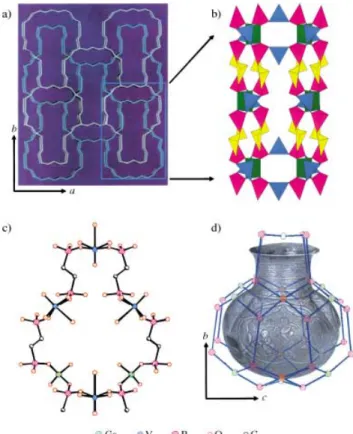
Interestingly, NCHU-3 consists of multidimensional channels
system with 6-ring apertures and 16-ring apertures, in which
the pore sizes are 5 ! ; 7 ! and 5 ! ; 14 !, respectively.
These channels intersect at the center of a chinese-vaselike
cage consisting of 63 atoms (six 6-rings and two 16-rings,
Figure 1 c and 1 d). The cage measures 11 ! ; 13 ! ; 14 !, as
measured between oxygen atoms by using the positional
coordinates of NCHU-3. Another important feature of the
NCHU-3 structure is the hydrophobic -CH
2moieties covering
the walls of the Chinese-vaselike cages. The approximate
vase-void volume is 1359 !
3per unit cell. Microporous
materials are often compared by framework density (FD,
number of density of tetrahedral atoms per 1000 !
3).
[14]The
smaller the FD value, the larger is the available space in the
crystal. The FD generally decreases with increasing numbers
of 4-rings. NCHU-3 has eight 4-rings per cage, for which the
FD is about 9.3 (tetrahedrally surrounded Ga and P atoms)
and 12 (which takes into account the V atoms with octahedral
coordination) compared with the very open faujasite (12.7)
and cloverite (11.1).
[15]The key feature of NCHU-3 rests on the extra-large
hydrophobic cages, which are occupied by free water
mole-cules and highly disordered K
+ions. Essentially, complete
replacement of K
+by NH
4+
ions by using saturated NH
4Cl
solution was easily accomplished, as confirmed by
energy-dispersive X-ray fluorescence analysis. To examine the
thermal and structural stability of this open framework,
thermogravimetric analysis (TGA) and in situ synchrotron
powder X-ray diffraction (PXRD) analysis were carried out.
The TGA reveals that the water guest molecules were
Figure 1. Molecular structure of NCHU-3. a) The framework structure of NCHU-3 view down thec axis showing vaselike channels in projec-tion. b) Polyhedral view of a section of vaselike cages. (GaO4: green
tetrahedron; VO5(OH2): blue octahedron; PO3C: red tetrahedron;
CH2P2: yellow tetrahedron). c) Ball-and-stick representations of the
largest cavityconstructed from 16-rings excluding tetrahedrallycoordi-nated C atoms. d) Projection of vaselike cages along thea axis (C, H, and O atoms are omitted for clarify) showing the additional 4-, 5-, and 6-rings and Chinese vaselike void volume of 1359 G3.
Figure 2. In situ PXRD patterns for NCHU-3 (synchrotron radiation, l = 1.32633 G). The sample was initiallyheated to 200 8C and then cooled to 40 8C in air. a) Simulated diffraction patterns on the basis of the single-crystal structure. Diffraction data recorded b) at room tem-perature, c) at 200 8C, and d) at 40 8C.I is the X-rayintensity(arbitrary units).
Zuschriften
liberated below 200 8C, which corresponds to a weight loss of
14 %. No weight loss was observed in the temperature range
of 200–550 8C. The simulated diffraction pattern based on the
analysis of a single-crystal X-ray structure (Figure 2 a) is in
good agreement with the PXRD pattern obtained for
NCHU-3 (Figure 2 b), which indicates that NCHU-3 is a
pure phase. The NCHU-3 sample was initially heated to
200 8C (Figure 2 c) and then cooled to 40 8C (Figure 2 d), both
diffraction patterns show that the positions of the most
intense lines remain unchanged relative to the unheated
sample of NCHU-3. The good agreement between PXRD
patterns demonstrates that the open-framework was retained
even after the loss of water molecules. Given the thermal and
structural stability of the open framework, the presence of
vacant cages in NCHU-3 affords a natural affinity to absorb
aliphatic and aromatic molecules reversibly. A TGA study
reveals a reversible aniline sorption cycle in the pores of
NCHU-3 (see Supporting Information). The framework,
which features redox oxovanadyl centers, provides an
inter-calation host for lithium ions.
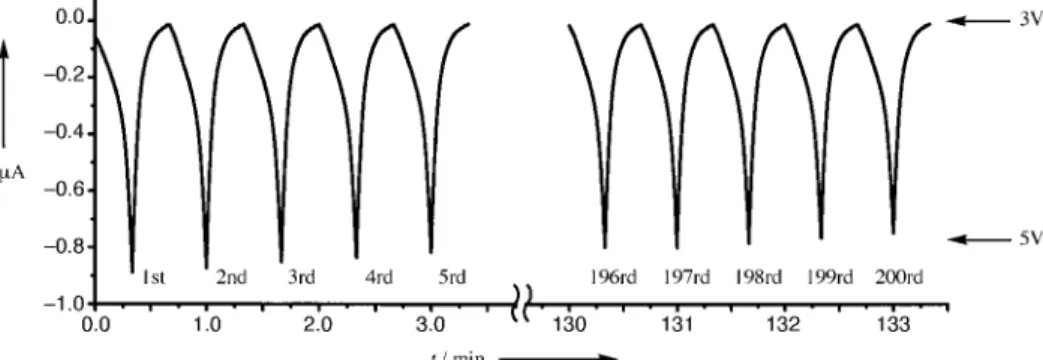
[16]Some preliminary reversible
cycling data are presented in Figure 3. The cyclability of the
cell was over 200 cycles between 3 and 5 V, which indicates
that lithium ions and electrons can be removed and reinserted
into the NCHU-3 host. This result demonstrates that
NCHU-3 is scientifically interesting and potentially attractive
as a new cathode material for rechargeable lithium
batter-ies.
[17–19]Further measurements of capacity are in progress.
In conclusion, we present the synthesis and structure of
the first multidimensional, intersecting, large-pore hybrid
organo-phosphonate molecular sieve. NCHU-3 is novel not
only in the unusual shape of its cages with hydrophobic walls,
but also in its framework featuring redox-active oxovanadyl
centers. The above results may provide new developments in
separation, catalytic, and nanoelectronic applications.
Experimental Section
NCHU-3: A reaction mixture of V2O5(0.0909 g, 0.5 mmole),
ethyl-enediphosphate (0.2850 g, 1.5 mmole), Ga2O3(0.0468 g, 0.25 mmole),
KOH (0.25 mL, 10 m), and H2O (10mL) was sealed in a 23 mL
teflon-lined stainless autoclave, heated at 200 8C for 72 h, then cooled to 70 8C at 9 K h1. The resulting blue crystals were isolated by filtration,
and washed with deionized water. Yield 0.046 g (34 % based on Ga2O5), and the synthesis was highly reproducible. Crystallography:
The X-ray diffraction low-temperature (120K) data were collected
on a CCD Bruker AXS SMART-1000 diffractometer with mono-chromated MoKa(l = 0.71069 !) in the w/2q scan. The structure was
solved with SHELXTL PLUS and refined with SHELXL-93 on F2by
full-matrix least-squares methods. The highly disordered potassium ions and water molecules could not be completely located in the structure analysis. The induction-coupled plasma-mass spectrometry and energy dispersive X-ray analysis both showed the compound contained K, Ga, V, and P in approximately constant proportions. Ga2(VO)3K2(OH2)3(C2H4P2O6)4(H2O)13, Crystal size 0.18 ; 0.06 ;
0.06 mm, Orthorhombic system, space group Cmcm, a = 16.6870(2), b = 14.7395(3), c = 17.5737(3) !, V = 4322.4(1) !3, Z = 4, 2V
max=
558; R1=0.101, wR2(F2) = 0.278, and GOF = 1.113; residual electron
density between 3.6 and 1.81 e !3. CCDC-195599 contains the
supplementary crystallographic data for this paper. These data can be obtained free of charge via www.ccdc.cam.ac.uk/conts/retrieving.html (or from the Cambridge Crystallographic Data Centre, 12 Union Road, Cambridge CB2 1EZ, UK; fax: (+ 44) 1223-336-033; or [email protected]).
The lithium-ion intercalation of NCHU-3 was prepared according to our previous procedures.[16] The cathode was fabricated by
compressing powdered Li·NCHU-3 (85 %), black carbon (10%) and PTFE (5 %) on an aluminum disk. The pellet was then dried at 120 8C in air. The electrolyte was prepared by dissolving LiClO4in a
mixture of ethylene carbonate (EC), dimethyl carbonate (DMC), and methyl formate (MF) (volume ratio 50:45:5) to give a 1m solution. Some properties of this electrolyte were reported.[19]
Received: November 13, 2002 [Z50544]
.
Keywords: gallium · hydrothermal synthesis · intercalations ·
microporous materials · vanadium
[1] M. E. Davis, C. Saldarriaga, C. Montes, J. Graces, C. Crowder, Nature 1988, 331, 698 – 699.
[2] M. E. Davis, Chem. Eur. J. 1997, 3, 1745 – 1750.
[3] R. I. Walton, F. Millange, T. Loiseau, D. O'Hare, G. Ferey, Angew. Chem. 2000, 112, 4726 – 4729; Angew. Chem. Int. Ed. 2000, 39, 4552 – 4555.
[4] X. Bu, P. Feng, G. D. Stucky, Science 1997, 278, 2080 – 2085. [5] H. Li, A. Laine, M. O'Keeffe, O. M. Yaghi, Science 1999, 283,
1145 – 1147.
[6] T. Asefa, M. J. MacLachian, N. Coombs, G. A. Ozin, Nature 1999, 402, 867 – 871.
[7] E. K. Brechin, R. A. Coxall, A. Parkin, S. Parsons, P. A. Tasker, R. E. P. Winpenny, Angew. Chem. 2001, 113, 2772 – 2775; Angew. Chem. Int. Ed. 2001, 40, 2700 – 2703.
[8] D. M. Poojary, B. Zhang, A. Clearfield, J. Am. Chem. Soc. 1997, 119, 12 550– 12 559.
Figure 3. Current versus time plot for cyclic voltage changes in the range 3–5 V for a C/Li·NCHU-3 cell employing a 1 m LiClO4in an EC-DMC-MF
electrolyte mixture (T = 30 8C, scan rate 100 mVs 1). The cyclability of NCHU-3 by intercalating/de-intercalating lithium ions is shown.
Angewandte
Chemie
1983
[9] V. Soghomonian, Q. Chen, R. C. Haushalter, J. Zubieta, Angew. Chem. 1995, 107, 229 – 231; Angew. Chem. Int. Ed. Engl. 1995, 34, 223 – 226.
[10] R. P. Hammond, J. A. Zubieta, J. Solid State Chem. 1999, 144, 442 – 448.
[11] M. I. Khan, L. M. Meyer, R. C. Haushalter, A. L. Schweitzer, J. Zubieta, J. L. Dye, Chem. Mater. 1996, 8, 43 – 53.
[12] a) S. Guan, S. Inagaki, T. Ohsuna, O. Terasaki, J. Am. Chem. Soc. 2000, 122, 5660– 5661; b) A. Stein, B. J. Melde, R. C. Schroden, Adv. Mater. 2000, 12, 1403 – 1419.
[13] At temperatures above 100 K, the susceptibility data obeys the Curie–Weiss law, and the magnetic moment (meff=3.82 BM) is
close to the expected spin-only value for two independent vanadium(iv) centers per molecule. (see Supporting Informa-tion)
[14] G. O. Brunner, W. M. Meier, Nature 1989, 337, 146 – 147. [15] a) M. Estermann, L. B. McCusker, C. Baerlocher, A. Merrouche,
H. Kessier, Nature 1991, 352, 320– 323; b) W. M. Meier, New Dev. Zeolite Sci. Technol. Proc. Int. Zeolite Conf. 1986, 7, 13 – 22. [16] L. W. Huang, C. J. Yang, K. J. Lin, Chem. Eur. J. 2002, 8, 394 –
400.
[17] J.-M. Tarascon, M. Armand, Nature 2002, 414, 359 – 367. [18] Z. Gadjourova, Y. G. Andreev, D. P. Tunstall, P. G. Bruce, Nature
2001, 412, 520– 523.
[19] a) A. R. Armstrong, P. G. Bruce, Nature 1996, 381, 499 – 500; b) S. R. P. Prabaharan, M. S. Michael, S. Radhakrishna, C. Julien, J. Mater. Chem. 1997, 7, 1791 – 1796.
![TraditionalMLCalgorithmsmainlytacklethebatchMLCproblem,wheretheinputdataarepresentedinabatch[24,28].Nevertheless,inmanyMLCapplicationssuchase-mailcategorization[22],multi-labelexamplesarriveasastream.Onlineanalysisistherefore dimensionreducermotivatedbyma](data:image/gif;base64,R0lGODlhAQABAIAAAP///wAAACH5BAEAAAAALAAAAAABAAEAAAICRAEAOw==)