
Influence of Genotypic Polymorphisms of the CYP1A1 and GSTM1 Genes on DNA-Protein Crosslinks (DPC) among Incinerator Workers in Hospitals in Taiwan
8
0
0
全文
(2) 12. leftover fluids in these vials and bottles are not cleaned out prior to incineration. Although the incinerating process of chemotherapeutic waste reduces its mass and volume effectively, toxic compounds can concentrate in the fly ashes or be vaporized [1]. Incinerators produce numerous carcinogenic compounds, such as polycyclic aromatic hydrocarbons (PAHs) [1]. Once these toxic compounds pass through the pollution control equipment, they accumulate in the environment and even in human tissue [2]. Cytochrome P450 (CYP1A1) enzyme metabolizes PAH compounds into electrophilic intermediates, and its polymorphic gene is known to be susceptible to particular carcinogens [3,4]. Greater enzyme activity in some individuals might augment the metabolism of PAHs, thereby increasing the risk of lung cancer [3,4]. Glutathione S-transferase (GSTM1) is an important detoxification enzyme responsible for the conjunction of glutathione and electrophilic compounds, which prevents them from reacting with DNA or proteins [5]. Individuals with the GSTM1 null genotype tend to detoxify PAHs less effectively. They therefore have higher levels of DNA lesions, which put them at greater risk of developing some types of cancer. Although this mechanism has been discussed in numerous papers [6-8], no association between the GSTM1 null type and DNA damage or cancer has been found [9,10]. The relationship between individuals' exposure to PAHs at work or in the environment and DNA-adducts has been explored by a few researchers [11,12]. For example, the formation of PAH-DNA adducts in white blood cells was found to be associated with the level of exposure to PAHs [11]. Whyatt and his colleagues examined Polish mothers and their neonates and found that DNA damage was related to local air pollution levels, and that DNA-adduct levels were drastically higher in certain heavily polluted areas [12]. In addition, a number of studies have shown that exposure to environmental contaminants or use of chemotherapeutic agents induced the formation of DNA-protein crosslinks (DPC) [13-. DPC and Incinerator Workers in Hospital. 16]. It has also been shown that levels of DPCs are associated with DNA strand breakage [16], sister chromatid exchanges (SCE) [17], cell transformation [18], augmentation of cell toxicity, and alteration of cell growth [19]. The formation of DPC reflects the net effects of competing metabolic and detoxification pathways and DNA repair. The purpose of this study was to measure the level of DNA damage in MWI workers according to the levels of DPC. We then examined the association between DPC levels and polymorphisms of the CYP1A1 and GSTM1 genes. MATERIALS AND METHODS. Study Subjects. This research was a case-control study. Thirty-one MWI workers were selected from 8 hospitals. Participants completed a questionnaire, and informed consent was obtained. The contents of the questionnaire included demographic data (such as gender and age), lifestyle behavior (such as cigarette smoking and alcohol consumption), and work history. Thirty-one healthy subjects matched by gender, age, and cigarette smoking behavior living within an uncontaminated area were selected as the control group. Furthermore, 6 mL of whole blood were drawn from each subject, of which 3 mL were stored in EDTA tubes for DNA extraction and genotype analyses. The remainder was kept in heparin tubes for DPC analyses. Measurement of Genotyping. Genomic DNA was prepared from human blood lymphocytes by standardized procedures. The CYP1A1 MspI polymorphism from each subject was analyzed by PCR-based methods, as described by Kawajiri et al [20]. The MspI polymorphism was assessed by amplifying a 295bp region of DNA containing an MspI restriction site followed by digestion with MspI. CYP1A1 (w/w) lacked the MspI cleavage site, CYP1A1 (v/v) was homozygous for the allele with the MspI site, and CYP1A1 (w/v) was heterozygous for the MspI site. The GSTM1 genotypes were determined by.
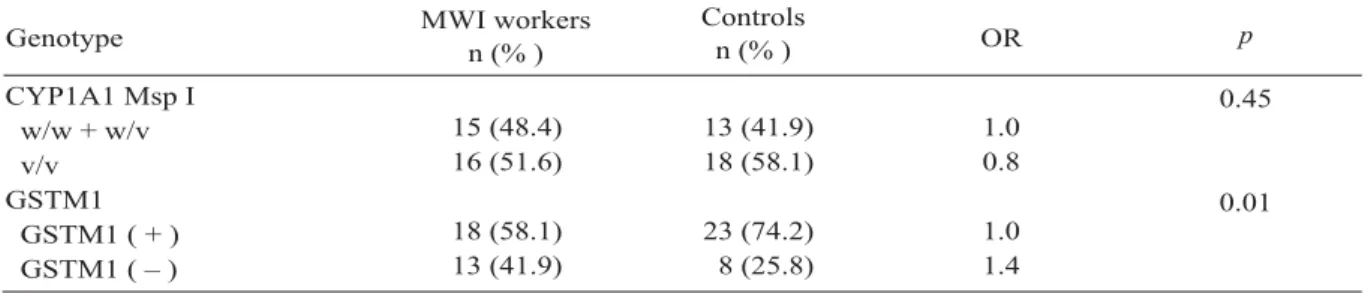
(3) Fang-Yang Wu, et al.. 13. Table 1. Demographic characteristics of the medical waste incinerator (MWI) and control groups. Variable Age (yr) Gender (%) Male Female Smoking (%) Betel nut consumption (%) Alcohol consumption (%) Work duration (yr) ≥5 ≤5. Controls (n = 31). MWI workers (n = 31) 35.8. 10.0. 36.1. 24 (77.4) 7 (22.6) 16 (51.6) 4 (12.9) 12 (38.7). p 0.91. 10.3. 1.00 1.00 1.00 0.81 0.72. 24 (77.4) 7 (22.6) 16 (51.6) 3 (9.7) 8 (25.8). 9 (29.1) 22 (70.9). Table 2. Odd ratios (OR) for both groups based on CYP1A1 and GSTM1 genotypes. Genotype CYP1A1 Msp I w/w + w/v v/v GSTM1 GSTM1 ( + ) GSTM1 ( – ). MWI workers n (% ). Controls n (% ). OR. 15 (48.4) 16 (51.6). 13 (41.9) 18 (58.1). 1.0 0.8. 18 (58.1) 13 (41.9). 23 (74.2) 8 (25.8). 1.0 1.4. p 0.45. 0.01. a modified method proposed by Comstock et al [21]. The β-globin primers described by Bell et al were included in the polymerase chain reaction (PCR) to confirm the presence of amplifiable DNA in the samples [7]. The commercial PCR kit containing Taq DNA polymerase (Blossom, Taiwan) required 1 µg DNA. Reactions were heated for 2 min at 94˚C, 2 min at 53˚C, and 3 min at 72˚C, with the cycle repeated 35 times in a Thermal Cycler. PCR products were electrophoresed on a 3% agarose gel. Individuals with an intact GSTM1 gene exhibited amplification of the 273bp GSTM1 fragments. A 100bp β-globin fragment served as a positive internal control. Measurement of DPC. DPC was detected by methods described previously [22]. Briefly, white blood cells (2 106) were lysed in 0.5% sodium dodecyl sulfate (SDS), as well as 20 mM Tris-HCl (pH 7.5) solution, and stored at 70 C before analyses. Meanwhile, fluorescence was measured at 450 nm during excitation at 360 nm by a Horfer Model Fluorescence Spectrophotometer.. Statistical Analysis. All data analyses were done by the SPSS 8.0 statistical software. χ 2 -tests and t tests compared the basic characteristics and distributions of CYP1A1, GSTM1 and DPC values in the research and control groups. To examine the association between polymorphic genes and MWI workers, odds ratio (OR) was calculated by unconditional logistic regression. Finally, factors affecting DPC levels were analyzed by the ordinary multiple regression model. RESULTS. Frequency distributions of personal characteristics for both groups are shown in Table 1. The mean ages of the MWI workers and those in the control group were 35.8 and 36.1 years, respectively (p = 0.9; non-significant). The number of men and women in both groups were equal (24 males and 7 females). There were no significant differences between the groups in cigarette smoking, betel nut chewing or alcohol.
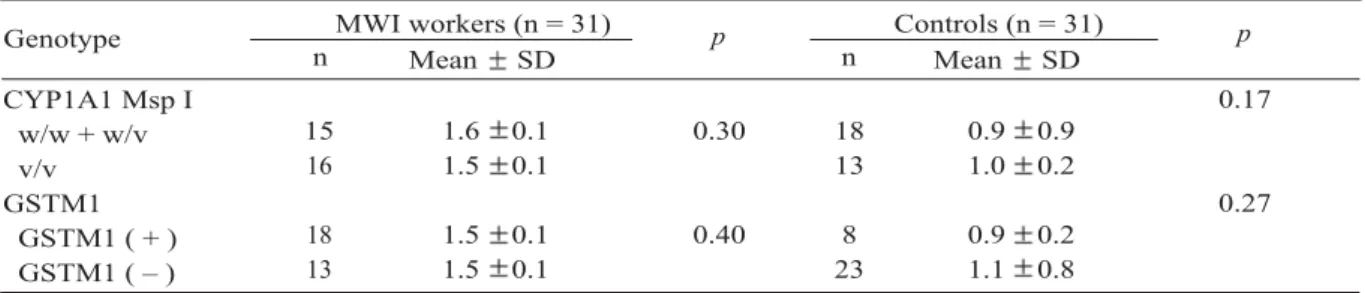
(4) 14. DPC and Incinerator Workers in Hospital. Table 3. DPC values in the MWI and control groups. n. Mean. 31 31. MWI workers Control group SD = standard deviation.. 1.5 0.9. p. SD. < 0.01. 0.1 0.2. Table 4. Effects of the CYP1A1 and GSTM1 genotypes on DPC values. Genotype CYP1A1 Msp I w/w + w/v v/v GSTM1 GSTM1 ( + ) GSTM1 ( – ). n. MWI workers (n = 31) Mean SD. p. n. Controls (n = 31) Mean SD. p 0.17. 15 16. 1.6 1.5. 0.1 0.1. 0.30. 18 13. 0.9 1.0. 0.9 0.2. 18 13. 1.5 1.5. 0.1 0.1. 0.40. 8 23. 0.9 1.1. 0.2 0.8. 0.27. Table 5. Factors affecting levels of DPC by multiple regression analysis. Variable MWI workers/control group Smoking (yes/no) Betel nut consumption (yes/no) Alcohol consumption (yes/no) CYP1A1 Msp I (v/v vs w/w+w/v) GSTM1 (null/non-null) R 2 = 0.85.. Regression coefficient 0.93 0.04 – 0.05 – 0.02 – 0.06 0.04. consumption. As for the MWI workers' work duration, 71% of the subjects (n = 22) had worked at a hospital incinerator for less than 5 years, and 29% (n = 9) for more than 5 years. Table 2 shows the frequency distributions and comparisons of CYP1A1 and GSTM1 genotypes. The frequencies of the CYP1A1 Msp I wild type (w/w + w/v) and variant type (v/v) in the exposure group were 48.4% and 51.6%, respectively (41.9% and 58.1%, respectively in the control group). There were no significant differences between the groups. In the exposure group, 58.1% had the GSTM1 non-null genotype (+) and 41.9% had the GSTM1 null genotype (–) (74.2% and 25.8% in the control group); there was a significant difference between the groups (OR = 1.4, p = 0.01). Comparison of DPC levels between the groups is shown in Table 3. The DPC levels for the exposure and control groups were 1.5% and 0.9%, respectively which was significant (p <. p < 0.01 0.49 0.36 0.67 0.29 0.52. 0.01). Table 4 shows the DPC level in CYP1A1 and GSTM1 genotypes. For the exposure group, the DPC levels in CYP1A1 Msp I wild type (w/w + w/v), variant type (v/v), GSTM1 non-null genotype, and null genotype were 1.6%, 1.5%, 1.5%, and 1.5%, respectively. In the control group, the percentages were 0.9%, 1.0%, 0.9%, and 1.1%, respectively. No significant differences were found in either group. Table 5 shows the factors affecting DPC levels according to multiple regression analysis. Only exposure to medical waste combustion at the worksite (MWI workers compared to controls) was found to be a significant risk factor, after adjusting for the other factors (R2 = 0.85, p < 0.01). DISCUSSION. The combustion of medical waste in hospital incinerators produces known human carcinogens such as polycyclic aromatic.
(5) Fang-Yang Wu, et al.. hydrocarbons (PAHs), aromatic amine, and dioxin [23]. PAH compounds enter the body via inhalation, and then accumulate in the lungs. They are distributed to other organ tissues through the bloodstream [23]. DNA damage, observed as sister chromatid exchanges (SCE), DNA adducts and DPC, is a suitable endpoint for monitoring the biological effect of exposure to potential carcinogens. These biomarkers are extensively used to evaluate occupational and environmental exposure. It has been shown previously that people living adjacent to chemical waste disposal sites have increased levels of SCEs [24]. That study indicated that PAH-DNA adduct levels vary according to the type of pollutant, and that smokers have higher adduct values than non-smokers [25]. Studies have also indicated that chemotherapeutic agents, such as cyclophosphamide, are capable of introducing cross-links in DNA [15,16]. Chemical carcinogens are metabolized by a wide variety of enzymes. Multiple forms of human cytochrome P-450 are involved in the oxidative metabolism of chemical carcinogens, such as PAHs [26]. Most studies have focused on the CYP1A1 enzyme and glutathione Stransferase M1 (GST M1) when studying PAHDNA adducts [3-8]. To our knowledge, no study has yet examined the effects of GSTM1 and CYP1A1 MspI genotypes on DPC formation among MWI workers in hospitals. In this study, no positive association between the MspI polymorphism and DPC was found, which was similar to the findings of our previous study of 60 breast cancer patients [27]. The proportion of the variant genotype (v/v) of CYP 1A1 was slightly lower in the incinerator workers than in the controls (51.6% vs 58.1%). The GST Ml gene is responsible for detoxification of reactive intermediates of PAH, by conjugating to glutathione. The GST Ml gene is polymorphic in humans in that the gene is either present or absent (null genotype) [21]. This study showed that the prevalence of the null genotype among the control group was 25.8%, but the prevalence among workers was 41.9%. In. 15. our study of breast cancer patients, the GST Ml gene (–) was found in 56.7% of cancer patients and in 41.7% of controls [27]. In addition, this study investigated the association between the GSTM1 null genotype and DPC levels. We hypothesized that subjects with this genotype would have higher levels of DPC because of their decreased ability to detoxify PAH metabolites. However, DPC levels were not significantly lower in subjects with the GSTM1 null genotype. DNA tends to be more sensitive than proteins to chemicals, although the effects of chemicals on both proteins and DNA are complex. Many chemicals enhance the formation of DPC [13,14,16,28]. DPC formation in treated cells may persist since its presence is easily detectable following the removal of the genotoxic agent [29,30]. Normal cells are able to repair these lesions with fidelity or by introducing errors. However, genotoxic compounds may reduce a cells ability to repair, possibly resulting in the production of DPC during DNA replication [31]. This study showed that DPC values in MWI workers were significantly higher than those in the control group (1.5% and 0.9%, respectively). Our previous studies have indicated an association between DPC and breast cancer patients [27] and between DPC and lead workers [32]. Hence, DPC formation may be associated with exposure to chemical compounds. In conclusion, this study suggests that DPC is a sensitive biomarker of DNA damage in workers exposed to MWI hazards. However, exposure to specific chemicals was not directly measured, which limited interpretation of this study. No significant differences in polymorphic genes were found between the worker and control groups. Further research is required to investigate the precise relationship between the various genotypes and MWI workers. ACKNOWLEDGMENT. This study was supported by the China Medical University Hospital (DMR-90-132) in Taichung, Taiwan..
(6) 16. DPC and Incinerator Workers in Hospital REFERENCES. 1. Lee WJ, Liow MC, Tsai PJ, et al. Emission of polycyclic aromatic hydrocarbons from medical waste incinerators. Atmos Environ 2002;36:781-90. 2. Rowat SC. Incinerator toxic emissions: a brief summary of human health effects with a note on regulatory control. Med Hypotheses 1999;52:389-93. 3. Nukachi K, Imai K, Hayashi S, et al. Polymorphisms of the CYP1A1 and glutathione S-transferase genes associated with susceptibility to lung cancer in relation to cigarette dose in a Japanese population. Cancer Res 1993;53:2994-9. 4. Shields PG, Caporaso NE, Falk RT, et al. Lung Cancer, race, and CYP1A1 genetic polymorphism. Cancer Epidemiol Biomarkers Prev 1993;2:481-5. 5. Wolf CR. Metabolic factors in cancer susceptibility. [Review] Cancer Surv 1990;9:437-74. 6. Hirvonen A, Husgafvel-Pursiainen K, Anttila S, et al. The GSTM1 null genotype as a potential risk modifier for squamous cell carcinoma of the lung Carcinogenesis 1993;14:1479-81. 7. Bell DA, Taylor JA, Paulson DF, et al. Genetic risk and carcinogen exposure, a common inherited defect of the carcinogen-metabolism gene glutathione Stransferase M1 that increase susceptibility to bladder cancer. J Natl Cancer Inst 1993;85:1159-64. 8. Lafuente A, Pujol F, Carretero P, et al. Human glutathione S-transferase mu (GST mu) deficiency as a marker for the susceptibility to bladder and larynx cancer among smokers. Cancer lett 1993;68:49-54. 9. Zhong S, Howie AF, Ketterer B, et al. Glutathione Stransferase mu locus: use of genotyping and phenotyping assays to assess association with lung cancer susceptibility. Carcinogenesis 1991;12:1533-7. 10. Brockmoller J, Kerb R, Drakoulis N, et al. Genotype and phenotype of glutathione S-transferase class mu isoenzymes mu and psi in lung cancer patients and controls. Cancer Res 1993;53:1004-11. 11. Perera FP, Dickey C, Santella R, et al. CarcinogenDNA adducts and gene mutation in foundry workers with low-level exposure to polycyclic aromatic hydrocarbons. Carcinogenesis 1994;15: 2905-10. 12. Whyatt RM, Santella RM, Jedrychowski W, et al. Relationship between ambient air pollution and DNA damage in Polish mother and newborns. Environ Health Perspect 1998;106:821-6. 13. Popp W, Vahrenholz C, Przygoda H, et al. DNAprotein cross-links and sister chromatid exchange frequencies in lymphocytes and hydroxyethyl mercapturic acid in urine of ethylene oxide-exposed hospital. workers. Int Arch Occup Environ Health 1994;66:32532. 14. Heck HD'A, Casanova M, Lam CW, et al. The formation of DNA-protein cross-links by aldehydes present in tobacco smoke, Banbury Report 23, Mechanisms in Tobacco Carcinogenesis. Cold Spring Harbor. NY: Cold Spring Harbor Laboratory, 1986:215-30. 15.Skare JA, Schrotel KR. Alkaline elution of rat testicular DNA: detection of DNA cross-links after in vivo treatment with chemical mutagens. Mutat Res 1984;130:295-303. 16. Fornace AJ Jr. Detection of DNA single-strand breaks produced during the repair of damage by DNA-protein cross-linking agents. Cancer Res 1982;42:145-9. 17. Bradley MO, Hsu IC, Harris CC. Relationships between sister chromaid exchange and mutagenicity, toxicity and DNA damage. Nature 1979;282:318-20. 18. Fornace AJ Jr, Little JB. Malignant transformation by the DNA-protein crosslinking agent trans-Pt(II) diamminedichloride. Carcinogenesis 1980;1:989-94. 19. Hansson J, Lewensohn R, Ringborg U, et al. Formation and removal of DNA-crosslinks induced by melphalan and nitrogen mustard in relation to druginduced cytotoxicity in human melanoma cells. Cancer Res 1987;47:2631-7. 20. Kawajiri K, Nakachi K, Imai K, et al. Identification of genetically high risk individuals to lung cancer by DNA polymorphisms of the cytochrome P4501AI gene. FEBS Lett 1990;263:131-3. 21. Comstock KE, Sanderson BJ, Claflin G, et al. GST1 gene deletion determined by polymerase chain reaction. Nucleic Acid Res 1990;18:3670. 22. Costa M, Zhitkovich A, Toniolo P. DNA-protein crosslinks in welders: molecular implications. Cancer Res 1993;53:460-3. 23. Monitoring human exposure to carcinogenic and mutagenic agents. Proceedings of a join symposium held in Espoo, Finland, 12-15, IARC Scientific Publications 1983;59. 24. Laurent C, Lakhanisky T, Jadot P, et al. Increased sister chromatid exchange frequencies observed in a cohort of inhabitants of a village located at the boundary of an industrial dumping ground: phase I. Cancer Epidemiol Biomarkers Prev 1993;2:355-62. 25. Van Schooten FJ, Jongeneelen FJ, Hillebrand MJX, et al. Polycyclic aromatic hydrocarbon-DNA adducts in white blood cell DNA and 1-hydroxypyrene in the urine from aluminum workers: relation with job category and synergistic effect of smoking. Cancer Epidemiol Biomarkers Prev 1995;4:69-77..
(7) Fang-Yang Wu, et al.. 26. Guengerich FP. Characterization of human microsomal cytochrome P-450 enzymes. [Review] Annu Rev Pharmacol Toxicol 1989;29:241-64. 27. Wu FY, Lee YJ, Chen DR, et al. Association of DNAprotein cross-links and breast cancer. Mutat Res 2002;501:69-78. 28. DeNeve WJ, Everett CK, Suminski JE, et al. Influence of WR2721 on DNA cross-linking by nitrogen mustard in normal mouse bone marrow and leukemia cells in vivo. Cancer Res 1988;48:6002-5. 29. Tsapakos MJ, Hampton TH, Wetterhahn KE. Chromium(VI)-induced DNA lesions and chromium distribution in rat kidney, liver, and lung. Cancer Res 1983;43:5662-7.. 17. 30. Sugiyama M, Wang XW, Costa M. Comparison of DNA lesions and cytotoxicity induced by calcium chromate in human, mouse, and hamster cell lines. Cancer Res 1986;46:4547-51. 31. Oleinick LN, Chiu SM, Ramakrishnan N, et al. The formation, identification, and significance of DNAprotein cross-links in mammalian cells. Br J Cancer Suppl 1987;55:135-40. 32. Wu FY, Chang PW, Wu CC, et al. Correlations of blood lead with DNA-protein cross-links and sister chromatid exchanges in lead workers. Cancer Epidemiol Biomarkers Prev 2002;11:287-90..
(8) 18. CYP1A1 GSTM1 DNA-Protein Crosslinks 1. 1. (CYPlA1. GSTM1). DNA-protein crosslinks (DPC). 8. 31. CYP1A1 (wt/vt) 41.9%. (wt/wt). 48.4%. (vt/vt). 58.1%. 51.6%. GSTM1. 58.1%. 41.9%. 74.2% 1.5%. 25.8%. 0.9%. ( p < 0.01) CYP1A1. GSTM1. DPC. DPC. DPC 2004;9:11-8. CYP1A1. DPC. GSTM1. 404. 19. 2003. 11. 3. 2003. 12. 22. 2003. 12. 15. DPC.
(9)
數據
相關文件
Should an employer find it necessary to continue the employment of the Class A Foreign Worker(s), the employer shall, within four (4) months prior to the expiration of the
6 《中論·觀因緣品》,《佛藏要籍選刊》第 9 冊,上海古籍出版社 1994 年版,第 1
Teachers may consider the school’s aims and conditions or even the language environment to select the most appropriate approach according to students’ need and ability; or develop
In order to understand the influence level of the variables to pension reform, this study aims to investigate the relationship among job characteristic,
Wang, Solving pseudomonotone variational inequalities and pseudocon- vex optimization problems using the projection neural network, IEEE Transactions on Neural Networks 17
Define instead the imaginary.. potential, magnetic field, lattice…) Dirac-BdG Hamiltonian:. with small, and matrix
Microphone and 600 ohm line conduits shall be mechanically and electrically connected to receptacle boxes and electrically grounded to the audio system ground point.. Lines in
The purpose of this study was to explore the effects of learning organization culture on teachers’ study and teaching potency in Public Elementary Schools.. The research tool of
