
工作階段知識支援:探勘與支援工作相關知識
50
0
0
全文
(2) 工作階段知識支援: 探勘與支援工作相關知識. Task-stage K-Support: Mining and Supporting Task-relevant Knowledge. 研 究 生:陳 韋 孝. Student: Wei-Hsiao Chen. 指導教授:劉 敦 仁. Advisor: Duen-Ren Liu. 國立交通大學 資訊管理研究所 碩士論文. A Thesis Submitted to Institute of Information Management College of Management National Chiao Tung University in Partial Fulfillment of the Requirements for the Degree of Master of Business Administration in Information Management July 2004 Hsinchu, Taiwan, the Republic of China 中華民國九十四年七月.
(3) Task-stage K-Support: Mining and Supporting Task-relevant Knowledge Student: Wei-Hsiao Chen. Advisor: Duen-Ren Liu. Institute of Information Management National Chiao Tung University. Abstract. Organizations mainly conduct knowledge-intensive tasks to achieve organizational goals. In such task-based environments, knowledge workers usually accomplish their tasks by stages, while their task-needs may be different at various stages of task performance. Accordingly, an important issue of deploying Knowledge Management Systems is to extract knowledge from the historical task and further support task-relevant knowledge according to workers’ task-needs at different task-stages. This work proposed a task-stage mining method for discovering task-stage needs from historical task executions. The proposed method adopts information retrieval techniques and a modified hierarchical agglomerative clustering (HAC) algorithm to identify task-stage needs by analyzing codified knowledge (documents) accessed or generated during task performance. Task-stage profiles are generated to model workers’ task-stage needs and are used for delivering task-relevant knowledge at various task stages. Finally, we conduct empirical evaluations to demonstrate that the proposed method provides effective knowledge support based on task-stages. Keywords: Knowledge management, Knowledge support based on task-stage, Hierarchical agglomerative clustering, Text mining, Task-stage profile.
(4) 工作階段知識支援: 探勘與支援工作相關知識. 研究生:陳 韋 孝. 指導教授: 劉敦仁 博士. 國立交通大學資訊管理所. 摘要 組織主要是處理知識密集工作來達成組織目標,而在工作為基礎的環境中,知識 工作者常常以階段性完成工作。在工作執行過程中,不同階段有不同的工作需求。 因此如何根據知識工作者在不同工作階段之需求,提供工作相關知識,為建構知識 管理系統之重要議題。本研究改良階層式凝聚分群演算法,提出一工作階段探勘方 法,從歷史工作資料發掘工作階段知識需求。依據所萃取之工作階段知識需求,進 而建構工作階段需求特徵檔,提供知識工作者執行工作時各階段之相關知識。本文 最後進行實驗比較以評估所提的方法在提供知識支援之有效性。 關鍵字:知識管理、工作階段知識支援、階層式凝聚分群、文件探勘、工作階段需 求特徵檔.
(5) 誌謝 首先非常感謝指導教授劉敦仁老師,在這兩年來給予許多建議與指導,不管是學 業上或是論文研究上,使我能夠順利完成碩士學位。也要感謝口試委員李瑞庭博士 與楊千博士在口試時給予許多寶貴的意見,讓本篇論文得以更加完善。. 另外也要感謝同實驗室的學長姐們,美玉、志坤、孟蓉、怡瑾、嘉源、昆學、錦 慧,在生活上與課業上對我的提攜與幫助,尤其特別感謝怡瑾學姊與昆學學長,在 平常與非常時期一直對我非常的照顧;感謝實驗室的同學們,桄瑋、秋雯、柏村, 一起研究課業,分享學習心得,共同分擔在學期間所遭遇到的問題。. 最後,要感謝我的家人與朋友,支持我往自己感興趣的方向發展,讓我得以順利 完成碩士學位。.
(6) Table of Content Table of Content ........................................................................................................... iv 1. Introduction .................................................................................................................... 1 1.1. Research Background & Motivation ..................................................................... 1 1.2. Research Objectives .............................................................................................. 2 1.3. Thesis Organization............................................................................................... 3 2. Related Works......................................................................................................... 4 2.1 Task-based Knowledge Management..................................................................... 4 2.2 Information Retrieval and Information Filtering.................................................... 4 2.3 Document Clustering.............................................................................................. 6 3. Task-stage Knowledge Support ............................................................................. 8 3.1. Problem Formulation............................................................................................. 8 3.2. Process of Mining Task-stage Needs..................................................................... 9 3.3. Term Definition ................................................................................................... 10 4. Mining of Task-stage Needs ......................................................................................... 12 4.1. Data Pre-processing............................................................................................. 12 4.2. Process of Mining Task-stage Needs................................................................... 13 5. An Illustrative Example and Discussion..................................................................... 20 5.1. Example 1............................................................................................................ 20 5.2. Example 2............................................................................................................ 22 6. Experiments .................................................................................................................. 25 6.1. Experimental Setup ............................................................................................. 25 6.2. Experimental Result ............................................................................................ 27 7. Conclusions and Future Works ................................................................................... 39 References ......................................................................................................................... 39 Appendix A1 .................................................................................................................. 42 Appendix A2-1 .................................................................................................................. 43 Appendix A2-2 .................................................................................................................. 44.
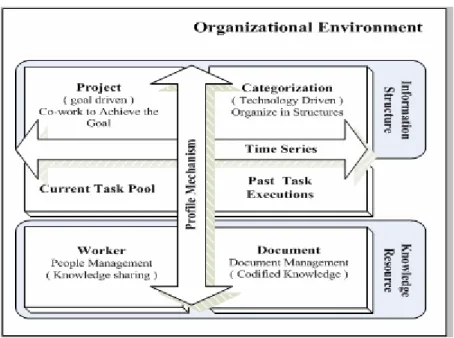
(7) 1. Introduction 1.1. Research Background & Motivation In task-based business environments, an important issue in deploying Knowledge Management Systems (KMSs) is providing task-relevant information to fulfill the information needs of knowledge workers. As the operations and management activities of enterprises are mainly task-based, Knowledge Management Systems (KMSs) focus on providing task-relevant knowledge to workers engaged in knowledge-intensive tasks (Abecker et al., 2000; Fenstermacher, 2002; Fischer & Ostwald, 2001; Staab & Schnurr, 2000). The KMS developed in the KnowMore project is an example of proactive delivery of task-specific knowledge according to the contexts of tasks within a process (Abecker et al., 2000). The Kabiria system supports knowledge-based document retrieval in office environments, allowing users to conduct document retrieval according to the operational context of task-associated procedures (Celentano et al., 1995) Among different type of knowledge, the repository of structured and explicit knowledge, especially in document form, is a codified strategy for managing knowledge (Davenport & Prusak, 1998; Wei et al., 2004; Zack 1999). Empirical findings indicate that codifying intellectual content into a knowledge repository makes workers highly exploit existing organizational resources (Gray, 2001). The Gartner Group (1999) noted that knowledge retrieval is a core component of KMSs. This work focuses on providing knowledge support for knowledge-intensive tasks within organizations. Examples of knowledge-intensive tasks include thesis works and research projects in academic organizations, project management in firms, research work and product development in R&D departments, and the like. In such task-based environments, reusing knowledge assets extracted from historical task executions is the key to providing effective knowledge support for conducting tasks. In our previous study, we built a knowledge support system from the perspective of task execution. Information Retrieval techniques are adopted to generate task profiles from text documents accessed and generated by historical task executions. The task profiles model workers’ task needs, and can be used as the kernel of knowledge retrieval to provide needed task relevant knowledge during task performance. Moreover, the system identifies task-based peer groups to provide a communication portal of knowledge sharing among knowledge workers. Consequently, knowledge reuse can be achieved through knowledge retrieval and knowledge sharing (Liu et al., 2005). Figure 1 illustrates the concepts of our proposed task-based organizational environments (Yang, 2004).. 1.
(8) Figure 1: Concept of Task-based Organizational Environment Moreover, we found that knowledge workers usually require a longer time to accomplish knowledge-intensive tasks. For such long-term tasks, the information needs of knowledge workers may vary according to different stages of progress towards task performance. Namely, with the growth understanding of perceived task, the worker’s information needs and information seeking activates will change throughout various stages of task performance. This observation is in accordance with the pilot studies of task-based information retrieval (Kuhlthau, 1993; Vakkari 2000, 2003). Therefore, the aim of this work is to support task-relevant knowledge according to workers’ task-needs at different task-stages.. 1.2. Research Objectives This work investigates the issues of deploying knowledge support systems based on task-stages. The research directions mainly include: y. Investigating the characteristics of knowledge-intensive tasks, and further proposing a system framework of supporting task-relevant knowledge based on task-stages;. y. Employing data mining and information retrieval techniques to analyze workers’ task-needs, which are modeled as profiles, at different task-stages;. y. Conducting the experiments to evaluate the effectiveness of the proposed methods. Our previous work did not consider knowledge workers’ stages of progress towards task. performance. Accordingly, this work proposed a task-stage mining method for discovering task-stage needs from historical task executions. The proposed method adopts information retrieval techniques and a modified hierarchical agglomerative clustering (HAC) algorithm to identify task-stage needs by analyzing codified knowledge (documents) accessed or generated during task performance. Task-stage profiles are generated to model workers’ task-stage needs. 2.
(9) and are used for delivering task-relevant knowledge at various task stages. A task-stage profile specifies the key subjects of a task stage, and is constructed to model the information needs of knowledge workers during a task stage of task execution. Finally, we conduct empirical evaluations to demonstrate that the proposed method provides effective knowledge support based on task-stages. Experiments are executed to verify the effectiveness of the proposed task-stage method compared with task-based, called non-stage method.. 1.3. Thesis Organization This paper is organized as follows: The literature review is given in Section 2. Section 3 describes the process of task-stage knowledge support. The method of mining task stage needs is described in Section 4. An illustrative example to explain the proposed idea is presented in Section 5. The experimental evaluations are presented in Section 6. Conclusions and future works are finally made in Section 7.. 3.
(10) 2. Related Work 2.1 Task-based Knowledge Management Managing Knowledge within and across organizations is considered as a prominent activity for creating sustainable competitive advantages in today’s business environments. Knowledge Management (KM) is a cycle, sometimes repeated process, which generally includes creation, management and sharing activities (Davenport & Prusak 1998; Gray 2001; Wiig 1993). The operations and management activities of enterprises are mainly based on tasks, in which organizational workers perform various tasks to achieve business goals. In task-based business environments, an important issue of deploying KMS is how to support task-relevant knowledge by considering the characteristics of tasks in organizations (Abecker et al., 2000; Fenstermacher, 2002; Fischer & Ostwald, 2001; Liu ea al, 2005, Staab & Schnurr, 2000). Organizations mainly conduct knowledge-intensive tasks to achieve organizational goals. In such task-based environments, knowledge workers usually accomplish their tasks by stages, while their task-needs may be different at various stages of task performance. Accordingly, another challenge of deploying KMS is how to support task-relevant knowledge according to workers’ task-needs at different task-stages. The Vakkari studies (2000), which focus on a user’s information seeking activities during task performance (e.g., writing a proposal, completing a project, etc.), show that information needs vary according to different task stages. Namely, with the growth understanding of perceived task, the worker’s information needs and information seeking activates will change throughout various stages of task performance. For example, the type of information needed may vary from general to specific information, and the choice of search terms may vary from broader terms to specific terms. Accordingly, the aim of this work is to support task-relevant knowledge according to workers’ task-needs at different task-stages by the proposed mining technique. Furthermore, this work tries to explore the possible application to adopt the proposed task-stage knowledge support method in knowledge-intensive tasks, such as project management activities, academic research, and industry analysis.. 2.2 Information Retrieval and Information Filtering Information retrieval (IR) deals with the representation, storage, organization of, and access to information items (Baeza-Yates & Ribeiro-Neto, 1999). In the past twenty years, Information Retrieval technology mainly focused on two dimensions: indexing and searching 4.
(11) from a large number of documents. Document pre-processing is important before indexing documents, including term transformation and term weighting (Salton, 1988). Term transformation includes case-folding, stemming and stop word omission or further thesaurus substitution. By the empirical study of Salton (1988), the most effective term-weighting approach considers three factors, which are term frequency, inverse document frequency and normalization. The vector model accomplishes the term weighting work by assigning non-binary term weight to each index term in documents (Baeza-Yates & Ribeiro-Neto, 1999). It is easy to represent documents in the form of vectors in vector space through the document preprocessing. Usually, users accomplish search by conducting query, represented as a set of keywords. The keyword set represents the user information needs. The query vector can be defined. r. q = {w1,q , w2,q, K, wn ,q }. as. ur. and. the. document. vector. can. be. defined. d j = {w1,d , w2,d ,K, wn ,d } where n is the total index terms in the system. Documents can be j. j. j. retrieved and presented to users according to the degree of similarity calculated by cosine similarity measure. In the past few years, research subjects discussed in the field of Information Retrieval were more general, like Document Classification, Document Categorization, User Modeling, Information Filtering, User Interfaces and so on. The Information Filtering technology is acknowledged to be an effective way to reduce the information overload and provide personalized information. With the dynamically changed environments, uncertainties associated with changing information needs of the user and the dynamic information stream must be handled efficiently. Information filtering stresses on maintaining a promising user profile, in which the system routes the proper information relevant to the user profile (Baeza-Yates & Ribeiro-Neto, 1999; Shapira, Shoval & Hanani, 1999). Information filtering technology relies on the support of traditional kernel technology of information retrieval, but this technology put more emphasis on methods to maintain and learn user profiles to find relevant documents (Baeza-Yates & Ribeiro-Neto, 1999; Widyantoro, Ioerger, &Yen, 2001). Various method for learning user interests or preferences from text documents or Web pages has been proposed in real-world applications in recommender systems, for example: e-mail-filtering systems (Mostafa et al., 1997), personalized online newspaper (Billsus & Pazzani, 1999), and so on. Information retrieval and information filtering technologies applied in document management systems are generally the first pace of knowledge management initiatives, since textual data such as articles, reports, manual, know-how documents and so on are treated as valuable and explicit knowledge within organizations (Nonaka, 1994). Information retrieval and information filtering are considered as the core techniques to achieve knowledge retrieval. In addition, information retrieval provides not only text processing technique, but also document classification technology to help organizations collect and process documents to 5.
(12) achieve the goal of knowledge reuse (Sebastiani, 1999). With the evolution of information filtering, it not only reduces the problem of information overloading but also provides relevant and needed information to users to accomplish their tasks. Accordingly, maintaining and learning user profiles is important in modern Knowledge Management Systems.. 2.3 Document Clustering Clustering is an unsupervised process of grouping the data (objects) into classes or clusters. The data (objects) within a cluster have similarity in comparison to one another, whereas dissimilar to data (objects) in other clusters (Han and Kamber ,2000; Jain et al., 1999). The clustering technique have been addressed in many contexts and by researchers in many domains such as pattern recognition, text categorization, image processing, market research and so on. Therefore, clustering is a useful tool to analyze data items and has been applied broadly. Generally, clustering techniques can be divided into two classes: one is partitioning clustering and the other is hierarchical clustering (Jain et al., 1999). Partition method outputs only one partition while hierarchical method produces a nested partitions. K-means clustering which is commonly used to partition a set of data into groups is one of examples of partition method (MacQueen, 1967). The clustering procedure follows a way to classify the given data (object) through a certain number of clusters, i.e. k clusters. The main idea is first to define k centroids, one for each cluster. After k new centroids have been selected, a loop has been generated. The algorithm assigns a data sample di to the cluster cj such that the distance from di to the center of cj is the minimum over all k clusters. The k centroids will change their location step by step until no more changes are done. The hierarchical clustering method creates a hierarchical decomposition of the given data set (Johnson, 1967). From the viewpoint of algorithmic structure and operation, there are two types of clustering approach, one is agglomerative and another is divisive. The agglomerative method starts with each data item as singleton cluster. It continuously merges clusters together according to the merging criterion until a stopping condition is satisfied. The divisive method starts with all data items as only one cluster. It divides until coming to a stopping condition. Since we adopt Hierarchical agglomerative clustering (HAC) in this work, we take length to introduce the method. Hierarchical agglomerative clustering (HAC) is a class of clustering approaches. This method produces clusters by merging, depended upon similarity of two existing clusters. The process repeats combining the two most proximity clusters; likes a binary tree, starts at leaves and grows up to root. The operations of HAC can be summarized into three steps as the following. (1). Each data item is considered as a singleton item initially 6.
(13) (2). Select the nearest pair of clusters and merge them. (3). Repeat step 2 until meeting the stopping condition. In step 2, we have to find the nearest pair. Therefore, a similarity measure has to be chosen. The similarity between any pair of cluster Ci and Cj, there are four well-known inter-cluster similarity function can be used to measure the similarity. •. The single-linkage function computes the largest similarity between two objects in the pair of clusters.. •. The complete-linkage function computes the smallest similarity between two objects in the pair of clusters.. •. The average-linkage function computes the average of all similarities among all objects in the pair of clusters.. •. The centroid function computes the similarity between the centroid of the two clusters.. Generally, the single-linkage method produces isolated and may not be cohesive clusters. Inversely, the complete-linkage method produces cohesive and may not be isolated clusters. The average-linkage method is a trade-off between single-linkage and complete-linkage method. Another commonly used measure is the centroid method, especially for text clustering. In this work, data items are time-variant. In order to consider the time factor, we modified the traditional HAC algorithm by setting a time window to select candidates for merging. Only the clusters in the time window can be merged (perform the merging operation).. 7.
(14) 3. Task-stage Knowledge Support Section 3.1 presents the problem formulation. Section 3.2 describes an overview of the process of mining task-stage needs. The terms and notations used in this work are defined in Section 3.3.. 3.1. Problem Formulation This work broadly refers to a task as a unit of work in organizations, such as a project, research work, or activity. Moreover, this work uses profiling approach to model workers’ task-stage needs, namely information needs (profiles) on task-stages. Task-stage profiles are generated to model worker’s task-stage needs and are used further to provide task-relevant knowledge at various task stages. A task-stage profile specifies the key subjects of a task stage and can be represented as a feature vector of weighted terms. The profile is used to retrieve relevant codified knowledge in the repository. The key contents of codified knowledge (textual data; documents), namely document profiles, are also represented as a feature vector of weighted terms. Relevant documents can be retrieved to provide knowledge support for task execution according to the similarity measures (e.g. cosine measures) between task-stage profiles and document profiles. A task class is defined to specify a type of tasks with similar properties (similar tasks, for brevity). Task classes are identified based on existing tasks. A task that belongs to a task class is called a task instance of the task class. Task class/instance resembles the concept of object class/instance. Tasks in different task classes generally have different task-stage needs, while tasks belonging to the same task class may have similar task-stage needs. Accordingly, task-stage profiles generated by analyzing existing similar tasks of the same task class are useful to provide needed relevant knowledge in supporting the execution of on-going tasks. The term virtual task is used to represent a task class of similar tasks. A virtual task may have more than one task instances. For example, a virtual task “Research on recommender systems” has several task instances including “Hybrid approaches for product recommendations” and “Comparisons of collaborative filtering for recommendations”. Each existing task instance is associated with documents accessed/generated during task performance. Accordingly, the problem of identifying task-stage needs of a virtual task is described as follows. Given a virtual task and a set of task instances with associated documents, find the number of task stages and the corresponding profile of each task-stage.. 8.
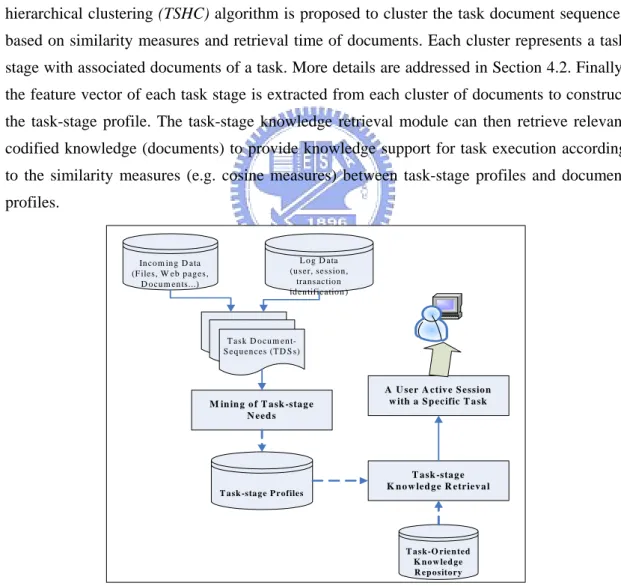
(15) 3.2. Process of Mining Task-stage Needs This work employs information retrieval techniques to conduct text processing and data mining techniques to analyze workers’ task-needs, which are modeled as profiles at different task-stages. Figure 2 illustrates the process of mining task-stage needs. The operational procedure is described as follows. The document database and the system log record the historical tasks with associated documents and usage data. The documents of a task are preprocessed and organized as a task document sequence (TDS) according to their accessed/generated time during task performance. Notably, each task has its own task document sequence. Clustering and information retrieval techniques are then employed to cluster the task document sequences of similar tasks belonging to the same task class. A task-stage hierarchical clustering (TSHC) algorithm is proposed to cluster the task document sequences based on similarity measures and retrieval time of documents. Each cluster represents a task stage with associated documents of a task. More details are addressed in Section 4.2. Finally, the feature vector of each task stage is extracted from each cluster of documents to construct the task-stage profile. The task-stage knowledge retrieval module can then retrieve relevant codified knowledge (documents) to provide knowledge support for task execution according to the similarity measures (e.g. cosine measures) between task-stage profiles and document profiles.. Incom ing D ata (F iles, W eb pages, D ocum ents...). L og D ata (user, session, transaction identification ). T ask D ocum entS equences (T D S s). A U ser A ctiv e S ession w ith a S p ecific T a sk. M in in g o f T ask -stag e N eed s. T ask -stag e K n o w led g e R etriev a l. T ask -stage P rofiles. T ask-O rien ted K n ow led ge R ep ository. Figure 2. Process of discovering task-stage needs. 9.
(16) 3.3. Term Definition This section lists the definitions of terms used in this work.. (1) Definition I: Task The task is the fundamental unit in business. This work broadly refers to a task as a unit of work in organizations, such as a project, research work, or activity.. tr: existing-task. A task is either an executing-task (on-going task) or an existing task in the task-based working environment. T = {t1, t2,…, tr, …, tn} An existing-task is a historical task accomplished within the organization.. tv: virtual task. A virtual task represents a task class of similar tasks. task instance. A task instance of tv is an existing-task that belongs to the class of tv.. Tv: set of task. A set of task instances of the virtual task tv. T: task set. instances. (2) Definition II: Task Document Sequence A task document sequence is a sequence of documents retrieved (accessed or generated) during task performance. Documents are sorted according to their retrieval time. Each task instance has its own task document sequence. TDS(tr): Task Document A sequence of documents accessed/generated while conducting a task tr. TDS(tr)=<d1, d2,…,dm> Sequence of tr. (3) Definition III: Task Stage Task document sequences of task instances are clustered into stages based on similarity measures and retrieval time of documents. The clustering result forms task stages of a task. TS(tr): task-stages of a A task tr comprises several task stages. TS(tr)=<tsr[1], tsr[2],…, task instance. tsr[k]>, where tsr[i] denotes the task-stage i of tr .. TS(tv): task-stages of a Task-stages of a virtual task tv which are derived from task stages virtual task. of task instances in Tv. TS(tv)=<tsv[1], tsv[2],…, tsv[k] >. (4) Definition IV: Task Stage Documents and Profiles Each cluster of documents represents a task stage with associated documents, named task stage documents. Documents in task stage k of task tr is denoted as tsr[k].docs, while documents in task stage k of virtual task tv is denoted as tsv[k].docs. Each task-stage profile can be derived from the feature vectors of documents in each task-stage. Let tsr[k].profile denote the profile of task stage k of task tr, and tsv[k].profile denote the profile of task stage k 10.
(17) of virtual task tv. tsr[k].docs: task-stage. Documents in task stage k of task tr.. documents d.profile tsr[k].profile: task-stage profile tsv[k].docs: task-stage. The feature vector (profile) of document d. The profile of task stage k of task tr. A task-stage profile is the vector obtained by averaging the feature vectors of documents in tsr[k].docs. Documents in task stage k of virtual task tv.. documents tsv[k].profile: virtual task-stage profile. The profile of task stage k of virtual task tv. A virtual task-stage profile is the vector obtained by averaging the feature vectors of documents in tsv[k].docs.. 11.
(18) 4. Mining of Task-stage Needs For mining the task-stage needs, Section 4.1 presents how to collect and analyze the contents of documents and workers’ usage data. Section 4.2 illustrates the proposed task-stage hierarchical clustering (TSHC) algorithm that is used to cluster the task document sequences based on similarity measures and retrieval time of documents.. 4.1. Data Pre-processing The data pre-processing phase is the most fundamental step of knowledge discovery process. Two types of valuable information sources of knowledge acquisition: content data and usage data are addressed as follows. Content Data: The key contents of a codified knowledge item (document) can be represented as a feature vector of weighted terms in n-dimensional space. The term transforming and term weighting steps are employed to find the most discriminating words among a set of documents (Baeza-Yates & Ribeiro-Neto 1999). The term transforming step includes case folding, stemming, and stop word removing. The tf-idf approach is a well-known approach for term weighting in the information retrieval literature (Salton 1988). Let the term frequency tfi,d be the occurrence frequency of term kwi in d, and let the document frequency dfi represent the number of documents that contain term kwi. The importance of term kwi to a document d, wi,d is proportional to the term frequency and inversely proportional to the document frequency, which is expressed as Eq. 1. According to the empirical experiments of Salton (1988), if there are many technical vocabularies in the data collection and the vocabulary is not very varied, normalized term frequency is a proper term weighting component. We use the normalized term frequency to derive the term weight, as shown in Eq. 1.. wi , d. = (0.5 +. 0.5 × t f i , d. ) × (log. max t f i , d. N. + 1). df i , d. (1). where N is the number of documents, and log(N/dfi) is the inverse document frequency, idfi.. r. The feature vector of document d is represented as d = <w1,d, w2,d, …, wn,d >. Usage Data: Each log record is parsed to extract important information, such as user name, role type, TaskID, DocID, request type and system time. Usage log processing engine is useful to collect and manage task-relevant information by tracking user’s document access behaviors in conducting a specific task. Similar tasks of the same task class are identified. Moreover, task document sequences of task instances are generated according to the usage log records. A time interval may be specified to select documents from usage logs. Documents with retrieval time within a specified time interval are collected to generate task document sequences.. 12.
(19) 4.2. Process of Mining Task-stage Needs Given a virtual task tv and a set of task instances with associated documents, the mining process identifies the number of task stages and the corresponding profile of each task-stage for tv.. Notably, a virtual task tv denotes a task class of similar tasks and has several task. instances. A task instance of tv is an existing-task that belongs to the class of tv. The documents of a task instance are preprocessed and organized as a task document sequence (TDS) according to their accessed/generated time during task performance. There are four steps to discover task-stage needs, as shown in Fig. 3. The mining procedure is described step by step. An example is given to explain the proposed idea.. Step1. Identifying task-stages of each task instance This step identifies the task-stages of each task instance. A TSHC algorithm, task-stage hierarchical clustering algorithm, is proposed to cluster each task document sequence into task stages.. The proposed algorithm modifies the hierarchical agglomerative clustering. (HAC) algorithm by considering time variant to determine clusters. Table 1 shows the TSHC algorithm. Let TDS(tr)=<d1, d2,…,dm> be the task document sequence of a task instance tr. The task document sequence is clustered into several clusters, which represent the stage information of the target task tr. A task tr comprises several task stages. TS(tr)=<tsr[1], tsr[2],…, tsr[k]>, where tsr[i] denotes the task-stage i of tr . Each cluster represents a task stage with associated documents, where tsr[i].docs denotes documents in task stage i of task tr. S tep 1 : P artition S et o f T ask D o cum en t S equ en ce b y T S H C algo rith m. S tep 2 : M erg e task-stag es 3 cases to p roceed m erg e fu n ctio n. S tep 3: R em ov in g n oisy d ocu m ents an d n oisy task stag e. S tep 4 : T ask -stag e featu re extractio n w ith asso ciated d o cu m en t set. T ask -stag es p rofiles. Figure 3: Process of mining task-stage needs. 13. E x tracting T em p oral stage features.
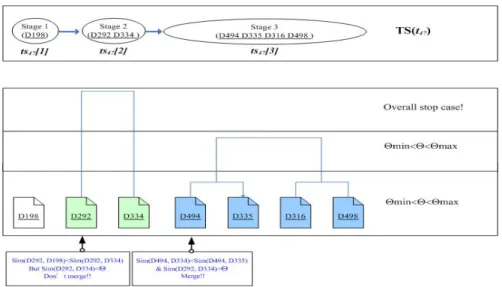
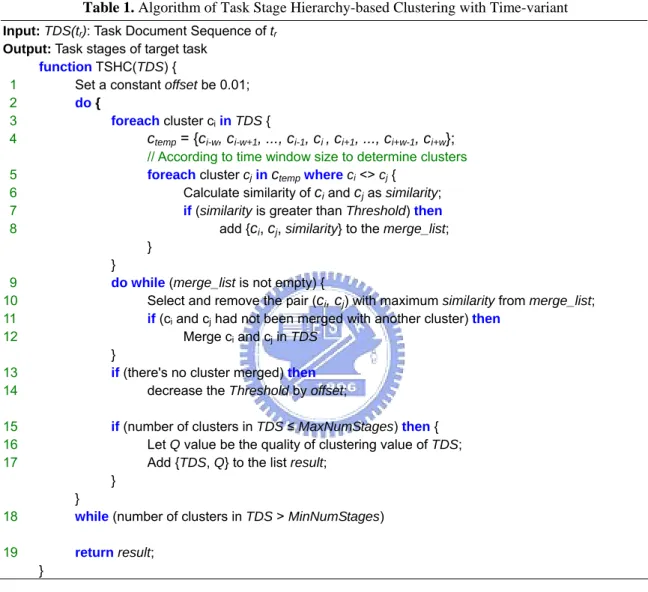
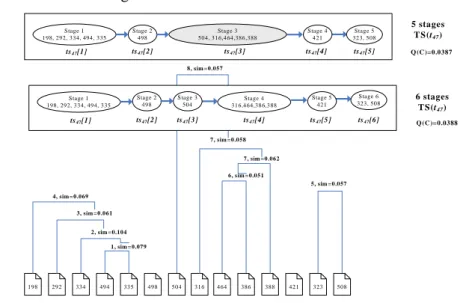
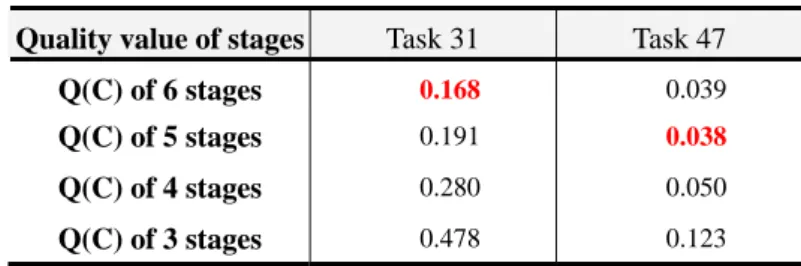
(20) Figure 4: An example of clustering result Fig. 4 illustrates the clustering result. Three clusters are generated after conducting the proposed clustering algorithm; namely, three stages are identified. In the following, we will explain the TSHC algorithm in detail. TSHC algorithm: The traditional Hierarchical Agglomerative Clustering (HAC) algorithms start with each individual item in its own cluster and iteratively merge clusters until all items belong in one cluster. For each level, the HAC algorithms determine new clusters by merging clusters from the previous level. Several techniques can used to determine if two clusters are to be merged according to the distance threshold and the distance between any two points in the two target clusters. Two clusters are merged, if the minimum (maximum or average) distance between any two points in the two target clusters is less than or equal to the distance threshold. The HAC algorithm examines all clusters in the previous level to determine new clusters, and does not consider the time dimension. The proposed TSHC algorithm adopts the HAC algorithm by considering the time dimension, since the task document sequence (TDS) is generated by ordering documents based on their retrieval time during task performance. A time window size w is set to define the scope of candidate clusters to be merged. Notably, the index position in the sequence rather than the actual time is used to decide if the candidate cluster is within the time window. Initially, each document in the TDS forms its own cluster. The TSHC algorithm then iteratively merges clusters until the number of clusters is less than or equal to MinNumStages (minimum number of stages). The algorithm finds clustering result with number of stages no less than MinNumStages and no greater than MaxNumStages (maximum number of stages). Due to the characteristics of our research problem, we prefer to cluster each TDS into three to six clusters. A clustering examination procedure is conducted to select the level of clustering that can derive the best clustering result by intra-similarities and inter-similarities examination.. 14.
(21) In the following, we explain the algorithm line by line. Note that the algorithm is listed in Table 1. During the procedure of clustering, each document is regarded as a single cluster initially. Accordingly, TDS is a sequence of clusters. For merging two target clusters ci and cj into a new cluster c’, where i < j, the index position of c’ is set to i. A new sequence of clusters is generated by ordering the new clusters according to their index positions. A specified time window size w is used as the scope to select candidate clusters for merging. For each cluster ci, clusters with index positions within the time window size from i - w to i + w are the candidates to be merged with ci (line 3 to 8). For a cluster cj within the time window of ci, if the similarity between ci and cj is greater than the Threshold, ci and cj are regarded as a pair of merging candidates; and they are added to the merging list with their similarity measure (line 8). The similarity measure between two cluster ci and cj is defined as the average of all pairwise similarities among the documents in ci and cj. The similarity between two documents is derived using the cosine of their feature vectors. The time window is moved from the first cluster to the last one in TDS to determine the merging candidates for each cluster. Then, all merging candidates will be merged as follows. In the merging process (line 9 to 12), the pair of merging candidates with maximum similarity will be selected from the merge list. If both merging candidates in the selected pair had not been merged with another merging candidate in any other pair, then the corresponding two in TDS are merged. If there is no clusters can be merged during the iteration, the Threshold is decreased by a constant (In our case, the constant is set to 0.01); otherwise, the threshold is not changed (line 13 to 14). The step avoids that the similarity between a cluster and a merged cluster is higher than the decreased threshold. The algorithm performs hierarchical clustering; thus various levels of clustering result can be derived. The algorithm records those levels of clustering results with the number of clusters within MinNumStages to MaxNumStages. As mentioned previously, we prefer to cluster each task document sequence (TDS) into three to six clusters. The quality measure, Q value, is derived to indicate the quality of each clustering result (line 15 to 17). We select the clustering result (among three to six clusters) that leads to the best quality value. The clusters of TSHC algorithm are the stages of a task instance. The profile of each task stage can be derived by averaging the feature vectors of documents in the corresponding cluster. Notably, the task-stage profile specifies the key subjects of a task stage. In the following, we explain the Q value that is used verify the quality of clusters. •. Clustering quality: Let C be the set of clusters derived from a particular level of clustering. The best clustering result is to maximize the intra-similarities of all those clusters and minimize the inter-similarities among the clusters produced at the level (Chuang & Chien, 2004). Let the inter-similarity between two cluster ci and cj be defined as the average of all pairwise similarities among the documents in ci and cj, 15.
(22) which is denoted as sim(ci, cj). Let the intra-similarity within the cluster ci be defined as the average of all pairwise similarities within ci, denoted as sim(ci, ci).. Q(C ) =. sim(ci , ci ) 1 where ci = ∪ k ≠ i ck ∑ | C | ci ∈C sim(ci , ci ). (2). Table 1. Algorithm of Task Stage Hierarchy-based Clustering with Time-variant Input: TDS(tr): Task Document Sequence of tr Output: Task stages of target task function TSHC(TDS) { 1 Set a constant offset be 0.01; 2 do { 3 foreach cluster ci in TDS { 4 ctemp = {ci-w, ci-w+1, ..., ci-1, ci , ci+1, ..., ci+w-1, ci+w}; // According to time window size to determine clusters 5 foreach cluster cj in ctemp where ci <> cj { 6 Calculate similarity of ci and cj as similarity; 7 if (similarity is greater than Threshold) then 8 add {ci, cj, similarity} to the merge_list; } } 9 do while (merge_list is not empty) { 10 Select and remove the pair (ci, cj) with maximum similarity from merge_list; 11 if (ci and cj had not been merged with another cluster) then 12 Merge ci and cj in TDS } 13 if (there's no cluster merged) then 14 decrease the Threshold by offset; 15 16 17. if (number of clusters in TDS ≤ MaxNumStages) then { Let Q value be the quality of clustering value of TDS; Add {TDS, Q} to the list result; } } while (number of clusters in TDS > MinNumStages). 18 19. return result; }. Step2. Merging Task-stages. Step 1 uses the TSHC algorithm to generate the task stages of each task instance. This step generates the task stages of the virtual task tv by merging the stages of task instances of tv. Tv is the set of task instances of tv. A kernel task instance tr is selected as the representative of the virtual task tv. Then, the stages of other task instances are merged to the stages of tr. The kernel task is the task instance with the best average Q value of clusters among task instances. During the merging process, documents from the stages of other task instances are merged to the stages of the kernel task instance.. 16.
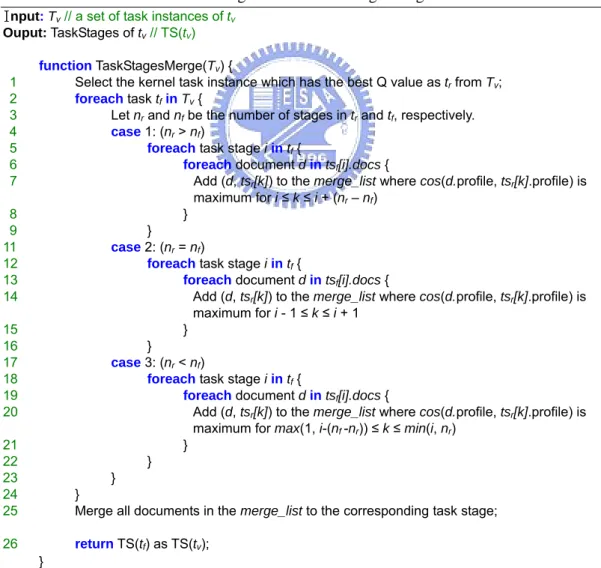
(23) Task Stage Merging algorithm: The algorithm is shown in Table 2. First, the task instance tr with the best average Q value of clusters is chosen as the kernel task (line 1). Then, for each other task instance tf, documents from the stages of tf are merged to the stages of tr. Let nr and nf be the number of stages (clusters) of tr and tf, respectively. Let tsf[i].docs be the documents in task stage i of task tf and tsr[k].profile denote the profile of task stage k of tr. Notably, tsr[k].profile is the vector obtained by averaging the feature vectors of documents in tsr[k].docs. Generally, several candidate stages in tr are possible to merge a document of tf. For each stage i of tf, each document d in tsf[i].docs is merged into the candidate stage k of tr that has the maximum similarity measure cos(d.profile, tsr[k].profile). There are three cases to select the candidate stages of tr for merging a stage i of tf. Case 1: nf > nf : The number of stages of tf is greater than the number of stages of tr. The candidate stages of tr selected are from stages i to i+(nr-nf), where nr – nf + 1 stages of tf are chosen as the candidate stages. Figure 5 is an illustrative example of Case 1, where nf = 3 and nr = 4. Two stages of tr are selected as the candidate stages to merge the documents of tf. For example, stages 2 and 3 of tr are the candidate stages to merge the documents in stage 2 of tf. Case 2: nf = nf : The number of stages of tf is equal to the number of stages of tr. The candidate stages of tr selected are from stages i-1 to i+1, where three stages of tf are chosen as the candidate stages. Case 3: nf > nf : The number of stages of tf is less than the number of stages of tr. The candidate stages of tr selected are from stages max(1, i-(nf -nr)) to min(i, nr). Figure 5-2 is an illustrative example of Case 3, where nf = 5 and nr = 3. For example, stages 1 and 2 of tr are the candidate stages to merge the documents in stage 2 of tf. Stages 1 to 3 of tr are the candidate stages to merge the documents in stage 3 of tf. Stages 2 and 3 of tr are the candidate stages to merge the documents in stage 4 of tf. Once the stage k with maximum similarity measure is determined, the pair (d, tsr[k]) is added to the merge list indicating that document d will be merged to stage k of tr (line 7, 14, 20). After the merging stages of all documents from other task instances are decided, the merging process conducts the merge (e.g. adding a document d to tsr[k].docs) according to the merge list (line 25). The final documents and corresponding task stages of the kernel task instance tr are regarded as the documents and stages of the virtual task tv. Note that the number of task stage of tv is equal to the number of stages of tr.. 17.
(24) Figure 5: An illustrative example of task stage merge of Case 1.. Table 2. Algorithm of Task Stage Merge Input: Tv // a set of task instances of tv Ouput: TaskStages of tv // TS(tv). 1 2 3 4 5 6 7 8 9 11 12 13 14 15 16 17 18 19 20 21 22 23 24 25. function TaskStagesMerge(Tv) { Select the kernel task instance which has the best Q value as tr from Tv; foreach task tf in Tv { Let nr and nf be the number of stages in tr and tf, respectively. case 1: (nr > nf) foreach task stage i in tf { foreach document d in tsf[i].docs { Add (d, tsr[k]) to the merge_list where cos(d.profile, tsr[k].profile) is maximum for i ≤ k ≤ i + (nr – nf) } } case 2: (nr = nf) foreach task stage i in tf { foreach document d in tsf[i].docs { Add (d, tsr[k]) to the merge_list where cos(d.profile, tsr[k].profile) is maximum for i - 1 ≤ k ≤ i + 1 } } case 3: (nr < nf) foreach task stage i in tf { foreach document d in tsf[i].docs { Add (d, tsr[k]) to the merge_list where cos(d.profile, tsr[k].profile) is maximum for max(1, i-(nf -nr)) ≤ k ≤ min(i, nr) } } } } Merge all documents in the merge_list to the corresponding task stage; return TS(tf) as TS(tv);. 26 }. 18.
(25) Step3. Reassigning documents. This step reorganizes the documents in task stages of tv to enhance the homogeneousness of each task-stage. Documents may be reassigned to other task stages according to the similarity measures (cosine measures) of document profiles and task-stage profiles. A document d is assigned to the stage k of tv that has the maximum similarity measure, i.e., cos(d.profile, tsv[k].profile), among all task stages of tv. Some noisy or irrelevant documents may be removed from tv, if their maximum similarity measures are below a defined threshold. After the reassignment, task stages with zero or one document will be removed. Consequently, we derive the final document set at each task stage of the virtual task tv. Notably, for some application domains, knowledge workers may need different types (categories) of codified knowledge during a particular stage of task performance. In such scenarios, documents need to be categorized to generate different categories of profiles at each task-stage. Accordingly, the process of mining task-stage needs must be modified to tackle such scenarios. It will be interesting to explore such issues in future work.. Step 4: Extracting Task-stage profiles. The profile of each task stage can be derived by averaging the feature vectors of documents in the corresponding stage. Notably, the task-stage profile specifies the key subjects of a task stage. For a stage k of virtual task tv, a task-stage profile tsv[k].profile is the vector obtained by averaging the feature vectors of documents in tsv[k].docs.. 4.3. Knowledge Support Relevant documents can be retrieved to provide knowledge support for task executions according to the similarity measures (e.g. cosine measures) between task-stage profiles and document profiles. For conducting an on-going task te, the system first identifies the task class tv that te belongs to. Then, the task-stage profiles of tv are used to provide task-relevant knowledge at each stage of executing te. A document d is provided to knowledge workers at the stage of k, if the similarity measure cos(d.profile, tsv[k].profile) is greater than a defined threshold. Alternatively, top-N approach can be used to provide N documents with N-highest similarity measures at each task stage.. 19.
(26) 5. An Illustrative Example and Discussion We give two examples to explain the proposed task-stage knowledge support approaches. The first example sets time window to 1 (w=1), whereas the second example sets time window=2 (w=2). Example one illustrates the case 3 of the task-merge algorithm and example two explains the case 1 of the task-merge algorithm. We explain the proposed approach step by step as follows.. 5.1. Example 1 A virtual task 3 named “Task-based knowledge support model and system” is adopted as the illustrative example to explain the proposed idea. Two task instances belonging to this virtual task are listed in Table 3. We will explain how to extract task stage needs according to the proposed task-stage mining approach. Table 3. Information of the virtual task 3. Virtual task 3: Task-based knowledge support model and system T3={t31,t47} 2003/09/15 A Collaborative Relevance Feedback Approach to Task-driven ~ 2004/04/13 Recommendation 2003/09/18 Implementation of Task-based Knowledge Support System ~ 2004/05/18. t31 t47. Step1. Identifying Task-stages. Five and six stages are identified from the task document sequences (TDS) of task 47 and task 31, respectively. The clustering process of task 47 is illustrated in Figure 6. •. Cluster examination: We adopted the proposed TSHC algorithm listed in Table 1 to conduct the clustering. Stage 1 198, 292, 334, 494, 335. Stage 2 498. Stage 3 504, 316,464,386,388. ts 47 [2]. ts 47 [1]. ts 47 [3]. Stage 4 421. Stage 5 323, 508. 5 stages TS(t 47 ). ts 47 [4]. ts 47 [5]. Q (C)=0.0387. 8, sim =0.057. Stage 1 198, 292, 334, 494, 335. ts 47 [1]. Stage 2 498. Stage 3 504. ts 47 [2]. ts 47 [3]. Stage 4 316,464,386,388. Stage 5 421. Stage 6 323, 508. 6 stages TS(t 47 ). ts 47 [4]. ts 47 [5]. ts 47 [6]. Q (C)=0.0388. 7, sim =0.058. 7, sim =0.062. 6, sim =0.051 5, sim =0.057 4, sim =0.069. 3, sim =0.061. 2, sim =0.104. 1, sim =0.079. 198. 292. 334. 494. 335. 498. 504. 316. 464. 386. 388. 421. 323. 508. Figure 6: Clustering process of task 47 (Step 1). 20.
(27) Table 4. Clustering examination Task 31. Task 47. Q(C) of 6 stages. 0.168. 0.039. Q(C) of 5 stages. 0.191. 0.038. Q(C) of 4 stages. 0.280. 0.050. Q(C) of 3 stages. 0.478. 0.123. Quality value of stages. Step2. Merging Task-stages. Task 47 is selected as the kernel task, since it has the best Q value. The process of merging the stages of task 31 to the stages of task 47 is shown in Figure 7. Case 3: The clusters number of kernel task is less than the clusters number of the other tasks Task 31 is merged to task 47 Task 31. Stage 1 196. Stage 3 442, 291, 296, 339, 340. Stage 2 293. ts31[1]. ts31[2]. 196. 293. Stage 4 347. 446, 354, 355, 323, 374, 385, 354, 347. ts31[3]. 442. 291. 339. 340. 296. 347. 323. ts31[4]. 355. 446. 374. Stage 5 467, 442, 400, 401 355, 402, 492, 407, 404, 412, 413. Stage 4 468. 385. 468. 354. 354. ts31[5]. 467. 347. 442. 400. 401. 355. 402. 492. 407. 404. 412. 413. Task 47 Stage 1 198, 292, 334, 494, 335. Stage 2 498. ts 47[2]. ts47 [1]. Stage 3 504, 316,464,386,388. ts47 [3]. Stage 4 421. Stage 5 323, 508. ts 47[4]. ts47[5]. TTS(2) Stage 1 196, 198, 292, 334, 494, 335, 293. Stage 2 498, 340. Stage 3 291, 504, 339, 385, 355, 347, 446, 323, 388, 354, 316, 442, 374, 296, 386, 464. Stage 5 508 492 404 412 407 400 323. Stage 4 413, 468, 421, 402, 401, 467. Figure 7: Task stage merge process (Step 2) Step3. Reassigning documents. The reassigned result is shown in Table 5. Notably, in this case, no document or stage is removed. The details of stage document set are listed in Appendix A(2). Step 4. Extracting Task-stages profiles. Finally, the feature set of each task stage is extracted from each cluster. Table 5. Final document set at each task stage of the virtual task 3 (Step 3) TS(t3) ts3[1].docs. D0000000335. D0000000494. D0000000198. D0000000334. D0000000292. D0000000196. D0000000464. D0000000388. D0000000504. D0000000291. D0000000347. D0000000354. D0000000355. D0000000412. D0000000407. D0000000400. D0000000293. ts3[2].docs D0000000498 D0000000340 D0000000386. D0000000316. ts3[3].docs D0000000296. D0000000442. D0000000339. D0000000385 D0000000446. D0000000374. ts3[4].docs D0000000421. D0000000468. D0000000508. D0000000323. D0000000492. D0000000404 D0000000413. ts3[5].docs. D0000000402. 21. D0000000401 D0000000467.
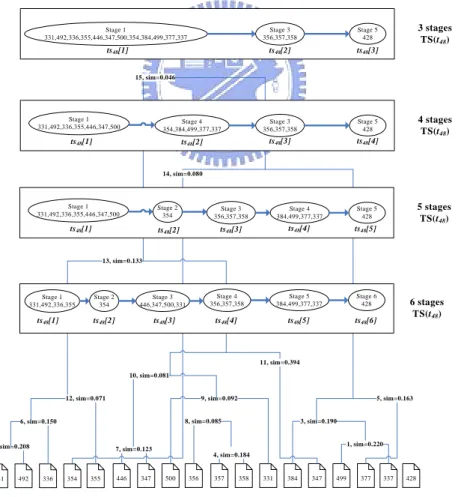
(28) 5.2. Example 2 A virtual task 2 named “Context-aware knowledge service and application” is adopted as the illustrative example to explain the proposed idea. Two task instances belonging to this virtual task are listed in Table 6. Table 6. Information of the virtual task 2. Virtual task 12: Context-aware knowledge service and application T2={t43,t48} t43 t48. 2003/09/16 Applying Topic Maps and Data Mining to Deploy Composite E-service ~ 2004/06/21 Platform 2003/09/23 Implementation of Personalized Recommendations for Composite E-service ~ 2004/04/30. Step1. Identifying Task-stages. Three and four stages are identified from the task document sequence of task 48 and task 43, respectively. The clustering process of task 48 is illustrated in Figure 8. Stage 1 331,492,336,355,446,347,500,354,384,499,377,337. Stage 3 356,357,358. Stage 5 428. ts 48[1]. ts48[2]. ts48[3]. Stage 4 354,384,499,377,337. Stage 3 356,357,358. Stage 5 428. ts48[2]. ts48[3]. ts48[4]. 3 stages TS(t48). 15, sim=0.046. Stage 1 331,492,336,355,446,347,500. ts48[1]. 4 stages TS(t48). 14, sim=0.080. Stage 1 331,492,336,355,446,347,500. Stage 2 354. ts48[1]. ts48[2]. Stage 3 356,357,358. Stage 4 384,499,377,337. Stage 5 428. ts48[3]. ts48[4]. ts48[5]. 5 stages TS(t48). 13, sim=0.133. Stage 1 331,492,336,355. ts48[1]. Stage 2 354. Stage 3 446,347,500,331. Stage 4 356,357,358. Stage 5 384,499,377,337. Stage 6 428. ts48[2]. ts 48[3]. ts48[4]. ts48[5]. ts48[6]. 6 stages TS(t48). 11, sim=0.394 10, sim=0.081. 12, sim=0.071. 9, sim=0.092. 6, sim=0.150. 2, sim=0.208. 331. 492. 354. 355. 446. 347. 3, sim=0.190. 1, sim=0.220. 7, sim=0.123. 336. 5, sim=0.163. 8, sim=0.085. 4, sim=0.184. 500. 356. 357. 358. 331. 384. 347. 499. 377. 337. Figure 8: Task stage clustering process (Step 2). 22. 428.
(29) •. Cluster examination: We adopted the proposed TSHC algorithm listed in Table 1 to conduct the clustering.. Step2. Merging Task-stages. Task 43 is selected as the kernel task, since it has the best Q value. The process of merging the stages of task 48 to the stages of task 43 is shown in Figure 9. Table 7. Clustering examination Task 43. Task 48. Q(C) of 6 stages. 0.125. 0.088. Q(C) of 5 stages. 0.139. 0.084. Q(C) of 4 stages. 0.074. 0.082. Q(C) of 3 stages. 0.110. 0.076. Quality value of stages. Case 3: The clusters number of kernel task is greater than the clusters number of the other tasks Task 48 is merged to task 43. Task 48. Stage 1 331,492,336,355,446,347,500,354,384,499,377,337. Stage 3 356,357,358. Stage 5 428. ts48[2]. ts48[3]. ts48[1]. 331. 492. 336. 355. 446. 347. 500. 354. 384. 499. 377. 337. 356. 357. 358. 428. Task 43. Stage 1 326,327,499,346,347,495,366,503,377,384,430,436,437. ts43[1]. Stage 2 361. Stage 3 343. Stage 4 327,505,382,429,435. ts43[2]. ts43[3]. ts43[4]. TTS(2) Stage 1 499,326,366,347,346,377,430,436,437,384,495,503,336,355,492,500,331,354,337,446. Stage 2 361,357,358,356. Stage 3 327,382,505,429,435,428,343. Figure 9. Task stage merge process (Step 2). Step3. Reassigning documents: The reassigned result is shown in Table 8. In this case, one stage is removed. Stage 3 contains only one document D0000000343. After calculating the similarity between neighborhoods, the document D0000000343 is merged to the stage 4. Then the stage 3 is removed.. 23.
(30) Table 8. Final document set at each task stage of target task 1 (Step 3) TS(t2). ts2[1].docs. D0000000499. D0000000326. D0000000366. D0000000347. D0000000346. D0000000377. D0000000430. D0000000436. D0000000D437. D0000000384. D0000000495. D0000000503. D0000000336. D0000000355. D0000000492. D0000000500. D0000000331. D0000000354. D0000000435. D0000000428. D0000000337 D0000000446 ts2[2].docs D0000000361 D0000000357 D0000000358 D0000000356 ts2[3].docs. D0000000327. D0000000382. D0000000505. D0000000429. D0000000343. Step 4. Extracting Task-stages profiles: Finally, the feature set of each task stage is extracted from each cluster.. 24.
(31) 6. Experiments 6.1. Experimental Setup Three experiments were performed to evaluate whether the proposed task-stage knowledge support approach based on the TSHC algorithm can achieve better performance than our previous task-based knowledge support approach (Liu et al., 2005). Section 6.1.1 reviews the objective of the experiments and the experimental design. Meanwhile, Section 6.1.2 and Section 6.1.3 describe the data, participants, and evaluation metrics, respectively.. 6.1.1. Overview of the experimental objective and design Three experiments are conducted to evaluate the effectiveness of the proposed task-stage mining method for supporting task-relevant knowledge. The objectives of experimental evaluations were threefold: (1) Experiment one evaluates the impact of our proposed method with different time window size; (2) the experiment two evaluates the effectiveness of knowledge support based on task-stage compared with the baseline method, non-stage knowledge support (task-based knowledge support). In this work, we refer our previous task-based knowledge support as non-stage knowledge support; and (3) experiment three is similar to experiment two except we use different answering set for evaluating the effectiveness of the proposed method under different condition. Note that the knowledge support based on task-stage means that a virtual task with task-stage profiles can be used to deliver task-relevant knowledge for an executing task belonging to the task class of the virtual task. Our baseline method, task-based knowledge support uses the task profile of the virtual task to deliver task-relevant knowledge for an executing task belonging to the task class of the virtual task. Two kinds of answering set of needed documents are prepared. The first is the task-answering set of a virtual task. The second is the stage-answering set for each stage of a virtual task. Note that the task-answering set is the union of the stage-answering sets. Section 6.1.2 explains the procedure to acquire the answering set in detail. Accordingly, experiment two compares task-stage knowledge support with non-stage knowledge support based on the task-answering set (named overall match). Experiment three compares stage knowledge support with non-stage knowledge support based on the stage-answering set (named stage match).. 25.
(32) 6.1.2. Data and participants Experiments were conducted using a real application domain on conducting research tasks in a laboratory of a research institute. The tasks concerned are writing research papers or conducting research projects. The real application domain restricts the sample size of the data and participants in the experiments. The test document set used in our experiment is collected from the laboratory in the institute of information management department. Over 600 task-related documents were collected. The smallest meaningful components of document information elements, such as title, abstract, journal and author, were extracted from documents. Each document contained an average of ninety distinct terms after information extraction, and document pre-processing (e.g. case folding, stemming, and stop word removal). Three virtual tasks are selected from our research domain to evaluate the effectiveness of the proposed method, including “Change mining and application”, “Context-aware knowledge service and application”, and “Task-based knowledge support model and system”. Each virtual task has its own needed kernel documents. The task-answering set of a virtual task is derived from the knowledge workers who have executed similar tasks and domain experts who have the knowledge of the virtual task. Furthermore, we asked the domain expert to select the needed documents at each stage of a virtual task. Consequently, the stage-answering set can be acquired. The limitation of this work is that it is not easy to identify the stage-answering sets of each virtual task. Therefore, only three stages of answering set of each virtual task are acquired from domain experts.. 6.1.3. Evaluation metrics The effectiveness of knowledge support is measured in terms of precision, recall and F1-measure, as in the research area of information retrieval. Precision and recall.. Precision is the fraction of retrieved items (tasks or documents) that. are relevant, while recall is the fraction of total known relevant items that are retrieved, defined as follows.. precision = recall =. retrieved items that are relevant total retrieved items. (3). relevant item s that are retrieved total know n relevant item s. (4). F-Measure. The F-metric (van Rijsbergen, 1979; Riloff & Lehnert, 1994) could be used to. 26.
(33) balance the trade-off between precision and recall. F1 metric assigned equal weight to precision and recall and was given by, F − measure(β) =. (1 + β 2) × precision × recall β 2 × p r ecision + recall. (5). The value of β is used to adjust the relative importance of the recall in comparison to the precision. In this experiment, we set β=1 such that the recall and precision have the same importance.. 6.2. Experimental Result 6.2.1. Experiment one: effect on task-stage knowledge support with different size of time window (1) Objective The objective of this experiment is to evaluate the effectiveness of our proposed method with different time window size. As we have mentioned in Section 4.2, a time window size w is set to define the scope of candidate clusters to be merged. The smaller the time window size is, the higher the timeliness is. When time window size is equal to n (the number of documents in TDS of a task instance), the proposed TSHC algorithm is the same as standard hierarchical clustering algorithm (HAC). Thus, we conduct experiment to evaluate the impact of the time window parameter. And then the best time window size w will be selected for the usage of the proposed stage knowledge support method.. (2) Experimental Result and Observations Table 9 shows the experimental results with different time window size in terms of precision, recall, and F1-measure. Four window sizes are evaluated: w=1, w=2, w=3 and w=n. Three virtual tasks are evaluated. In addition, we also evaluated the effectiveness of the proposed method under various top-N (N=10, 20, and 30) knowledge support, i.e., providing top-N documents with N-highest ranked similarity measures. Observation 1: Generally, the best performance can be achieved when time window equals. to one (w=1). Bold type denotes the best performance with different time window size. Specifically, when conducting top-30 knowledge support, time window equals to one (w=1) has the best performance. In addition, it is also apparently that the greater the time window, the lower effectiveness of the proposed method. Observation 2: Interestingly, the virtual task 3 has the same performance no matter w=1 or. w=2. It implies that the time effect is not obvious in this virtual task. On the other hand, w=1. 27.
(34) not always leading to best performance for virtual task 1. It indicates that higher variant of TDS (task document sequence) exists for task instances of virtual task 1. Table 9. Result of knowledge support with different time window for three virtual tasks Parameters Top-N. w. Virtual Task 1 Pre.. Virtual Task 2. Re. F1-measure Pre.. Virtual Task 3. Re.. F1-measure. Pre.. Re.. F1-measure. w=1 0.267 0.203. 0.231. 0.231. 0.084. 0.171. 0.344. 0.175. 0.232. w=2 0.255 0.161. 0.197. 0.166. 0.065. 0.127. 0.344. 0.175. 0.232. w=3 None None. None. 0.156. 0.063. 0.121. 0.244. 0.124. 0.165. w=n 0.167 0.116. 0.137. 0.133. 0.019. 0.033. None. None. None. w=1 0.267 0.126. 0.171. 0.217. 0.069. 0.152. 0.350. 0.118. 0.177. w=2 0.350 0.152. 0.212. 0.156. 0.049. 0.118. 0.350. 0.118. 0.177. w=3 None None. None. 0.133. 0.037. 0.088. 0.250. 0.085. 0.126. w=n 0.167 0.079. 0.107. 0.150. 0.039. 0.062. None. None. None. w=1 0.333 0.080. 0.129. 0.300. 0.047. 0.144. 0.433. 0.074. 0.126. w=2 0.367 0.080. 0.132. 0.200. 0.026. 0.085. 0.433. 0.074. 0.126. w=3 None None. None. 0.167. 0.023. 0.074. 0.333. 0.056. 0.096. w=n 0.200 0.050. 0.080. 0.156. 0.059. 0.086. None. None. None. Top-30. Top-20. Top-10. Note: “None” denotes the proposed method is unable to generate 3 stages (clusters). Table 10 shows the knowledge support results with different time window size of different task stages in terms of precision, recall, and F1-measure. As we have mentioned in Section 5.1.2, due to the limitation of stage answering set, only three stages of each virtual task are identified. According to previous pilot study (Vakkari 2000, 2003), stage one indicates the task pre-focus stage; stage two indicates the task focus formulation stage; and stage three indicates the task post-focus stage. Note that the measure of each stage is the average of three virtual tasks. Observation 3: Generally, the best performance can be achieved for all virtual task at stage 2. and stage 3 while conducting Top-20 and Top-10 knowledge support, when the time window size is set to one (w=1). Bold type denotes the best performance with different time window size. However, for the same top-N knowledge support, the best performance of different task stage is achieved in different time window size. Observation 4: Generally, the greater the time window size, the lower effectiveness of the. proposed method, especially for stage 2 and stage 3. However, stage 1 seems abnormal compared with stage 2 and stage 3. That is the greater the time window size, the higher effectiveness of the proposed method, especially in providing more documents.. 28.
(35) Table 10. Result of knowledge support under different time window size for task stages Parameters Top-N. Stage1. w. Pre.. Re.. Stage 2. Stage3. F-measure. Pre.. Re.. F-measure. Pre.. Re.. F-measure. w=1 0.333 0.183. 0.119. 0.222. 0.131. 0.163. 0.233. 0.147. 0.176. w=2 0.366 0.195. 0.251. 0.233. 0.098. 0.137. 0.167. 0.107. 0.126. w=3 0.234 0.095. 0.133. 0.117. 0.055. 0.075. 0.250. 0.132. 0.172. w=n 0.367 0.253. 0.200. 0.084. 0.034. 0.067. 0.033. 0.029. 0.018. w=1 0.333 0.122. 0.177. 0.283. 0.112. 0.159. 0.217. 0.080. 0.116. w=2 0.433 0.249. 0.179. 0.283. 0.080. 0.125. 0.167. 0.060. 0.088. w=3 0.225 0.064. 0.098. 0.125. 0.040. 0.060. 0.117. 0.055. 0.075. w=n 0.350 0.184. 0.128. 0.075. 0.021. 0.046. 0.050. 0.029. 0.022. w=1 0.400 0.070. 0.119. 0.400. 0.080. 0.133. 0.267. 0.049. 0.083. w=2 0.433 0.089. 0.147. 0.367. 0.054. 0.094. 0.200. 0.036. 0.061. w=3 0.350 0.053. 0.091. 0.250. 0.040. 0.068. 0.150. 0.027. 0.029. w=n 0.350 0.111. 0.067. 0.050. 0.007. 0.020. 0.100. 0.029. 0.028. Top-30. Top-20. Top-10. (3) Implications: This experiment evaluates the impact of the time window size in the proposed TSHC algorithm. The result reveals that generally the smaller the time window size, the better the effectiveness (the higher precision, recall, and F-measure) of knowledge support. Accordingly, we set time window size to one (w=1) in the proposed algorithm. Interestingly, when time window size is equal to n (number of document TDS of a task instance), the proposed TSHC algorithm is the same as standard hierarchical clustering algorithm (HAC). The time effect disappeared when time window size is equal to n. The result is similar to topics clustering, i.e., documents within the same cluster may discuss a similar topic without considering the effect of stage.. 29.
(36) 6.2.2 Experiment two: comparing task-stage knowledge support with non-stage knowledge support based on overall match (1) Objective The objective of this experiment is to evaluate the effectiveness of task-stage mining method for knowledge support. Task-stage profiles are generated to model workers’ task-stage needs and are used for delivering task-relevant knowledge at various task stages. The task stage knowledge support method is compared with the baseline method, non-stage knowledge support method (task-based knowledge support). The task-stage knowledge support denotes providing needed documents based on task-stage profiles, whereas non-stage knowledge support denotes providing knowledge support based on task profiles. The task-stage profiles or task profiles are used to deliver task-relevant knowledge for an executing task that is similar to the virtual task. Note that this experiment compares task-stage knowledge support with non-stage knowledge support according to the task-answering set of a virtual task (named overall match). On the other hand, the experiment three compares task-stage knowledge support with non-stage knowledge support according to the stage answering set of a virtual task (named stage match).. (2) Result and Observations Table 11 shows the result of task-stage knowledge support method and non-stage knowledge support method in terms of precision, recall, and F1-measure. Notably, three virtual tasks are evaluated under various top-N (N=10, 20, and 30) document supports. Table 12 shows the average result of task-stage knowledge support method and non-stage knowledge support method. Observation 1: The precision, recall and F1-measure of task stage knowledge support. method are greater than the non-stage method for virtual task one and two. However, for virtual task three, the precision, recall and F1-measure of task stage knowledge support method are lesser than non-stage method. The precision of non-stage method under Top-30 support is greater than that of the task stage knowledge support method. Observation 2: Notably, for task stage knowledge support method, the fewer number of. supporting documents, the higher precision value is. The rank of precision value is Top-10 > Top-20 > Top-30. The observation doest not apply to the non-stage knowledge support method. The precision values of task stage knowledge support method are greater than those of the non-stage method under top-10 knowledge support for three virtual tasks. The result reveals that task stage knowledge support method can provide more effective knowledge. 30.
(37) support than the non-stage knowledge support method when providing fewer number of task-stage relevant documents. Table 11. Compare task stage knowledge support method with none-stage knowledge support method for three virtual tasks Task Stage Knowledge Support. Non-Stage (Task-based) Knowledge Support. Pre.. Re.. F-measure. Pre.. Re.. F-measure. Top-10. 0.667. 0.082. 0.146. 0.600. 0.078. 0.138. Virtual. Top-20. 0.633. 0.165. 0.261. 0.600. 0.156. 0.248. Task 1. Top-30. 0.578. 0.225. 0.324. 0.567. 0.220. 0.317. Average. 0.626. 0.157. 0.244. 0.589. 0.151. 0.234. Top-10. 0.433. 0.03. 0.06. 0.300. 0.021. 0.039. Virtual. Top-20. 0.350. 0.05. 0.09. 0.400. 0.056. 0.098. Task 2. Top-30. 0.322. 0.07. 0.11. 0.400. 0.085. 0.140. Average. 0.369. 0.050. 0.086. 0.367. 0.054. 0.093. Top-10. 0.567. 0.060. 0.109. 0.500. 0.053. 0.096. Virtual. Top-20. 0.467. 0.099. 0.163. 0.450. 0.096. 0.158. Task 3. Top-30. 0.444. 0.142. 0.215. 0.567. 0.181. 0.274. Average. 0.493. 0.100. 0.162. 0.506. 0.110. 0.176. Observation 3: Table 11 shows the details of the experiment result, which shows that virtual. task one has best result. This may result from that the best clustering number for virtual task one is 3, but clustering number for virtual task two and three are not 3. As we have addressed in step 1 of Section 4.2, we use the Q value to determine the cluster quality for deciding the number of clusters of each task. Observation 4: Table 12 shows the result of task stage knowledge support method and. non-stage knowledge support method. The average precision, recall and F1-measure of task stage knowledge support method are greater than those of the non-stage method under top-10 and top-20 knowledge support. Meanwhile, for task stage knowledge support method, the fewer number of supporting documents, the higher precision value is. The rank of precision value is Top-10 > Top-20 > Top-30. For non- stage knowledge support method, the fewer number of supporting documents, the lower precision value is. The rank of precision value is Top-30 > Top-20 > Top-10.. 31.
(38) Table 12. Results of knowledge support by overall match Stage knowledge support. Non- stage knowledge support. β=1. Precision. Recall. F1-measure. Precision. Recall. F1-measure. Top-10. 0.556. 0.058. 0.104. 0.467. 0.051. 0.091. Top-20. 0.483. 0.104. 0.171. 0.483. 0.103. 0.168. Top-30. 0.448. 0.145. 0.217. 0.511. 0.162. 0.244. Average. 0.496. 0.102. 0.164. 0.487. 0.105. 0.168. Table 13, and Figure 10 (A), (B), and (C) shows the results of task stage knowledge support method with none-stage knowledge support method of different task stages. Note that the none-stage knowledge support method of different task stages has the same performance value. The reason is that the non-stage knowledge support method only has one task profile. In addition, this experiment evaluates the performance of two methods according to the task-answering set (named overall match) not the stage answering sets. Observation 5: Generally, task stage knowledge support method has better performance than. non-stage method under top-10 knowledge support for three task stages. In addition, no matter top-10, 20 or 30 knowledge supports, task stage knowledge support method has better performance than non-stage method in task pre-focus stage (stage 1). Table 13: Compare task stage knowledge support method with none-stage knowledge support. method under different task stages Task Stage-based Knowledge Support. Non-Stage (Task-based) Knowledge Support. Pre.. Re.. F-measure. Pre.. Re.. F-measure. Top-10. 0.567. 0.064. 0.218. 0.467. 0.051. 0.177. Stage 1. Top-20. 0.517. 0.120. 0.309. 0.483. 0.103. 0.278. (Pre-focus). Top-30. 0.522. 0.181. 0.376. 0.511. 0.162. 0.357. Average. 0.535. 0.122. 0.301. 0.487. 0.105. 0.270. Top-10. 0.500. 0.051. 0.179. 0.467. 0.051. 0.177. Stage 2. Top-20. 0.417. 0.091. 0.240. 0.483. 0.103. 0.278. (Focus). Top-30. 0.311. 0.101. 0.217. 0.511. 0.162. 0.357. Average. 0.409. 0.081. 0.212. 0.487. 0.105. 0.270. Top-10. 0.600. 0.059. 0.209. 0.467. 0.051. 0.177. Stage 3. Top-20. 0.517. 0.102. 0.281. 0.483. 0.103. 0.278. (Post-focus). Top-30. 0.511. 0.153. 0.343. 0.511. 0.162. 0.357. Average. 0.543. 0.105. 0.277. 0.487. 0.105. 0.270. Note: The details of stage knowledge support of each group are listed in Appendix B1 32.
(39) Observation 6: Figure 10(A), (B), and (C) depict the result of knowledge support based on. various number of top-N knowledge support. Interestingly, stage 1 and stage 3 of task-stage knowledge support method has better performance than non-stage knowledge support. However, stage 2 of task-stage knowledge support method is not always better than non-stage knowledge support method under various top-N knowledge supports. Top-10 Knowledge Support 0.7 0.6 0.5 Stage 1. 0.4. Stage 2 Stage 3. 0.3. Non-stage. 0.2 0.1 0 Precision. Recall. F-measure. Figure 10(A): Result of top-10 knowledge support Top-20 Knowledge Support 0.6 0.5 0.4. Stage 1 Stage 2. 0.3. Stage 3 Non-stage. 0.2 0.1 0 Precision. Recall. F-measure. Figure 10(B): Result of top-20 knowledge support. 33.
(40) Top-30 Knowledge Support 0.6 0.5 0.4. Stage 1 Stage 2. 0.3. Stage 3 Non-stage. 0.2 0.1 0. Precision. Recall. F-measure. Figure 10(C): Result of top-30 knowledge support. (3) Implications: This experiment evaluates the effectiveness of the proposed task-stage mining method for knowledge support. The experimental result reveals that generally the task stage knowledge support method is better than the baseline method, non-stage knowledge support method (task-based knowledge support). Notably, for task stage knowledge support method, the fewer number of supporting documents, the higher precision value is (Top-10 > Top-20 > Top-30). The result revels that the proposed stage mining method can provide more effective knowledge support. Meanwhile, knowledge workers generally do not need a lot of documents at each task stage; therefore, the system needs to determine appropriate number of needed documents to support task-execution. The experimental result is useful to suggest the number of supporting documents at each task stage.. 34.
數據
+7

![Table 8. Final document set at each task stage of target task 1 (Step 3) TS(t 2 ) ts 2 [1].docs D0000000499 D0000000326 D0000000366 D0000000347 D0000000346 D0000000377 D0000000430 D0000000436 D0000000D437 D0000000384 D0000000495 D0000000503 D0000000336](https://thumb-ap.123doks.com/thumbv2/9libinfo/8431159.181182/30.892.140.767.143.316/table-final-document-task-stage-target-step-docs.webp)
相關文件
The Government also established the Task Force on Promotion of Vocational and Professional Education and Training in April 2018 to evaluate the implementation
• following up the recommendation of offering vocational English as a new Applied Learning (ApL) course, as proposed by the Task Force on Review of School Curriculum with a view
To tie in with the implementation of the recommendations of the Task Force on Professional Development of Teachers and enable Primary School Curriculum Leaders in schools of a
Then they work in groups of four to design a questionnaire on diets and eating habits based on the information they have collected from the internet and in Part A, and with
1) Pre-learning task [Edupuzzle task] on “Investor and Financial Education Council (IFEC): Chin Family” Youtube video clip.. Teaching financial literacy in junior form curriculum.
Having reviewed the current implementation of the SBM policy, the Task Force considers it appropriate to study how to optimise SBM along three broad areas: (I) improving the
• Contact with both parents is generally said to be the right of the child, as opposed to the right of the parent. • In other words the child has the right to see and to have a
Although many excellent resource synchronization protocols have been pro- posed, most of them are either for hard real-time task scheduling with the maxi- mum priority inversion
