Derived from 2,2
ⴕ-Bis(4-carboxyphenoxy)-9,9ⴕ-spirobifluorene
SHEN-CHANG WU, CHING-FONG SHU
Department of Applied Chemistry, National Chiao Tung University, 1001 Ta Hsueh Road, Hsin-Chu, Taiwan 30035, Republic of China
Received 24 November 2002; accepted 29 January 2003
ABSTRACT: The synthesis of a new bis(ether carboxylic acid), 2,2 ⬘-bis(4-carboxyphe-noxy)-9,9⬘-spirobifluorene, in which two orthogonally arranged carboxyphenoxyflu-orene entities are connected through an sp3carbon atom (the spiro center), is reported.
The direct phosphorylation polycondensation of this diacid monomer with various aromatic diamines yields aromatic polyamides containing 9,9⬘-spirobifluorene moieties in the main chain. The presence of the spiro segment restricts the close packing of the polymer chains and decreases interchain interactions, resulting in amorphous poly-amides with enhanced solubility, and high glass-transition temperatures and good thermal stability are maintained through controlled segmental mobility. The glass-transition temperatures of these polyamides are in the range of 234 –306 °C, with 10% weight losses occurring at temperatures above 530 °C.© 2003 Wiley Periodicals, Inc. J Polym Sci Part A: Polym Chem 41: 1160 –1166, 2003
Keywords: amorphous; polyamides; spirobifluorene; solubility; thermal properties
INTRODUCTION
Aromatic polyamides are well known as high-per-formance polymers because of their combination of excellent thermal, mechanical, and chemical properties.1–5 Despite their outstanding
proper-ties, the infusibility and limited solubility of aro-matic polyamides restrict their areas of applica-tion. Therefore, much research effort has been directed at improving their processability without compromising their other desired properties. The strategies that have been employed to enhance the solubility of polyamides include the introduc-tion of flexible linkages,6 –11 alkylphthalimido
pendant groups,12bulky lateral groups,13–17and
kinked or noncoplanar structures18 –25 into the
polymer backbone.
It has been demonstrated that incorporating a spirobifluorene linkage into defined, low molecu-lar weight structures leads to amorphous materi-als with an improvement in both solubility and thermal stability.26 –32Such spiro structures have also been applied to polymeric materials such as polyfluorenes,33–35 polyquinolines,36and polyim-ides37,38 to enhance their solubility,
glass-transi-tion temperature (Tg), and thermal stability. In a
continuation of our studies on spirobifluorene-based polymers, we herein report on the synthesis of organosoluble aromatic polyamides containing 9,9⬘-spirobifluorene (1) moieties along with flexi-ble ether linkages in the polymer main chain, based on a novel diacid monomer: 2,2 ⬘-bis(4-car-boxyphenoxy)-9,9⬘-spirobifluorene (6). In this spiro-fused monomer, the two identical carboxy-phenoxyfluorene moieties are orthogonally ar-ranged and are connected through a common sp3 carbon atom, the spiro center.39,40The resulting polyamides are anticipated to have a polymer
Correspondence to: C.-F. Shu (E-mail: shu@cc. nctu.edu.tw)
Journal of Polymer Science: Part A: Polymer Chemistry, Vol. 41, 1160 –1166 (2003) © 2003 Wiley Periodicals, Inc.
backbone periodically twisted by an angle of 90° at each spiro center. This structural feature would restrict interchain interactions and de-crease hydrogen bonding between the amide groups. As a result, the packing efficiency and crystallinity of the polymers are reduced to yield soluble polyamides. In addition, the rigidity of the main chain would be preserved because of the presence of the spiro structure, with both high
Tg’s and good thermal stability maintained. The
solubility, crystallinity, and thermal properties of the obtained polyamides have been examined.
EXPERIMENTAL
Materials
2,2⬘-Dihydroxy-9,9⬘-spirobifluorene (4) was pre-pared as described in the literature.413,3 ⬘-Meth-ylenedianiline (7a), 4,4⬘-oxydianiline (7b), and 9,9-bis(4-aminophenyl)fluorene (7e) were recrys-tallized from ethanol. 4,4 ⬘-(Hexafluoroisopropyli-dene)dianiline (7c) and 1,4-phenylenediamine (7f) were purified by vacuum sublimation. 1,3-Phenylenediamine (7d) was vacuum-distilled be-fore use. N-Methyl-2-pyrrolidinone (NMP) and
N,N-dimethylformamide (DMF) were distilled
over CaH2under reduced pressure. Pyridine (Py)
was dried by distillation after being refluxed with KOH. Triphenylphosphite (TPP) was purified by distillation under reduced pressure. LiCl was dried at 120 °C in vacuo. All other reagents and solvents were used as received from commercial sources unless otherwise stated.
Characterization
1H and 13C NMR spectra were recorded with a
Varian Unity 300-MHz or Bruker-DRX 300-MHz spectrometer. IR spectra were taken with a Nico-let 360 FTIR spectrometer. Mass spectra were obtained with a JEOL JMS-SX/SX 102A mass spectrometer. Gel permeation chromatography (GPC) was carried out with a Waters chromato-graph connected to a Waters 410 differential re-fractometer. Three 5-m Waters Styragel col-umns (300 ⫻ 7.8 mm) were connected in series and in decreasing order of pore size (105, 104, and
103 Å), with DMF as the eluent; poly(methyl
methacrylate) (PMMA) standard samples were used for calibration. Differential scanning calo-rimetry (DSC) was performed with a DuPont TA 2000 instrument at a heating/cooling rate of 20 °C min⫺1. Samples were scanned from 30 to 350 °C
and then cooled to 30 °C and scanned for a second time over the same range. Tg was determined
from the second heating scan. Thermogravimetric analysis (TGA) was made with a DuPont TGA 2950 instrument. The thermal stabilities of all the samples were determined in nitrogen by the measurement of the weight loss during heating at a rate of 20 °C min⫺1. X-ray crystal structure determination was performed with a Bruker Smater Apex diffractometer with graphite mono-chromated Mo K␣ radiation ( ⫽ 0.7107 Å). Struc-ture analyses were performed with the SHELXTL/PC program. Wide-angle X-ray diffrac-tion patterns were obtained at room temperature with a Rigaku XRD-RU 200 (Cu K␣, 40 mA, 30 kV) at a sampling step of 0.02° and at a scan rate of 5° min⫺1.
2,2ⴕ-Bis(4-cyanophenoxy)-9,9ⴕ-spirobifluorene (5)
A mixture of 4 (5.00 g, 14.4 mmol), 4-fluoroben-zonitrile (3.83 g, 31.7 mmol), potassium carbonate (4.38 g, 31.7 mmol), and anhydrous DMF (30 mL) was heated at 100 °C for 24 h under nitrogen. After cooling, the resulting solution was slowly added into water (300 mL). The precipitate ob-tained was collected by filtration, washed repeat-edly with water and hexane, and dried in vacuo. The product was recrystallized from methanol to afford 5 (7.20 g, 90.9%). 1H NMR [dimethyl sulfoxide-d 6(DMSO-d6),␦]: 8.08 (d, 2H, J⫽ 8.4 Hz), 7.99 (d, 2 H, J ⫽ 7.5 Hz), 7.75 (d, 4H, J⫽ 8.7 Hz), 7.40 (dd, 2H, J ⫽ 7.5, 7.5 Hz), 7.17 (dd, 2H, J⫽ 8.4, 2.1 Hz), 7.14 (dd, 2H, J ⫽ 7.5, 7.5 Hz), 6.97 (d, 4H, J ⫽ 8.7 Hz), 6.65 (d, 2H, J ⫽ 7.5 Hz), 6.41 (d, 2H, J ⫽ 2.1 Hz). 13C NMR (DMSO-d6, ␦): 160.9, 154.3, 150.1, 147.8, 140.4, 138.3, 134.4, 128.2, 127.9, 123.3, 122.3, 120.6, 120.1, 118.5, 117.8, 115.4, 105.1, 65.4. IR (KBr): 2223 (C'N), 1250 cm⫺1(COO). High-res-olution mass spectrometry (HRMS): [M⫹], 550.1677. Calcd. for C39H22N2O2, 550.1681. ELEM.
ANAL. Calcd.: C, 85.07%; H, 4.03%; N, 5.09%. Found: C, 85.14%; H, 4.41%; N, 5.00%.
2,2ⴕ-Bis(4-carboxyphenoxy)-9,9ⴕ-spirobifluorene (6)
To a solution of potassium hydroxide (5.0 g) in a mixture of water and ethanol (20 mL/40 mL) was added compound 5 (1.00 g, 1.81 mmol). The mix-ture was then refluxed for 54 h. The resulting solution was cooled and acidified with 6 N HCl (aqueous). The precipitate was filtered, washed thoroughly with water, and dried. The product
was purified by recrystallization from acetic acid to give 6 (0.92 g, 86.5%). 1H NMR (DMSO-d 6, ␦): 12.62 (s, 2H), 8.05 (d, 2H, J⫽ 8.7 Hz), 7.97 (d, 2H, J ⫽ 7.5 Hz), 7.86 (d, 4H, J⫽ 8.7 Hz), 7.39 (dd, 2H, J ⫽ 7.8, 7.5 Hz), 7.14 (dd, 2H, J ⫽ 7.8, 6.6 Hz), 7.13 (dd, 2H, J ⫽ 8.4, 2.1 Hz), 6.92 (d, 4H, J ⫽ 8.7 Hz), 6.66 (d, 2H, J ⫽ 7.8 Hz), 6.35 (d, 2H, J ⫽ 2.1 Hz). 13C NMR (DMSO-d6, ␦): 166.7, 160.8, 155.2, 150.2, 147.9, 140.6, 137.8, 131.6, 128.2, 127.8, 125.4, 123.5, 122.2, 120.5, 119.7, 117.2, 115.0, 65.4. IR (KBr): 2500 –3400 (broad, OOH), 1685 cm⫺1 (CAO). HRMS: [M⫹], 588.1564. Calcd. for C39H24O6, 588.1573. ELEM. ANAL. Calcd.: C,
79.58%; H, 4.11%. Found: C, 79.22%; H, 4.34%.
Polymerization
A typical polymerization procedure was as fol-lows. A mixture of diacid 6 (472 mg, 800 mol), diamine 7a (159 mg, 800mol), LiCl (70 mg, 1.6 mmol), TPP (0.70 mL, 2.7 mmol), Py (0.75 mL), and NMP (3.0 mL) was heated at 150 °C under nitrogen for 8 h. After cooling, the reaction mix-ture was added dropwise to an agitated methanol solution (100 mL). The precipitate was collected by filtration, washed thoroughly with methanol and hot water, and dried in vacuo to give poly-amide 8a, which was purified by reprecipitation from tetrahydrofuran (THF) into methanol twice.
8a Yield: 93.1%. 1H NMR (DMSO-d6, ␦): 10.08 (s, 2H), 7.98 (d, 2H, J⫽ 8.1 Hz), 7.91–7.85 (m, 6H), 7.57 (d, 2H, J⫽ 7.8 Hz), 7.56 (s, 2H), 7.32 (dd, 2H, J⫽ 7.2, 6.9 Hz), 7.18 (dd, 2H, J ⫽ 7.2, 7.2 Hz), 7.12–7.02 (m, 4H), 6.91 (d, 6H, J⫽ 7.2 Hz), 6.60 (d, 2H, J⫽ 7.5 Hz), 6.31 (s, 2H), 3.83 (s, 2H).13C NMR (DMSO-d6, ␦): 164.5, 159.4, 155.6, 150.1, 147.8, 141.5, 140.5, 139.3, 137.5, 129.9, 129.6, 128.6, 128.2, 127.8, 124.1, 123.4, 122.2, 120.6, 120.4, 119.3, 118.2, 117.3, 114.5, 65.4. IR (KBr): 3309 (NOH), 1655 (CAO), 1255 cm⫺1(COO).
8b Yield: 94.0%. 1H NMR (DMSO-d 6, ␦): 10.15 (s, 2H), 8.03 (d, 2H, J⫽ 8.1 Hz), 7.95 (d, 2H, J ⫽ 7.8 Hz), 7.90 (d, 4H, J⫽ 8.4 Hz), 7.71 (d, 4H, J ⫽ 8.4 Hz), 7.37 (dd, 2H, J⫽ 7.8, 6.9 Hz), 7.17–7.07 (m, 4H), 7.01– 6.89 (m, 8H), 6.65 (d, 2H, J⫽ 7.5 Hz), 6.34 (s, 2 H).13C NMR (DMSO-d 6,␦): 164.4, 159.5, 155.6, 152.8, 150.2, 147.9, 140.5, 137.5, 134.7, 129.8, 129.6, 128.2, 127.8, 123.4, 122.1, 120.4, 119.3,118.5, 117.4, 114.5, 65.4. IR (KBr): 3314 (NOH), 1655 (CAO), 1260 cm⫺1(COO).
8c Yield: 93.1%. 1H NMR (DMSO-d 6, ␦): 10.35 (s, 2H), 8.03 (d, 2H, J⫽ 8.4 Hz), 7.96–7.89 (m, 6H), 7.83 (d, 4H, J⫽ 8.4 Hz), 7.36 (dd, 2H, J ⫽ 7.5, 7.5 Hz), 7.28 (d, 4H, J⫽ 8.4 Hz), 7.11–7.06 (m, 4H), 6.96 (d, 4H, J⫽ 8.1 Hz), 6.64 (d, 2H, J ⫽ 7.5 Hz), 6.35 (s, 2H).13C NMR (DMSO-d 6,␦): 164.9, 159.7, 155.5, 150.2, 147.9, 140.5, 140.1, 137.6, 130.0, 129.3, 128.2, 127.8, 126.9, 123.4, 122.2, 120.5, 119.9, 119.4, 117.3, 114.6, 65.4. IR (KBr): 3304 (NOH), 1675 (CAO), 1244 cm⫺1(COO).
8d Yield: 92.3%. 1H NMR (DMSO-d 6, ␦): 10.17 (s, 2H), 8.23 (s, 1H), 8.01 (d, 2 H, J⫽ 8.1 Hz), 7.94– 7.89 (m, 6H), 7.42 (d, 2H, J⫽ 8.4 Hz), 7.35 (dd, 2H, J ⫽ 6.9, 6.6 Hz), 7.21 (t, 2H, J ⫽ 8.4 Hz), 7.15–7.05 (m, 4H), 6.95 (d, 4H, J⫽ 8.1 Hz), 6.63 (d, 2H, J ⫽ 7.2 Hz), 6.34 (s, 2H). 13C NMR (DMSO-d6, ␦): 164.6, 159.5, 155.6, 150.2, 147.9, 140.6, 139.4, 137.5, 130.0, 129.7, 128.5, 128.2, 127.8, 123.4, 122.2, 120.5, 119.3, 117.4, 116.0, 114.5, 112.9, 65.4. IR (KBr): 3324 (NOH), 1669 (CAO), 1250 cm⫺1(COO). 8e Yield: 93.0%. 1H NMR (DMSO-d 6, ␦): 10.12 (s, 2H), 7.99 (d, 2H, J⫽ 7.5 Hz), 7.92–7.84 (m, 8H), 7.59 (d, 4H, J⫽ 8.4 Hz), 7.40–7.24 (m, 8H), 7.14– 7.01 (m, 8H), 6.93 (d, 4H, J⫽ 7.2 Hz), 6.61 (d, 2H, J⫽ 6.6 Hz), 6.31 (s, 2H).13C NMR (DMSO-d 6,␦): 164.5, 159.4, 155.6, 150.8, 150.1, 147.9, 140.7, 140.5, 139.5, 137.8, 137.5, 129.9, 129.6, 129.4, 128.2, 127.8, 126.0, 123.4, 122.2, 120.3, 119.2, 117.4, 114.5, 65.4, 64.2. IR (KBr): 3303 (NOH), 1669 (CAO), 1255 cm⫺1(COO). 8f Yield: 94.2%. 1H NMR (DMSO-d 6, ␦): 10.10 (s, 2H), 8.02 (d, 2H, J⫽ 8.1 Hz), 7.94 (d, 2H, J ⫽ 7.8 Hz), 7.89 (d, 4H, J⫽ 8.1 Hz), 7.66 (s, 4H), 7.37 (dd, 2H, J⫽ 6.9, 6.9 Hz), 7.17–7.04 (m, 4H), 6.94 (d, 4H, J⫽ 8.1 Hz), 6.64 (d, 2H, J ⫽ 6.9 Hz), 6.34 (s, 2 H). 13C NMR (DMSO-d 6, ␦): 164.4, 159.4, 155.6, 150.1, 147.8, 140.5, 137.5, 134.9, 129.8, 129.7, 128.2, 127.8, 123.4, 122.2, 120.7, 120.4, 119.3,117.3, 114.5, 65.4. IR (KBr): 3313 (NOH), 1654 (CAO), 1239 cm⫺1(COO).
RESULTS AND DISCUSSION
Synthesis of the Monomer
Scheme 1 outlines the synthetic route for the preparation of the new dicarboxylic acid monomer
6 containing a 9,9⬘-spirobifluorene skeleton along
with two flexible ether linkages. The precursor 1 was prepared according to the literature proce-dures.42On acylation and oxidation, followed by alkaline hydrolysis, 1 gave 4.41The aromatic nu-cleophilic substitution reaction of 4 with 4-fluoro-nitrobenzene in DMF/K2CO3 medium yielded 5,
which subsequently, on hydrolysis in KOH (aque-ous)/ethanol, afforded the desired product 6. The structures of compounds 5 and 6 were character-ized by1H NMR,13C NMR, and IR spectroscopy, as well as HRMS and elemental analysis. Figure 1 shows the1H NMR spectra of compounds 5 and
6. With the reported1H NMR data of 2,2 ⬘-disub-stituted 143and auxiliary two-dimensional1H–1H correlation spectroscopy, the positions of the chemical shifts for protons in compounds 5 and 6 were readily assigned. In the13C NMR spectra, the relevant change from the dicyano compound
to the dicarboxylic acid monomer is the disap-pearance of the signal at 118.5 ppm, assigned to the cyano carbon, and the appearance of the res-onance for the carbonyl carbon at 166.7 ppm. The central spiro carbons (C-9) of both compounds resonate at 65.4 ppm, indicating the presence of a spiro skeleton in 5 and 6. In the IR spectrum, the presence of the cyano function (C'N) in 5 is evident from the peak at 2223 cm⫺1. In compound
6, the cyano stretching vibration disappears, and
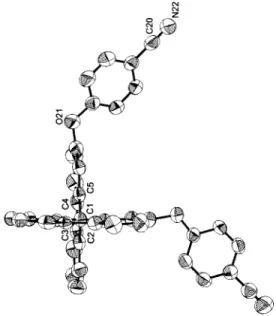
absorption bands associated with the carboxylic group appear at 2500 –3400 (OOH stretching) and 1685 cm⫺1(CAO stretching). The molecular structure of compound 5, in the solid state, was elucidated by X-ray crystallography analysis. Sin-gle crystals of 5 were obtained by careful crystal-lization from methanol solutions. Figure 2 dis-plays the Oak Ridge thermal ellipsoid plot (OR-TEP) of 5, calculated by X-ray diffraction at 295 K. The spiro molecule consists of two identical 2-(4-carboxyphenoxy)fluorene moieties connected through a common tetracoordinate carbon atom (the spiro center). In the spiro segment, the rings of the connected bifluorene entities are orthogo-nally arranged (dihedral angle⫽ 89.9°), and this agrees nicely with the proposed structure.
Preparation of the Polyamides
As shown in Scheme 2, aromatic polyamides were prepared from the spiro-fused dicarboxylic acid monomer 6 and various aromatic diamines 7a–7f
Scheme 1
Figure 1. 1H NMR spectra for the aromatic regions of
compounds (a) 5 and (b) 6 in DMSO-d6.
Figure 2. ORTEP diagram of compound 5 deter-mined by X-ray crystallography. All hydrogens have been omitted for clarity.
with the Yamazaki phosphorylation polyconden-sation procedure, with TPP/Py as a condensing agent and LiCl as a solubility enhancer.44All of
the polycondensations proceeded in homogeneous solutions, and the polyamides were isolated as fibrous solids by precipitation into methanol and drying in vacuo. The structures of the obtained polyamides were verified by1H NMR, 13C NMR,
and IR spectroscopy. Figure 3 shows the1H NMR
spectra of polymers 8a–8f, where all the peaks are readily assigned to the aromatic protons of the repeating unit. In addition to the distinct features associated with the spirobifluorene di-acid component, resonances corresponding to the aromatic protons of the diamine component are clearly present. 13C NMR data provide
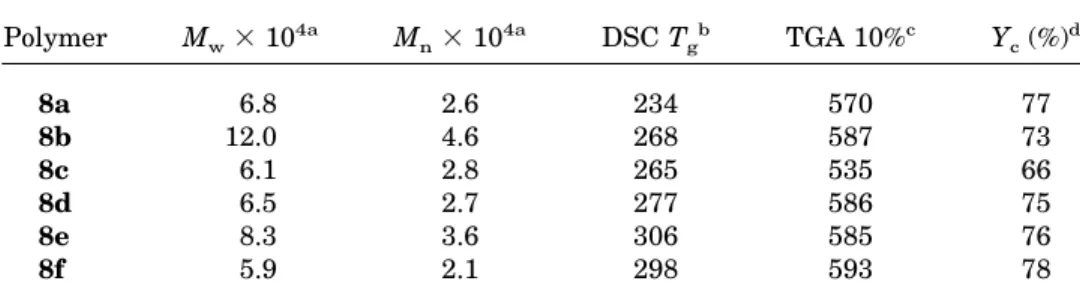
comple-mentary information. Resonances associated with the carbonyl carbons of the amide group appear in the relatively downfield region (164.4 –164.9 ppm). Polyamides 8a–8f again have the central spiro carbon (C-9) signal at 65.4 ppm, which in-dicates the presence of a spirobifluorene moiety. Polyamide 8e, which contains a diphenylfluorene component, has a cardo carbon (C-9) signal at 64.2 ppm. In the IR spectra, these polymers show characteristic amide group absorptions at 3303– 3324 (NOH) and 1654–1675 cm⫺1(CAO), which support the formation of polyamides. The molec-ular weights of the polyamides were determined by GPC with DMF as the eluent, calibrated against PMMA standards, with the results pre-sented in Table 1.
Properties of the Polymers
The crystallinity of the polyamides was evaluated by wide-angle X-ray diffraction experiments.
Each polymer was found to produce an amor-phous diffraction pattern. It appears that the presence of the kinked 1 moiety, together with flexible aryl ether linkages in the diacid compo-nent, results in poor chain packing. The amor-phous nature of the polyamides is also reflected in their high solubility. The solubility of polyamides
8a–8f was tested in a variety of organic solvents,
and these results are summarized in Table 2. All of the polyamides exhibit good solubility in THF and in polar aprotic solvents such as DMF, N,N-dimethylacetamide (DMAc), NMP, DMSO, and Py, despite the fact that some of them were de-rived from diamines with a rigid structure, such as 7e and 7f. Flexible films of the polyamides can be obtained by solution casting. The highly amor-phous nature and good solubility of these poly-amides can be attributed to the incorporation of kinked spirobifluorene units into the polymer backbone. In the case of the spiro-fused bifluorene moiety, the two mutually perpendicular fluorene rings are connected via a common tetracoordi-nated carbon atom.39,40As a result, the resulting
polymer chain repeatedly zigzags with an angle of 90° at each spiro center. This structural feature, which minimizes interchain interactions and re-stricts the close packing of the polymer chains, leads to a reduction in crystallinity and an en-hancement in solubility.
The thermal properties of the polyamides were investigated by DSC and TGA, and the results are
Figure 3. 1H NMR spectra of polyamides (a) 8a, (b)
8b, (c) 8c, (d) 8d, (e) 8e, and (f) 8f in DMSO-d6.
presented in Table 1. The presence of rigid spiro-bifluorene units in the polymer backbone results in polyamides with high Tg’s. All exhibit Tg’s in the range of 234 –306 °C, depending on the struc-ture of the diamine component. The Tg order is related to the increasing order of stiffness of the polymer backbone. The comparatively lower Tg value of polymer 8a can be attributed to the pres-ence of flexible 3,3⬘-methylenediphenyl units in its polymer chain. Polyamide 8f, containing a stiff 1,4-phenylene group, exhibits a higher Tg value. The cardo polymer 8e exhibits the highest Tg value. In general, the chain rigidity of the poly-mer increases because of the presence of bulky pendent groups, which restrict rotation of the polymer chain. It has been demonstrated that the incorporation of a cyclic cardo side group,45such
as fluorene, into the polymer backbone affords aromatic polyamides and polyimides high Tg’s and good thermal stability.20,46,47These
spirobif-luorene-based polyamides possess Tgvalues com-parable to those of the structurally related cardo-type polyamides derived from
9,9-bis[4-(4-carboxy-phenoxy)phenyl]fluorine, as reported previously.20
This observation reveals the effectiveness of incor-porating spiro-fused bifluorene moieties for increas-ing the rigidity of the polymer backbone.
As shown by TGA, all of the polyamides show similar patterns of decomposition and have good thermal stability, with more than 65% char yields in nitrogen at 900 °C. The temperatures corre-sponding to a 10% weight loss in nitrogen are in the range of 535–593 °C, about 50 °C higher than the temperature range of the corresponding flu-orene-based cardo polyamides. The high thermal stabilities of these polyamides reflect the rigid nature of the spiro-segment unit in the polymer main chain.
CONCLUSIONS
A series of organosoluble aromatic polyamides have been synthesized via the direct polyconden-sation of a novel diacid, which contains a 9,9 ⬘-spirobifluorene moiety along with two flexible ether linkages, with aromatic diamines with the phosphorylation method. The introduction of 9,9 ⬘-spirobifluorene units into the polymer backbone enhances the polyamides solubility because of a decrease in the degree of molecular packing and crystallinity. The high Tg’s (234 –306 °C) and good
thermal stabilities (temperature of 10% weight loss ⫽ 535–593 °C) of the polyamide indicates that the presence of these units does not impair the thermal properties of these polymers. Further studies concerning the incorporation of the spiro-bifluorene unit into the polymer backbone to pro-duce novel and processable high-performance polymeric materials are in progress.
The authors thank the National Science Council of the Republic of China for its financial support. They also
Table 1. Molecular Weights and Thermal Properties of Polyamides 8a– 8f
Polymer Mw⫻ 10 4a M n⫻ 10 4a DSC T g b TGA 10%c Y c(%) d 8a 6.8 2.6 234 570 77 8b 12.0 4.6 268 587 73 8c 6.1 2.8 265 535 66 8d 6.5 2.7 277 586 75 8e 8.3 3.6 306 585 76 8f 5.9 2.1 298 593 78
aThe molecular weight (g mol⫺1) was determined by GPC in DMF based on PMMA standards. bT
g(°C) was determined by DSC at a heating rate of 20 °C min⫺1under nitrogen.
cTemperature (⫾5 °C) at which a 10% weight loss was detected at a heating rate of 20 °C min⫺1
under nitrogen.
dChar yields at 900 °C in nitrogen.
Table 2. Solubility of Aromatic Polyamides
Solvent Solubilitya 8a 8b 8c 8d 8e 8f THF ⫹ ⫹ ⫹ ⫹ ⫹ ⫹ DMF ⫹ ⫹ ⫹ ⫹ ⫹ ⫹ DMAc ⫹ ⫹ ⫹ ⫹ ⫹ ⫹ NMP ⫹ ⫹ ⫹ ⫹ ⫹ ⫹ DMSO ⫹ ⫹ ⫹ ⫹ ⫹ ⫹ Py ⫹ ⫹ ⫹ ⫹ ⫹ ⫹ m-Cresol ⫹ ⫹ ⫹ ⫾ ⫾ ⫾
a⫹ ⫽ Soluble at room temperature; ⫾ ⫽ soluble on
thank Gene-Hsiang Lee (Instrumentation Center, Col-lege of Science, National Taiwan University) for the X-ray crystal structure determination.
REFERENCES AND NOTES
1. Cassidy, P. E. Thermally Stable Polymer; Marcel Dekker: New York, 1980.
2. Preston, J. In Encyclopedia of Polymer Science and Technology; Mark, H. F.; Bikales, N. M.; Over-berger, C. G.; Menges, G., Eds.; Wiley-Interscience: New York, 1988; Vol. 11, p 381.
3. Vollbracht, L. In Comprehensive Polymer Science; Allen, G.; Bevington, J., Eds.; Pergamon, Wheaton & Co.: Exeter, England, 1989; Vol. 5, p 375. 4. Yang, H. H. Aromatic High-Strength Fibers;
Wiley-Interscience: New York, 1989; p 202.
5. Lin, J.; Sherrington, D. C. Adv Polym Sci 1994, 111, 177.
6. Bellomo, M. R.; Di Pasquale, G.; La Rosa, A.; Pol-licino, A.; Siracusa, G. Polymer 1996, 37, 2877. 7. Hsiao, S. H.; Huang, P. C. J Polym Sci Part A:
Polym Chem 1997, 35, 2421.
8. Liaw, D. J.; Liaw, B. Y.; Su, K. L. J Polym Sci Part A: Polym Chem 1999, 37, 1997.
9. Espeso, J. F.; Ferrero, E.; De La Campa, J. G.; Lozano, A. E.; De Abajo, J. J Polym Sci Part A: Polym Chem 2001, 39, 475.
10. Hsiao, S. H.; Chang, C. F. J Polym Sci Part A: Polym Chem 1996, 34, 1433.
11. Takeichi, T.; Suefuji, K.; Inoue, K. J Polym Sci Part A: Polym Chem 2002, 40, 3497.
12. Ferrero, E.; Espeso, J. F.; De La Campa, J. G.; De Abajo, J.; Lozano, A. E. J Polym Sci Part A: Polym Chem 2002, 40, 3711.
13. Carter, K. R.; Furuta, P. T.; Gong, V. Macromole-cules 1998, 31, 208.
14. Spiliopoulos, I. K.; Kikroyannidis, J. A.; Tsivgoulis, G. M. Macromolecules 1998, 31, 522.
15. Spiliopoulos, I. K.; Kikroyannidis, J. A. Macromol-ecules 1998, 31, 1236.
16. Liaw, D. J.; Liaw, B. Y.; Chung, C. Y. Macromol Chem Phys 1999, 200, 1023.
17. Liaw, D. J.; Hsu, P. N.; Chen, J. J.; Liaw, B. Y.; Hwang, C. Y. J Polym Sci Part A: Polym Chem 2001, 39, 1557.
18. Chern, Y. T. Polymer 1998, 39, 4123.
19. Liaw, D. J.; Liaw, B. Y.; Yang, C. M. Macromole-cules 1999, 32, 7248.
20. Hsiao, S. H.; Yang, C. P.; Lin, W. L. Macromol Chem Phys 1999, 200, 1428.
21. Liaw, D. J.; Liaw, B. Y.; Yu, C. W. J Polym Sci Part A: Polym Chem 2000, 38, 2787.
22. Liaw, D. J.; Liaw, B. Y.; Yang, C. M.; Hsu, P. N.; Hwang, C. Y. J Polym Sci Part A: Polym Chem 2001, 39, 1156.
23. Liaw, D. J.; Liaw, B. Y.; Lai, S. H. Macromol Chem Phys 2001, 202, 807.
24. Liu, Y. L.; Tsai, S. H. Polymer 2002, 43, 5757. 25. Liou, G. S.; Hsiao, S. H.; Ishida, M.; Kakimoto, M.;
Imai, Y. J Polym Sci Part A: Polym Chem 2002, 40, 2810.
26. Salbeck, J.; Yu, N.; Bauer, J.; Weisso¨rtel, F.; Best-gen, H. Synth Met 1997, 91, 209.
27. Salbeck, J.; Bauer, J.; Weisso¨rtel, F. Macromol Symp 1997, 125, 121.
28. Johansson, N.; Salbeck, J.; Bauer, J.; Weisso¨rtel, F.; Bro¨ms, P.; Andersson, A.; Salaneck, W. R. Adv Mater 1998, 10, 1136.
29. Steuber, F.; Staudigel, J.; Sto¨ssel, M.; Simmerer, J.; Winnacker, A.; Spreitzer, H.; Weisso¨rtel, F.; Sal-beck, J. Adv Mater 2000, 12, 130.
30. Kim, Y. H.; Shin, D. C.; Kim, S. H.; Ko, C. H.; Yu, H. S.; Chae, Y. S.; Kwon, S. K. Adv Mater 2001, 13, 1690.
31. Katsis, D.; Geng, Y. H.; Ou, J. J.; Culligan, S. W.; Trajkovska, A.; Chen, S. H.; Rothberg, L. J. Chem Mater 2002, 14, 1332.
32. Wong, K. T.; Chien, Y. Y.; Chen. R. T.; Wang, C. F.; Lin, Y. T.; Chiang, H. H.; Hsieh, P. Y.; Wu, C. C.; Chou, C. H.; Su, Y. O.; Lee, G. H.; Peng, S. M. J Am Chem Soc 2002, 124, 11576.
33. Yu, W. -L.; Pei, J.; Huang, W.; Heeger, A. J. Adv Mater 2000, 12, 828.
34. Marsitzky, D.; Murray, J.; Scott, J. C.; Carter, K. R. Chem Mater 2001, 13, 4285.
35. Wu, F.-I.; Dodda, R.; Reddy, D. S.; Shu, C.-F. J Mater Chem 2002, 12, 2893.
36. Chiang, C.-L.; Shu, C.-F. Chem Mater 2002, 14, 682.
37. Reddy, D. S.; Shu, C.-F.; Wu, F.-I. J Polym Sci Part A: Polym Chem 2002, 40, 262.
38. Chou, C.-H.; Reddy, D. S.; Shu, C.-F. J Polym Sci Part A: Polym Chem 2002, 40, 3615.
39. Wu, R.; Schumm, J. S.; Pearson, D. L.; Tour, J. M. J Org Chem 1996, 61, 6906.
40. Johansson, N.; dos Santos, D. A.; Guo, S.; Cornil, J.; Fahlman, M.; Salbeck, J.; Schenk, H.; Arwin, H.; Bre´das, J. L.; Salenek, W. R. J Chem Phys 1997, 107, 2542.
41. Prelog, V.; Bedekovic, D. Helv Chim Acta 1979, 62, 2285.
42. Weisburger, J. H.; Weisburger, E. K.; Ray, F. E. J Am Chem Soc 1950, 72, 4250.
43. Haas, G.; Prelog, V. Helv Chim Acta 1969, 52, 1202.
44. Yamazaki, N.; Matsumoto, M.; Higashi, F. J Polym Sci Polym Chem Ed 1975, 13, 1373.
45. Korshak, V. V.; Vinogradova, S. V.; Vygodskii, Y. S. J Macromol Sci Rev Macromol Chem 1974, 11, 45. 46. Yang, C. P.; Lin, J. H. J Polym Sci Part A: Polym
Chem 1993, 31, 2153.
47. Hsiao, S. H.; Li, C. T. J Polym Sci Part A: Polym Chem 1999, 37, 1403.