12 IEEE PHOTONICS TECHNOLOGY LETTERS, VOL. 22, NO. 1, JANUARY 1, 2010
Self-Assembled Two-Dimensional Surface Structures
for Beam Shaping of GaN-Based Vertical-Injection
Light-Emitting Diodes
Min-An Tsai, Peichen Yu, Member, IEEE, C. H. Chiu, H. C. Kuo, Senior Member, IEEE, T. C. Lu, Member, IEEE,
and S. H. Lin
Abstract—Enhanced light extraction and beam shaping of
GaN-based vertical-injection light-emitting diodes (VI-LEDs) employing biomimetic surface structures were demonstrated. The biomimetic surface structures were fabricated using self-assem-bled polystyrene nanospheres serving as a monolayer mask, and followed by anisotropic inductively coupled plasma reactive ion etching. The light output power of the VI-LEDs with the patterned structures exhibited an efficiency enhancement factor of 68% at a driving current of 350 mA, compared to those without any surface structures. The structures also resulted in a modified heart-shaped radiation pattern, which is preferable for backlight applications in flat panel displays.
Index Terms—Biomimetic structure, polystyrene (PS) nanospheres, vertical-injection light-emitting diodes (VI-LEDs).
I. INTRODUCTION
O
VER the past decade, the development of GaN-based light-emitting diodes (LEDs) has shown tremendous progress and improvements. Recently, GaN-based LEDs have been commercialized for a variety of applications, including backlights for cell phones, outdoor displays, and white light LEDs [1]–[3]. High-efficiency white light LEDs have also attracted much interest for their potential in replacing incan-descent or fluorescent mercury (Hg) and xenon (Xe) lamps. However, the aforementioned applications require not only the improvement of light extraction efficiencies, but also the Lambertian-like radiation profile of conventional GaN–InGaN LEDs [4]. For example, mobile phone cameras and vehicle head lamps prefer collimated radiation patterns, while backlight sources and general lighting devices favor heart-shaped profiles for efficient light diffusion. To this date, various techniques have been proposed to enhance the light extraction efficiency of conventional LEDs [5]–[7]. However, the resulting surface textures cannot be used to tailor the emission pattern. More-over, some of the proposed techniques may also deteriorate theManuscript received June 10, 2009; revised September 19, 2009. First published October 23, 2009; current version published December 16, 2009. This work was supported in part by the National Science Council in Taiwan under Grant NSC96-2221-E-009-095-MY3 and Grant NSC96-2628-E-009-017-MY3.
M.-A. Tsai and S. H. Lin are with the Department of Electrophysics, National Chiao-Tung University, Hsinchu, 30010, Taiwan (e-mail: [email protected]). P. Yu, C. H. Chiu, H. C. Kuo, and T. C. Lu are with Department of Photonics and Institute of Electro-Optical Engineering, National Chiao-Tung Univer-sity, Hsinchu, 30010, Taiwan (e-mail: [email protected]; hckuo@ faculty.nctu.edu.tw).
Color versions of one or more of the figures in this letter are available online at http://ieeexplore.ieee.org.
Digital Object Identifier 10.1109/LPT.2009.2034470
electrical properties of conventional LEDs, since the p-type GaN top layer is 200 nm thick, limiting the depth of surface textures.
Recently, subwavelength periodic nanostructures such as two-dimensional photonic crystals (2-D-PCs) or biomimetic structures have been widely investigated due to the capability of photonic band engineering and output light redistribution [8]. The LEDs with a 2-D-PC pattern have shown enhanced light extraction efficiencies and the modification of radiation profiles [9]. The fabrication techniques for forming 2-D-PC structures on the surface of LEDs generally involve either electron beam lithography (EBL) [10], nano-imprint lithography (NIL) [11], or copolymer lithography (CPL) [12]. However, the involved fabrication cost is relatively high, hindering further applications of 2-D-PCs and biomimetic structures in light-emitting devices. Most recently, several low-cost approaches using self-assembled polystyrene (PS) or/and SiO nanospheres have been employed to improve light extraction efficiency in ni-tride LEDs [13]–[15]. In this research, we employ a similar method to fabricate large-scale biomimetic surface structures on vertical-injection light-emitting diodes (VI-LEDs). The fabrication of VI-LEDs, which combines wafer bonding and laser lift-off (LLO) techniques, results in a thick n-GaN top layer, providing an excellent platform to fabricate high-as-pect-ratio biomimetic structures. These structures contribute to the enhanced light-extraction efficiencies and heart-shaped radiation profiles, favorable for backlights in flat panel displays. The light output power of VI-LEDs with biomimetic structures reaches 241 mW at a driving current of 350 mA with a chip size of 1 1 mm , giving rise to an efficiency enhancement factor of about 68%, compared to those with a flat surface.
II. EXPERIMENTS
First, a conventional LED structure was grown on a -plane sapphire substrate by metal–organic chemical vapor deposition (MOCVD). The epitaxial LED structure consisted of a 1.7- m -thick heavily doped n-type GaN layer, followed by ten-pair InGaN–GaN multiquantum wells (MQWs) with a total thick-ness of 90 nm, and a 0.2- m-thick p-type GaN layer. The LED structure was first deposited with Au and Sn for adhesion, and then bonded to a gold-coated Si substrate at 350 C. The detailed bonding and LLO procedures can be found in [16]. After the bonding and LLO process, the biomimetic structures were fab-ricated on the surface of n-type GaN. Schematics of the etching process are illustrated in Fig. 1(a)–(d).
As shown in Fig. 1(a), PS nanospheres with a plurality of 10 wt.% was first spun on the surface of the VI-LED, naturally
TSAI et al.: SELF-ASSEMBLED TWO-DIMENSIONAL SURFACE STRUCTURES FOR BEAM SHAPING OF GaN-BASED VI-LEDs 13
Fig. 1. Schematics of the fabrication of biomimetic structures utilizing the PS nanospheres on the n-type GaN layer: (a) a monolayer of PS nanospheres by spin coating; (b) shrinking PS spheres via anisotropic ICP-RIE with incident oxygen plasma; (c) the formation of self-assembled surface structures after ICP-RIE; and (d) the removal of PS sphere masks.
Fig. 2. (a) SEM image of the fabricated biomimetic surface structures. (b) The magnified image of (a).
forming into a closely packed triangular lattice, which serve as a self-assembled monolayer mask. Next, inductively coupled plasma reactive ion etching (ICP-RIE) with incident oxygen (O ) plasma was performed to shrink the size of the PS spheres as shown in Fig. 1(b), in order to facilitate the following GaN etching. The flow rate was set to be 20 sccm with a chamber pressure of 0.06 Pa and an RF power of 100 W. It is worth noting that the positions of PS spheres did not change during the size shrinking. The separations between PS spheres increased as their sizes decreased. ICP-RIE was then performed on GaN with a Cl –Ar flow rate of 45/30 sccm, a chamber pressure of 0.66 Pa, and an ICP/bias power of 200/200 W. The remaining PS nanospheres were removed by dipping into acetone with sonifi-cation for 5 min, as illustrated in Fig. 1(d). Finally, an n-GaN electrode consisting of Ti–Pt–Au (100 nm/100 nm/2000 nm) was deposited. The diameter of the n-pad was 100 m.
III. RESULTS ANDDISCUSSION
Fig. 2(a) and (b) shows the scanning electron microscopic (SEM) images of the fabricated biomimetic structures at dif-ferent magnifications. The moth-eye-like structures revealed a triangular lattice with a period of 350 nm. The periodic islands have a mean diameter of 250 nm with uniformity better than 10% and an averaged height of 300 nm with uniformity better than 5%. In this process, the 2-D lattice showed single-crystal domains on the order of 10- to 50- m range. However, the lattice has different crystal domains in the large dimension above 10- to 50- m range. As seen in Fig. 2(b), the biomimetic structures show flat-top surfaces which were covered by the
Fig. 3. I–V and L–I characteristics for GaN-based vertical-injection LEDs with biomimetic surface structures and with a flat surface.
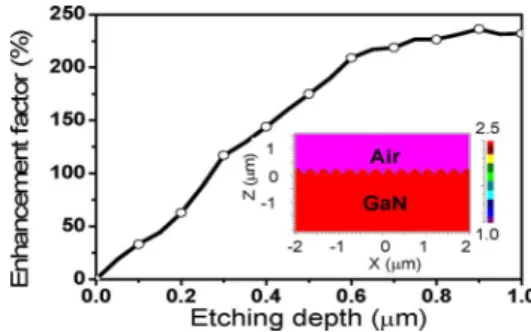
Fig. 4. Enhancement factor of light output power versus the height of biomimetic surface structures for a VI-LED. The inset shows the simulated index profile.
remaining PS nanospheres after the ICP-RIE process. There-fore, the biomimetic structures with larger aspect ratios are achievable with further optimized etching conditions.
The current–voltage ( – ) and the intensity–current ( – ) characteristics of VI-LED with and without the self-assembled biomimetic surface structures are shown in Fig. 3. The – curves of both devices are nearly identical, indicating that the fabrication process did not deteriorate the electrical properties of the VI-LED. The corresponding – characteristics of both devices show great linearity up to 500 mA due to efficient thermal dissipation in the design of VI-LEDs. The respective output powers for VI-LEDs with a flat surface and with self-as-sembled biomimetic surface structures were 143 and 241 mW at a driving current of 350 mA, showing an enhancement factor of 68%. The light output power increment arises from both the roughened surface and also the gradient changed refractive index due to the biomimetic structural profile [17].
A 2-D finite-difference time-domain (FDTD) method with the perfectly matched layer (PML) boundary condition was employed to examine the relationship between the etching depth and the enhancement factor. The simulated index profile is shown on the inset of Fig. 4, where an array of parabolic structures is defined on top of the GaN surface. The structural dimensions are extracted from the SEM images shown in Fig. 2 with 15 dipole illumination sources placed at 1.5 m below the tip of surface structures and three detectors around the simulated device [18]. As shown in Fig. 4, the enhancement factor monotonically increases with the etching depth. The optimized depth lies between 600 nm and 1 m due to both the waveguiding effect and the shortened distance between the roughened surface and the active region. Further etching depths are not preferred due to the distance required for current spreading. In this process, the etching depth of 300 nm is
14 IEEE PHOTONICS TECHNOLOGY LETTERS, VOL. 22, NO. 1, JANUARY 1, 2010
Fig. 5. Measured far-field pattern for the VI-LEDs with a flat surface and with biomimetic surface structures.
limited by the selectivity ratio between the nanospheres and GaN. Finally, we note that a factor of 115% is predicted for the 300-nm depth. The discrepancy between the experiment and simulation is possibly due to shape imperfections during the fabrication of biomimetic structures.
The far-field radiation patterns of the VI-LEDs with a flat surface and with biomimetic surface structures were measured, as shown in Fig. 5. A regular Lambertian-like emission pat-tern is observed from the VI-LED with a flat surface. Nev-ertheless, the VI-LED with biomimetic surface structures re-sults in a heart-shaped radiation profile, since the dimension of biomimetic structures is close to the blue light wavelength. The diffraction of the particular 2-D structures redistributes the output light along lateral directions. We have also found that the radiation profile is highly related to both the arrangement and the shape of the nanostructures [16].
IV. CONCLUSION
GaN-based VI-LEDs with biomimetic surface struc-tures demonstrated enhanced light-extraction and a distinct heart-shaped radiation profile. The FDTD simulation explains the efficiency enhancement of the experiments and also sug-gests further improvements.
ACKNOWLEDGMENT
The authors thank H. S. Chu, Dr. E. Wu, and S. Yuan of ASTRI, Hong Kong for their technical support and helpful sug-gestions.
REFERENCES
[1] Y. Narukawa, I. Niki, K. Izuno, M. Yamada, Y. Murazki, and T. Mukai, “Phosphor-conversion white light emitting diode using InGaN near-ultraviolet chip,” Jpn. J. Appl. Phys., vol. 41, pp. L371–L373, 2002. [2] E. F. Schubert and J. K. Kim, “Solid-state light sources getting smart,”
Science, vol. 308, pp. 1274–1278, 2005.
[3] S. Nakamura and M. Senoh, “Super bright green InGaN single quantum-well-structure light-emitting diodes,” Jpn. J. Appl. Phys., vol. 34, pp. L1332–L1335, 1995.
[4] C. H. Chiu, H. C. Kuo, C. F. Lai, H. W. Huang, W. C. Wang, T. C. Lu, S. C. Wang, and C. H. Lin, “Enhancement of InGaN/GaN flip-chip ITO LEDs with incline sidewalls coated with TiO /SiO omnidirectional reflector,” J. Elec. Soc., vol. 154, pp. H944–H947, 2007.
[5] C. M. Tsai, J. K. Sheu, W. C. Lai, Y. P. Hsu, P. T. Wang, C. T. Kuo, C. W. Kuo, S. J. Chang, and Y. K. Su, “Enhanced output power in GaN-based LEDs with naturally textured surface grown by MOCVD,”
IEEE Electron Device Lett., vol. 26, no. 7, pp. 464–466, Jul. 2005.
[6] C. H. Chang, P. Yu, and C. S. Yang, “Broadband and omnidirectional antireflection from conductive indium-tin-oxide nanocolumns pre-pared by glancing-angle deposition with nitrogen,” Appl. Phys. Lett., vol. 94, 2009, Article 051114.
[7] C. H. Chiu, C. E. Lee, C. L. Chao, B. S. Cheng, H. W. Huang, H. C. Kuo, T. C. Lu, S. C. Wang, W. L. Kuo, C. S. Hsiao, and S. Y. Chen, “Enhancement of light output intensity by integrating ZnO nanorod arrays on GaN-based LLO vertical LEDs,” Elec. Sol. Stat. Lett., vol. 11, pp. H84–H88, 2008.
[8] B. S. Cheng, C. H. Chiu, K. J. Huang, C. F. Lai, H. C. Kuo, C. H. Lin, T. C. Lu, S. C. Wang, and C. C. Yu, “Enhanced light extraction of InGaN-based green LEDs by nano-imprinted 2D photonic crystal pattern,” Semicond. Sci. Technol., vol. 23, 2008, Article 055002. [9] J. J. Wierer, M. R. Krames, J. E. Epler, N. F. Gardner, M. G. Craford, J.
R. Wendt, J. A. Simmons, and M. M. Sigalas, “InGaN/GaN quantum-well heterostructure light-emitting diodes employing photonic crystal structuresr,” Appl. Phys. Lett., vol. 84, pp. 3885–3887, 2004. [10] C. E. Lee, C. F. Lai, Y. C. Lee, H. C. Kuo, T. C. Lu, and S. C.
Wang, “Nitride-based thin-film light-emitting diodes with photonic quasi-crystal surface,” IEEE Photon. Technol. Lett., vol. 21, no. 5, pp. 331–333, Mar. 1, 2009.
[11] H. K. Cho, J. Jang, J. H. Choi, J. Choi, J. Kim, J. S. Lee, B. Lee, Y. H. Choe, K. D. Lee, S. H. Kim, K. Lee, S. K. Kim, and Y. H. Lee, “Light extraction enhancement from nanoimprinted photonic crystal GaN-based blue light emitting diodes,” Opt. Express, vol. 14, pp. 8654–8660, 2006.
[12] S. Park, D. H. Lee, J. Xu, B. Kim, S. W. Hong, U. Jeong, T. Xu, and T. P. Russell, “Macroscopic 10-Terabit-per-Square-Inch arrays from block copolymers with lateral orders,” Science, vol. 323, pp. 1030–1033, 2009.
[13] A. J. Danner, B. Z. Wang, S. J. Chua, and J. K. Hwang, “Fabrication of efficient light-emitting diodes with a self-assembled photonic crystal array of polystyrene nanoparticles,” IEEE Photon. Technol. Lett., vol. 20, no. 1, pp. 48–50, Jan. 1, 2008.
[14] Y. K. Ee, P. Kumnorkaew, R. A. Arif, J. F. Gilchrist, and N. Tansu, “Enhancement of light extraction efficiency of InGaN quantum wells light emitting diodes using SiO /polystyrene microlens arrays,” Appl.
Phys. Lett., vol. 91, 2007, Article 221107.
[15] J. W. Park, J. H. Park, H. Y. Koo, S. I. Na, S. J. Park, H. Y. Song, J. W. Kim, W. C. Kim, and D. Y. Kim, “Improvement of light extraction efficiency in GaN-based light emitting diodes by random pattern of the p-GaN surface using a silica colloidal mask,” Jpn. J. Appl. Phys., vol. 47, pp. 5327–5329, 2008.
[16] M. A. Tsai, P. Yu, C. L. Chao, C. H. Chiu, H. C. Kuo, S. H. Lin, J. J. Huang, T. C. Lu, and S. C. Wang, “Efficiency enhancement and beam shaping of GaN–InGaN vertical-injection light-emitting diodes via high-aspect-ratio nanorod arrays,” IEEE Photon. Technol. Lett., vol. 21, no. 4, pp. 257–259, Feb. 15, 2009.
[17] H.-M. Wu, C.-M. Lai, and L.-H. Peng, “Optical response from lenslike semiconductor nipple arrays,” Appl. Phys. Lett., vol. 93, 2008, Article 211903.