Pergamon
S0021-8502(96)00038-9
J . A e r o s o l S c i . Vol. 27, No. 7, pp. 1035-1061, 1996 Copyright © 1996 Elsevier Science Ltd Printed in Great Britain. All rights reserved 0021-8502/96 $15.00 + 0.00
T H E R M O P H O R E S I S O F A N A R B I T R A R Y T H R E E - D I M E N S I O N A L
A R R A Y O F N I N T E R A C T I N G A R B I T R A R Y S P H E R E S
H u a n J. K e h * a n d
Shih H.
C h e nDepartment of Chemical Engineering, National Taiwan University, Taipei 106-17 Taiwan, R.O.C. (First received 25 January 1996; and in final form 6 March 1996)
Abstract--A boundary-collocation technique, used earlier by Chen and Keh [(1996) Aerosol Sci. Technol. 24, 21-35] in the study of the thermophoresis of N coaxial spheres along the line of their centers, is extended to describe the motion of an assemblage of N aerosol spheres arranged arbitrarily in three-dimensional space. The spheres are allowed to differ in radius, in thermal conductivity and in surface properties; they may move independently, or they may be linked by infinitesimally thin rods to form a rigid aggregate. The Knudsen numbers are assumed to be small so that the fluid flow is described by a continuum model with a thermal creep and a hydrodynamic slip at the particle surfaces.
Results are presented in terms of pair-interaction coefficients for the thermophoretic velocities of the particles. For two-sphere systems• the translational and angular velocities of the particles at all orientations and separation distances agree very well with the exact solutions obtained by using spherical bipolar coordinates or the asymptotic solutions obtained by using a method of reflections. The particle-interaction parameters of linear chains of three spheres show that the existence of the third sphere can significantly affect the mobilities of the other two spheres, For the cases of a rigid dumbbell composed of two spheres, the numerical solutions for the particle velocities compare quite favorably with the formulas derived analytically. Finally, our numerical results for the interaction between two spheres are used to find the effect of volume fractions of particles of each type on the mean thermophoretic velocities in a polydisperse aerosol. Copyright © 1996 Elsevier Science Ltd. N O M E N C L A T U R E a , a i A, A i Aj,,n• Bj,,n, Ci,, D~,.., Ej,,,., Fjmn z !9 n(!. ) rq) . - j t m n • ~ f l r a n , v 3 t m n n(!) F(9 tz(9 - - j t r n n • - - j t m n ~ --Jlmn bi, ci, di B*., C*.,E*. B**, C**,E * I e r a , C m i C~, Csl Ct, C , e e~, £r, £z er,, £0i' e~bi Eo~ F~ Gi~n I k £ k, k,* K , K * g!'] ) I M, M * Nij M i j ~ = M ~ ~ M ("~ Ni. ' i j ' J N P~ particle radius (m)
thermophoretic mobility of a sphere defined by equation (lb) (m 2 s-1 K - l ) coefficients defined by equation (13)
functions of ri, 01 and ~bj in equation (15)
rectangular coordinates of the center of sphere i (m) functions of ri, Oi and q~i defined by equation (17) functions of r~, 01 and q5 i defined by equation (18)
dimensionless coefficient accounting for the hydrodynamic slip dimensionless coefficient accounting for the thermal slip dimensionless coefficient accounting for the temperature jump
unit vector directed from the center of sphere 1 toward the center of sphere 2 unit vectors in rectangular coordinates
unit vectors in the spherical coordinates originated from particle i undisturbed temperature gradient (K m-~)
drag force acting on sphere i (N)
function of r~ a n d / t i defined by equation (9) unit dyadic
thermal conductivity of the fluid (W m - 1 K - 1 ) thermal conductivity of the particle (W m - ~ K - 1 )
ratio of thermal conductivities between sphere i and the fluid the number of collocation rings on each particle surface dimensionless mobility parameters defined by equation (36) mean free path of the gas molecules (m)
the number of terms reserved in the Fourier series dimensionless mobility tensors defined by equation (22) dimensionless mobility parameters defined by equation (31) the number of particles in an assemblage
the associated Legendre function of order m and degree n
* Author to whom correspondence should be addressed
1036 H.J. Keh and S. H. Chen
roi r12 ri, Oi, 6~i ri R~,.., Sj~. Rimn~ Simn Rji.,., Sji.. T T i T . z To T, Uo, Uo W, U~, U~ s, U~. U m) u~o') ~ j , - - j <U,) t2 Dr,, UO i, U~,i W X, y, Z Greek lettels o~ij 2i #i P
equal to Iro, I, distance between the hydrodynamic center of a rigid cluster and the center of its sphere i (m)
distance between centers of sphere 1 and sphere 2 (m) spherical coordinates measured from the origin of sphere i position vector in spherical coordinates (ri, Oi, (Ji) (m)
coefficients in the expression of equation (4a) for the temperature field of the fluid coefficients in the expression of equation (4b) for the temperature field of sphere i functions of ri, 0i and ~b i in equation (5)
temperature field of the fluid (K) temperature field of sphere i (K) undisturbed temperature distribution (K) prescribed temperature at the plane x = 0 (K) prescribed temperature at the particle center (K) hydrodynamic torque on sphere i about its center (N m) therrnophoretic velocity at the origin of a rigid cluster (m s ~) translational velocity of sphere i (m s- 1 )
components of U~ in rectangular coordinates (m s 1)
thermophoretic velocity of sphere j in the absence of all the other spheres (m s- ~ ) mean thermophoretic velocity of type i particles (ms 1 )
velocity field of the fluid (m s - 1 )
components of v in spherical coordinates (ri, Oi, ~i) (ms i) separation parameter defined by equation (44)
rectangular coordinates (m)
interaction coefficient defined by equation (42) viscosity of the fluid (kg m- 1 s 1 )
dimensionless coefficient defined by equation (41) equal to cos 01
density of the fluid (kgm 3)
viscous stress tensor of the fluid (N m 2) volume fraction of type i particles in a suspension
solid harmonic functions of order n in spherical coordinates (r, 01, ~hi) angular velocity of sphere (s- 1 )
components of ~ in rectangular coordinates (s 1 )
1. I N T R O D U C T I O N
T h e r m o p h o r e s i s refers to the m o t i o n of a e r o s o l p a r t i c l e s m r e s p o n s e to a t e m p e r a t u r e g r a d i e n t . This p h e n o m e n o n was first d e s c r i b e d in 1870 b y T y n d a l l , w h o o b s e r v e d a dust-free z o n e in a d u s t y gas a r o u n d a h o t b o d y ( W a l d m a n n a n d S c h m i t t , 1966). T h e t h e r m o p h o r e t i c effect c a n be e x p l a i n e d b y a p p e a l i n g to the k i n e t i c t h e o r y of gases ( K e n n a r d , 1938). T h e h i g h e r - e n e r g y m o l e c u l e s in the h o t r e g i o n of the gas i m p i n g e o n the p a r t i c l e s with g r e a t e r m o m e n t a t h a n m o l e c u l e s c o m i n g f r o m the c o l d region, t h u s l e a d i n g to the m i g r a t i o n of the p a r t i c l e s in the d i r e c t i o n o p p o s i t e to the t e m p e r a t u r e g r a d i e n t . Being a m e c h a n i s m for the c a p t u r e of a e r o s o l p a r t i c l e s o n c o l d surfaces, t h e r m o p h o r e s i s is of c o n s i d e r a b l e i m p o r t - a n c e in m a n y p r a c t i c a l a p p l i c a t i o n s , such as s a m p l i n g of a e r o s o l p a r t i c l e s ( F r i e d l a n d e r , 1977), c l e a n i n g o f air (Sasse e t al., 1994), scale f o r m a t i o n o n surfaces of h e a t e x c h a n g e r s ( M o n t a s s i e r e t al., 1991), m o d i f i e d c h e m i c a l v a p o r d e p o s i t i o n ( W e i n b e r g , 1982), m i c r o - e l e c t r o n i c m a n u f a c t u r i n g (Ye e t al., 1991), a n d n u c l e a r r e a c t o r safety ( W i l l i a m s a n d L o y a l k a ,
1991).
B a s e d on the a s s u m p t i o n s of s m a l l K n u d s e n n u m b e r (l/a, where a is the r a d i u s of the p a r t i c l e a n d l the m e a n free p a t h o f the gas molecules), s m a l l t h e r m a l P e c l e t n u m b e r a n d small R e y n o l d s n u m b e r as well as the effects o f t e m p e r a t u r e j u m p , t h e r m a l creep a n d h y d r o d y n a m i c slip at the g a s - p a r t i c l e surface, B r o c k (1962) o b t a i n e d the t h e r m o p h o r e t i c v e l o c i t y o f a n a e r o s o l s p h e r e in a c o n s t a n t t e m p e r a t u r e g r a d i e n t V T ~ as
U (°) = - - A V T .... ( l a )
w h e r e the t h e r m o p h o r e t i c m o b i l i t y
A= I
2C~(k+f~C,I/a)
I;_T
Thermophoresis of an arbitrary three-dimensional array 1037 In equation (lb), p, q and k are the density, viscosity and thermal conductivity, respectively, of the gas; /~ is the thermal conductivity of the particle; T is the bulk-gas absolute temperature at the particle center in the absence of the particle (or the mean gas temper- ature in the vicinity of the particle); Cs, Ct and Cm are dimensionless coefficients accounting for the thermal creep, temperature jump and hydrodynamic slip phenomena, respectively, at the particle surface and must be determined experimentally for each gas-solid system. A set of reasonable kinetic-theory values for complete thermal and momentum accommo- dations appear to be C~ = 1.17, Ct = 2.18 and Cm = 1.14 (Talbot et al., 1980). Note that the negative sign in equation (la) indicates that the particle migration is in the direction of decreasing temperature and p T in equation (lb) is a constant for an ideal gas at constant pressure. Brock's (1962) analysis was extended to spheroidal particles by using prolate and oblate spheroidal coordinate systems (Leong, 1984).
In most real situations of thermophoresis, aerosol particles are not isolated and will move in the presence of neighboring particles. Through an exact representation in spherical bipolar coordinates, the thermophoretic motion of two separate, arbitrary spherical par- ticles along the line of their centers was recently examined (Chen and Keh, 1995). Numerical results of correction to equation (lb) for each particle were presented for various cases. On the other hand, the thermophoresis of two arbitrary spheres whose connecting axis is oriented arbitrarily relative to the temperature gradient was analyzed using a method of reflections (Keh and Chen, 1995). The particle velocities were determined in an approximate solution of increasing powers of
r121
up to O(r~-27), where rl 2 is the center-to-center distance between the particles. Several important conclusions result from these investigations of the two-sphere interactions in thermophoresis. First, the particle interaction effects on ther- mophoresis in general are much weaker than on sedimentation, because the disturbance to the fluid velocity field caused by a thermophoretic sphere decays faster (as r - 3, where r is the distance from the particle center) than that caused by a settling sphere (as r-l). In sedimentation, there is a net gravitational force exerted on the particle and this force is balanced by a nonzero hydrodynamic force. In thermophoresis, however, there is no hydrodynamic force exerted on the particle. As a consequence, the disturbance velocity fields in the surrounding fluid for the two situations decay at different rates with r. Second, for the situation of two identical spheres aligned parallel to the prescribed temperature gradient, the interaction effects make each particle move faster than the velocity it would possess if isolated, while for the situation of two identical spheres undergoing thermophor- esis normal to the line of their centers, each particle migrates slower than its undisturbed velocity. Third, the thermophoretic velocity of each of two coexistent identical spheres, which can be arbitrarily oriented, is unaffected by the presence of the other in the case of[~/k -- 0 or Ctl/a ~ 0o. Fourth, the influence of the interactions between the particles in
general is far greater on the smaller one than on the larger one.
In view of the fact that the interactions among multiple particles may be important and aggregates of particles can be formed in concentrated aerosol suspensions, in a previous article (Chen and Keh, 1996) we studied the axisymmetric thermophoretic motion of a string of N freely suspended or linked spherical particles along the line of their centers using a boundary collocation technique. In that analysis, the particles could differ in physical properties and in radius and they were allowed to be unequally spaced. The numerical results of particle interaction effects could be obtained with good accuracy even when the particles were touching one another.
This paper is an extension of the previous work (Chen and Keh, 1996) to the situation of the thermophoretic motion of multiple spheres in an arbitrary configuration. Again, the spheres may differ in radius and in physical properties. The quasi-steady energy and momentum equations applicable to the system are solved by using the boundary collo- cation technique and the particle interaction parameters are obtained for various cases. For the simple case of thermophoresis of two spheres normal to the line of their centers, our numerical results for the particle velocities show excellent agreement with the asymptotic solution obtained by using the method of reflections. The combined analytical=-numerical solution method for the thermophoresis of freely suspended spheres is also employed to
1038 H.J. Keh and S. H. Chen
examine the thermophoretic motion of a three-dimensional rigid cluster composed of N arbitrary spheres connected by thin rods of arbitrary lengths through their centers. The complete collocation results for the interaction effects between pairs of spheres are also used to evaluate the mean thermophoretic velocity in a bounded suspension of aerosol spheres.
2. A N A L Y S I S F O R M U L T I P L E S P H E R E S
Consider the thermophoretic motion of N spherical particles in an infinite gaseous medium, which is assumed to be Newtonian and incompressible, in an arbitrary three- dimensional configuration as shown in Fig. 1. F o r convenience, the Cartesian coordinate system (x, y, z) is established such that the center of the first sphere is at the origin and the uniform imposed thermal gradient V T ~ equals Eo~ex, where e~ together with % and e= are the unit vectors in the coordinate system. The position of the center of particle i is represented by coordinates (bi, ci, de), and we have set bl -- Cl = dl = 0. The particles may be formed from different materials and have unequal radii. Our purpose here is to determine the correction to equation (1) for the motion of each particle due to the presence of the other ones in proximity. At first, the temperature distributions inside and outside the particles and the fluid velocity field must be solved.
2.1. T e m p e r a t u r e distributions
The thermophoretic motion of multiple particles is inherently unsteady. However, the problem can be considered quasi-steady if the Reynolds and Peclet numbers are small. The conduction equation governing the temperature distribution T (r) for the suspending fluid of constant thermal conductivity k is
V2T = 0. (2a)
F o r the temperature field T i ( r ) inside the particle i, one has
VZT/= 0,
i = 1,2 . . . . ,N.(2b)
The boundary conditions at the particle surfaces require that the normal heat fluxes be continuous and a temperature jump occur which is proportional to the normal temperature gradient (Kennard, 1938). Also, the fluid temperature must approach the linear prescribed field far from the particles and the temperature inside each particle is finite everywhere. Thus, one has
(?T
ri -- ae: T -- T i = Ctel 8 r i (3a)
k ~ T ~Te
c~ri = ke Or---[' (3b)
ri < ae: T i is finite,
(3c)
(X2 + y2
+ 2.2)1/2 ~ O0 : T --* T ~ = To + E ~ x , (3d)for i = 1,2 . . . N. Here, ai, ki and C , are the radius, thermal conductivity and temperature jump coefficient of particle i respectively, l is the mean free path of the surrounding fluid, (re, 0i, q~e) are spherical coordinates measured from the center of particle i, and To is the temperature far from the particles at the plane x = 0.
The fundamental solution of Laplace's equation that is capable of describing an arbitrary disturbance on the surface of a sphere consists of the internal and external solid spherical harmonic functions. F o r N spherical particles dispersed in the temperature field, the general
T h e r m o p h o r e s i s o f a n a r b i t r a r y t h r e e - d i m e n s i o n a l a r r a y 1039
Eooex
(x,y,z)(ri
,OI ,~)©
Z
.S~ "d .J - - _ - ~ r l(bi,Gi,di)
.,.f_.~ ..__-_- - _ . . .Y
al Fig. 1. G e o m e t r i c a l s k e t c h f o r t h e t h e r m o p h o r e s i s o f m u l t i p l e a e r o s o l s p h e r e s .solution to equation (2) can be written as
N
T = Eo~ ~ ~ ~ rfn-lP~(ktj)[RjmnCOS(mqbj) + Simnsin(mq~j)]
j = l n = 0 m = 0
+ Eo~ x + To, (4a)
Ti = Eo~ ~ ~ rTP'~(l~i)[RimnCOS(mc~i) +
S~m~sin(m~bi)]n = 0 m = 0
+ E ~ x + To, i = l , 2 . . . N. (4b)
Here P~ are the associated Legendre functions and ~ is used to denote cos 0~ for brevity. A solution of the form of equation (4) immediately satisfies boundary conditions (3c) and (3d). The unknown coefficients
Rjmn,
Sjran , R i m n and Sgm. are to be determined using the boundary conditions at the particle surfaces. It is understood thatSjm,,
= S~,~ = 0 if m = 0. Application of the boundary conditions (3a) and (3b) along the surface of each sphere to equation (4) leads to~ ~ {Rj,~[rj-"-lP~(pj)cos(m(bj)]r,=,, + Sjmn[rT~-lP~(#j)sin(mqSj)],,=a,}
j = l n = O m = O
-
~ ~ (a~' + na~-tk*Ct, l)P~(#,) [R,m,,Cos(mc~) +
Simnsin(m~b,)] n = O ra=O= k* Ctil(1 - ~2)1/2
cos q~i, (5a)~,
[ Rjm~ Rjim,.(ai, I~i, ~i) + SjmnSjimn(ai, 12i,
(~i)]j = 1 n = O m = O
--
k* ~ ~ na'/-x
P~(/~,)[/~,mncos(m~b,) + $1m~sin(mq~,)]n = O m = O
1040 H J. Keh and S. H. Chen
where k* = k j k , functions R~iim,(ri,//i, Oi) and Sji,,,(ri,//i, Oi) are defined by equation (2.7) of K e h and Yang (1991) and i --- 1, 2, ... , N. In equation (5a), the coordinates (rj, Oj, (o j) of an arbitrary position relative to the center of the j t h particle are related to the coordinates (r~, 0i, qS~) of the position relative to the center of the ith sphere by equation (2.8) of Keh and Yang (1991). To satisfy the b o u n d a r y conditions (5a) and (5b) exactly along the entire surface of each particle would require the solution of the entire infinite arrays of unknown constants R j,.., S j,.., e i m n and &m.- However, the b o u n d a r y collocation method allows one to truncate the infinite series in equation (4) and then to enforce the b o u n d a r y conditions at a finite n u m b e r of discrete points on the surface of each sphere (Hassonjee et al., 1988; Keh and Yang, 1991; Williams and Loyalka, 1991).
To apply the collocation technique, the order of s u m m a t i o n y."2 o ~ : o in equations (4) and (5) is changed to y~,~= o Y"~,. without the loss of any terms in the series. Then the infinite
0 6 •
OC
series Z., = o is truncated after the first M terms and the infinite series Z . =m is truncated after its first K terms for each value o f j or i. With this arrangement, equation (4) becomes
N M 1 m + K 1
T = Eoc ~ ~ ~ rjn-lPmn(//j)[Rjmncos(rnOj) + Sj,nnsin(md?j)]
j= 1 m=0
n = m+ E~ x + To, (6a)
M 1 m + K 1
Ti = E~, ~ ~ r'~ P~. (//i)[Rim,,Cos(m~i) +Sim. sin(m(gi)]
m - O n - m
+ E . x + To, i = 1,2 . . . N, (6b)
and equation (5) must be altered accordingly.
Equation (6) leaves a total of 2 N K ( 2 M - 1) unknown coefficients R~,.., Sj.,., Rim. and
S~,.. (Sjo. = ~7~o. = 0) to be determined. To generate the equations needed to evaluate these u n k n o w n constants, we multiply the truncated form of equation (5) by the function sets cos(re' ~bi) and sin(m' ~bi), integrate with respect to ~bi from 0 to 27z, and utilize the ortho- gonality properties of these functions in this interval to obtain
~ M~lm+K-1 {
f:r~
2 R J mn
[rf"-
1 p m ( / / j ) C O S ( m ( g j ) ] r i = a icos(m'
4 ) i ) d ~ ij=l m=0
n = m+ &m. [_rf" 1 PY(//j)sin(m4i)]~,=., cos(m'~b~)d4~ m ' + K - 1
- rc y~ (a'i + na'i -1 k*Ctil)Rim,.P2'(//i)
n = m '
rc (a'~ + na~ 1 k* Ctil)Rio.P°(//i)
n=0
rrk*Ctil(1
--//?)1/2
(m' = 0)
(m' = 1)
(m' = 2,3 . . . M - 1), (7a)
Rjm. [rj - n - 1 Pm(//j) cos(mdpj)]ri=a, sin(m' 4~i)dQ)i
, j = l
m=O
n = m+ Sj.,. [r;-"- 1 p,~(l~i)sin(rn~b~)]r, =., sin(re' ~bi)dqSi m ' + K - 1
- n ~ (a'd + na'~-lk*C.1)~gim,.P~'(//~)
n ~ m '
Thermophoresis of an arbitrary three-dimensional array 1041
M-1 m+K-i {
~:n
2
Z
Rjmn
Rjimn(ai,~i,~)i)cos(m'¢i)d~i
j = l
m=O n:m
+ Sjm. Sjim. (ai, Yi, ¢i) cos (m' ¢i) dqSi
m'+K-1
- rck* ~, na n - l - R i m , . P . (th) m"n=m '
K - 1 rck* ~ n a ' 1 - 1 -RionPn (l, Li)
o n=O re(k* - 1)(1 - kt{) 1/2 0 (m' = 0) (m' = 1) (m' = 2,3 . . . M -- 1), (7c)Z
Rim n
Rjimn (ai, ].ti, ~bi)
sin ( m ' ¢ i ) d~bi j = l m=On=m
+ Sjm. S j i m . ( a i , # i , c ) i ) s i n ( m ' ~ b i ) d ¢ im'+K-1
~ k * Z na'~- l - m" -Sim,.P. (]1i)
n=m"
= 0 (m' = 1,2, . . . , M - - 1), (7d)where i = 1, 2, . . . , N. The above boundary conditions are satisfied at K discrete values of 0i (rings) at the surface of each particle i. This results in a set of 2 N K ( 2 M - 1) simultaneous linear algebraic equations, which is exactly equal in number to the unknown constants Rjm,,, Sjm,, /~im, and Si,.. in the truncated solution (6) for the temperature field. These 2 N K ( 2 M - 1) equations can be solved using any standard matrix-reduction technique. Note that the definite integrals in equation (7) for each collocation ring must be performed numerically.
The accuracy of this boundary-collocation, truncated-series solution technique can be improved to any degree by taking sufficiently large values of M and K. Naturally, the truncation error reduces to zero as M ~ ~ and K ~ ~ . In general cases, the series in equation (6) converge quite rapidly, and very good accuracy can be achieved with only a small number of terms in the Fourier series (M) and collocation rings on each particle (K). One special case of the general three-dimensional theory described above is the case with planar symmetry, i.e. the centers of all the spheres lie in the plane y = 0. F o r these planar symmetric configurations, the constants S j,., and Si,,~ are all zero and equations (7b) and (7d) become trivial. So the number of unknowns (Rim. a n d / ~ , , , only) is reduced to 2 N K M and they can be determined by an equal number of equations in the form of equations (7a) and (7c) satisfied at K discrete rings on the surface of each sphere. Furthermore, there are two special cases which can be deduced from the planar case: a string of spheres oriented parallel to the prescribed thermal gradient (the centers of all spheres lie on x-axis) and a string of spheres oriented normal to the applied field (the centers of all spheres lie along the z-axis). The temperature distributions for the former case are axisymmetric about the x-axis and were solved in a previous article (Chen and Keh, 1996).
F o r the configuration of a finite chain of spheres located on the z-axis, we have ¢~ = ¢, bi = ci = 0 (i = 1, 2 . . . . , N ) , and only the coefficients for m = 1 will be nonzero. Thus, the
1042 H.J. Keh and S. H. Chen truncated form of equation (5) can be simplified as
N K K
~'~ R j x . [ r f " - l PX.(ktj)]r,=., - ~'~ (aT + na']-' k*Ctil)ff.ilnP2(~i) = k* Ctil(1
-- ] . / 2 ) 1 / 2j = l n = l n = l (Sa) (8b) N K K
~ Ria.Gj,.(a,,p,) - k* ~
n a n - l R i l n e l ( 1 2 i ) ~-(k* -
1)(1 - #2),/2, j = l n = l n = l whereGji~(r~,p~)= r ~ - 4 { - - ( n + 1)[r~ + l a ~ ( d i - d j ) ] r j p l ( p j ) - ( 1 - It2)(di-dj)r~dPd~J) },
(9)and the dependence on q5 factors out. Instead of using equation (7) one can apply equation (8) at K discrete values of 0~ along the surface of each of the N particles and the numerical integration with respect to the variable ~b is not needed. This generates a set of
2NK
linear algebraic equations for the2NK
unknown coefficients Rj~, a n d / ~ , . Once these coefficients are determined by a matrix-reduction technique, the temperature distributions for this special case are completely solved.2.2.
Fluid velocity distribution
With knowledge of the solution for the temperature field, we can now proceed to find the fluid velocity distribution. Due to the low Reynolds numbers encountered in thermo- phoretic motion, the fluid velocity is governed by the Stokes equations
qV2v -- Vp = 0, (10a)
v.v_ = o, (10b)
where v(r,) is the velocity field for the fluid flow and p(£) is the corresponding pressure distribution. Owing to the thermal creep velocity and the frictional slip velocity along the particle surfaces as well as the fluid at rest far from the particles, the boundary conditions for the fluid velocity are
~
Cmil(I
C, 11
= - e~ e~.)e~ :r +
si-=--V~T,
ri -~ ai: ~ U i + a i ~ i × e p i + T ~ . . . . Z p T i (lla) ( x 2 + y2 + z 2 ) l / 2 - - ~ 00: ~---~Q, ( l l b ) T ~ - - T o + E~ bi, which is the prescribed temperature at the
n - 2 ~ 2 1 " 7 ~ ( j ) 2rtn(2n -- 1) "i , , v - , , - 1 +
n + l . r.p(J~ ]
tln~n -
11-' - " - ' ~ ' (12) for i = 1,2, ... ,N. Here,position of the center of particle i; ~ ( = t/IVy + (Vv) T]) is the viscous stress tensor for the fluid; er, is the radial unit vector in the spherical coordinates measured from the center of particle i; / is the unit dyadic; Cmi and Csl are the hydrodynamic slip and thermal slip coefficients, respectively, about the surface of particle i; Ui( = Uixex + Uiyey + U~ez) and ~ ( = f~ixex + f~rey + f~zez) are the translational and angular velocities of particle i to be determined. The tangential temperature gradient, Vs T = ~ - er,er,)" VT, can be obtained from equation (6a) with coefficients determined from equation (7). The validity of the expression for the thermal creep velocity in equation (1 la) is based on the assumption that the fluid is only slightly nonuniform in the undisturbed temperature on the length scale of the particle radii.
T h e r m o p h o r e s i s of an a r b i t r a r y three-dimensional a r r a y 1043
where
~((--J)--l, ~b(--J)-i
and p~,)_ 1 are the solid spherical harmonic functions of order- (n + 1) which depend on the spherical coordinates (r~, 0~, ~bj) originating at the center of particle j and r~ = r~e~. These functions can be expressed as
~)(J)-i I = ?.j-n-1 ~" pnm([.lj)
P(J)-l J
m:O
Cim, [ cos(rn¢i) + Djm,
Ejm .
F~,,,sin(me j) (13)
The boundary condition (1 lb) is immediately satisfied by a solution of this form and the unknown coefficients At,,., B i . . . , and Fir,. remain to be determined from equation (1 la). In the construction of solution (12), the superposition of Lamb's general solution (Happel and Brenner, 1983) to equation (10) as written from N different origins can be utilized owing to the linearity of the governing equations.
Substituting equation (13) into equation (12) and applying equations (2.8), (2.23) and (2.24) of Keh and Yang (1991) for the coordinate transformation leads to an expression for the fluid velocity field in terms of spherical coordinates measured from the center of the ith particle:
v = v,,(ri, Oi, (bi)£,, + Vo, (ri, Oi, ~Pl)£o, + ve~,(ri, Oi, ~bi)£o,, (14) where
n . (2) [ (2) 2)
Vo, = ~ Arm. A jim,, + Bjm, B~im. + "'" + Fjmn "" ,
j = l n = l 0 (3) / | R ~3) /
v4,, A~im, I L
x.njimn
J(15)
and i = 1,2 . . . N. The functions -4~im. (r~,/~i, 4~), (z)
B)imn (ri, lti, ~91) ....
(o and F(jimn ~)(ri, pli, ~i)
with l = 1,2 and 3 in equation (15) are defined by equation (2.27) of Keh and Yang (1991).
Application of boundary condition ( l l a ) to equation (14) can be accomplished by utilizing the collocation technique presented in the previous subsection for the solution of the temperature distributions. First, the order of summation Y~,~I ~ , = 0 in equation (15) is changed to ~ = o ~ , ~ , , , . ~ o without loss of any terms in the series. Then the infinite series y.m~=o and ~ , ~ , . ¢ o are truncated after M * and K* terms, respectively, for each value ofj. Substitution of equations (14) and (6a) after this arrangement into equation (lla) yields three algebraic formulas which leave a total of 3 N K * (2M* - 1) unknown constants Arm., Bj . . . and Fj,,. to be determined (equation (13) gives Bj0. = D~o, = Fjo, = 0). Multiply- ing these formulas by the function sets cos (m' q~i) (m' = 0, 1, 2 . . . . , M* - 1) and sin (m' ~bi) ( m ' = 1,2 . . . M * - 1 ) , integrating with respect to ~bi from 0 to 2n, and utilizing the orthogonality properties of these functions in this interval allow one to obtain 3(2M* - 1) equations which are similar in form to equation (7). These equations can be satisfied at K* discrete values of 01 (rings) along the surface of each of the N particles to result in a set of 3 N K * (2M* - 1) linear algebraic equations, which can be solved by a matrix- reduction method to obtain the equal-number unknown constants in terms of the particle velocities U~ and ~ . Once these constants are determined, the fluid velocity field is completely solved.
For the case of planar symmetry, i.e. the centers of all the spheres lie in the plane y = 0, U~ r = fl~x = fl~ = 0, the coefficients
Ajmn, Dim n
andFjm n
a r e all zero and the integration of three algebraic formulas after multiplication by sin(m' <pg) with respect to ~b~ from 0 to 2n is trivial. Thus, the number of unknown coefficients (Bjm,, Cjm, and Ej,..) is reduced to 3 N K * M * and they are determined by an equal number of collocation equations.1044 H.J. Keh and S. H. Chen
Similar to the previous subsection, two special cases can be deduced from the planar case. The fluid velocity field about a chain of spheres undergoing thermophoretic motion along the line of their centers (x-axis) is axisymmetric and was solved by employing the Stokes stream function (Chen and Keh, 1996). F o r the case of a string of spheres oriented normal to the prescribed thermal gradient (the centers of all the spheres lie on the z-axis), one has ~bi = ~b, b i = cl =
0
andUix = Ui=
= Qix = ~i= = 0 (i = 1,2 . . . N), and only thecoefficients for m = 1 will be nonzero. Thus, the three algebraic formulas obtained by substituting equations (14) (after truncation) and (6a) into equation (1 la) can be simpli- fied to
N K*
Y, Y" [Bj,.dj..(ai,')
.i, 4') + Cj,. "(') "~ji~.tai, ~'i, 40 + E:j,. E~,,.(ai,(') Ui, 4')] j = l n = l= Uix(1
- ,2)1/2 COS ~b, (16a)N K*
Z Z [Bj,.B~j~.(ai,l~i,(a)
+
CjlnCjln(ai,]Ai,~))
Ji- Ejlnejln(~i,~li,~))]
j = l n = l
~- (Uixfli + ai[~iy )COS gb
_ Csi ~EOOpTi
tlil
[ n=l
~
Riln("n -~ Ylan- l kt Ctil)(1- ]Ai2)l/2dpl (~li)d.i
- (ai +
k *Ctil)#i]cos~) ,
(16b)N K*
Z 2
[ B j l , B j i , ( a i , , i , O ) + C j l . C j * * ( a i , # i , * ) + E
** jln )i.(ai,fli,q)~JE** . . . .
j = l n = l= - (Ui~ + a i ~ i r , i ) s i n ~b
Cs' rlE°° l
Ti al
.=~1Rnn(a'] + na'~- l k * Ca l ) ( 1 - 'u{ )l/2 pl (ffl ) + ai + k* C'i l ] sin c~'
(16c) where
[BS*.(r,,.,,4~i)] i~.j,,.r~(2)
lj [
I
l <,2',° l----Cmll
rl
r,L.~Ji,.j
.(2)
]
r.(2)
v(2) ~ | v t 2)• ~ji,.j
/~..,°
[
~(1) ]--
(1__
. ? ) 1 / 2 ~ / ~jiln|
~!?-)
/ k'flln J (17),ln,
,' Jilnr 'i' 1
** emil (~ /.(3' / __/~jj~;n/ (1 .12) -1/2 ~ ~/--,(1)Ic:,,,(r,,,,i,*i)t=lTZ'l--z
- - . . , , .[_--,j,l,, j
.-,..,,, j
L-,,l,, j
(18) Note that the dependence on q~ in equation (16) will factor out for this special case. Application of equation (16) at K * discrete values of 01 on the surface of each particle i can generate a set of3 N K *
linear algebraic equations for the3 N K *
unknown coefficients Bjl,,Thermophoresis of an arbitrary three-dimensional array 1045 2.3. Velocities o f f r e e spheres
The force exerted by the fluid on the ith sphere and the hydrodynamic torque experienced by the sphere about its center are given by (Happel and Brenner, 1983)
Fi = - 4rcV [rap(_°2], (19a)
T~ = - 8zrrlV [r/a • ~)2 ], (19b)
which shows that only the lowest-order solid spherical harmonic functions contribute to the force and torque on each particle. Substitution of equation (13) into equation (19) leads to
Fi = -- 4rr(Eilxex + F i l l e y + Emlez), (20a)
Ti = -- 8~rl(Aill e x q- Billey q- Aiol£z), (20b)
where the six coefficients for each of the N spheres are known from the collocation solution. Because the particles are freely suspended in the surrounding fluid, the net force and torque exerted by the fluid on each sphere must vanish. Applying this constraint to equation (20), one has
A i o l - - A i l l = Bill = Eiol = Ell 1 = Fil 1 = 0 , i = 1, 2 . . . . , N. (21)
T o determine the instantaneous translational and angular velocities U~ and ~ of the N particles (6N components in total), the above 6N equations must be solved simulta- neously. The result can be expressed as
N = 2 U m~ , (22a) j = l N 1[ (0) ai~)i = E N~j" = j , i = 1,2 . . . N, (22b) j = l with U~ °~ = - A j V Too, (23)
which is the thermophoretic velocity of sphere j in the absence of all the other ones. Aj is used to represent the value of A defined by equation (lb) for the undisturbed ther- mophoretic mobility of particle j. The dimensionless mobility tensors Mij and N~j are functions of the physical properties (k*, Ct~, Cml), sizes, orientations and separation ~listan- ces of the particles. It can be shown that M~j and N~j are independent of the thermal slip coefficients (Cs~) of the particles. When t h e ith sphe're is separated by an infinite distance from all of the others, it is evident that
Mii = I , M i j = 0 ( j = 1,2 . . . N b u t j ~ i), Nij --- 0 ( j = 1,2 . . . . N),
(24a)
(24b) (24c) for i = l, 2, ... , o r N .2.4. Velocity o f a rigid cluster o f spheres
We now consider the thermophoretic motion of a rigid cluster of N spheres connected through their centers with rigid rods of arbitrary lengths. The connecting rods are assumed to be infinitesimally thin compared to the sphere sizes; hence they make neither thermal nor hydrodynamic contributions but only serve to ensure the rigid-body motion of the cluster. Here, our aim is to explore the thermophoresis of aggregates formed by flocculation of aerosol particles.
1046 H.J. Keh and S. H. Chen
F o r such a rigid cluster of spheres undergoing thermophoresis, all of the equations in the previous subsections except for equations (21) and (24) still apply. Since the angular velocity of a rigid body is independent of the choice of origin, one has
~ = ~ , i = 1,2 . . . N , (25)
where ~ is the angular velocity of the cluster. The translational velocity of each sphere in the rigid cluster can be written as
U,=
U o + g X r o , , i = 1,2 . . . N, (26)where Uo refers to the translational velocity of a point on the cluster designated as the origin and roi is the position vector of the center of sphere i measured from the origin. Using equations (25) and (26) in Section 2.2, the set of unknown constants {Aj,,,, Bj . . . Fj,,. } or {Bj~,, C~I,, Eil,} can be solved in terms of the components of the cluster velocities Uo and
by the same collocation method.
T o determine U0 and ~ the constraint that the net force and net torque exerted by the fluid on the rigid cluster are zero is needed. Since the force acting on a rigid body is independent of the choice of origin, the net force on the cluster can be expressed in terms of the forces exerted on the individual spheres as
N
F = ~ F , = 0 . (27)
/ = 1
The net torque about the cluster's origin can also be expressed in terms of the forces and torques acting on the N spheres as
N
To = ~ (7", + £o, x F,) = 0. (28)
i = 1
Substitution of equation (20) into equations (27) and (28) leads to
N E,11 = 0, (29a) / = 1 N F i l l = 0, (29b) ' = 1 N E Eiol =- 0 ,
(29c)
i = 1 N(2qA,11 + YoiE,ol - z o i F i l l ) = 0, (30a)
/ = 1 N (2qBnl + z o i E i l l -- xoiEiol) -~ 0 , (30b) / = 1 N (2q Am1 + xoiF,11 -- y o , E , 1) = 0, (30c) , = 1
where Xo,, Yoi and Zo, are the components of vector ro, in Cartesian coordinates. The translational and angular velocities Uo and ~2 (each having three components) can be determined by solving the above six equations simultaneously.
3. R E S U L T S F O R T W O F R E E S P H E R E S
In this section we consider the thermophoretic motion of two freely suspended spheres which are oriented arbitrarily relative to the direction of the prescribed temperature
Thermophoresis of an arbitrary three-dimensional array 1047
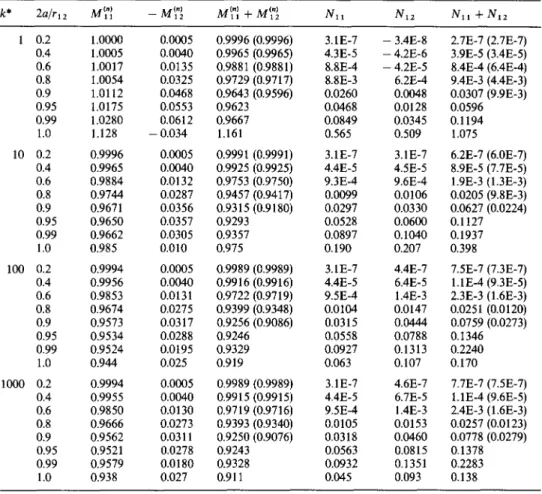
Table 1. The mobility parameters for the thermophoresisoftwoidenticalspheres normal to the line of their
centers with Ct I/a = 0.2 and Cm l/a = 0.1 (the values in parentheses are calculated from the approximate
formulas obtained by the method of reflections for comparison)
~,, 11 + MiD2 N i l NI2 N H 4- N12 1 0.2 1.0000 0.0005 0.9996 (0.9996) 3.1E-7 - 3.4E-8 2.7E-7 (2.7E-7)
0.4 1.0005 0.0040 0.9965 (0.9965) 4,3E-5 - 4.2E-6 3.9E-5 (3.4E-5) 0.6 1.0017 0.0135 0.9881 (0.9881) 8.8E-4 - 4.2E-5 8.4E-4 (6.4E-4) 0.8 1.0054 0.0325 0.9729 (0.9717) 8.8E-3 6.2E-4 9.4E-3 (4.4E-3) 0.9 1.0112 0.0468 0.9643 (0.9596) 0.0260 0.0048 0.0307 (9.9E-3) 0.95 1.0175 0.0553 0.9623 0.0468 0.0128 0.0596 0.99 1.0280 0.0612 0.9667 0.0849 0.0345 0.1194 1.0 1.128 - 0.034 1.161 0.565 0.509 1.075 10 0.2 0.9996 0.0005 0.9991 (0.9991) 3.1E-7 3.1E-7 6.2E-7 (6.0E-7)
0.4 0.9965 0.0040 0.9925 (0.9925) 4.4E-5 4.5E-5 8.9E-5 (7.7E-5) 0.6 0.9884 0.0132 0.9753 (0.9750) 9.3E-4 9.6E-4 1.9E-3 (1.3E-3) 0.8 0.9744 0.0287 0.9457 (0.9417) 0.0099 0.0106 0.0205 (9.8E-3) 0.9 0.9671 0.0356 0.9315 (0.9180) 0.0297 0.0330 0.0627 (0.0224) 0.95 0.9650 0.0357 0.9293 0.0528 0.0600 0.1127 0.99 0.9662 0.0305 0.9357 0.0897 0.1040 0.1937 1.0 0.985 0.010 0.975 0.190 0.207 0.398
100 0.2 0.9994 0.0005 0.9989 (0.9989) 3.1E-7 4.4E-7 7.5E-7 (7.3E-7) 0.4 0.9956 0.0040 0.9916 (0.9916) 4.4E-5 6.4E-5 1.1E-4 (9.3E-5) 0.6 0.9853 0.0131 0.9722 (0.9719) 9.5E-4 1.4E-3 2.3E-3 (1.6E-3) 0.8 0.9674 0.0275 0.9399 (0.9348) 0.0104 0.0147 0.0251 (0.0120) 0.9 0.9573 0.0317 0.9256 (0.9086) 0.0315 0.0444 0.0759 (0.0273) 0.95 0.9534 0.0288 0.9246 0.0558 0.0788 0.1346 0.99 0.9524 0.0195 0.9329 0.0927 0.1313 0.2240 1.0 0.944 0.025 0.919 0.063 0.107 0.170
1000 0.2 0.9994 0.0005 0.9989 (0.9989) 3.1E-7 4.6E-7 7.7E-7 (7.5E-7)
0.4 0.9955 0.0040 0.9915 (0.9915) 4.4E-5 6.7E-5 1.1E-4 (9.6E-5) 0.6 0.9850 0.0130 0.9719 (0.9716) 9.5E-4 1.4E-3 2.4E-3 (1.6E-3) 0.8 0.9666 0.0273 0.9393 (0.9340) 0.0105 0.0153 0.0257 (0.0123) 0.9 0.9562 0.0311 0.9250 (0.9076) 0.0318 0.0460 0.0778 (0.0279) 0.95 0.9521 0.0278 0.9243 0.0563 0.0815 0.1378 0.99 0.9579 0.0180 0.9328 0.0932 0.1351 0.2283 1.0 0.938 0.027 0.911 0.045 0.093 0.138
gradient. For this simple case, equations (22a) and (22b) for the translational and rotational velocities of the particles become
N ~ r M ( P ) e e ~r!.")(t _ ee)]" t7 ~.°) (31a) U i = 2 t_ ij _ _ '[- - , - t j ~,~ ~,,j , j = l N
ai~i
= - - 2 N i j e x U~ °', (31b) j = lwhere N = 2, i = 1 or 2, and e is the unit vector directed from the center of particle 1 toward the center of particle 2. Using a method of reflections, the formulas for the mobility parameters "'(Pl .,(,) M q , Jvlij ano Nq were derived in power series ofri-z 1 up to O(ri-27), where r12 is - the center-to-center distance between the two spheres (Keh and Chen, 1995).
On the other hand, the exact solution of the mobility parameters M]~, ~,,A~(P)t2, Mt2~ and
M(P~
22 for the thermophoresis of two arbitrary spheres along the line of their centers was presented by utilizing spherical bipolar coordinates (Chen and Keh, 1996). The combined analytical-numerical solution of these particle interaction parameters, resulting from using the boundary collocation technique for the axisymmetric motion of multiple spheres, was also obtained (Chen and Keh, 1996). It was found that the collocation results agree very well with the exact solution for various sizes, spacings and physical properties of the two particles. In this section the numerical results of the remaining eight parameters (Mt~"l, M~2 ) ,M(n) air(n) N1 21, ~*'l 22, 1, N 1 2 , N21, and N22), obtained by using the boundary-collocation, trun- cated-series method described in the previous section, will be presented. The accuracy
1048 H . J . Keh and S. H. Chen
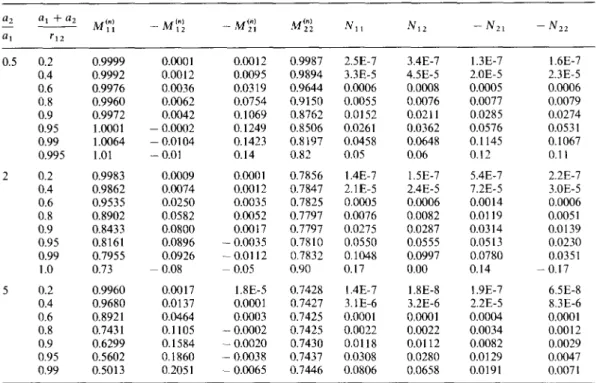
Table 2. The mobility parameters M~ ) and N~j for the thermophoresis of two spheres of unequal radii with the same physical properties (k* = 100, Gl/a~ = 0.2 a n d Cml/al = 0.1)
0 2 a 1 + a2 M~"~ -- M~"~ -- M~"~ M~")z N1, N l z - N z , - N22
al rl2
0.5 0.2 0.9999 0.0001 0.0012 0.9987 2.5E-7 3.4E-7 1.3E-7 1.6E-7
0.4 0.9992 0.0012 0.0095 0.9894 3.3E-5 4.5E-5 2.0E-5 2.3E-5
0.6 0.9976 0.0036 0.0319 0.9644 0.0006 0.0008 0.0005 0.0006 0.8 0.9960 0.0062 0.0754 0.9150 0.0055 0.0076 0.0077 0.0079 0.9 0.9972 0.0042 0.1069 0.8762 0.0152 0.0211 0.0285 0.0274 0.95 1.0001 - 0.0002 0.1249 0.8506 0.0261 0.0362 0.0576 0.0531 0.99 1.0064 -- 0.0104 0.1423 0.8197 0.0458 0.0648 0.1145 0.1067 0.995 1.01 - 0.01 0.14 0.82 0.05 0.06 0.12 0.11
2 0.2 0.9983 0.0009 0.0001 0.7856 1.4E-7 1.5E-7 5.4E-7 2.2E-7
0.4 0.9862 0.0074 0.0012 0.7847 2.1E-5 2.4E-5 7.2E-5 3.0E-5
0.6 0.9535 0.0250 0.0035 0.7825 0.0005 0.0006 0.0014 0.0006 0.8 0.8902 0.0582 0.0052 0.7797 0.0076 0.0082 0.0119 0.0051 0.9 0.8433 0.0800 0.0017 0.7797 0.0275 0.0287 0.0314 0.0139 0.95 0.8161 0.0896 - 0.0035 0.7810 0.0550 0.0555 0.0513 0.0230 0.99 0.7955 0.0926 - 0.0112 0.7832 0.1048 0.0997 0.0780 0.0351 1.0 0.73 - 0.08 - 0.05 0.90 0.17 0.00 0.14 - 0.17
5 0.2 0.9960 0.0017 1.8E-5 0.7428 1.4E-7 1.8E-8 1.9E-7 6.5E-8
0.4 0.9680 0.0137 0.0001 0.7427 3.1E-6 3.2E-6 2.2E-5 8.3E-6
0.6 0.8921 0.0464 0.0003 0.7425 0.0001 0.0001 0.0004 0.0001
0.8 0.7431 0.1105 - 0.0002 0.7425 0.0022 0.0022 0.0034 0.0012
0.9 0.6299 0.1584 - 0.0020 0.7430 0.0118 0.0112 0.0082 0.0029
0.95 0.5602 0.1860 - 0.0038 0.7437 0.0308 0.0280 0.0129 0.0047
0.99 0.5013 0.2051 - 0.0065 0.7446 0.0806 0.0658 0.0191 0.0071
of this solution technique will be tested by comparing the results with the asymptotic solution given in Keh and Chen (1995).
The details of the collocation scheme used for this work are given in Keh and Yang (1991) and a D E C 3000/600 AXP workstation was utilized to perform the calculations. All of the numerical results presented in Tables 1-5 converge to at least the digits as shown with reasonable choices of K and K*. A number of collocation solutions of the interaction parameters ~v,A~t")11, ~*,Ast")12, N 11 and N 1 2 for the thermophoretic motion of two identical spheres
(a 1 = a 2 --- a, Ctl = Ct2 = Ct, Cml = Cm2 = Cm, k~ = k~ = k* a n d A 1 = A 2 ) w i t h v a r i o u s
relative thermal conductivities and spacings are presented in Table 1. The two identical spheres will translate at the same velocity (because M~2"~ = M]"2 ) , M~2"2 ) = M]"~ and utO) = U ~0)) and rotate with angular velocities equal in magnitude but opposite in direction 2 (since N22 = -- N i l and N21 = - N12). Note that the spheres are still allowed to rotate freely when they are touched with each other
(2a/r~2
= 1). The asymptotic solutions for Mtl"~ + Mtt"2 ) and N l l + N 1 2 accurate to O(r(27) obtained by using the method of reflections are also listed (in the parentheses) in Table 1 for comparison. It can be seen that these method-of-reflections results agree quite well with the collocation results so long as the particle surfaces are more than ~ of the sum of the radii apart (i.e.2a/ra2 <~
0.6). However, the accuracy of the asymptotic solutions (especially for Ni~) deteriorates rapidly, as ex- pected, when the particles get close to each other. While the reflection results accurate to O(r~ -7) always underestimate the value of M]~ + M]~ (Keh and Chen, 1995), they also underestimate the values of M]"~ + M(~"2 ) and N l l + N 1 2 . Note that, the direction of rotation (relative to the direction of translation) of two spheres undergoing thermophoresis is opposite to that of two settling spheres.Some numerical values of the mobility parameters
M~i~ )
andNi~
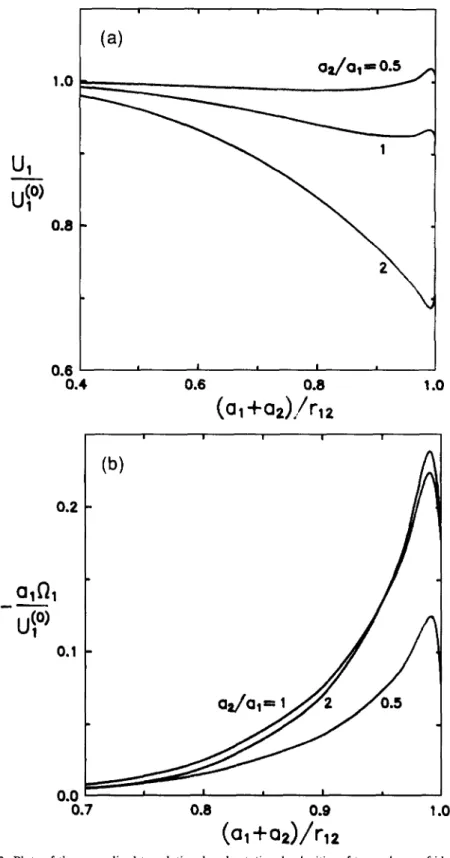
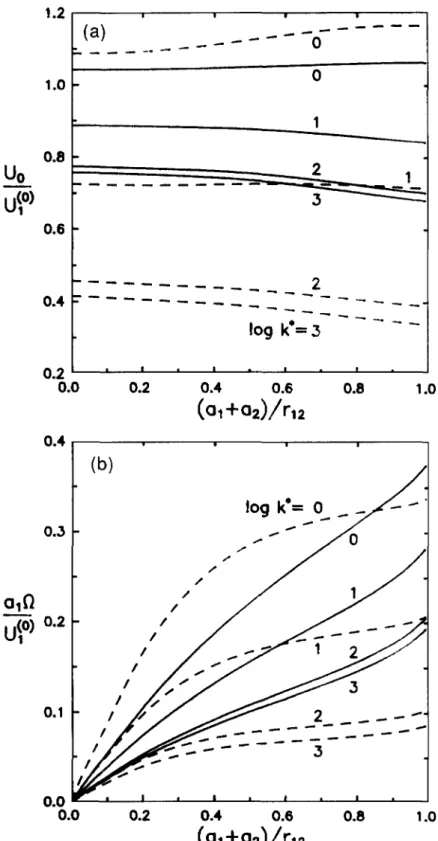
for the thermophoretic motion of two different-sized spheres with the same physical properties Ctx = C,2 = Ct, Cma = Cm2 = Cm and k* = k~' = k*) are listed in Table 2. Also, in Fig. 2, the normalized translational and rotational velocities of particle 1 of two spheres which have the same physical properties and experience thermophoresis perpendicular to the line through their centers are plotted as a function of(al + a2)/r12
witha2/al
as a parameter. The results inThermophoresis of an arbitrary three-dimensional array 1049
U1
u~ o)
alQ1
-u O)
L . w I I I(a)
o,la,=~
1 . 0 ~ 0.8 0.6 I I I I I 0 . , 0 . , 0.~ , . o(a,+Q~)/r,~
I ! I I I I I0.2
0.1 0.0 t_0.7
(b)
oJa,= ~ / / 2
/ 0 . 5
O.8 O.9 1.0(a, +02)/r12
Fig. 2, Plots of the normalized translational and rotational velocities of two spheres of identical thermal conductivities and surface properties with k* = 100, Ctl/al = 0.2 and Cml/al = 0.1 under- going thermophoresis perpendicular to the line of their centers versus the separation parameter
1050 H . J . K e h a n d S. H . C h e n
Tables 1 and 2 and Fig. 2 illustrate that the particles' interaction decreases rapidly, for all values of k* and a2/al, with an increase in the gap between them (i.e. decreasing
(a~ + az)/r12). However, the interaction between particles can be strong when the surface-to-surface spacing approaches zero. The effect of the interaction, in general, is greater on the smaller of the spheres than on the larger one for given values of k* and
(a~ + az)/r12. Note that the translational and rotational velocities of the particles are not necessarily a monotonic increasing functions of the separation parameter (al + a2)/r~2. These complex results are generated from the combined effects of particle interactions on local temperature and fluid velocity fields.
4. R E S U L T S FOR T H R E E C O A X I A L F R E E S P H E R E S
In the previous section solutions for the thermophoresis of two spherical particles based on the collocation technique have been presented and were shown to be in good agreement with the method-of-reflection results. This section will examine the solutions for the thermophoretic motion of three spheres using the same collocation method. Since the number of particle interaction parameters in the general problem of three spheres is so great, here we only consider the motion of three coaxial spheres with the same physical properties in a symmetric configuration that the two end particles have the same radius and distance from the central one (al = a3 and r12 = r 2 3 ) . F o r this linear and symmetric case,
equation (31) for the translational and rotational velocities is still valid (now with N = 3 and i = 1,2 or 3) and one has U1 = U 3 , ~'~1 = - ~ 3 and ~'~2 = 0, or
M]P/"~ = M~3P~ "', (32a) = m (p'"I (32b) m ~ n) 32 , M~2~"' = M~2P/"', (32c) M~3P/") = M(P'13 ") , (32d) N11 = - N33, (32e) N12 = - N3E, (32f) N 2 3 = - - N 2 1 , (32g) N31 = - N 1 3 , (32h) N 2 2 = 0 . (32i)
One may wonder what the shielding effect of neighboring particles on thermophoresis is. F o r the particle-interaction effects on the motion of a sphere (say, sphere 1) in an aerosol, the contribution of the closest neighbors should be carried in terms of parameters M]v~ ") and the contribution of the next layer of neighbors is conducted through parameters M(tP~ ") for the above-mentioned linear and symmetric case. A comparison between the magnitudes of M ~ ") and M ~ "~ gives the shielding effect. The numerical solution _c ~,(p) o, 1vl ij for this case, resulting from using the collocation method for the axisymmetric motion of three spheres, was obtained by Chen and Keh (1996). These collocation results compare quite favorably with the formulas analytically derived.
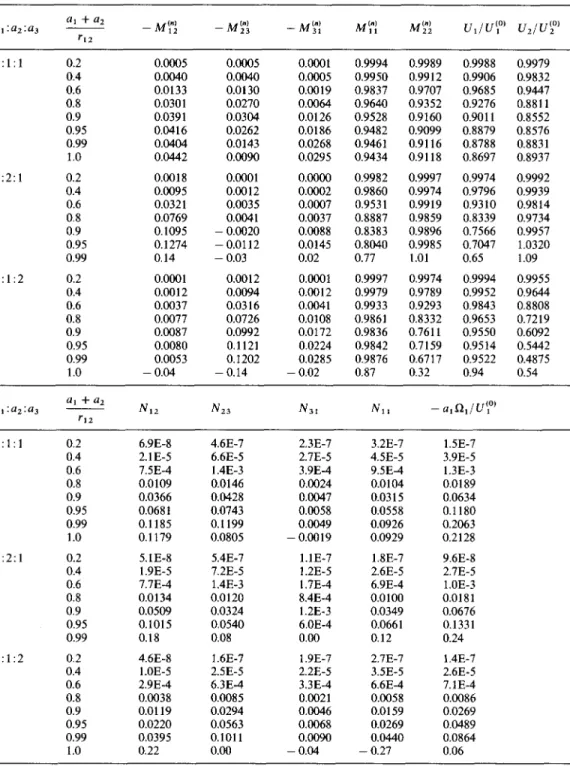
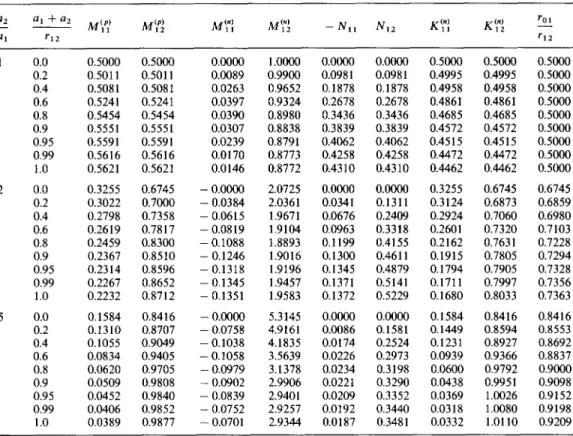
In Table 3, numerical results of the mobility parameters MI~ -) and N o for the thermo- phoretic motion of three coaxial spheres are presented for three cases of relative radii. The normalized translational and rotational velocities of these particles undergoing thermo- phoresis perpendicular to the line through their centers are also listed in the same table. In general, the particle interactions decrease with increasing gap thickness between two neighboring particles. However, similar to the case of two particles, the mobility parameters or normalized particle velocities are not necessarily a monotonic function of the separation
Thermophoresis of an arbitrary three-dimensional array 1051
parameter
(al + a2)/rxz.
The collocation results for the more general case of three coaxial spheres, such as ax ~ a3, r12 ¢ r23 or the situation that the physical properties of the particles are different, can be obtained without any further difficulty. However, all 27 mobility parameters, instead of 14, are required to compute the particle velocities.For the thermophoretic motion of three identical spheres along the line of their centers, it was found that the presence of an end sphere is to enhance the two-particle interaction effect on the other two spheres (Chen and Keh, 1996). One may be interested to see how significantly the existence of a third collinear sphere affects the thermophoretic velocities of
Table 3. The mobility parameter ~!~-) and ~ - * 13 N~s for the thermophoresis of three coaxial spheres with the same physical properties (k* = 100, Ctl/a 1 = 0.2 and C,.,,I/al = 0.1) for the symmetric case of al = a3 and r12 = r23
al + a2
al :az:a3 _ M(~)2 - - a r l 2 3 A,H"J - - a r l 3 1 ~("~ ~ v l 1 1 A~") ~ v ~ 2 2 A ~ ( " ) U1/U~ °) UE/U~2 °)
r 1 2 1 : 1 : 1 0.2 0.0005 0.0005 0.0001 0.9994 0.9989 0.9988 0.9979 0.4 0.0040 0.0040 0.0005 0.9950 0.9912 0.9906 0.9832 0.6 0.0133 0.0130 0.0019 0.9837 0.9707 0.9685 0.9447 0.8 0.0301 0.0270 0.0064 0.9640 0.9352 0.9276 0.8811 0.9 0.0391 0.0304 0.0126 0.9528 0.9160 0.9011 0.8552 0.95 0.0416 0.0262 0.0186 0.9482 0.9099 0.8879 0.8576 0.99 0.0404 0.0143 0.0268 0.9461 0.9116 0.8788 0.8831 1.0 0.0442 0.0090 0.0295 0.9434 0.9118 0.8697 0.8937 1 : 2:1 0.2 0.0018 0.0001 0.0000 0.9982 0.9997 0.9974 0.9992 0.4 0.0095 0.0012 0.0002 0.9860 0.9974 0.9796 0.9939 0.6 0.0321 0.0035 0.0007 0.9531 0.9919 0.9310 0.9814 0.8 0.0769 0.0041 0.0037 0.8887 0.9859 0.8339 0.9734 0.9 0.1095 - 0.0020 0.0088 0.8383 0.9896 0.7566 0.9957 0.95 0.1274 - 0.0112 0.0145 0.8040 0.9985 0.7047 1.0320 0.99 0.14 -- 0.03 0.02 0.77 1.01 0.65 1.09 2:1 : 2 0.2 0.0001 0.0012 0.0001 0.9997 0.9974 0.9994 0.9955 0.4 0.0012 0.0094 0.0012 0.9979 0.9789 0.9952 0.9644 0.6 0.0037 0.0316 0.0041 0.9933 0.9293 0.9843 0.8808 0.8 0.0077 0.0726 0.0108 0.9861 0.8332 0.9653 0.7219 0.9 0.0087 0.0992 0.0172 0.9836 0.7611 0.9550 0.6092 0.95 0.0080 0.1121 0.0224 0.9842 0.7159 0.9514 0.5442 0.99 0.0053 0.1202 0.0285 0.9876 0.6717 0.9522 0.4875 1.0 - 0.04 - 0.14 -- 0.02 0.87 0.32 0.94 0.54 al + a2 al:az:a3 N12 N23 N3x N i l - a l O a / U ] °~ 1 " 1 2
1 : 1 : 1 0.2 6.9E-8 4.6E-7 2.3E-7 3.2E-7 1.5E-7
0.4 2.1E-5 6.6E-5 2.7E-5 4.5E-5 3.9E-5
0.6 7.5E-4 1.4E-3 3.9E-4 9.5E-4 1.3E-3
0.8 0.0109 0.0146 0.0024 0.0104 0.0189
0.9 0.0366 0.0428 0.0047 0.0315 0.0634
0.95 0.0681 0.0743 0.0058 0.0558 0.1180
0.99 0.1185 0.1199 0.0049 0.0926 0.2063
1.0 0.1179 0.0805 - 0.0019 0.0929 0.2128
1:2:1 0.2 5.1E-8 5.4E-7 1.1E-7 1.8E-7 9.6E-8
0.4 1.9E-5 7.2E-5 1.2E-5 2.6E-5 2.7E-5
0.6 7.7E-4 1.4E-3 1.7E-4 6.9E-4 1.0E-3
0.8 0.0134 0.0120 8.4E-4 0.0100 0.0181
0.9 0.0509 0.0324 1.2E-3 0.0349 0.0676
0.95 0.1015 0.0540 6.0E-4 0.0661 0.1331
0.99 0.18 0.08 0.00 0.12 0.24
2:1 : 2 0.2 4.6E-8 1.6E-7 1.9E-7 2.7E-7 1.4E-7
0.4 1.0E-5 2.5E-5 2.2E-5 3.5E-5 2.6E-5
0.6 2.9E-4 6.3E-4 3.3E-4 6.6E-4 7.1E-4
0.8 0.0038 0.0085 0.0021 0.0058 0.0086
0.9 0.0119 0.0294 0.0046 0.0159 0.0269
0.95 0.0220 0.0563 0.0068 0.0269 0.0489
0.99 0.0395 0.1011 0.0090 0.0440 0.0864
1052 H . J . Keh and S. H. Chen
its two nearby particles when the temperature gradient is imposed normal to the line of their centers. In Fig. 3, the normalized translational and rotational velocities of three identical spheres with equal spacings undergoing thermophoresis perpendicular to the line of their centers are plotted by solid curves as a function of separation parameter
2a/r12.
The1.0 U l u ( O ) o.e 0 . 8 t - 0.4 1.t U2 1 .o U (o) 0.9 0.8 0.4 i ~ I i f : _ ( a ) /
(b)
0.6 0,8 1.0 2 o / r 1 2 i i i i i d i I i I i 0.6 0.8 2 a / r 1 2Fig. 3(a) and (b).
Thermophoresis of an arbitrary three-dimensional array 1053 0.6 I
(c)
o.4
u(O)
0.2
. C ..7
0.0~
'
0.7 0.8 0.92o/rla
Fig. 3. Plots of the normalized translational and rotational velocities of three identical coaxial
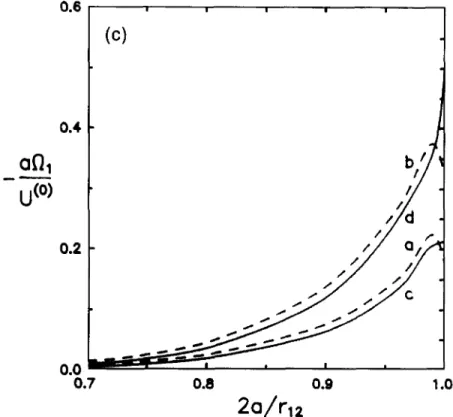
spheres of radius a with equal spacings undergoing thermophoresis perpendicular to the line of their centers versus the separation parameter 2a/r~2: (a) translational velocity of particle 1 (or particle 3); (b) translational velocity of particle 2; (c) rotational velocity of particle 1 (or particle 3). For comparison, the dashed curves are plotted for the particle velocities when only two spheres are present. For curves (a) and (c), Ctl/a = 0.2, Cml/a = 0.1 and k* = 100; for curves (b) and (d),
Cilia = 0.02, Cml/a = 0.01 and k* = 100.
corresponding values of the first and second spheres when the third one is not present are plotted by dashed curves in the same figure for comparison. Similar to the case of the motion of three spheres parallel to the line of their centers, the existence of the third sphere in general is to increase the two-particle interaction effect on the thermophoretic migration velocities of the other two spheres. On the other hand, the existence of the third sphere is to decrease the two-particle interaction effect on the rotational velocities of the other two spheres, with exceptions when the spacing between two neighboring spheres gets close to zero. F o r small to moderate values of 2a/r12, the thermophoretic velocity of the central sphere is smaller than that of the end ones. However, when the particles are close together, the central sphere migrates faster than the end ones. On the contrary, the migration velocity of the central sphere is always smaller than that of the end ones for the thermophoresis of three identical spheres along the line through their centers (Chen and Keh, 1996). Note that the shielding effect of neighboring spheres on thermophoresis can also be observed from Fig. 3a.
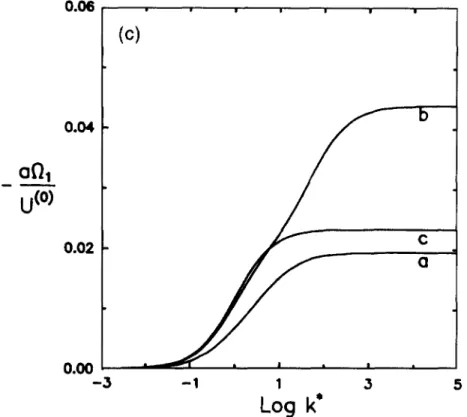
The normalized translational and rotational velocities of three identical spheres with equal spacings undergoing thermophoresis perpendicular to the line of their centers are plotted versus the conductivity ratio k* in Fig. 4 with C,I/a and Cml/a as parameters for the case of
2a/r12
= 0.8. It can be found that the particle interaction effect in general is moresignificant if the value of k* becomes greater or the values of Ctl/a and Cml/a become smaller (with exceptions for the rotation of the end spheres). In the limit k* -- 0 or in the limit Ctl/a --* oo, our collocation results show that the thermophoretic velocity of each of these three identical spheres is unaffected by the presence of the others; i.e. each sphere translates in the same velocity as it is isolated with no rotation.
1054 H.J. Keh and S. H. Chen
5. R E S U L T S F O R A R I G I D C L U S T E R O F T W O S P H E R E S
The translational and angular velocities of a rigid cluster of spheres undergoing thermo- phoresis can also be determined by the procedure described in Section 2. For conciseness, here we only consider the motion of a dumbbell, the cluster composed of two spheres
,U1
u(O)
1.02 0.98 0.94 |(a)
b
CI 0.90 - 3 - 1 1 3 5Log k"
(b)
0b
c 3 1,00 0.96U__~_2
U (0) 0.92 0 . 8 8 0 . 8 4 L.. - 3 - 1 1Log k"
Fig. 4(a) and (b).
T h e r m o p h o r e s i s of a n arbitrary three-dimensional array 1055 0 . 0 6
(C)
'b
0.04
0.02
C
0.00
"
,0
- 3-1
1
35
Log k*
Fig. 4. Plots of the normalized translational and rotational velocities of three identical coaxial spheres of radius a with equal spacings undergoing thermophoresis perpendicular to the line of their centers versus the thermal conductivity ratio k* with Ctl/a and Cml/a as parameters (2a/r12 = 0.8): (a) translational velocity of particle 1 (or particle 3); (b) translational velocity of particle 2; (c) rotational velocity of particle 1 (or particle 3). F o r curve (a), Ct l/a = 0.2 a n d C,,,I/a = 0.1; for curve
(b), Ctl/a = 0.02 and CmUa = 0.01; for curve (c), CtUa = Cml/a = O.
connected by an infinitesimally thin and rigid rod. For this case, equation (31) can still be used to describe the translational and rotational velocities of two spheres; but now, the mobility parameters to account for the two-sphere interactions must reconcile with the relations given by equations (25) and (26).
Applying equation (26) for the two spheres and eliminating U o, one has
U 2 ---- - U1 -+- 9 x r x 2 e . ( 3 3 )
Using the fact that 9 1 ----~ 9 2 = 9 and substituting equation (31) into equation (33) yield
M ~ 1r121 , ~(v) (34a) M(p) 12 --- lvJ 22, ~,v(v) (34b)
M(n)
aat(n) /'12 11 . . . . 21 + - - N i l ,(34c)
a l M(~2 ) = M(2,2 ) + r12 NIe, (34d) a lNil =--al N21, (34e)
a 2
N 1 2 = a-!1 N22. (34f)
a 2
Although the angular velocity ~ of the rigid dumbbell is independent of the location of its origin, the choice of the origin will affect the presentation of the results for the translational
1056 H . J . K e h a n d S. H . C h e n
velocity Uo. Here we place the origin of the dumbbell at its center of hydrodynamic stress. The center of hydrodynamic stress is the unique point for bodies of revolution at which there is no coupling between translation and rotation (Happel and Brenner, 1983). For the dumbbell this point lies along the line connecting the centers of the spheres a distance rol from the center of sphere 1. The detailed procedure to determine the ratio rol/rl 2 was provided by Fair and Anderson (1991) and its results for various values of Cml I/al, Cm2 I/a2,
a2/al and (al + a2)/r12 can be obtained by using the collocation method to solve for the hydrodynamic interactions between two aerosol spheres. Applying equation (26) for sphere 1 and using equation (33) to eliminate ~ , one can express the translational velocity Uo of the dumbbell in terms of the translational velocities of the two spheres as
U o = ( 1 - r ° l ~ U 1 +r°--~lU2. (35)
r 1 2 / ~ p l 2
Substitution of equations (31a) and (34) into equation (35) leads to the expression
2
Uo = ~ [ M ~ f ) e e + K!".)(I - e£)]' U ~.°), (36)
j = l
where i can be either 1 or 2, and
K~ 7 = M~] ~ -- r°---5 N l j , (37a)
a l
2j = N2j. (37b)
a2
Using equations (34c-f) and (37), one obtains
K~,I) = a , L 2 1 ~ y,, <n) (38a)
Kin) 1 2 = ~(.) a ' 2 2 " (38b)
In the limit (al + az)/r12 ~ O, it can be shown by the linearity of the Stokes equations that the dumbbell velocities
- T~(0) r r ( o ) a x A 1 u 1 + a2,~.2 ,.Z_ 2 Uo --* , (39a) a~21 + a 2 2 2 ~ 1 - - e X L ~ 2 rrr(°) - - ~ 1 U (°)1 b (39b) -- E l 2 --
or the mobility parameters
M]~) =
K].~
_ ro2 _ a l ) q (40a) rl2 a121 + a222' M ] ~ = K]")2 - rol az,t2 (40b) r12 a12t + a 2 , ~ 2 ' where a l N l l = - - N 1 2 - , ( 4 0 c ) l ' 1 2 1 + 2Cmi l/ai 2i - 1 + 3 Cml l/ai i 1 or 2. (41) lr(O) iT(o~In equation (39), z i and z 2 are the thermophoretic velocities of sphere 1 and sphere 2, respectively, in the absence of the other, as given by equation (23).
(p)
To evaluate the mobility parameters M x 1 and M ~ , the axisymmetric thermophoresis of the dumbbell along the line connecting the sphere centers must be considered. For this case,