Effects of geometrical characteristics of surface roughness
on droplet wetting
Yu-Jane Sheng
Department of Chemical Engineering, National Taiwan University, Taipei, Taiwan 106, Republic of China Shaoyi Jiang
Department of Chemical Engineering, University of Washington, Seattle, Washington 98195, USA Heng-Kwong Tsaoa兲
Department of Chemical and Materials Engineering, Institute of Materials Science and Engineering, National Central University, Jhongli, Taiwan 320, Republic of China
共Received 10 September 2007; accepted 10 October 2007; published online 19 December 2007兲 Surface roughness is known to alter the wettability on a solid substrate. In general, either Wenzel or Cassie-Baxter theory is adopted to describe the apparent contact angle. Following the minimum free energy pathway associated with the imbibition process, we have derived a generalized expression for the apparent contact angle on a textured surface and the liquid-gas contact area within the groove that plays a key role. Depending on the geometrical characteristics of the grooves, the surface wetting falls into three regimes: 共i兲 single stable state which is either Wenzel 共completely wetted roughness兲 or Cassie-Baxter 共completely nonwetted roughness兲 state, 共ii兲 two stable states 共Wenzel and Cassie-Baxter兲 separated by an energy barrier, and 共iii兲 single stable state with partially wetted roughness. The sufficient condition for each regime is derived and several groove geometries are given to show the free energy path. Alteration in the geometric parameters may lead to the wetting crossover. We also show that the Cassie-Baxter can occur at a hydrophilic surface for particular pore shapes. © 2007 American Institute of Physics.关DOI:10.1063/1.2804425兴
I. INTRODUCTION
The wetting of solid surfaces by a liquid共water in par-ticularly兲 is ubiquitous in everyday lives as well as in indus-trial processes. Wettability is one of the most important prop-erties associated with a solid surface and the wetting behavior is governed by two factors; the chemical composi-tion and the roughness of the solid surfaces. In terms of the contact anglebetween the gas-liquid and solid-liquid inter-faces, the wettability of an ideal flat solid is depicted by Young’s equation,1
cos=␥s−␥sl
␥l
, 共1兲
where ␥sl, ␥s, and ␥l represent the interfacial tensions of
solid-liquid, solid-gas, and liquid-gas interfaces, respectively. In the absence of surface roughness, Young’s equation indi-cates that the nature of wetting is determined by the relative affinity of the solid for the liquid or gas phases, as illustrated by the difference between solid-gas and solid-liquid interfa-cial tensions in Young’s equation. The interfainterfa-cial tensions␥sl
and␥sare intrinsic properties associated with a surface and
they can be controlled by chemical modification, such as fluorination. As␥s−␥sl⬎0, the contact angle is less than 90°
共hydrophilic surface兲, whereas⬎90° 共hydrophobic surface兲 for ␥s−␥sl⬍0.
Real solids are actually rough and, thus, their wettability is significantly influenced by the geometrical structure of the
surface roughness. The earliest work on the wetting of rough substrates was addressed by Wenzel2and later by Cassie and Baxter.3Wenzel assumed that the liquid filled up the grooves on the rough surface and generalized Young’s equation to obtain the apparent contact anglea,
cosa= r cos, 共2兲
where r is termed the “roughness factor” and defined as the ratio of the actual area of a rough surface to the geometric, projected area on the horizontal plane. Evidently, the effect of the roughness results in the improvement of the wetting for ⬍90° but enhances the hydrophobicity for ⬎90°. Cassie and Baxter considered the wettability of a composite surface, composed of two types of homogeneous patches that have different solid-fluid interfacial tensions. The apparent contact angle is then given by
cosa= f1cos1+ f2cos2, 共3兲
where fi andi represent the surface area fraction and the
contact angle of patch i, respectively.
For porous or corrugated surfaces, the roughness is mainly filled with air. The openings of the pores can be re-garded as nonwetting patches with 2= 180°. Since f2= 1 − f1, Eq.共3兲 becomes
cosa= f1共1 + cos1兲 − 1. 共4兲
In accord with Eq. 共4兲, if surface hydrophobicity 共1兲 and surface roughness 共f1兲 are appropriately combined, a water
droplet deposited on such a superhydrophobic surface can remain nearly spherical. A beautiful example is the leaves of a兲Electronic mail: [email protected].
the lotus plant. Owing to the geometrical structure of solid surfaces alone, the contact angles for water on those surfaces can range from 140° to as much as 174°.4,5Recent advent of microfabrication techniques allow us to design microscale structures on a solid surface and thus to control the wettabil-ity by roughening it, even without altering any surface chem-istry. Inspired by the so-called lotus effect, superhydrophobic surfaces have been created by decorating a homogeneous substrate with an array of pillars.6–8
Besides the roughness factor 共r兲 and the wetted area fraction 共f兲, the Wenzel and Cassie-Baxter theories are es-sentially independent of the geometrical characteristics of the roughness 共the shape of the pore兲. For a given roughness geometry, the Wenzel and Cassie-Baxter theories may pre-dict different apparent contact angles. The wetting state is usually believed to be in either Wenzel or Cassie-Baxter state. However, it is not decisively clear on which theory should be employed and when. A simple criterion is that the wetting state corresponds to the one with a lower free energy. In general, the Wenzel state 共wetted groove兲 prevails for ⬍c, while the Cassie-Baxter state共air pocket兲 dominates for ⬎c, where c denotes the critical point and c艌/2.6,8
Recently, it is experimentally showed that even if the Wenzel drop possesses the lower energy, a Cassie-Baxter drop can be observed. In fact, there could be two apparent contact angles on the same rough surface, depending on how a drop is formed.6,8 For example, when pressing a drop on a hydro-phobic surface decorated with spikes, a sharp change in the apparent contact angle from 170° to 130°共±5°兲 is observed.6 Another example is that the Cassie-Baxter state is formed if the droplet is deposited gently on a hydrophobic surface with square pillars but the Wenzel state is formed if dropped from a height.8The possibility of multiple free energy minima for droplet states has been proposed to explain the phenomenon of multiple apparent contact angles.8–11 Therefore, work must be done to cause the transition from the Cassie-Baxter to Wenzel state because of the energy barrier between them. The actual details of the crossover from the Cassie-Baxter to Wenzel state are not well understood and there may exist many pathways. A possible pathway has been consid-ered: the liquid enters the valleys and wets the sides of the pillars by maintaining the location of the liquid-gas interface at the same height from the bottom of the groove共imbibition in parallel兲.10,11 In fact, the extent of penetration into the roughness grooves is initially unknown and has to be deter-mined by the minimization of the free energy.12As a result, the role of the liquid-gas interfaces within the roughness grooves is essential. If the imbibition of liquid into rough-ness pores in parallel corresponds to the minimum free en-ergy pathway in the free enen-ergy landscape, one is able to write down a generalized free energy formulation and finds out the possible stable states for wetting on a textured sur-face. In this paper, we focus on surfaces with roughness pores and predict the existence of a stable state with partially wetted roughness in addition to the Wenzel共completely wet-ted roughness兲 and Cassie-Baxter 共completely nonwetwet-ted roughness兲 states. In addition, the influences of the geometri-cal characteristics associated with roughness pores on the wetting state are examined.
II. FREE ENERGY FORMULATION
We start by considering the free energy of a droplet sit-ting on a rough, chemically heterogeneous substrate. For simplicity, we assume that the radius of the drop is much greater than the separation of asperities. For a sufficient small drop, where the change in hydrostatic pressure with height can be negligible, it can be shown that the solutions of the axisymmetric Laplace equation yield a gas-liquid inter-face that has the shape of a spherical cap with the radius R of curvature.13 Therefore, the free energy can simply be ex-pressed by F =共R sina兲2共␥sl * −␥s *兲 + 2 R2共1 − cosa兲␥l, 共5兲 where␥sl * and␥s *
denote the effective interfacial tensions for solid-liquid and solid-gas contacts, respectively, due to the heterogeneity of surfaces. Since the volume V of the drop is constant, the drop radius R of curvature is related to apparent contact angle cosaby
V =R 3
3 共1 −兲
2共2 +兲, 共6兲
where = cosa. Equation 共6兲 is justified when the liquid
volume within the roughness 共pores兲 is small compared to the total volume. The minimization of the free energy,
F/= 0, yields a relation similar to Young’s equation,
␥lcosa=␥s*−␥sl*. 共7兲
In terms of the apparent contact angle, the free energy can be rewritten as F共兲 ␥l =
冉
3V 冊
2/3 关共1 −兲2共2 +兲兴1/3. 共8兲Since F decreases monotonically with increasing, this re-sult reveals that a droplet with a lower apparent contact angle possesses a lower free energy.
Now the goal is to determine the effective interfacial tensions associated with a composite surface. For a homoge-neous surface, one has␥i*=␥iand Eq.共7兲 simply reduces to
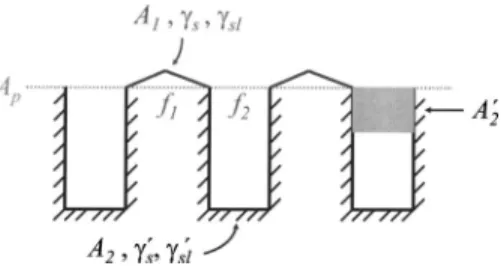
Young’s equation. Without loss of generality, we consider a textured surface with two types of roughness. As shown in Fig.1, the first type of surface共convex surface兲, possessing actual area A1 and interfacial tensions ␥s and␥sl, is always
wetted by the liquid. The second type of surface 共concave surface兲 is associated with pores or spikes, which may form air pockets. Its actual area and interfacial tensions are de-FIG. 1. Schematic representation of a heterogeneous surface containing two types of roughness. The first type is always wetted and possesses actual area
A1, interfacial tensions␥sand␥sl, and projected area fraction f1. The second
type can form air pockets共grooves兲 and has the corresponding properties 兵A2,␥s⬘,␥sl⬘, f2其. A2⬘depicts the wetted area within the grooves.
noted by A2, ␥s
⬘
, and ␥sl⬘
, respectively. Note that these twodifferent types of surfaces can have different interfacial ten-sions. The total projected area is Ap and the area fraction of
the type i corresponding to Ap is fi with f1+ f2= 1. The
roughness factor of the type i surface共ri兲 is defined as ri=
Ai Apfi
艌 1. 共9兲
The effective solid-gas interfacial tension共per unit projected area兲 ␥s*is simply the sum of the contributions originating
from all types of surfaces in the absence of liquid.
␥s
*
= f1共r1␥s兲 + f2共r2␥s
⬘兲.
共10兲The effective solid-liquid interfacial tension␥sl* is more
complicated. It may involve liquid-gas and solid-gas contacts within the air pockets. If the liquid wets the pores partially, then the wetted area of the second type共A2
⬘兲 can be related to
the projected area by r2⬘
= A2⬘
/Apf2 with 0艋r2⬘
艋r2. In termsof r2
⬘
,␥sl * can be expressed by ␥sl * = f1共r1␥sl兲 + f2关r2⬘
␥sl⬘
+共r2− r2⬘兲
␥s⬘
+ h共r2⬘兲
␥l兴. 共11兲Besides the contribution from the first type of surface, the liquid may wet the second type of surface partially with area
A2
⬘
in the air pockets and the rest of the second type of surface with area 共A2− A2⬘兲 is still in contact with air. When
the pores are partially wetted, the liquid is also in contact with air. The liquid-gas contact area within the groove共Ah兲 is
related to the projected area by h = Ah/Apf2. Note that this
scaled liquid-gas contact area 共h兲 may vary with the wetted area in the pores and relates to the minimum free energy pathway along the “wetting coordinate” r2
⬘
, 0艋h共r2⬘兲艋1.
Owing to the two extreme conditions, nonwetting and com-plete wetting of the pores, one has h共r2⬘
= 0兲=1 and h共r2⬘
= r2兲=0.
Knowing␥s*and␥sl*gives the relation between apparent
contact angle and the extent of imbibition, which follows the minimum free energy pathway. Substituting Eqs. 共10兲 and 共11兲into Eq.共7兲 yields
cosa= r1f1cos+关r2
⬘
cos⬘
− h共r2⬘兲兴共1 − f
1兲, 共12兲where cos
⬘
=共␥s⬘
−␥sl⬘
兲/␥l. This generalized expression canbe reduced to the Wenzel and the Cassie-Baxter theories. As cos
⬘
= cosand r2⬘
= r2共complete wetting of the pores兲, Eq.共12兲becomes cosa=
冉
A1+ A2 Ap
冊
cos= r cos, 共13兲
which is simply the result of the Wenzel theory. On the other hand, as r2
⬘
= 0共nonwetting of the pores兲, one hascosa= r1f1cos−共1 − f1兲. 共14兲
If r1= 1, the above equation reduces to the result of the
Cassie-Baxter theory. Equation共14兲indicates that the appar-ent contact angle of a hydrophobic surface is amplified by both the surface roughness of the wetted, convex area and the liquid-air contact at the openings of the air pockets. It contains main characteristics associated with both Wenzel and Cassie-Baxter theories and can be used in both
hydro-philic and hydrophobic regions. Equation 共12兲 also reveals that if r2cos
⬘
⬎−1 the free energy of the Wenzel state islower than that of the Cassie-Baxter state. For r2cos
⬘
⬍−1, one has the opposite result. However, this information alone is not enough to judge what the stable state is.
III. ENERGY BARRIER AND PARTIALLY WETTED ROUGHNESS
The importance of the scaled gliquid contact area as-sociated with partial wetting of the pores has been disclosed in Eq.共12兲, which manifests the free energy path associated with the imbibition process. Along the wetting coordinate r2
⬘
,h共r2
⬘兲 is assumed to follow the minimum free energy pathway
from the Cassie-Baxter scenario 共nonwetting of the pores and r2
⬘
= 0兲 to Wenzel scenario 共complete wetting of the pores and r2⬘
= r2兲 or vice versa. That is, for a simple geometry ofroughness such as circular cones, h共r2
⬘兲 corresponds to the
minimum liquid-gas contact area at a given r2
⬘
共wetting area in the pores兲. If one knows the wetting/dewetting path and the geometry of the pores, then the relation between h and r2⬘
can be determined. Consequently, the free energy pathF关共r2
⬘兲兴 can be obtained for a given set of physical
proper-ties兵,
⬘
, r1, r2, f1其. After locating the free energy minima orthe energy barrier 共maximum兲, the stable droplet shape 共or apparent contact angle兲 can be inferred.
The actual detail of the wetting path is not well under-stood and it depends on the wetting process. Although dif-ferent possibilities may be hypothesized, the simplest sce-narios for the wetting/dewetting process are wetting/ dewetting all pores in parallel10,11 or in series. We assume that imbibition into all pores proceeds in parallel and the effect of meniscus in the grooves is neglected. For a speci-fied geometry of the pores, the variation of the free energy with increasing the wetting area can be evaluated by Eq.共8兲,
F r2
⬘
= F 冉
r2⬘
冊
= − 共1 +兲 关共1 −兲共2 +兲2兴1/3冉
r2⬘
冊
, 共15兲where the free energy is scaled by ␥l共3V/兲2/3. The
pos-sible stable states of wetting can be decided by Eq.共15兲for −1艋艋1. IfF/r2
⬘
⫽0 for 0艋r2⬘
艋r2, then one has abor-der minimum corresponding to a single stable state. When
F/r2
⬘
⬍0 共/r2⬘
⬎0兲, the Wenzel state is the only stablestate because the free energy declines with increasing the wetting area in the roughness. On the contrary, when
F/r2
⬘
⬎0 共/r2⬘
⬍0兲, the Cassie-Baxter state is the onlystable state since wetting the grooves results in the increment in free energy.
IfF/r2
⬘
= 0 at r⬘
2= r2*with the condition 0⬍r2*⬍r2, thenthere exists the extremum corresponding to a possible wet-ting state in the free energy landscape. The stability of the state F共r2*兲 has to be determined by the sign of the second
derivative. When 2F/r
⬘
22共r2*兲⬍0, F共r2*兲 denotes the localmaximum and thus both the Wenzel and Cassie-Baxter states are the border minima. That is, there exists two stable states and the energy barrier from the Cassie-Baxter to Wenzel state is ⌬Fb= F共r2*兲−F共r2
⬘
= 0兲. The energy barrier is able toresist a certain extent of external disturbances and prevents the crossover from one state to another. On the contrary, for
2F/r 2
⬘
2共r 2 *兲⬎0, F共r 2*兲 denotes the local minimum and,
therefore, the stable wetting state is associated with partially wetted roughness with the penetration extent 0⬍r2*/r2⬍1.
This equilibrium state is neither the Wenzel nor Cassie-Baxter state and only a part of the pore surface is wetted. Two examples for the minimum free energy pathway are illustrated in Fig. 2. The wetting surface with two stable states can be achieved from hemispherical pores while that with partially wetted grooves is obtained from pores created by the revolution of y = x1/3 about the y axis.
The above analysis indicates that depending on the wet-ting characteristics of the grooves h共r2
⬘兲, the wetting state
falls into one of the three regimes: 共i兲 single stable state which is either Wenzel or Cassie-Baxter state,共ii兲 two stable states 共Wenzel and Cassie-Baxter兲 separated by an energy barrier, and 共iii兲 single stable state with partially wetted roughness. Clearly, the “phase diagram” of the wetting states on a textured rough surface has to be determined by the scaled liquid-gas contact area function h共r2
⬘兲, which is, in
turn, dependent on the geometric characteristics associated with the surface roughness. According to Eqs.共12兲and共15兲, the free energy is closely related to h共r2
⬘兲 through
r2
⬘
=共1 − f1兲冉
cos⬘
− hr2
⬘
冊
. 共16兲The sufficient condition to have the Wenzel state is F/r2
⬘
⬍0 at r2
⬘
= r2. According to Eq. 共16兲, one hascos
⬘
⬎ hr2
⬘
共r2⬘
= r2兲 共17兲for the Wenzel regime.
On the other hand, the sufficient condition to have the Cassie-Baxter state is F/r2
⬘
⬎0 at r2⬘
= 0. Using Eq. 共16兲 leads tocos
⬘
⬍ hr2
⬘
共r2⬘
= 0兲 共18兲for the Cassie-Baxter regime.
These two equations indicate that the possible wetting state is the result of the competition between the energy re-duction by wetting the surface of the roughness共cos
⬘兲 and
the energy increment due to the increase of the liquid-gas contact area within the groove 共h/r2⬘兲. When the former
dominates over the latter, one has the Wenzel state. On the contrary, the Cassie-Baxter model is the stable state as the latter is dominant. For a given pore shape, Eqs.共17兲and共18兲 provide the boundaries in the phase diagram. The overlapped domain between the Wenzel and Cassie-Baxter regimes rep-resents the regime with two stable states. Conversely, the domain, which is neither the Wenzel or Cassie-Baxter re-gimes, denotes the stable state with partially wetted rough-ness.
IV. EXAMPLES OF PHASE DIAGRAM
The phase diagram is determined by the liquid-gas con-tact area within the grooves h共r2
⬘兲, which is a function of the
geometrical characteristic of the roughness. In general, the shape of the pore can simply be classified into linear 共e.g., circular cone兲, convex 共e.g., hemisphere兲, or concave 共e.g., revolution of asteroid兲 functions. In order to demonstrate the three regimes, we consider an example for each case.
A. Single stable state: Wenzel or Cassie-Baxter
We consider a smooth surface with linear pores, which are modeled as circular cones. The radius of the opening is a and the depth is h. We assume that r1= 1 and the area fraction occupied by pores is 1 − f1. The total second type surface area is represented by the roughness factor r2=al/a2⬎1,
where l =共a2+ h2兲1/2. When the liquid-gas contact area in the
pore is depicted by a circle with radius b, the wetted area within the grooves is r2
⬘
=al共1+b/a兲共1−b/a兲/a2=关1−共b/a兲2兴r
2. As a result, the liquid-gas contact area is h共r2
⬘兲 =
冉
ba
冊
2= 1 −
冉
r2⬘
r2
冊
. 共19兲According to Eq.共12兲, the apparent contact angle is cosa= f1cos+
冋
r2⬘
冉
cos⬘
+1
r2
冊
− 1册
共1 − f1兲, 共20兲which varies linearly with the wetting area r2
⬘
with the slope 共1− f1兲 共cos⬘
+ 1/r2兲. Since/r2⬘
⫽0, there exists noex-treme value for 0艋r2
⬘
艋r2. As a result, only one stable state共either at r2
⬘
= 0 or r2⬘
= r2兲 is possible and the stable state共minimum free energy兲 is determined by the value of FIG. 2. The minimum free energy pathway along the wetting coordinate r2⬘.
The free energy is scaled by␥l共3V/兲2/3. The two-state regime with an
energy barrier is drawn for hemispherical共convex兲 pores while the stable state with partially wetted roughness is obtained from concave pores of depth 0.5, created by the revolution of y = x1/3about the y axis. The used parameters are cos= cos⬘= −0.5, r1= 1, and f1= 0.4.
共r2cos
⬘
+ 1兲. As r2cos⬘
⬍−1, r2⬘
= 0 yields the lowest freeenergy 共Cassie-Baxter state兲. On the contrary, for r2cos
⬘
⬎−1, r2
⬘
= r2corresponds to the largest apparent contact angle共Wenzel state兲. That is, even for hydrophobic pores 共cos
⬘
⬍0兲, the pores can be completely wetted as long as the pore is shallow enough 共small l兲. If cos⬘
= −1/r2, the apparentcontact angle maintains the same regardless of the wetting area. This consequence indicates that for a given cos
⬘
⬍0, the Cassie-Baxter state can be achieved by increasing r2. Forexample, increasing the depth of the pore 共h兲 large enough leads to the formation of air pockets. Nevertheless, the high-est apparent contact angle that can be achieved depends on the area fraction of solid surface f1, i.e., cosa= f1cos
−共1− f1兲. Note that for such a geometry with a given r2 or
兵a,h其, it is impossible to observe the crossover between the Cassie-Baxter and Wenzel states by external disturbances.
B. Single stable state: partially wetted roughness
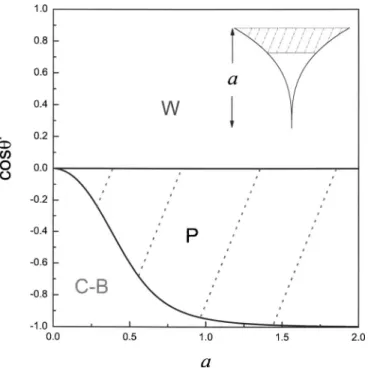
When the liquid-gas contact area in the pore declines fast enough with increasing the wetting area, the minimum free energy may take place at neither complete nonwetting nor complete wetting of the pores. In the second case, we consider a smooth surface with concave pores. They are cre-ated by the revolution of y = c2/3x1/3 about the y axis, as de-picted in Fig.3. The depth of the pore is ac. The analysis is
simplified if all lengths are scaled by c, i.e. y = x1/3with depth
a. In terms of roughness factor, the area of the second type of
surface is r2=关共1+9a4兲3/2− 1兴/27a6. Since imbibition into all
pores in parallel is a reasonable assumption, the liquid-gas contact area is h共r2
⬘兲 =
再
冋
1 +共共1 + 9a4兲3/2− 1兲 ⫻冉
1 −r2⬘
r2冊
册
2/3 − 1冎
3/2冒
27a6. 共21兲According to Eq.共16兲, the solution共0⬍r2*⬍r2兲 satisfy-ing cos
⬘
=h/r⬘共
2 F/r2⬘
= 0兲 gives an extremum of the free energy atr2*= r2−关共sin
⬘
兲−3− 1兴/27a6.The stability of this state can be examined by 2/r2
⬘
2⬍0共2F/r 2
⬘
2⬎0兲 at r 2*. Since the second derivative ofat r
2 *is given by 2 r2
⬘
2=共1 − f1兲冉
− 2h r2⬘
2冊
= −共1 − f1兲9a 6sin 3⬘
兩cos⬘兩
⬍ 0, 共22兲 this extremum corresponds to a minimum of the free energy and a maximum of the apparent contact angle. This result indicates the stable, wetting state with partially wetted roughness. According to Eqs.共17兲and共18兲, the Wenzel and Cassie-Baxter regimes are cos⬘
⬎0 and cos⬘
⬍−3a2/共1+ 9a4兲1/2, respectively. The wetting state depends mainly on
the contact angle of the pore 共cos
⬘
兲 and the geometrical parameter 共a兲. The phase diagram is shown in Fig. 3. For hydrophilic surfaces 共cos⬘⬎0兲, the Wenzel state is
pre-ferred. For hydrophobic surfaces 共cos⬘
⬍0兲, however, the Cassie-Baxter state exists only for shallow pores. The rough-ness becomes partially wetted for deep apertures.C. Two stable states: Wenzel and Cassie-Baxter
In the third case, we consider square pillars of size 2a, height H, and spacing 2b arranged in a regular array. The pillar is based on a square pyramid with slant height l共⬎b兲 as illustrated in Fig.4. This geometry can be regarded as con-vex pores. Assume that r1= 1 and the area fraction associated
with the top surface of the pillar is f1. The area of the second
type of surface is r2= 2aH/关共a+b兲2− a2兴+l/b. Assume
imbi-bition into grooves in parallel and then the liquid-gas contact area is h共r2
⬘兲 =
冦
1, for x艋 H冋
1 +2a + b l冉
r2⬘
− r2+ l b冊
册冋
1 − b l冉
r2⬘
− r2+ l b冊
册
, for x⬎ H,冧
共23兲 FIG. 3. The phase diagram for concave pores created by the revolution ofy = x1/3about the y axis. Depending on the intrinsic contact angle of the roughness共cos⬘兲 and the depth of the pore 共a兲, the wetting state may be in the regime of Wenzel共W兲, Cassie-Baxter 共CB兲, or partially wetted rough-ness共P兲. The two-state regime does not exist for such geometry. The phase boundaries are determined by Eqs.共17兲and共18兲.
where x is the depth.
The extremum of the free energy is determined by cos
⬘
=h/r2⬘
and takes place atr2*=关2aH + l共a − l cos
⬘/2兲兴/共2a + b兲b.
共24兲 The stability of this state is examined by 2F/r2
⬘
2 at r 2*.
Since the second derivative of at r2*is
2 r2
⬘
2=共1 − f1兲冉
− 2h r2⬘
2冊
= 2共1 − f1兲 共2a + b兲b l2 ⬎ 0, 共25兲this extreme corresponds to a maximum of the free energy and a minimum of the apparent contact angle. This conse-quence indicates that this state is unstable and represents the energy barrier between the two border minima 共r2
⬘
= 0 andr2
⬘
= r2兲. From Eqs. 共17兲 and 共18兲, the Wenzel andCassie-Baxter regimes are cos
⬘
⬎−2共a+b兲/l and cos⬘
⬍0, re-spectively. The overlapped domain corresponds to the wet-ting regime with the two stable states. The result discloses that the pillar height H has no direct effect on the phase diagram. However, in the two-state regime, r2cos⬘
declineswith increasing H and, therefore, the Cassie-Baxter state dominates the lower energy state. The external disturbance may lead to the crossover from the Cassie-Baxter to Wenzel state. If one wants to avoid the wetting crossover due to external work, the single Cassie-Baxter regime can be ob-tained by decreasing共a+b兲/l.
V. COULD THE CASSIE-BAXTER STATE OCCUR AT HYDROPHILIC ROUGHNESS?
Typically, the liquid-gas contact area within the rough-ness grooves declines with increasing the wetting area and, thus, h/r2
⬘共r
2⬘
= 0兲艋0 with 1艌h共r2⬘兲艌0. For such
rough-ness, Eq. 共18兲 reveals that the Cassie-Baxter state always takes place at hydrophobic surfaces共cos
⬘
艋0兲. In fact, it is generally believed that the Cassie-Baxter state can occur only at hydrophobic roughness. However, on the basis of Eq. 共18兲, one can design a particular pore shape so that the Cassie-Baxter state occurs even for hydrophilic pores. That is, one must satisfy the criterion h/r2⬘共r
2⬘
= 0兲⬎0 to obtainthe completely nonwetted roughness condition for hydro-philic grooves 共cos
⬘
⬎0兲. For cos⬘
⬎0, the conditionh/r2
⬘
⬎0 reveals that the liquid-gas contact area within thepores rises with increasing the wetting area r2
⬘
. In other words, the Cassie-Baxter state can occur at hydrophilic roughness only when h共r2⬘兲⬎1 at r
2⬘
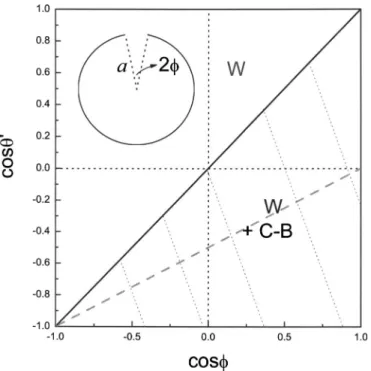
→0+. A simple exampleis spherical cap pores, as illustrated in Fig. 5. The radius of the opening is a sinand the area of the second type surface is r2= 2共1+cos兲/sin2. The liquid-gas contact area is then
given by h共r2
⬘兲 =
1 −冋
cos−共1 + cos兲r2⬘
r2册
2 sin2 . 共26兲According to Eq.共18兲, the criterion for the Cassie-Baxter regime yields
FIG. 4. The phase diagram for convex grooves created by square pillars based on square pyramids. There exists a two-state regime where both the Wenzel共W兲 and Cassie-Baxter 共CB兲 states are stable. The dashed line de-picts the boundary for the state with lower free energy. External work is required for the wetting transition from the Cassie-Baxter to Wenzel state. The boundary between the Cassie-Baxter and two-state regimes can be moved toward smaller contact angle by decreasing共a+b兲/l. The used pa-rameters are a = 0.2, b = 0.8, and l = 2.5.
FIG. 5. The phase diagram for spherical cap pores in terms of the opening angleand contact angle⬘. For such roughness the two-state regime can happen at all contact angles by tuning the opening angle. The Cassie-Baxter state共CB兲 may occur at hydrophilic surfaces for cos⬎0 while the Wenzel state共W兲 can take place at very hydrophobic surfaces for cos⬍0.
cos
⬘
⬍ 2r2
cos共1 + cos兲
sin2 = cos. 共27兲
This result indicates that the Cassie-Baxter state can occur for hydrophilic grooves in the two-state regime for⬍90°, as illustrated in Fig. 5. Conversely, the Wenzel state may persist for very hydrophobic grooves as⬎90°. Our result reveals that it is possible to increase the apparent contact angle of a surface with hydrophilic pores by the help of specially designed roughness, which can sustain the Cassie-Baxter state. Our analysis agrees with the fact that water cannot enter many soils 共a particle bed兲 unless the contact angle is considerably lower than 90°, down to approximately 50°, if the average contact angle between the soil and water is 90° or lower.14 Recently, similar phenomena have been observed for an aqueous surfactant drop on a porous surface.15
VI. CONCLUSION
The free energy of a droplet sitting on a textured surface can be expressed in terms of the effective interfacial ten-sions. The minimization of the free energy yields a relation similar to Young’s equation, which relates the apparent tact angle to the effective interfacial tensions. We have con-sidered a textured surface with two types of roughness. The first type of surface is always wetted by the liquid while the second type of surface representing pores or spikes is able to form air pockets. The effective interfacial tensions can then be related to the liquid-gas contact area within the grooves, which plays an essential role in determining the wetting state of a droplet.
Our analyses have shown clearly that the wetting state of a droplet on a textured rough surface depends on the geo-metrical shape of the grooves 共such as linear, convex, and concave pores兲 in addition to the intrinsic contact angle. The wetting state may fall into single stable state regime
共com-pletely wetted roughness, com共com-pletely nonwetted roughness, or partially wetted roughness兲 or two stable states regime 共Wenzel or Cassie-Baxter兲 with an energy barrier separating them. On the basis of imbibition into pores in parallel and following the minimum free energy pathway, the sufficient condition for each regime is derived and the phase diagram can be obtained for a specified roughness. In general, the linear pores exhibit single stable state. The convex pores give two stable states while the concave pores yield single stable state with partially wetted roughness. Our study also sug-gests that the Cassie-Baxter state may form at a hydrophilic surface with suitably designed grooves.
ACKNOWLEDGMENTS
This research work is financially supported by BASF Electronic Materials Taiwan Ltd. and National Science Council of Taiwan.
1P. G. de Gennes, F. Brochard-Wyart, and D. Quéré, Capillarity and
Wet-ting Phenomena, Drops, Bubbles, Pearls, Waves共Springer, New York,
2004兲.
2R. N. Wenzel, Ind. Eng. Chem. 28, 988共1936兲.
3A. B. D. Cassie and S. Baxter, Trans. Faraday Soc. 40, 546共1944兲. 4T. Onda, S. Shibuichi, N. Satoh, and K. Tsujii, Langmuir 12, 2125
共1996兲.
5S. Shibuichi, T. Onda, N. Satoh, and K. Tsujii, J. Phys. Chem. 100,
19512共1996兲.
6J. Bico, C. Marzolin, and D. Quéré, Europhys. Lett. 47, 220共1999兲. 7J. Bico, C. Tordeux, and D. Quéré, Europhys. Lett. 55, 214共2001兲. 8B. He, N. A. Patankar, and J. Lee, Langmuir 19, 4999共2003兲. 9N. A. Patankar, Langmuir 19, 1249共2003兲.
10N. A. Patankar, Langmuir 20, 7097共2004兲.
11C. Ishino, K. Okumura, and D. Quéré, Europhys. Lett. 68, 419共2004兲. 12A. Marmur, Langmuir 19, 8343共2003兲.
13R. J. Hunter, Foundations of Colloid Science I共Oxford University Press,
New York, 1991兲.
14N. Shirtcliffe, G. McHale, M. I. Newton, F. B. Pyatt, and S. H. Doerr,
Appl. Phys. Lett. 89, 094101共2006兲.
15F.-M. Chang, Y.-J. Sheng, H. Chen, and H.-K. Tsao, Appl. Phys. Lett. 91,