Charge renormalization of charged spheres based on thermodynamic
properties
Wei Lun Hsin and Tzu-Yu Wang
Department of Chemical and Materials Engineering, National Central University, Jhongli, Taiwan 320, Republic of China
Yu-Jane Sheng
Department of Chemical Engineering, National Taiwan University, Taipei, Taiwan 106, Republic of China
Heng-Kwong Tsaoa)
Department of Chemical and Materials Engineering, National Central University, Jhongli, Taiwan 320, Republic of China
共Received 9 April 2004; accepted 21 June 2004兲
At strong electrostatic coupling, counterions are accumulated in the vicinity of the surface of the charged particle with intrinsic charge Z. In order to explain the behavior of highly charged particles, effective charge Z*is therefore invoked in the models based on Debye-Hu¨ckel approximation, such as the Derjaguin-Landau-Verwey-Overbeek potential. For a salt-free colloidal suspension, we perform Monte Carlo simulations to obtain various thermodynamic properties in a spherical Wigner-Seitz cell. The effect of dielectric discontinuity is examined. We show that at the same particle volume fraction, counterions around a highly charged sphere with Z may display the same value of as those around a weakly charged sphere with Z*, i.e.,(Z)⫽(Z*). There exists a maximally attainable value ofat which Z⫽Z*. Defining Z*as the effective charge, we find that the effective charge passes through a maximum and declines again due to ion-ion correlation as the number of counterions is increased. The effective charge is even smaller if one adopts the Debye-Hu¨ckel expressionDH. Our results suggest that charge renormalization can be performed
by chemical potential, which may be observed in osmotic pressure measurements. © 2004 American Institute of Physics. 关DOI: 10.1063/1.1782431兴
I. INTRODUCTION
The concept of the effective charge is commonly used in the literature to describe the equilibrium and dynamic prop-erties of colloidal solutions. The basic idea of charge renor-malization is that owing to strong electrostatic coupling, counterions accumulate in the vicinity of the surface of the particle with intrinsic charge Z. As a result, the decorated object共charged particle plus counterions兲 may be regarded as a single entity which possesses an effective charge, Z*.1,2
The effective charge共in absolute value兲 can be much smaller than the intrinsic charge Z*ⰆZ. The determination of the effective charge depends on which property is considered. This quantity is often regarded as an adjustable parameter in a fit of experimental data with approximated models. For example, the effective charge can be inferred from electro-phoresis or voltammetry.3
The accumulation of counterions close to the charged particle, so-called counterion condensation, is the sufficient condition of charge renormalization. Evidently, the intrinsic charge carried by the particle Z and the particle size a are important factors. However, whether counterion accumula-tion occurs at the surface of an isolated charged object de-pends on the geometric shape as well. At infinite dilution, counterion condensation takes place only at infinitely
ex-tended planes and cylinders, but not at spherical particles. This can be illustrated by considering the electric potential felt by a single counterion at the particle surface. For a charged plate it grows linearly with the size of the plate, s⬃⫺a. Thus the infinitely extended plate possesses infinite surface potential and is able to bind any counterions. The renormalized charge per unit area is effectively zero. This is completely inverted for an isolated sphere because the poten-tial energy of a counterion on the surface of a totally ionized sphere, s⬃⫺Za⫺1, is finite. The entropy associated with the counterion is proportional to kBT ln V with the available volume V→⬁ at infinite dilution. Therefore, the charged sphere is unable to bind a counterion at finite temperature. In the intermediate case of a rodlike particle, one has s
⬃⫺ln a. For an infinitely extended line, the electrostatic
en-ergy gain is able to balance the counterion entropy loss. Manning4 and Oosawa5 therefore pointed out that the line charge density of a polyelectrolyte is limited to a maximum value given by this balance point of energy and entropy. All other counterions are ‘‘condensed’’ to the polyelectrolyte.
Despite the fact that charge renormalization does not oc-cur for an isolated charged sphere,6 the counterion entropy,
⬃⫺kBT ln c, is finite in all practical salt-free colloidal sys-tems due to finite counterion concentration c. A salt-free col-loidal dispersion contains electrically charged particles with counterions dissociated from the particle’s surface. A typical example is charged micelles, which are formed by ionic sur-a兲Electronic mail: [email protected]
5494
factant such as n-dodecyle sulfate, surrounded by counteri-ons. Charge renormalization7 essentially corresponds to a battle fought between energy and entropy in minimizing the free energy of a solution of mobile charges near charged particles. As a consequence, one anticipates that charge renormalization takes place eventually when the electrostatic energy gain overwhelms the counterion entropy loss.
Since a colloidal dispersion, involving many charged particles and small ions, is a very complicated system, one commonly adopts a spherical Wigner-Seitz 共WS兲 cell to in-vestigate the physical properties associated with colloids.1– 4,8 –11 The cell model approximation reduces the theoretical description of the whole system to just one cell. While the interactions among charged particles are ne-glected, the interaction between small ions with ‘‘their’’ charged particle as well as with small ions are explicitly taken into account in the same cell. Therefore, the cell model approach can be regarded as an approximate attempt to fac-torize the partition function in the particle coordinates and hence the many-colloid problem is replaced by a single-colloid problem.12The symmetry of the cell may reduce the problem further to a one-dimensional one and allows an ana-lytic treatment. The radius of the WS cell, R, is often related to the volume fraction of charged particles, , by R
⫽a⫺1/3.
On the basis of the spherical WS cell, the effective charge can be determined theoretically according to various definitions. The simple and intuitive definition is the two-state approximation, i.e., condensed and free counterions. The boundary between the two states is defined arbitrarily. For example, the position at which the local concentration of counterions equals the mean value is chosen so that the counterions between the particle surface and the boundary neutralize an equivalent number of charges on the particle. The effective charge is therefore the rest of the charge carried by the particle.3Similarly, one can also define the boundary as the position at which the interaction energy of the coun-terion with the parent particle is equal to the thermal energy.13 Nevertheless, such definitions of Z* do not relate to thermodynamic quantities.
Another approach of charge renormalization is the elec-tric field felt by a counterion far from the parent particle.1 The electrostatic stabilization of colloidal dispersions against aggregation is usually depicted by the DLVO theory, named after Derjaguin, Landau, Verwey, and Overbeek.14The elec-trostatic repulsion in the DLVO theory originates from the effective interaction potential between two charged colloids based on the Poisson-Boltzmann共PB兲 mean-field description of the ion clouds. Within a linearized approximation, it takes the well-known Debye-Hu¨ckel 共DH兲 form, u(r)⬃Z2exp (⫺r)/r, where Z is the intrinsic charge of the particle and represents the inverse Debye screening length. This approxi-mation becomes inadequate to describe highly charged par-ticles because the electrostatic energy of counterions near the particle’s surface exceeds the thermal energy kBT. Far from the charged particle, nevertheless, the electrostatic potential still follows the DH form because the thermal energy be-comes dominant. Although the intrinsic surface charge of a particle Z can be directly measured, the DLVO theory often
requires an effective charge Z*, which accounts for screen-ing of the intrinsic charge by counterions. Within the frame-work of the effective pair potential, the effective charge can be determined by matching the DH form to the long distance behavior of the ‘‘exact’’ PB solution.1
In the cell model, the thermodynamic properties of a colloidal dispersion, such as osmotic pressure(,Z,a) and bulk osmotic modulus, are related to the counterion concen-tration on the surface of the WS sphere with radius R, c(R).1 If the effective charge is known, one is able to evaluate c(R;Z*) by solving the linearized PB equation analytically and hence the osmotic pressure can be predicted,(R;Z*). Following the opposite line of reasoning, the measurement of a particular thermodynamic property(Z) of a colloidal dis-persion can yield the effective charge through the theoretical value of (Z*) calculated from the linearized PB theory based on the cell model. In other words, the effective charge determined by the second approach is in a close relation with a thermodynamic quantity. A similar framework can also be established for the determination of the effective charge from transport properties of a colloidal dispersion, such as self-diffusion coefficient11and electrophoretic mobility共 poten-tial兲.
Previous studies disclose the fact that charge renormal-ization takes place for highly charged particles. Due to strong screening, the effective charge concept is invoked for ex-plaining the far-field behavior of a highly charged particle by the one associated with a weakly charged particle. Based on the PB theory, it is generally accepted that there is a maxi-mum for c(R) as Z diverges. In other words, at a given volume fraction, the effective charge of a spherical colloid reaches a plateau value for large intrinsic charge because no more counterions are able to desorb from the particle’s surface.1,8 The thermal energy of a counterion is exactly compensated by the reversible work required to remove a counterion from the surface of the particle. However, some simulation studies9 showed that the effective charge of a spherical colloid does not reach a plateau value for large intrinsic charge. Instead, the effective charge passes through a maximum, and decreases again as the number of counteri-ons increases.
In this paper we investigate the charge renormalization of a colloidal dispersion by employing the WS cell. In order to provide the effective charge with proper thermodynamic meaning, the charge renormalization is performed based on the thermodynamic properties of the system, such as chemi-cal potential or osmotic pressure. In Sec. II we analyze the thermodynamic properties of the system derived from the partition function. In the limit of very weak electrostatic cou-pling, we are able to obtain the electric potential, counterion concentration, and chemical potential without resorting to the PB equation under the DH approximation. In Sec. III the details of Monte Carol 共MC兲 simulations are briefly de-scribed. In Sec. IV we show the agreement between the the-oretical results and MC results in the very weak coupling regime. Furthermore, we demonstrate that two colloidal dis-persions with the same particle size and volume fraction may display exactly the same thermodynamic property even though they possess very different charges. Therefore, two
methods based on thermodynamic properties are proposed to determine the effective charge.
II. THEORY
Appropriate thermodynamic properties for charge renor-malization include osmotic pressure, chemical potential, par-ticle surface potential, and mean-square dipole moment. A natural choice to study charge renormalization by Monte Carlo simulations is based on the osmotic pressure, which is the counterion concentration at the boundary of the cell. However, this quantity is relatively difficult to be measured accurately in the dilute limit. Another possible choice is the chemical potential, which is a constant throughout the sys-tem at thermodynamic equilibrium. In this paper, we adopt the chemical potential to define the effective charge. Follow-ing the conventional treatment, one can always define the effective charge by the Debye-Hu¨ckel chemical potential DH, that is,(Z)⫽DH(Z*) with Z⬎Z*. In the following
paragraph, we aim to derive the DH expression associated with the thermodynamic property, such asDH. First of all,
we write down the partition function. The relevant properties can then be related to the partition function. The Helmholtz free energy can be divided into two parts. The chemical po-tential is then obtained with two different contributions. As the intrinsic charge of the colloidal particle is increased, one contribution increases while the other one declines.
On the basis of the WS cell model, we consider a charged particle with radius a and valency⫺Z located at the center of a spherical cell of radius R. There are N counterions with valency zc distributed within the cell. The electroneu-trality condition is satisfied because of Z⫽Nzc. The parti-tion funcparti-tion of the system is expressed as
Z共a,R,zc,Z,ᐉB兲⫽ 1
N!
冕
¯冕
e⫺Hdr1¯dr
N, 共1兲
whereᐉB⫽e2/4⑀r⑀0kBT 共⯝0.71 nm in aqueous solution at 298 K兲 denotes the Bjerrum length. The Hamiltonian H is given by H⫽ᐉB
冋
⫺兺
i⫽1 N Zzc ri ⫹兺
i⫽1 i⫽ j N兺
j⫽1 N zc2 兩ri⫺rj兩册
. 共2兲For simplicity, the dielectric mismatch between the charged particle and the solvent is ignored. The effect of dielectric contrast will be examined later by Monte Carlo simulations. In the dilute limit 共in terms of the mean counterion concen-tration兲, the finite size effect of counterions can be neglected as well. In fact, the strong Coulomb repulsion between coun-terions at short separation renders the excluded volume ef-fect. Equation共2兲 can be made dimensionless in terms of the Bjerrum length associated with counterions with valency zc() and the number of counterions N⫽Z/zc,
H⫽
冋
⫺兺
i⫽1 N 共Z/zc兲 rˆi ⫹兺
i⫽1 i⫽ j N兺
j⫽1 N 1 兩rˆi⫺rˆj兩册
, 共3兲where the dimensionless position is rˆ⫽r/ with ⫽zc2ᐉB. On the right-hand side of Eq.共3兲, the first term comes from the electrostatic attraction between counterions and the
charged particle and is proportional to N2zc2. The second term denotes the electrostatic repulsion among counterions and is essentially proportional to N(N⫺1)zc2/2.
In accordance with the partition function, all thermody-namic properties can be obtained. The Helmholtz free energy is related to the partition function by
F⫽⫺ln Z⫽N
冋
lnN V⫺1册
⫺ln共1⫹⍀N兲, 共4兲 where ⍀N关R/,a/兴⫽ 1 VˆN冕
¯冕
共e ⫺H⫺1兲drˆ1¯drˆ N. 共5兲 The available volume is V⫽(4/3)(R3⫺a3). Equations共3兲 and共5兲 reveal that the property associated with ⍀N only is a function of a/, R/, and Z/zc(⫽N). On the other hand, one is unable to express the total free energy simply as a function of a/, R/, and Z/zc. From the free energy, the chemical potential is given by⫽
冉
NF冊
Z,T ⫽lnNV⫺Nln冋
1⫹⍀N冉
R , a 冊册
. 共6兲This result indicates that the chemical potential can be sepa-rated into two parts, the ideal chemical potential i
⫽kBT ln(N/V) and the configuration chemical potential c(⍀N), ⫽i⫹c. The former denotes the entropy con-tribution without electrostatic interactions and grows with the number of counterions. The latter represents the electro-static contribution and always declines with increasing Z/zc. Note that for a given set of 兵a/,R/其,cis a constant but i may vary with the combination of兵a,R,其 because the volume V is independent of.
Similarly, the electric potential is defined as e共r兲⫽ 1 N!
冕
¯冕
lB冋
⫺ Z 兩r兩 ⫹i兺
⫽1 N zc 兩ri⫺r兩册
⫻e⫺HZ dr1¯drN. 共7兲Since the counterion distribution c(r) is related to the parti-tion funcparti-tion by
c共r1兲⫽ 1
共N⫺1兲!
冕
¯冕
e⫺H
Z dr2¯drN, 共8兲
the electric potential can be rewritten as zce共rˆ兲⫽⫺Z/zc
兩rˆ兩 ⫹
冕
ˆV c共rˆ1兲3兩rˆ1⫺rˆ兩 drˆ1. 共9兲
The above equation can also be written down directly from the Coulomb’s law. When all counterions are condensed on the particle surface, one has the mean concentration c(r)
⫽(N/V)␦(兩r兩⫺a) and hence the mean surface potential is zero, s⫽0.
In the WS cell model the osmotic pressure is given by12 ⫽⫺
冉
FV冊
N ⫽ kBT 4R2冉
lnZ R冊
⫽c共r⫽R兲kBT. 共10兲Using Eqs.共8兲 and 共10兲, one has ln c共兩r1兩⫽R兲⯝
冋
F共N兲⫺F共N⫺1兲 1册
Z ⯝冉
F N冊
Z ⫽, 共11兲where the equality is justified if the free energy of the system containing N⫺1 counterions is essentially equal to that con-taining N counterions but with one counterion fixed at the cell surface, i.e., F(N⫺1)⯝F(N;兩r1兩⫽R). Note that the particle charge Z remains unchanged. This consequence in-dicates that the chemical potential can be obtained through the osmotic pressure measured in experiments. The methods of charge renormalization based on chemical potential and osmotic pressure are essentially equivalent.
Albeit the mean dipole associated to the system is zero due to spherical symmetry, the mean-square dipole moment can serve as an indicator of the charge renormalization. With the dipole moment defined as P⫽zc兺i⫽1
N r
i, the mean-square dipole moment is given by
具
P2典
⫽ 1 N!冕
¯冕
P 2e ⫺H Z dr1¯drN⫽zc 22冓
兺
i⫽1 N rˆi 2冔
. 共12兲When the thermal motion is dominant
具
P2典
⬃O(NR2). On the other hand, if all counterions are uniformly condensed on the particle surface,具
P2典
⬃O(Na2). As the number of coun-terions is increased,具
P2典
may grow at first and decline later due to counterion condensation. The above equation also in-dicates that for the same set of 兵N,R/,a/其, one should arrive at the same result of具
P2典
/zc22.A. Very weak coupling: Debye-Hu¨ ckel approximation In general, the DH result of the thermodynamic quantity is used to perform charge renormalization. That is, Z* is the effective charge of a particle with intrinsic charge Z when (Z)⫽DH(Z*). In the very weak coupling limit HⰆ1,
one is able to obtain the DH results analytically from the partition function, Eqs. 共1兲 and 共2兲, by linearization. When HⰆ1, exp共⫺H兲⯝1⫺H and the N-dimensional integra-tion in the partiintegra-tion funcintegra-tion becomes N identical one-dimensional integrals. Thereby the problem becomes trac-table and the integral for a particular property can be carried out analytically.
When the thermal motion dominates, the internal energy U can be evaluated analytically from the partition function,
U⫽ 1 N!
冕
¯冕
H e⫺H Z dr1¯drN, ⯝⫺⌬共N兲Ⰶ1, 共13兲 where ⌬共X兲⫽32XZzclB R2⫺a2 R3⫺a3 ⫺X共N⫺1兲zc 2 lB 3 5共R 5⫺a5兲⫺3 2a 3共R2⫺a2兲 共R3⫺a3兲2 . Note that Z⯝V N N!关1⫹⌬共N兲兴.From Eq. 共6兲, the configuration chemical potential is evalu-ated, c⯝⫺ 3 2ZzcᐉB R2⫺a2 R3⫺a3 ⫺2Nzc 2ᐉ B 3 5 共R 5⫺a5兲⫺3 2a 3共R2⫺a2兲 共R3⫺a3兲2 . 共14兲
Similarly, the thermal motion results in the counterion con-centration uniform, as a first approximation, c(r)⯝N/V, and thus Eq. 共9兲 reduces to
zce⫽⫺ZzcᐉB r ⫹ 3 2Nzc 2ᐉ B R2⫺1 3r 2⫺2 3 a3 r R3⫺a3 ⫽43关共R兲 3⫺共a兲3兴 r ⫹2
冋
共R兲 2⫺1 3共r兲 2 ⫺2 3 共a兲3 r册
, 共15兲where the inverse Debye length is defined as 2
⫽N/Vzc
2ᐉ
B. Note that the electric potential satisfies the two boundary conditions for the PB equation: 共1兲 d/dr⫽0 at r⫽R and 共2兲⑀r⑀0d/dr⫽Z/4a2. That is, this result agrees
with the solution of linearized PB equation with rⰆ1. The surface potentials⫽(r⫽a) is therefore
es⫽⫺ Z aᐉB
冋
1⫺ 3 2 a共R2⫺a2兲 R3⫺a3册
. 共16兲The above expression clearly indicates that the DH surface potential is linearly proportional to Z/a and the electric field established by the particle charge dominates the surface po-tential in a dilute dispersion (RⰇa).
c共r兲⫽N V
再
1⫹ ZzcᐉB r ⫺ 3 2共N⫺1兲zc 2ᐉ B ⫻ R2⫺1 3r 2⫺2 3 a3 r R3⫺a3 ⫺⌬共1兲冎
⫽N V关1⫺e共r;r1兲⫺⌬共1兲兴. 共17兲 Because N/V does not represent the bulk concentration as in the simple liquid theory, the constant ⌬共1兲 is present. Note that Eq.共17兲 does satisfy the conservation condition冕
Vc共r兲dr⫽N.
According to Eqs. 共10兲 and 共12兲, the osmotic pressure and mean-square dipole moment are given, respectively, by
⫽NVkBT
冋
1⫹ zc 2ᐉ B R ⫺⌬共1兲册
共18兲 and具
P2典
⫽3 5Nzc 6ᐉ B 2R ˆ5⫺aˆ5 Rˆ3⫺aˆ3. 共19兲It is worth noting that all the aforementioned derivations are based on the partition function and do not resort to the PB equation.
III. MONTE CARLO SIMULATION
The condition of very weak coupling is justified only when N2zc2ᐉB/RⰆ1. That is, it corresponds to low charged particle of large radius, low valency counterion, and high dielectric constant. However, this extremely stringent condi-tion is often violated in most interesting situacondi-tions. For strong electrostatic coupling, the partition function can only be calculated numerically. In order to take into account the effect of counterion fluctuation and correlation, we perform Monte Carlo simulations to evaluate the thermodynamic properties based on the WS cell model. In addition, the effect of dielectric contrast between the particle (⑀p⯝2) and the solvent (⑀s⯝80) is examined.
There are N counterions with radius d enclosed in a spherical cavity of radius R. The charged particle of radius a is positioned at the center. These counterions are located at positions兵ri其 with charges zce, where i⫽1,¯,N. The space charge distribution a⬍兩ri兩⬍R is related to the electric po-tential by the Poisson equation,
ⵜ•关⑀r共r兲⑀0ⵜ共r兲兴⫽⫺
兺
j⫽1N
zce␦共r⫺rj兲. 共20兲
Because of the linearity associated with Eq.共20兲, the electric potential is simply the sum of those caused by each ion. Inside the cavity, the solution of Eq.共20兲 due to the ion k at
rkcan be expressed analytically,15
k共r兲⫽⫺ Ze 4⑀s⑀0r⫹ zce 4⑀s⑀0 1 兩r⫺rk兩 ⫹k
⬘
冉
r;⑀p ⑀s冊
. 共21兲 k⬘
(r) represents the image contribution due to dielectric dif-ferences and is given byk
⬘
共r兲⫽ zce 4⑀s⑀0兺
i⫽0 ⬁ Bi冉
a r冊
i⫹1 Pi共cos兲, 共22兲where Pj is the Legendre polynomial and
Bi⫽
k共⑀s⫺⑀p兲 k⑀p⫹共k⫹1兲⑀s
ak
rik⫹1. 共23兲
The angle is formed by the vectors r and rk and rk⫽兩rk兩. Note that the image contribution vanishes, Bi⫽0, if there is no dielectric mismatch, ⑀p⫽⑀s. In the simulation, the infi-nite series of Legendre polynomials are truncated after the first 20 terms.
A brief description of MC simulations is given below. The simulation details can be seen elsewhere.15 The system simulated in this work consists of a collection of hard spheres. The valency of counterion is set to be zc⫽1, 2, or 3. The diameter of the counterion is assumed to be d
⫽0.4 nm. We take kBT/e as the unit for the electric potential and d for the spatial length. At 298 K, the dimensionless energy parameter is given as e2/(4⑀s⑀0)kBTd⫽1.785. The simulations were performed under conditions of constant temperature, volume, and total number of counterions. The initial configuration for a given number of ions was obtained by randomly putting the ion within the cavity without over-lapping each other. The system was equilibrated for about 105 MC steps per ion and the production period for each simulation was 5⫻105steps per ion. The moves employed in our simulations were bead displacement motions. Bead dis-placement moves involve randomly picking a counterion and displacing it to a new position in the vicinity of the old position. The new configurations resulting from the moves were accepted according to the standard Metropolis accep-tance criterion, Pacc⫽min关1,exp(⫺⌬Uel/kBT)兴, where ⌬Uel is the change in the total electrostatic energy of the system due to the move.
The chemical potential is given by16
⫽0⫹kBT ln c共r兲d3⫹ex共r兲, 共24兲
whereexdenotes the excess chemical potential. For
conve-nience, the reference chemical potential is set to be zero, 0⫽0. The ideal 共counterion concentration兲 and excess
chemical potentials vary with the radial position and can be evaluated from MC. We divide the spherical volume into 30 spherical shells and record the number of ions in each shell. The excess chemical potential is obtained by the Widom’s method,16which is the reversible work needed to add a coun-terion to the system,
ex⫽⫺kBT ln
具
exp共⫺⌬U/kBT兲典
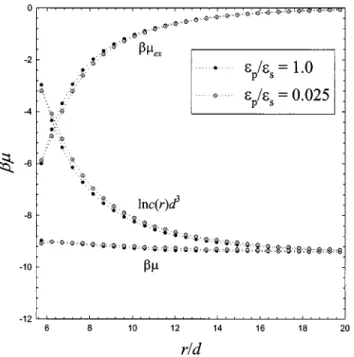
.Figure 1 shows typical distributions of counterion concentra-tions, excess chemical potential, and the total chemical po-tential. The counterion concentration c(r) declines rapidly
from the particle surface to the boundary of the WS cell because of the attraction of the charged colloid. On the other hand, the excess chemical potential increases from r⫽a⫹d and approaches zero at r⫽R due to repulsion among coun-terions. The sum of ln c(r)d3 and ex(r) yield the total
chemical potential, which is essentially constant as illus-trated in Fig. 1. Note that the Widom’s method may be inac-curate at small N or concentrated regions.16
IV. RESULTS AND DISCUSSION
When a salt-free colloidal dispersion contains colloidal particles with small radius and large amount of charges Z, the counterions and the particle are in strong electrostatic cou-pling. Under such a circumstance, the thermodynamic prop-erties displayed by the dispersion may be the same as those associated with particle charge Z*. The charge renormaliza-tion of intrinsic charge Z by the effective charge Z*is com-monly done based on the WS cell model. In this paper we investigate the charge renormalization of the intrinsic par-ticle charge in accordance with the thermodynamic proper-ties of the system, which are computed by MC simulations. It is generally assumed that the thermodynamic behavior of the colloidal dispersion can be described by the mean-field theory, i.e., PB equation. As a result, the effective charge is determined by comparing the DH results to the PB results. That is, one can evaluate the effective charge based on the thermodynamic quantity with DH(Z*)⫽PB(Z).
Obvi-ously, in the weak coupling limit, one has Z*⫽Z because the PB result reduces to the DH result. When the electrostatic coupling is increased, the PB result deviates from the DH result. In general, one anticipates that the latter must be greater than the former if both are estimated based on the
same intrinsic charge, i.e., DH(Z)⬎PB(Z)⬎0. If one adopts surface potential, osmotic pressure, or chemical po-tential as the interesting property, then the effective charge can be identified, respectively, by Eqs. 共16兲, 共18兲, or 共14兲 with Z*⭐Z.
Since the PB theory neglects ion fluctuations and corre-lations, significant deviations from the exact result based on the partition function are observed in strong electrostatic coupling regime. In order to accurately study the charge renormalization phenomenon associated with highly charged particles, we compute the thermodynamic properties numeri-cally by MC simulations. We focus on the chemical potential
共osmotic pressure兲 and surface potential. The former can be
measured experimentally while the latter is closely related to the counterion distributions.
A. Comparison between DH and MC results
In the very weak coupling regime, the analytical expres-sions of chemical potential, surface potential, mean-square dipole moment, and internal energy can be obtained under the DH assumption. Figure 2共a兲 depicts the variation of the configuration chemical potential c with the number of counterions Z/zc. Under the same condition of 兵a/,R/其, data points of different combinations of 兵zc,lB,a,R,其 fall into a single curve. When Z/zc is small enough, the MC results are consistent with the DH theory, Eq. 共14兲. Figure 2共b兲 illustrates the change of the total chemical potential with the intrinsic particle charge Z/zc. Owing to the ideal chemical potentiali, the total chemical potentials are sepa-rated into three curves even though they have the same 兵a/,R/其. Note that the configuration chemical potential grows with N,c⬀N, more rapidly than the ideal chemical potential,i⬀ln N. However, the proportional factor ofcis small and hence the ideal chemical potential dominates. The total chemical potential thus increases logarithmically with increasing N in the very weak coupling regime.
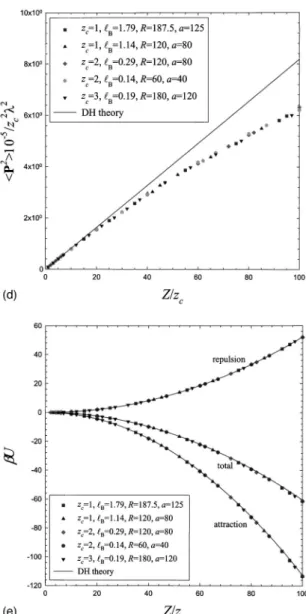
Figures 2共c兲 and 2共d兲 plot the surface potentialesand the mean-square dipole moment
具
P2典
against the number of counterions N for different combinations of parameters, re-spectively. Again, all data points collapse into a single curve, which agrees with the DH expressions, Eqs.共16兲 and 共19兲, at small Z/zc. The variation of the internal energy with Z/zcis shown in Fig. 2共e兲. The internal energy can be separated into attraction between the particle and counterions and repulsion among counterions. One can clearly see that the attractive energy is always about twice larger than the repulsive energy. Both contributions can be well represented by the DH theory, Eq.共13兲. This result indicates that the internal energy always declines with increasing intrinsic particle charge, U⬀⫺N2. In other words, the internal energy gain due to the
attractive contribution may compensate the entropy loss as the intrinsic particle charge is increased. Overall, the excel-lent agreement between DH and MC results in the very weak coupling regime justifies both our theory and MC simula-tions. Evidently, the thermodynamic properties are essen-tially related to the intrinsic particle charge in this regime, instead of the effective charge. The analytical expressions associated with the DH theory are convenient for further use in theoretical and experimental studies.
FIG. 1. The variation of the counterion concentration (ln cd3), the excess
chemical potential (ex), and the total chemical potential共兲 with the radial
distance for zc⫽2, N⫽20, a⫽5d, and R⫽20.5d. Two conditions are
con-sidered, dielectric continuity (⑀p/⑀s⫽1.0) and dielectric discontinuity
FIG. 2.共a兲 The configuration chemical potential is plotted against the number of counterions for various combination of parameters. 共b兲 The variation of the total chemical potential with the number of counterions for different sets of parameters in the very weak coupling regime.共c兲 The electric potential on the particle surface is plotted against the number of counterions for different combination of parameters in the very weak coupling regime.共d兲 The mean-square dipole moment is plotted against the number of counterions for different combination of parameters in the very weak coupling regime.共e兲 The variation of the internal energy with the number of counterions in the very weak coupling regime. It includes the attraction between the particle and counterions and the repulsion among counterions.
B. Charge renormalization by chemical potential
„osmotic pressure…
As indicated in Eq. 共6兲, the total chemical potential consists of two parts, the ideal and configuration chemical potential, i.e., i and c, respectively. The advantage of adopting the chemical potential as the basis for charge renor-malization is that the chemical potential remains constant everywhere in the system. The osmotic pressure possesses the same characteristic and has been shown essentially equivalent to the chemical potential in Eqs.共10兲 and 共11兲. It is very common to adopt the DH expression as the basis to determine the effective charge, i.e.,DH(Z*)⫽(Z). None-theless, we shall show later that two dispersions with the same particle size and volume fraction but different intrinsic charges (Z*⬍Z) may display the same chemical potential, (Z˜ )⫽(Z). Thereby, one can also define Z˜ as the effective charge.
We consider a typical example of charge renormaliza-tion, such as sodium counterion condensation on the surface of a SDS micelle. The ion diameter is d⫽0.4 nm and the radius of the micelle is a⫽2 nm. If the surfactant concentra-tion is 50 mM with the aggregaconcentra-tion number 80, the radius of the WS cell is about R⫽8 nm. Figure 3 shows the variation of the chemical potential with the intrinsic particle charge Z for different counterion valency at a⫽5d and R⫽20d. For monovalent counterions, zc⫽1, the chemical potential as-cends fast at small Z but seems to approach an asymptotic value for large intrinsic particle charge. In comparison with the DH chemical potential (⯝ln Z*d3/z
cV), one is able to define the effective charge as DH(Z*)⫽(Z). When the
intrinsic charge is large enough (Zⲏ50), the effective charge is essentially constant and independent of the intrinsic charge (Z*⯝16). This result seems to be in agreement with the PB theory, which predicts that the effective charge is increased
with the intrinsic charge up to the point where the entropy balances the internal energy. From that point on, the effective charge remains constant.1,9
For divalent counterions (zc⫽2), however, we clearly observe that the chemical potential of counterions reaches a maximum value and declines with increasing Z/zc. It is a consequence of the competition between the counterion en-tropy and the internal energy associated with the particle-counterion interactions. When the number of particle-counterions is small, the entropy term, scaled as ln N, dominates. On the other hand, the internal energy, scaled as Z␦ with␦⬎0, be-comes dominant as Z is large. The maximum chemical po-tential corresponds to the point of equal importance for both contributions. The existence of a maximum (Z⫽Zm) also indicates that a dispersion with particle charge Z⬎Zm pos-sesses the same chemical potential of counterions 共osmotic pressure兲 as that with Z*⬍Zm. Note that both dispersions have the same characteristics of colloidal particles except intrinsic charges. As a consequence, one can define Z*as the effective charge for the intrinsic charge Z, as demonstrated by the arrows in Fig. 3. For trivalent counterions (zc⫽3), the maximum chemical potential takes place even earlier, i.e., at smaller intrinsic charge Zm(zc⫽3)⬍Zm(zc⫽2). Therefore, the effective charge of trivalent counterions is smaller than that of divalent counterions for the same intrin-sic charge Z. In view of the behavior associated with divalent and trivalent counterions, it is natural to anticipate that the chemical potential associated with monovalent counterions may eventually decline for large enough Z. In other words, in the strong coupling regime 共very large N for zc⫽1), the PB theory fails and the ion fluctuations and correlations must be taken into account.
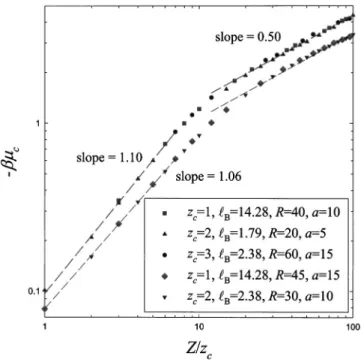
The analysis based on the partition function indicates that ln(1⫹⍀N)⫽f(N,R/,a/) and therefore the configuration chemical potentialc(N) of a given set兵R/,a/其, should collapse into a single curve for different combination of 兵zc,a,R,ᐉB其. Figure 4 confirms this result. Since /R
⯝0.36 does not satisfy the very weak coupling condition
even for N⫽1 of those data points, the configuration chemi-cal potential does not follow the DH result, c⬀⫺N1. The effect of electrostatic coupling starts to contribute to the chemical potential c and leads to the deviation, c⬀⫺N withslightly greater than unity, for small number of coun-terions. However, as N is increased, the growth of the con-figuration chemical potential with N becomes slower and turn toc⬀⫺N1/2. The exponent 1/2 can be attributed to the strong correlation effect, which is ignored in the mean-field PB theory. In fact, the PB theory reveals that the configura-tion chemical potential behaves as c→⫺ln N in the strong coupling regime. This is because the PB theory in the strong coupling limit assumes that
1⫹⍀N⫽ 1 VˆN
冕
¯冕
e ⫺Hdrˆ1¯drˆ N ⬃冋
1 Vˆ冕
e ⫺zcedrˆ册
N ⯝冋
冕
c共r兲drˆ册
N ⫽NN. As a result, the dependence of i andc on N cancels outFIG. 3. The variation of the total chemical potential with the intrinsic par-ticle charge for different counterion valency at a/d⫽5 and R/d⫽20.
each and leads to an asymptotic values of both the total chemical potential (Z⫽Zm) and the counterion concentra-tion at the WS surface, c(R;Z⫽Zm). For counterions con-densed on a charged plane 共two-dimensional system兲, the correlation effect of so-called strongly correlated liquid17can be estimated based on the interaction energy of an ion with its WS cell of the background charge. This estimate gives ⬃n1/2, where n(⫽N/4a2) denotes the surface
concentra-tion. Albeit the counterions are not totally confined at the particle surface in the present study, the picture of strongly correlated liquid may shed some light on the behavior of the configuration chemical potential.
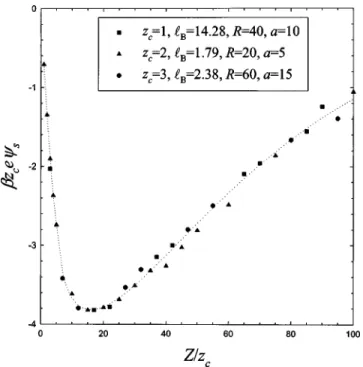
C. Charge renormalization by surface potential The surface electric potential is also a good indication of charge renormalization. Figure 5 illustrates the variation of the surface potential with the intrinsic charge for different counterion valency with a/d⫽5 and R/d⫽20. Equation 共9兲 shows that the surface potentials⫽(r⫽a) can be divided into two parts, the attractive and repulsive contributions. The attractive part is proportional to N and is the dominant part. The repulsive part varies with the counterion distribution and reduces the absolute value of the surface potential. Two lim-iting conditions happen. When the thermal motion is domi-nant, the counterion concentration can be approximated to be uniform 关c(r)⯝N/V兴 and thereby one recovers the DH re-sult, Eq.共16兲. On the other hand, if all counterions are accu-mulated near the surface, the repulsive contribution is essen-tially equal to the attractive part and therefore the surface potential approaches zero. As the electrostatic coupling is increased, the surface potential deviates from the thermal motion dominated regime (s⬃⫺ZᐉB/a) toward the charge renormalization regime (s→0). The variation of
the surface potential with the intrinsic particle charge s(Z) is able to demonstrate the extent of charge renormalization.
Similar to Fig. 3, one can define the effective charge by s(Z*)⫽s(Z) as well, particularly for multivalent counte-rions in Fig. 5. As to monovalent countecounte-rions, it is antici-pated that the surface potential ⫺es will decrease ulti-mately at large enough N and the above definition is appropriate.9The renormalized charge can also be defined by the DH surface potential, Eq.共16兲. Since the DH expression,
⫺s⬀Z, is always greater than that obtained from MC, i.e.,
⫺es,DH(Z)⬎⫺es(Z), the effective charge can be de-termined by s,DH(Z*)⫽s(Z). To verify that monovalent counterions are able to display similar behavior as multiva-lent counterions, we examine the surface potential and the mean-square dipole moment of different valency but with the same 兵R/,a/其. Figures 6 and 7 show that all data points fall into a single curve and are consistent with the dimen-sionless forms of Eqs. 共9兲 and 共12兲. A maximum point of
⫺zce or
具
P2典
/zc22 is observed without doubt. Note that
the surface potential calculated by the nonlinear PB equation is increased monotonically, and for large intrinsic charge the leading order behavior is
es⬃⫺ln Z2,
which is qualitatively different from the MC results for mul-tivalent counterions due to the neglect of the correlation ef-fect in the strong electrostatic coupling regime.
For the charge renormalization phenomenon, the internal energy favors counterion accumulation on the surface but the entropy prefers counterions dispersed in the solvent medium. Figure 8 depicts the variation of the internal energy with the intrinsic charge. Similar to共兲,s, and
具
P2典
, the data sets associated with monovalent and trivalent counterions fallFIG. 4. The configuration chemical potential is plotted against the number of counterions for different combination of parameters in the strong cou-pling regime.
FIG. 5. The variation of the surface potentiale˙ (a⫹d/2) with the
intrin-sic particle charge for different counterion valency at a/d⫽5 and R˙/d
into the same curves because of the same 兵R/,a/其. The attractive contribution is about UA⬇⫺1.29N2 while the
re-pulsive one can be well fitted by UR⬇0.54N2. Thus, the
total internal energy always decreases like N2 as Z is in-creased. Note that the absolute ratio of UA to UR decreases from 5/2 of a dilute dispersion in the very weak coupling regime to 2 of totally condensed condition. In comparison to the mean-field contribution, the correlation effect is not sig-nificant. The internal energy gain O(N2) is able to
compen-sate the entropy loss associated with counterions. In spite of the fact of the unimportant contribution associated with the correlation effect to the internal energy, its role is very cru-cial in determining the chemical potential. For simplicity, we consider the condition of total condensation. Based on the mean-field approximation, one has UA⫽⫺ZNzcᐉB/a and UR⫽1/2Nzc
2ᐉ
B/a. The internal energy part of the chemical potential is therefore (U/N)z⫽0. The chemical potential is calculated by inserting one more counterion with the in-trinsic charge Z held fixed. Thus the correlation contribution must come into play and balances the change in the entropy part of the chemical potential, i.e., nonuniform counterion distribution.
D. Effect of dielectric discontinuity
In general, the charged colloid possesses typically a low dielectric constant共about 2–5兲, which is small compared to the surrounding solvent共about 80 for water兲. In most of the theoretical works, however, the dielectric contrast is ne-glected. In addition to Coulomb interactions, there is another contribution stemming from the dielectric discontinuity, i.e., the image force.15 That is, at the particle-solvent interface, surface charges are induced owing to electric polarization. Thereby, the charge positioned in the solvent with higher dielectric constant feels an electrostatic repulsion from an ‘‘image charge’’共a continuous linear charge distribution lo-cated in the colloidal particle兲 whose net charge has the same sign.18
The effects of image charges in spherical geometry have been studied recently.18 Convergence of the Legendre sums with a relative error of 10⫺6 was obtained by keeping the first 100 terms.18 It is found that the effect of image forces declines with increasing the number of counterions.18 More-over, for multivalent counterions,18 a maximum counterion FIG. 6. The surface potentialzce(a⫹d/2) is plotted against the number
of counterions for different combination of parameters in the strong cou-pling regime. The dotted line is drawn to guide the eyes.
FIG. 7. The mean-square dipole moment is plotted against the number of counterions for different combination of parameters in the strong coupling regime. The dotted line is drawn to guide the eyes.
FIG. 8. The variation of the internal energy with the number of counterions in the strong coupling regime. It includes the attraction between the particle and counterions and the repulsion among counterions.
concentration is located very close to the particle surface, i.e., 关r⫺(a⫹d/2)兴/d⬍0.5. In our simulations, the first 20 terms were kept in order to save the computing time. The typical error of the energy calculation is less than 1% and thus accurate enough results can be obtained in our simula-tions. Since we focus on the chemical potential distributed in the system, only 30 spherical shells are used to collect the data. The width of the interval is too large and therefore we are unable to see the maximum point in c(r) as reported in Ref. 18.
We examine the effect of dielectric discontinuity by comparing the MC results of the chemical potential and sur-face potential with/without the image contribution. Figure 1 shows that the distributions of counterions and the excess chemical potential for zc⫽2, Z⫽40, a⫽5d, and R⫽20d. In the neighborhood of the surface of the charged particle, the counterion concentration of ⑀p/⑀s⫽1 is higher than that of ⑀p/⑀s⫽0.025 due to polarization charges. However, the ex-cess chemical potential with ⑀p/⑀s⫽1 is larger than that of ⑀p/⑀s⫽0.025. As a result, the total chemical potential of both cases are essentially the same. Table I lists both total chemical potential and surface potential as a function of the particle charges. The results further indicate that the influ-ence of dielectric discontinuity is not significant in evaluat-ing the chemical potential. Nonetheless, the surface potential is significantly affected by the concentration profile of coun-terions and thus兩e兩 with dielectric contrast is larger than that with ⑀p/⑀s⫽1 because counterions are pushed away from the interface for the former case.
In the strong coupling regime, the decline of the chemi-cal potential, surface potential, or mean-square dipole mo-ment with increasing N is attributed to the correlation effect, i.e., mutual ordering of counterions near the particle surface.9 For two colloidal dispersions containing charged particles of the same size and volume fraction, the particular thermody-namic property 共兲 of them may be the same even though they possess different particle charges Z* and Z, i.e.,
(Z*)⫽(Z). As a consequence, one may define Z*as the effective charge for the dispersion with Z if Z⬎Z*. Another common approach for the effective charge determination is the DH expression, which is valid under the condition of very weak coupling, that is, DH(Z*)⫽(Z). The
advan-tage of the latter method is that analytical expressions are generally available for various properties and further uses. Compared to the surface potential, the chemical potential or osmotic pressure remains constant everywhere in the system and is relatively insensitive to the dielectric discontinuity. The aforementioned approaches can be directly applied to salty dispersions in determining the effective charge. In the present cell simulations, the effect of colloid-colloid interac-tion is not taken into account because neighboring particles were absent. Our approach is justified for dilute dispersions. In addition, previous study9 also concluded that the results based on WS cell simulations agree reasonably well with those obtained by periodic boundary condition.
ACKNOWLEDGMENTS
This research was supported by National Council of Sci-ence of Taiwan under Grant No. NSC-92-2214-E-008-001. Computing time provided by the National Center for High-Performance Computing of Taiwan is gratefully acknowl-edged.
1S. Alexander, P. M. Chaikin, P. Grant, G. J. Morales, and P. Pincus, J.
Chem. Phys. 80, 5776共1984兲.
2E. Trizac, L. Bocquet, and M. Aubouy, Phys. Rev. Lett. 89, 248301
共2002兲.
3J. M. Roberts, J. J. O’Dea, and J. G. Osteryoung, Anal. Chem. 70, 3667
共1998兲.
4
G. S. Manning, J. Chem. Phys. 51, 924共1969兲.
5F. Oosawa, Polyelectrolytes共Dekker, New York, 1971兲.
6B. H. Zimm and M. Le Bret, J. Biomol. Struct. Dyn. 1, 461共1983兲. 7W. M. Gelbart, R. F. Bruinsma, P. A. Pincus, and V. A. Parsegian, Phys.
Today 53, 38共2000兲.
8M. J. Stevens, M. L. Falk, and M. O. Robbins, J. Chem. Phys. 104, 5209
共1996兲.
9R. D. Groot, J. Chem. Phys. 95, 9191共1991兲. 10G. V. Ramanathan, J. Chem. Phys. 88, 3887共1988兲. 11
L. Belloni, Colloids Surf., A 140, 227共1998兲.
12M. Deserno and C. Holm, Electrostatic Effects in Soft Matter and
Bio-phyiscs共Kluwer Academic, Netherlands, 2001兲, p. 27; H. Wennerstro¨m,
B. Jo¨nsson, and P. Linse, J. Chem. Phys. 76, 4665共1982兲.
13
V. Sanghiran and K. S. Schmitz, Langmuir 16, 7566共2000兲.
14
E. J. W. Verwey and J. T. G. Overbeek, Theory of the Stability of
Lyopho-bic Colloids共Elsevier, Amsterdam, 1948兲.
15Y.-J. Sheng and H.-K. Tsao, Phys. Rev. Lett. 87, 185501 共2001兲; Y.-J.
Sheng and H.-K. Tsao, Phys. Rev. E 66, 040201共R兲 共2002兲; C.-H. Ho, H.-K. Tsao, and Y.-J. Sheng, J. Chem. Phys. 119, 2369共2003兲.
16D. Frenkel and B. Smit, Understanding Molecular Simulation共Academic,
New York, 1996兲.
17B. I. Shklovkii, Phys. Rev. E 60, 5802共1999兲. 18
R. Messina, J. Chem. Phys. 117, 11062共2002兲. TABLE I. Effects of dielectric discontinuity with zc⫽2. A comparison of
chemical potential and surface potential with/without dielectric contrast.
Z (⑀p/ ⑀s⫽0.025) (⑀p/ ⑀s⫽1) es(⑀p/ ⑀s⫽0.025) es(⑀p/ ⑀s⫽1) 20 ⫺9.22 ⫺9.27 ⫺4.12 ⫺3.62 40 ⫺9.29 ⫺9.33 ⫺4.30 ⫺3.79 80 ⫺9.47 ⫺9.46 ⫺3.35 ⫺3.26 120 ⫺9.61 ⫺9.65 ⫺2.60 ⫺2.49 150 ⫺9.90 ⫺9.81 ⫺1.88 ⫺1.86 200 ⫺10.15 ⫺10.18 ⫺1.29 ⫺1.06