2406 IEEE PHOTONICS TECHNOLOGY LETTERS, VOL. 17, NO. 11, NOVEMBER 2005
Optoelectronic-Based High-Efficiency Quasi-CW
Terahertz Imaging
Ja-Yu Lu, Hsu-Hao Chang, Li-Jin Chen, Ming-Chun Tien, and Chi-Kuang Sun, Senior Member, IEEE
Abstract—We demonstrate an optoelectronic-based
high-effi-ciency terahertz (THz) imaging system. Based on a micron-sized photonic transmitter operating at room temperature, an improved signal-to-noise ratio with a reasonable spatial resolution can be achieved. Biomedical THz imaging was demonstrated with a dried seahorse and a fresh flower, which were hidden in plastic sample holders and were invisible. Tissue and water distributions of distinct regions of the bio-samples were clearly resolved, showing the high imaging contrasts of the demonstrated system. These results reveal the possibility to construct a high-sensitivity THz imaging system with less than 1-mW optical excitation.
Index Terms—Far-infrared, millimeter-wave, photonic
trans-mitter, submillimeter wave, terahertz (THz) wave imaging.
I. INTRODUCTION
R
ECENTLY, owing to advances in generating and sensing terahertz (THz) radiation, THz imaging becomes a rapidly expanding field of research and has potential for nondestructive package inspection and biomedical imaging [1] applications due to its high molecular specificity and high penetration capability due to reduced Rayleigh scatterings in dry biological specimens. For clinical or outdoor applications, a compact THz imaging system is desired with low power consumption and reasonable signal-to-noise ratio (SNR).Compared with femtosecond-pulsed broad-band [1] THz imaging systems, continuous-wave (CW) THz [2]–[4] imaging systems offer several benefits including reduced complexity in data analysis and significantly reduced constraints in timing between the pump and probe arms for gated photoconductive or electrooptic detection. Current technologies to generate narrow-band THz radiation include free-electron lasers [1], quantum cascade lasers [1], and photomixing of two CW laser frequencies in photoconductive antenna [2]–[4], nonlinear crystals [4], or photonic transmitters [5]. Free-electron lasers can provide extremely high-power THz emission, but the system is expensive with a huge size. Poor frequency tunability and operation requirement at the liquid-helium temperature of the recently demonstrated THz quantum cascade lasers present some limitations on its applications. It is, thus, highly desirable to develop CW THz imaging with optoelectronic-based pho-tomixing technique. A CW imaging system demonstrated by Gregory et al. [3] employed two independent diode lasers. With
Manuscript received April 29, 2005; revised July 26, 2005. This work was supported by National Science Council of Taiwan under Grant NSC93-2215-E-002-040.
The authors are with the Department of Electrical Engineering and Graduate Institute of Electro-Optical Engineering, National Taiwan University, Taipei 10617, Taiwan, R.O.C. (e-mail: [email protected]).
Digital Object Identifier 10.1109/LPT.2005.857602
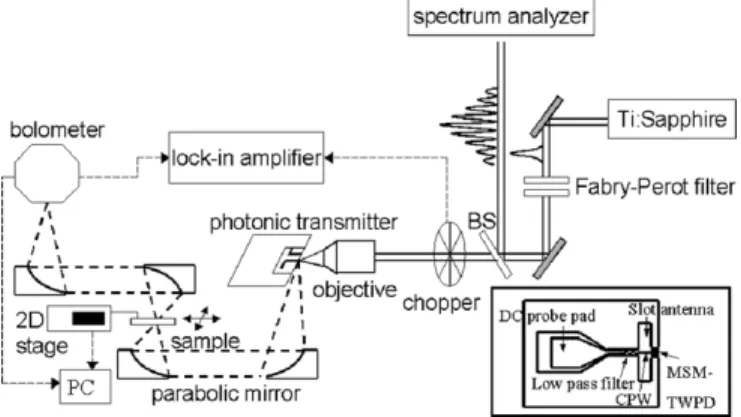
Fig. 1. Schematic diagram of the quasi-CW THz imaging system. BS: beam splitter. Solid line: excitation beam. Dashed line: radiated quasi-CW THz beam. Inset shows the top view of the photonic transmitter.
an optical excitation power of 50 mW, a system SNR of 100 : 1 utilizing photoconductive antenna sensing was successfully reported. A system SNR of 1000 : 1 was achieved in a similar two-dimensional (2-D) imaging system demonstrated by Na-hata et al. [4] with 40-mW CW optical excitation power and electrooptic detection. Kleine-Ostmann et al. [2] has also devel-oped a CW imaging system using a two-color external-cavity laser diode. By using bolometric detection, a system SNR of 75 : 1 was achieved with a lower optical excitation power of 29 mW.
In this letter, we demonstrate that it is possible to construct an optoelectronic-based quasi-CW THz imaging system which can achieve an SNR on the order of 300 : 1 with only 1-mW optical excitation power. By photomixing in a THz-bandwidth photodetector at room temperature, the THz photocurrents can be efficiently generated which can then be fed into a THz an-tenna for radiation. With an optical excitation power of 1 mW, a quasi-CW THz imaging system with an SNR on the order of 300 is achieved under bolometric detection scheme. Quasi-CW THz transmission images of biological and metal specimens, which are acquired at different THz frequencies, are compared. Our results indicate that the demonstrated photodetector-based imaging system can provide reasonable SNR even at 1-THz fre-quency with a reasonable spatial resolution (500 m), achieved due to coherent excitation.
Fig. 1 shows the schematic diagram of the optoelec-tronic-based quasi-CW THz imaging system. An 82-MHz mode-locked Ti : sapphire laser, of which the wavelength was centered around 780 nm, combined with a tunable high finesse Fabry–Pérot (FP) filter, was used to mimic a quasi-CW exci-tation source [6]. For future optoelectronic system integration, picosecond to nanosecond edge-emitting semiconductor lasers
LU et al.: OPTOELECTRONIC-BASED HIGH-EFFICIENCY QUASI-CW THz IMAGING 2407
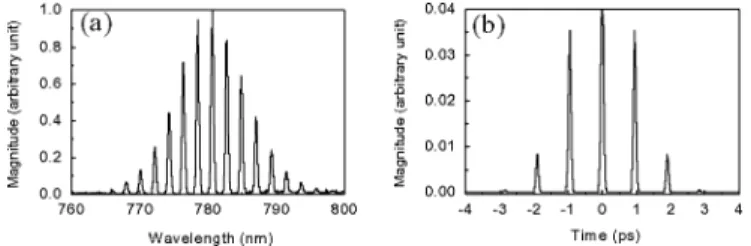
Fig. 2. (a) Spectrum of the optical excitation with a center wavelength of 780 nm. (b) Its corresponding time domain optical intensity.
should be employed. After passing the broad-band femtosecond pulses through an FP filter, a temporal modulated pulse train can be created, where the modulation frequency was controlled by the spacing of the FP filter. Fig. 2(a) shows an example of the optical spectrum recorded by a spectrometer with a 1.03-THz free-spectral range and 0.32-nm linewidth (158 GHz, limited by spectrometer resolution). Its corresponding time-domain intensity trace after Fourier transform is shown in Fig. 2(b). The temporal modulation frequency inside the pulse envelope is approximately 1 THz, with a full-width at half-maximum enve-lope width on the order of 3 ps. The pulse train width should be longer in reality and is limited by the spectral resolution of the spectrometer. The optical excitation was then fed into a photonic transmitter for THz radiation. The employed photonic trans-mitter is composed of a low-temperature-grown GaAs-based edge-coupled metal–semiconductor–metal traveling-wave photodetector [7] and a coplanar-waveguide (CPW) fed slot antenna [6] (shown in inset of Fig. 1). For ease of edge-coupling of the input optical beam, we utilized a membrane-substrate structure [8] for coupling THz radiation into free space instead of Si-lens. Taking advantage of the edge-coupled structure, light illumination can be completely absorbed while the high detector bandwidth is preserved through a traveling-wave structure [7], leading to a high power-bandwidth-product per-formance [9]. The light-driven THz photocurrent propagated through the CPW and fed into the narrow-band slot antenna with a bandwidth on the order of 50 GHz [6] while the an-tenna resonance frequencies were designed to range between 400 GHz to 1 THz. Due to the combination of optical excitation linewidth and antenna resonance bandwidth, narrow-band THz radiation can, thus, be generated. In a similar but different device with a 645-GHz resonance antenna, a high external light-to-THz conversion efficiency ( 0.11% power conversion efficiency or 66% quantum efficiency at 645 GHz) has been previously reported [6]. By tuning the spacing of the FP filter, the modulation frequency of the optical excitation onto the photonic transmitter can be modified to match the resonant fre-quency of the slot antenna, and the THz waves can be radiated with high efficiency. Typical optical excitation average power used for this experiment ranges on the order of 1 mW. The excited quasi-CW THz waves with duration of several picosec-onds radiated from the substrate side into the free space were collected and then focused by a 2-cm focal length off-parabolic mirror onto the samples. The average collected THz power is on the order of microwatt. The transmitted THz waves after the sample were collected with another parabolic mirror and focused onto a liquid-helium-cooled Si bolometer. The details
Fig. 3. Normalized power transmission during scanning a metal blade across the THz focus.
of the THz power measurement including propagation loss and bolometer calibration are described in [8]. For a future room-temperature system, high-sensitivity golay cell detectors [10] could be employed to improve the system performance. By chopping the optical excitation source with a chopper, the electronic output of the bolometer was fed into a lock-in amplifier to improve SNR. By scanning the sample position with a PC-controlled - translational stage, transmission THz images on the focusing plane can, thus, be obtained. From the optical excitation linewidth [ 150 GHz shown in Fig. 2(a)] and the designed antenna return loss [6] (typical bandwidth value is on the order of 50 GHz), we could estimate the spectral resolution of this specific quasi-CW THz imaging system to be on the order of 50 GHz. Better spectral resolution can be easily achieved with reduced optical excitation linewidth.
For the specific photonic transmitter designed for 1 THz, the typical value of the collected THz average power at 1 THz is 2.9 W after considering the measured propagation loss (0.05 cm at 1 THz), under 1.4-mW optical power excitation and 15-V applied bias, which corresponds to an external power conversion efficiency of 0.19% (or 73% external quantum efficiency). If we consider the device surface reflection and mode coupling efficiency, the effective optical excitation into the device was less than 0.6 mW. By analyzing THz average transmission power versus its standard deviation, the SNR ob-tained under this specific operation condition at 1 THz (without samples in the beam path) was found to be 340 : 1. The obtained SNR can be further enhanced with higher optical pump power or another sensitive detection method such as optical gating based on photoconductive switch [3], electrical–optical sam-pling based on nonlinear crystal [1], golay cell detection [10], or pyroelectric detector [11]. In order to determine the focal diameter of the quasi-CW THz imaging system, the edge of a metal blade was moved across the focal plane of the THz beam. The 10%–90% rise in the transmitted THz power provides the spatial resolution approximately 500 m of the imaging system at the 1-THz operation frequency (shown in Fig. 3). We placed biological samples between two thick optically opaque plastic (acrylic) plates. Samples mounted between acrylic plates were then held on a 2-D motorized translation stage and were scan-ning with a 500- m stepsize. With 300-ms lock-in integration time, the scanning of a 90 120-pixel image took 1 h.
2408 IEEE PHOTONICS TECHNOLOGY LETTERS, VOL. 17, NO. 11, NOVEMBER 2005
Fig. 4. Quasi-CW THz images of (a) a dried seahorse acquired at 1 THz, (b) a fresh flower acquired at 945 GHz, and (c) a metal blade acquired at 465 GHz.
Fig. 4(a) shows a THz transmission image of a dried seahorse. The image of size cm was acquired at the 1-THz resonant frequency of the photonic transmitter. With negligible Rayleigh scatterings [12] due to the loose structure of the dried seahorse and with the long THz wavelength, the reduced THz transmis-sion in Fig. 4(a) (dark area) should, thus, be contributed from the absorption of THz wave by organic polar molecules. Fig. 4(b) shows a THz transmission image of two fresh flowers (dwarf ixora) containing water with an image size of cm. To demonstrate the feasibility of wavelength selectivity, Fig. 4(b) was acquired at a 945-GHz resonant frequency of another pho-tonic transmitter. According to Beer’s law, we calculated the ef-fective attenuation constant in the darkest region of Fig. 4(b) to be 131 cm , which is 1.7 times lower than that of pure water at 945 GHz [13]. This result is close to the value of the effective attenuation constant from a fresh bio-tissue derived in a pre-vious study [12]. Hence, we contribute the contrast of the THz image shown in Fig. 4(b) to water distribution in plants. We can see the flower parts of the plants with rich water, which results in low transmission of THz waves [dark area of Fig. 4(b)]. On the other hand in the stem parts of the plants with less water, a brighter image than that of the flower part can be obtained. Fig. 4(c) is the THz transmission image of part of a metal blade acquired at 465 GHz with another device with an image size of cm. The dark region Fig. 4(c) results mainly from reflection of THz waves by metal. The obtained SNRs of the demonstrated THz imaging system utilizing photonic transmit-ters with different resonant antennas at 465 GHz, 945 GHz and 1 THz are 160, 320, and 340, respectively. The SNR increases with frequency can be attributed to the THz power increase with frequency due to the adopted quasi-CW excitation scheme.
In summary, we have demonstrated an optoelectronic-based high-efficiency THz imaging system. Based on a micron-sized photonic transmitter operating at room temperature, an
im-proved SNR with a reasonable spatial resolution can be achieved. Biomedical THz imaging was demonstrated with a dried seahorse and a fresh flower, which were all hidden in plastic sample holders and were invisible. Tissue and water distributions of distinct regions of the bio-samples were clearly resolved, showing the high imaging contrasts of the demon-strated system. These results reveal the possibility to construct a high sensitivity THz imaging system with on the order of or less than 1-mW optical excitation.
ACKNOWLEDGMENT
The authors would like to acknowledge the stimulating scien-tific discussions and technical support by J.-W. Shi, S.-Y. Chen, R.-B. Wu, W.-S. Liu, J.-I. Chyi, and C.-L. Pan.
REFERENCES
[1] B. Ferguson and X. C. Zhang, “Materials for terahertz science and tech-nology,” Nature Mater., vol. 1, pp. 26–33, 2002.
[2] T. K. Ostmann, A. Knobloch, M. Koch, S. Hoffmann, M. Breede, M. Hofmann, G. Hein, K. Pierz, M. Sperling, and K. Donhuijsen, “Contin-uous-wave THz imaging,” Electron. Lett., vol. 37, pp. 1461–1463, 2001. [3] I. S. Gregory, W. R. Tribe, B. E. Cole, C. Baker, M. J. Evans, I. V. Bradley, E. H. Linfield, A. G. Davies, and M. Missous, “Phase sensi-tive continuous-wave THz imaging using diode lasers,” Electron. Lett., vol. 40, pp. 143–144, 2004.
[4] A. Nahata, J. T. Yardley, and T. F. Heinz, “Two-dimensional imaging of continuous-wave terahertz radiation using electro-optic detection,” Appl.
Phys. Lett., vol. 81, pp. 963–965, 2002.
[5] S. M. Duffy, S. Verghese, K. A. McIntosh, A. Jackson, A. C. Gossard, and S. Matsuura, “Accurate modeling of dual dipole and slot elements used with photomixers for coherent terahertz output power,” IEEE Trans.
Microw. Theory Tech., vol. 49, no. 6, pp. 1032–1038, Jun. 2001.
[6] M.-C. Tien, H.-H. Chang, J.-Y. Lu, L.-J. Chen, C.-Y. Chen, R.-B. Wu, W.-S. Liu, J.-I. Chyi, and C.-K. Sun, “Device saturation behavior of submillimeter-wave membrane photonic transmitters,” IEEE Photon.
Technol. Lett., vol. 16, no. 3, pp. 873–875, Mar. 2004.
[7] J.-W. Shi, K.-G. Gan, Y.-J. Chiu, Y.-H. Chen, C.-K. Sun, Y.-J. Yang, and J. E. Bowers, “Metal-semiconductor-metal traveling-wave photode-tectors,” IEEE Photon. Technol. Lett., vol. 13, no. 6, pp. 623–625, Jun. 2001.
[8] J.-W. Shi, S.-W. Chu, M.-C. Tien, C.-K. Sun, Y.-J. Chiu, and J. E. Bowers, “Edge-coupled membrane terahertz photonic transmitters based on metal-semiconductor-metal traveling photodetectors,” Appl.
Phys. Lett., vol. 81, pp. 5108–5110, 2002.
[9] J.-W. Shi, K.-G. Gan, Y.-H. Chen, C.-K. Sun, Y.-J. Chiu, and J. E. Bowers, “Ultrahigh-power-bandwidth product and nonlinear photo-conductance performances of low-temperature-grown GaAs-based metal-semiconductor-metal traveling-wave photodetectors,” IEEE Photon. Technol. Lett., vol. 14, no. 11, pp. 1587–1589, Nov. 2002.
[10] E. R. Brown, J. Bjarnason, T. L. J. Chan, D. C. Driscoll, M. Hanson, and A. C. Gossard, “Room temperature, THz photomixing sweep oscillator and its application to spectroscopic transmission through organic mate-rials,” Rev. Sci. Instrum., vol. 75, pp. 5333–5342, 2004.
[11] T. L. J. Chan, J. E. Bjarnason, A. W. M. Lee, M. A. Celis, and E. R. Brown, “Attenuation contrast between biomolecular and inorganic mate-rials at terahertz frequencies,” Appl. Phys. Lett., vol. 85, pp. 2523–2525, 2004.
[12] P. Y. Han, G. C. Cho, and X. C. Zhang, “Time-domain transillumina-tion of biological tissues with terahertz pulses,” Opt. Lett., vol. 25, pp. 242–244, 2000.
[13] L. Thrane, R. H. Jacobsen, P. U. Jepsen, and S. R. Keiding, “THz reflec-tion spectroscopy of liquid water,” Chem. Phys. Lett., vol. 240, p. 330, 1995.