
ARTICLE NO.CS964743
An Integral Expression for the Electrical Potential Distribution
for Charged Surfaces in Electrolyte Solutions
JYH-PINGHSU1ANDMING-TSANTSENG
Department of Chemical Engineering, National Taiwan University, Taipei, Taiwan 10617, Republic of China Received September 26, 1996; accepted December 13, 1996
associated boundary conditions, and the type of electrolyte.
An analytical procedure is suggested for the resolution of the In general, a nonlinear equation needs to be considered. If linearized Poisson – Boltzmann equation governing the electrical
a surface is not highly charged, or if its surface potential is
potential distribution of a charged surface in an electrolyte solution
sufficiently low ( the Debye – Huckel condition ) , the
corre-under the Debye – Huckel condition. An Integral expression based
sponding PBE can be approximated by the Helmholtz
on the Green function of the linearized Poisson – Boltzmann
equa-tion, the solution of which may be expressed as a linear
tion is derived. The electrical potential distributions for the
follow-combination of harmonic functions ( 10 – 13 ) . The Debye –
ing cases are solved to illustrate the present method: an
arbitrary-Huckel condition is satisfactory for a surface potential on
shaped thin surface, a porous ( ion-penetrable ) sphere bearing fixed
the order of 25 mV. This may be violated for some of the
charges, a rigid, planar surface covered by a porous membrane
bearing fixed charges, and a rigid, nonuniformly charged planar charged surfaces in practice. Nevertheless, it is often adopted
surface. q 1997 Academic Press in the literature for a simpler treatment. Although reported
Key Words: Poisson – Boltzmann equation, linearized; Helmholtz results are ample in the literature, most of them are based
equation; electrical potential distribution; Green function repre- on simple geometries such as planar ( 13 ) , cylindrical ( 9 ) , sentation; general expression; rigid charged surface; planar ;
non-spherical ( 10 – 11 ) , and spheroidal surfaces ( 14 – 15 ) , and
uniform surface condition; rigid charged surface; thin, arbitrary
uniform surface conditions, for example, uniform surface
shape; porous object, ion-penetrable, planar, or spherical.
potential or uniform surface charge density. Since a charged surface can take virtually any shape, and various surface conditions can be assumed in practice, a more general
treat-1. INTRODUCTION
ment is highly desirable.
In the present study the solution procedure for the electri-The electrical potential distribution for a charged surface
cal potential distribution around a charged surface in an in a vacuum is governed by the Poisson equation. It can
electrolyte solution under the Debye – Huckel condition is be solved by considering an equivalent integral equation
discussed. The types of charged surfaces examined include: containing the Green function of the Poisson equation and
an arbitrary-shaped thin rigid surface, a porous ( ion-penetra-the charge density of ion-penetra-the surface ( 1 ) . The integral equation
ble ) sphere bearing fixed charges, a planar surface covered is based on the principle that the electrical potential of the
by a porous membrane bearing fixed charges, and a rigid, system under consideration is the sum of the electrical
poten-nonuniformly charged planar surface. The mathematical tials contributed by each individual charges on the surface.
treatment is based on the Green function of the linearized For a charged surface immersed in an electrolyte solution,
PBE. A similar approach was adopted by Halle ( 16 ) for the the electrolyte provides an additional charge source. In this
case of two infinitely thin rodlike macroions. case, if the concentration of electrolyte follows the
Boltz-mann distribution, the electrical potential distribution of the
2. THEORY
system under consideration is governed by the Poisson – Boltzmann equation ( PBE ) ( 2 ) . For an infinite planar
sur-face in a symmetric electrolyte solution, the solution to the Consider first a unit positive fixed point charge located at PBE can be derived analytically ( 2 ) . Other than this case, the dimensionless position xVÅ[ x1, x2, x3] in an electrolyte the PBE needs to be solved either numerically ( 3 – 5 ) or solution. The dimensionless electrical potential distribution approximately ( 6 – 9 ) . The difficulty of solving the PBE induced by this charge, G , is described by the Helmholtz depends largely on the geometry of a charged surface, the equation
1
To whom correspondence should be addressed. Ç2eVG ( eV, xV)ÅG ( eV, xV)0d ( eV 0 xV), [1]
Consider next an infinitesimally thin charged surface im-whereÇ2
eV is the Laplace operator based on the coordinates
mersed in an electrolyte solution. If the surface is not highly
eV Å[ e1, e2, e3] , and d the delta function. The dimensionless
charged, the potential distribution satisfies variables are defined as
Ç2
eVC( eV)ÅC( eV) , eV √ E , [ 7 ]
G ÅeF / kBT [1a ]
xi Åk xIi, i Å1, 2, 3 [1b ] where E is the domain excluding the charged surface. By
referring to Fig. 1, the boundary condition associated with
k Å (
∑
e2 Z2 iCi ,0/ ere0kBT ) 1 / 2 , [1c ] Eq. [ 7 ] is where e is the elementary charge, F the electrical potential,erand e0, respectively, the relative permittivity and the per- ÌC ÌnV
Z
pV/0ÌC ÌnV
Z
pV0År( pV), pV √V, [ 8 ]
mittivity of a vacuum, Zi the valence of ion species i , kB the Boltzmann constant, T the absolute temperature, Ci ,0the
bulk concentration of ion species i , k01
the Debye length, where (ÌC /Ì
nV)pV is the directional derivative of C at point
and x˜i, i Å1, 2, 3, the position variables. The solution to
pV, r(pV) the surface charge distribution at pV, V the domain
Eq. [1] is
of the charged surface, nV the unit outer normal, and pV/and
pV0the points immediately above and below pV, respectively. Define the function u ( eV) as
G ( eV, xV)Åexp (0r ( eV, xV))
4pr ( eV, xV) , [ 2 ]
u ( eV) Å
*
VG ( eV, xV)r(xV)dV, xV√V, [ 9 ] where r ( eV, xV) is the distance between an arbitrary point eV
and xV. For a distribution of fixed charges r(eV) in the
electro-where the right-hand side of this expression denotes the lyte solution the electrical potential distribution, C, is
gov-surface integral over the charged gov-surface. It can be shown erned by
that u ( eV) satisfies Eq. [ 7 ] , and Ç2 eVC( eV) ÅC( eV) 0r( eV) . [ 3 ] Ìu ÌnV
Z
pV/ Å*
V ÌG ( eV, xV) ÌnVZ
eVÅpV r( xV)dV/ 1 2r( pV) [10 ] Define £( eV) Å*
V G ( eV, xV)r(xV)dxV, [ 4 ] Ìu ÌnVZ
pV0 Å*
V ÌG ( eV, xV) ÌnVZ
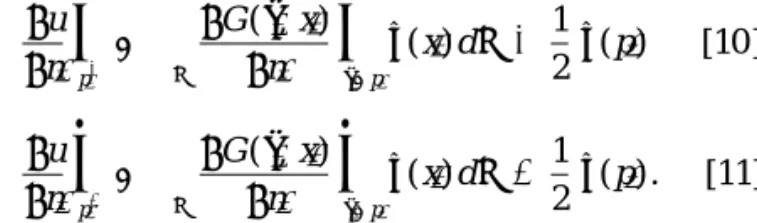
eVÅpV r( xV)dV0 1 2r( pV). [11] where the right-hand side of this expression denotes the These expressions imply that u satisfies Eq. [ 8 ] , and, there-volume integral over V . Employing the Laplace operator on fore, is the solution of Eq. [ 7 ] ; i.e.,Eq. [ 4 ] yields Ç2 eV£( eV)Å
*
V Ç2 eVG ( eV, xV)r(xV)dxV Å*
V [ G ( eV, xV)0d ( eV, xV)]r(xV)dxV Å*
V G ( eV, xV)r(xV)dxV0r( eV) Å £( eV) 0r( eV) . [ 5 ] This implies that£satisfies Eq. [ 3 ] ; i.e.,C( eV) Å
*
V
G ( eV, xV)r(xV)dxV. [ 6 ]
FIG. 1. A schematic representation of an arbitrary thin surface. nV is the
The expression was derived previously for the case the func- unit outer normal, pV the position of an arbitrary point on the surface, pV/
and pV0
the points immediately above and below pV, respectively. tion G on the right-hand side of Eq. [1] vanishes ( 1 ) .
The same result can be obtained by solving the Poisson – Boltzmann equation for the present case
d2
C dp2 /
2 dC
pdp ÅC0r( p ) , p§0. [15 ]
This problem was discussed by Ohshima ( 12 ) , and he ar-rived at
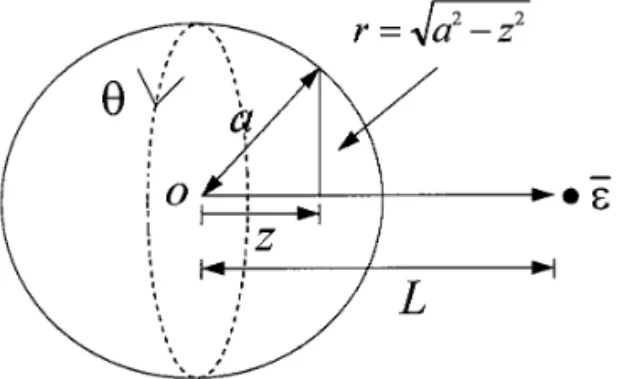
FIG. 2. The coordinates used for a porous ( ion-penetrable ) sphere of radius a . The center of the sphere is located at the origin O . eV denotes an arbitrary point, and L is the distance between eV and O . CÅ
C0a exp (0( L 0a ) ) / L , L§a
F
*
L 0 r*r0sinh ( r* 0L ) dr* / sinh ( L )*
a 0 r*r0exp (0r*) dr*GY
L , L£a , C( eV) Å*
S G ( eV, xV)r(xV)dSxV. [12 ] [16 ] Note that the function G defined above is the generalizedGreen function of the Helmholtz equation, Eq. [1] . where r* is a dummy variable and
3. EXAMPLES
C0Åexp (0a ) / a
*
a
0
r*r ( r*) sinh ( r*) dr*. Several examples are discussed to illustrate the
applicabil-ity of the present method.
A similar problem was examined by Hsu et al. ( 17 ) . Note that the present approach is applicable to an arbitrary-shaped
3.1. Porous ( Ion-Penetrable ) Sphere Bearing Fixed
porous object.
Charges
Let us consider a porous sphere bearing fixed charges 3.2. Planar Surface Covered by a Membrane Bearing
with radius a in an electrolyte solution. For illustration, we Fixed Charges
assume that the fixed charge distribution, r( eV) , is
By referring to Fig. 3, we consider a planar rigid surface covered by an ion-penetrable membrane bearing fixed charges. Suppose that the dielectric constant of the rigid
r( eV)Å
H
r0, q e2 1/e 2 2/e 2 3£ a 0, q e2 1/e 2 2/e 2 3úa . [13 ]solid phase is small compared to that of the membrane phase. Let the charge density of the rigid surface and the fixed charge distribution in the membrane be rs( eV) and rV( eV) ,
For the coordinate system shown in Fig. 2, we have, on the basis of Eq. [ 6 ] , CÅ 1 4p
*
a 0a*
qa20z2 0*
2p 0 exp (0 q r2 /( z0L )2 ) q r2 /( z0L )2 r0rdudrdz Å0r0 2 L ( exp (0a ) ( a/1 ) )É aÅÉa0LÉ aÅÉa/LÉ /r0 2*
a 0a exp (0Éz0LÉ) dz Å r0exp ( a0L ) [ a01/exp (02a ) ( a/1 ) ] / 2 L , if Lúa r0( a/1 ) exp ( L0a ) [01/exp (02 L ) ] / 2 L/1,if Lõa . FIG. 3. A schematic representation of a rigid surface covered by an ion-penetrable charged membrane. The rigid surface-membrane interface is located at e3Å0.
respectively. In this case, the electrical potential distribution the right-hand side of Eq. [ 25 ] vanishes. A similar problem was examined by Hsu et al. ( 19 ) .
is governed by
3.2.1. Nonuniformly charged planar surface. Let us
Ç2
eVC( eV) ÅC( eV) 0rV( eV) , e3ú0. [17 ] consider a planar surface with surface condition The associated boundary condition is ÌC
Ìe3
Z
e3Å0/Å 0g ( e1, e2) . [ 26 ] ÌC
Ìe3
Å 0rs( eV) , e3Å0. [18 ]
Applying Eq. [ 25 ] yields The problem under consideration can be reformulated
C( eV)Å
*
` 0`*
` 0` G ( eV, xV)(2g(x1, x2) ) dx1dx2. [ 27 ] through an image method ( 11 – 12 ) . Let us consider theproblem
As an example, let us consider the case Ç2
eVC( eV)ÅC( eV)0rV( eV) , e3ú0 [19 ]
g ( e1, e2)Åcos ( e1) cos ( e2)/1,0` õe1, e2õ`. [ 28 ] Ç2
eVC( eV)ÅC( eV)0r*V( eV) , e3õ0 [ 20 ]
Substituting Eq. [ 28 ] into Eq. [ 27 ] gives the electrical poten-ÌC
Ìe3
Z
e3Å0/ 0ÌCÌe3
Z
e3Å00Å 02rs( eV) , e3Å0, [ 21]
tial distribution. In practice, the computational effort can be reduced significantly if the infinite domain in Eq. [ 27 ] is replaced by an adequately chosen finite domain S . Suppose where r*V( eV) is the image charge distribution satisfying
that g ( e1, e2) is bounded, i.e.,
r*V( e1, e2, e3) ÅrV( e1, e2,0e3) , e3õ0. [ 22 ]
Ég ( e1, e2)Éõ gmax, 0` õe1, e2õ` [ 29 ] Equations [19 ] – [ 22 ] suggest that the electrical potential
where gmax is a certain finite value. Then S can be chosen distribution is symmetric about e3Å0. Therefore,
as SÅ{ ( e1, e2)É q ( e10x1) 2 /( e20x2) 2 £Rmax, ÌC Ìe3
Z
e3Å0/ Å 0ÌC Ìe3Z
e3Å00 [ 23 ] Rmaxú ln ( 4pgmax/ d ) } , [ 30 ]and where d is a prespecified degree of accuracy.
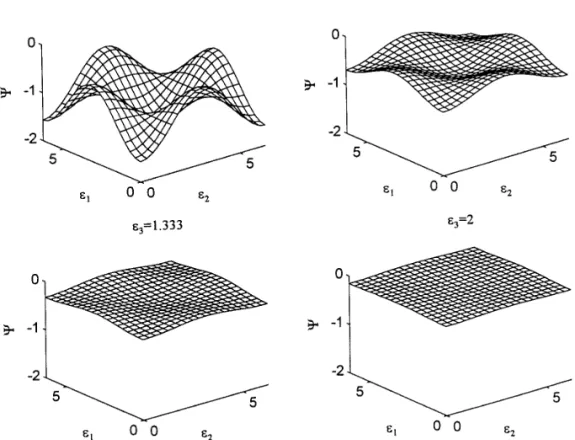
Figure 4 shows the spatial electrical potential distribution calculated by Eqs. [ 27 ] and [ 30 ] with dõ0.001, gmaxÅ2, ÌC
Ìe3
Z
e3Å0/Å 0rs( eV) . [ 24 ]
and RmaxÅ10.13. In a discussion of the interaction between two nonuniformly charged surfaces, Kuin ( 13 ) assumed a periodic surface charge distribution. It is a special case of This implies that the solution to the reformulated problem, Eq. [ 27 ] .
Eqs. [19 ] – [ 24 ] , in the region e3 ú 0, is the same as that 3.2.2. Thin, planar-charged surface. Let us consider a of Eqs. [17 ] and [18 ] . According to Eqs. [ 6 ] and [12 ] , the
thin, planar charged surface on the e10e2plane with surface former can be expressed as
condition C( eV)Å
*
` 0`*
` 0` G ( eV, xV)(2rs( xV))dx1dx2 ÌC Ìe3Z
e3Å0/ Å 0g ( e1, e2) . [ 31] /*
` 0`*
` 0`*
00 0` G ( eV, xV)r*V( xV)dx3dx1dx2Here, we assume that the dielectric constant of the solid phase is small, and that the electrical potential distribution /
*
` 0`*
` 0`*
` 0/ G ( eV, xV)rV( xV)dx3dx1dx2. [ 25 ]inside is negligible. Employing Eq. [ 25 ] leads to The special case in which rV Å rV( e3) and rS Å 0 was
C( xV)Å
*
S
G ( eV, xV)(2g(e1, e2) ) de1de2. [ 32 ] analyzed by Ohshima ( 18 ) . In this case, the first term on
FIG. 4. Simulated spatial electrical potential distribution for the case of a nonuniformly charged rigid planar surface. The rigid surface is represented by e3Å0, and its surface potential is g ( e1, e2)Åcos ( e1) cos ( e2)/1.
As an example, consider a thin disk of radius R with surface It can be shown that condition
*
` 0 l q 1/l2 J0( lRH )J0( lR ) exp (0 q 1/l2 x3) d l g ( e1, e2)ÅH
f ( R ) , R £Rm 0, R úRm , [ 33 ] Å*
2p 0 exp (0 q ( R0 RH cos uH)2/ ( RH sin uH )2/ x2 3) 2p q ( R0 RH cos uH)2 /( RH sin uH )2 / x2 3 duH, [ 36 ] where R Å q e2 1/e 22. The electrical potential distribution for e3ú0 is
and Eq. [ 34 ] is equivalent to Eq. [ 35 ] .
Figure 5 shows the electrical potential distribution for the case C( R , x3) Å 1 2p
*
Rm 0 RH f ( RH)*
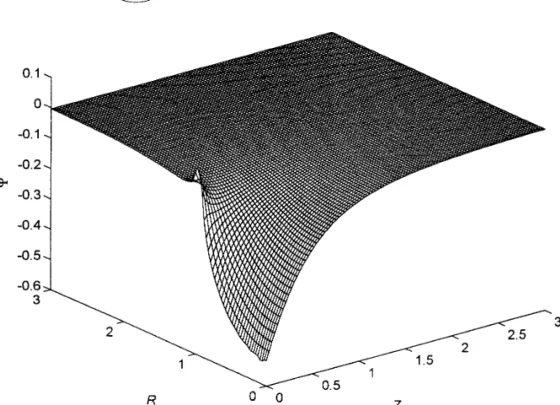
2p 0 f ( R )Å 01, R £0.9 2, 0.9 õR £1 0, 1õR . [ 37 ] 1exp (0 q ( R0RH cos uH)2 /( RH sin uH)2 /x2 3) q ( R 0RH cos uH)2 /( RH sin uH)2 /x2 3 d RH duH. [ 34 ]This type of surface condition simulates that of a kaolin particle in a low pH aqueous solution ( 21 ) . In this case the In a study of the electrical interactions between two thin,
basal plane of a particle is negatively charged and its edge charged disks, Hsu and Tseng ( 20 ) derived the expression
positively charged ( 22 ) .
3.3. Thin, Arbitrary Surface C( R , x3) Å
*
Rm 0 RH f ( RH)*
` 0 l q1/l2 J0( lRH )J0( lR ) For illustration, let us consider the axis-symmetric, thin charged surface formed by rotating the curve defined below about the z axis:
1exp (0q1/l2
FIG. 5. Simulated electrical potential distribution over an infinitesimally thin, charged disk for the case the surface condition is defined in Eq. [ 37 ] . potential distribution on the r0z plane for the case rsÅ1
H
rÅf ( t )zÅg ( t ) , 0£t £tmax. [ 38 ] are shown in Fig. 7. Since the electrical potential distribution
is axis-symmetric, only those on the half r 0 z plane are
presented. Suppose that f ( t ) § 0, f ( 0 ) Å f ( tmax) Å 0, and d g ( t ) / dt
§0, 0£t£tmax. Under these conditions the surface defined
4. CONCLUSION
is a simple closed surface with surface charge density
rs( eV) Å rs( t ) . The potential distribution can be calculated We show that the exact solution to the linearized Poisson –
by Eq. [12 ] . We have
Boltzmann equation governing the electrical potential distri-bution of a charged surface in an electrolyte solution under the Debye – Huckel condition can be expressed as
C( r , z )Å
*
tmax 0*
2p 0 exp (0R ) rs( t ) 1f ( t ) q ( f*( t ) )2 / ( g*( t ) )2 / ( 4pR ) dudt , [ 39 ] CÅ*
V G ( eV, xV)r(xV)deV, [ 41] where R Å (( r 0 f ( t ) cos ( u ) )2 / ( f ( t ) sin ( u ) )2 / ( z 0 g ( t ) )2 )1/2 . where G ( eV, xV) is the generalized Green function of the linear-Figure 6 shows the surface defined by rotating the curve ized Poisson – Boltzmann equation. Equation [ 41] is valid for the case the fixed charges are distributed in the liquid phase; e.g., they are carried by an ion-penetrable membrane.
H
r Åt ( 50t ) ( sin2( t )/0.3 ) / ( t /3 )
zÅ t ( t/1 ) / 15 , 0£t£ 5 If the fixed charges are distributed over a rigid surface, an
image method can be applied which transforms the original problem to a form that Eq. [ 41] is applicable. The distribu-[ 40 ]
tion r( xV) in both cases can be arbitrary. Most of the reported results for the linearized Poisson – Boltzmann equation in the about the z axis ( or e3axis ) . The contours for the electrical
FIG. 6. An arbitrary thin surface obtained by rotating the curve defined by Eq. [ 40 ] about the e3axis.
FIG. 7. The contours of the electrical potential distribution on the r0z plane for the case of Fig. 6. The surface charge density is rsÅ1. The dashed line denotes the curve described by Eq. [ 40 ] .
7. Stokes, A. N., J. Chem. Phys. 65, 261 ( 1976 ) . literature can be recovered as special cases of the present
8. Hsu, J. P., and Kuo, Y. C., J. Chem. Soc. Faraday Trans. 89, 1229 analysis.
( 1993 ) .
9. van Aken, G. A., Lekkerkerker, H. N. W., Overbeek, J. Th. G., and de
ACKNOWLEDGMENT Bruyn, P. L., J. Phys. Chem. 94, 8468 ( 1990 ) .
10. Glendinning, A. B., and Russel, W. B., J. Colloid Interface Sci. 93, 95 ( 1983 ) .
This work is supported by the National Science Council of the Republic
11. Carnie, S. L., Chan, D. Y. C., and Gunning, J. S., Langmuir 10, 2993 of China under project NSC85-2214-E002-023.
( 1994 ) .
12. Ohshima, H., Adv. Colloid Interface Sci. 53, 77 ( 1994 ) .
REFERENCES 13. Kuin, A., J. Chem. Soc. Faraday Discuss. 90, 235 ( 1990 ) .
14. Hsu, J. P., and Liu, B. T., J. Colloid Interface Sci. 175, 785 ( 1996 ) . 1. Guenther, R. B., and Lee, J. W., ‘‘Partial Differential Equations of 15. Yoon, B. J., and Kim, S., J. Colloid Interface Sci. 128, 275 ( 1989 ) .
Mathematical Physics and Integral Equations.’’ Prentice Hall, London, 16. Halle, B., J. Chem. Phys. 102, 7239 ( 1995 ) .
1982. 17. Hsu, J. P., Hsu, W. C., and Chang, Y. I., J. Colloid Interface Sci. 165, 2. Hunter, R. J., ‘‘Foundations of Colloid Science,’’ Vol. I. Oxford Univ. 1 ( 1994 ) .
Press, London, 1989. 18. Ohshima, H., and Kondo, T., Biophys. Chem. 39, 191 ( 1991 ) . 3. Carnie, S. L., Chan, D. Y. C., and Stankovich, J., J. Colloid Interface 19. Hsu, W. C., Hsu, J. P., and Chang, Y. I., J. Colloid Interface Sci. 155,
Sci. 165, 116 ( 1994 ) . 1 ( 1993 ) .
4. Chang, F. C., and Sposito, G., J. Colloid Interface Sci. 163, 19 ( 1994 ) . 20. Hsu, J. P., and Tseng, M. T., Langmuir, accepted.
5. Anandarajah, A., and Chen, J., J. Colloid Interface Sci. 168, 111 21. Sherwood, J. D., and Stone, H. A., Phys. Fluids 7, 697 ( 1995 ) . ( 1994 ) . 22. Nabzar, L., Pefferkorn, E., and Varoqui, R., J. Colloid Interface Sci.
102, 380 ( 1984 ) . 6. Parlange, J. Y., J. Chem. Phys. 57, 376 ( 1972 ) .
![FIG. 6. An arbitrary thin surface obtained by rotating the curve defined by Eq. [ 40 ] about the e 3 axis.](https://thumb-ap.123doks.com/thumbv2/9libinfo/8844103.239892/7.918.169.750.57.590/fig-arbitrary-surface-obtained-rotating-curve-defined-axis.webp)
