國立臺灣大學管理學院資訊管理學系 碩士論文
Department of Information Management College of Management
National Taiwan University Master Thesis
證書模式或訂閱模式?
大規模開放式線上課程的最佳定價策略 Certificate or Subscription?
The Optimal Pricing Strategy of Massive Open Online Courses
楊佩蓉 Pei-Jung Yang
指導教授:孔令傑 博士 Adviser: Ling-Chieh Kung, Ph.D.
中華民國 107 年 7 月
謝辭
時光飛逝,還沒做好準備,碩班生活卻已要邁入尾聲。回首這兩年的時光,真的 很慶幸自己當初的決定,在臺大資管所的這些日子裡,不論是在學術方面抑或是 待人處世方面都覺得受益良多,不過,縱使心中感慨萬千,也只能在這裡簡短向 大家道出我的感謝了。
首先要感謝我的家人,總是放任我做任何決定、容忍我的任性與叛逆,並默默的 扮演我最堅強的後盾,在我累的時候提供我避難的港灣,讓我能夠隨時充電重新 再出發。
再來要感謝我的教授孔令傑,如果說小傑是我生命中的貴人也不為過。小傑總是 能給予我各種正向的鼓勵、會在我人生迷惘時開導我並指引我方向、更會不斷的 給予我各種挑戰,讓我能夠在碩班生涯看見更開闊世界。此外,小傑從不吝惜在 我做錯事時給予我當頭棒喝,也從不曾因為我低落的程度就放棄我。對我來說,
小傑亦師亦友,沒有小傑就沒有今天的我。
感謝 IEDO Lab 的大家,尤其是同屆的敬傑、鑑霖、子翔,大家一起認真一起衝 刺以及一起玩樂的時光,是我碩班生涯不可抹滅的重要回憶。另外就是學長姊及 學弟妹們,學長姐們總會在我們遇到困難時,二話不說地對我們伸出援手,畢業 後也很常回來看大家;學弟妹們則是熱情又認真,為 Lab 注入源源不絕的活力。
最後特別感謝這兩年幾乎是形影不離的好夥伴們:志融、文傑、建逸、魏瑋、昱 賢、書瑀、隆翔以及東峻,大家一路上互相扶持走過了各種風風雨雨,真的很慶 幸能夠結交到你們這群好友。希望不論過了多久,大家都還是能帶著我們這份最 初的信仰,記得我們一起走過的這些感動,繼續朝各自的人生勇往直前。
感謝一路上遇到的所有人,祝福大家都能夠有璀璨的人生。
楊佩蓉 于臺大資訊管理研究所 民國一百零七年八月
摘要
近年來,大規模開放式線上課程的興起在全球蔚為一股風潮。相較 於一般資訊商品,大規模開放式線上課程又具備了教育性質的成分,
也因此使得它的訂價策略廣受學界的關注。在觀察到現今大多數線 上課程平台的收費方式都逐漸由證書模式轉為訂閱模式後,我們決 定針對大規模開放式線上課程平台在商業模式的選擇上可能面臨 的問題來進行研究。在本篇論文中,我們將會建構由一家教育機構、
一個大規模開放式線上課程平台,以及一群線上課程的學習者組成 的賽局模型,進而探討在證書模式、訂閱模式以及混合模式下平台 的獲利情形,並發現學習者對於自身能力有錯誤認知,也就是有限 理性的情形為平台引入訂閱模式的關鍵。有趣的是,在高估自身能 力的學習者會提升平台獲益的情況下,低估自身能力的學習者反而 對於平台的獲益不造成任何影響。
關鍵字: 大規模開放式線上課程,有限理性,訂價策略,賽局理論。
Abstract
Massive Online Open Courses (MOOCs) are raising worldwide concerns now. The educational characteristic of MOOCs makes it different from the traditional information goods, and its pricing strategy therefore deserves high attention. By observing that major MOOC platforms started to move from the certificate business model to the subscription one, we focus on the business model selection problem faced by MOOC platforms. In this paper, we construct a game theoretical model with a MOOCs platform, an educational institution, and a group of learners. We study the profitability of three models: the certificate model, the subscription model, and the mixed model. We find that learners’ bounded rationality is a key for MOOC platforms to introduce the subscription option to learners. Interestingly, while having some learners overestimating their ability benefits the institution and platform, it does not matter whether learners underestimate themselves or not.
Keywords: Massive online open courses, bounded rationality, pricing, game theory.
Contents
1 Introduction 1
1.1 Background and motivation . . . 1 1.2 Research objectives . . . 3 1.3 Research plan . . . 4
2 Literature Review 5
2.1 MOOCs . . . 5 2.2 Revenue sharing mechanism . . . 6 2.3 Information goods pricing . . . 7
3 Model 11
4 Rationality 17
4.1 The certificate model . . . 17 4.2 The subscription model . . . 18 4.3 The mixed model . . . 21
4.4 Comparison . . . 24
5 Diligence and Externality 27 5.1 The certificate model . . . 27
5.2 The subscription model . . . 28
5.3 The mixed model . . . 32
5.4 Comparison . . . 38
6 Conclusion 43
A Proof of Propositions 45
Bibliography 51
List of Figures
4.1 Number of subscribers and the paying amounts of the subscription model 19 4.2 Number of consumers and the paying amounts of the mixed model . . . 22
5.1 Number of subscribers and the paying amounts of the subscription model 29 5.2 Market segments for the subscription model . . . 29 5.3 Number of consumers and the paying amounts of the mixed model. . . . 33
5.4 Market segment for the mixed model. (t = 1.2, η = 0.8, h = 0.6, k = 0.3, and β = 0.7) . . . . 36 5.5 Profits comparison . . . 41
List of Tables
3.1 List of decision variables and parameters . . . 15
Chapter 1
Introduction
1.1 Background and motivation
The advance of technology has significantly changed our life, especially the way we learn.
One of the impacts on traditional education is the rising of online education. Massive Open Online Courses (MOOCs), free online courses that are available for anyone to enroll, offer more flexibility to students and greatly reduce the learning cost compared with traditional education. Moreover, the idea of MOOCs allows the contents of courses to reach all over the world as the internet spreads, while speeding up the delivery of knowledge.
As of 2017, there have been more than 750 universities that participated in MOOCs (Shan, 2017). The top three MOOC platforms of 2017 are Coursera, edX, and Udacity according to Credentialing, Course Diversity, Course Feature, Social Feature and Partner Institutions Reviews.com (2017). Dhawal Shah’s Class Central’s Top 50 MOOCs of All
Time (2017 edition) also points out that Coursera is the top provider with 28 courses in the Top 50, and edX is second with 9 courses. Stanford and MIT top the list with four courses each.
The main reasons for educational institutions to offer MOOCs are extending reach and access of knowledge, improving reputation, and ultimately increasing revenues (Hollands and Tirthali, 2014). However, while MOOC platforms also share these objectives, it is critical for MOOC platforms to find a successful business model to be financially sustainable. For MOOC platforms, business model and platform sustainability are the central issues (Baker and Passmore, 2016). When MOOC platforms emerged around 2012, the main business model was to sell course certificates. A learner may study course materials for free. After completing a course, she may pay for a certificate only if she wants to earn one. This traditional model has been discouraged recently; instead, a new subscription model has been suggested by at least Coursera and Udacity. Under this model, a learner who wants a certificate should first subscribe to a course by paying a monthly fee. She then studies the materials at her own pace until the course is completed (or she unsubscribe). A certificate will be awarded to her upon course completion without additional charge.
Since the profit model of MOOC platforms has been held in high regard today, the pricing strategies of MOOC platform also appeal to us. Once a platform adopts a revenue model (free-material-paid-certificate or subscription), educational institutions must follow and determine the prices (certificate prices or monthly subscription fees) accordingly.
Different models obviously induce institutions to choose different prices, which together provide a learner different incentives about course participation and effort exertion. We
investigate the profitability of the two revenue models and explain the underlying reasons from the perspective of incentives. For ease of exposition, throughout this study we will call the free-material-paid-certificate model the certificate model and the other the subscription model.
1.2 Research objectives
As mentioned above, we aim to verify whether the free-material-paid-certificate model or the subscription model is more desirable for MOOC platforms. In this study, we will develop a game theoretical model to describe the demand and supply market of MOOCs. There are three players in our model, which are MOOC platforms, educational institutions, and learners. We assume that there is a monopoly platform in the MOOCs market, which connects the MOOCs supply side and demand side, and the main task of the platform is to select the revenue model in either one of the free-material-paid- certificate model and the subscription model, or both. There is an institution offering a MOOC on the platform. As the provider of the MOOC, the institution has the right to determine the price of the course certificate and the monthly subscription fee. Learners are heterogeneous in their willingness to pay for a certificate, efficiency in completing the course, and rationality in estimating the course difficulty exist in the market. They decide whether to subscribe to the course, purchase a certificate after completing the course, or pay nothing. We adopt a game-theoretic analysis to solve for the revenue-maximizing pricing strategy and investigate its underlying driving forces.
In this model, both the platform and the institution are looking for revenue maxi-
mization, while learners care about their own utility. As the platform and the institution are on the same side, the former will choose the revenue model which is more profitable first, then the later determine the appropriate price depends on the selected model. At the end of the game, learners make decisions according to the payment and their own ability about the courses. Under this setting, we plan to provide some economic insights about the two revenue models of MOOCs market.
1.3 Research plan
In the next chapter, we will review some related works on MOOCs and the platform pricing strategies. In Chapter 3, we will construct a game-theoretic model to display how students react when facing different online course payment and the profitability of each collection manner. Then, we will discuss the effect of learner heterogeneity in rationality and diligence independently in Chapter 4 and Chapter 5. Finally, the conclusion and future work are made in Chapter 6.
Chapter 2
Literature Review
2.1 MOOCs
Regarding the reasons for MOOCs to be popular not only among learners but also among universities, several researchers have provided different arguments, which mainly focus on three aspects: learners, educational institutions, and MOOC platforms. For learners, most researchers tend to investigate the motivation of using MOOCs and the factors that affect course completion rate (Hew and Cheung, 2014). For educational institutions, lecture design and the integration of traditional education and online courses raise the most concern (Lawton and Katsomitros, 2012). In this section, we briefly review related works about this issue.
Hew and Cheung (2014) summarize the motivations and challenges of students’ and instructors’ use of massive open online courses (MOOCs). By processing a total of 362 related articles as of July 31, 2013, they suggest four reasons why students sign up for
MOOCs, which are the desire to learn about a new topic or to extend current knowledge, the curious about MOOCs, personal challenging issues, and the desire to collect as many completion certificates as possible.
Hollands and Tirthali (2014) investigate reasons for universities to offer MOOCs.
They list six possible reasons, and conclude that extending reach and access and building and maintaining brand are ranked as the top reasons. We can find that although it is still hard to generate profits by offering MOOCs, universities are still willing to do so for educational purpose.
Baker and Passmore (2016) then propose five major value propositions for MOOCs:
headhunting, certification, face-to-face learning, personalized learning, and marketing of integration with services external to the MOOC.
As both universities and learners are highly interested in MOOCs, it makes sense for some companies to run platforms to connect these two parties. In the next section, we will review several studies about the revenue models and revenue sharing mechanisms of MOOC platforms.
2.2 Revenue sharing mechanism
Jia et al. (2017) form a theoretical model against the certificate pricing strategy in B2C (business to customer) market, and analyze 1236 real MOOCs certificate selling data.
They point out that the best-selling MOOCs are economic and management courses, whereas MOOCs with highest payment rate are those science and engineering courses, and according to law of diminishing returns, the witness to pay of customer for courses
offered repeatedly declines.
Regardless which kind of MOOCs makes the most profit, since MOOC platforms do not create courses themselves, they need to cooperate with educational institutions.
Kolowich (2013) points out that both EdX and Coursera share part of their revenue from MOOCs with educational institutions. Its purpose is to induce the institution to provide high quality MOOCs. He further indicates that when it comes to profit generation of MOOC platform, the design of revenue sharing mechanism plays an important role.
Back to pricing strategy. For information goods, Sundararajan (2004) proves that comparing to usage-based pricing, the introduction of fixed fee subscription model in- crease both consumer surplus and total surplus. But when transaction cost exists, it is more profitable to offer both the usage-based price and the monthly subscription fee.
Despite the fact that there have been several researchers provided different arguments on the MOOCs business model and the comparison between usage-based and subscrip- tion, seldom of them discusses the combination of these two objects, and there is still no evidence to show which of the revenue model is more suitable for MOOCs market currently. Hence, we try to investigate above problems and hope to contribute to the MOOCs research field.
2.3 Information goods pricing
After having the basic knowledge about MOOC,it is not hard to find that MOOC can be regarded as kind of information good, because the institution and the learner are not contact practically, but through the MOOC platform. There are some particular traits
in the information good that make its pricing strategy differs from the physical good.
Following are some related works about pricing information goods.
Screening is one of the most common pricing strategy. Through offering products with different qualities and using the second-degree price discrimination strategy, the supplier can avoid the consumer from adverse selection. Bhargava and Choudhary (2001) investi- gate the vertical differentiation of information goods. They indicate that for information good, because the highest quality product usually have the lowest marginal cost/quality ratio, which is inadaptable for the supplier to screening its consumers. They also point out that consumers may prefer low quality product than hight quality one, thus lower the supplier’s profit.
Bundling is also a widely used pricing strategy, which means joins products or services together in order to sell them as a single combined unit and reconstruct the consumer’s preference toward products. Bakos and Brynjolfsson (1999) find it more beneficial for information goods to sell bundling. Especially when the bundled unit exceeds a certain threshold, the supplier’s profit will monotonically increase. However, simple bundling may not suit for every market segments when consumers differ in their valuation for goods. The offering of mixed bundling or menu of bundling may be the optimal choice.
Hui et al. (2012) also investigates how the initial willingness-to-pay for the first uni (IWTP), and the appetite of the quantity consumed when product is free (APP) affect the profitability of bundling information goods. He shows that APP heterogeneity enhances the motivation of adopting the mixed bundling, while IWTP heterogeneity will moderate this effect.
After reviewing the related works about MOOCs and information goods pricing, we
can find that seldom of them combine the two objects together, which means the pricing strategy of MOOCs. So, our study aims to figure out this problem, and hopes can broaden the vision in this particular field.
Chapter 3
Model
We consider a MOOC platform (it) connecting an educational institution (she) and a group of learners (for each of them, he). The platform chooses to implement one of the two revenue models, the certificate model or the subscription model, or both (which is called the mixed model). The most significant difference between the two revenue models is that the certificate model allows learners to view the course materials for free and then pay if they want to get a certificate. On the contrary, the subscription model requests learners to pay a monthly subscription fee first. They may then have the right to access the course materials and obtain a certificate after completing the course. The institution sets up a course and determining the certificate price and/or the monthly subscription fee. A learner decides whether to purchase a certificate (if there is a certificate option), subscribe to the course (if there is a subscription option), or not to pay anything. There will , of course, be some learners viewing the course materials without paying anything.
For whatever revenue generated through certificate sales and/or subscription, the platform and institution share the revenue proportionally. The platform, which is a profit
maximizer, needs to consider the institution’s pricing decision when choosing the revenue model. Note that though institutions in general are not profit maximizer (e.g., many of them care more about reputation in practice), when it is about the pricing decision, all an institution may do is to maximize its revenue. Therefore, to maximize its own profit, the platform should choose the model which allows the institution to maximize her profit (which is equivalent to revenue as there is no variable cost).
A learner will gain a positive utility u after obtaining the certificate. Obviously, different learners evaluate the certificate differently. Therefore, we assume that u spread uniformly in [0, 1]. Having a higher value of u means a learner evaluates the certificate more and thus is willing to pay more. Learners are also heterogeneous in their intelligence, background knowledge for the course, and amount of time to invest in this course. To capture this dimension of heterogeneity, we assume that there are efficient learners who take tL months to complete the course and inefficient ones taking tH > tL months. To avoid tedious derivations with no managerial implication, we normalize tLto 1 and simply denote tH by t > 1 throughout this study. The proportion of learners who is efficient is β ∈ (0, 1). Let τ ∈ {1, t} be the amount of time one spends on completing the course.
A learner decides whether to purchase a certificate or subscribe to the course by considering the certificate price p and monthly subscription fee f . Let the total amount of money paid by a learner be T , his utility of obtaining the certificate then becoming u− T . Under the certificate model, T is simply the certificate price p, which has nothing to do with one’s learning time. A learner’s utility of purchasing a certificate is thus UC = u − p. Under the subscription model, we have T = f, which depends on the amount of time one spends on completing the course. Therefore, a learner’s utility of
subscribing the course is US = u− f. A learner receives a null utility if he does not obtain the certificate.
Naturally, not all learners understand themselves and the course as well. In particular, a learner may underestimate or overestimate the time he needs to complete the course.
To capture this bounded rationality, we assume that some efficient learners overestimate the learning time and believe that they need t months to complete the course (while they actually need just 1 month). Let the proportion of irrational efficient learners by αE ∈ [0, 1]. Similarly, some inefficient learners underestimate the learning time and believe that they need only 1 month (while they actually need t months). We denote the proportion of inefficient learners that make such a mistake by αI ∈ [0, 1]. Note that if αE = αI = 0, all learners are fully rational. In this case, all learners perfectly estimate the amount of money to pay and make their decisions accordingly. On the contrary, if any of αE or αI is positive, there will be irrational learners. An irrational learner will estimate his total subscription fee based on his belief on the learning time, not the true learning time. We assume that t is sufficiently small so that an irrational learner will find it optimal to complete the course and earn the certificate even after he finds his true learning time. The case that t is large so that some learners may quit does not bring additional managerial insights is omitted. To avoid tedious derivations that do not bring useful insights, we will assume that t≤ 2 throughout this study.
Despite the learner irrationality, it is also reasonably that not all learners are diligent.
When taking a course, some learners are hard-working and the others are not. Diligent means that a learner may listens to the lecture video attentively, discusses enthusiastically in the forum, and do the group projects with whole-hearted. Usually, this kind of learners
can spend less time to finish the course than those not taking effort, and their effort may bring some positive effect which is conductive to the entire learning ecosystem. To capture the learner heterogeneity on diligence, we assume that a learner can reduce h proportion of the total learning time by exerting effort, which costs k. Here, we set h be a proportion is because for efficient learners, it is hard to make marked progress on their existing achievements, while in the contrary, inefficient learners can just spend little effort and eventually get significant improvement. As for external benefits, we denote η as the positive effect a diligent learner can bring to the whole ecosystem. Let x represents the entire proportion of diligent learners, the total external benefits will become ηx.
The sequence of events is the following. First, the platform chooses one of the three revenue models: the certificate model, the subscription model, and the mixed model.
Second, the institution makes her pricing decision. Under the certificate model, the institution sets the certificate price p; under the subscription model, she sets of monthly subscription fee f ; under the mixed model, she sets both p and f . If we do not consider the diligency, all the learners just decide whether to purchase the certificate (if there is such an option), subscribe to the course (if there is such an option), or pay nothing. Else, learners should further decide whether to exert effort if choosing the subscription model or the mixed model. The payments are then made accordingly.
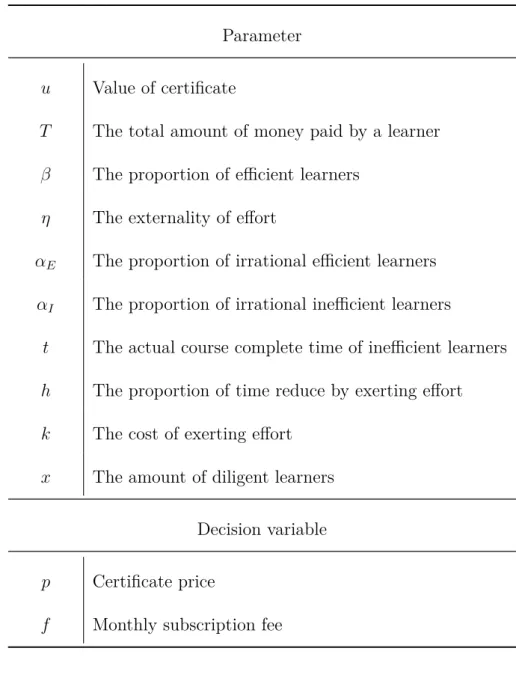
A list of notations is provided in Table 3.1.
Table 3.1: List of decision variables and parameters
Parameter
u Value of certificate
T The total amount of money paid by a learner β The proportion of efficient learners
η The externality of effort
αE The proportion of irrational efficient learners αI The proportion of irrational inefficient learners
t The actual course complete time of inefficient learners h The proportion of time reduce by exerting effort k The cost of exerting effort
x The amount of diligent learners Decision variable
p Certificate price
f Monthly subscription fee
Chapter 4
Rationality
4.1 The certificate model
Suppose that the platform chooses the certificate model, i.e., the institution may only offer learners the certificate option. In this case, the institution determines the certificate price pC to maximize her profit. Given pC, a learner would purchase the certificate if his utility UC = u − pC ≥ 0. Note that as the payment amount is independent of the learning time, all learners with identical willingness-to-pay u will behave the same, regardless their rationality and efficiency. Therefore, the number of learners who will purchase the certificate is 1− u, and the institution’s profit maximization problem can be formulated as
maxpC
πC(pC) = pC(1− pC) (4.1)
The optimal price and associated profit are summarized in Proposition 1.
Proposition 1. The optimal certificate price and equilibrium profit under the certificate
model are
p∗C = 1
2 and πC∗ = 1 4.
Proposition 1 is a consequence of the very typical price-quantity trade-off. The insti- tution finds it optimal to set the price to a level that best balances the earning per sales and the sales volume. The equilibrium profit π∗C = 14 will be the benchmark of the other two models.
4.2 The subscription model
Suppose that the platform chooses the subscription model, and thus the learners are left with the subscription option only. In this case, the institution determines the monthly subscription fee fS to maximize her profit.
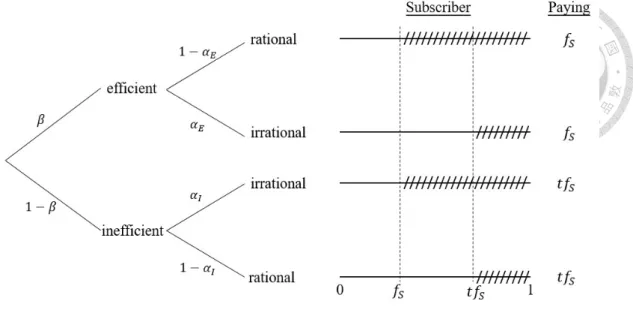
Given fS, now the four types of learners (different in their degrees of efficiency and rationality) make different considerations. On one hand, both a rational efficient learner and an irrational inefficient learner believe that their learning time is 1 and their utility of subscription is US = u− fS. Therefore, the proportions of these two types of leaners that will subscribe are both 1− fS. However, while the former will only pay fS to the institution by completing the course in 1 month, the latter will end up paying tfS. On the other hand, both a rational inefficient learner and an irrational efficient learner believe that their learning time is t and their utility of subscription is US = u− tfS. They also pay differently, however: A rational inefficient one really pays tfS while an irrational efficient one only pays fS.
Figure 4.1: Number of subscribers and the paying amounts of the subscription model
Because subscribers now may pay different total amounts (either fS or tfS), the institution has two choices in inducing subscription. First, she may set tfS < 1 to induce all four types of learners to subscribe. In this case, the proportions of rational inefficient and irrational efficient learners that will subscribe are both 1− tfS. Alternatively, if the institution set tfS ≥ 1, all these learners will not subscribe to the course. While setting tfS ≥ 1 may be optimal under the subscription model, this will never be better than the certificate model. To see this, first note that all subscribers pay a single amount just as what happens under the certificate model. However, the number of subscribers, which come from only two types of learners, is lower than the number of purchasers, which come from all four types. As the objective of this study is the comparison among revenue models, later we will only focus on the case that the monthly subscription fee fS is lower than 1t. The number of subscribers and their paying amounts are visualized in Figure 4.1.
By considering the four types of learners’ behavior and relative proportions, the in-
stitution solves max
fS
πS(fS) = βfS[(1− αE)(1− fS) + αE(1− tfS)]
+ (1− β)tfS[αI(1− fS) + (1− αI)(1− tfS)]
(4.2)
to maximize her profit. The optimal monthly subscription fee is characterized in Propo- sition 2
Proposition 2. Suppose that fs < 1t, the optimal subscription fee and equilibrium profit under the subscription model are
fS∗ = β + t(1− β)
2[β(1− αE+ αEt) + t(1− β)(t + αI − αIt)]
and
πS∗ = [β + t(1− β)]2
4[β(1− αE + αEt) + t(1− β)(t + αI− αIt)].
Moreover, we have fS∗ < 12 = p∗C, and fS∗ decreases in β, increases in αI, and decreases in αE.
According to Proposition 2, we observe that the optimal monthly subscription fee is affected by β, αI, αE, and t. Consider β first. When β increases, there are more learners that are efficient. As efficient learners pay less to complete the course, the institution must cut down the price to enlarge the size of subscribers. When αI increases, there are more learners that consider themselves as efficient. In this case, however, these learners actually pay more than they should. This makes subscription a better idea for the institution to collect revenues from learners. The monthly subscription fee should therefore go up. This also explains why it should go down when αE increases. Note that fS∗ < 12 = p∗C, which means that the optimal monthly subscription fee should be lower than the optimal certificate fee. This is intuitive, as otherwise even confident learners
find it more expensive under the subscription model. The monthly subscription fee then must be too high.
4.3 The mixed model
The last revenue model that the platform may consider is the mixed model. Under the mixed model, the institution offers the learners both the certificate and subscription options by determining the certificate price pM and monthly subscription fee fM. Note that either the certificate model or subscription model is a special case of the mixed model, the mixed model will obviously outperform the other two pure models. For example, the institution may set fM to be extremely high so that no learner would be willing to subscribe to the course. The mixed model then degenerates to the certificate model. It is still non-obvious, however, whether the mixed model will strictly outperform them. One thing for sure is that if the mixed model may strictly outperform the other two models, it must be the case that in equilibrium some learners choose to purchase the certificate while some others choose to subscribe to the course. Otherwise one may mimic the mixed model by one of the two pure models. Therefore, below we will focus on such a differentiating strategy when deriving the optimal pricing decisions for the mixed model.
To differentiate learners, the only possibility is to make the rational efficient and irra- tional inefficient learners choose subscription and the other two types choose certificate.
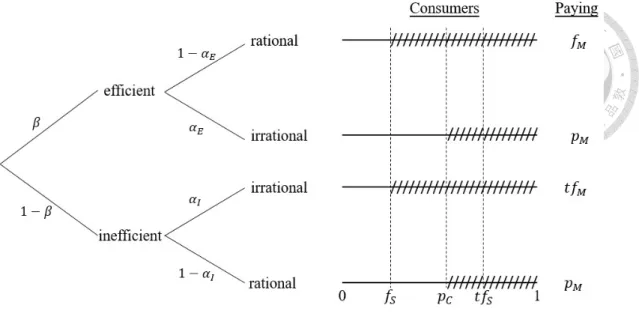
The former requires fS ≤ pC, so that one who believes that he is efficient will choose subscription and try to complete the course in one month. The latter requires pC ≤ tfS, which makes those unconfident learners feel that purchasing a certificate is better than
Figure 4.2: Number of consumers and the paying amounts of the mixed model
paying the subscription fee for t months. These two constraints will be imposed on the institution’s profit maximization problem.
Given the certificate price pM and monthly subscription fee fM, each learner would compare the three options (purchasing the certificate, subscribing to the course, and paying nothing) and choose the one with the highest utility. Consider a rational efficient learner first. As he is efficient, he will prefer to subscribe and eventually pay fM. Similarly, an irrational inefficient learner will also subscribe. However, he will end up with paying tfM if he really subscribe. On the contrary, rational inefficient and irrational efficient learners will all prefer the certificate option by paying pM. Learners whose willingness- to-pay are high enough will subscribe to the course or purchase the certificate according to their preferences. Figure 4.2 depicts the numbers of subscribers and purchasers and their paying amounts.
Collectively, the institution’s profit maximization problem is
pmaxM,fM
β[(1− αE)(1− fM)fM + αE(1− pM)pM]
+ (1− β)[αI(1− fM)tfM + (1− αI)(1− pM)pM] s.t. fM ≤ pM ≤ tfM
(4.3)
We summarize the optimal certificate price and monthly subscription fee in the next proposition. Interestingly, the two amounts are identical. 3.
Proposition 3. The optimal certificate price, optimal monthly subscription fee, and equilibrium profit under the mixed model are
fM∗ = 1
2, p∗M = 1
2, and πM∗ = 1
4[1 + αI(1− β)(t − 1)].
Under the mixed model, the optimal monthly subscription fee and certificate price are ”identical.” Note that this does not mean subscribing to the course and purchasing the certificate are equivalent. There are still some learners, those irrational inefficient learners, who will end up paying tfM∗ = 2t, a price higher than the certificate price. They think they may pay just fM∗ , but they are wrong. The subscription model is needed to extract as much surplus as possible from them. WhenI increases, there are more rational inefficient learners, and naturally the institution may earn more.
Somewhat surprisingly, however, the proportion of efficient learners that are irrational,
E, does not affect the institution’s profit. To understand this, note that under the optimal pricing plan, an irrational efficient learner pays pM to purchase a certificate while a rational efficient learner pays fM by subscribing to the course. The irrational one does
not pay less! In other words, the institution finds it optimal to equalize the monthly subscription fee and the certificate price. This eliminates the potential detriment brought by irrational efficient learners.
4.4 Comparison
Now we are ready to compare the three revenue models regarding their profitability.
By comparing πC∗, πS∗, and πM∗ derived in Propositions 1, 2, and 3, we obtain the next proposition.
Proposition 4. Regarding profitability:
1. If all inefficient learners are rational, the mixed model and the certificate model are equally good. Moreover, they both strictly outperform the subscription model:
π∗M = π∗C > π∗S if αI = 0.
2. If some inefficient learners are irrational, the mixed model strictly outperforms the certificate model, which strictly outperforms the subscription model: π∗M > π∗C > π∗S if αI > 0.
Whether there exist irrational efficient learners does not matter.
Proposition 4 provides several insights to us. First, if all learners are rational (more precisely, if all inefficient learners are rational), there is no need for the institution to introduce the subscription model to learners. The pure certificate model is sufficient to maximize the institution’s profit. As the pure certificate model does not require
institutions and MOOC platforms to prevent unpaid learners viewing course materials, it is arguably the least costly to offer. The certificate model is thus optimal.
If this is the case, why did Coursera and other major MOOC platforms start to introduce the subscription option? According to our study, learners’ bounded rationality on their efficiency may be one reason. As long as there is a learner overestimate his efficiency (and thus underestimate the learning time), he will end up paying ”too much.”
Institutions as well as MOOC platforms then benefit from the existence of these learners with bounded rationality.
Finally, whether some learners underestimate their efficiency does not affect the op- timality of the mixed model. Note that it does affect the profit under the subscription model: If more learners underestimate their efficiency and pay less than they expect, the profit under the subscription model will decrease. Then why the detriment disappears under the mixed model? According to Proposition 4, we find that all irrational efficient learners choose to purchase a certificate. This implies that, by adding the certificate option into the pure subscription model to create the mixed model, the institution may carefully design the prices and induce irrational efficient learner to prefer certificate to subscription. They then all pay the amount they ”should” pay, and their existence does not hurt the institution.
Chapter 5
Diligence and Externality
Recently, there are more and more MOOC platforms switching their revenue model from the certificate model to the subscription model. However, we can find in the previous discussion that no matter there exists learner irrationality or not, the profitability of the subscription model is dominated by the others most of the time. It then appeals to us that why there’s still institutions adopting the subscription model.
Besides economics benefit, Hollands (2014) revealed that there still other reasons for institutions to offer MOOCs, and improving educational outcomes is one of them.
Therefore, we hold the view that this kind of payment may encourage learners to be more assiduous, and we try to verify this in the following discussion.
5.1 The certificate model
As explained earlier, the total payment under the certificate model will not be affected by the learning time, which is always pC. Given pC and the cost for being diligent k,
the utility of learner who decided to exert effort is UC = u− pC − k + ηx. Compare to utility of not taking effort UC = u− pC + ηx, the utility of exerting effort will always be lower. That is to say, under this model, none of the learners are motivated to be assiduous because exerting effort brings no advantage to them.
Therefore, the institution’s profit function can also be represented as
maxpC
πC(pC) = pC(1− pC) (5.1)
the optimal certificate price and equilibrium profit are both the same as the previous case, which we already shown in Proposition 1.
5.2 The subscription model
Recall that in this model, the institution decides the monthly subscription fee fS, and different types of learners differ in the total amount according to their learning time.
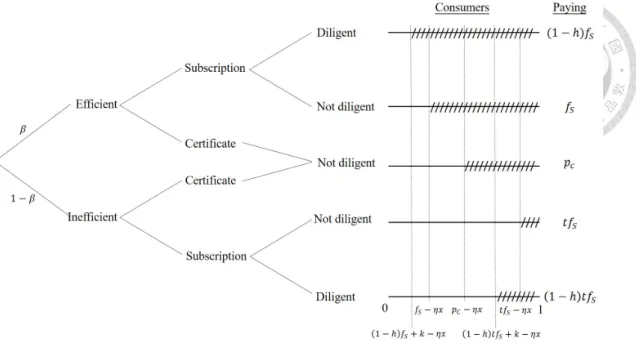
Now, considering the proportion of time h that can be reduced by being diligent, the corresponding cost k, and the potential external benefit ηx, learners can decide whether to exert effort after observing monthly subscription fee fS. If an efficient learner who believes his learning time is 1 decides to be diligent, his utility becomes US = u−(1−h)fS−k+ηx.
On the other hand, if an inefficient learner who believes his learning time is t decides to exert effort, his utility is US = u− (1 − h)tfS− k + ηx. Figure 5.1 shows the subscribers of each type of learners, the corresponding market demand, and their paying amount.
To differentiate learners, the institution can induce only the inefficient learners to be diligent, or induce all of the learners. The former requires thk ≤ fS ≤ kh, which makes the inefficient learner to have higher utility, and the efficient learner to have lower utility
Figure 5.1: Number of subscribers and the paying amounts of the subscription model
Figure 5.2: Market segments for the subscription model
if they exerting effort. The later requires fS ≥ hk, which both types of learners can get higher utilities by exerting effort.
Given fS, learners would first decide whether to subscribe to the course, then choose whether to be diligent to obtain the highest utility. Hence, by setting different monthly subscription fee fS, we can separate the market into three regions according the behavior of learners, which are shown in figure 5.2. The institution can solve the profit maximiza- tion problem of each region, then choose the one with the highest profitability as the final decision.
The institution’s profit maximization functions for each region are as follow:
For region A (Both Efficient and Inefficient learners are undiligent):
max β(1− fS)fS+ (1− β)(1 − tfS)tfS s.t. fS ≤ k
th
(5.2)
For region B (Efficient learners are undiligent, and Inefficient learners are diligent):
max β(1− fS+ ηx)fS
+ (1− β)[1 − (1 − h)tfS− k + ηx](1 − h)tfS
s.t. k
th ≤ fS ≤ k h
(5.3)
, For region C (Both Efficient and Inefficient learners are diligent):
max β[1− (1 − h)fS− k + ηx](1 − h)fS
+ (1− β)[1 − (1 − h)tfS− k + ηx](1 − h)tfS
s.t. k h ≤ fS
(5.4)
We summarize the optimal subscription fee and the equilibrium profit in Proposition 5.
Proposition 5. Suppose that our pricing strategy is design for region A, the optimal subscription fee and equilibrium profit under the subscription model are
fSA∗ =
k
th , if 2(β+(1β+(1−β)t−β)t2) > thk
β+(1−β)t
2(β+(1−β)t2) , otherwise,
(5.5)
and
π∗SA=
k(k(t2(−1+β)−β)+ht(t+β−tβ))
t2h2 , if 2(β+(1β+(1−β)t−β)t2) > thk
(β+(1−β)t)2
4(β+(1−β)t2) , otherwise.
(5.6)
If for region B, the optimal subscription fee and equilibrium profit under the subscription model are
fSB∗ =
k
th , if β+(1−β)[(1−h)(1−k)t−βηk]
2{β+(1−β)[(1−h)2t2+βη((1−h)t−1)]} < thk
k
h , if β+(1−β)[(1−h)(1−k)t−βηk]
2{β+(1−β)[(1−h)2t2+βη((1−h)t−1)]} > kh
β+(1−β)[(1−h)(1−k)t−βηk]
2{β+(1−β)[(1−h)2t2+βη((1−h)t−1)]} , otherwise,
(5.7)
and
πSB∗ =
k(ht((1+k)t(1−β)+β)−h2t2(1−β)−k(β+(1−β)(t2+(t−1)βη)))
h2(t−t(1−β)η) , if fSB∗ = thk
k(h(β+(1−β)(t(1+k(2t−1))+k(t−1)βη))−h2(1+k(t−1))t(1−β)−k(β+(1−β)(t2+(t−1)βη)))
h2(1−(1−β)η)) , if fSB∗ = kh
(β+(1−β)((1−h−k+hk)t+βηk))2
4((1−(1−β)η)(β−(1−β)((1−(1−h)t)βη−(1−h)2t2))) , otherwise.
(5.8) Last, if our pricing strategy is target at region C, the optimal subscription fee and equi- librium profit under the subscription model become
fSC∗ =
k
h , if (1−k)(β+(1−β)t)
2(1−h)(β−(1−β)((t−1)2βη−t2)) < kh
(1−k)(β+(1−β)t)
2(1−h)(β−(1−β)((t−1)2βη−t2)) , otherwise,
(5.9)
and
π∗SC =
(1−h)k(h(β−(1−β)(k(t−1)2βη−t(1−k+kt)))−k(β+(1−β)(t2−(t−1)2βη)))
h2(1−η) , if fSC∗ = kh
(1−k)2(β+(1−β)t)2
4(1−η)(β−(1−β)((t−1)2βη−t2)) , otherwise.
(5.10) Moreover, we have π∗SA always less than 14 = p∗C, but πSB∗ and π∗SC will sometimes greater than πC. Besides, both πSB∗ and πSC∗ decrease in t, increase in η, and decrease in k.
Proposition 5 somehow interprets the reason why the institution choose to adopt the subscription model. We can observe that, if the institution offers the subscription model but not encourages learners to exert effort, which means the region A, her profit will never be more than 1. However, by inducing learners to be diligent, that is, region B
and C, the whole ecosystem can benefit from the externality, thus higher the utility of learners. As the increasing of learner utility, the market demand for certain courses will also increase, and in this particular condition, the profit of the institution will become higher than 14, which is the maximum profit of adopting the certificate model.
5.3 The mixed model
For the last strategy, the institution will now offer both the certificate price and the monthly subscription fee for learners in the mixed model. We have proved that most of the time the mixed model will outperform the other two revenue models in the previous chapter. By properly implementing the pricing strategy, the institution can not only pre- vent learners from pretending other types, but eliminate the potential determinant cause by irrational efficient learners. In this section, we will also focus on the differentiating strategy, and further consider the effect of externality.
To differentiate learners, the institution now has two choice. One is to induce different type of learners choosing the different revenue model, and the other is to induce different type of learners choosing the different learning attitude. For the first condition, the institution will induce the efficient learner to choose the subscription model so that they can paying less amount then choosing the certificate model, and let inefficient learners choose the certificate model. That is to say, the two price should compliance with the restriction that fM ≤ pM ≤ tfM. For the second condition, since the threshold for efficient learners to be assiduous is higher than for inefficient learners, the institution then can induce only the inefficient one to differentiate the learners. In this case, she just need to
Figure 5.3: Number of consumers and the paying amounts of the mixed model.
set the monthly subscription fee fM within the range that the efficient learners will not exert effort and the inefficient learners will, which can be characterized as thk ≤ fM ≤ kh. It is worth mentioning that, there will be positive externality if diligent learners exist in this particular ecosystem. So, sometimes for the external benefits, the institution may not want to differentiate learner by their learning attitude, but induce all of them to be diligent. To meet this, the monthly subscription fee fM should be greater than kh.
Given the certificate price pM and the monthly subscription fee fM, learners first need to compare the three options (purchasing the certificate, subscribing to the course, and paying nothing), and decide whether to exert effort if choosing the subscription model to obtain the highest utility. The sequence and the following paying amount can be shown in Figure 5.3.
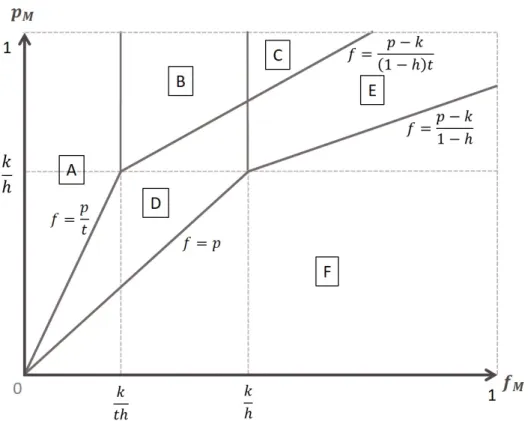
Again, by setting different certificate price and monthly subscription fee, learners will consequently make different choice, thus separates the market into several regions.
Figure 5.4 depicts the above phenomenon. The institution can determine the target segment after solving the profit maximization problems of each region. Collectively, the institution’s profit maximum function are:
Region A (Both of the learners choose the subscription model and exert effort):
max β(1− fM)fM + (1− β)(1 − tfM)tfM s.t. fM ≤ k
th
(5.11)
Region B (Both of the learners choose the subscription model. Efficient learners are undiligent, and Inefficient learners are diligent):
max β(1− fM + ηx)fM + (1− β)[1 − (1 − h)tfS− k + ηx](1 − h)tfM
s.t. k
th ≤ fM ≤ k h
(5.12)
, Region C (Both of the learners choose the subscription model and exert no effort.):
max β[1− (1 − h)fM − k + ηx](1 − h)fM
+ (1− β)[1 − (1 − h)tfM − k + ηx](1 − h)tfM
s.t. k h ≤ fM
(5.13)
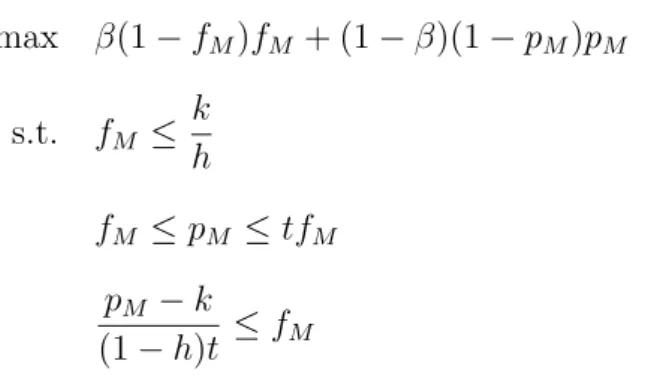
Region D (The efficient learners choose the subscription model and exert no effort. The inefficient learners choose the certificate model):
max β(1− fM)fM + (1− β)(1 − pM)pM s.t. fM ≤ k
h
fM ≤ pM ≤ tfM
pM − k
(1− h)t ≤ fM
(5.14)
Region E (The efficient learners choose the subscription model and exert effort. The
inefficient learners choose the certificate model):
max β[1− (1 − h)fM − k + ηx](1 − h)fM + (1− β)[1 − pM + ηx]pM s.t. k
h ≤ fM
(1− h)fM + k ≤ pM ≤ (1 − h)tfM + k
(5.15)
Region F (Both the efficient learners and the inefficient learners choose the certificate model and exert no effort):
max (1− pM)pM
s.t. pM ≤ fM
(1− h)fM + k ≤ pM ≤ (1 − h)tfM + k.
(5.16)
The optimal price corresponding to each region are presented in Proposition 6.
Proposition 6. The optimal certificate price, optimal monthly subscription fee, and
equilibrium profit under the mixed model are:
Region A:
fM A∗ =
k
th , if 2(β+(1β+(1−β)t−β)t2) > thk
β+(1−β)t
2(β+(1−β)t2) , otherwise,
(5.17)
and
πM A∗ =
k(k(t2(−1+β)−β)+ht(t+β−tβ))
t2h2 , if 2(β+(1β+(1−β)t−β)t2) > thk
(β+(1−β)t)2
4(β+(1−β)t2) , otherwise.
(5.18)
Region B:
fM B∗ =
k
th , if β+(1−β)[(1−h)(1−k)t−βηk]
2{β+(1−β)[(1−h)2t2+βη((1−h)t−1)]} < thk
k
h , if β+(1−β)[(1−h)(1−k)t−βηk]
2{β+(1−β)[(1−h)2t2+βη((1−h)t−1)]} > kh
β+(1−β)[(1−h)(1−k)t−βηk]
2{β+(1−β)[(1−h)2t2+βη((1−h)t−1)]} , otherwise,
(5.19)
Figure 5.4: Market segment for the mixed model. (t = 1.2, η = 0.8, h = 0.6, k = 0.3, and β = 0.7)