計劃主持人自我評估表
計劃名稱:修飾電極在一氧化碳感測器應用之研究 計劃編號:NSC 89-2214-E-006-050
主 持 人:楊明長
執行機構:國立成功大學 化工系 一、完成的成果及創見
1. 研發的以錫修飾之電化學感測器可大幅度提高對一氧化碳的感測 能力。
2. 發現以錫修飾的電化學感測器時,感測電位變得較不費電。
3. 探討了以錫修飾感測電極時,電極製備條件對感測能力的影響。
二、是否有未完成之項目 [說明未完成項目]
( )是 (×)否
三、是否具有專利申請之項目[說明可申請專利之項目]
( )是 (×)尚未成熟 ( )否
四、是否有創新或改進之技術推界至產業界,並請列出可推介之業界產商 (×) 可推介 [請說明之]
產業若製造氣體感測元件時,本計畫的研究經驗可供參考。
( ) 尚須繼續研究 [請說明之]
( ) 無
五、建議兩位您認為合適的評審人 (以供參考) 1. 台灣大學化工系何國川教授,
行政院國家科學委員會補助專題研究計畫成果報告
※※※※※※※※※※※※※※※※※※※※※※※※※
※ ※
※ 修飾電極在一氧化碳感測器應用之研究 ※
※ ※
※※※※※※※※※※※※※※※※※※※※※※※※※
計畫類別:þ個別型計畫 ¨整合型計畫 計畫編號:NSC-89-2214-E-006-050
執行期間:89 年 08 月 01 日至 90 年 07 月 31 日
計畫主持人:楊明長
本成果報告包括以下應繳交之附件:
□赴國外出差或研習心得報告一份
□赴大陸地區出差或研習心得報告一份
□出席國際學術會議心得報告及發表之論文各一份
□國際合作研究計畫國外研究報告書一份
執行單位:國立成功大學化工系
中 華 民 國 90 年 10 月 23 日
修飾電極在一氧化碳感測器應用之研究
On the Application of Modified Electrode on Carbon Monoxide Sensor
計畫編號:NSC 89-2214-E-006-050 執行期間:89 年 8 月 1 日至 90 年 7 月 31 日 主持人:楊明長 國立成功大學化學工程學系
計畫參與人員:曾坤億、王瓊紫 國立成功大學化學工程學系
1. 摘要(感測器、一氧化碳、電化學、錫)
一氧化碳為燃料不完全燃燒的產生的 有毒氣體,常被採用的電流式感測器有時 使用白金觸媒與 Nafion 薄膜。但白金卻會 被一氧化碳毒化,因此而以加錫修飾已提
高靈敏度的研究。在本研究中,Pt/Nafion
經錫修飾後內靈敏度可提高六倍。Pt W /
Nafion /Pt C 經錫修飾後靈敏度可提高三 倍。各種電極製備條件對靈敏度的影響均 在本研究中予以探討。
ABSTRACT (Sensor , Car bon Monoxide, Electr ochemistr y, Tin)
Carbon monoxide, as a toxic gas, is produced from incomplete oxidation of fuel, e.g., gasoline and natural gas.
Amperometric CO sensor is one of the commonly used sensors. One of the common electrodes for this type of sensors is catalytic Pt on Nafion membrane.
However, the sensing performance of Pt is not very satisfied due to poisoning of Pt by CO itself. The Pt electrode modified with Sn was studied to improve the sensitivity of CO. In our study, the sensitivity of CO on Sn-modified Pt/Nafion electrode was about six times larger than Pt/Nafion electrode in the range of 0~400 ppm. With Pt W / Nafion /Pt C electrode assembly, the CO sensing current on the Sn-modified electrode was also about three times larger than the non-modified electrodes.
2. INTRODUCTION
Carbon monoxide is one of the major atmosphere pollutants mainly resulting from
two common methods: potentiometry and amperometry. In this report, an amperometric sensor was chosen to detecting the concentration of CO.
In general, amperometry CO sensors use noble metal, such as Au, Pt and Pd [1,2] as the working electrode. In some sensors, porous catalytic platinum is deposited on Nafion , which works as a solid electrolyte.
However, there are several problems with Pt electrode, such as low sensitivity, poor selectivity and CO poisoning. Many researchers have spent efforts on increasing current in CO oxidation (e.g., fuel cell) or fundamental research by introducing second or third metals, such as Ru, Pb and Sn [3~5]
etc. In this study, the Pt electrode in amperometric sensors was modified with Sn.
3. EXPERIMENTALS
Four types of sensing electrodes in this research were fabricated:
Pt/Nafion Assembly. Platinum catalyst was deposited on Nafion 117 to form Pt W /Nafion assembly by impregnation-reduction method. One side of the Nafion first contacted with Pt(NH 3 ) 4-
Cl 2 solution for Pt(II) ion permeation into the Nafion membrane. Pt(NH 3 ) 4 Cl 2 was then reduced on the same side of Nafion by NaBH 4 .
Pt W /Nafion /Pt C Assembly. The Pt catalyst was alternately deposited on the both sides of the Nafion by the same method as for Pt/Nafion assembly. The first deposited Pt electrode was used as the working electrode, Pt W , and the second one was the counter electrode, Pt C .
Sn/Pt/Nafion Assembly. A
Pt/Nafion assembly was modified by tin
deposition. Tin was deposited
was deposited electrochemically on the working electrode of Pt W /Nafion /Pt C assembly from SnCl 4 in H 2 SO 4 .
The electrochemical measurements of CO with four different assemblies were carried out with two different types of sensing apparatus. For the Pt/Nafion and Sn/Pt/Nafion assemblies, the working electrode was placed on the side of sensing chamber into which the sensing gas flew.
The other side of the electrodes was contacted with sulfuric acid. Pt wire and Ag/AgCl electrode were the counter and the reference electrodes, respectively. For the Pt W /Nafion /Pt C and Sn/Pt W /Nafion /Pt C
assemblies, the working electrode Pt W faced to the sensing chamber, and Pt C electrode faced to N 2 . The gases before flowing into sensing and Pt C chambers were saturated with water by a humidifier.
4. RESULTS AND DISCUSSION
CO Sensing at Pt W /Nafion Assembly
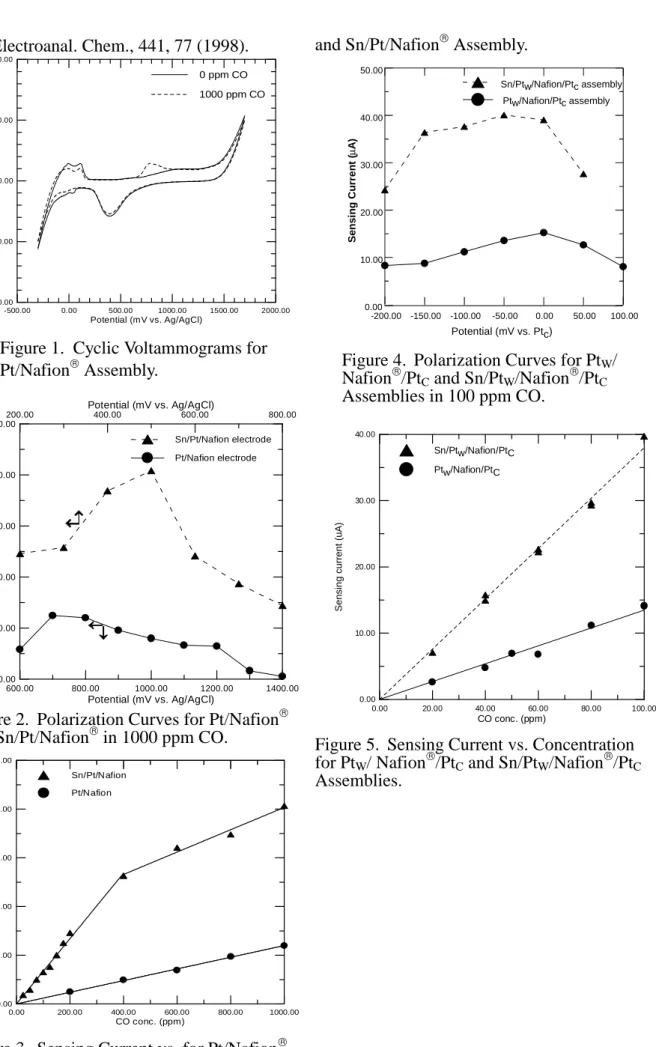
From the Scanning Electron Microscopic (SEM) photograms and Pt mapping image with Energy Dispersive Spectrometer (EDS), the thickness of Pt catalyst layer in the Pt/Nafion assembly was about 12 µm. The loading of Pt determined by Atomic Adsorption Spectrometer (AA) was 1.39 mg/cm 2 . Figure 1 shows the cyclic voltammograms with a Pt/Nafion assembly, scanned at 50 mV/sec in 1 M H 2 SO 4 . Over the Pt electrode were 100 ml/min of gases, containing N 2 (solid line) and 1000 ppm CO (dash line). The charge of hydrogen formation on the Pt electrode in N 2 (solid line) was 70.14 mC. By using the conversion factor of 210 µC/cm 2 [6], it was found that the area ratio of electrochemical active surface to geometry surface of Pt was 63.0. In the range of 0.7~0.8 V (vs.
Ag/AgCl), an electroxidation peak for CO was observed during the positive sweeping.
Platinum was passivated at potential more positive than about 0.8 V (vs. Ag/AgCl).
A polarization curve for Pt/Nafion assembly with 1000 ppm CO is shown in Figure 2. The sensing current was the measured current subtracted from background current. A constant sensing current on the Pt/Nafion assembly (solid
line) was observed to be 120 µA in the range of 0.7~0.8 V (vs. Ag/AgCl). At the potential more positive than 0.8 V (vs.
Ag/AgCl), the sensing current decreased.
This was due to platinum passivation as observed in Figure 1. At more positive potential, more platinum oxide was produced, less active Pt catalyst was left, and hence smaller sensing current was observed.
At a flow rate of 100 ml/min and potential of 0.8 V (vs. Ag/AgCl), the dependence of sensing current on the concentration of CO for the Pt/Nafion assembly was shown in Figure 3. The sensitivity of the Pt/Nafion electrode was 0.12 µA/ppm CO.
CO Sensing at Sn/Pt/Nafion Assembly Tin was electrodeposited on platinum catalyst surface at -0.5 V (vs. Ag/AgCl) for 20 minutes. From EDS analysis, the atomic ratio of Pt to Sn on the electrode was found 96:4. At this range of atomic ratio, the accuracy with EDS is low. This result only indicated that little Sn was deposited on Pt electrode. The cyclic voltammograms of Pt/Nafion assembly with and without tin modification were obtained. Compared with the results, it was found that oxidation of Sn was occurred at potential more positive than 0.35 V (vs. Ag/AgCl), and only one reduction peak in the range of 0.3~0.8 V. It is believed that the reduction peaks of tin oxide and platinum oxide overlapped. It was also found that a significant peak at potential 0.5~0.6 V (vs. Ag/AgCl) with Sn/Pt/Nafion assembly in 1000 ppm CO.
The oxidation peak of CO shifted more negatively by 0.2 V, compared with curve in Figure 1. When the current in the positively scanning of the CV with a Sn/Pt/Nafion assembly in 1000 ppm CO was subtracted from that in N 2 , the relationship of net CO oxidation current-voltage was obtained.
The oxidation of CO could be divided into
two potential ranges: 0.5~0.6 V (vs. Ag/AgCl)
and 0.7~0.8 V (vs. Ag/AgCl). Other report
[7] found that the CO was oxidized at lower
and higher potential range via bridge- and
linear-adsorbed CO, respectively. It is
believed that the oxidation peaks of 0.5~0.6
V and 0.7~0.8 V (vs. Ag/AgCl) corresponded
to oxidation via bridge-adsorption and linear-adsorption, respectively. The bridge-adsorbed CO was oxidized more easily. These results agreed with literature [8] in which Sn was found to promote the oxidation of bridge-adsorbed CO on Pt. We also observed that tin-modified Pt electrode can enhance the oxidation current of CO.
The polarization curve of the Sn/Pt/Nafion assembly in 1000 ppm CO was shown in Figure 2 (dash line), the maximum sensing current was observed at 0.5 V (vs. Ag/AgCl), which was more negative than that on the non-modified Pt/Nafion assembly. The relationship of sensing current and the concentration of CO with the Sn/Pt/Nafion assembly at 0.5 V (vs. Ag/AgCl) can be divided into two linear region as shown in Figure 3 (dash line). The sensitivity was 0.67 and 0.23µA/ppm CO for low concentration (0~400 ppm CO) and high concentration (400~1000 ppm CO), respectively. The sensitivity in the low concentration range was about six times of that on the Pt/Nafion assembly. However, the sensitivity was decreased to two times at the higher concentration range. This phenomenon suggested that the type of adsorption changed from bridge type to linear type at high concentration, and sensing current decreased by a factor about 3.
CO Sensing at Pt W /Nafion /Pt C and Sn/Pt W / Nafion /Pt C Assemblies
From SEM photograph and EDS mapping, it was observed that thickness of Pt W and Pt C electrodes were about 12 and 3 µm, respectively. The polarization curves of the Pt W /Nafion /Pt C and Sn/Pt W /Nafion / Pt C assemblies in 100 ppm CO were shown in Figure 4. It was found that the potentials for constant currents of the Pt W /Nafion /Pt C and Sn/Pt W /Nafion /Pt C assemblies was at 0.0 V and –0.15~0.0 V (vs. Pt C ), respectively.
At the potential of 0.0 V (vs. Pt C ), the sensitivity of Pt W /Nafion /Pt C assembly in the range of 0~100 ppm CO was 0.137 µA/ppm CO, according to Figure 5 (solid line). However, at –0.05 V with Sn/Pt W /
Pt W /Nafion /Pt C electrode.
5. CONCLUSIONS
Tin modified platinum electrode for amperometric CO sensing has been developed. In this research, a tin-modified Pt electrode was found to enhance the electroxidation of CO with less positive potential, i.e. the potentials for limiting currents of Sn/Pt/ Nafion and Pt/Nafion assemblies was 0.5 and 0.8 V (vs. Ag/AgCl), respectively. For single Pt catalyst electrode system, the Sn/Pt/ Nafion assembly had better performance at CO sensing than non-modified Pt/Nafion electrode. The sensitivity at the Sn/Pt/
Nafion assembly was 0.67 µA/ppm CO, about 6 times of that at the Pt/Nafion assembly (0.12 µA/ppm CO) in the range of 0~400 ppm CO. The improvement in sensitivity was believed due to the oxidation mechanism shift from linear adsorption to bridge adsorption. For the double Pt catalyst assembly, the tin modified Pt W /Nafion /Pt C assembly also had a better sensing behavior. The sensitivity of Sn/Pt W /Nafion /Pt C was 0.38 µA/ppm CO, about 2 times of that at Pt W /Nafion /Pt C
assembly (0.137 µA/ppm CO). Besides, the operating potential was also more negative at tin modified assembly.
6. REFERENCES
1. P. Millet, R. Durand, E. Dartyge, G.
Tourillon and A. Fontaine, J.
Electrochem. Soc., 140(5), 1373 (1993).
2. A. Yasuda, T. Fujioka, N. Yamaga, and S.
Kusanagi, 5th International Conference on Polymer Supported Reactions in Organic Chemistry, 15, 203, (Nov 1991).
3. R. Ianniello, V. M. Schmidt, U.
Stimming, J. Stumper and A. Wallau, Electrochimica Acta, 39(11/12), 1863 (1994).
4. G. Ritzoulis and N. Georgolios, J.
Electroanal. Chem., 370, 219 (1994).
5. W. T. Napporn, J. M. Leger and C. Lamy, J. Electroanal. Chem., 408, 141 (1996).
6. T. Biegler, D. A. J. Rand and R. Woods, J.
Electroanal. Chem., 29, 269 (1971).
Electroanal. Chem., 441, 77 (1998).
Figure 1. Cyclic Voltammograms for Pt/Nafion Assembly.
Figure 2. Polarization Curves for Pt/Nafion and Sn/Pt/Nafion in 1000 ppm CO.
Figure 3. Sensing Current vs. for Pt/Nafion
and Sn/Pt/Nafion Assembly.
Figure 4. Polarization Curves for Pt W / Nafion /Pt C and Sn/Pt W /Nafion /Pt C Assemblies in 100 ppm CO.
Figure 5. Sensing Current vs. Concentration for Pt W / Nafion /Pt C and Sn/Pt W /Nafion /Pt C Assemblies.
600.00 800.00 1000.00 1200.00 1400.00
Potential (mV vs. Ag/AgCl) 0.00
100.00 200.00 300.00 400.00 500.00
Sensingcurrent(uA)
200.00 Potential (mV vs. Ag/AgCl)400.00 600.00 800.00
Sn/Pt/Nafion electrode Pt/Nafion electrode
0.00 200.00 400.00 600.00 800.00 1000.00
CO conc. (ppm) 0.00
100.00 200.00 300.00 400.00 500.00
Sensingcurrent(uA)
Sn/Pt/Nafion Pt/Nafion
0.00 20.00 40.00 60.00 80.00 100.00
CO conc. (ppm) 0.00
10.00 20.00 30.00 40.00
Sensingcurrent(uA)
Sn/Ptw/Nafion/PtC Ptw/Nafion/PtC
-500.00 0.00 500.00 1000.00 1500.00 2000.00
Potential (mV vs. Ag/AgCl) -100.00
-50.00 0.00 50.00 100.00
Current(mA)
0 ppm CO 1000 ppm CO
-200.00 -150.00 -100.00 -50.00 0.00 50.00 100.00 Potential (mV vs. Ptc)
0.00 10.00 20.00 30.00 40.00 50.00
Sn/Ptw/Nafion/Ptc assembly Ptw/Nafion/Ptc assembly
Sensing Current (µA)