1
行政院國家科學委員會專題研究計畫成果報告
幾何雷射刻紋外型對碟片磨潤性質之影響
The Effect of Laser Bump on Tr ibological Pr oper ties of Har d-Disk
Media
計畫編號:NSC 89-2212-E-006-017
執行期限:88 年 8 月 1 日至 89 年 10 月 31 日
主持人:蘇演良 教授 國立成功大學機械系
計畫參與人員:高文顯、林俊男、呂鴻彬
國立成功大學機械系
一、中文摘要 本論文探討硬碟碟片中磁頭起降區 (Contact-Start-Stop,簡稱 CSS Zone)上的雷 射刻紋(Laser Texture),對磁頭與碟片介面之磨 潤性質的影響。 因磁記錄密度增加的要求,磁頭滑行高度必須 逐年降低,此要求將造成磁頭與碟片介面產生黏滯 力的問題。雷射刻紋可精準的控制表面形貌,以降 低黏滯力並減少磁頭與碟片間的磨耗。 本文首先研究雷射參數(能量等)對於雷射刻 紋型態及凸點高度的影響,驗證刻紋的形成機構。 其次利用磨潤試驗機,量取每次 CSS 循環磁頭/碟 片間的黏滯力,以瞭解不同型態之雷射刻紋對磁頭 /碟片介面磨潤性質的影響,及得到最佳刻紋參 數。 關鍵詞:雷射刻紋、磨潤性質、磁頭/碟片介面 AbstractThe aim of this research is to investigate the effect of laser texture bump on tribological properties between head and disk interface on CSS zone of the disk.
Because of increasing the magnetic recording density, the fly-height of the head must be reduced year by year. And this request will cause the stiction problems between the head-disk interface. Laser texture can control and increase the surface texture exactly, achieve the aim of decreasing stiction and wear between head and disk interface.
First this research is to investigate the effect of laser parameters (laser energy etc.) on laser bump shape and height. We use the Spectra-Physics laser texture machine to prove the bump formation mechanism. Second through the CSS performance, we take the stiction value between the head and disk interface every single CSS cycle, and analyze the CSS profile both on strain gage and AE sensor to understand the tribological properties and the best bump parameters on various laser textures.
Keywords: Laser Texture、Tribological Properties、 Head/Disk Interface
二、Introduction
As the areal density of magnetic recording devices increases, the magnetic flying height of the recording head over the data zone of the disk needs to be decreased. Laser zone texturing technique was developed for high recording density media [1-3], because it can provided well-defined bump geometry to ensure the tribological durability. The laser texturing parameters (laser pulse energy, laser pulse repetition rate) have a great effect on laser bump shape and height(fig.1), and can change of the Mensicus mode would lead the change of tribological performance. The purpose of this study is to investigate the formation mechanism and to establish the relationship between the laser texturing parameters and laser bump parameters, and to realize the contribution of various type laser textures on tribological performance between the head and disk interface.
三、Experimental Procedures
Prior to tribological testing , the bump formation mechanism is studied using a Nd:YVO4, solid state laser with a characteristic wavelength 1064nm.The output laser pulse energy is adjusted by Acoustic-Optic Modulation (AOM) ,and the voltage of the AOM is proportional to the output energy of the laser-texturing tool.
A. Bump Formation Mechanism and Tribological Analysis
In this study, Ni-P/Al substrates were laser textured with different laser pulse repetition rate and voltage of AOM. First, to investigate the effect of laser parameters on laser bump shape and height. Second, to understand the effect of the bump formation on tribological performance, four types of bump shape were obtained with 20nm bump
2 μm *20μm,40μm *40μm,40μm *50μm,40μ m*120 μ m spacing in radial and circumferential directions respectively. The substrates obtained from different laser texturing parameters were sputtered a:CNH overcoat with 85Å and lubricated with Z-Dol +X1P with a nominal thickness of 19Å .
B. W2 shape CSS test
In various type of bump shape, the W shape have the smaller radius of curvature, and this is good for lower flying height and higher recording media developed. In this study, the aluminum disks were laser-textured with the W2 profile. The bump height is varied from 100Å , 130 Å , 140Å , 170Å and 190Å respectively. The bump spacing is 40μm*100μm, and the 85 Å a:CHN overcoat was covered with Z-Dol +X1P lubricant with 19Å . The commercial available slider is used in this study. The take-off time (TOT) of the slider is determined by acoustic emission (AE) signal from the piezoelectric (PZT) sensor measured during CSS test in ambient environment. The disk topography was evaluated using atomic force microscopy (AFM), and optical profilometry (WYKO).
四、Results and Discussion
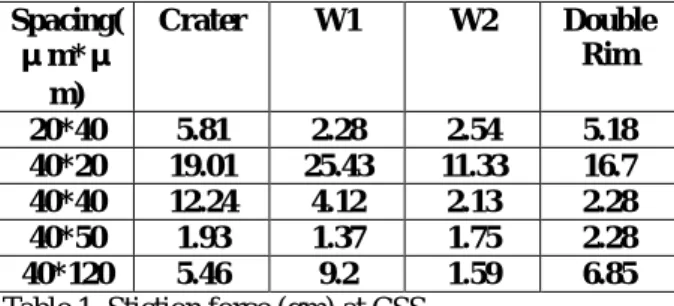
1). The voltage of AOM can affect the bump Spacing( μm*μ m) Cr ater W1 W2 Double Rim 20*40 5.81 2.28 2.54 5.18 40*20 19.01 25.43 11.33 16.7 40*40 12.24 4.12 2.13 2.28 40*50 1.93 1.37 1.75 2.28 40*120 5.46 9.2 1.59 6.85
Table 1. Stiction force (gm) at CSS
formation mechanism. As the voltage increases, the laser bump shape is varied form Crater shape, Sombrero shape, W1 shape, W2 shape to Double-rim shape respectively. Figure 2 demonstrate the bump shape geometry change with the change of voltage of AOM at 30K-repetition rate.
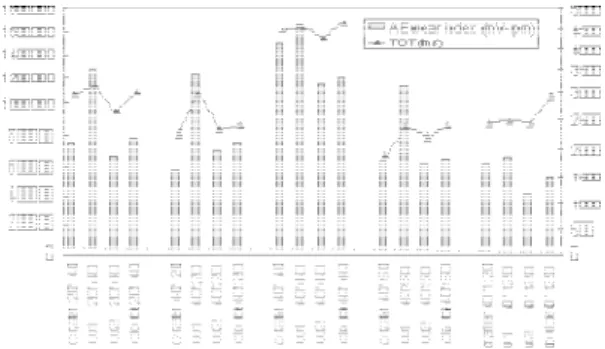
2). With the AE wear index increases, the energy caused by relative motion between slider-disk increases, and it means that it's much easier to wear. The AE wear index and TOT with different types of bump shape and spacing is shown in Figure 3. Three general trends here are: first , the TOT always agrees with the AE wear index, the second, the W2 shape always have the lowest AE wear index and TOT, and the third, the bump spacing 40μm*120μm have the lowest AE wear index. To understand more about the tribological performance, stiction force was measured during CSS test. Table 1 shows the stiction performance of various bump shape and bump spacing at CSS test. The stiction force is much lower with W2 bump shape. Combination the results of the AE wear index and stiction, the bump shape of W2 have the
best tribological performance. That is the reason why we do some more research on it.
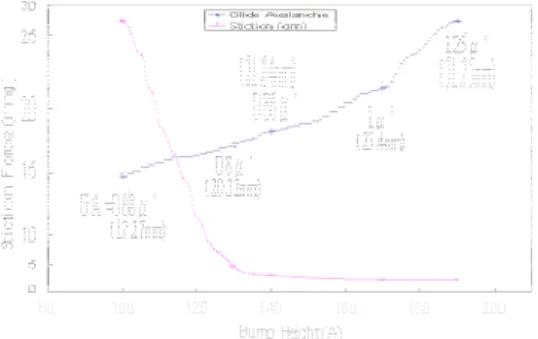
3) The issue of stiction force is a key point for high speed, high recording density media. The former experiment results show that the W2 shape have characteristic of low AE wear index and stiction force. In figure 4, it is shown that W2 shape with 140 Å bump height have the lowest value no matter in AE wear index or TOT. In order to increase recording density, the flying height of the slider in decreased, so during the CSS, Glide avalanche is as low as possible. Figure 5 demonstrate the W2 shape Glide avalanche and stiction with different bump height. It is found that for the bump height of 140Å is the best choice for optimum Glide avalanche and stiction design.
五、Summer y and Conclusions
Laser-texture at disk landing-zone provides a well-defined asperity geometry, the bumps, for tribology performances. The change of the laser-texturing parameters can affect the bump formation is studied in this paper. To understand tribological performance of different types of laser bump shape using AE wear index and stiction force, it's found that the W2 shape have the best performance during CSS test. For further research, the W2 shape with 140Å - bump height give the optimum of stiction performance and Glide Avalanche. The analysis of the acoustic emission wear index during the CSS test offers additional insight to the tribological performance of the disk.
六、Acknowledgments
The authors would like to thank Chengsung Wei for the AE measurements and collecting CSS data, Chengshih Fan for the help of laser-texture and the disks. We are very appreciative of Kenny Sun for his support of the work.
七、Reference [1] J . J . Li u , “O p t i m i z a t i o n o f L a s e r Te x t u r e fo r t h e H e a d D i s k I n t e r fa c e ,” I E E E Tr a n s . M a g . , Vo l . 3 1 , N o . 5 , 1 9 9 7 , p p 3 2 0 2 -3 2 0 4 . [ 2 ] W . G o h , C . J i a a , E . Te n g a n d A . E h o u k h y, “T h e D e s i g n o f La s e r Te x t u r e M e d i a U s i n g A c o u s t i c E m i s s i o n M e a s u r e m e n t s , ” I E E E Tr a n s . M a g . Vo l . 3 3 , N o . 5 , 1 9 9 7 , p p 3 1 9 9 - 3 2 0 1 . [ 3 ] M. Tomatsu,.; J. Kozu, H. Murayama;Y. Arita, “Gradual laser zone texture for low flying height sliders”, Magnetics, I E E E Tr a n s . M a g . Vol.33 , No.5, 1997, pp 3178-3180. [4] T. C . M c M i l l a n , F. E . Ta l ke , a nd J . C . H a r r i s o n , “I d e n t i f i c a t i o n o f S l i d e r / D i s k C o n t a c t s U s i n g t h e E n e rg y o f t h e A c o u s t i c E m i s s i o n S i g n a l ”, I E E E Tr a ns . M a g . Vo l . 3 4 N o . 4 , 1 9 9 8 , p p 1 8 1 9 -1 8 2 1 .
[ 5 ] B. Knigge, F.E. Talke; P. Baumgart, “Acoustic emission and stiction analysis of patterned laser textured media,” I E E E Tr a n s . M a g . Vo l . 3 5 N o . 2
3 M a r c h 1 9 9 9 , p p 9 2 1 -9 2 6 . [ 6 ] B . K n i g g e , Q . Z h a o , F. E . Ta l k e , a n d P. B a u mg a r t , “Tr i b o l o g i c a l P r o p e r t i e s a n d E n v i r o n m e n t a l E ffe c t s o f N a n o a n d P i c o S l i d e r s o n L a s e r Te x t u r e M e d i a , ” I E E E Tr a n s . M a g . Vo l . 3 4 , N o . 4 , 1 9 9 8 , p p 1 7 3 2 -1 7 3 4 .
[7]P. Baumgart, D. J. Krajnovich, T. A. Nguyen, and A. C. Tam, "A new laser texturing technique for high performance magnetic disk drives," IEEE Transactions on Magnetics, Vol. 31, No. 6, Nov. 1995, pp2946-2951.
[8]R. Ranjan, D. N. Lambeth, M. Tromel, P. Goglia, and Y. Li, "Laser texturing for low-flying -height media," J. Appl. Phys. 69(8), 15 April 1991, pp.5745-5747,.
[9]David Kuo, Jing Gui, Bruno Marchon, Sang Lee, Istvan Boszormenyi, Jia J. Liu, Gary C. Rauch and Stan Vierk, "Design of laser zone texture for low glide media," IEEE Transactions on Magnetics, Vol. 32, No. 5, September 1996, pp.3753-3758,. [10] C . M . M a t e , P. H . K a s a i , G . W. Ty n d a l l , C . H . Le e , V. R a n ma n , D . J . P o c ke r, R . J . Wa l t ma n , “I n v e s t i g a t i o n o f P h o s p h a z e n e A d d i t i v e fo r M a g n e t i c R e c o r d i n g L ub r i c a t i o n”, I E E E Tr a n s . M a g . Vo l . 3 4 , N o . 4 , 1 9 9 8 , p p 1 7 4 4 -1 7 4 6 . [ 11 ] Q . Z h a o , . J . K a n g , L . F u , F. E . Ta l k e , D . J . P r e r t t i e , a n d T. A. M o rg a n , “Tr i b o l o g i c a l S t u d y o f P h o s p h a z e n e -Ty p e A d d i t i v e s i n P e r f l u o r o p o l y e t h e r L u b r i c a n t fo r H a r d D i s k A p p l i c a t i o n , ” A S M E / S T L E Tr i b o l o g y C o n fe r e n c e i n To r o n t o , O n t a r i o , C a n a d a , O c t . 2 6 -2 8 , 1 9 9 8 . p p 1 5 6 . [ 1 2 ] T. D . B e n n e t t , P. B a u m g a r t , A . C . Ta m, a n d C . P. G r i g o r o p o u l o s , “M o d e l i n g S t i c t i o n P e r fo r ma n c e o f La s e r -Te x t u r e , ” I E E E Tr a n s . M a g . Vo l . 3 3 N o . 5 , 1 9 9 7 , p p 3 2 0 5 -3 2 0 7 . [ 1 3 ] B . Li u , G . S h e n g a n d S . T. Li m , “M e n i s c u s F o u r c e M o l d i n g a n d S t u d y o n t h e F l u c t u a t i o n o f S t i c t i o n/ F r i c t i o n F o u r c e i n C S S Te s t P r o c e s s , ” I E E E Tr a n s . M a g. Vo l . 3 3 , N o . 5 , 1 9 9 7 p p 3 1 2 1 -3 1 2 3 . [ 1 4 ] D . K n o , J . G u i , B . M a r c h o n , S . L e e , I . B o s z o r m e n y i, J . J . L i u , G . C . R a u c h , a n d S . Vi e r k , “D e s i g n o f La s e r Zo n e Te x t u r e fo r Lo w G l i d e M e d i a”, I E E E Tr a n s . M a g . , Vo l . 3 2 , N o . 5 , 1 9 9 6 , p p 3 7 5 3 -3 7 5 8 . [ 1 5 ] J . G u i , a n d B . M a r c h o n “A S t i c t i o n M o d e l f o r A H e a d -D i s k I n t e r fa c e o f A R i g i d D i s k D r i v e , ” J . A p p l . P h y s . Vo l . 7 8 , 1 9 9 5 , p p 4 2 0 6 - 4 2 0 8 .
Fig. 1 AFM surface profile of the laser bump
Fig. 2 laser-texture distribution map
Fig. 3 AE wear index and TOT During CSS with different laser-texture parameters
4 Fig. 4 W2 shpae Wear index and TOT at CSS with different laser-texture parameters