Chapter 21:
Transition Metals and Transition Metals and Coordination Chemistry Coordination Chemistry
鐵— — 鋼鐵
銅— — 電線、水管 鈦— — 塗料 銀— — 照相底片
Mg, Cr, V, Co— — 鋼鐵添加物 Pt— — 工業及汽車用催化劑
過渡金屬離子在生物體組織上的重要性:
Fe complexes: 提供O2的運輸及儲存
Mo and Fe complexes: nitrogen fixation的催化劑 Zn: 存在於人體150種以上的生物分子
Cu, Fe: 在呼吸循環上扮演重要角色
Co:存在於基本的生物分子,例如維他命B12
21.1 Transition Metals 21.1 Transition Metals
show great similarities within a given period as well as within a given vertical group.
Key reason: last electrons added are inner electrons (d’s, f’s).
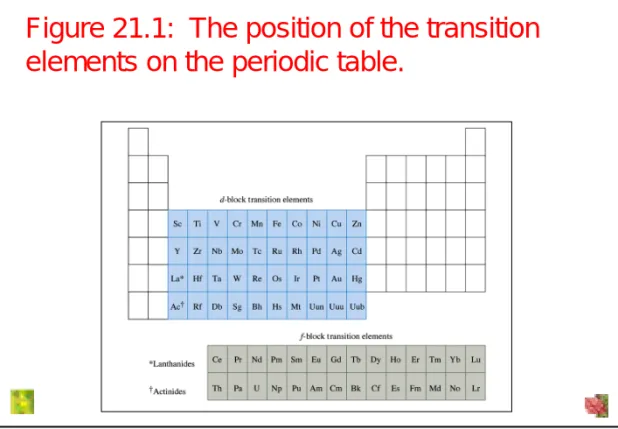
Figure 21.1: The position of the transition elements on the periodic table.
過渡金屬性質的多樣化
過渡金屬性質的多樣化::
1. 展現典型的金屬性質,具有金屬光澤,及相對上 高的導電、及導熱性。例如Cu, Ag
2. W melting point: 3400 oC; Hg: liquid at 25 oC Fe, Ti: hard; Cu, Au, Ag: soft
Cr, Ni, Co… 等的氧化物會附著在金屬表面;
Fe的氧化物會剝落;
Au, Ag, Pt, Pd 不會形成氧化物
3. 含有一種以上的氧化態Complex Ions
species where the transition metal ion is
surrounded by a certain number of ligands (Lewis bases).
Co(NH3)63+ Pt(NH3)3Br+
A Coordination Compound
typically consists of a complex ion and counter ions(anions or cations as needed to produce a neutral compound).
[Co(NH3)5Cl]Cl2 [Fe(en)2(NO2)2]2SO4
過渡金屬錯化合物大部分具有顏色
PbMoO4 MnCO3
過渡金屬錯化合物大部分具有顏色
(From left to right) Metals containing the metal ions Co2+, Mn2+, Cr3+, Fe3+, and Ni2+.
Figure 21.2: Plots of the first (red dots) and third (blue dots) ionization energies for the first-row transition metals.
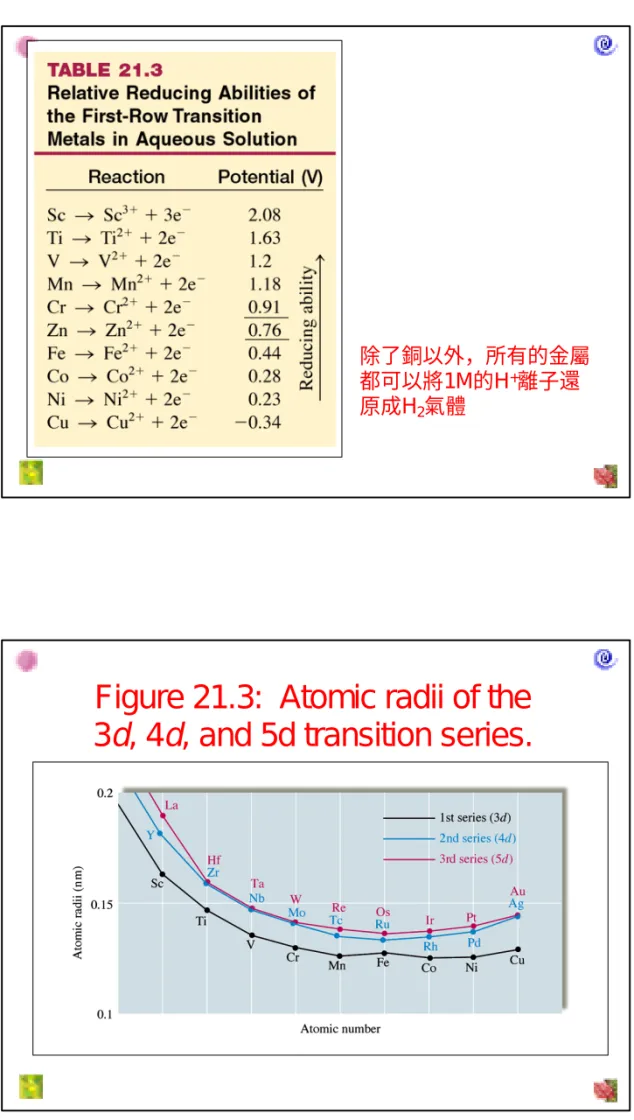
除了銅以外,所有的金屬
都可以將1M的H+離子還
原成H2氣體
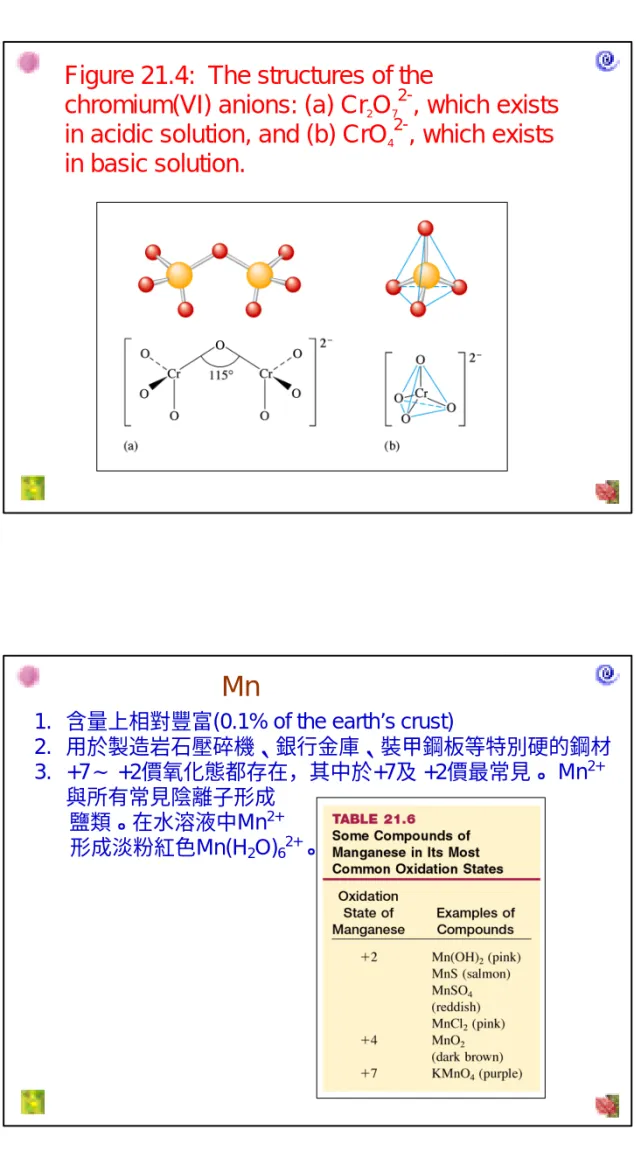
Figure 21.3: Atomic radii of the
3d, 4d, and 5d transition series.
半徑的一般傾向
半徑的一般傾向1. 隨週期表由左至右逐漸減少
2. 由於鑭系縮收的結果4d及5d元素的半徑大小類似 由於半徑大小類似, 4d及5d元素有非常相似的化學性
質。元素的差異性隨著週期表往右而漸增,例如Nb與Ta 非常類似,但是不如Zr與Hf類似。
4d
4d及 及5 5d d元素的應用: 元素的應用:
1. Zr, ZrO2與Nb, Mo的合金: 抗高溫,用於太空梭零件。
2. Nb, Mo :鋼材中重要的合金物質。
3. Ta: 抗體液,用於人工骨骼。
4. Ru, Os, Rh, Ir, Pd, Pt: 工業製程上的催化劑。
21.2 The First
21.2 The First- -Raw Transition Metals Raw Transition Metals
Sc
1. 稀有元素
2. 通常以+3價氧化態存在於化合物中
3. 大部分化合物無色(+3價沒有d電子),逆磁性 4. 曾被用於電子裝置,例如高密度燈泡
Ti
1. 廣泛分佈於地殼中 (0.6% by mass)
2. 相對上低密度、高強度、耐高溫 — — 用於噴射機引擎 3. 抗拒化學物質攻擊— — 用於管線、馬達、化學反應槽 4. 常以+4價氧化態存在,例如TiO2 (白色固體), TiCl4
(無色液體)
5. Ti3+在水溶液中以Ti(H2O)63 +存在,呈紫色
TiO2
1. 白色色素,用於紙張、塗料、地毯 、塑膠 、合 成纖維 、白色輪胎 、化妝品(遮光劑)
V
1. 廣泛分佈於地殼中 (0.02% by mass) 2. V2O5用於生產硫酸的催化劑
3. V金屬具灰藍色,硬度高,耐腐蝕 4. 合金鋼鐵用於引擎零件及輪軸製造 5. 主要氧化態+5價,而+5∼ +2價氧化態
都存在於水溶液中
Cr
1. 相對上較稀少
2. 通常形成+2、+3、+4、及+6價化合物,Cr2+是很強的還 原劑,可以將水中O2的移除。 Cr6+是很好的氧化劑,在 酸性溶液中會被還原成Cr3+。
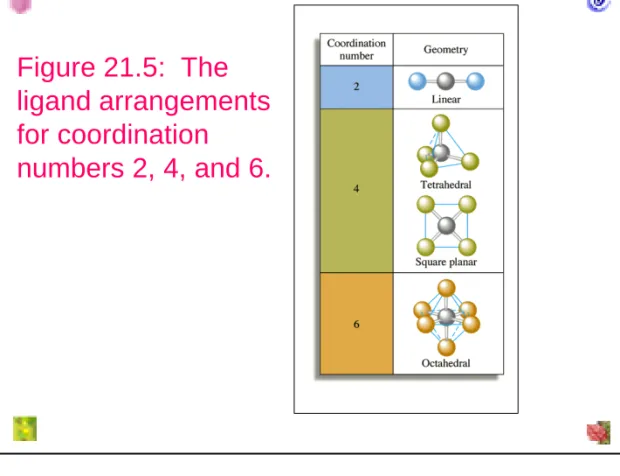
Figure 21.4: The structures of the
chromium(VI) anions: (a) Cr
2O
72-, which exists in acidic solution, and (b) CrO
42-, which exists in basic solution.
Mn
1. 含量上相對豐富(0.1% of the earth’s crust)
2. 用於製造岩石壓碎機、銀行金庫、裝甲鋼板等特別硬的鋼材 3. +7∼ +2價氧化態都存在,其中於+7及 +2價最常見。 Mn2+
與所有常見陰離子形成 鹽類。在水溶液中Mn2+
形成淡粉紅色Mn(H2O)62+。
Fe
1. 含量最豐富的重金屬 (4.7% of the earth’s crust) 2. 白色、光亮、硬度不大
3. 在潮濕的空氣中快速的被氧氧 化,形成鐵銹
4. 在化合物中以+2及 +3價氧化 態存在
5. 水合物Fe(H2O)62+呈現淡綠 色, Fe(H2O)63+無色
Co
1. 用於製造不銹鋼及鎢鉻鈷合金 2. 在化合物中主要以+2及 +3價
氧化態存在
Ni
1. 在地殼中含量排列第24 2. 銀白色,具有高導電
性、及高導熱性。非常 抗腐蝕,用於放置活性 較高的金屬,也被使用 在合金的製造
3. 在化合物中幾乎以+2價 氧化態存在
Cu
1. 廣泛的分佈在含S, As, Cl,及碳酸鹽的礦物中
2. 具有高導電性及抗腐蝕性,用於鉛管及電子上的應用方 面,及合金的製造
3. 在空氣中慢慢腐蝕,形成銅綠
4. 在化合物中以+1及 +2價氧化態存在,而主要為+2價 5. 微量的Cu為生命所必需,大量的Cu則有劇毒
Zn
1. 廣泛的分佈於地殼中
2. 白色、光澤、活性強,是很好的還原劑 3. 約90%使用於鍍鋅鋼鐵
21.3 Coordination Compounds
typically consists of a complex ion and counter ions(anions or cations as needed to produce a neutral compound).
[Co(NH3)5Cl]Cl2 [Fe(en)2(NO2)2]2SO4 Na3[Mo(CO)3(CN)3]
Coordination Number
Figure 21.5: The ligand arrangements for coordination
numbers 2, 4, and 6.
a neutral molecule or ion having a lone electron pair that can be used to form a bond to a metal ion (Lewis base).
coordinate covalent bond: metal-ligand bond
monodentate ligand: one bond to metal ion
polydentate ligand
(chelate): can form more than two bonds to a metal ionA Ligand
Figure 21.6:
(a) The bidentate ligand ethylenediamine can bond to the metal ion through the lone pair on each nitrogen atom, thus forming two coordinate covalent bonds.
(b) Ammonia is a monodentate ligand.
Figure 21.7:
The coordination of EDTA
with a 2+ metal ion.
Naming Coordination Compounds
[Co(NH3)
[
Co(NH3)55Cl]ClCl]Cl
221. Cation is named before the anion.
“chloride” goes last
2. Ligands are named before the metal ion.
ammine, chlorine named before cobalt
3. For ligand, an “o” is added to the root name of an anion (fluoro, bromo). For neutral ligands the name of the molecule is used, with exceptions NH3,
H2O, CO
4. The prefixes mono-, di-, tri-, etc., are used to denote the number of simple ligands.
pentaammine
5. The oxidation state of the central metal ion is designated by a (Roman numeral).
cobalt (III)
6. When more than one type of ligand is present, they are named alphabetically.
pentaammine chloro
7. If the complex ion has a negative charge, the suffix
“ate” is added to the name of the metal.
pentaamminechlorocobalt (III) chloride
21.4 Isomerism
結構異構物:含有相同原子,但是 有一個或多個不同的鍵結
立體異構物:所有鍵結都相同,但 是原子的空間排列不同
Structure Isomerism
coordination isomerism: The composition of the complex ion varies.
[Cr(NH3)5SO4]Br and [Cr(NH3)5Br]SO4 [Co(en)3][Cr(ox)3] and [Cr(en)3][Co(ox)3]
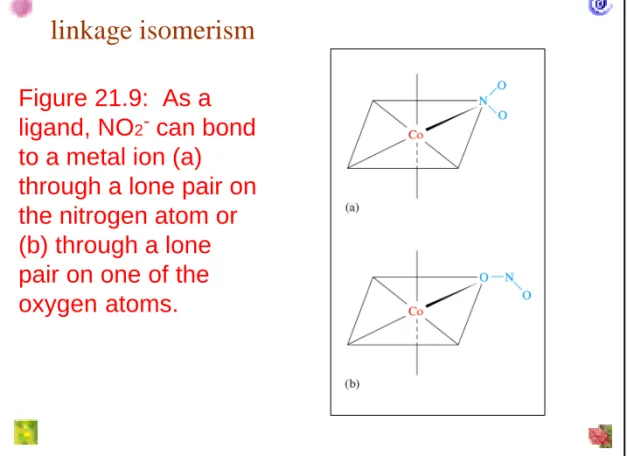
linkage isomerism: Same complex ion structure but point of attachment of at least one of the ligands differs.
[Co(NH3)4(NO2)Cl]Cl and [Co(NH3)4(ONO)Cl]Cl yellow red
linkage isomerism
Figure 21.9: As a ligand, NO
2-can bond to a metal ion (a) through a lone pair on the nitrogen atom or (b) through a lone pair on one of the oxygen atoms.
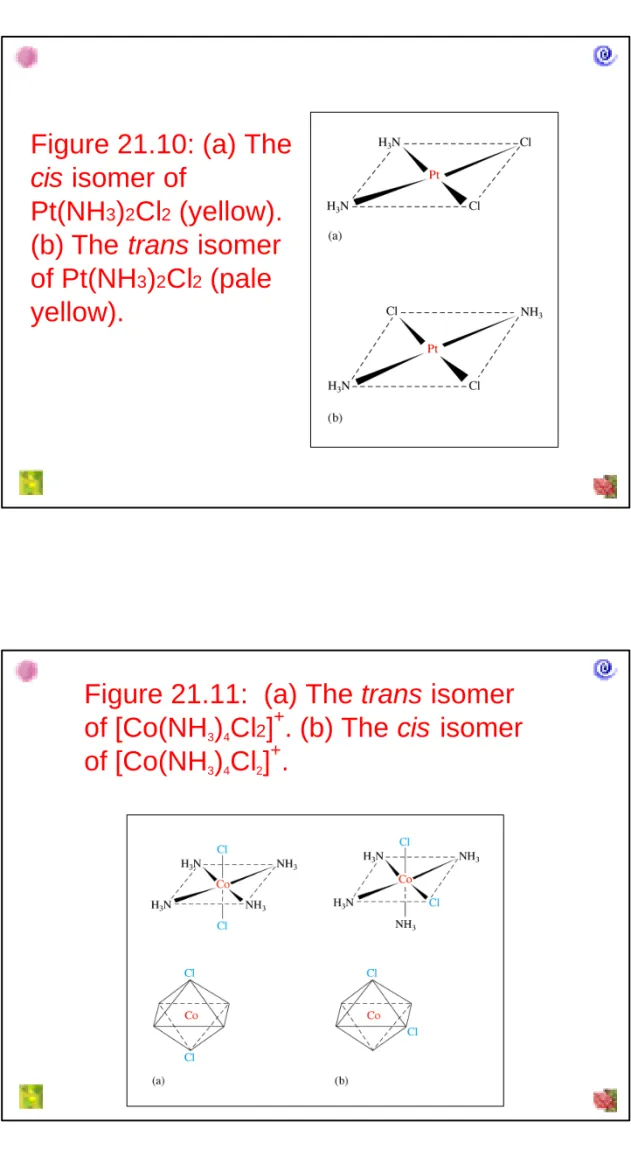
geometrical isomerism (cis-trans): Atoms or groups of atoms can assume different positions around a rigid ring.
Pt(NH3)2Cl2
optical isomerism: the isomers have opposite effects on plane-polarized light.
Stereoisomerism
Figure 21.10: (a) The cis isomer of
Pt(NH3)2Cl2 (yellow).
(b) The trans isomer of Pt(NH3)2Cl2 (pale yellow).
Figure 21.11: (a) The trans isomer of [Co(NH3)4Cl2]+. (b) The cis isomer of [Co(NH3)4Cl2]+.
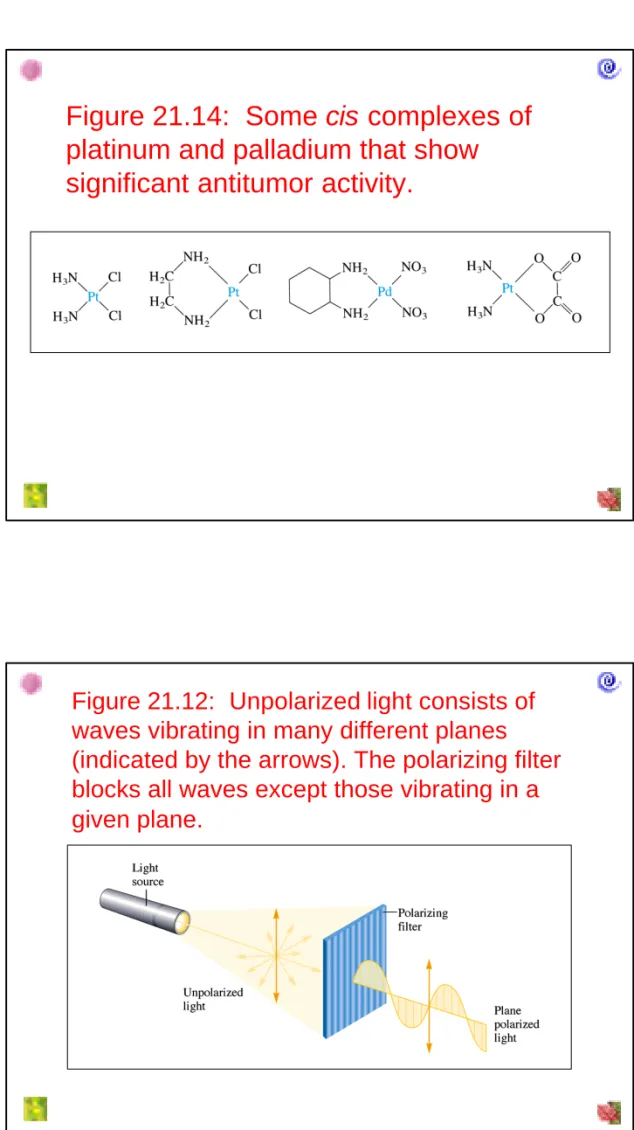
Figure 21.14: Some cis complexes of platinum and palladium that show significant antitumor activity.
Figure 21.12: Unpolarized light consists of
waves vibrating in many different planes
(indicated by the arrows). The polarizing filter
blocks all waves except those vibrating in a
given plane.
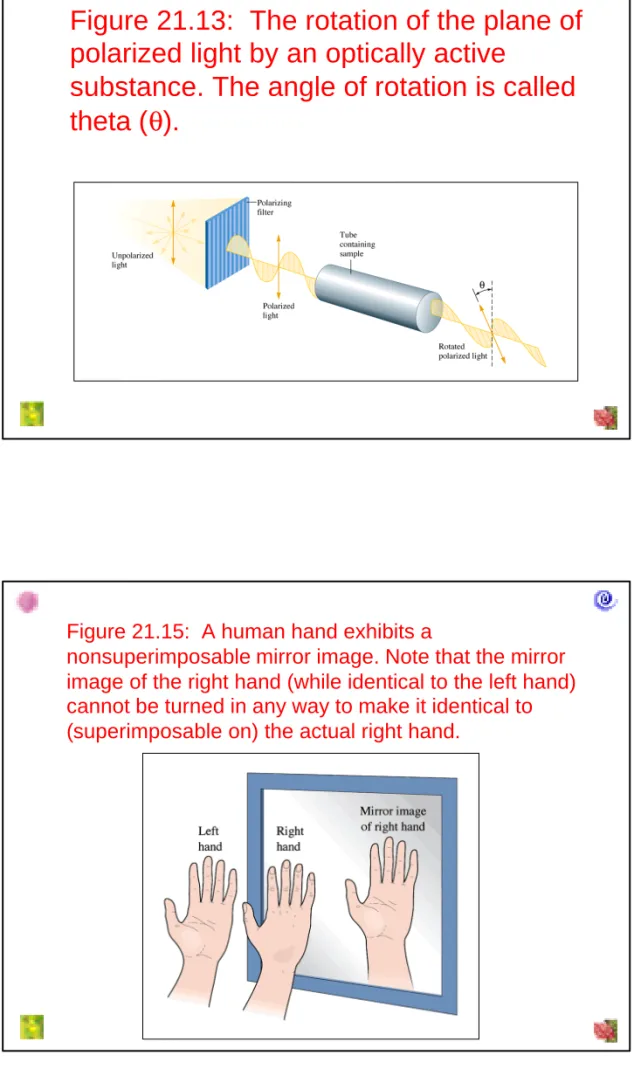
Figure 21.13: The rotation of the plane of polarized light by an optically active
substance. The angle of rotation is called theta (θ).
Figure 21.15: A human hand exhibits a
nonsuperimposable mirror image. Note that the mirror image of the right hand (while identical to the left hand) cannot be turned in any way to make it identical to (superimposable on) the actual right hand.
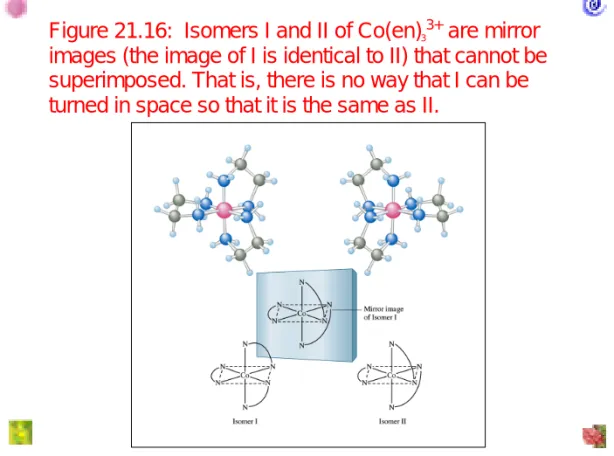
Figure 21.16: Isomers I and II of Co(en)3
3+ are mirror images (the image of I is identical to II) that cannot be superimposed. That is, there is no way that I can be turned in space so that it is the same as II.
物體如果具有不可重疊的鏡像,則物體具有對掌性,
物體與它的鏡像互為鏡像異構物
具有不可重疊鏡像的異構物稱為:enantiomers 會使平面極化光偏折,因此是光學異構物
使平面極化光轉向右邊的異構物稱為:dextrorotatory 使平面極化光轉向左邊的異構物稱為:levorotatory 含有等量 l 及 d form 異構物的混合(溶液)稱為:
racemic mixture,會彼此抵銷效應,不會使平面極化 光偏折
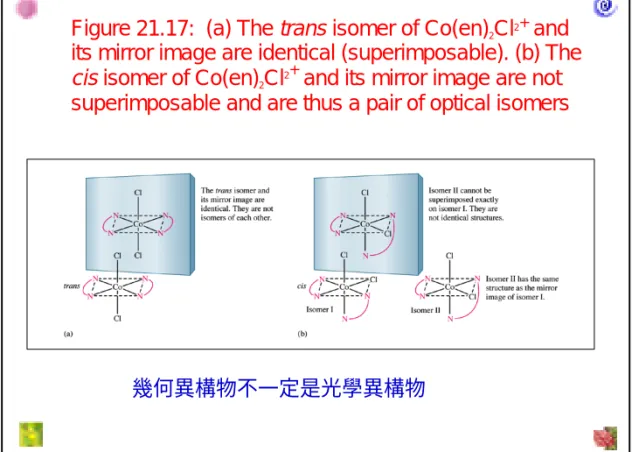
Figure 21.17: (a) The trans isomer of Co(en)2Cl2+and its mirror image are identical (superimposable). (b) The cis isomer of Co(en)2Cl2+ and its mirror image are not superimposable and are thus a pair of optical isomers
幾何異構物不一定是光學異構物
21.5 Bonding in Complex Ions:
The Localized Electron Model
Figure 21.18: A set of six d2sp3 hybrid orbitals on Co3+ can accept an electron pair from each of six NH3 ligands to form the Co(NH3)6
3+ ion.
Figure 21.19:
The hybrid orbitals
required for tetrahedral,
square planar, and
linear complex ions.
Pt ↓↑ ↓↑ ↓↑ ↓ ↓5d 1
Valence bond theory
---- 利用coordinate covalent bond解釋鍵結,由 Pauling 在1930s提出,可以解釋分子形狀及磁性。
例: PtCl2-4 square planar, diamagnetic
2+
8
21.6 Crystal Field Model
focuses on the energies of the d orbitals.
Assumptions
1. Ligands are negative point charges.
2. Metal-ligand bonding is entirely ionic.
strong-field (low-spin):
large splitting of d orbitalsweak-field (high-spin):
small splitting of d orbitalsFigure 21.20: An octahedral arrangement of point-charge ligands and the orientation of the 3d orbitals.
Figure 21.21: The energies of the 3d orbitals for a metal ion in an octahedral complex.
Figure 21.22: Possible electron arrangements in the split 3d orbitals in an
octahedral complex of Co3+
(electron configuration 3d6).
(a) In a strong field (large ? value), the electrons fill the t2gset first, giving a
diamagnetic complex. (b) In a weak field (small ? value), the electrons occupy all five orbitals before any pairing occurs.
(a) Co(NH3)6 ; (b) CoF6
3+ 3-
例
(a) Spectrochemical series:
CN-> NO2- > en > NH3 > H2O > OH- > F-> Cl- > Br-> I-
Strong field weak field
(b)
∆隨著metal ion的電荷增加而增加
Co(NH
3)
6weak-field complex Co(NH
3)
6strong-field complex
2+
3+
(c) ∆值第二、三週期過渡金屬 >第一週期過渡金屬
Figure 21.23: The visible spectrum.
Figure 21.24:
(a) When white light shines on a filter that absorbs in the yellow-green region, the emerging light is violet. (b) Because the complex ion Ti(H2O)6
3+ absorbs yellow- green light, a solution of it is violet.
紅 橙
黃 藍 綠
紫
Figure 21.25: The complex ion Ti(H
2O)
63+can absorb visible light in the yellow-green region to transfer the lone d electron from the t
2gto the e
gset.
Solutions of [Cr(NH3)6]CI3 (yellow) and [Cr(NH3)5CI]CI2 (purple)
Other Coordination Geometries
Other Coordination GeometriesFigure 21.26: (a) Tetrahedral and octahedral arrangements of ligands shown inscribed in cubes.(b) The orientations of the 3d orbitals relative to the tetrahedral set of point charges.
x y z
Figure 21.27: The crystal field diagrams for octahedral and tetrahedral complexes.
Td complexes 通常為 weak-field; ∆tet= 4/9 ∆oct
Figure 21.28: (a) The crystal field diagram for a square planar complex oriented in the xy plane with ligands along the
x and y axes.
(b) The crystal field diagram for a linear complex where the ligands lie along the z axis.
21.7 The Biologic Importance of Coordination Complexes
Figure 21.29: The heme (原血紅素) complex, in which an Fe
2+ion is coordinated to four nitrogen atoms of a planar porphyrin
ligand.
Figure 21.30: Chlorophyll (葉綠素)is a porphyrin complex of Mg2+. There are two similar forms of chlorophyll, one of which is shown here.
Figure 21.31: A representation of the myoglobin(肌紅蛋白) molecule.
Figure 21.32: A representation of the hemoglobin
(血紅素)
structure.Figure 21.33: A normal red blood cell (right) and a sickle cell (left), both magnified 18,000 times.
21.8 Metallurgy and Iron and Steel Production
Figure 21.34: A schematic diagram of a cyclone separator(氣旋分離器).
Figure 21.35: A schematic representation of zone refining.
Figure 21.36: The blast furnace used in the production of iron.
Figure 21.37: A schematic diagram of the open hearth process for steelmaking.
Figure 21.38: The basic oxygen process for steelmaking.