Chapter Two
Literature Review and Linguistic Properties of Zenme and Hui
In this chapter, Section 2.1 discusses two related studies of zenme. Section 2.2 examines the linguistic properties of the wh-word zenme, modal verb hui and their interpretations. Section 2.3 reviews some research on the sequence of acquisition of causal and manner questions. Finally, a summary of this chapter will be given in Section 2.4.
2.1 Previous Theoretical Studies of Zenme
In this section, we will review two related studies of the wh-word zenme by Lin (1992), and Tsai (2000) in Chinese.
2.1.1 Lin (1992)
Lin argues that weisheme is base-generated in the Spec of CP and zenmeyang is base-generated within VP. There are two arguments for the position of weisheme.
Take (1) for example.
(1) Why/*When/*Where/*How didn’t he go?
Lin argues that a wh-word may not move across a negation not. That is to say, the grammaticality of (1) lies in that the wh-word why does not exhibit the blocking effect under the assumption that it is base-generated higher than not. Moreover, why is argued to be in the Spec of CP in (2).
(2) a. Why do you believe John is crazy?
b. *Why do you believe John to be crazy?
c. Why do you think John is foolish?
d. *Why do you think John foolish?
For (2b) and (2d), why, semantically, cannot be interpreted as asking for a reason for
John’s being crazy or foolish. The two sentences can be a small clause or be an Exceptional Case-marking clause (i.e., IP complement.) Contrarily, the well-formedness of (2a) and (2c) involves two embedded clauses, which are CPs. The embedded clauses in (2b) and (2c) are only IPs, while those in (2a) and (2c) are CPs.
Since (2b) and (2d) do not contain a CP complement, why can not originate in the embedded clauses.
The argument that zenmeyang is within VP can be supported by the VP-deletion and the ba construction. First, manner adverbs are deleted along with the verb phrases.
(3) Lisi henkuaidi likai le fanjian, Zhangsan ye shi.
Lisi quickly leave PF room Zhangsan also be
‘Lisi left the room quickly, and Zhangsan did, too.’
Second, the ba construction favors zenmeyang in VP, as can be seen in (4):
(4) a. Ta zixidi ba xin kan-wan le.
he carefully BA letter read-finish PF
‘He has read the letter carefully.’
b. Ta ba xin zixidi kanwan le.
he BA letter carefully read-finish PF
‘He has read the letter carefully.’
In Chinese literature, ba-phrases are often analyzed as a constituent immediately dominated by VP. Therefore, the manner adjunct zenmeyang, responded with zixidi in (4), is part of a VP.
The structural difference between weisheme and zenmeyang leads to different syntactic distributions. First, weisheme can either precede the subject or follow the subject, and zenmeyang can only follow the subject.
(5) a. Weisheme ta zuotian mei lai?
why he yesterday NEG come
‘Why didn’t he come yesterday?’
b. Ta weisheme zuotian mei lai?
he why yesterday NEG come
‘Why didn’t he come yesterday?’
Suppose weisheme is base-generated in the Spec of CP, (5a) is the deep structure and (5b) is the derived form. In (5b), the subject NP ta ‘he’ may undergo topicalization and be adjoined to CP (Tajima and Arimura 1988) and become the topic of the sentence.
(6) a. Ta zenmeyang chuli na jian shi?
he how handle that CL matter
‘How did he handle the matter?’
b. *Zenmeyang ta chuli na jian shi?
how he handle that CL matter
‘How did he handle the matter?’
Since zenmeyang is a manner adverb used to modify VP, based on the Adjunct Projection Principle or the Adjunct Licensing Theory1, it must be licensed by V within VP as its scope of modification. Therefore, when zenmeyang is placed sentence-initially, it will have a wrong scope of modification.
The second different syntactic distribution between weisheme and zenmeyang lies in that the former can only occur in the object position followed by conjecture verbs while the latter can occur in the object position followed by both conjecture
1 According to Travis (1988) and Tang (1990), adjuncts are licensed by heads and may be generated under the projection of a head if and only if it is licensed by the head. This is quite similar to the Adjunct Projection Principle by Sportiche (1988), ‘If some semantic type X “modifies” some semantic type Y, and X and Y are syntactically realized as a and b, a is projected as adjacent either to b or to the head of b.’
verbs and opinion verbs. The Empty Category Principle is used to account for this asymmetry.
(7) a. Ni shuo/cai/renwei weisheme ta zuotian mei lai?
you say/guess/think why he yesterday NEG come
‘Why do you say/guess/think he didn’t come yesterday?’
b. *Ni xiangxin/xiwang/jiading weisheme ta mei lai?
you believe/hope/assume why he NEG come?
‘Why do you believe/hope/assume he didn’t come?’
(8) a. Ni shuo/cai/xiang/renwei ta hui zenmeyang zuo?
you say/guess/thinkg/think he will how do
‘How do you say/guess/think/think he will do it?’
Conjecture verbs and opinion verbs involve two different Comps. One is called the Strong Comp, which is with the conjecture verb functioning as a matrix verb and attached to the embedded clause, as shown in (9a) and may be lexically filled by a particle, and the other is the Weak Comp, as shown in (9b), which is with the opinion verbs functioning as a matrix verb and cannot occur with a particle (See Tang 1988):
(9) a. Ni cai/xiang/yiwei/renwei/shuo [ta hui lai ma]?
you guess/think/think/think/say he will come QP
“Do you guess/think/think/think/say he will come?”
b. Ni xianxin/xiwang/danxin [ta hui lai] ma you believe/hope/worry he will come QP
‘Do you believe/hope/worry he will come?’
Recall that weisheme is based-generated in the Spec of CP. Thus, when it is extracted at LF, the initial trace is in the Spec of CP. Since the complement clauses in (7a) and (7b) are both full CPs theta-marked by the matrix verbs, the embedded CP is not a barrier, and the extraction of weisheme ‘why’ at LF should go through without a
violation of antecedent-government for (7a) and (7b). This suggests that the contrast between (7a) and (7b) results from the requirement of head-government. In other word, the requirement of head-government is not satisfied in (13b), but satisfied in (7a). In sentences (7), the only possible head governor for the Spec of CP is Comp.
The higher matrix verb, though it governs the trace, does not count as a head governor, since it does not Case-mark or theta-mark the trace. But with a scope over the whole clause, weiheme ‘why’ can be licensed by Comp according to the adjunct licensing theory and projected under a projection of Comp (cf. C.-C.J. Tang 1990, Travis (1998).) Suppose that unless Comp can be filled lexically by something strong can it serve as a proper governor, it may not be a proper head-governor. It follows that only the trace left by weisheme in (7a) is head-governed by the embedded strong Comp; on the other hand, the embedded Comp in (7b) is inert for government and thus the trace left fails to satisfy the requirement of head-government and thus is ungrammatical.
To sum up, Lin argued the different position of weisheme and zenmeyang.
Weisheme is in the Spec of Comp, and zenmeyang is within VP. This difference in position leads to their different syntactic distributions, in which the type of Comp selected by the matrix verbs plays a role.
Lin succeeded in explaining the syntactical distribution of zenmeyang and weisheme. Nevertheless, regarding zenmeyang, there is one more meaning of zenmeyang left in the discussion. Zenmeyang discussed in this study modifies the VP, and indicates the manner in which the action is performed. In addition to the manner meaning, zenmeyang can also suggest the result of some actions, and the position of this result zenmeyang is left unexplained, as in (10):
(10) A: Zuotian bisai, Lisi ge chang de zenmeyang?
yesterday game Lisi song sing de how
‘How was Lisi’s singing in the singing contest yesterday?’
B: Ta nadao guanjun.
he got championship
‘He won the championship.’
2.1.2 Tsai (2000)
Different from Lin (1992), who mainly discusses zenmeyang ‘how’ and the genuine ‘why’ weisheme, Tsai discusses the meanings of zenme ‘how’ and its related meaning ‘why’ and its how-why alternation in Mandarin Chinese from syntax-semantic interface perspective.
There are three types of interpretations: the manner reading, the causal reading, and the degree reading. The factors contributing to these three differences are (a) relative position of zenme to modals, frequency adverbs, and the negative bu/mei, (b) the quality of the verbs and predicates, (c) the agent-hood of the subject in the sentence, and (d) the property of being realis/irrealis.
The first type is manner zenme, which can be further divided into three sub-types, the method as in (11a) and the style as in (11b) and the means as in (11c).
(11) a. A: A.Q zenme lai?
A.Q how come
‘How does A.Q come?’
B: Da che lai.
take car come
‘By car.’
b. A: A.Q (pinchang) zenme shui?
A.Q usually how sleep
‘How does A.Q usually sleep?’
B: Ce zhe shui.
side DUR sleep
‘On his side.’
c. A: A.Q zenme qu Taipei?
A.Q.how go Taipei
‘How will A.Q. go to Taipei?’
B: Zou gaosu gonglu.
walk high-speed road
‘On the freeway.’
The second type is causal zenme, which scopes over modal verbs, frequency adverbs and negative bu. In addition, when zenme co-occurs with stative predicates (mang ‘busy’/congming ‘smart’) as shown in (12a) and noncausative psych verbs as in (12b), only the causal reading is possible.
(12) a. A.Q. zenme zheme congming?
A.Q. how so smart
‘How come A.Q is so smart?’
b. A.Q. zenme zheme pa XiaoD.?
A.Q. how so afraid of XiaoD.
‘How come A.Q. is so afraid of XiaoD.?’
Furthermore, if the subject is not an agent, even with a causative psych verb, only the causal zenme is possible. For example, the subject in (13) is not an agent, but a causer:
(13) Zhe bu dianyin zenme zheme xia-ren?
this CL movie how so scary-people
‘How come this movie is so scary?’
On the other hand, when the subject is agentive, both the manner reading and the causal reading are possible as in (14).
(14) a. A.Q (mei shi) zenme xia XiaoD.?
A.Q NEG reason zenme scare XiaoD.
‘How come A.Q scared Xiao.D without any reason?’
b. A.Q (na tian) zenme xia XiaoD.?
A.Q that day how scare XiaoD.?
‘How did A.Q scare XiaoD. that day?’
Thirdly, when co-occurring with aspect showing realis, zenme allows causal reading as shown in (15).
(15) A.Q. zenme zai shuijao?
A.Q. how PROG sleep
‘How come A.Q. is sleeping?’
Similar to English how and how many, the last type is the degree reading, as shown in (16):
(16) Lisi bu zenme xi che.
Lisi NEG how wash car
‘Lisi does not wash the car very often.’
Based on the distribution and the interpretations of zenme, Tsai claims that the syntactic position of causal zenme is much higher than its manner counterpart. In other words, his analysis supports the assumption that why is an adjunct with sentential scope, behaving like a matrix predicate. On the other hand, the manner zenme behaves more like a VP modifier, and thus is sensitive to subject agentivity.
However, weisheme ‘why’ cannot have the manner meaning because weisheme is not related to the subject’s intention and purpose.
To sum up, the wh-word zenme is analyzed in a way that its syntactic distributions reflect its interpretations. The causal interpretation is in the higher position and the manner interpretation is in the lower position, which echoes Lin’s
(1992) analysis on the position of weisheme ‘why’ and zenmeyang ‘how’. On the other hand, weisheme fails to have the how-why alternation. That is, weisheme cannot have the manner reading.
Tsai provides a clear picture of the how-why alternation of the question word zenme and a thorough description of its meaning and corresponding syntactic
distribution and constraint. Based on the discussion, when the subject is not an agent, zenme can only have the causal meaning. Nevertheless, with a context given, there are some cases in which the manner meaning is still possible with a non-agent subject, as in (17):
(17) A: A.Q.hui zenme xihuan XiaoD.?
A.Q.will how like XiaoD.
‘How will A.Q like XiaoD.?’
B: Toutoudi xihuan.
secretly like
‘(He) likes XiaoD. secretly.’
With the verb xihuan, A.Q. is more like an affected argument than an agent.
2.2 Linguistic Properties of Zenme and Hui
Every language has its own devices to form questions. In Mandarin Chinese, one of the devices is to use wh-words. Chinese question words are semantically equivalents to such English words as who, what, where, how, why, and so on.
Interestingly, one of these wh-words in Chinese, zenme, denotes the meanings of how and why at the same time. What follows is a discussion of the meanings and uses of zenme as in Section 2.2.1. and the modal verb hui as in Section 2.2.2, and the interpretations of zenme with hui as in Section 2.2.3.
2.2.1 Semantic Classifications of Zenme
The use of wh-words in Chinese can be interrogative use or non-interrogative.
Since the purpose of the present study is to investigate preschoolers’ acquisition of zenme questions, we will only discuss its interrogative use2.
One of the most noticeable semantic properties of zenme in interrogative use is the alternation of how-and-why, which corresponds to the use of asking manners3 and causes.
Meaning 1: Manner
The manner zenme can be used to ask about in what way and style and by what means an action is carried out when it occurs right before a verb, as shown below.
2 The non-interrogative use of zenme involves the notion of degree, exclamation, and correspondence, as shown in (i), (ii), and (iii), respectively.
(i) Jingtian de tianqi bu zenme leng.
today POSS weather NEG how cold
‘It is not that cold today.’
(ii) Zenme ni hai mei hui qu a.
how you still NEG back go QP
‘What! You are still here!’
(iii) Ni zenme dui wo, wo jiou zenme dui ni.
you how treat me I will how treat you
‘I will treat you in the same way you treat me.’
3 According to Tsai (2000), the interpretation of zenme can be further divided into three types, as in (i), (ii) and (iii). (i) refers to the method reading of zenme, (ii) the mean reading, and (iii) the style reading.
In the present study, we will not further distinguish these interpretations, and we use the general term manner to cover all different interpretations.
(i) A: Ni hui zenme qu Taipei?
you will how go Taipei
‘How will you go to Taipei?’
B: Kai che qu.
drive car go
‘I will drive the car.’
(ii) A: Ni hui zenme qu Taipei?
you will how go Taipei
‘How will you go to Taipei?’
B: Zou gaosugonglu.
walk highway
‘Through highway.’
(iii) A: Ni pingchang zenme shuei?
you usually how sleep
‘How do you usually sleep?’
B: Ce shui.
side sleep
‘On my side.’
(18) A: Ni zenme zhu zhe dao cai?
you how cook this CL dish
‘How will you cook this meal?’
B: Yong da huo zhu.
with big fire cook
‘Cook the meal with big fire.’
Meaning 2: Causal
However, when zenme is not directly followed by a verb, then zenme usually carries a causal meaning. The causal zenme is found when it is followed not directly by verbs but by a negative like bu ‘not’ or mei ‘not’ or frequency adverbs like changchang
‘often’ or zongshi ‘always.’
(19) Ni zenme mei zhu zhe dao cai?
you how NEG cook this CL dish
‘How come you didn’t make the dish?’
(20) Ni zenme changchang zhu zhe dao cai?
you how often make this CL dish
‘How come you often make the meal?’
When a speaker utters a question which asks about causes, some events must have happened or is going to happen. Hence, the proposition of the sentence must be presupposed. In other words, the event being questioned in (21) and (22) must have happened or is going to happen before they are asked. Based on this, we may infer that the aspect markers denoting events that have already happened or are going to happen can also attribute to the causal zenme.
(21) Ta zenme zai xizao?
he how PROG take a bath
‘How come he is taking a bath (now)’
(22) Ta zenme chi le fan cai chuxian ne?
ta how eat PF rice just show-up QP
‘How come he did not show up until he had his meal? ’
Accordingly, it seems natural to conclude that the causal zenme appears when the notion of realis is involved (cf. Tsai 2000).
2.2.2 Semantic Classification of Hui
Lyon’s (1977) classification of modality—epistemic and deontic—has been widely accepted as the two most semantically fundamental kinds of modality (Bybee et al. 1994, Palmer 1990, van der Auwera & Plunguan 1998). As defined by Lyon, epistemic modality refers to ‘the speaker’s opinion or attitude towards the proposition that the sentence expresses or the situation that proposition describes (p. 452) and deontic modality is ‘concerned with the necessity or possibility of acts performed by a morally responsible agent (p. 823) In other words, epistemic modality is about the speaker’s attitude towards the proposition content of an utterance, rather than actions, states, events, etc. Deontic modality is about speaker’s hope about how the world should be, in which the speaker gives permission and lays obligations on others. In addition to these two basic kinds of modality, Palmer (1990) adds a third kind of modality—dynamic. Dynamic modality is basically about the ability or volition of the subject of the sentence. As far as the modal hui is concerned, the modal hui can be epistemic and dynamic (Li 2004). In addition, Tang (1979) indicates hui has two meanings. One is capacity hui and the other is predictive hui. The former refers to knowledge, skills, and physical ability etc. and the latter refers to the judgment on the possibility of an event.
Meaning 1: Dynamic (capacity)
Sentences (23) ~ (25) are examples for the capacity hui all taken from Tang
(1979). The modal hui shows the knowledge and skills of the subject.
(23) Ta hui tiaowu.
he can dance
‘He can dance.’
(24) Ta hui shuo san zhong yuyan.
he can speak three CL languages
‘He can speak three languages.’
(25) Ta hui kan xiang.
he can read face
‘He can tell your future from the faces.’
Actually, Lu (1980) further defines the capacity hui as ‘ability and knowledge of doing something’ and ‘being good at doing something.’ Examples for ability-knowledge hui are shown in (23) ~ (25). As for hui to mean ‘being good at’, some modifiers such as hen ‘very,’ zhen ‘really,’ and zui ‘the most’ are usually added, as in (26).
(26) Ta hen hui kan-xiang.
he very can read-face
‘He is very good at telling the future from the faces.’
Actually, both of these two huis show the ability of the subject ta ‘he.’
Accordingly, the huis as in (23) ~ (26) belong to the dynamic modality.
Meaning 2: Epistemic4
The other meaning of hui pointed out by Tang (1979) is the predictive hui. This
4 If we take a closer look at (27) and (29), we can see that these two sentences can also be deontic (cf.
Huang 1999). As Lyon (1977) argues, deontic modality comes from two functions of language: to indicate or express one’s wants or desire and to get things done by imposing one’s will on other agents.
That is to say, deontic modality is essentially performative (Palmer 1990). Simply put, speakers use the deontic modals to influence listeners’ behaviors and thoughts. Accordingly, (27) can be said by a mom who wants her children to put on a coat before they go out in the cold weather. (29) can be said by a person who tries to stop his son from going out.
hui can be used to make judgments or to show the speaker’s attitude toward an event in the future, in the past or at present, as shown in (27) ~ (29):
(27) Ni zheyang hui ganmao. (Tang 1979)
you doing-this will catch-cold
‘You will catch a cold if you do this.’
(28) Mei xiangdao hui zheme shunli.
NEG think would so without difficulty
‘It came as a surprise that something was done without any difficulty.’
(29) Xianzai ta bu hui zai jiali. (Lu 1983)
now he NEG will at home-in
‘He can’t be home right now.’
Sentences (27) ~ (29) are the speaker’s judgments on the possibility of an event described. Therefore, the huis here are epistemic.
Meaning 3: Generic
In addition to the above-mentioned meanings, hui can be generic (Wu 1995), which is not included in Palmer’s classification of modality. Generic hui involves natural laws, habits or personality traits and characteristics of a place, as exemplified below:
(30) Mutou hui fu zai shuimian.
Wood can float on water-surface
‘Wood can float on the water surface.’
(31) Ta hen hui mai dongxi.
she very can buy things
‘She tends to buy many things.
(32) Taipei dongtian hui hen leng.
Taipei winter can very cold
‘It is very cold in Taipei in winter.’
(30) states a natural phenomenon that wood can float on water; (31) describes a person’s tendency to shop; (32) reports a weather condition of a place.
Interestingly enough, hui as in (31) can also be dynamic ‘capacity.’ Thus, (31) can be interpreted as (33):
(33) Ta hen hui mai dongxi.
she very can buy things
‘She is good at buying things.’
The ambiguity between the dynamic ‘capacity’ and generic uses of hui can be easily figured out by context, as shown in (34) and (35), taken from Huang (1999).
(34) Ta hen hui mai dongxi, mei ge libai dou hua henduo qian.
she very can buy thing, every CL week always spend much money
‘She tends to shop. She always spends much money every week.’
(35) Ta hen hui mai dongxi, mai de dongxi dou jingji shihui.
she very can buy things, buy REL things all inexpensive useful
‘She is good at buying thing. Everything she buys is cheap and useful.’
To sum up, there are three meanings of hui: dynamic ‘capacity’—describing one’s ability, epistemic—judging the possibility of an event, and generic—involving natural laws, habits or personality traits and characteristics of a place.
2.2.3 Interpretations of Zenme with the Modal Hui
As we have reported in Section 2.1.1, the wh-word zenme has two meanings, manner and causal. When it occurs with the modal hui, these two meanings still hold but different word orders of zenme with hui lead to different interpretations. For
example, when hui occurs before zenme, the manner interpretation is obtained.
(36) a. Ta hui zenme zhufan?
he will how cook-rice
‘How will he cook?’
b. Ta (hen) hui zenme zhufan?
he very can how cook-rice
‘What is the way X in which he is very good at cooking?’
c. Mutou hui zenme piao zai shuimain?
wood will how float on water-surface
‘How will the wood float on the water?’
In (36), the manner interpretation arises, and three types of hui can also be found.
The first type of hui is epistemic, which indicates the possible ways of cooking, as in (36a). Another other type of hui is dynamic ‘capacity as in (36b).’ It not only confirms the speaker’s ability to cook but further asks the way in which the subject is good at cooking. When asking (36c), the speaker does not question about the quality of wood of floating; instead, he is asking about the way the wood floats. At first sight, (36c) may be frowned on and seems not acceptable. However, with a context, (36c) becomes acceptable. (37) asks about the style in which the wood will float on the creek.
(37) A: Zai na tiao xiaoxi li, mutou hui zenme piao?
in that CL creek in, wood will how float
‘How will the wood float in the creek?’
B: Manmandi piao.
Slowly float
‘(The wood will) Float slowly.’
Comparing (36a) and (36b) with (36c), we can see that there exists different
acceptability. This difference of acceptability may relate to the reading of the questions. (36c) is about natural laws and thus generic, while (36a) and (36b) are about ability and possibility. Therefore, we can see that the genericity of the questions can be a factor affecting the acceptability of the zenme questions in (36). In addition to genericity, agency of the subjects is another factor. Without the answer provided, the question sounds weird:
(38) A: Lisi hui zenme xihuan Zhangsan?
Lisi will zenme like Zhangsan
‘How will Lisi like Zhangsan?’
B: Toutou-di xihuan.
secretly like
“(Lisi) likes Zhangsan secretly.”
Therefore, we can conclude that the combination of the wh-word zenme with hui can lead to two different interpretations, manner and causal. Moreover, it was found that genericity of the questions and agency of the subject may affect the acceptability of zenme questions. This will lead to the following eight types of zenme questions, four sub-types for the manner interpretation, and four sub-types for the causal interpretation, each of which will be discussed in the following sections.
2.2.3.1 Interpretation of Zenme with Hui: Manner
Type 1-1 with an agent subject in nongeneric condition
This type is the most prototypical, as in (39) the same as (36):
(39) a. Ta hui zenme zhufan?
he will how cook-rice
‘How will he cook?’
b. Ta (hen) hui zenme zhufan?
he very can how cook-rice
‘What is the way X in which he is very good at cooking?’
The subject ta an agent5, which carries out the action of zhu ‘cook’ and affects the object fan ‘rice.’ With an agent subject, hui can be epistemic or dynamic ‘capacity’.
The epistemic hui states the speaker’s possible ways of cooking, as in (43a), and the dynamic ‘capacity’ hui indicates the speaker’s ability to cook and in which way he can cook the best.
Type 1-2 with an agent subject in generic condition
An example of this type of zenme questions can be seen in (40). Like the subject in the previous type, huo ‘fire,’ is an agent, which starts the action of burning and affects another entity fangzi ‘house.’
(40) Huo hui zenme shao fangzi?
fire will how burn house
‘How will fire burn a house?’
However, there are two differences between this type and Type 1-1—lower acceptability and lack of the dynamic ‘capacity’ hui. At first sight, sentence (40) sounds strange. However, with a context, (40) can be more acceptable as in (41):
5 In the present study, we will adopt Kreidler’s (1998) classification of semantic roles. In his classification, agent is defined as ‘the role of an argument that by its action affects some other entity.
Tom broke a window.’ Actor is defined as ‘the role of an argument that performs some action without affecting any other entity. Sylvia left.’ Affected is defined as the role of an argument that undergoes a change due to some event or is affected by other entities. Betty likes opera.’
(41) A: Ruguo feng wang dong-bian chui,
if wind toward east-side blow
huo hui zenme shao fangzi.
fire will how burn house
‘If the wind blows in the east, in what way will fire burn a house?’
B: Cong dong-bian wang xi-bian shao.
from east-side to west-side burn
‘It will burn (a house) from the east to the west.’
Besides, this type of question does not exhibit the dynamic ‘capacity’ use of hui since the subject huo ‘fire’ does not have the ‘ability’ to choose the way to burn the house or to be good at burning the house.
Type 1-3 with a nonagent subject in nongeneric condition
Type 1-3 is not as acceptable as Type 1-1. However, like Type 1-2, with a context given, this type is acceptable for most people, as in (42).
(42) A: Lisi hui zenme xihuan Zhangsan?
Lisi will zenme like Zhangsan
‘How will Lisi like Zhangsan?’
B: Toutoudi xihuan.
secretly like
‘Lisi likes Zhangsan secretly.’
In addition, like Type 1-2, this type of question does not exhibit the dynamic
‘capacity’ or generic use of hui. It is not possible for the subject to perform the action xihuan ‘like’ with a nonagent role. According to the classification of semantic roles adopted in the present study, the subject Lisi is an affected argument in essence. In other words, Lisi can not actively start the action; instead, he is the one who is
influenced. Besides, the condition cannot be generic since Lisi’s liking Zhangsan is subject neither to a natural law nor Lisi’s habits and personality traits.
Type 1-4 with a nonagent subject in generic condition
The last type of manner zenme is with a nonagent subject in generic condition.
(43) Mutou hui zenme piao zai shuimain?
wood will how float on water-surface
‘How will the wood float on the water?’
The subject mutou is neither an agent nor an affected argument because it neither starts an action on other entities nor gets affected by them. It is an actor according to the definition. Like the previous two types, Type 1-4 is not so acceptable at first sight unless a context is given.
(44) A: Zai na-tiao xiaoxi li, mutou hui zenme piao?
in that creek in wood will how float
‘How will the wood float in the creek?’
B: Manman-di piao.
slowly float
‘(The wood will) Float slowly.’
Furthermore, this type is similar to Type 1-2 and Type 1-3 in that hui cannot be dynamic ‘capacity’ or epistemic ‘predictive’ hui because no intention is involved in this type.
So far, we have discussed four sub-types of zenme with a manner meaning in terms of agency of the subject and the generic conditions. We can make a conclusion that except for Type 1-1 the other types of manner zenme questions need context or answers to ensure their acceptability.
In the following, we will discuss four sub-types of zenme with a causal meaning.
In order to show the differences in interpreting zenme with hui between the two
meanings, the same examples will be used with a change in the word order of zenme and hui.
2.2.3.2 Interpretation of Zenme with Hui: Causal
Type 2-1 with an agent in nongeneric condition
In causal zenme questions asking about causes of some events like (45), hui can be epistemic and dynamic ‘capacity’, both of which can be seen in the translations: a) hui shows the speaker’s attitude toward the proposition of the cooking event; b) hui shows the subject’s ability of cooking. These interpretations indicate the possible causes for the subject’s cooking and his ability to cook.
(45) Ta zenme hui zhufan?
he how can cook-rice
‘How come he cooked (today)?’
‘How is it possible that he knows how to cook?’
Type 2-2 with an agent subject in generic condition
Sentence (46) presents the Type 2-2. It asks about the natural laws that fire can burn down things. Besides, like Type 1-2, the dynamic ‘capacity’ use of hui is banned since no intention of the subject is involved.
(46) Huo zenme hui shao-kua fangzi?
fire how will burn -collapse house
‘How come fire can burn down a house?’
Type 2-3 with a nonagent subject in nongeneric condition
Different from its counterpart in Type 1-3, the causal reading is accepted even without a context.
(47) Lisi zenme hui xihuan Zhangsan?
Lisi how will like Zhangsan
‘How come Lisi likes Zhangsa?’
Hui in (51) belongs to the epistemic type, suggesting the possibility of Lisi’s liking Zhangsan. Neither the dynamic/capacity nor generic use of hui is possible since the verb xihuan does not denote an ability nor it can be learned; thus, the event that Lisi likes Zhangsan is not Lisi’s habit nor his personality traits.
Type 2-4 with a nonagent subject in generic condition
Last, sentence (48) presents the causal zenme questions in generic condition.
Different from its manner counterpart, no context is needed to make the question acceptable.
(48) Mutou zenme hui piao zai shuimian?
wood how can float on water-surface
‘How come the wood can float on the water?’
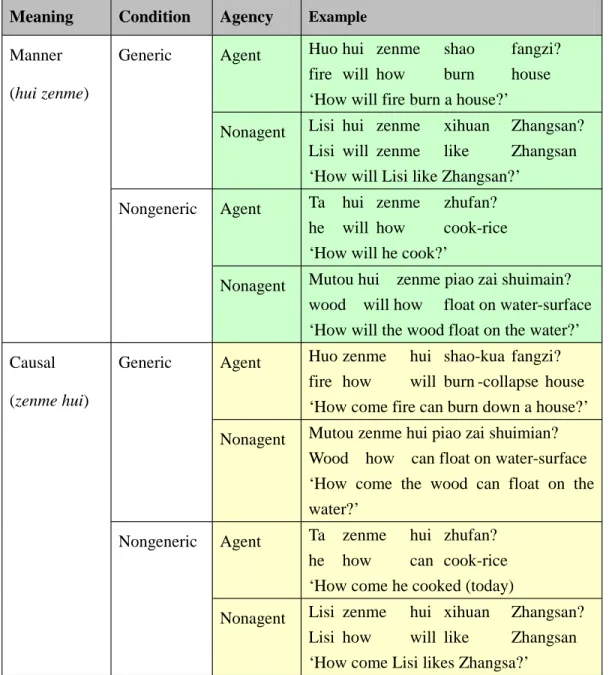
To sum up, we can find that generally speaking the causal interpretation of zenme with hui has a higher degree of acceptability than the manner interpretation. Table 2-1 summarizes our classification of the meaning of zenme with hui in generic and nongeneric condition.
Table 2-1. Classification of the Meanings of Zenme with Hui Meaning Condition Agency Example
Agent Huo hui zenme shao fangzi?
fire will how burn house
‘How will fire burn a house?’
Generic
Nonagent Lisi hui zenme xihuan Zhangsan?
Lisi will zenme like Zhangsan
‘How will Lisi like Zhangsan?’
Agent Ta hui zenme zhufan?
he will how cook-rice
‘How will he cook?’
Manner (hui zenme)
Nongeneric
Nonagent Mutou hui zenme piao zai shuimain?
wood will how float on water-surface
‘How will the wood float on the water?’
Agent Huo zenme hui shao-kua fangzi?
fire how will burn -collapse house
‘How come fire can burn down a house?’
Generic
Nonagent Mutou zenme hui piao zai shuimian?
Wood how can float on water-surface
‘How come the wood can float on the water?’
Agent Ta zenme hui zhufan?
he how can cook-rice
‘How come he cooked (today) Causal
(zenme hui)
Nongeneric
Nonagent Lisi zenme hui xihuan Zhangsan?
Lisi how will like Zhangsan
‘How come Lisi likes Zhangsa?’
2.3 Empirical Studies on the Acquisition of Casual and Manner Questions
In this section, we will review three studies on the sequence of the acquisition of causal and manner questions by Cairns and Hsu (1978), Bloom, Merkin and Wootten (1982), and Clancy (1989).
2.3.1 Cairns and Hsu (1978)
Cairns and Hsu conducted an experimental study on children’s responses to six types of wh-questions: 1) who-subject, 2) who-object using the progressive aspect, 3) who-subject using do-support, 4) why, 5) when, and 6) how. Fifty monolingual subjects from the white middle class participated in their study. These subjects were further divided into five groups with equal number of boys and girls. There were five video segments presented in the same order to the subjects which depicted a family life. After each video, the subjects were asked those six-type questions of the six types in random order, and then went to the next video.
The results showed that, across all ages, the subjects gained the highest scores when answering who-object (do) and who (subject) questions, followed by who-object (progressive) and why questions, and gained the lowest scores in response to when questions and how questions.
As the results indicated, the correct responses to who-object (do) and who-subject, both of which were about equal, were higher than who-object (progressive). The superiority of who-object (do) and who-subject on performance was attributed to the revelation of the grammatical relation in the questions. The grammatical relation of who-object (do) and who-subject questions revealed earlier than that of who-object (progressive). Three examples were used to illustrate the grammatical relation.
(49) Who-subject: Who dressed the boy?
(50) Who-object: do: Who did the boy dress?
(51) Who-object: progressive: Who was the boy dressing?
By the time the subject heard the noun phrase the boy, it was determined that who was the agent of the action in (49) and the recipient in (50). However, in the case of (51), at the time when the boy was heard, the status of who was still not clear. It could be
asking either the referent of the object of the action or the identification of the boy (e.g., Who is the boy dressing the doll?) Such finding indicated that children started looking for answers in their brain while still processing the questions.
As for why-questions, the easiest ones after who-questions, the causality relations developed fairly early. It seemed that the children were able to perceive the causal relations operating in the direction of antecedent-consequent. That is, the interpretation of causal relations depended on the direction of causality.
As for the acquisition of when-questions, it was necessary that the ability to encode temporal relationships rested on the children’s ability to encode causal relationships. Of the responses to the when-questions, 27% of them were
‘temporal-clausal.’ These answers mentioned the causal events as the temporal locus for the questioned event. In other words, the children interpreted the when-questions as related to causality, and thus produced temporal-causal responses. In addition, it was found that when the children interpreted when relationally6, it was always with reference to the preceding events, just as they interpreted the why-question with reference to the antecedent events. Therefore, for young children, temporal relations are like causal relations, moving from ‘left to right.’ Based on this account, Cairns and Hsu concluded that children necessarily progress through some stages to acquire when questions7.
Last, in the case of how-questions, the most difficult question type as shown in
6 In terms of sequencing, an event can be located in time with respect to events preceding it, following it, or simultaneous with it.
7 These five stages are as follows:
Stage I: an inability to encode linguistically either causal or temporal.
Stage II: an ability to encode causal relations in which a consequence event is accounted for by a causal antecedent event.
Stage III: the emergence of the ability to encode temporal relationships between events only if there is a causal relationship between them. Now the consequence event is placed in time in relation to the causal antecedent event.
Stage IV: the emergence of the ability to encode temporal relationships between events which are not causally related. However, the temporal relationship will always encode with reference to a prior event.
Stage V: an ability to encode temporal relationships with reverence to following events. No child achieved at this stage in the present study.
the study, there seemed no central ability that must be mastered before mastery of how.
It was found that the difficult of answering the how-question lay in the lack of sentence production skills. Besides, there was an enormous amount of variability in terms of types of how answers. There were three major types: 1) locative or instrumental responses such as in a dish or with a knife, 2) statements of syntactic form by + V-ing such as by jumping on her, and 3) a statement describing the events such as He put on jelly, then he put on the peanut butter. These types of answers might co-vary with cognitive demands placed on the children who answering the how questions.
In their attempt to investigate the children’s responses to the six-type wh-questions, Cairns and Hu succeeded in conducting a systematic experiment.
However, there was one flaw in their experiment design which caused the biased results. This flaw lies in the mismatch between the questions asked and the content of the video presented to the children. In other words, the answers to the questions asked, especially how questions and why questions, could not be found in the video presented.
In some episodes, the answers to the how or why questions were obvious, but in others such information is missing. On account of this, some children were likely to response with I don’t know or even refused to answer since the video segments presented did not provide the information. Besides, without the obvious information, the children might be forced to respond by inferring from the context, which might be difficult for them, and fail to answer.
2.3.2. Bloom, Merkin and Wootten (1982)
Bloom et al. showed that there were three linguistic factors that co-varied with the sequence of acquisition and determined the cognitive requirements for learning wh-words. These factors were: a) the syntactic function of the wh-words, b) the
complexity of verbs in the questions, and c) the use of wh-questions in different discourse environments.
In this study, seven children were observed longitudinally from 22 months to 36 months. Each of them was the firstborn child from college-educated parents living in university communities in New York City. During the observation sessions, the data were all audio-recorded, and transcriptions included the speech of the children and others; besides, the transcriptions also provided a non-linguistic context (e.g.,.
children’s and others’ actions while speaking). There were 7,877 wh-questions produced in total.
The question acquired earlier in the sequence differed syntactically from those acquired late. The wh-words which first emerged with verbs were where, what, and who. These wh-words asked for the major sentence constituents that they replaced, and were described as wh-pronominals. On the contrary, those late acquired wh-words such as how, why, and when were sentence adjuncts rather than verb arguments of verbs. These later acquired questions were described as wh-sententials, which have a semantic scope that extends over the whole proposition expressed in the sentence.
In terms of verb complexity, the wh-pronominal questions first emerged with the copula. At this time, the children asked for the identities of objects, persons or places with copula in such questions as ‘What’s this?’ and ‘Where’s the girl?’. Regarding to the verb use with non-identifying wh-question, all-purpose pro-verbs (do, go, happen) were mostly used. Do refers to activities in general, go refers to locative actions, and happen refers to completed actions and events. On the other hand, the wh-sentential questions were most likely to occur with another group of verbs, called descriptive verbs, which were semantically more complex such as sing, break, and fix. The results showed that what, where, and who predominately occurred with pro-verbs and the copula, while why and how occurred most with descriptive verbs.
The last analysis was on the discourse. There were three kinds of discourse adjustments that differentiated among the wh-questions with development: verb deletion, linguistic contingency and verb cohesion. First, the verb deletion was of two types, a) obligatory verb deletion (i.e., in complete questions in which a verb is obligatory in adult’s language but deleted in children’s), and b) nonobligatory (i.e., a verb is not expected such in the example as ‘why?’ or ‘What book’ responding to
‘Give me the book.’) The results showed that what, where, and who presented an increase in the pattern of verb ellipsis with non-obligatory verbs. In contrast, how and why presented a pattern of increasing expansion of utterance length with verbs that were optional in the discourse. Second, why questions showed the highest proportion of linguistic contingency and how questions showed the lowest. Third, in terms of verb cohesion, verb cohesion was the greatest with why questions, indicating that even though they mostly occurred with descriptive verbs, why and how functioned differently in discourse. Why questions were responsive to topics initiated by someone else, and how questions introduced new topics.
Bloom et al. provide another analysis for discussing the sequence of wh-words acquisition. Nevertheless, the methodology may pose a question on the sequence of acquiring wh-words. By drawing the conclusion only from the production data, the exact order of acquiring wh-words is not clear. There may be a chance that children have already acquired certain wh-questions but they do not produce them. Therefore, some data from a comprehension task is necessary.
2.3.3 Clancy (1989)
Clancy analyzed the order in which wh-questions were comprehended and produced in Korea, focusing on the meanings of wh-questions and their functions. In this study, two girls, W aged 1;8 and H aged 1;10, were longitudinally observed and
were audio-recorded for one hour in spontaneous interaction with their caregivers every two weeks for a year. The sessions included a wide range of daily activities, such as playing with toys, reading book stories, eating snacks, etc. Throughout the whole observation sessions, W, whose MLU ranged from 1.5 to 3.9, produced 418 questions, and her mother asked a total of 963 wh-questions. H, whose MLU ranged from 1.3 to 3.4, produced 367 wh-questions, and her mother produced a total of 407 wh-questions.
The comprehension and production order of wh-questions for both children were overall similar to previous findings. However, it was obvious that the children had a grasp of some certain wh-questions which occurred only a few months later.
Therefore, the grasp of a particular notion was not a sufficient condition for productive use. Besides, the appearance of wh-forms conformed Bloom et al. (1982) in that certain wh-forms occurred with certain verbs, followed by a gradual expansion to a larger range of linguistic context. Later emergence of how, why, and when was interpreted as a reflection of relative difficulty, abstractness, and heterogeneity of the notions manner/means, causality and temporality.
In addition to the cognition account, input frequency was adopted to account for emergence of the wh-questions of W and H. A Spearsman rank-order correlation was computed for the data. The correlation between frequency and order of production was significant for W and her mother, and was strong although non-significant for H and her mother. Take the acquisition of why for example, which was most frequently used to manipulate or react to the children’s behavior. Why can be either questioning the cause or serving as a rhetorical question and both can be used elliptically or sententially. In the case of H, her mother used a much higher percentage of elliptical why functioning as a rhetorical question, which made it difficult for H to grasp the meaning of causal why. Therefore, H acquired elliptical rhetorical why before using
causal why productive in sentences. On the other hand, W acquired both usages at the same time, which was consistent with the frequency of causal why in her input.
Therefore, the functional potential of particular wh-questions in interaction influenced input frequency, which in turn influenced the order in which wh-questions were acquired.
The other input factor that influenced the sequence of wh-question acquisition was the timing of introduction. In the speech of H’s mother, elliptical why started being used one month after H began responding appropriately. Similarly, W’s mother introduced why in a sentence two weeks after W reached the criterion for productive use for why. Therefore, the two mothers delayed their introduction of causal wh-questions until there was clear evidence from their children’s production or comprehension that they were able to grasp the notion of causality. These results showed that input itself did not constitute an independent determinant on the acquisition, but it itself was constrained by the children’s conceptual limitations. In other words, the children’s conceptual levels affected both the order in which wh-forms can be understood and the timing care-givers introduced them.
The frequency of input and the development of cognition did not guarantee the active use of certain forms. It was found that the function of the form selected must fit the children’s current interests, activities, and purpose in asking questions. The functional account could probably explain the lack of temporal when in the mothers’
speech since the children of two years rarely have the temporal information that their mothers lacked. Consequently, the children did not receive sufficient input of when to permit acquisition.
To sum up, according to Clancy (1989), function influenced the children’s selectivity in production and the frequency of wh-questions input, and this in turn influenced the emergence of the children’s wh-questions. Besides, the conceptual
limitations on the children’s development influenced the wh-questions acquisition by forcing the care-givers to adjust their timing in introducing wh-questions and their frequency in the input. Thus, the functions presented in the input and selected by the children would interact with cognitive development in creating the order in which wh-questions were acquired across languages.
Clancy’s study offers an interesting discussion on the acquisition sequence of wh-questions. Nevertheless, there is no strong evidence for her to argue for the influence of the input frequency. Indeed, the strong correlation between the input frequency and the emergence of wh-forms is statistically significant in W’s production, but not in H production.
2.4 Summary of Chapter Two
In this chapter, we have reviewed two linguistic analyses of the wh-word zenme, focusing on the meaning of how and why. Lin (1992) attempted to argue for the different base-generated position of zenmeyang and weisheme and to explain the asymmetry in the syntactic distribution. Tsai (2000) accounted for the how-why alternations in terms of syntax-semantic interface. The syntactic positions of zenme are related to its interpretations. In addition, we have discussed the linguistic properties of the Chinese wh-word zenme and the modal hui. Also, we have provided a classification of the interpretations (i.e, manner reading and causal reading) of zenme with hui in terms of the agency of subjects and the conditions in which they occur.
Three empirical studies on the acquisition of wh-words have been reviewed as well. Cairns and Hsu (1978) conducted an experimental study and found that the children’s ability to encode the causal relationships lead to the ability to encode temporal relationships, and that the difficulty of manner questions might lie in the
lack of language skill to respond such questions. Bloom et al. (1982) found that three linguistic factors influenced the development of wh-words. Clancy (1989) conducted a longitudinal study on two Korean children and argued for the importance of the frequency of input and the mutual influence of the development of cognition and the input.
Even though these studies reviewed did show the order in which wh-words emerge, the sequence of the acquisition of wh-words is still worth investigation.
Firstly, the studies reviewed in the previous sections put emphasis on wh-forms in general, but the difficulty of how and why has not been discussed much.
Furthermore, most of the studies are conducted in languages other than Mandarin Chinese. Therefore, the present study may fill part of the gap by examining the ambiguous zenme, which can be used to ask how questions and why questions.
Based on linguistic properties and classification of zenme with hui, the methodology and the experiment designs of the present study will be presented in Chapter Three.