Higher moisture content associated with the greater emission of DEHP from the plastic wallpaper
Nai-Yun Hsu1, Yu-Chun Liu1, Chia-Wei Lee2, Ching-Chang Lee1, Huey-Jen Su1,*
1 National Cheng Kung University, Tainan, Taiwan
2 National Kaohsiung First University of Science and Technology, Kaohsiung, Taiwan
*Corresponding email: [email protected]
SUMMARY
Water damage and damp problem in buildings is becoming more prevalent due to the increasing frequency of extreme precipitation and flooding events under the impact of climate change.
However, the effects of the moisture levels on the phthalate emission from building materials are still underreported. This study aimed to evaluate the effect of moisture content (MC) on the level of the di-(2ethylhexyl) phthalate (DEHP) emitted from the plastic wallpaper within 15 days in the closed chamber. The scenario of short-term exposure profile of the phthalate in the indoor environment after suffering from water damage was simulated. The results shown that higher DEHP concentrations emitted into the air and deposited on the dust were found with higher MC in the wallpapers.
PRACTICAL IMPLICATIONS
Preventing dampness problem or improving moisture resistance of building materials is not only critical to control microbial burdens but also chemical exposures such as phthalates in indoor environments.
KEYWORDS
Di-(2ethylhexyl) phthalate, building material, wallpaper, dampness, moisture
1 INTRODUCTION
Bornehag et al. (2005) indicated that the higher concentration of n-butyl benzyl phthalate (BBzP) was found in the Swedish homes with self-reported water leakage. In China, levels of BBzP, di-2-ethylhexyl phthalate (DEHP), dioctyl phthalate (DOP) and total phthalates were higher in the houses where condensation or dampness was common than in those without (Zhang et al., 2013). Ait Bamai et al. (2014) have shown that increased levels of di-n-butyl phthalate (DnBP) and DEHP were associated with the higher score of dampness signs in Japanese residences. In our earlier finding, increased DEHP level in Taiwan households was found to associate with self-reported floods or water leakages in the past year, and the lager diameter of damp stain/visible mold growth on the walls was recorded by the field investigator, the higher DnBP and DEHP levels were found (Hsu et al., 2012a).
The exposure of indoor phthalates emerges as an important issue owing to its various hazardous concerns on human health (Braun et al., 2013; Kay et al., 2013; Kay et al., 2014; North et al., 2014). It is suggested that phthalates could be released due to the degradation of materials caused by the water and moisture (Bornehag et al., 2005). However, whether the level of phthalate emitted from materials could be affected by the inside MC is still unclear. Once the building material get wet after flood or water damage, how much increase of indoor level occupants expose to should be a critical issue. In order to understand the short-term exposure profile of phthalate after suffering from water damage indoors, this study aimed to evaluate the
effect of MC on the level of the phthalate emitted from the plastic wallpaper within 15 days by the closed chamber. The DEHP, with highest level detected in the house dusts in Taiwan (Hsu et al., 2012b) and other countries, is selected as the examined target for the short-term emission profile.
2 MATERIALS/METHODS
Test material and chamber design
The five most widespread plastic wallpapers in the market were analyzed for DEHP concentration, and the one with highest level (2160.67 mg/g, 0.22%) was adopted in the current study. Wallpapers of standard size were put in the 2.4 liter airtight chamber set up with the magnetic stirrer to mix air (Figure 1a). The wallpaper with a total area of 1269.6 cm2 and the weight of 35.7g was used in each chamber.
(a) (b)
Figure 1. (a) Chamber illustration and (b) RO water injected into the chamber
Experimental conditions
A total of five chambers with three conditions varied by MC levels of wallpapers were examined:
(I) control chamber without wallpaper;
(II) chamber with dry wallpaper with MC at 3.57 ± 0.22%;
(III) chamber with damp wallpaper with MC at 52.31 ± 2.45%.
MC about 3% was the original state of the test wallpaper. Pre-treatment of soaking it in RO water for at least 30 minutes was needed to achieve the MC around 50%, the saturated state of water content for the test material. Duplicates were conducted for both of the second (II) and third conditions (III).
The air temperature and relative humidity (RH) in the airtight chamber was set at 28°C and 100%, respectively. Fixed volume of RO water was added regularly (Figure 1b) to well-control the air RH and wallpapers MC in the five chambers during whole experiment, and with the stability in terms of CV (coefficient of variation) during the 15 days less than 2% and 5%, respectively. Fixed-size pieces of wallpaper were cut out from each chamber every two days to determine their MC levels by the Infrared Moisture Balance (FD-610, Kett).
Sample collections
Air and dust samples were collected every second day during the whole experiment, and the wipe sample was conducted at the last day of the experiment. DEHP in the air was sampled by Tenax® Sorbent (SKC 226-56) at the flow rate of 1 L/min (Gillian GilAir-5) for 60 min. The pumps were calibrated before and after the experiment. While air sampling conducted, the fresh air inlet with active carbon filter was opened for enough volume of pumped air, 25-fold of the
chamber volume. Air concentration of DEHP outside the chamber was also monitored to refrain from contamination through inlet air.
Seven customized boxes (15×1×1 cm3) made by stainess steel contained with 1g of the ASHRAE 52/76 standard dust was set up inside each chamber (Figure 1a). A box was take out from the chamber every two days until there was out of it during the experiment. The standard size of cotton cloth (2 × 2 cm2) soaked with acetone and methanol was use to wipe the wall of each chamber at the last day of the experiment.
DEHP analysis
The concentration of DEHP in all collected samples were analyzed by gas chromatography- mass spectrophotometer (GC/MS) based on the method published (Hsu et al., 2012b). One blank, one quality check (QC) with a mixture of phthalate standard and one spiked sample (0.04 μg/ml for DEHP) were included in each batch of samples analyzed. The mean recoveries of air, dust and wipe in QC samples were 88.9 ± 3.7%, 88.6 ± 2.8% and 102.9 ± 14.1%, respectively;
while the mean recoveries in spiked sample were 87.3 ± 3.9%, 88.6 ± 2.8% and 87.3 ± 5.0%, respectively. The mass concentration (ng) of DEHP emitted from wallpaper was estimated by the concentration in the sample (ng/m3 for air; ng/g for dust and wipe cloth) multiply the sampling volume (m3 for air; gram for dust and wipe cloth). Total mass concentration (ng) is the sum of mass concentrations in air, dust, and wipe samples.
3 RESULTS AND DISCUSSION
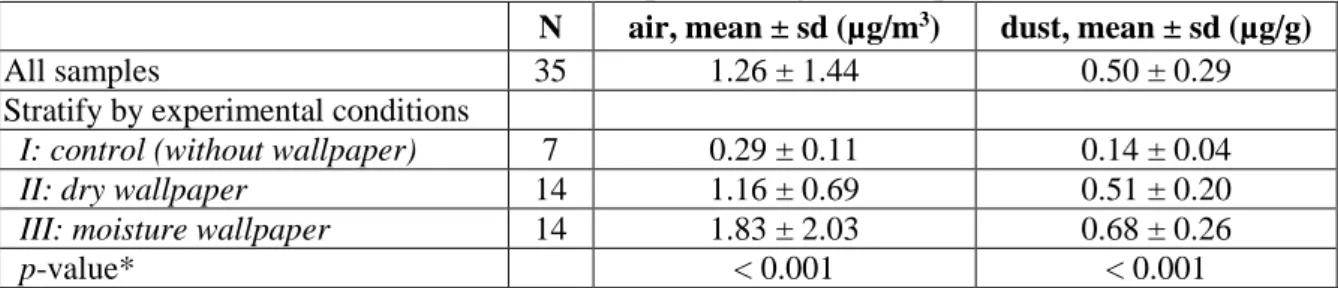
The overall average concentration of DEHP in the air among three conditions were 0.29, 1.16, 1.83 µg/m3, while in the dusts were 0.14, 0.51, 0.68 µg/g (Table 1). The significant difference of levels was found among three conditions. The levels in wipe samples among three conditions were 0.19 × 10⁻³, 0.40 × 10⁻³, 0.65 × 10⁻³ µg/g, respectively.
Table 1. DEHP levels in the air and dust samples among three experimental conditions N air, mean ± sd (µg/m3) dust, mean ± sd (µg/g)
All samples 35 1.26 ± 1.44 0.50 ± 0.29
Stratify by experimental conditions
I: control (without wallpaper) 7 0.29 ± 0.11 0.14 ± 0.04
II: dry wallpaper 14 1.16 ± 0.69 0.51 ± 0.20
III: moisture wallpaper 14 1.83 ± 2.03 0.68 ± 0.26
p-value* < 0.001 < 0.001
* Kruskal Wallis Test
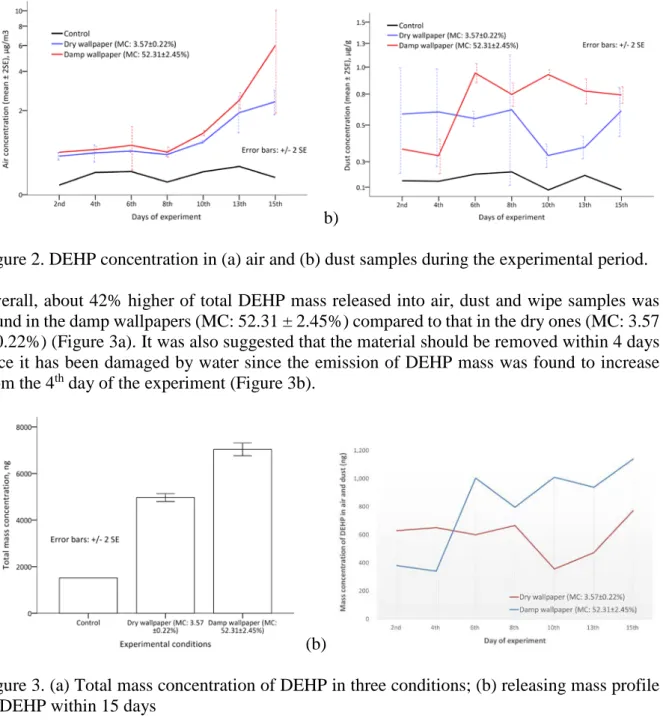
Increasing concentrations of DEHP emitted into the air and deposited on the dust with the time were shown in the chambers set up with wallpapers (Figure 2). Although the DEHP level detected in the dusts was relatively low (range 0.09 – 0.99 µg/g) compared to those reported previously (Clausen et al., 2004; Schripp et al., 2010; Jeon et al., 2016), it had increased with the length of the experiment, at the maximum of 15 days. Lower levels detected in dusts might due to no direct contact between the dust samples and wallpapers in the experimental setting. It is believed that the distance to the emission source is one of the factors related to the exposure level (Wang, 2009; Schripp et al., 2010). In addition, DEHP constitutes only about 0.22% of the tested material’s weight in this experiment, a relatively less percentage compared to those used in other studies.
a) b)
Figure 2. DEHP concentration in (a) air and (b) dust samples during the experimental period.
Overall, about 42% higher of total DEHP mass released into air, dust and wipe samples was found in the damp wallpapers (MC: 52.31 ± 2.45%) compared to that in the dry ones (MC: 3.57
± 0.22%) (Figure 3a). It was also suggested that the material should be removed within 4 days once it has been damaged by water since the emission of DEHP mass was found to increase from the 4th day of the experiment (Figure 3b).
(a) (b)
Figure 3. (a) Total mass concentration of DEHP in three conditions; (b) releasing mass profile of DEHP within 15 days
4 CONCLUSIONS
This is the first study to evaluate the effects of material moisture on the emission of phthalates in the indoor environments. Preventing dampness problem or improving moisture resistance of building materials could decrease the exposure levels of phthalates indoors as well as health risks of occupants.
5 REFERENCE
Ait Bamai Y., Araki A., Kawai T., et al. 2014. Associations of phthalate concentrations in floor dust and multi-surface dust with the interior materials in Japanese dwellings. Sci Total Environ, 468–469(0), 147-157.
Bornehag C. G., Lundgren B., Weschler C. J., et al. 2005. Phthalates in indoor dust and their association with building characteristics. Environ Health Perspect, 113(10), 1399-1404.
Braun J. M., Sathyanarayana S., and Hauser R. 2013. Phthalate exposure and children's health.
Curr Opin Pediatr, 25(2), 247-54.
Clausen P. A., Hansen V., Gunnarsen L., et al. 2004. Emission of di-2-ethylhexyl phthalate from PVC flooring into air and uptake in dust: emission and sorption experiments in FLEC and CLIMPAQ. Environmental science & technology, 38(9), 2531-2537.
Hsu N. Y., Chen C. Y., Lee C. C., et al. 2012a. Relationship between indoor phthalate concentrations and dampness or visible mold. 10th International Healthy Buildings Conference 2012, 1575-1576.
Hsu N. Y., Lee C. C., Wang J. Y., et al. 2012b. Predicted risk of childhood allergy, asthma and reported symptoms using measured phthalate exposure in dust and urine. Indoor Air, 22(3), 186–199.
Jeon S., Kim K. T., and Choi K. 2016. Migration of DEHP and DINP into dust from PVC flooring products at different surface temperature. Sci Total Environ, 547(0), 441-446.
Kay V. R., Bloom M. S., and Foster W. G. 2014. Reproductive and developmental effects of phthalate diesters in males. Crit Rev Toxicol, 44(6), 467-498.
Kay V. R., Chambers C., and Foster W. G. 2013. Reproductive and developmental effects of phthalate diesters in females. Crit Rev Toxicol, 43(3), 200-19.
North M. L., Takaro T. K., Diamond M. L., et al. 2014. Effects of phthalates on the development and expression of allergic disease and asthma. Ann Allergy Asthma Immunol, 112(6), 496–502.
Schripp T., Fauck C., and Salthammer T. 2010. Chamber studies on mass-transfer of di(2- ethylhexyl)phthalate (DEHP) and di-n-butylphthalate (DnBP) from emission sources into house dust. Atmos Environ, 44(24), 2840-2845.
Wang M. C. 2009. Adsorption of cable emitted DEHP (Di-(2ethylhexyl) phthalate) on indoor dust: M.S. thesis, National Kaohsiung First University of Science and Technology, Kaohsiung, Taiwan, 90 p.
Zhang Q., Lu X. M., Zhang X. L., et al. 2013. Levels of phthalate esters in settled house dust from urban dwellings with young children in Nanjing, China. Atmos Environ, 69(0), 258-264.