台灣科大
學 號 :B9506005 _______________________________________________________
一個新型共軛高分子帶有茀、砒碇、不對稱咔唑基團:
合成、質子化、電化學特性研究
A novel, conjugated polymer containing fluorene, pyridine and unsymmetric carbazole moieties: Synthesis,
Protonation and Electrochemical Properties
專 題 生 : 陶 柏 成
指 導 教 授 : 廖 德 章 教 授
中 華 民 國 九 十 九 年 六 月
國 立 台 灣 科 技 大 學
化 學 工 程 系
專 題 報 告
1
摘要
一個含有雜環吡啶和咔唑基團的新型雙碘單體,藉由齊齊巴賓反應合成與鈴木偶合得到此 共軛聚合物。此共軛聚合物於常溫下與常見有機溶劑具有優異溶解性,如 N-甲基-2-吡酮、四氫 呋喃、二氯甲烷、氯仿、甲苯、二甲苯、苯。
此聚合物在氮氣下具有玻璃轉移溫度 192℃和 10%熱重損失溫度(Td10%)為 437℃。原始聚
合物經質子化後,紫外光-可見光最大吸收波長自 355 奈米躍升到 420 奈米。經鹽酸四級化後 的聚合物在四氫呋喃溶液中發射自藍色區域內最大峰值為 400 奈米(nm)至黃色區域內最大峰值 在 540 奈米(nm),其發射強度取決於酸的濃度。此聚合物在供應電壓下也顯示了電致變色行為。
此聚合物薄膜在被供應 2.5 伏特電壓下,放射顏色自藍色(417 奈米)改變為黃色(550
奈米)。此聚合物由三穩態形態現象下,展示了單寫複讀的聚合物記憶效應。
關鍵詞:共軛聚合物、芴、帶有雜環聚合物、吡啶、合成
ABSTRACT
A new diiodo monomer containing heterocyclic pyridine and carbazole groups was synthesized via Chichibabin reaction and used in the preparation of a conjugated polymer via Suzuki coupling approach. The conjugated polymer was highly soluble in common organic solvents such as NMP, THF, dichloromethane, chloroform, toluene, xylene, and benzene at room temperature.
The polymer had high glass transition temperature at 192℃ and Td10 at 437℃ in nitrogen atmosphere. The pristine polymer exhibited the UV–vis maximum absorption at 355 nm and shifted polymer in THF solution changed from the blue region with maximum peak at 400 nm to the yellow region with maximum peak at 540 nm after protonated by HCl, and the intensity of emission depended on the concentration of acid.
The polymer also showed electrochromic behavior under applied voltage. The emission color of the polymer film changed from blue (417 nm) to yellow (550 nm) when 2.5 V bias voltage was applied. The polymer also exhibited writeonce and read-many-times (WORM) polymer memory effect with tristable states.
Keywords: Conjugated Polymer, Optical, Fluorene, Pyridine, Chromophore, Carbazole
3
致謝
這一年多的日子,最要感謝指導老師廖德章教授對我的細心指導及永不止息的提攜與督促。引 領我踏進高分子合成領域,除了給我有效率的學習之外,也向我教導做人做事的道理;此外,
廖老師也積極鼓勵我參與國際會議,與世界接軌,培養我的國際觀,讓我得以看得更高,看得 更遠。廖老師,能躋身您的門生,對熱愛研究的我而言,是一件幸福而雀躍的事,也是一件光 耀門楣的事!
再來要感謝的是北科大化工系 汪昆立老師。感謝您時常撥空前來,給予我在實驗及投稿上 的指導,除了增進我實驗技巧之外,更使我在專業英文上受益匪淺,感謝您。
感謝實驗室與我一同研究的夥伴,學長陳文祥、張正宏、吳翰宇、連蔚任、林義倫等給予 我寶貴意見的重要夥伴。文祥學長,感謝您在我實驗時於實驗安全細節上的指導,讓我在實務 專題期間,能夠懂得保護自身安全。正宏學長,感謝您在實驗技巧上的協助。翰宇學長,感謝 您在實驗上的討論,及這段日子的幫忙。同學旻宏與英治,這段日子以來,如果沒有你們參與,
我們無法有這番成果,英治順利直升碩班,預祝你的研究能夠更加發光發熱。因為有你們的參 與,這一年多實務專題的日子是務實而豐富的。
感謝高雄高工化工科的老師群(賴勝煌、孫燕鳳、陳琇惠、楊美容等老師),沒有您於高工 時間訓練的紮實,讓我有化學實驗的底子,也讓我在專題時間的跑反應與測定方面更加得心應 手,使我一路走來平順許多。
最後,最要感謝的是我家人。感謝您們這二十二年來的栽培與支持,讓我沒有後顧之憂的 做我想做的事。雖然你們一直擔心我大學的成績,但我覺得,能夠開創豐富生命的是研發能力。
在此,謹將此專題報告獻給我所親愛的家人們!
目錄
摘 要 … … … 1
英 文 摘 要 … … … 2
致謝………3
目 錄 … … … 4
表 目 錄 … … … 5
圖 目 錄 … … … 6
Appendix. Supplementary data………7
1 . I n t r o d u c t i o n … … … 8
2 . E x p e r i m e n t a l … … … 9
2 . 1 . M a t e r i a l s … … … 9
2 . 2 . M e a s u r e m e n t s … … … 9
2.3.1.1. 4-(9-Ethyl-3-carbazole)-2,6-bis(4-iodophenyl)pyridine (M1) ………9
2.3.1.2. Synthesis of model compound, 4-(9-ethyl-3-carbazole)-2,6-biphenyl -pyridine (M2) ………10
2 .3. 2. S yn th esis o f th e co nj uga te d p ol yme r, P yCz P F8… ……… 1 0 2 . 4 . P r e p a r a t i o n o f p r o t o n a t e d p o l ym e r s o l u t i o n s … … … 1 1
3 . R e s u l t s a n d d i s c u s s i o n … … … … ……… ……… ……… 11
3 . 1 . M o n o m e r s y n t h e s i s … … … 1 1 3 . 2 . P o l y m e r i z a t i o n … … … 1 1 3 . 3 . P h y s i c a l p r o p e r t i e s … … … 1 24 . C o n c l u s i o n … … … 1 5
5 . R e f e r e n c e s … … … 1 6
5
表目錄
Table Captions:
Table 1. Molecular weight of the conjugated polymer PyCzPF8…18
Table 2.Thermal properties of the conjugated polymer PyCzPF8…19
Table 3. Photophysical Properties of the monomers and conjugated
p o l y m e r s … … … 2 0Table 4. Electrochemical properties of the monomers and polymer
P y C z P F 8 … … … 2 1
圖目錄
Figure Captions:
Figure 1. Synthesis of monomer (M1) and model compound
( M 2 ) … … … 2 2Figure 2. (A) 1H-NMR (B) 13C-NMR (C) COSY and (D) HMQC
spectra of model compound (M2) ………23F i g u r e 3 . P r e p a r a t i o n o f t h e n o v e l c o n j u g a t e d p o l y m e r
P y C z P F 8 … … … 2 5
Figure 4. DSC curve of PyCzPF8 in nitrogen………26
F i g u r e 5 . T GA s p ec t r a o f P yC z P F 8 i n n i t ro g e n an d a i r
atmos pheres… ………… ……… ………… ……… ………… ……27Figure 6. UV and PL spectra of related compounds and the
conjugated polymer PyCzPF8 in solution (A) and (B) in film s t a t e … … … 2 8Figure 7. UV-vis spectra of PyCzPF8 in different solvents………29
Figure 8. The color changing of PyCzPF8 solution from blue (left) to
yellow after protonated by 1M MSA (middle) or HCl (right) ………30Figure 9. Color changing of PyCzPF8 under different applied
v o l t a g e s … … … 3 17
Appendix. Supplementary Figure
Appendix. Supplementary Figure Captions:
Figure S1. (A) 1H-NMR (B) 13C-NMR (C) COSY (D) HMQC and (E)
HMBC spectra of PyCzPF8………32Figure S2. (A) Absorption and (B) Emission of PyCzPF8 after
protonation by different concentration of HCl (up), MSA (middle) and PTS (bottom) … … ……… …… ……… ………… ……… ………37Figure S3. (A) Absorption and (B) Emission of protonated PyCzPF12
(1M HCl) after adding additional sodium hydroxide………41Figure S4. (A) UV and (B) PL spectra of PyCzPF8 under different
appl i ed v ol tages………43Figure S5. Cyclic voltammetric diagrams for (A) monomers PyCzBI
(M1) and PyCz (M2) in chloroform solution, (B) PyCzPF8 in chloroform solution and PyCzPF8 film on an ITO-coated glass substrate in CH3CN solution. The solutions contain 0.1 M TBAP and the scanning rate is 0.1 V/s………451. Introduction
Over the past decade, much research has focussed on π-conjugated polymers, which offer potential applications both in optoelectronics and photonics owing to their unique electronic properties [1]. In particular, fluorene and its derivatives have attracted much attention because of their wide energy gap and high luminescent efficiency [2].
In terms of high thermal stability, n-type heterocyclic compounds, pyridine has been the subject of much interest owing to its high thermal and chemical stability [3-12]. In addition, polymers which contain a pyridine moiety display electron-transporting abilities and can undergo modification of their optical properties, via protonation, because of the localized, lone pair of sp2 orbital electrons of the nitrogen atom [7-9]. Moreover, Koleva’s group observed a relationship between structure and spectroscopic properties of some pyridinium compounds [13-16]. Recently, Liu et al. showed that a conjugated polymer containing pyridine in the main chain exhibited potential applications in polymeric memory materials [17].
In contrast, the carbazole substituent is an interesting functional group for incorporation into a polymer backbone owing to its high thermal stability, good solubility, extended glassy state and moderately high oxidation potential [18]; in this context, an unsymmetrical pendant structure shows higher solubility than comparable symmetrical architecture [19-21].
Carbazole is also a conjugated group that is of interest in terms of both optical and electronic applicationss such as photoconductivity, photorefractivity and high charge mobility [22-23].
This work concerns the design and synthesis of novel diiodo compounds containing pyridine and unsymmetric carbazole moieties incorporated within a conjugated polymer having high thermal stability and good solubility. In this paper, the novel, conjugated polymer (PyCzPF8) containing fluorene, pyridine and unsymmetric carbazole moieties is reported and its optical, electrochemical and electrochromic properties were investigated using fluorescence spectroscopy and cyclic voltammetry (CV) and its thermal stability was determined.
9
2. Experimental
2.1. Materials4-Iodoacetophenone and ammonium acetate were purchased from Merck, acetophenone from BDH Chemicals Ltd and 9-ethyl-3-carbazolecarboxaldehyde, 9,9-dioctylfluorene-2,7-diboronic acid from Aldrich. The catalyst, tetrakis-(triphenylphosphine) palladium (Pd(PPh3)4) was purchased from Acros Organics and was used as received. THF (Merck) was distilled from sodium/benzophenone under nitrogen; DMSO, hydrochloric acid (Acros Organics), methanesulfonic acid (MSA; Fluka), p-toluene sulfonic acid (PTS; TCI) and glacial acetic acid (Aldrich) were used as received.
2.2. Measurements
IR spectra were recorded in the range 400-4000 cm-1 for the synthesized monomer and polymer in a KBr disk (Bio-Rad Digilab FTS-3500). Elemental analysis was made on a Perkin-Elmer 2400 instrument. NMR spectra were recorded using a BRUKER AVANCE 500 NMR (1H at 500 MHz and 13C at 125 MHz). Weight-average (Mw) and number-average (Mn) molecular weights were determined by gel permeation chromatography (GPC). Four Waters (Ultrastyragel) columns (300 × 7.5 mm, guard, 105, 104, 103, and 500 Å in a series) were used for GPC analysis with tetrahydrofuran (THF; 1 mL_min-1) as the eluent. The eluents were monitored with a UV detector (JMST Systems, VUV-24, USA) at 254 nm. Polystyrene was used as the standard. Thermogravimetric data were obtained on a TA instrument Dynamic TGA 2950 under nitrogen flowing condition at a rate of 30 cm3.min-1 and a heating rate of 10℃.min-1. Differential scanning calorimetric analysis was performed on a differential scanning calorimeter (TA instrument TA 910) under nitrogen flowing condition at a rate of 30 cm3.min-1 and a heating rate of 10℃.min-1. UV-vis spectra of the polymer films or solutions were recorded on a JASCO V-550 spectrophotometer at room temperature in air. The fluorescence spectra were recorded by a Shimadzu RF-5031 spectrophotometer.
Photoluminescent (PL) was observed by HORIBA JOBIN FluoroMax-3. Electrochemical properties was measured by Cyclic Voltammeter (CV) CH Instrument Electrochemical Analyzer with a standard three-electrode electrochemical cell in acetonitrile solution containing 0.1 M tetra-butylammonium hexafluorophosphate (TBAPF6) at a scan rate of 0.1 V/s at room temperature under the protection of argon. For the measurement of electrochromic behavior, polymer was deposited on ITO glasses by casting from polymer solution of 10 mg.mL-1 in chloroform.
2.3. Synthesis of monomer
2.3.1.1. 4-(9-Ethyl-3-carbazole)-2,6-bis(4-iodophenyl)pyridine (M1)
The diiodo monomer of 4-(9-ethyl-3-carbazole)-2,6-bis(4-iodophenyl)pyridine (M1) was synthesized from 9-ethyl-3-carbazolecarboxaldehyde and 4-iodoacetophenone via the Chichibabin reaction in the presence of ammonium acetate and acetic acid according [7-9].
The crude product of M1 was recrystallized five times from DMSO to obtain light yellow particles with 30% yield. M.P.=141 °C. FTIR (KBr, cm-1) Ar-H, 3050; C-H, 2971; C-H, 2932;
C=N, 1597 for C-N of pyridine group; C=C, 1480; Ar-I, 1001.
1H-NMR (500 MHz, CDCl3): δ(ppm)= 8.39 (s, 1H), 8.18-8.17 (d, J= 8.2Hz, 1H), 7.91-7.90 (m, 6H), 7.82-7.81 (d, J= 7.8Hz, 4H), 7.78-7.76 (m, 1H), 7.53-7.50 (d, J= 7.5Hz, 1H),
7.48-7.46 (d, J= 7.5Hz, 1H), 7.45-7.43 (d, J= 7.43Hz, 1H), 7.30-7.27 (m, 1H), 4.41-4.36 (m, 2H), 1.47-1.44 (t, J= 1.5Hz, 3H).
13C-NMR (125 MHz, CDCl3): δ(ppm)= 156.27, 151.24, 140.48, 140.42, 139.03, 137.75, 129.13, 128.80, 126.26, 124.73, 123.63, 122.83, 120.59, 119.37, 119.05, 117.02, 108.98, 108.82, 95.31, 37.72, 13.81.
Elemental Analysis (%): C31H22I2N2 Calcd.: C, 55.05; H, 3.28; I, 37.53; N, 4.14 found: C, 54.98; H, 3.38; N, 3.92.
2.3.1.2. Synthesis of model compound, 4-(9-ethyl-3-carbazole)-2,6-biphenyl pyridine (M2)
The model compound M2 was prepared in the similar procedure with the monomer M1 except using acetophenone instead of 4-iodoacetophenone. In a round-bottomed flask equipped with a reflux condenser, a mixture of 9-ethyl-3-carbazolecarboxaldehyde (10 g, 44.8 mmol), acetophenone (10.44 mL, 89.6 mmol), ammonium acetate (60 g, 0.67 mol) and glacial acetic acid 214 mL were refluxed for 72 h. Upon cooling, the ensuing viscous oil was separated and washed with hot ethanol and then purified by column separation from toluene to afford a light yellow coloured, solid product (Tm = 120 ℃ by DSC). FTIR (KBr; cm-1) Ar-H, 3039; C-H, 2970; C-H, 2926; C=N, 1597; C-N, 1226 for C-N of pyridine group; C=C, 1479.
1H-NMR (500 MHz, CDCl3): δ(ppm)= 8.58-8.57 (d, J= 1.6Hz, 1H), 8.45-8.43 (t, J= 8.4Hz, 4H), 8.34-8.32 (dd, 1H), 8.13 (s, 2H), 7.91-7.89 (m, 1H), 7.71-7.68 (m, 4H), 7.65-7.60 (m, 3H), 7.53-7.50 (t, J= 18.2Hz, 2H), 7.45-7.42 (m, 1H), 4.38-4.34 (q, 2H), 1.52-1.49 (t, J= 14.5Hz, 3H).
13C-NMR (125 MHz, CDCl3): δ(ppm)= 157.13, 150.70, 140.29, 140.17, 139.73, 129.34, 128.78, 128.53, 127.05, 126.02, 124.66, 123.42, 122.77, 120.48, 119.15, 118.89, 116.85, 108.77, 116.85, 37.40, 13.62.
Elemental Analysis : C31H24N2 Calcd.: C, 87.70 ; H, 5.70 ; N, 6.60 found: C, 87.80 ; H ,5.67; N, 6.76.
2.3.2. Synthesis of the conjugated polymer, PyCzPF8
In a 50 ml round flask fitted by a thermometer and a condenser was added 0.621 g (0.92 mmol) of M1, 0.439 g (0.92 mmol) of 9,9-dioctylfluorene-2,7-diboronic acid (M3), and 9.18 mL of K2CO3 (2M in H2O) in 20 mL of THF under nitrogen atmosphere. Then, Pd(PPh3)4 (0.6%
mol) was added, and the mixture was allowed to reflux at 60 ℃ for another 24h. The polymer was precipitated in 1 L of acetone/ MeOH (v/v = 1:1) and filtered. The precipitate was washed with a large amount of water. The polymer reprecipitated three times. The polymer was further purified by washing with acetone in a Soxhlet apparatus for 24 h to remove oligomers and catalyst residues and was dried under reduced pressure at 150 ℃ with a high yield of 92%. FTIR (KBr; cm-1) Ar-H, 3031; C-H, 2927; C-H, 2853; C=N, 1596; C=C, 1489.
1H-NMR (500 MHz, CDCl3): δ(ppm)= 8.59 (s, 1H), 8.48-8.46 (d, J= 8.5Hz , 4H), 8.30-8.29 (d, J= 8.3Hz, 1H), 8.15 (s, 2H), 7.97-7.87 (m, 7H), 7.80 (s, 2H) , 7.77-7.73 (t, J= 7.7 Hz, 2H) ,7.60-7.57 (t, J= 7.5Hz, 2H), 7.52-7.50 (d, J= 7.5Hz, 1H), 7.38-7.35 (t, J= 7.4Hz, 1H), 4.46-4.45 (m, 2H), 2.19 (m, 4H), 1.54-1.51 (t, J=1.54Hz, 3H), 2.28-1.19 (m, 20H), 0.89-0.76 (m, 10H).
11
13C-NMR (125 MHz, CDCl3): δ(ppm)= 157.03, 151.86, 151.05, 142.16, 140.51, 140.40, 140.28, 139.63, 138.64, 129.77, 127.59, 127.42, 126.21, 126.09, 124.90, 123.68, 122.95, 121.52, 120.63, 120.15, 119.35, 119.16, 117.03, 109.01, 108.80, 55.35, 40.40, 37.72, 31.78, 30.05, 29.24, 29.21, 23.93, 22.60, 14.06, 13.82.
Elemental Analysis (%) : Calcd. For (C60H62N2)n : C, 88.84; H, 7.70; N, 3.45 found C, 88.11; H,7.67; N,3.19.
2.4. Preparation of protonated polymer solutions
The protonation of the polymer was carried out by MSA, p-toluene sulfonic acid (PTS) and HCl solutions. For example, the polymer solution of 10-7 mg/mL with 1 M HCl was prepared by combining equal volume of a polymer solution of 2×10⁻⁷ mg/mL in THF and a 2M HCl and THF solution. Then, the UV-vis and PL spectra of the polymer solution were recorded.
3. Results and Discussion
3.1. Monomer synthesis
The diiodo compound, 4-(9-ethyl-3-carbazole)-2,6-bis(4-iodophenyl)pyridine (M1), and model compound, 4-(9-ethyl-3-carbazole)-2,6-diphenyl pyridine (M2), containing pyridine and carbazole groups were synthesized via facile Chichibabin reaction from 4-iodoacetophenone and acetophenone, respectively, with 9-ethyl-3-carbazolecarboxaldehyde as shown in Figure 1. The structures were confirmed by elemental analysis, IR and NMR spectra. The characteristic band for the pyridine group in M1 and M2 monomer was observed at 1597 cm-1 in the FTIR spectrum. Figure 2 shows the 1H-NMR (Figure 2A) and 13C-NMR (Figure 2B) spectra as well as two dimensional spectra including COSY (Figure 2C) and HMQC (Figure 2D) of the model compound (M2). The ethyl protons attached on the carbazole group appeared at 1.50 and 4.36 ppm in 1H-NMR spectrum (Figure 2A). The signals appeared at 157.1, 150.7 and 116.9 ppm in 13C-NMR spectrum (Figure 2B) confirmed the formation of heterocyclic pyridine ring. The assignments of the proton and the carbon peaks are assisted by the integral of proton peaks and the two dimensional COSY (Figure 2C) and HMQC (Figure 2D) techniques. The basic COSY and HMQC procedures give two dimensional spectra from which almost all of the 1H-1H and 1H-13C connectivity can be determined.
Elemental analysis, IR and NMR spectra clearly confirm that the monomer compound (M1) and model compound (M2) synthesized herein is consistent with the proposed structure.
Figure 1; Figure 2
3.2. Polymerization
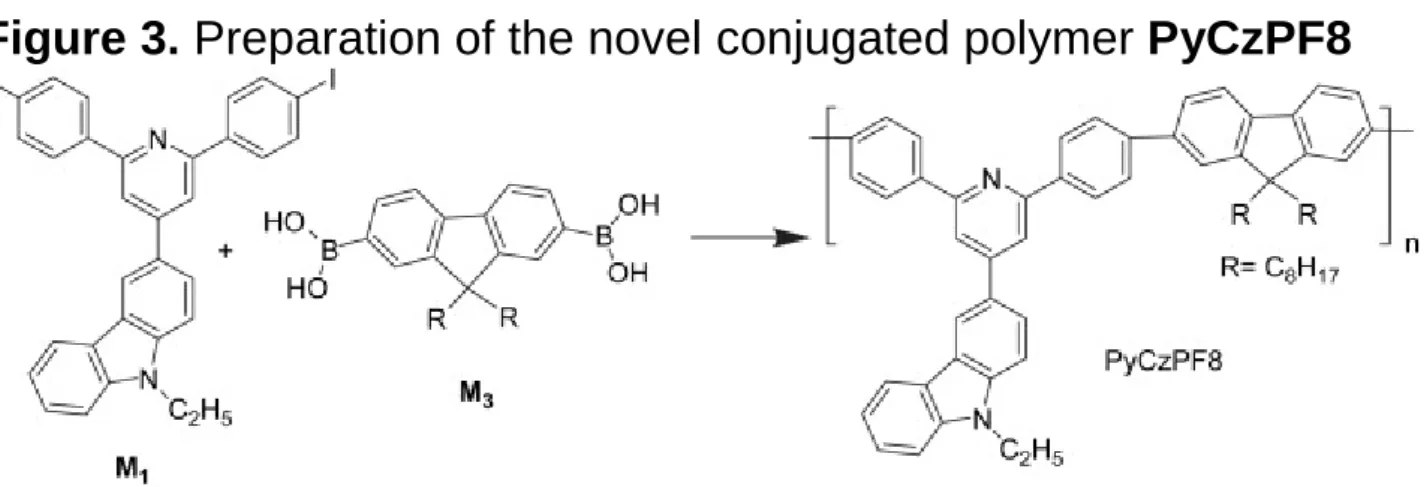
The synthesis of the conjugated polymer PyCzPF8 containing pyridine and fluorene groups in the main chain and carbazole moiety in the side chain is depicted in Figure 3. The conjugated polymer was prepared from the diiodo monomer (M1) and 9,9-dioctylfluorene-2,7-diboronic acid (M3) via Suzuki coupling reaction, which was carried out in a mixture of tetrahydrofuran (THF) and aqueous potassium carbonate solution (2 M) containing 0.6 mol % Pd(PPh3)4 under vigorous stirring at 60℃ for 24 h. After purification and drying, the polymer PyCzPF8 was obtained as white color in good yield of 92%. The chemical
structure of the polymer was verified by FT-IR, elemental analyses and NMR spectra. The
1H-NMR and 13C-NMR in d-chloroform as well as peak assignments of polymer PyCzPF8 were confirmed by the assistance of two-dimensional NMR spectra of PyCzPF8, such as COSY, HMQC, HMBC (supplementary Figure S1) . The peaks of hydrogen in fluorene alkyl chain appear at 0–2 ppm. The integral of the hydrogen in 1H-NMR is consistent with the proposed polymer structure. The proton resonance signal of pyridine appeared at 7.90, 8.13 and 8.15 ppm for M1, M2 and PyCzPF8, respectively. This means the electronic environment of model compound (M2) is more similar to that of corresponding structure in PyCzPF8 than that of monomer compound (M1). In 13C-NMR spectrum, there are 26 well-resolved signals for the aromatic carbons appeared in the range of 100-160 ppm and the peaks for the octyl carbon appeared in the range of 14–40 ppm. In addition, the carbon at 9-position of fluorene appeared at 55.3 ppm. All the results suggest that the conjugated polymer was successfully prepared.
Figure 3
3.3. Physical properties
The molecular weight of the polymer was determined by gel permeation chromatography (GPC) using the polystyrene as the standard and summarized in Table 1. The number-average molecular weight of the prepared polymer was as high as 2.28 × 10⁴ and the polydispersity index of PyCzPF8 was 1.38. The polymer was soluble in common organic solvents, such as N-methyl-2-pyrrolidinone (NMP), tetrahydrofuran (THF), dichloromethane (DCM), chloroform, toluene, 1,4-dioxane, xylene, 1,2-dichlorobenzene, anisole and benzene at room temperature.
Table 1
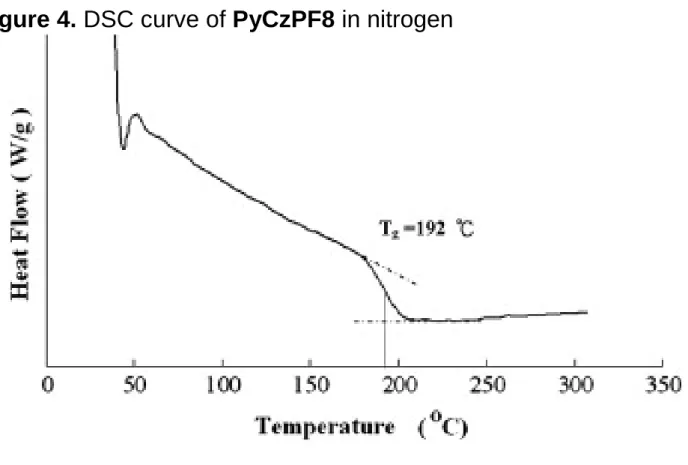
The thermal properties of the polymer were measured by DSC and TGA, and the results are summarized in Table 2. The glass transition temperature of PyCzPF8 was 192℃ (Figure 4), which is much higher than that of poly-(9,9-dioctylfluorene) (POF) (POF; Tg = 75℃) [20-21]
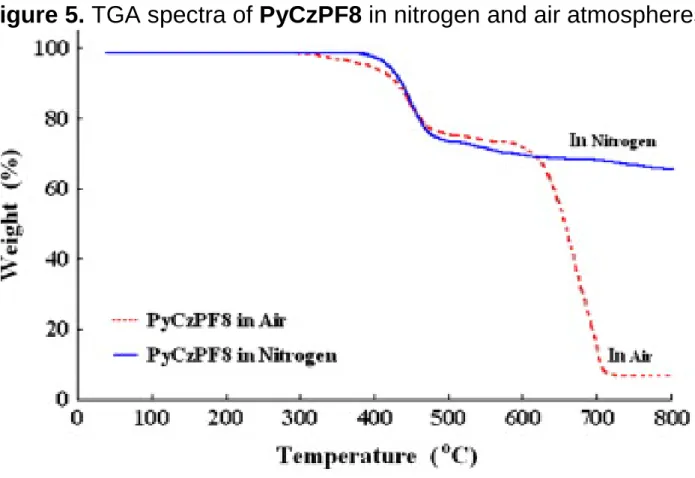
due to the rigid heterocyclic pyridine groups [7-9] in the main chain and unsymmetric carbazole groups in the side chain [14,18]. The relatively high glass transition temperature has the thermal advantage for the application of electronic materials [15]. The thermal stability of the polymer was measured by TGA in nitrogen and air atmospheres as shown in Figure 5. Two-step degradation was observed in the TGA spectrum in air atmosphere. The 1st degradation begins at about 401℃ and the 2nd at about 482℃. The weight loss of PyCzPF8 at 1st stage is 26.9%, which is also consistent with the content (28.0%) of alky chain in the polymer. This result suggested that the 1st degradation was due to the decomposition of the weak alkyl groups attached on fluorene. The result showed that the Td10
was 437℃ in nitrogen atmosphere.
Table 2; Figure 4; Figure 5
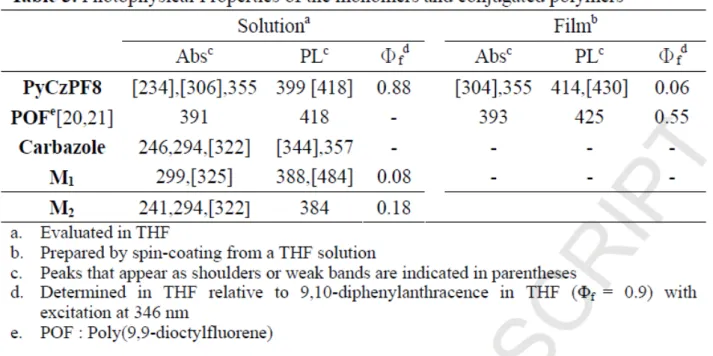
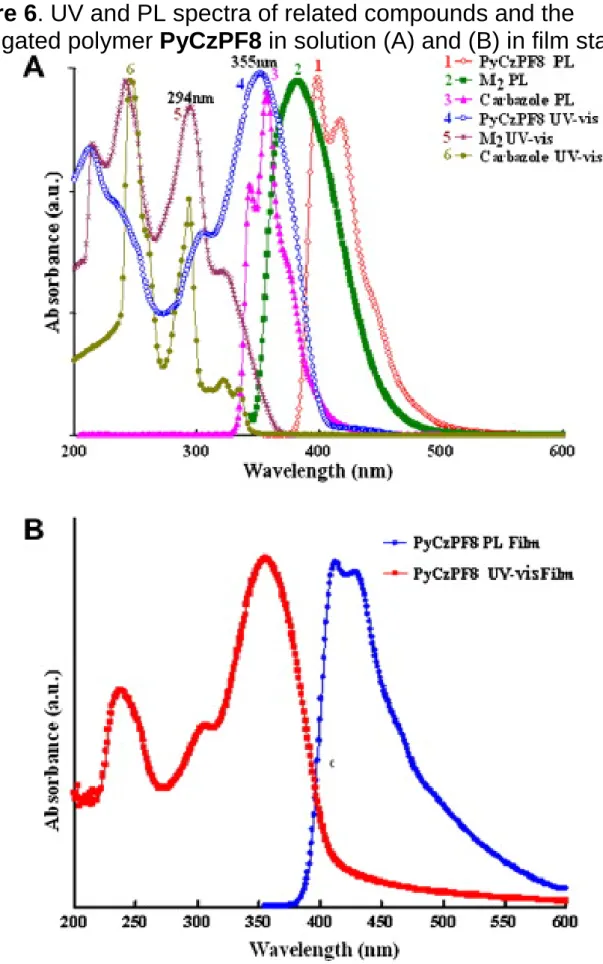
The optical properties of the polymer were investigated by UV-vis and PL spectroscopy in solid state and in THF. The UV-vis and PL spectroscopes of the polymer are shown in Figure 6. The absorption and emission spectra of the polymer in THF solution as well as the model compound M2 and carbazole are shown in Figure 6A. The photophysical properties of the polymer as well as the monomer and carbazole are summarized in Table 3. In THF
13
solution, a major absorption at around 355 nm and a minor absorption at 306 nm were observed. By comparing with the absorption spectra of M2 and carbazole, we ascribe the minor absorption at 306 nm to π-π* transition of pendant carbazole groups. From the result of the maximum absorption peak for poly-(9,9-dioctylfluorene) (POF) at 391 nm [24], the major absorption to π-π* transition was ascribed to the conjugated polymer backbone. The polymer emits blue fluorescence in THF solution with a major emission at 399 nm and a minor emission at 418 nm. As comparing to emission peak of poly-(9,9-dioctylfluorene) (POF) [24], it is clear that the major emission originated from the fluorene structure. The emission peak of carbazole is overlapped by the absorption of the polymer. Therefore, the minor peak at 418 nm may be due to the Förster energy transfer as a consequence of good spectral overlap between the emission spectrum of carbazole and the absorption spectrum of the polymer backbone [26]. The fluorescence quantum yield (ΦF) of the polymer in THF was estimated by comparing with the standard of 9,10-diphenylanthracene (ca. 1 x 10⁻⁵ M solution). The fluorescent quantum yield for PyCzPF8 was 88% in THF solution. The choice of pyridine moiety as a comonomer for blue emission was motivated by their electron-deficient character, which generally leads to good electron transport properties. The absorption and PL spectra in solid state shown in Figure 6B are similar to those in THF solution. The UV absorption peaks of the solid film were observed at 304 and 355 nm and the PL spectrum at 414 and 430 nm due to the interchain interaction of the polymer. However, the polymer in solid state has very low fluorescent quantum yield (only about 6%).
Table 3; Figure 6
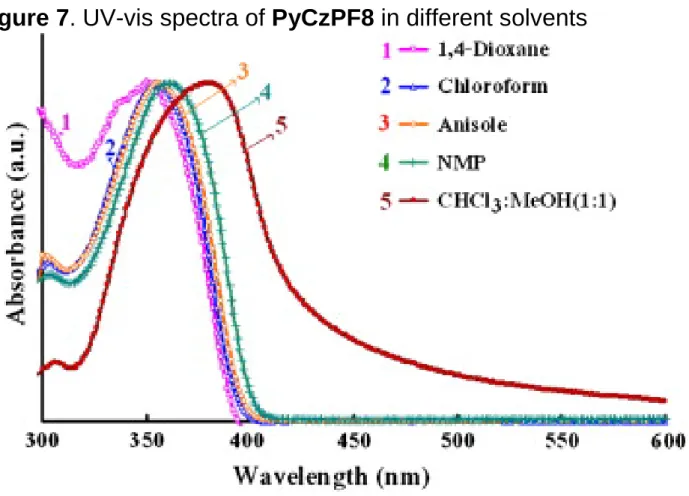
The UV-vis absorption of the polymer in dilute solution (ca. 10-6 M) was investigated in different solutions with increasing solvent polarity including 1,4-dioxane, chloroform, anisole, NMP and mixture of chloroform and methanol (1:1) as shown in Figure 7. The maximum absorption λmax in above mentioned solvents appeared at 352 nm for less polar solvent like 1,4-dioxane and red-shifted to 382 nm for more polar mixture solvent such as chloroform and methanol (1:1) to 382 nm. It suggests that λmax could increase up to 30 nm with increasing the solvent polarity. Such positive solvatochromism indicates significant intermolecular charge transfer between polar solvent and polymer [27-32].
Figure 7
Compared to benzene ring, pyridine is an electron-deficient aromatic heterocyclic substituent, with localized lone pair electrons in sp2 orbital on the nitrogen atom.
Consequently, the derived polymer offers the possibility of protonation or alkylation of the lone pair as a way of modifying their properties. Herein, the optical properties of the polymers after protonation with p-toluene sulfonic acid (PTS), methanesulfonic acid (MSA) and hydrochloric acid (HCl) were also investigated. The absorption spectra of PyCzPF8 as a function of HCl, MSA and PTS concentration (supplementary Figure S2A). At low protonated concentration (lower than 0.1M) the absorption bands are almost the same with pristine polymer. When the acid concentration was increased (higher than 0.1M), it was apparent that the absorption decreased at around 355 nm and a new absorption band at 411, 412 and 422 nm was formed gradually after protonated by PTS, MSA, HCl, respectively. The new band at 430 nm could be attributed to the protonated form structure of pyridine. At high degree of protonation, the isosbestic point is lost due to repulsion between the charged pyridinium fragments [8]. The emission spectra of protonated polymer with HCl, MSA or PTS (supplementary Figure S2B). The fluorescence peaks at 400 and 417 nm for the neutral polymer solution decreased and a new fluorescence peak arose at 556, 558 and 542 nm after protonation by PTS, MSA and HCl, respectively. This phenomenon suggests that the
protonated structure emits fluorescence at longer wavelength than the unprotonated structure.
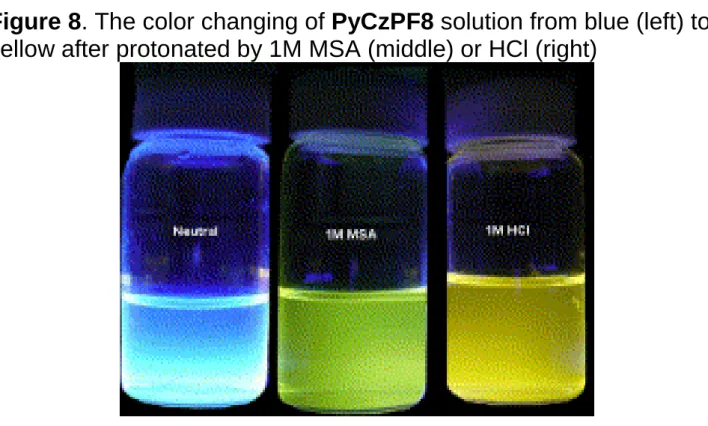
In addition, the absorption and emission spectra of polymer protonated by PTS and MSA are almost the same, because PTS and MSA have the same structure of sulfonic group. This suggests that the absorption and emission of protonated polymer are relative to the structure of the conjugated base of the acid. Figure 8 shows the change of emission color from original blue to yellow in THF solution after protonation by 1M HCl and MSA.
Figure 8
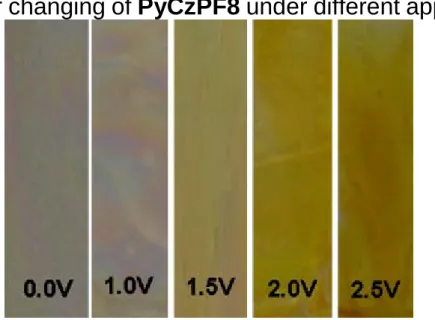
In order to understand the reversibility of the protonation, the optical properties of protonated polymer solution (protonated by 1M HCl) was studied by adding additional sodium hydroxide. The reversible absorption and emission spectra were shown in (supplementary Figure S3). The absorption peak at 420 nm resulted from the quaternized structure decreased and absorption at 355 nm increased as sodium hydroxide was added (supplementary Figure S3A). Moreover, the emission peak at 400 nm increased and the peak at 540 nm resulted from quaternized structure decreased after sodium hydroxide added (supplementary Figure SB). The results suggest that the optical properties of the polymer are reversible under protonation and deprotonation. The spectroelectrochemical analysis of the polymer was carried out on an ITO-coated glass substrate, and it showed electrochromic behavior when the applied potential was changed. The typical spectroelectrochemical absorption spectra of polymer PyCzPF8 at various applied potentials are depicted (supplementary Figure S4A). When the applied potential was increased positively from 0 to 2.5V, the peak of characteristic UV absorbance of PyCzPF8 decreased at 350 nm gradually, while one new shoulder band grew up at 450 nm due to the electron oxidation of pyridine group. The PL emission spectra of the polymer PyCzPF8 are depicted (supplementary Figure S4B). Increasing the voltage from 0 to 2.5V, the PL peak of characteristic emission of PyCzPF8 from 417 shifted to 550 nm. The change of the film from white yellow to deep brown with increasing the bias voltage is shown in Figure 9 due to the oxidation of pyridine group.
Figure 9
The electrochemical behavior of the monomers and the polymer was investigated by cyclic voltammetry (CV) (supplementary Figure 5S). From the oxidation potential relative to ferrocene/ferrocenenium one, which can correspond to 4.8 eV [33] for ferrocene below the vacuum level, we can approximately calculate the HOMO energy level of the conjugated polymer. The LUMO level of the polymer was calculated according to the equation: LUMO = HOMO + Eg. The electrochemical properties of the monomers and polymer are summarized in Table 4. There are two oxidation states for the monomers and the polymer due to the nitrogen in the pyridine and carbazole groups. The HOMO and LUMO values of PyCzPF8 were calculated to be -5.35 and -2.25 eV in chloroform and to be -5.97 and -2.94 eV for the film state. The energy gap for the polymer is ca. 3 eV.
15
4. Conclusion
A conjugated poly(pyridine-fluorene) polymer was successfully prepared via Suzuki coupling reaction from fluorene derivative and novel diiodo monomer containing pyridine with unsymmetric carbazole moieties. The structure of the poly(pyridine-fluorene) having unsymmetric pedant carbazole was well identified. All the optical properties clearly indicate that this new conjugated poly(pyridine-fluorene) exhibited chromic properties for the development of polymeric electrochromic and chemochromic materials. In particular, new poly(pyridine-fluorene) has excellent solubility in common organic solvents, high molecular weight, good thermal stability and high glass transition temperature, which could meet the basic requirements for the development of optoelectronics and photonics.
5. Reference
[1] J.E. Frommer and R.R. Chance, Encyclopedia of polymer science and engineering vol. 5, Wiley, New York (1986).
[2] J. Pei, X.L. Liu, Z.K. Chen, X.H. Zhang, Y.H. Lai and W. Huang, First hydrogen-bonding-induced self-assembled aggregates of a polyfluorene derivative, Macromolecules 36 (2) (2003), pp. 323–327.
[3] J.G. Liu, L.F. Wang, H.X. Yang, H.S. Li, Y.F. Li and L. Fan, Synthesis and characterization of new polybenzimidazopyrrolones derived from pyridine-bridged aromatic tetraamines and dianhydrides, Journal of Polymer Science, Part A: Polymer Chemistry 42 (8) (2004), pp.
1845–1856.
[4] G. Liu, Q.D. Ling, E.T. Kang, K.G. Neoh, D.J. Liaw and F.C. Chang, Bistable electrical switching and write-once read-many-times memory effect in a donor–acceptor containing polyfluorene derivative and its carbon nanotube composites, Journal of Applied Physics 102 (2) (2007),
[5] S. Chen, X. Xu, Y. Liu, G. Yu, X. Sun and W. Qiu, Synthesis and characterization of n-type materials for non-doped organic red-light-emitting diodes, Advanced Functional Materials 15 (9) (2005), pp. 1541–1546.
[6] X. Pan, S. Liu, H.S.O. Chan and S.C. Ng, Novel fluorescent carbazolyl–pyridinyl alternating copolymers: synthesis, characterization, and properties, Macromolecules 38 (18) (2005), pp. 7629–7635.
[7] K.L. Wang, D.J. Liaw, W.T. Liou and W.T. Chen, A novel fluorescent poly(pyridine–imide) acid chemosensor, Dyes and Pigments 78 (2) (2008), pp. 93–100.
[8] D.J. Liaw, K.L. Wang and F.C. Chang, Novel organosoluble poly(pyridine–imide) with pendent pyrene group: synthesis, thermal, optical, electrochemical, electrochromic, and protonation characterization, Macromolecules 40 (10) (2007), pp. 3568–3574.
[9] K.L. Wang, D.J. Liaw, W.T. Liou and S.T. Huang, High glass transition and thermal stability of new pyridine-containing polyimides: effect of protonation on fluorescence, Polymer 49 (6) (2008), pp. 1538–1546.
[10] J.X. Yang, X.T. Tao, X.Y. Chun, X.Y. Yun, L. Wang and Z. Liu, A facile synthesis and properties of multicarbazole molecules containing multiple vinylene bridges, Journal of the American Chemical Society 127 (10) (2005), pp. 3278–3279.
[11] M. Sonntag and P. Strohriegl, Novel 2,7-linked carbazole trimers as model compounds for conjugated carbazole polymers, Chemistry of Materials 16 (23) (2004), pp. 4736–4742.
[12] N. Zaami, C. Slugovc, A. Pogantsch and F. Stelzer, Blue light emission from a fluorene–carbazole–fluorene trimer incorporated as the side chain into a polynorbornene, Macromolecular Chemistry and Physics 205 (4) (2004), pp. 523–529.
[13] T. Kolev, B.B. Koleva, M. Spiteller, H. Mayer-Figge and W.S. Sheldrick, The crystal structure and optical properties of 1-methyl-4-[2-(4-hydroxyphenyl)ethenyl]-pyridinium dihydrogen phosphate: new aspects on crystallographic disorder and its effects on polarized solid-state IR spectra, Dyes and Pigments 79 (1) (2008), pp. 7–13.
[14] B.B. Koleva, T. Kolev, R.W. Seidel, H. Mayer-Figge, M. Spiteller and W.S. Sheldrick, On the origin of the colour in the solid-state. Crystal structure and optical and magnetic properties of 4-cynopyridinium hydrogensquarate monohydrate, Journal of Physical Chemistry, Part A 112 (13) (2008), pp. 2899–2905.
[15] B.B. Koleva, S. Stoyanov, T. Kolev, I. Petkov and M. Spiteller, Spectroscopic and
structural elucidation of merocyanine dye 2,5-[1-methyl-4-[2-(4-hydroxyphenyl)-ethenyl]piridinium]-hexane tetraphenylborate.
aggregation processes, Spectrochimica Acta, Part A 71 (5) (2008), pp. 847–853.
[16] T. Kolev, B.B. Koleva, S. Stoyanov, M. Spiteller and I. Petkov, The aggregation of the merocyanine dyes, depending of the type of the counterions, Spectrochimica Acta Part A 70 (5) (2008), pp. 1087–1096.
17
[17] Liu G, Liaw DJ, Lee WY, Ling QD, Zhu CX, Chan DSH. Tristable electrical conductivity switching in a polyfluorene–diphenylpyridine copolymer with pendant carbazole groups.
Philosophical Transactions of the Royal Society A—Mathematical Physical And Engineering Sciences, in press.
[18] M. Vetrichelvan, R. Nagarajan and S. Valiyaveettil, Carbazole-containing conjugated copolymers as colorimetric/fluorimetric sensor for iodide anion, Macromolecules 39 (24) (2006), pp. 8303–8310.
[19] D.J. Liaw, W.H. Chen and C.C. Huang In: K.L. Mittal, Editor, Polyimides and other high-temperature polymers, VSP Publisher (2003), pp. 47–70.
[20] D.J. Liaw In: N. Ueyama and A. Harada, Editors, Macromolecular nanostructured materials, Kodansha & Springer (2004), pp. 80–100 [chapter 2.2].
[21] D.J. Liaw, B.Y. Liaw and C.M. Yang, Synthesis and properties of new polyamides based on bis[4-(4-aminophenoxy)phenyl]diphenylmethane, Macromolecules 32 (21) (1999), pp.
7248–7250.
[22] J.V. Grazulevicius, P. Strohriegl, J. Pielichowski and K. Pielichowski, Carbazole-containing polymers: synthesis, properties and applications, Progress in Polymer Science 28 (9) (2003), pp. 1297–1353.
[23] Y. Fu and Z. Bo, Synthesis, optical, and electrochemical properties of the high-molecular-weight conjugated polycarbazoles, Macromolecular Rapid Communications 26 (21) (2005), pp. 1704–1710.
[24] M. Grell, D.D.C. Bradley, M. Inbasekaran and E.P. Woo, A glass-forming conjugated main-chain liquid crystal polymer for polarized electroluminescence applications, Advanced Materials 9 (10) (1997), pp. 798–802.
[25] J.F. Morin and M. Leclerc, 2,7-Carbazole-based conjugated polymers for blue, green, and red light emission, Macromolecules 35 (22) (2002), pp. 8413–8417.
[26] T. Förster, 10th spiers memorial lecture. Transfer mechanisms of electronic excitation, Discussions of the Faraday Society 27 (1959), pp. 7–17.
[27] C. Reichardt, Solvatochromic dyes as solvent polarity indicators, Chemical Reviews 94 (8) (1994), pp. 2319–2358.
[28] A.P. De Silva, H.O.N. Gunaratne, T. Gunnlaugsson, A.J.M. Huxley, C.P. McCoy and J.T.
Rademacher et al., Signaling recognition events with fluorescent sensors and switches, Chemical Reviews 97 (5) (1997), pp. 1515–1566.
[29] T. Yasuda, T. Imase and T. Yamamoto, Synthesis, characterization, and optical and electrochemical properties of new 2,1,3-benzoselenadiazole-based CT-type copolymers, Macromolecules 38 (17) (2005), pp. 7378–7385.
[30] S.A. Jenekhe, L. Lu and M.M. Alam, New conjugated polymers with donor–acceptor architectures: synthesis and photophysics of carbazole–quinoline and phenothiazine–quinoline copolymers and oligomers exhibiting large intramolecular charge transfer, Macromolecules 34 (21) (2001), pp. 7315–7324.
[31] G. Zhou, M. Baumgarten and K. Mullen, Mesitylboron-substituted ladder-type pentaphenylenes: charge-transfer, electronic communication, and sensing properties, Journal of the American Chemical Society 130 (37) (2008), pp. 12477–12484.
[32] W.C. Wu, C.L. Liu and W.C. Chen, Synthesis and characterization of new fluorene–acceptor alternating and random copolymers for light-emitting applications, Polymer 47 (2) (2006), pp. 527–538.
[33] Y. Llif, M.S. Liu and A.K. Jen, Synthesis and characterization of a novel and highly efficient light-emitting polymer, Acta Polymerica 50 (2–3) (1999), pp. 105–108.
Note: The article already publish at Dyes and Pigments 82 (2009) 109–117 Note: The related article already publish at Journal of Polymer Science: Part A:
Polymer Chemistry, Vol. 47, 991–1002 (2009)
Table Captions:
Table 1. Molecular weight of the conjugated polymer PyCzPF8
19
Table 2. Thermal properties of the conjugated polymer PyCzPF8
Table 3. Photophysical Properties of the monomers and conjugated
polymers21
Table 4. Electrochemical properties of the monomers and polymer
PyCzPF8
Figure Captions:
Figure 1. Synthesis of monomer (M1) and model compound (M2)
23
Figure 2. (A) 1H-NMR (B) 13C-NMR (C) COSY and (D) HMQC
spectra of model compound (M2)25
Figure 3. Preparation of the novel conjugated polymer PyCzPF8
Figure 4. DSC curve of PyCzPF8 in nitrogen
27
Figure 5. TGA spectra of PyCzPF8 in nitrogen and air atmospheres
Figure 6. UV and PL spectra of related compounds and the
conjugated polymer PyCzPF8 in solution (A) and (B) in film state
29
Figure 7. UV-vis spectra of PyCzPF8 in different solvents
Figure 8. The color changing of PyCzPF8 solution from blue (left) to
yellow after protonated by 1M MSA (middle) or HCl (right)31
Figure 9. Color changing of PyCzPF8 under different applied voltages
Appendix. Supplementary Figure Captions:
Figure S1. (A) 1H-NMR (B) 13C-NMR (C) COSY (D) HMQC and (E)
HMBC spectra of PyCzPF8(A)
33
(B)
(C)
35
(D)
(E)
37
Figure S2. (A) Absorption and (B) Emission of PyCzPF8 after
protonation by different concentration of HCl (up), MSA (middle) and PTS (bottom)
(A)
39
(B)
41
Figure S3. (A) Absorption and (B) Emission of protonated PyCzPF12
(1M HCl) after adding additional sodium hydroxide(A)
(B)
43
Figure S4. (A) UV and (B) PL spectra of PyCzPF8 under different
applied voltages(A)
(B)
45
Figure S5. Cyclic voltammetric diagrams for (A) monomers PyCzBI
(M1) and PyCz (M2) in chloroform solution, (B) PyCzPF8 inchloroform solution and PyCzPF8 film on an ITO-coated glass
substrate in CH3CN solution. The solutions contain 0.1 M TBAP and the scanning rate is 0.1 V/s
(A)
1.34V (I)
0.95V (I) 0.39V (II)
0.43V (II)
(a) (b) (b) (b)
(a) (a)
(B)
1.48V (I) 0.92V (II)
0.91V (II) 1.55V (I)
(a) (b)
(a)
(b) (a)
(b)