Research Express@NCKU - Articles Digest
1 of 2
Research Express@NCKU Volume 23 Issue 3 - January 25, 2013 [ http://research.ncku.edu.tw/re/articles/e/20130125/2.html ]
Product-form design model based on genetic algorithms
Shih-Wen Hsiao*, Fu-Yuan Chiu, Shu-Hong Lu
Department of Industrial Design, College of Planning & Design, National Cheng Kung University [email protected]
International Journal of Industrial Ergonomics 40 (2010), pp. 237-246
I
n highly competitive market, enterprises must continually design products to satisfy customer needs to avoid displacement by market competitors. When planning strategies for marketing products to various users and consumers, managers must often consider multiple combinations of product shapes and must design products that cater to consumer tastes to minimize the risk of their products being rejected by the market. This study analyzed product styles by applying genetic algorithms and Kansei Engineering, in which thepsychological conceptions of consumers were transferred into product images. A program was constructed to enable designers to simulate consumer logic.
In this case study, the items and the categories of the target product were classified using a morphological analysis of a drip coffee maker, the Outline of the design model as flow:
1. Collect various product styles and linguistic variables to establish the relationship between the product’s form and its image.
2. Construct a product style database encoded with items and categories based on Morphological Analysis theory.
3. Apply Quantification Theory Type I to obtain the contribution values of product styles from each component.
4. Construct a genetic algorithm program to obtain the category combinations that conform to the fitness value.
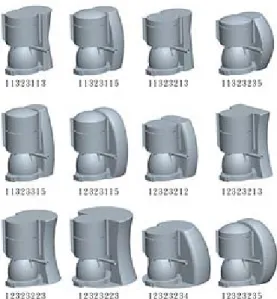
5. Decode these combinations of categories and display them using 3D models to confirm the effectiveness of the genetic algorithm program. (Fig. 1)
Fig. 1. The interface of decode program and the 3D models.
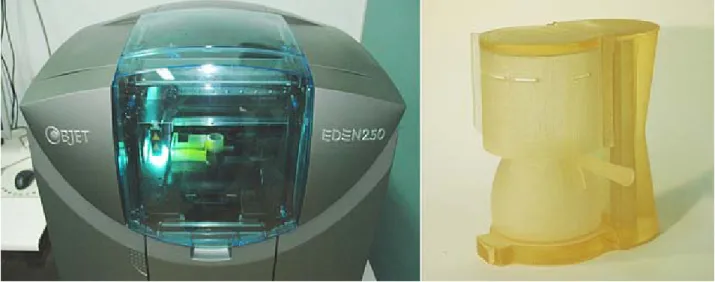
6. Use 3D imaging and rapid prototyping models (Fig. 2) to inspect the finished products.
Research Express@NCKU - Articles Digest
2 of 2
Fig 2. The rapid prototyping model of code11323113
This study demonstrated the effective use of genetic algorithms for assessing product design feasibility. The optimum solutions derived from linguistic data based on this method can increase the efficiency of the design process and yield products that closely conform to customer needs. The concept of using assembled models, which is based on morphological theory, enables the rapid development of product shapes and accelerated product development schedules.
The application of this genetic algorithm model to other decision theories may achieve even faster and more accurate computational results.