Hysteresis loop and pattern from the dual-wavelength competition in an Nd:YVO
4laser with an intracavity periodically-poled lithium
niobate Bragg modulator
Kun-Guei Hong1, Shoutai Lin2, and Ming-Dar Wei1*
1Department of Photonics, National Cheng Kung University, No.1, University Road, Tainan City 701, Taiwan; 2Department of Photonics, Feng Chia University, 100, Wenhwa Road, Seatwen,
Taichung 407, Taiwan
*E-mail: [email protected]
ABSTRACT
This study demonstrates hysteresis loop and pattern formation in a Nd:YVO4 laser at 1064nm (4F3/2→4I11/2) and 1342nm (4F3/2→4I13/2) with an intracavity electro-optic periodically poled lithium niobate (EO PPLN) Bragg modulator by using a T-type cavity configuration. Based on these dual wavelengths sharing population inversion in the same upper energy level to lase, the transmission, Tp, of EO PPLN was chosen as the controlling parameter to explore the dynamics of dual- wavelength competition. A hysteresis loop occurred when the extracting efficiencies of dual wavelength were near equivalent. When the pump power was 9.0 W, the hysteresis loop was observed in the region of the transmission of PPLN between Tp=64.88% to Tp=84.47%. The slope efficiencies were 25.96 and 3.92% and the thresholds were 2.5 and 3.5 W for the wavelengths of 1064 and 1342 nm, respectively. The width of the hysteresis loop increased when the pump power increased. Moreover, the hysteresis loop accompanied with the variation of the pattern formation. A high-order transvers mode was easily observed at 1342 nm light, but a simple spot existed for 1064 nm light. Apparently, the role of gain competition is worthy to deeply explore.
Keywords: solid-state laser, diode-pumped, dual-wavelength,
1. INTRODUCTION
In diode-pumped solid-state laser systems, Nd-doped crystal lasers have been widely investigated because of the low thermal conductivity and high conversion efficiency. For a four-level Nd-doped crystal laser, there are three primary lasing wavelengths, 0.9, 1.064 and 1.34 μm corresponding to the transition of 4F3/2→4I9/2, 4F3/2→4I11/2, and 4F3/2→4I13/2
[1]. Because these wavelengths share the same upper-level state, simultaneous multiple-wavelength lasing can be implemented in Nd-doped laser systems including Nd:YAlO3 [2-4], Nd:YVO4 [5], Nd:GdVO4 [6], Nd:YAG [7], and Nd:LuVO4 [8,9]. Simultaneously dual-wavelength lasing can be analyzed by rate equations which were extended to dual-transition at the same upper energy level and wasted the same population inversion in pulse pumping laser [10].
Due to consume the same upper energy level, there will be energy competitive behavior between dual-wavelength lasing regime. In a Nd-doped laser, adjusting both 1.064 and 1.342 μm cavity modes can reduce the competitive interaction and optimize dual-wavelength emission simultaneously [5]. The required loss at 1.06 μm can be calculated to avoid 1.06 μm oscillated and wavelength at 0.946 μm was made to oscillate from quasi-three level and 1.06 μm loss calculation model [11]. Based on residual pump, the Yb-doped fiber laser has bistable input–output hysterisis behaviors of the two lasing wavelengths 1.04 and 1.537μm [12]. The bistable behavior of dual-wavelength laser has been studied and applied to optical communication on Er-doped fiber laser because of nonlinear saturable absorption [13]. The phenomenon of optical bistability of Nd-doped laser was discovered due to resonator configuration transition at 1.064 μm only [14]. In this work, hysteresis loop and pattern formation were observed in a Nd:YVO4 laser with simultaneously multiple wavelength emission at 1064nm and 1342nm. Because the stimulated emission cross section of 1.342 μm light is less than that of 1.064 μm light, the EO PPLN Bragg modulator were introduced to increase intracavity loss at 1.064 μm by Bragg diffraction [15]. Based on the dual wavelengths sharing the upper energy level to lase, an EO PPLN Bragg modulator inserted in the 1064 nm cavity will easily and finely tune the loss of 1064 nm beam to explore the dynamics of dual-wavelength competition.
2. EXPERIMENTAL SETUP
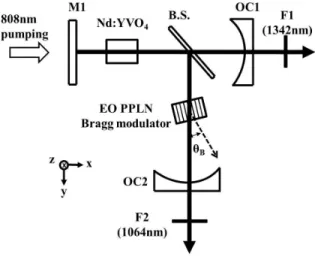
Figure 1 shows the experimental setup. The c-cut Nd:YVO4 crystal had dimensions of 3 × 3 × 8 mm3 and 0.5% at Nd3+
doping. and was mounted by a water cooled cooper block was pumped by an 808 nm and 16 W with spot diameter of approximately 400 μm. The temperature of circulating water was controlled at 18°C. Both sides of the Nd:YVO4 crystal were coated with antireflection (AR) coating from 800 to 1450 nm. A T-type cavity was designed to explore the dynamics of dual-wavelength competition. The mirror, M1, was one of the cavity mirror for both wavelengths. One side of the M1 had high transmission (HT) coating at 808 nm and the other side of the M1 had high reflection (HR) coating at 1064 and 1342 nm, as well as HT coating at 808 nm. The dichroic beam-splitter (BS) with HT coating at 1342 nm and HR coating at 1064 nm distinguished dual wavelengths to be a T-type cavity. The output coupler, OC1, of 1342 nm was a spherical concave mirror with a radius of curvature of 200 mm and a reflection of 99%. A plano-concave cavity configuration was formed in the laser wavelength of 1342 nm. The same plano-concave configuration was arranged for the 1064 nm laser with a radius of curvature of 150 mm and a 90% reflection of the plane output coupler OC2. The F1
and F2 are 1342 nm and 1064 nm bandpass filters, respectively. The 1342 nm cavity length is 11.69 cm and the 1064 nm cavity length is 14.18 cm.
The Bragg grating was constructed by cascading several PPLN Pockel cells with period of 20.3 μm along the x direction, in which each adjoining cell were arranged in the opposite orientation. The dimensions of the PPLN were 10 mm (width in x) × 15 mm (length in y) × 2 mm (length in z). The z surfaces of the PPLN was coated the electrodes and applied a voltage. The EO effect induced a periodic refractive-index modulation in the PPLN to form a set of Bragg grating. The variation of refractive-index of each Pockel cell is given by ( )
2
3ESx n=−nγ z
Δ , where n is refraction index, γ is the Pockel coefficient, and s(x)= ±1 denotes the sign of the domain orientation of each Pockel cell of PPLN crystal as a periodic function of x. The characteristics of the Bragg grating follows the Bragg condition to be 2ΛsinθB,m = mλ0/n, where m is the diffraction order, λ0 is the incident laser wavelength, n is the average refractive index of the Bragg grating, and Λ is the grating period. When the grating period is 20.3 μm, the Bragg angle is 0.7∘for m = 1 at 1064 nm.
Figure 2 shows the 1064-nm transmission, Tp, of the EO PPLN Bragg modulator at the m = 0 direction as a function of the applied voltage, Va. The half-wave voltage of this EO PPLN is 507.9 V. When the PPLN was added in the 1064 nm cavity, as shown in Fig. 1, the applied voltage of the PPLN will control the intracavity transmission of 1064 nm light to achieve the variation of intracavity loss.
Fig.1. The experimental setup of T-type laser cavity. Fig. 2. The transmission of EO PPLN versus drive voltage at m = 0.
3. EXPERIMENTAL RESULT
Because dual wavelength lasing shares the upper level state, the competition between two wavelength lights must be approximately equal. Thus, dual wavelength laser could be achieved by cavity design companied with varying the intracavity loss. The cavity design determines the extracting efficiencies of the two lights from pump power, and the intracavity EO PPLN controls the intracavity loss of 1064 nm light to explore the competition between these two wavelength lights. Because the extracting efficiency depends on the overlap integral between the pump and cavity distributions, the precision alignment of the cavity is needed to implement a dual wavelength laser. Figure 3 with Va=0 V shows the output powers versus pump power for simultaneous emission lights of 1064 and 1342 nm. The slope efficiencies were 25.96 and 3.92% and the thresholds were 2.5 and 3.5 W for the wavelengths of 1064 nm and 1342 nm, respectively. The cavity lengths were 11.69 and 14.18 cm for 1064 nm and 1342 nm cavities, respectively. When the intracavity loss of 1064 nm cavity was induced by varying the transmission of the PPLN, Figure 4 depicts the output power as a function of the transmission of the PPLN at the pump power of 9 W. Apparently, a hysteresis occurs. When the transmission of the PPLN increases from 59.54% to 84.47%, the loss of 1064 nm is too large to suppress the lasing behavior. Thus, the 1342 nm light mainly extracts the pump power to lase. As Tp = 84.47%, the capacity of the extracting efficiency for 1064 nm light gradually approach to that for 1342 nm. The power of the 1064 nm light suddenly increases as continuing to add Tp, because the emission cross section of 1064 nm is greater than that of 1342 nm. The power of 1342 nm light decreases at the same time based on the power conservation. However, a different tendency of the output power was observed as Tp decreases. The output power of the 1064 nm light gradually decreases as Tp decreases until 67.93%. A suddenly variation to near zero occurs as Tp = 64.88%. A hysteresis occurs between Tp= 64.88% to 84.47%.
Moreover, the hysteresis area increases as the pump power increases. Figure 5 demonstrates the variant transmission of the hysteresis as a function of the pump power, in which TH and TL correspond to the suddenly variances for increasing and decreasing transmission, respectively. The difference between TH and TL represents the width of the hysteresis.
When the pump power was less than 7W, the hysteresis was not clear.
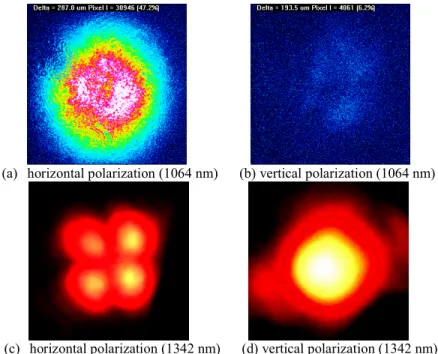
Not only did the output power have hysteresis, but also was the pattern dependent on the Tp. Figure 6 displays the horizontal and vertical polarizations for both of 1064 nm and 1342 nm at Tp=70.22%. We can find that the 1064 nm laser is dominant by TEM00 mode at the horizontal polarization. In the contrary, the polarization of 1342 nm laser is more complicated. The patterns approached to TEM11 and TEM00 modes for the horizontal and vertical polarizations, respectively. It is interesting that the hysteresis of the dual wavelength laser could be dependent on the polarization; i.e., the competition of the dual wavelengths occurs at two dimensions. The further work continues to keep.
Fig. 3. The output power as a function of the pump power for simultaneous emission lights at 1064 and 1342 nm.
Fig. 4. Hysteresis loop at pumping power 9.0 W. The solid black and dashed blue lines correspond to the 1064 nm and 1342 nm lights, respectively
Fig. 5. The suddenly variant point of transmission of the hysteresis
(a) horizontal polarization (1064 nm) (b) vertical polarization (1064 nm)
(c) horizontal polarization (1342 nm) (d) vertical polarization (1342 nm)
Fig. 6. The pattern of various polarizations in dual wavelength: (a) horizontal polarization for 1064 nm light, (b) vertical polarization for 1064 nm light, (c) horizontal polarization for 1342 nm light, and (d) vertical polarization for 1342 nm light.
4. CONCLUSION
In an c-cut Nd:YVO4 laser, the dual-wavelength competition formed power hysteresis loops by using an intracavity PPLN to control the loss of 1064 nm laser. When the applied voltage of the PPLN was zero, a dual wavelength laser can be obtained. The slope efficiencies were 25.96 and 3.92% and the thresholds were 2.5 and 3.5 W for the wavelengths of 1064 and 1342 nm, respectively. Focusing on the pump power was 9.0 W and varying the transmission of the PPLN, the hysteresis loop was observed in the region of the transmission between T=64.88% to T=84.47%. The area of the hysteresis increases as the pump power increased. In the hysteresis region, the polarization-dependent pattern appears that the competition of these two wavelengths could be a two-dimensional behavior.
ACKNOWLEDGMENTS
The authors would like to thank the National Science Council of the Republic of China for financially supporting this research under Contracts No. NSC 101-2112-M-006-014-MY3 and NSC 100-2221-E-035 -063 -MY3.
REFERENCES [1] Walsh, B. M., Laser Phys. 20, 622-634 (2010).
[2] Nadtocheev, V. E. and Nanii, O. E., “Two-wave emission from a c.w. solid-state YAG:Nd3+ laser,” Sov. J.
Quantum Electron. 19, 444-446 (1989).
[3] Shen, H. Y., Zeng, R. R., Zhou, Y. P., Yu, G. F., Guang, C. H., Zeng, Z. D., Zhang, W. J., and Ye, Q. J.,
“Comparison of simultaneous multiple wavelength lasing in various neodymium host crystals at transitions from
4f3/2-4f11/2 and 4f3/2-4f13/2,” Appl. Phys. Lett. 56, 1937-1938 (1990).
[4] Shen, H. Y., Lin, W. X., Zeng, R. R., Zhou, Y. P., Yu, G. F., Huang, C. H., Zeng, Z. D., Zhang, W. J., Wu, R. F.
and Ye, Q. J. “1079.5- and 1341.4-nm larger energy from a dual-wavelength Nd:YAIO3 pulsed laser,” Appl. Opt.
32, 5952-5957 (1993).
[5] Chen, Y. F., “cw dual-wavelength operation of a diode-end-pumped Nd:YVO4 laser,” Appl. Phys. B 70, 475-478 (2000).
[6] He, J. L., Du, J., Sun, J., Liu, S., Fan, Y. X., Wang, H. T., Zhang, L. H. and Hang, Y. “High efficiency single- and dual-wavelength Nd:GdVO4 lasers pumped by a fiber-coupled diode,” Appl. Phys. B 79, 301-304 (2004).
[7] Hou, Y. E., Fa, Y. X., He, J. L. and Wang, H. T. “High-efficiency continuous-wave and Q-switched diode-end- pumped multi-wavelength Nd:YAG lasers,” Opt. Commun. 265, 301-305 (2006).
[8] Hsu, C. C., Wu, S. S., Chou, C. C. and Wei, M. D., “Continuous Wave Simultaneous Dual-Wavelength and Power Ratio Tunable Operation at 1064 and 1342 nm in an Nd:LuVO4 Laser”, Laser Phys. 21, 1039-1041 (2011)
[9] Maunier, C., Doualan, J. L., Monocorge, R., Speghini, A., Bettinelli, M. and Cavalli, E., “Growth, spectroscopic characterization, and laser performance of Nd:LuVO4, a new infrared laser material that is suitable for diode pumping,” J. Opt. Soc. Am. B 19, 1794-1800 (2002).
[10] Su, H., Shen, H. Y., Lin, W. X., Zeng, R. R., Huang, C. H. and Zhang, G. “Computational model of Q-switch Nd:
YAlO3 dual-wavelength laser,” J. Appl. Phys. 84, 6519-6522 (1998).
[11] Fan, T. Y., “Modeling and CW operation of a quasi-three-level 946nm Nd:YAG laser,” IEEE J. Sel. Top. Quant.
Electr. 23, 605-612 (1987).
[12] Li, J. L., Musha, M., Shirakawa, A., Ueda, K. I. and Zhong, L. X., “Dual-wavelength-switching operation based on optical bistability in pump-bypassed ytterbium-doped fiber laser,” Appl. Phys. B 85, 545-548 (2006).
[13] Mao, Q. and Lit, John W. Y., “Optical Bistability in an L-Band Dual-Wavelength Erbium-Doped Fiber Laser With Overlapping Cavities,” IEEE Photonic. Tech. L. 14, 1252-1254 (2002).
[14] Lee, C. S. and Osada, H., “Observation of optical bistability due to resonator configuration transition,” Opt. Lett.
10, 232-234 (1985).
[15] Lin, Y. Y., Lin, S. T., Chang, G. W., Chiang, A. C. and Huang, Y. C., “Electro-optic periodically poled lithium niobate Bragg modulator as a laser Q-switch,” Opt. Lett. 32, 545-547 (2007).
[16] Liu, F. Q., He, J. L., Xu, J. L., Yang, J. F., Zhang, B. T., Huang, H. T., Gao, C. Y., Xu, J. Q. and Zhang, H. J.,
“Dual-wavelength laser operation at 1064 and 914 nm in two Nd:YVO4 crystals,” Laser Phys. 20, 737-739 (2010).
[17] Lü, Y. F., Zhang, X. H., Chen, J. F., Sun, G. C. and Zhao, Z. M., “All-solid-state Nd:LuVO4 laser operating at 1066 nm and 1343 nm under diode pumping into the emitting level”, Laser Phys. Lett. 7, 699-702 (2010).
[18] Wei, M. D., Cheng, C. C. and Wu, S. S., “Instability and satellite pulse of passively Q-switching Nd:LuVO4 laser with Cr4+: YAG saturable absorber”, Opt. Commun. 281, 3527-3531 (2008).