Study of Powerful Disturbing Sand Discharge
within Reservoir
Ting-To Yu, Wen-Fei Peng, Pin-kun Lu, and Ming-Hsiung Hsu
Abstract
Tseng-Wen Reservoir is the largest reservoir in Taiwan located between Chiayi country and Tainan city. It is the most important water resource facility for Chianan plain. Unfortunately, the Tseng-Wen Reservoir was suffered from the sediment disaster during 2009 typhoon Morakot. It causes the 9,108 m3 capacity decrease. In order to disturb silt discharge within reservoir, we explore the water gel explosive in the silt of Tseng-Wen Reservoir. The extent of disturb is measured. The result shows that it is a possibility to remove the sediment by the explode scheme designed in this project.
Two explode procedure are designed, namely (1) sinking method and (2) drilling method, respectively. In sinking method, water gel explosive (4kg or 6kg) is embedded in the sandbag (40kg), and the sandbag is sunk into silt before explode. In the drilling method, drilling through the silt to construct a hole with 10~12m depth, and the water gel explosive (15kg or 20kg) pass through the casing and reach the sediment before explode.
The result of measurement shows that, in sinking method, a cave of 844m3 is created after explode test carried out, in this test, 16 sets of sandbags are constructed, only 4kg water gel explosive are embedded in each sandbag. For the result of the drilling method, the range of disturbance is reached to a depth about 30m in the sediment after exploding procedure. The result of the exploding test is further used to design the procedure that creates a 12km channel in the Tseng-Wen Reservoir. The channel would promote the discharge of silt through the Desilting tunnel or PRO.
Keywords: blast, reservoir deposition, disturbing
1 Explode procedure
We design two procedures, sinking method and drilling method, to carry out the test explosion respectively. The advantage of sinking method is the high efficiency. On the other hand, the disturbance region for drilling method is deeper. The procedure of the two explode method is explained as follows.
1.1 Sinking method
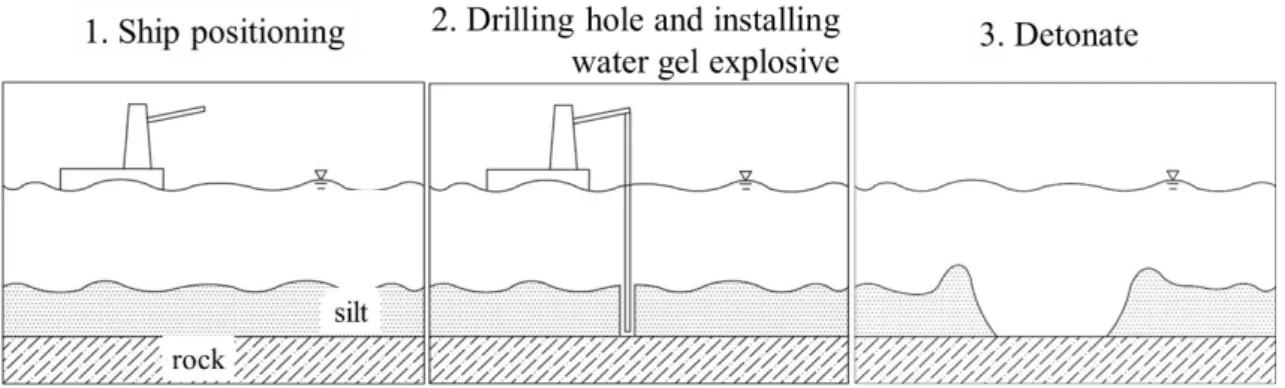
The main procedure of sinking method is illustrated in Fig. 1. The explosive package consists of water gel explosive (4kg or 6kg), sand (40kg) and sandbag. The ship carries the explosive packages to the locations of test explosion. At a distance of 1.5m or 6m, throw the explosive package into the water one by one. In the first and second round of
test explosive, 16 and 14 explosive packages are set up, respectively. The explosive package sunk into silt in about 0.5m. Finally, detonate all explosive packages at once in one explosive round.
Fig. 1: Operating procedures of sinking method.
1.2 Drilling method
The main procedure of drilling method is illustrated in Fig. 2. The floating platform carries water gel explosive and drilling machine to the locations of the test explosion. A hole with 10m~12m depth on the silt is constructed by the drilling machine on the floating platform, the water gel explosive (15kg or 20kg) delivered through the casing and reach the bottom of the hole. In one explosive round, 6~9 holes are constructed. Detonate explosive packages in all holes at once in one explosive round.
Fig. 2: Operating procedures of drilling method.
2 Preparation and planning of test explosion
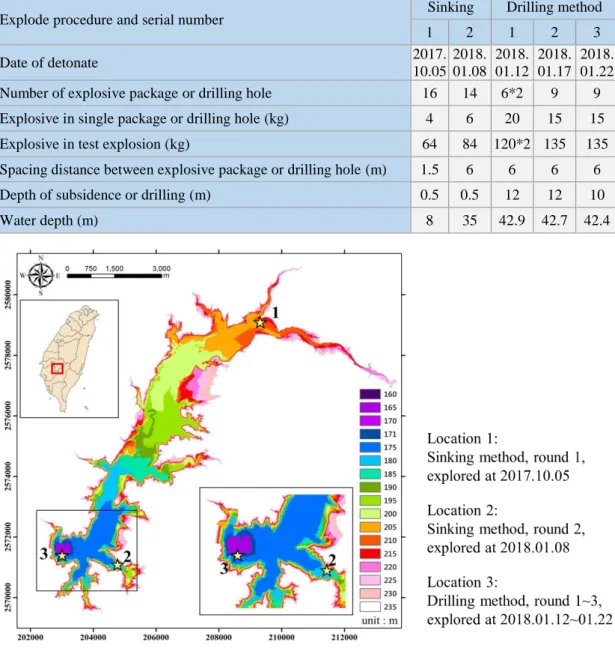
In this study, five rounds of test explosion are performed in Tseng-Wen Reservoir during 2017.10 to 2018.01. Basic information and arrangement about the test explosion are listed in Tab. 1. The locations of the test explosion and the corresponding explode method and explosion date are shown in Fig. 3.
For the safety reason, the radius of the control area set for 50m, where vessels are not allowed to enter. Diving is not allowed in the whole reservoir at the moment of the explosion. Three seismographs are prepared to record the shaking intensity induced
by explosive. To protect the fish in Tseng-Wen Reservoir from the harm of blast wave, following protective measures are performed: (1) Suspend a waterproof-horn in the water to play a series of noise. (2) Create a bubble curtain to breaking the propagation of blast waves. (3) Put the chilis and stones in the cotton bags, submerged these bags into the water. (4) One minute before the test explosion, detonate the extra detonating cord to disturb and disperse the fish.
Tab. 1: Information and arrangement of test explosion
Explode procedure and serial number Sinking Drilling method
1 2 1 2 3 Date of detonate 2017. 10.05 2018. 01.08 2018. 01.12 2018. 01.17 2018. 01.22 Number of explosive package or drilling hole 16 14 6*2 9 9 Explosive in single package or drilling hole (kg) 4 6 20 15 15
Explosive in test explosion (kg) 64 84 120*2 135 135
Spacing distance between explosive package or drilling hole (m) 1.5 6 6 6 6
Depth of subsidence or drilling (m) 0.5 0.5 12 12 10
Water depth (m) 8 35 42.9 42.7 42.4
Fig. 3: Locations of test explosion and the corresponding explode procedure and explosion date.
3 Analyses and results
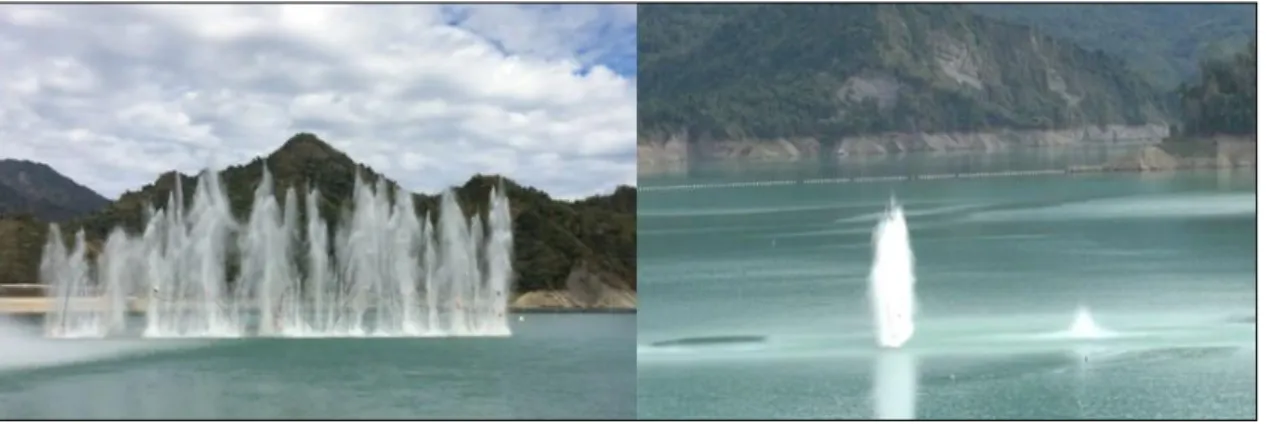
The snapshot of the test explosion (drilling method round 3) is shown in Fig. 4. At the moment of detonating, the shaking intensity is recorded by seismographs immediately and water samples are also collected. Side-scan sonar is performed before and
after detonate to calculating the change of silt terrain that induced by the explosion. The seismic profiles are produced to find out the depth of disturbance. The work about collecting and organizing the carcass of the fish is carried out for several days.
Tab. 2: The result of test explosions
Explode procedure and serial number Sinking Drilling method
1 2 1 2 3
Amount of silt moved in the test explosion (m3) 844 644 2,281 427 636
Amount of silt moved by explosion of unit explosive (m3/kg) 13 8 10 3 5
Depth of disturbance (m) 8-10 - 50-58 50-56 49-55
Diameter where the silt content changed obviously (m) 47 - 60 60 53
Casualties of fish (kg) 16* 3.5 0.4 0.2 0.2
Ammonia nitrogen immediately in the test explosion (mg/L)** 0.08 0.13 0.04 0.07 0.04
*denote no protective measures are performed
**allowance is 1 mg/L, background values is about 0.02~0.09mg/L.
Fig. 4: Picture of test explosion with the procedure of drilling method, round 3.
3.1 Disturbance of test explosions
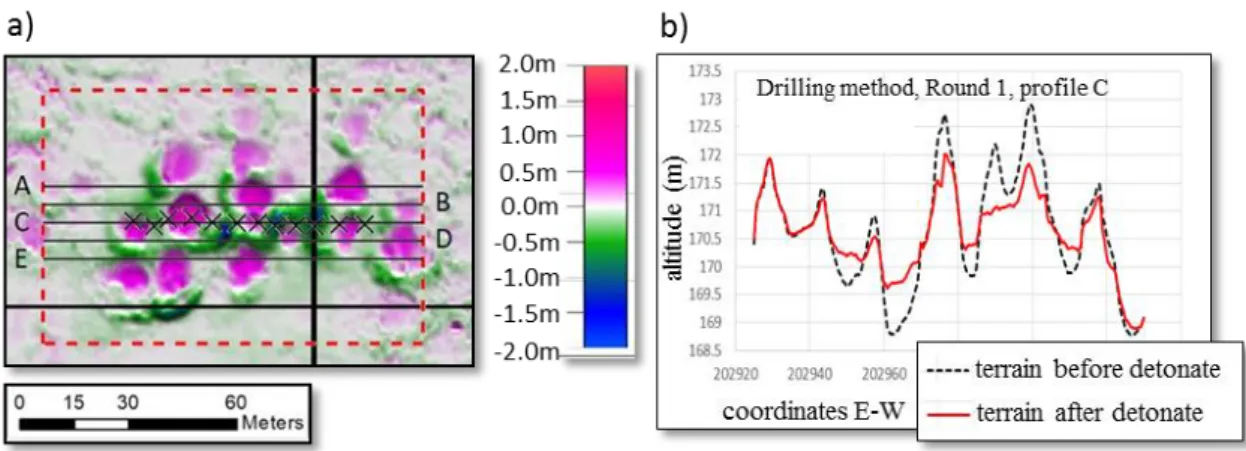
Side-scan sonar before and after detonate shows a mass of silt are moved by the explosions (Fig. 5a). Observe the pattern of terrain change in Fig. 5b, silt removed from the bulge, and deposit on the hollow. The amount of silt moved in the test explosion is from 427~2,281m3, the amount of silt moved by the explosion of unit explosive is 3~13m3/kg. The variance of the number is due to the different arrangement of explosion design. Obviously, the result shows the efficiency that silt is disturbed and moved by the explosion.
Comparing the seismic profiles estimated before and after detonate, the depth of disturbance region could be detected. For example, the comparing of seismic profiles estimated from drilling method (round 3) is shown in Fig. 6. The dotted circle marked in Fig. 6b (after detonate) indicate the reflection signal that do not exist in Fig. 6a (before detonate). And the depth of disturbance hence be detected, range from 47~60m for different test explosion.
Fig. 5: Change of silt terrain during the test explosion of drilling method, round 3.
Fig. 6: The seismic profiles during the test explosion of drilling method, round 3.
3.2 Change of silt content
The pictures shown in Fig. 7 are taken by UAV few minutes after the test explosion, it shows that explosion could not only disturb the silt, but also increase the silt content in the water. The diameter of the area where the silt content obviously changed is about 47~60m for different test explosions.
3.3 Attenuation of shaking intensity
Based on the shaking intensity recorded at the moment of test explosions, the relationships between shaking intensity and distance are observed. For example, the attenuation pattern that the shaking acceleration in the free-field decrease with distance is shown in Fig. 8 (solid point) for the explosion with the drilling method. Further, a series of attenuation equations in different shaking intensity (acceleration or velocity) could be estimated based on the parameters of distance, amount of water gel explosive, explode procedure (sinking or drilling method), and site condition (free-field or dam). For example, the attenuation equation of shaking acceleration in the free-field for the explosion with the drilling method is (solid line in Fig. 8):
𝐴 = 5.0 × 10³× (𝑄1 3⁄ /𝑅)1.3
where A is peak acceleration in cm/s2, Q is the amount of water gel explosive in kg, R is the distance in meter. These estimated attenuation equations could use to calculate the safe distance to avoid that structure or dam damaged in the explosion.
Fig. 8: Attenuation pattern of shaking intensity decrease with distance for the test explosion with the procedure of drilling method.
3.4 Casualties of the fish
There is no protective measure performed in the first test explosion of sinking method, the casualties of fish is 16kg, this could be the control group. After that, protective measures are performed in the other test explosions, and casualties of fish is down to 3.5kg for sinking method, less than 0.5kg for drilling method. The results show that the protective measures used in this study could control the damage of fish.
3.5 Ammonia nitrogen release by explosion
The test of water samples shows that the average concentration of ammonia nitrogen (NH3 or NH4+) immediately after the test explosion is 0.04~0.14 mg/L, which is close to the background values of 0.02~0.09mg/L and dramatically less than the allowance of 1 mg/L.
4 Conclusions
A series of test explosions demonstrate the power ability that disturb the silt under the reservoir. Two procedures of explosion are designed: sinking method and drilling method. In sinking method, the ability of removing the silt is strong, the amount of silt moved by the explosion in unit explosive is 8~13m3/kg. In drilling method, the range of disturbing is wide and deep, the depth of disturbance is 49~58m. The damage to the fish is acceptable under the protective measures, and the explosions almost release no pollution for ammonia nitrogen. The attenuation equations estimated in this study could use to calculate the safe distance to avoid that structure or dam damaged in the explosion.
Acknowledgement
This research was made possible by the financial support of the Water Resources Agency (Project No. MOEAWRA1060267).
Authors:
Ting-To Yu (corresponding Author)
Department of Resources Engineering, National Cheng Kung University (NCKU) Email: [email protected]
Wen-Fei Peng
GeoResources Research Center, National Cheng Kung University (NCKU) Email: [email protected]
Pin-kun Lu
Director, Facility Maintenance Section, Southern Region Water Resources Office, Water Resources Agency, Ministry of Economic Affairs, Taiwan
Ming-Hsiung Hsu