Optically switchable biphotonic photorefractive effect in dye-doped liquid crystal films
Mei-Ru Lee, Jyun-Ruei Wang, and Chia-Rong Lee
Department of Physics, National Cheng Kung University, Tainan, Taiwan 701, ROC Andy Y.-G. Fuha)
Department of Physics and Institute of Electro-optical Science and Engineering, National Cheng Kung University, Tainan, Taiwan 701, ROC
(Received 2 August 2004; accepted 21 October 2004)
This study reports the optically swichable photorefractive (PR) effect induced in a biphotonic grating in the presence of an applied dc voltage, in an azo-dye-doped liquid crystal(LC) film. When one green light is switched on (off), the PR grating can be turned on (off) by irradiating an interference field generated by two linearly polarized red lights. Experimental results demonstrate that such a PR effect follows primarily from a biphotonic process, with two mechanisms—the generation of green light-induced space charges by trans–cis isomerization, and the suppression of the formation of space charges by the red light in cis–trans back isomerization. These mechanisms apply to the dark and bright fringes of the red interference field, respectively. A spatially inhomogeneous space-charge field is then established to modulate the orientation of LCs, forming the PR grating in the presence of a dc voltage. Strong coupling of the two red lights is observable and measured dynamically during the formation of the PR grating in this study. © 2004 American Institute of Physics. [DOI: 10.1063/1.1836864]
Photorefractive (PR) materials have recently attracted much considerable interest because of their large optical non- linearity and wide range of potential applications, such as holographic recording, phase conjugation, optical image pro- cessing, beam amplification, spatial filtering, and others.1,2 Nematic liquid crystals(NLCs) exhibit innate fluidity, high dielectric and conductive anisotropies, and birefringence.
They are particularly useful in investigations of photorefrac- tivity. In recent years, scientists have widely exploited NLCs doped with dye or carbon materials in this field.3–10Briefly, two coherent beams cause an interference modulation to ex- cite the dopants and establish a periodic distribution of space charges throughout the liquid crystal (LC) host. When a dc voltage is applied, the subsequent redistribution of the space charges induces a spatially inhomogeneous space-charge field, which changes the orientation of the LC molecules, periodically modulating the nonlocal refractive index in the cell. Such an index modulation leads to the PR effect.
PR effects in NLCs doped with dye or carbon materials have usually been studied using typical holography, in which the two pump beams are mainly blue green.1–11The bipho- tonic holography has been realized and developed in azo materials written using red lights.12–15 Yet, few researchers had ever studied the PR effect using a biphotonic holography in the past. This report verifies that a PR effect can be ob- served and studied in a biphotonic grating(BG) in an azo- dye(D2)-doped LC (ADDLC) system. Lee et al.15had stud- ied the BGs, in methyl red (MR)-doped LC films recently.
Under the illumination of one linearly polarized green light with the simultaneous irradiation of an interference pattern created by two linearly polarized red lights, the BGs can form. They ascribe to the formation of such local gratings as two mechanisms. One is the green light-induced dye adsorp-
tion effect through the trans–cis isomerization; the other the inhibition effect of dye adsorption induced by red light through the cis–trans back isomerization. Azo-dyes are usu- ally in the stable trans-state in the dark. Most of their ab- sorption bands lie in the blue–green region of shorter wave- lengths. Excitation with blue–green light transforms the azo- dyes from trans- to cis-isomers, causing the absorption band to shift to a region with a longer wavelength (red or infrared).14–16Unlike the MR dyes, the azo-dye(D2) used in the present study does not adsorb onto the substrates in its cis-form. A linearly polarized red interference pattern and a linearly polarized green light simultaneously pump the sample, and the PR grating effect appears in the presence of a dc voltage. This experiment also reveals the two-beam cou- pling (TBC) effect of the two red beams which shows the nonlocal PR effect.
The azo-dye and the LC used in this experiment are D2 and E7, respectively (from Merck). The dyes constitute
⬃1 wt % of the homogeneous D2–E7 mixture. An empty cell is fabricated by combining two n,n-dimethyl- n-octadecyl-3-aminopropyltrimethoxysilyl chloride-treated glass plates coated with indium-tin oxide. The cell is 25µm thick. The homogeneous mixture is then injected into the empty cell to form a homeotropically aligned ADDLC film;
the alignment is verified using a conoscope.
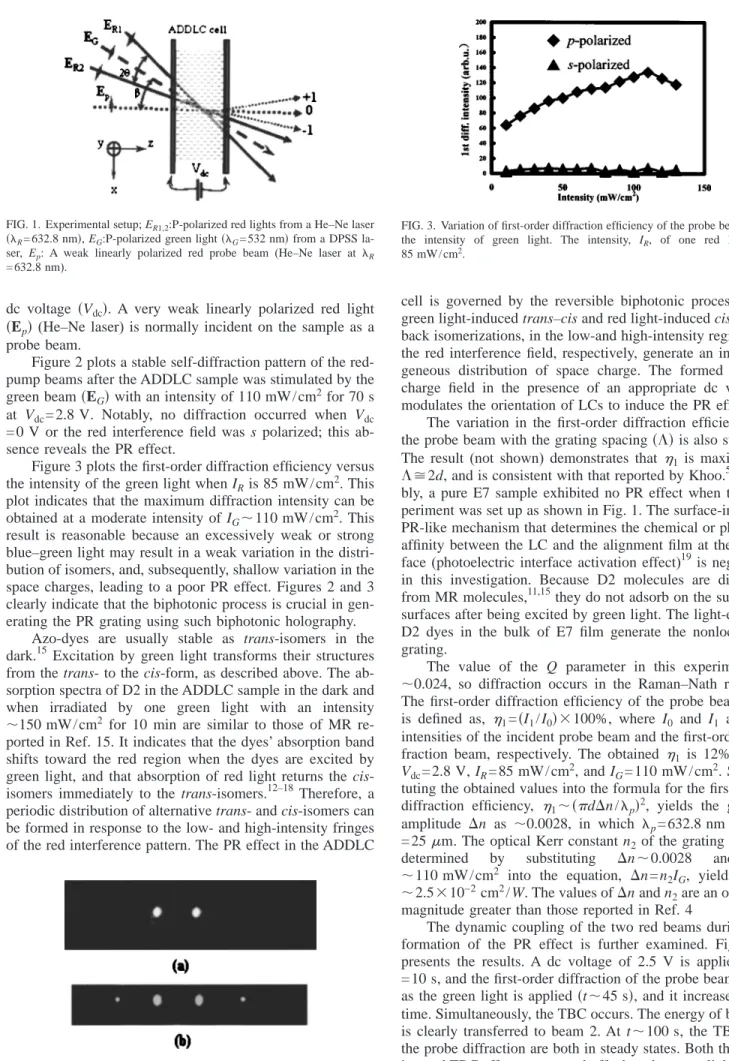
Figure 1 presents the experimental setup used in this work. Two p-polarized (on x–z plane) red lights 共R
= 632.8 nm兲 from a He–Ne laser, ER1,2, intersect at an angle of 2⬵0.73°, establishing an interference field, ER, in the ADDLC sample. They are unfocused and have an equal in- tensity of IR. The angle is set to 45°, which is the angle between the bisector of the red lights and the normal to the plane of the sample. One p-polarized green light共EG兲, with an intensity of IG, from a diode-pumped solid-state (DPSS) laser, lasing at 532 nm共G兲, simultaneously impinges on the red interference area of an ADDLC cell in the presence of a
a)Author to whom correspondence should be addressed; electronic mail:
APPLIED PHYSICS LETTERS VOLUME 85, NUMBER 24 13 DECEMBER 2004
0003-6951/2004/85(24)/5822/3/$22.00 5822 © 2004 American Institute of Physics
Downloaded 27 Apr 2010 to 140.116.208.55. Redistribution subject to AIP license or copyright; see http://apl.aip.org/apl/copyright.jsp
dc voltage 共Vdc兲. A very weak linearly polarized red light 共Ep兲 (He–Ne laser) is normally incident on the sample as a probe beam.
Figure 2 plots a stable self-diffraction pattern of the red- pump beams after the ADDLC sample was stimulated by the green beam共EG兲 with an intensity of 110 mW/cm2for 70 s at Vdc= 2.8 V. Notably, no diffraction occurred when Vdc
= 0 V or the red interference field was s polarized; this ab- sence reveals the PR effect.
Figure 3 plots the first-order diffraction efficiency versus the intensity of the green light when IRis 85 mW/ cm2. This plot indicates that the maximum diffraction intensity can be obtained at a moderate intensity of IG⬃110 mW/cm2. This result is reasonable because an excessively weak or strong blue–green light may result in a weak variation in the distri- bution of isomers, and, subsequently, shallow variation in the space charges, leading to a poor PR effect. Figures 2 and 3 clearly indicate that the biphotonic process is crucial in gen- erating the PR grating using such biphotonic holography.
Azo-dyes are usually stable as trans-isomers in the dark.15 Excitation by green light transforms their structures from the trans- to the cis-form, as described above. The ab- sorption spectra of D2 in the ADDLC sample in the dark and when irradiated by one green light with an intensity
⬃150 mW/cm2 for 10 min are similar to those of MR re- ported in Ref. 15. It indicates that the dyes’ absorption band shifts toward the red region when the dyes are excited by green light, and that absorption of red light returns the cis- isomers immediately to the trans-isomers.12–18 Therefore, a periodic distribution of alternative trans- and cis-isomers can be formed in response to the low- and high-intensity fringes of the red interference pattern. The PR effect in the ADDLC
cell is governed by the reversible biphotonic process. The green light-induced trans–cis and red light-induced cis–trans back isomerizations, in the low-and high-intensity regions of the red interference field, respectively, generate an inhomo- geneous distribution of space charge. The formed space- charge field in the presence of an appropriate dc voltage modulates the orientation of LCs to induce the PR effect.
The variation in the first-order diffraction efficiency of the probe beam with the grating spacing共⌳兲 is also studied.
The result(not shown) demonstrates that 1 is maximal at
⌳⬵2d, and is consistent with that reported by Khoo.5Nota- bly, a pure E7 sample exhibited no PR effect when the ex- periment was set up as shown in Fig. 1. The surface-induced PR-like mechanism that determines the chemical or physical affinity between the LC and the alignment film at the inter- face(photoelectric interface activation effect)19 is neglected in this investigation. Because D2 molecules are different from MR molecules,11,15they do not adsorb on the substrate surfaces after being excited by green light. The light-excited D2 dyes in the bulk of E7 film generate the nonlocal PR grating.
The value of the Q parameter in this experiment is
⬃0.024, so diffraction occurs in the Raman–Nath regime.
The first-order diffraction efficiency of the probe beam,1, is defined as, 1=共I1/ I0兲⫻100%, where I0 and I1 are the intensities of the incident probe beam and the first-order dif- fraction beam, respectively. The obtained 1 is 12% when Vdc= 2.8 V, IR= 85 mW/ cm2, and IG= 110 mW/ cm2. Substi- tuting the obtained values into the formula for the first-order diffraction efficiency, 1⬃共d⌬n/p兲2, yields the grating amplitude ⌬n as ⬃0.0028, in which p= 632.8 nm and d
= 25m. The optical Kerr constant n2 of the grating can be determined by substituting ⌬n⬃0.0028 and IG
⬃110 mW/cm2 into the equation, ⌬n=n2IG, yielding n2
⬃2.5⫻10−2cm2/ W. The values of⌬n and n2are an order of magnitude greater than those reported in Ref. 4
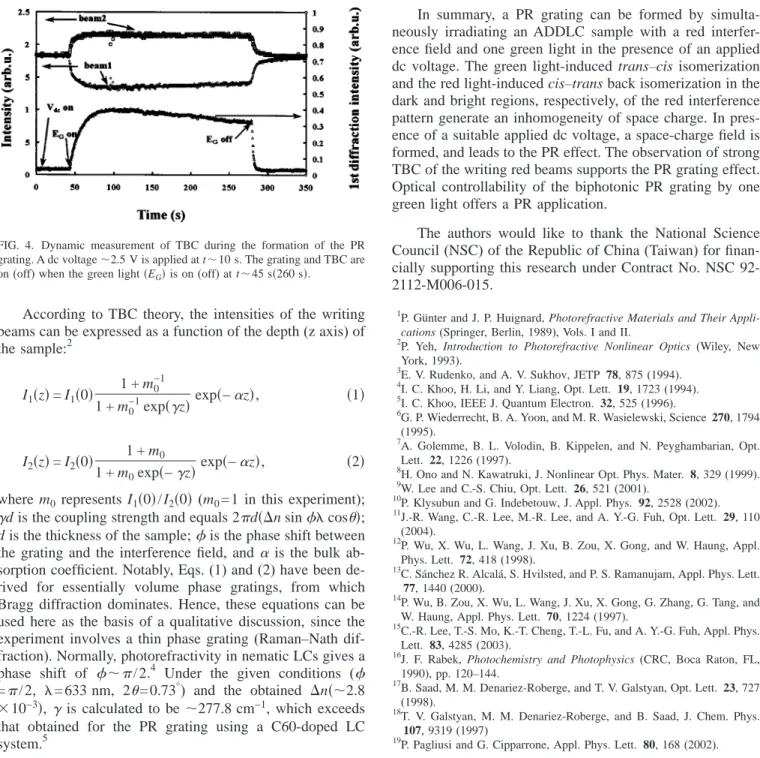
The dynamic coupling of the two red beams during the formation of the PR effect is further examined. Figure 4 presents the results. A dc voltage of 2.5 V is applied at t
= 10 s, and the first-order diffraction of the probe beam is on as the green light is applied共t⬃45 s兲, and it increases with time. Simultaneously, the TBC occurs. The energy of beam 1 is clearly transferred to beam 2. At t⬃100 s, the TBC and the probe diffraction are both in steady states. Both the grat- ing and TBC effects are turned off when the green light is off at⬃260 s. Such an optically controllable PR effect may be useful in optical switching applications.
FIG. 3. Variation of first-order diffraction efficiency of the probe beam with the intensity of green light. The intensity, IR, of one red light, is 85 mW/ cm2.
FIG. 1. Experimental setup; ER1,2:P-polarized red lights from a He–Ne laser 共R= 632.8 nm兲, EG:P-polarized green light共G= 532 nm兲 from a DPSS la- ser, Ep: A weak linearly polarized red probe beam (He–Ne laser at R
= 632.8 nm).
FIG. 2. Stable self-diffraction pattern of the red pump beams from the formed PR BG(a) in the absence and (b) in the presence of an applied dc voltage of 2.8 V.
Appl. Phys. Lett., Vol. 85, No. 24, 13 December 2004 Leeet al. 5823
Downloaded 27 Apr 2010 to 140.116.208.55. Redistribution subject to AIP license or copyright; see http://apl.aip.org/apl/copyright.jsp
According to TBC theory, the intensities of the writing beams can be expressed as a function of the depth(z axis) of the sample:2
I1共z兲 = I1共0兲 1 + m0−1
1 + m0−1exp共␥z兲exp共−␣z兲, 共1兲
I2共z兲 = I2共0兲 1 + m0
1 + m0exp共−␥z兲exp共−␣z兲, 共2兲 where m0 represents I1共0兲/I2共0兲 (m0= 1 in this experiment);
␥d is the coupling strength and equals 2d共⌬n sin cos兲;
d is the thickness of the sample;is the phase shift between the grating and the interference field, and␣ is the bulk ab- sorption coefficient. Notably, Eqs.(1) and (2) have been de- rived for essentially volume phase gratings, from which Bragg diffraction dominates. Hence, these equations can be used here as the basis of a qualitative discussion, since the experiment involves a thin phase grating(Raman–Nath dif- fraction). Normally, photorefractivity in nematic LCs gives a phase shift of ⬃/ 2.4 Under the given conditions (
=/ 2, =633 nm, 2= 0.73°) and the obtained ⌬n共⬃2.8
⫻10−3兲, ␥ is calculated to be ⬃277.8 cm−1, which exceeds that obtained for the PR grating using a C60-doped LC system.5
In summary, a PR grating can be formed by simulta- neously irradiating an ADDLC sample with a red interfer- ence field and one green light in the presence of an applied dc voltage. The green light-induced trans–cis isomerization and the red light-induced cis–trans back isomerization in the dark and bright regions, respectively, of the red interference pattern generate an inhomogeneity of space charge. In pres- ence of a suitable applied dc voltage, a space-charge field is formed, and leads to the PR effect. The observation of strong TBC of the writing red beams supports the PR grating effect.
Optical controllability of the biphotonic PR grating by one green light offers a PR application.
The authors would like to thank the National Science Council(NSC) of the Republic of China (Taiwan) for finan- cially supporting this research under Contract No. NSC 92- 2112-M006-015.
1P. Günter and J. P. Huignard, Photorefractive Materials and Their Appli- cations(Springer, Berlin, 1989), Vols. I and II.
2P. Yeh, Introduction to Photorefractive Nonlinear Optics(Wiley, New York, 1993).
3E. V. Rudenko, and A. V. Sukhov, JETP 78, 875(1994).
4I. C. Khoo, H. Li, and Y. Liang, Opt. Lett. 19, 1723(1994).
5I. C. Khoo, IEEE J. Quantum Electron. 32, 525(1996).
6G. P. Wiederrecht, B. A. Yoon, and M. R. Wasielewski, Science 270, 1794 (1995).
7A. Golemme, B. L. Volodin, B. Kippelen, and N. Peyghambarian, Opt.
Lett. 22, 1226(1997).
8H. Ono and N. Kawatruki, J. Nonlinear Opt. Phys. Mater. 8, 329(1999).
9W. Lee and C.-S. Chiu, Opt. Lett. 26, 521(2001).
10P. Klysubun and G. Indebetouw, J. Appl. Phys. 92, 2528(2002).
11J.-R. Wang, C.-R. Lee, M.-R. Lee, and A. Y.-G. Fuh, Opt. Lett. 29, 110 (2004).
12P. Wu, X. Wu, L. Wang, J. Xu, B. Zou, X. Gong, and W. Haung, Appl.
Phys. Lett. 72, 418(1998).
13C. Sánchez R. Alcalá, S. Hvilsted, and P. S. Ramanujam, Appl. Phys. Lett.
77, 1440(2000).
14P. Wu, B. Zou, X. Wu, L. Wang, J. Xu, X. Gong, G. Zhang, G. Tang, and W. Haung, Appl. Phys. Lett. 70, 1224(1997).
15C.-R. Lee, T.-S. Mo, K.-T. Cheng, T.-L. Fu, and A. Y.-G. Fuh, Appl. Phys.
Lett. 83, 4285(2003).
16J. F. Rabek, Photochemistry and Photophysics(CRC, Boca Raton, FL, 1990), pp. 120–144.
17B. Saad, M. M. Denariez-Roberge, and T. V. Galstyan, Opt. Lett. 23, 727 (1998).
18T. V. Galstyan, M. M. Denariez-Roberge, and B. Saad, J. Chem. Phys.
107, 9319(1997)
19P. Pagliusi and G. Cipparrone, Appl. Phys. Lett. 80, 168(2002).
FIG. 4. Dynamic measurement of TBC during the formation of the PR grating. A dc voltage⬃2.5 V is applied at t⬃10 s. The grating and TBC are on(off) when the green light共EG兲 is on (off) at t⬃45 s共260 s兲.
5824 Appl. Phys. Lett., Vol. 85, No. 24, 13 December 2004 Leeet al.
Downloaded 27 Apr 2010 to 140.116.208.55. Redistribution subject to AIP license or copyright; see http://apl.aip.org/apl/copyright.jsp