行政院國家科學委員會補助專題研究計畫成果報告
※※※※※※※※※※※※※※※※※※※※※※※
※
微流道散熱器之三維熱流整合分析與
※
※
形狀設計最佳化 ※
※※※※※※※※※※※※※※※※※※※※※※※
計畫類別:●個別型計畫 □整合型計畫 計畫編號:NSC 90-2212-E-011-063-
執行期間: 90 年 08 月 01 日至 91 年 07 月 31 日
計畫主持人:莊福盛
共同主持人:
本成果報告包括以下應繳交之附件:
□赴國外出差或研習心得報告一份
□赴大陸地區出差或研習心得報告一份
□出席國際學術會議心得報告及發表之論文各一份
□國際合作研究計畫國外研究報告書一份
執行單位:國立台灣科技大學機械工程系
中 華 民 國 年 月 日
微流道散熱器之三維熱流整合分析與形狀設計最佳化 Integrated 3D heat-flow analysis and optimal design
of Microchannel heat sink
計劃編號:NSC90-2212-E-011-063 執行期限:90 年 8 月 1 日 至 91 年 7 月 31 日 主持人:莊福盛 國立台灣科技大學機械系副教授
一、 中文摘要
本研究為一整合熱流計算方法與工程設 計最佳化方法中之均質化拓樸最佳化技術而 應用於微流道散熱器之最佳形狀設計。此種整 合熱傳、熱流、固力分析之散熱片設計工作為 一多領域最佳化設計技術,具有高度之工業實 用價值。本研究利用熱流之有限元素數值計算 方法,分析三維層流流場與散熱片間之複合熱 傳,建立一熱流分析模組,再使用均質化拓樸 最佳化方法得到散熱片之最佳化形狀。
關鍵字:均質化拓樸最佳化、散熱片、有限元 素法、複合熱傳。
Abstract
This research aims to conduct a multidisciplinary optimal shape design of a microchannel heat sink. This research established the capabilities of the heat transfer analysis of fluid flow in small-scale flow channel. The homogenization method based on topology optimization techniques was then used to search for the optimal shape of the fin design for maximum heat-dissipation. The heat/flow analysis model was based on the finite element analysis of the conjugate heat transfer of 3-D laminar flow on the heat-dissipation fin. The research has provided an integrated design environment combining the analysis of a 3D heat/flow model and the optimal design of a
heat-dissipation fin.
Keywords: optimal shape design, heat dissipation fin, finite element method, heat/flow analysis.
二、 計劃緣由及目的
微流道散熱器(Microchannel Heat Sink)是一 極小尺寸,且高效率之熱交換器,其構造為由很 多小尺寸之翼片所圍起來之微流道而構成。翼片 之厚度及高度約可為100µm×100µm,而流道
之大小亦為相同之等級。由於其極小之尺寸,故 可非常貼近熱源,且因其具有極大之熱傳面積/
體積之比值,使得當流體在流道中流動時,其熱 傳之效率高。
微流道散熱器之製造在小尺寸之加工及黏 結(Bonding)上都需有精密之技術配合。由於近 來製造技術之進步,使得其成為實用上可能之產 品,漸有被用於微電子元件之散熱上。在過去的 一些實驗研究上,顯示在微流道內流體之流動狀 況及熱傳與大尺寸之流道內之流動及熱傳有很 大的不同。故微流道內流場與熱傳是個值得探討 之問題。
微 流 道 散 熱 器 之 概 念 最 早 於 1981 年 由 Tuckerman 和 Pease﹝ 1 ﹞其後陸續 有 Philips
﹝2﹞,Knight et al.﹝3﹞,Weisberg et al.﹝4﹞,
Yu 和 Xin﹝5﹞,Copeland﹝6﹞等人對微流道熱 流場做不等程度之分析及改進。其中有實驗的量 測,也有理論的分析。在實驗上,不同的微流道 數,流道高度,流道間距等對熱傳之影響皆有探
討。在理論上大體以簡化之模型做二維熱流場之 分析或以商業軟體做三維熱流場之分析。在這些 分析中,實驗量測確能在微流道散熱器之整體表 現上提供不錯之資訊,但其缺憾為由於流道之狹 小,流場內細部之量測變為不可能。而在理論之 分析上,以商業軟體做三維之分析,大致可得尚 稱滿意之結果,但由不同軟體所算出之結果,在 速度及壓力上卻會有所差異,故其可靠性實讓人 存 疑 。 本 研 究 以 複 合 熱 傳 (Conjugate Heat Transfer) 之分析模式,結合翼片之溫度方程式 及其周圍流場之熱流方程式,以有限元素法求 解。
當具備了分析微流道散熱器之有限元素法 之後,接著則開始進行散熱片之設計及最佳化工 作,最新的拓樸最佳化(Topology Optimization) 方法為均質化方法(Homogenization Method)係 由 Bendsoe 與 Kikuchi 於 1988 發明﹝7﹞。結構 造形及形態設計(Configuration Design)係在一允 許的結構範圍內,以事先定義之材料上限量,求 解出目標函數值最佳之材料分佈來。拓樸最佳化 可以配合形狀最佳化(Shape Optimization) ,以 最少次數的分析,求出各種目標函數定義之散熱 片的最佳形狀來。設計之目標函數可以包括最低 的散熱片溫度,最大的散熱量,最低且最平均的 中層之溫度分佈等。
本研究整合熱流計算分析方法與工程設計 最佳化方法中之均質化拓樸最佳化技術而應用 於微流道散熱器之最佳形狀設計。此種整合熱 傳、熱流、固力分析之散熱片設計工作為ㄧ多領 域最佳化設計(Multidisciplinary Optimization)技 術,具有高度之工業實用價值。
三、 熱流場數值分析
在數值分析上,本研究採一具散熱片裝置 之三維流道為依據,利用有限元素法建立一數 值模擬之程式,來分析此流場與散熱片之複合 熱傳。所採用之電腦為 Pentium III-733,且具 有 512MB 記憶體,其對應之執行時間約 30 小
時。
(一) 散熱片與流場之配置
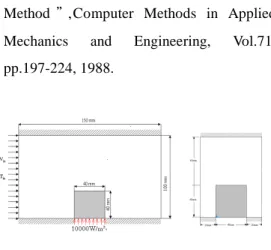
散熱片與流場之配置如圖 1 所示,流體 由左向右流動,而在散熱片底部有一均勻分布 之熱通量流入。
(二) 散熱片之溫度
原始散熱片溫度場之分布如圖 3 所 示,在迎風面有較大之熱傳,故有較低之溫 度,而在下風處,熱傳效果較差,有較高之溫 度。
四、 形狀最佳化
本研究以一三維矩形散熱片為標的,進行 拓樸最佳化之設計。散熱片元素分割為 10×
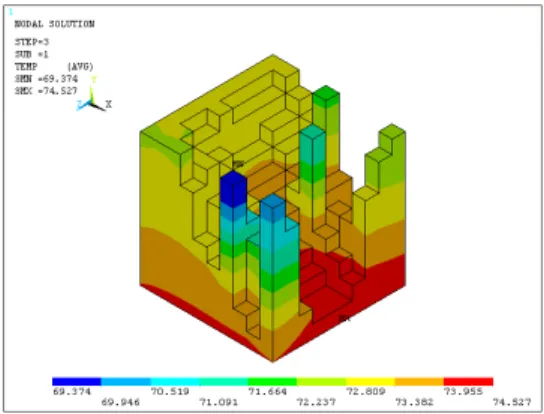
10×10 個元素,以元素的熱通量大小當作材 料取捨的判斷條件,用來判斷元素對散熱片結 構的貢獻大小,每次迭代移除 20 個元素,共 執行迭代 40 次、取走 780 個元素,圖 2 為迭 代過程中散熱片最高溫度變化圖,圖 4 -- 7 為 在移除過程中散熱片形狀及其溫度分布之變 化圖。由圖上可知在移除 400 元素後之散熱片 形狀有較低之最高溫度,且散熱片材料比初始 設計約減少 40%。
五、 結論
本研究旨在整合熱流計算分析方法與工 程設計最佳化方法中之均質化拓樸最佳化技 術而應用於微流道散熱片之最佳形狀設計。在 流場之計算上,本研究利用有限元素法建立了 三維複合熱傳分析之模組,使得流場在溫度之 計算時得與散熱片同時計算,而得較真實之結 果。在散熱片之形狀最佳化上,本研究利用拓 樸最佳化之理念,設計出一適合散熱片形狀分 析之步驟,而得一利用較少材料而有最佳散熱 效果之散熱片形狀。
六、 計劃成果自評
本 研 究 之 成 果與 原 計 劃 之內 容 大 致相
符,亦達成預定之研究目標。本研究成果主要 提供一結合複合熱流分析及拓樸最佳化技術 而應用於微流道散熱片之形狀最佳化的分析 步驟,具有相當價值。本研究成果將會被投稿 至國際知名期刊尋求發表。
參考文獻:
1. Tuckerman, D.N., and Pease, R.F. W.,
“ High-Performance Heat Sinking for VLSI ”, IEEE Electron Device Letter, Vol. 2, No.5, pp.126-129,1981.
2. Philips, R. J.,“Microchannel Heat Sinks ”, Advances in Thermal Modeling of Electronic Components, Vol, 2, Ch. 3, pp.109-184, ASME Press, 1990.
3. Knight, R. W., Hall, D. J., Goodling, J. S., and Jaeger, R. C., “Heat Sink Optimization with Application to Microchannels ”, IEEE Transactions on Components, Hybrids, and Manufacturing technology, Vol. 15, No.5, pp.832-842, 1992.
4. Weisberg, A., Bau, H. M., and Zemel, J. N.,
“Analysis of Microchannels for Integrated Cooling ”,International Journal of Heat and Mass Transfer, Vol. 35, No. 10.
pp.2465-2473, 1992.
5. Yu, S. P., and Xin, M. D.,“Analysis and Experiment on Gas Convection Microchannel Heat Exchangers ” , Proceedings for the Tenth International Heat Transfer Conference, Vol. 4, pp.459-464, 1994.
6. Copeland, D., “ Manifold Microchannel Heat Sinks: Analysis and Optimization ” ,Thermal Science and Engineering, Vol. 3, No. 1, pp.7-12. 1995.
7. Bendsoe, M. P. and Kikuchi, N.,
“ Generating Optimal Topologies in
Structural Design Using a Homogenization Method ”,Computer Methods in Applied Mechanics and Engineering, Vol.71, pp.197-224, 1988.
圖 1 流場散熱片幾何形狀尺寸示意圖
0 5 10 15 20 25 30 35 40
70 80 90 100 110 120 130 140
Iteration
Max Temperature
Iteration takes out (20)element
圖 2 散熱片最高溫度曲線圖
圖 3 初始設計之散熱片溫度分佈圖
圖 4 迭代 5 次,移除 80 個元素之散熱片溫度分 佈圖
圖 5 迭代 10 次,移除 180 個元素之散熱片溫度 分佈圖
圖 6 迭代 15 次,移除 280 個元素之散熱片溫度 分佈圖
圖 7 最佳設計散熱片溫度分佈圖(迭代 21 次,移 除 400 個元素)