A Distributed Spectrum Sharing Algorithm in Cognitive Radio Networks
Wei Sun†, Tong Liu†, Yanmin Zhu†, Bo Li‡
†Shanghai Jiao Tong University
‡Hong Kong University of Science and Technology Email:†{sunwit,liutong25691640,yzhu}@sjtu.edu.cn,‡[email protected]
Abstract—In this paper we study a social welfare maximization problem for spectrum sharing in cognitive radio networks. To fully use the spectrum resource, the licensed spectrum owned by the primary user (PU) can be leased to secondary users (SUs) for transmitting data. We first formulate the social welfare of a cognitive radio network, considering the cost for the primary user sharing spectrum and the utility gained for secondary users transmitting data. The social welfare maximization is a convex optimization, which can be solved by standard methods in a centralized manner. However, the utility function of each secondary user always contains the private information, which leads to the centralized methods disabled. To overcome this challenge, we propose an iterative distributed algorithm based on a pricing-based decomposition framework. It is theoretically proved that our proposed algorithm converges to the optimal solution. Numerical simulation results are presented to show that our proposed algorithm achieves optimal social welfare and fast convergence speed.
Index Terms—Decomposition, social welfare maximization, optimization, cognitive radio network.
I. INTRODUCTION
With the increasing development of wireless communica- tions, spectrum becomes a more and more limited resource.
However, many studies [1] [2] [3] show that spectrum is under utilized in reality. The technology of cognitive radio (CR) [4] provides a promising mechanism for flexible usage of spectrum. The utilization of spectrum can be improved by sharing vacant spectrum with unlicensed users.
We consider a cognitive radio network, which consists of a primary user (PU), the licensed owner of spectrum, and several secondary users without licences. Each secondary user consists of a pair of nodes, a sender and a receiver, which have the demand of transmitting data. To fully utilize spectrum, the primary user can lease its vacant spectrum to secondary users with monetary rewards.
We consider the problem of spectrum sharing among sec- ondary users in a cognitive radio network. A cost is incurred and paid by the primary user for allocating spectrum to sec- ondary users. Each secondary user obtains an amount of utility for transmitting data, which contains its private information.
We first formulate the cost and the utilities, respectively. Then, our objective of such a cognitive radio network is to maximize the social welfare, which is defined as the sum of the utility obtained by each secondary user minus the cost paid by the primary user.
Allocated spectrum
PU
SU1 SU2 SU3
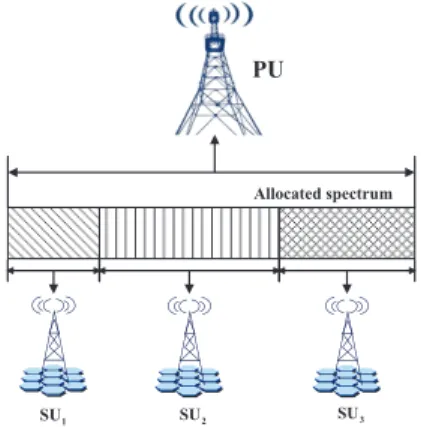
Fig. 1. The illustration of spectrum allocation in a cognitive radio network.
A number of existing works [5] [6] have been done to solve the problem of spectrum sharing in cognitive radio networks.
Some of these works [7] [8] [9] take advantage of the models in game theory to characterize cognitive radio networks, which cannot achieve social welfare maximization. These works always assume that secondary users are rational and selfish.
Some other works [10] [11] [12] can really maximize the network utility for spectrum sharing. However, the algorithms designed in these works are executed in a centralized manner.
Therefore, the privacy of secondary users is not protected.
Different with these works, we focus on designing a distributed algorithm to maximize the social welfare.
Such an optimal spectrum sharing problem is significantly challenging because of unique characteristics of cognitive radio networks. First, the utility function of each secondary user contains the user-specific information, which is their privacy. It means that the problem cannot be solved in a centralized manner by the standard methods such as Newton method. A distributed algorithm is necessary by decoupling the problem into several subproblems, each of which can be independently solved by a secondary user. Second, the objective in the problem, maximizing social welfare, is coupled with the cost function of the primary user and the utility function of each secondary user. In other words, the objective function cannot be directly decoupled into several independent subproblems.
In response to the challenges mentioned above, we propose a fully distributed algorithm for spectrum sharing in cognitive
radio networks. As the shared spectrum is priced by the pri- mary user, we find that the optimal social welfare is obtained when optimal solution of an equivalent pricing problem is achieved. Then, we propose a pricing-based decomposition framework, which decouples the problem into several subprob- lems. The primary user and each secondary user is responsible for a subproblem, which only contains its own privacy.
Based on the decomposition framework, a distributed al- gorithm is provided, which is executed iteratively. In each iteration, each secondary user informs the primary user its demanded spectrum, according to the given price. The primary user updates the price based on the collected information.
We also propose a price updating rule, under which our iterative algorithm is rigorously proved to converge to the optimal solution in finite steps. Extensive simulations have been conducted to evaluate the social welfare and convergence speed achieved by our distributed algorithm.
We have made three technical contributions in our paper.
• We model the cost paid by the primary user for spectrum sharing and the utility obtained by secondary users. The concept of social welfare is formally defined as the objective of a cognitive radio network to pursue.
• To maximize the social welfare in a distributed manner, we propose a novel pricing-based decomposition frame- work. A distributed algorithm is designed based on the decomposition framework, where iterative operations are executed by the primary user and the secondary users in turn.
• Rigorous theoretical analysis is conducted to demonstrate that our iterative algorithm converges to the optimal solution in finite steps. Extensive simulation results show that our distributed algorithm can achieve the optimal social welfare, and converge quickly.
The remainder of this paper is organized as follows. We introduce the network model and problem formulation in Section II. The optimal distributed approach is described in Section III. In Section IV, simulation results are reported to show the performance of our algorithm and compared algo- rithms. We review related work in Section V and conclude the paper in Section VI.
II. NETWORKMODEL ANDPROBLEMFORMULATION
In this section, we first describe the model of cognitive radio networks, and then formulate the problem solved in this paper.
A. Network Model
We consider a cognitive radio network which consists a primary user and n secondary users. The set of secondary users is denoted by {SU1, SU2,· · · , SUn}. Each secondary user actually consists of a sender and a receiver. The primary user, the owner of the spectrum, allocates its unused spectrum to secondary users. Each secondary user is allocated with a portion of spectrum, namely bands. Each band is associated with a bandwidth representing a divided frequency range. The bandwidth allocated to secondary user SUiis noted by pi, 1≤ i ≤ n. We assume that the primary user can communicate
with each secondary user directly. Moreover, the frequency allocated to different secondary user is orthogonal to avoid interference. The network model is illustrated in Fig. 1.
B. Problem Formulation
In this subsection, we formulate the social welfare of a cognitive radio network, including two folds: the cost paid by the primary user for spectrum allocation and the utility obtained by the secondary users for data transmission.
Cost for spectrum allocation. The spectrum sharing with secondary users may impact the data transmission of the primary user. This leads to a highly increasing cost associated with the allocated bandwidth, which is formulated as an exponential function. We define the cost function as follows, Definition 1. The cost function of the primary user is formu- lated as
C (p) = βe
∑n i=1
pi
− 1 (1)
where p = (p1, p2,· · · , pm) and β is a system parameter.
The primary user expects a payment in return from sec- ondary users for using spectrum. The primary user provides a price qi for the spectrum spent by the SUi. Considering this payment, we formulate the profit of the primary user in Definition 2.
Definition 2. The primary user obtains a profit for sharing spectrum as
Φ (p, q) = pqT− C (p) . (2) Utility for data transmission.It is intuitive that each sec- ondary user obtains a utility for transmitting data. According to the bandwidth piallocated to the secondary user, we define the utility function in the following,
Definition 3. The utility function of secondary user SUi is defined as
ui(pi) = ailog (1 + pi) , (3) where ai is a user-specific parameter.
According to the law of diminishing marginal utility in economics [13], the log function implies that the increasing ratio of utility gain obtained by secondary users degrades as the allocated bandwidth increases. Note that the parameter ai is the privacy information of secondary user SUi. which is unknown to the primary user and other secondary users.
Thus, the payoff of SUi is formulated as follows,
Definition 4. The payoff of secondary user SUiis equal to the utility obtained minus the payment paid to the primary user,
Pi
(qi,pi)
= ui(pi)− qipi. (4) In this paper, we consider secondary users are rational, trying to maximize their own payoffs given a price qi by the secondary user.
Social welfare.We introduce the concept of social welfare, which is equal to the utilities gained by secondary users
minus the cost paid by the primary user, is formulated in the following definition.
Definition 5. The social welfare of a cognitive radio network is defined as
S (p) =
∑n i=1
ui(pi)− C (p) . (5)
In this paper, we aim to maximize the social welfare of a cognitive radio network. The problem of social welfare maximization is defined in the following.
Definition 6. The problem of maximizing the social welfare of a cognitive radio network is defined as
max
∑n i=1
ui(pi)− C(p) (6) s.t. pi∈ [0, δi] ,∀i ∈ [1, n] , (7) where δi is the upper bound of pi, determined by secondary user SUi.
Note that the problem defined in Definition 6 is a convex optimization problem. According to [14], the problem must have an optimal solution p∗= [p∗1, p∗2,· · · , p∗m].
The problem of maximizing the social welfare in a cognitive radio network should be solved in a distributed manner. First, if the problem is centrally solved in one point, it incurs a huge computation load on the single point. Second, the utility function of each secondary user is privacy, which leads to unknowing the exact formulation of social welfare.
III. OPTIMALDISTRIBUTEDAPPROACH
A. Overview
In response to the difficulties described above, we design a distributed algorithm based on a pricing-based decomposition method. The algorithm can achieve the maximal social welfare and protect the private information for each secondary user at the same time.
We first convert the original problem in (6) into an e- quivalent pricing problem. The optimal spectrum allocation can be obtained when the optimal prices are achieved. Then, we propose a decomposition framework, which decouples the optimization problem into several subproblems. In the frame- work, each secondary user maximizes its own payoff based on the price given by the primary user. The primary user updates the price after collecting the returned spectrum demand from secondary users. The above operations are executed iteratively until the spectrum allocation converges to the optimal solution.
A price updating rule is also provided, given the insight of the condition that the optimal prices should satisfy. At last, we theoretically prove that our iterative algorithm converges to the optimum in finite steps. The notations appeared in this paper are summarized in Table I.
TABLE I
MAJOR ADOPTED NOTATIONS.
Variable Description
SUi The i-th secondary user n The number of secondary users
pi The bandwidth of spectrum allocated to the i-th secondary user
qi The price given to the i-th secondary user β The system parameter in the cost function of the
primary user
ai The user-specific parameter in the utility of the i-th secondary user
C(p) The cost function of the primary user Φ(p, q) The profit function of the primary user
ui(pi) The utility function of the i-th secondary user Pi(qi, pi) The payoff function of the i-th secondary user S(p) The social welfare of a cognitive radio network
t The current number of iterations
˜
qi(t) The price updated for the i-th secondary user in the t-th iteration
˜
p(t)i The value of spectrum computed by the i-th sec- ondary user in the t-th iteration
ε The system variable in the price updating rule
Algorithm 1 Optimal Distributed Algorithm for Spectrum Sharing
Input: A cognitive radio network consisting of many sec- ondary users, denoted by{SU1, SU2,· · · , SUn}. The cost function of the primary user is C(p) and the utility func- tion of each secondary user is ui(pi),∀i ∈ {1, · · · , n}.
Output: The optimal spectrum allocation p∗i for each sec- ondary user.
1: t = 0 // t counts the number of iterations.
2: The primary user sets the same initial value q(0) = θ sent to all secondary users, where θ is a little positive real value.
3: Repeatfor t = 0, 1,· · · .
4: For each secondary user, the value of ˜p(t+1)i is computed according to
˜
p(t+1)i (qi) = arg max
pi∈[0,δi]
ui(pi)− qipi.
5: For the primary user, according to the returned ˜p(t+1)i , the value of qi(t+1) is updated as
q(t+1)i = (1− ε) q(t)i + ε∂C (p)
∂ pi
p=˜p(t+1)
.
6: Untilif ˜p(t+1)− ˜p(t)
∞≤ ζ, where ζ is a tunable little real number.
7: p∗= ˜p(t+1), q∗= q(t+1).
B. Equivalent optimal pricing problem
As mentioned above, the primary user gives a price qi
to each secondary user for leasing spectrum. According to the price, each secondary user decides the bandwidth of the spectrum pi it demands. Based on the pricing mechanism, the social welfare can be rewritten as follows,
PU
SU1
SU2
SU3
q1
q2
q3
p1
p2
p3
( ) [ ] ( )
0,
arg max
i i
i i i i i i
p
p q u p q p
d Î
=ar -
i i
p qii ii ararar
( ) ( )
1 ,
i i
i
q q C i
e e p
=
= - + ¶ "
¶ pp
p
Fig. 2. The pricing-based decomposition framework
S (p) =
∑n i=1
ui(pi)− C (p)
=
∑n i=1
(ui(pi)− piqi) + pqT − C (p)
=
∑n i=1
Pi(qi, pi) + Φ (p, q) (8)
Considering secondary users are rational, they will choose the bandwidth of allocated spectrum by maximizing their own payoffs given a spectrum price,
˜
pi(qi) = arg max
pi∈[0,δi]
ui(pi)− qipi. (9)
We denote ˜pi(qi) as ˜pi for short in the next context.
Therefore, the social welfare maximization problem (6) can be transformed into an equivalent optimal pricing problem, which determines the optimal price vector q =[
q1,··· ,qn] by maximizing the social welfare as follows,
maxq Φ (˜p, q) +
∑n i=1
Pi(qi, ˜pi) (10)
We illustrate why the pricing problem is equivalent to the original problem briefly. Assume that the optimal solution of problem (10) is q∗. The secondary user chooses ˜pi(q∗i) depending on the optimal price qi∗ by maximizing the payoff (9). After knowing ˜pi(qi∗) and qi∗, the social welfare is maximized depending on (8). Therefore, the optimal solution of p can be obtained when finding the optimal price vector q∗= [q1 ,∗ · · · , qn∗] .
C. Pricing-based decomposition framework
In this subsection, we introduce a pricing-based decompo- sition framework, which is shown in Fig.2.
Each secondary user computes the value of ˜pi as shown in (9) locally and sends the result to the primary user. According to the collected value of ˜pi, the primary user updates the price qi according to a updating rule, which is given in the coming
context. The alternate operations are executed iteratively by the primary user and secondary users in turn until the optimal solution q∗ and p∗ is achieved.
Intuitively, the price updating rule is significant to guarantee the iterative operations eventually converge to the optimal solution. Here, we propose a pricing updating rule according to the the Karuth-Kuhn-Tucker (KKT) condition. According to the convex optimization theory [15], the optimal solution q∗= [q∗1,· · · , qn∗] of (10) must satisfy the KKT condition as shown in the following proposition.
Proposition 1. An optimal price vector q∗ = [
q∗
1 ,· ··,qn∗] should satisfy
qi∗= ∂C (p)
∂ pi
p=˜p
,∀i, (11)
where ˜p = [˜p1 ,· ··,p˜n]T with ˜pi= ˜pi(qi∗) given in (9).
Proof: First, according to the first order condition, there exists ∂ Pi
(pi,qi)/
∂ pi= 0 for (2). Therefore, we obtain qi= u′i(˜pi) . (12) Moreover, applying the KKT condition ∂S (p)/∂ qi= 0 to (5), there is
(
u′i(˜pi)− ∂C(p)∂pi
p=˜p
)
∂ ˜pi
∂qi = 0 since ∂ ˜∂qpi
i < 0, we have
u′i(˜pi)− ∂C (p)
∂pi
p =˜p
= 0. (13)
The proposition is proved by combining the (12) and (13).
Given the insight of Proposition 1, we propose a price updating rule as follows,
qi= (1− ε) qi+ ε∂C (p)
∂ pi
p=˜p,
∀i, (14)
where ε∈ (0, 1] is a tunable parameter.
Note that in our decomposition framework, updating price is unnecessary to be executed after all ˜pi,∀i ∈ {1, · · · , n}
are returned. The primary user can update qi for secondary user SUiarbitrary times before qj(j̸= i) is updated. It means that our decomposition framework can be realized in an asynchronous way so that the number of iterations can be largely degraded as different secondary users have different communication delay with the primary user.
D. Distributed Algorithm
In this subsection, we propose a distributed algorithm to maximize the social welfare of a cognitive radio network. In the distributed algorithm, the primary user and all secondary users should participate as follows,
• For each secondary user SUi, it maximizes the payoff Pi(pi, qi) = ui(pi)− qipi locally to obtain the value of ˜pi based on the price qi given by the primary user.
Each secondary user only needs to know its own utility function.
• For the primary user, it updates the value of qi based on
˜
pireturned from each secondary user. The price updating rule is given in (14).
The primary user generates a new price based on an original price and partial derivative ∂C(p)∂ p
i
p=˜p
, which pushes the price qi towards the optimal value q∗i = ∂C(p∂ p∗)
i . The details of the distributed algorithm are described in algorithm 1.
E. Convergence Analysis
Contraction Mapping. Many iterative algorithms can be expressed as x (l + 1) = φ(x (l)),l = 0,1,···, where x (·) ∈ X and l denotes the number of iterations. Mapping φ is called a contraction if
∥φ (x) − φ (y)∥ ≤ κ∥x − y∥,∀x,y∈ X, (15) where ∥·∥ is a norm and κ ∈ [0,1) is called a modulus of φ. Moreover, the mapping φ is called a pseudo-contraction if there exists a fixed point x∗∈ X (means x∗∈ φ (x∗)) and
∥φ (x) − x∗∥ ≤ ∥x − x∗∥,∀x ∈ X. (16) The convergence property of contraction or pseudo- contractions is given in Theorem 1.
Theorem 1(Geometric Convergence). Supposing the mapping or the pseudo-contraction and the modulus of φ is κ∈ [0,1).
Then, φ has an unique fixed point x∗ and a sequence {
x(l),l = 0,1,· ··}
generated by x (l + 1) = φ (x (l)) satisfies
∥x (l) − x∗∥ ≤ κl∥x (0) − x∗∥,∀l ≥ 0, (17) for every choice of initial x (0) ∈ X. In particular, x (l) converges to x∗ geometrically.
In this section, we analyze the convergence of our algorithm under the condition of ε = 1 and ε < 1 in Proposition 2 and Proposition 3, respectively. For simplicity, the second order partial derivatives of C(p) is denoted by ∂pjpiC (p) = ∂p∂C(p)
j∂pi. Convergence of Algorithm 1 with ε = 1. We first define a notation [λ]+i to denote the projection of λi ∈ ℜ onto the range [0,τi],
[λ]+i = arg max
z=[0,τi]|z − λi| . Briefly, a solution to (9) is equivalent to
˜
pi(qi) = [arg maxpi ui(pi)− qipi]+i =[
u−1i (qi)]+ i . Therefore, when ε = 1, the price updating rule turns to qi= ci(˜p). Substituting it into ˜pi(qi) obtains
˜
pi= φi(˜p) =[
u−1i (ci(˜p))]+
i . (18)
Algorithm 1 applied with ε = 1 eventually achieves conver- gence under a certain condition which is given in the following proposition.
Proposition 2. Supposing ε = 1, if we have
∑n j=1
∂pjpiC (p) < min
pi |u′i(pi)| , ∀p ∈∏
i
[0, δi], (19) {
˜ pi
( qi(t)
)}
generated by Algorithm 1 converges geometrical- ly [16] to the optimal solution p∗i of (6), giving an initial value q(0)i .
Proof: For each i, a function gi is defined as follows.
gi(r) = u−1i (ci(z (r))) = u−1i (ci(rx + (1− r) y)),
where gi(r) is differentiable and r∈ [0,1]. We have
∥φi(x)− φi(y)∥ = [u−1i (ci(x))] +
i − [u−1i (ci(y))] +
i
≤ |gi(1)− gi(0)| = ∫ 1
0
dgi(r) dr
≤
∫ 1
0
dgi(r) dr
≤ maxr∈[0,1]
dgi(r) dr
,
where the first inequality is because [xi]+i − [yi]+i ≤
|xi− yi| for all xi− yi ∈ ℜ. Furthermore, applying a chain rule, we have
dgi(r) dr = ∑n
j=1∇jc−1i (ci(rx + (1− r) y) · (xj− yj))
≤ ( u−1i )′
(ci(z (r))) ·∑n
j=1|∇jci(z (r))| · |xj− yj| . If condition (19) holds, we have
∑n j=1
|∇jci(x)| < min
xi (u′i(xi))≤ u′i(
u−1i (c′i(x))) for all x∈∏
i[0,τi]. Therefore, there exists a number κ < 1 which enables that
dgi(r) dr
≤ κmaxj |xj− yj| = κ∥x − y∥∞,∀r ∈ [0, 1]
Therefore, we have
∥φi(x)− φi(y)∥∞≤ κ∥x − y∥∞,∀x,y∈∏
i
[0,τi],
which shows φi is a contraction with modulus κ respect to a maximum norm. Therefore, a proposition is proved.
Convergence of Algorithm 1 with ε < 1.We relax a value of ε by considering a convergence condition with ε < 1. In this situation, we suppose that ˜p(
q(l))
generated with each iteration l is always within a range ∏
i[0,τi]. Therefore, we can rewrite a solution to (9) as ˜pi(qi) = u−1i (qi), which has a little difference from ε = 1 situation. Combining it with qi= (1− ε) qi+ εci(˜p), we can obtain
˜
pi= φi(˜p) = u−1i ((1− ε) ui(˜pi) + εci(˜p)) (20) Applied with (20), the Algorithm 1 can achieve optimal under a convergence condition in the following proposition.
Proposition 3. Set ˜pi(q(0)i ) to be 0 for all i or δi for all i. If we have
0≤ ε ≤(
1 +∂pj pic′ C(p)
i(pi)
)−1
∑ ,
j̸=i∂pjpiC(p)≥ 0 ∀p ∈∏
i
[0,δi], (21) {
˜ pi
( q(t)i
)}
generated by our algorithm 1 converges geomet- rically [16] to the optimal solution p∗i of (6).
Proof: For each i a function gi is defined as follows.
gi(r) = u−1i ((1− ε) ui(z (r))) + εci(z (r)),, where z (r) = rx + (1− r) y.
Supposing x < x∗, we will show xi < φi(x) ≤ x∗i. We have
φi(x)− φi(x∗) = gi(1)− gi(0) =
∫ 1
0
dgi(r) dr dr,
where dgdri(r) is given by (22).
dgi(r) dr =(
u−1i )′(
(1− ε) ui(z (r)) + εci(z (r)) )
· (1 − ε) u′i(z (r))· (xi− x∗i) + ε∑
j
∇jci(z (r))·( xj− x∗j
)
= (u′i(φi(z (r))))−1·
( ((1− ε) u′i(z (r)) + ε∇ici(z (r)))· (xi− x∗i) +ε∑
j̸=i∇jci(z (r))·( xj− x∗j
) )
(22) Applying h−1i (·) to both sides yields xi < φi(x). There- fore, there exists a number κ < 1 enables that|φi(x)− x∗i| ≤ κ|x − x∗|, which is equivalent to
∥φi(x)− x∗∥∞≤ κ∥x − x∗∥∞,∀xi∈ [0,x∗i] . In other words, φi is a pseudo-contraction in [0,x∗i]. Simi- larly, if x > x∗, we can get φi, which is a pseudo-contraction in
[ x∗i ,τi∗
]
. Therefore, the proposition is proved.
IV. PERFORMANCEEVALUATION
A. Methodology and Simulation Setup
We perform simulations to evaluate the performance of our optimal distributed algorithm, compared with a baseline algorithm as follows.
Distributed weighted allocation scheme (DWAS). First, the primary user provides an initial value q0 for all secondary users. Each secondary user SUi returns the value of pei(q0) by maximizing P (qi, pi). Next, the primary user decides the final value of qi,∀i ∈ {1, · · · , n} by maximizing Φ(q, p), assuming that ui(pi) is a linear function of pi, i.e., ui(pi) = bipi. bi represents the weight of secondary user SUi, which is computed as pei(q0)/q0. After receiving qi, each secondary user computes its optimalpei(qi).
In addition to the DWAS, we also compare our algorithm with the optimal value. The optimal value is obtained by maximizing the social welfare directly.
The evaluation of our algorithm is performed from two aspects, including the network performance and the conver- gence speed. The metrics of network performance are the social welfare and the total allocated spectrum. We perform the simulations with varying two factors: the number of secondary users and the value of β. The metric of convergence speed is the number of iterations. The simulations are performed under different numbers of secondary users and values of ε.
The initial values of qi,∀i ∈ {1, 2, · · · , n} in our proposed algorithm and the DWAS are set to 1. The default values of β and ε are 0.2 and 0.1, respectively. The values of ai are standard uniformly distributed in the open interval (0.5, 1).
5 10 15 20 25 30
125 130 135 140 145 150 155
Number of iterations
Socialwelfare
Algorithm 1(ε =0.1) Algorithm 1(ε =0.15)
Fig. 3. Social welfare achieved with the number of iterations
B. Impacts of the number of secondary users
We first study the social welfare and allocated spectrum of our algorithm and the DWAS under the condition of different numbers of secondary users, compared with the optimum. The results are shown in Fig. 4 and Fig. 7.
Fig. 4 shows that the social welfare obtained by our algo- rithm performs as well as the optimum, and much better than the DWAS. The social welfare obtained by our algorithm and the DWAS increases with the increasing number of secondary users. When there are 20 secondary users, the social welfare obtained by our algorithm is 50.34% higher than the DWAS.
In Fig. 7, the spectrum allocated by our algorithm is the same as the optimum, and more than the DWAS. The spectrum obtained by our algorithm and the DWAS increases with the increasing number of secondary users. However, the spectrum allocated by DWAS is always less than the spectrum allocated by our algorithm. When there are 20 secondary users, the allocated spectrum obtained by our algorithm is 96.23% more than the DWAS.
C. Effects of the value of β
We next study the performance of our algorithm and the DWAS under the condition of different values of β, compared with the optimum. The results are shown in Fig. 5 and Fig. 8.
Fig. 5 shows that the social welfare achieved by our algo- rithm performs as well as the optimum, and more than the DWAS. The social welfare obtained by our algorithm and the DWAS decreases with the increasing value of β. When there are 20 secondary users, the social welfare obtained by our algorithm is 40% more than the DWAS.
In Fig. 8, the spectrum allocated by our algorithm is the same as the optimum, and more than the DWAS. For our algorithm and the DWAS, the allocated spectrum decreases, when the value of β increases. When there are 20 secondary users, the allocated spectrum obtained by our algorithm is 97.43% more than the DWAS.
D. Convergence Speed
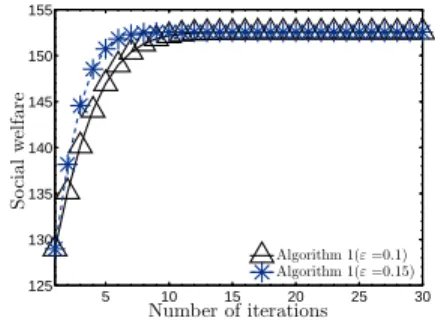
In this subsection, we study the convergence speed of our algorithm under different numbers of secondary users and values of ε. The results are shown in Fig. 3, Fig. 6 and Fig. 9.
20 40 60 80 100 0
50 100 150 200
Number of secondary users
Socialwelfare
Optimum Algorithm 1 DWAS
Fig. 4. Social welfare comparison of different algorithms with varying number of secondary users
0.2 0.3 0.4 0.5 0.6
40 60 80 100 120 140 160
Value of β
Socialwelfare
Optimum Algorithm 1 DWAS
Fig. 5. Social welfare comparison of different algorithms with varying β
varepsilon = 0.1 varepsilon = 0.15 0
5 10 15 20 25 30 35
Number of secondary users
Numberofiterations
n = 20 n = 40 n = 60 n = 80 n = 100
Fig. 6. Convergence of Algorithm 1 with different number of secondary users
20 30 40 50 60 70 80 90 100
0 20 40 60 80 100 120 140
Number of secondary users
Allocatedspectrum
Algorithm 1 Optimum DWAS
Fig. 7. Allocated spectrum comparison of different algorithms with varying number of secondary users
0.2 0.4 0.6 0.8 1
0 20 40 60 80 100 120 140
Value of β
Allocatedspectrum
Optimum Algorithm 1 DWAS
Fig. 8. Allocated spectrum comparison of different algorithms with varying β
0.1 0.11 0.12 0.13 0.14 0.15
18 20 22 24 26 28 30 32 34
Value of ε
Numberofiterations
Algorithm 1 with 60 secondary users Algorithm 1 with 100 secondary users
Fig. 9. Convergence of Algorithm 1 with different value of parameter ε
Fig. 3 plots the social welfare achieved by our algorithm in each iteration, when the value of system parameter ε is 0.1 and 0.15, respectively. Under the two settings, we can see that 99.9% of the optimal social welfare is achieved in the first ten iterations, which implies our algorithm converges quickly.
In Fig. 6, We study simulations of our algorithm when the number of secondary users is 20, 40, 60, 80 and 100, respectively. The value of parameter ε is 0.1 and 0.15. The numbers of iterations under different numbers of secondary users and different values of ε are close, which illustrates our algorithm is adapted to large-scale cognitive radio networks.
Fig. 9 shows that the convergence speed of our algorithm under the condition of the value of ε varying from 0.1 to 0.15.
The number of secondary users is 60 and 100. The number of iterations under different values of ε is less than 32. The higher value of system parameter ε, the faster the convergence speed. Our algorithm converges fast under varying values of ε.
V. RELATEDWORK
Increasing works focus on the problems in cognitive radio networks. Some works focus on estimation of interference temperature of the radio environment and detection of spec- trum holes. such as [17] [18]. Works in [19] [20] [21] focus on estimation of channel-state information and prediction of channel capacity for using by the transmitter. Some other
works [5] [6] focus on transmit-power control and dynamic spectrum management.
The spectrum allocation in cognitive radio networks has been extensively studied. By taking advantage of the models in game theory, some of existing works solve the spectrum sharing problem by achieving Nash Equilibrium. Niyato et al.
[7] formulate the problem of spectrum sharing as an oligopoly market competition and use a Cournot game to obtain the spectrum allocation. However, the static Cournot game only adapts to some special environment. Han et al. [9] propose a correlated equilibrium concept for users to have the distributive opportunistic spectrum access. Wang et al. [8] propose a competitive spectrum-sharing scheme according to auction theorem without achieving social welfare maximization.
Some centralized algorithms in some other works can actu- ally achieve the social welfare maximization. However, these algorithms could not protect the privacy of each user. Ileri et al.
[12] propose a framework under the regulation of a spectrum policy server for spectrum sharing. Peng et al. [10] propose a framework that defines the spectrum sharing problem for some definitions of overall system utility. The central sever is designed for allocation assignments. Raman et al. [11] propose a centralized spectrum server that coordinates users to sharing a common spectrum.
VI. CONCLUSION
The problem of maximizing social welfare for spectrum sharing in cognitive radio networks is studied in this paper.
We first define the concept of social welfare by formulating the cost of the primary user and the utility of each secondary user. To protect the private information of secondary users, we propose a distributed algorithm based on a pricing-based decomposition framework. The distributed algorithm is exe- cuted iteratively by the primary user and each secondary user in turn. Theoretical analysis is conducted to demonstrate that the algorithm converges to the optimal solution. Extensive simulation results show that our proposed achieves maximal social welfare and converges quickly.
REFERENCES
[1] P. Gupta and P. R. Kumar, “The capacity of wireless networks,”
Information Theory, IEEE Transactions on, vol. 46, no. 2, pp. 388–404, 2000.
[2] J. M. III and Q. G. J. Maguire, “Cognitive radio: making software radios more personal,” Personal Communications, IEEE, vol. 6, no. 4, pp. 13–
18, 1999.
[3] S. Haykin, “Cognitive radio: brain-empowered wireless communication- s,” Selected Areas in Communications, IEEE Journal on, vol. 23, no. 2, pp. 201–220, 2005.
[4] Q. Zhao and B. M. Sadler, “A survey of dynamic spectrum access,”
Signal Processing Magazine, IEEE.
[5] W. Yu, “Competition and cooperation in multi-user communication environments,” Ph.D. dissertation, 2002.
[6] J. Zander, S. Kim, M. Almgren, and O. Queseth, Radio resource management for wireless networks. Artech House, Inc., 2001.
[7] a. E. H. D. Niyato, “A game-theoretic approach to competitive spectrum sharing in cognitive radio networks,” in Wireless Communications and Networking Conference, 2007.
[8] X. Wang, Z. Li, P. c. Xu, Y. y. Xu, X. b. Gao, and H. H. Chen, “Spectrum sharing in cognitive radio networksłan auction-based approach,” Systems, Man, and Cybernetics, Part B: Cybernetics, IEEE Transactions on, vol. 40, no. 3, pp. 587–596, 2010.
[9] Z. Han and a. K. R. L. C. Pandana, “Distributive opportunistic spectrum access for cognitive radio using correlated equilibrium and no-regret learning,” in Wireless Communications and Networking Conference, 2007.
[10] C. Peng, H. t. Zheng, and B. Y. Zhao, “Utilization and fairness in spec- trum assignment for opportunistic spectrum access,” Mobile Networks and Applications, vol. 11, no. 4, pp. 555–576, 2006.
[11] C. Raman, R. Yates, and N. B. Mandayam, “Scheduling variable rate links via a spectrum server,” in New Frontiers in Dynamic Spectrum Access Networks, 2005.
[12] O. Ileri, D. Samardzija, and N. B. Mandayam, “Demand responsive pricing and competitive spectrum allocation via a spectrum server,” in New Frontiers in Dynamic Spectrum Access Networks, 2005.
[13] A. Chateauneuf and M. Cohen, “Risk seeking with diminishing marginal utility in a non-expected utility model,” Journal of Risk and Uncertainty, vol. 9, no. 1, pp. 77–91, 1994.
[14] S. P. Boyd and L. Vandenberghe, Convex optimization. Cambridge university press, 2004.
[15] D. P. Bertsekas, A. Nedi, and A. E. Ozdaglar, Convex analysis and optimization. Athena Scientific Belmont, 2003.
[16] K. H. Khalil, Nonlinear systems. Prentice hall Upper Saddle River, 2002, vol. 3.
[17] S. Haykin, “Communication systems,” New York, 2001.
[18] J. D. Thomson, “Spectrum estimation and harmonic analysis,” Proc.
IEEE INFOCOM, vol. 70, no. 9, pp. 1055–1096, 1982.
[19] S. Haykin, K. Huber, and Z. Chen, “Bayesian sequential state estimation for mimo wireless communications,” Proc. IEEE INFOCOM, vol. 92, no. 3, pp. 439–454, 2004.
[20] B. M. Hochwald, T. L. Marzetta, and V. Tarokh, “Multiple-antenna channel hardening and its implications for rate feedback and scheduling,”
Information Theory, IEEE Transactions on, vol. 50, no. 9, pp. 1893–
1909, 2004.
[21] G. J. Foschini and M. J. Gans, “On limits of wireless communications in a fading environment when using multiple antennas,” Wireless personal communications, vol. 6, no. 3, pp. 311–335, 1998.