• 沒有找到結果。

The result of the statistical analyses, along with the outcome of T-tests, is also presented in this chapter.

N/A
N/A
Protected

Academic year: 2021

Share "The result of the statistical analyses, along with the outcome of T-tests, is also presented in this chapter. "

Copied!
14
0
0

加載中.... (立即查看全文)

全文

(1)

Chapter Three Methodology

The present study aimed to investigate the comparative effect of traditional output-based instruction and input-based processing instruction on the acquisition of the English subjunctive mood. The target pattern was focused on the conditional If-clause describing a condition contrary to the present fact. In this chapter, the methodology adopted in the study is described. The details involve the design of the study: the choice of subjects, the construction of instructional packets, the procedures of the treatment, scoring, two posttests for measurement.

The result of the statistical analyses, along with the outcome of T-tests, is also presented in this chapter.

3.1 The Target Pattern

In this study, the target form is English conditional clauses with the subjunctive mood describing situations contrary to the present fact. According to the English grammar, conditional clauses can be classified into three types:

(1) The first type of conditional clauses suggests no special meaning about the possibility of the condition. That is, the condition might come true or might not come true. Thus, this type of conditionals is called “ open conditional clause.”

The form of this type of conditional clauses involves using the present tense in the

If-clause, and using the present tense or the future tense in the main clause, as in 1a

and 1b:

(2)

1a. If you work hard, you will succeed.

1b. If he takes a taxi, he will get here in time.

Model auxiliary such as can, may, must, should can also be used in the main clause, as in 1c:

1c. If the weather gets worse, the flight may be delayed.

(2) The second type of conditional clauses is used to suggest or imply that the conditions are contrary to the present fact or are unlikely to happen. The form of this type is as follows:

If –clause , main clause

(past tense or could + V) ( would, could, should, or might +V)

In the If-clause, the past tense is used and in the main clause, modal auxiliaries like would, could should or might are used, as in 2a and 2b

2a. If I had a lot of money, I would buy a house

. Contrary to the present fact ( In fact, I don’t have much money, so I can’t buy a house.)

2b. If I were you, I would accept the job.

Unlikely to happen ( In fact, I am not you.)

(3) The third type of conditional clauses is used to describe conditions contrary to the past fact. The pattern of this type is as follows:

If- clause , main clause

had +p.p would, should, could, or might + have + p.p

The past perfect tense is used in the If-clause and for the main clause, the form is more complicated, as in 3a and 3b.

3a. If you had studied hard, you would not have failed the test.

(3)

( In fact, you didn’t study hard, so you failed the test.)

3b. If we had started earlier, we would have finished the work.

(In fact, we didn’t start earlier, so we didn’t finish the work.) The target pattern for this study was the second type of conditional clauses.

The acquisition of the target pattern would refer to the ability to use the pattern for production and the ability to comprehend the implied meaning of the speaker, suggesting a condition contrary to the present fact or the impossibility of the condition.

3.2 Subjects

The subjects of this study were 90 Taiwan EFL learners. They were the first graders at Yangming Senior High School in Taoyuan. As far as students’

academic performance is concerned, Yangming Senior High School ranks in the middle among all of the public senior high schools in Taoyuan. The subjects were at intermediate level and had learned English for at least three years. They had four periods of regular English classes and one-hour listening and speaking course each week during their freshman year in senior high school. In order not to disturb the regular teaching program, and for convenience and easy control, two intact classes with equal number of students instructed by the same teacher were chosen as subjects. Besides, since the study was to compare the effect of two different teaching approaches on the performance of subjects, it was necessary to make sure the two classes were of the same proficiency in English.

Thus, the average grades of a class in English collected in monthly exams during

the first semester were also taken into consideration when choosing classes as

(4)

subjects. For these reasons, Class 112 and Class 113 were chosen as subjects.

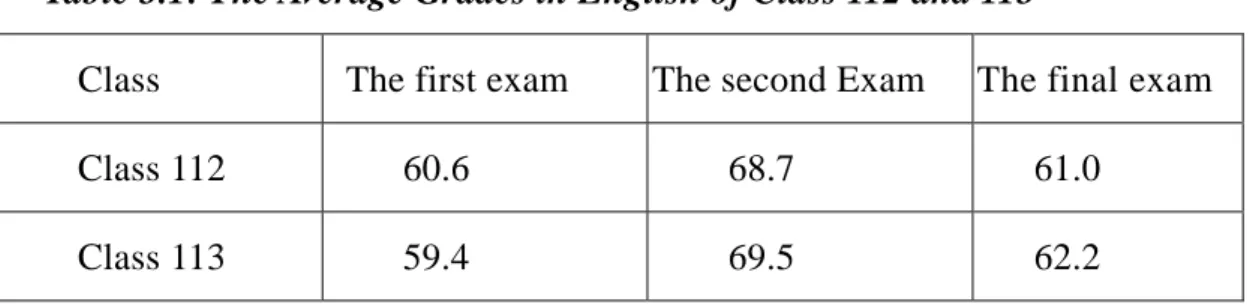
According to their performances in the monthly exams during the first semester, these two classes were almost at the same proficiency level (see Table 3.1.) Furthermore, these 90 students had never received instruction on the English subjunctive mood before.

Table 3.1: The Average Grades in English of Class 112 and 113

Class The first exam The second Exam The final exam

Class 112 60.6 68.7 61.0

Class 113 59.4 69.5 62.2

All subjects’ first language was Chinese. The two classes were randomly assigned to each of the two treatment groups. Class 113 served as the experimental group, (N=45) receiving input processing instruction on the subjunctive mood, and class 112 served as the controlled group (N=45), receiving traditional grammar instruction on the subjunctive mood

3.3 Instructional Packets

Since the present study aimed to compare the effect of traditional

output-based instruction and input processing instruction, two instructional

packets were constructed for the two treatment groups according to the nature of

these two approaches. For the control group, the instructor adopted the traditional

output-based instruction, which consisted of the presentation and explanation of

the target structure and output-based oral practice. The experiment group, on the

(5)

other hand, received input-based instruction, which was composed of presentation and explanation of the target structure and input-based practice activities aimed at directing subjects’ attention to the form and meaning connection.

3.3.1 The Traditional Output-based Instruction

The traditional output-based instruction, which is adopted by most teachers

when teaching grammar, involves presenting the subjects with the target structure

and a few examples with explanations concerning the connection of form and

meaning, and then providing the learners with production activities to practice

using the pattern. In other words, this type of instruction focuses on teaching

subjects how to produce the pattern. Based on the nature of the traditional

instruction, the organization of the teaching sequence for the traditional group

was as follows: (a) presentation and explanation of the structure of the

subjunctive mood (b) activities in which the subjects practice producing correct

sentences using the subjunctive mood. During the presentation and explanation,

subjects were told that the pattern was used if the speaker intended to suggest that

the condition was contrary to the present fact or to imply the impossibility of the

condition. In terms of practice, traditional instruction involveed moving the

subjects from mechanical form-oriented practice to meaningful practice and

finally to more open-ended communicative practice. Three main types of

exercises were given in the packet for production practice: (a) activities in which

students were given the present fact and were asked to change the sentences into

the subjunctive mood, (b) sentence completion activities in which subjects had to

(6)

complete the sentences by using the subjunctive mood (c) question-answer activities in which subjects had to answer questions based on the questions given by using the subjunctive mood. The design of types of exercise and questions was based on Far East English Reader for Senior High Schools, Lung Teng English Reader for Senior High Schools and Longman English Grammar Practice. These

three types of production tasks, adopted from the exercises used in most of the textbooks and grammar book in Taiwan, were the most common ones for practicing using the subjunctive mood. No matter what types of exercises the activities were, subjects in the traditional instruction group were asked to produce the target forms at all times. (see Appendix C)

Examples of output-based exercises (a) Sentence combining

I am in a hurry. I won’t stay for dinner.

→ If I were not in a hurry, I would stay for dinner.

I don’t have a spare ticket. I can’t take you to the concert.

→ If I had a spare ticket, I could take you to the concert.

(b) Sentence completion

If today were Sunday, ___________________________.

If I won the lottery, ___________________________.

(c) Question answering

What would you do if there were an earthquake right now?

(7)

3.3.2 The Input-based Processing Instruction

According to Vanpatten, the input-based processing instruction aims to direct

the learners’ processing of input containing the target structure. The instructional

packet for the processing group also began with presentation and explanation of

the pattern of the subjunctive mood stating situations contrary to the present fact,

but during the presentation and explanation, two different kinds of conditional

sentences were compared—open conditionals and the target pattern. Subjects

were told that the target pattern implied that the conditional was contrary to the

present fact or impossible to happen. Then Subjects were provided with practice

which focused their attention on discrimination of the form and interpretation of

the meaning. That is, subjects were not taught to produce the pattern, but to

interpret the meaning implied by the pattern. The organization of the instruction

was as follows: (a) presentation and explanation of the structure of the

subjunctive mood (b) activities in which the subjects were presented with the

structure of the subjunctive mood in the input and practice decoding and

interpreting meaning and activities in which the subjects responded to the content

of sentences. There were also three main types of structural input practice

activities: (a) activities in which subjects were presented with input at the

sentential level and had to identify whether the statement is the target structure or

not, (b) activities in which subjects were asked to interpret the implied meaning

according to the given subjunctive mood (c) activities in which subjects were

presented with input in the sentential level or in the discourse level and were

asked to perform different types of tasks based on the information content of the

(8)

input. Instead of producing the target form, subjects in processing instruction were taught how to correctly interpret the subjunctive mood by focusing their attention on the form and help them establish form and meaning connection.

The first type of activity was constructed to focus subjects’ attention on the pattern. The second type was used to help them decode and interpret the meaning according to the form. The third type would put the pattern in real use and help subjects learn when to use the pattern. That is, the activities were specially contrived to induce conscious noticing in learners, and as mentioned, “noticing”

should involve noticing the form, establishing form and meaning connection and also knowing when to use the form in the context. During the section of practice, subjects were kept reminded that the target pattern denoting a statement contrary to the present fact (See Appendix D).

Examples of input-based exercises

(a) The identifying task

Directions: Put a check in front of the sentence implying a condition contrary to the present fact

If you study hard, you can have better grades.

9If you studied hard, you would have better grades.

(b) The interpretation task

Directions: Judge whether the statement is true or not according to the conditional sentences.

If I had a million dollars, I would buy a new car.

( ○ ) I don’t have a million dollars, so I can’t buy a new car.

(9)

(c) Situation Task

What should the other turtle say to the one who lost the race?

( b ) a. If I am you, I will win the race.

b. If I were you, I would win the race.

c. If I were you, I will win the race.

The handouts adopted by both instructional packets were a little different in the presentation and explanation of the patterns. For the traditional group, the handout only involved the target structure, providing no discrimination of the If-clause between the first type and the second type of the subjunctive mood. For the input processing group, in additional to the target structure, the handout used also included the comparison with the first type, which doesn’t imply contrary condition. On the other hand, what mainly made these two packets different was the activities that followed the presentation and explanation. Input-based processing instruction provided the learners with activities focusing their attention on the structure in the input, helping them to discriminate the structure, establish form and meaning connection and know when to use the target structure.

In contrast to traditional output-based instruction, processing instruction teaches learners to interpret and comprehend the target items in oral and written form and not on producing them.

3.4 Instructional Procedures

The study took place in April in 2003, during the second semester of the

(10)

freshman year. All experimentation was conducted in the subjects’ regular classrooms during their regular class hours. Both experimental instruction was conducted by the same teacher—the researcher, who was originally the subjects’

regular English instructor. The experiment was integrated into the normal course curriculum. The instruction was based on the Far East English Reader, Book II, Lesson Seven, in which the subjunctive mood denoting conditions contrary to the present fact was the target structure. According to the regular course schedule, four hours were needed for teaching one lesson. Therefore, for both treatment groups, subjects were scheduled to have four periods receiving instruction on the target pattern. Because of a delayed posttest needed, the whole experiment involved 5 class periods each.

Schedule of instruction

Day 1: 25 minutes for presentation and explanation of the pattern, 25 minutes of practice.

Day 2: 25 minutes of practice.

Day 3: 25 minutes of practice.

Day 4: 25 minutes for the first posttest. ( see Appendix A,B for lesson plans) Day 5 (One month after the instruction): 25 minutes for the delayed posttest.

(see Appendix E)

From day 2 to day 5, the subjects in both groups didn’t receive instruction

on the target structure during the rest 25 minutes. Between the first posttest and

the second posttest, both groups continued with the regular curriculum, which did

not involve the subjunctive mood.

(11)

During all practice sessions, subjects could refer to their explanation handout. They were given a few minutes to work on the tasks alone, and then the instructor discussed with them and provided correct answers. During all practice sessions and tests, the instructor was free to provide translations or give explanations of the vocabulary items that subjects did not know or had forgotten.

For avoidance of any bias by the instructor toward either of the instruction treatments, efforts were made to keep both treatments comparable as to the amount of practice, time on task and level of vocabulary. All the vocabulary items appearing in the exercise for both treatment groups and two posttests were composed of highly frequent words. As to the amount of practice the subjects received, and time spent on the instruction, neither of the groups was favored.

Both of them received almost the same amount of practice during the same procedure.

Since subjects of both treatment groups were not ware of participating in the experiment and equal attention was paid to both groups, there was no possibility of a Hawthorne effect that special attention can cause in improvement in the performance of either group.

3.5 Posttests

A posttest procedure was used as the means as of assessing the effect of the

instruction. As the study attempted to examine both immediate and long term

effects of instruction, two posttests were administrated to the subjects at two

different points in time after instruction: immediately after instruction, and one

month after instruction. For these two tests, two different versions were created,

(12)

each with the same task types but with different questions. Both of these posttests consisted of comprehension tasks and production tasks. (see Appendix E)

The comprehension tasks were based on the activities used in processing instruction. They included two items. The first item consisted of 10 sentences containing If-clause, and the task of the subjects was to identify whether the sentence was the subjunctive mood or not. For the second item, subjects were asked to judge whether the statement was true or false according to the given subjunctive mood. (Appendix E)

Examples of the comprehension task

(A) The identifying task

If you work hard, you will succeed.

ˇIf I had much money, I would buy a new car.

(B) The interpretation task

If he were not a movie star, he would not be so rich and famous.

(○) He is a movie star, so he is very rich and famous.

If she were a movie star, she would be rich and famous.

(×) She was not a movie star, so she was not rich and famous.

The production tasks were not totally based on the activities used in

traditional instruction. They were also composed of two items in both of the

posttests. The first item included 10 sentences, and each of them consisted of an

incomplete subjunctive mood expressing a statement contrary to the present fact.

(13)

The subjects were asked to fill in the blank with the verb provided in parentheses.

This type of task is often used in the exercise of some grammar books for testing.

The second item was based on the activity used in the traditional instruction. It contained 10 questions, and the subjects’ task was to change the present fact into the subjunctive mood. (see Appendix E)

Examples of Production tasks

(A) Blank-filling Task

If there __were___ (be) no music, life would be very boring.

If I won the lottery, I __would give______ (give) it to the poor.

(B) Sentence-combining task

I am not your boss. I can’t give you a promotion.

→ If I were your boss, I could give you a promotion.

The first posttest was administrated on the fourth period immediately after the instruction was over, and the second posttest was given one month later to determine whether or not instruction had more than an immediate effect on a learner’s developing system.

3.6 Scoring Procedures and Data Collection

Raw scores of the tests were calculated in the following way: for the

comprehension task, the correct answer in both items was given a score of one

point. Incorrect answers were given a score of zero. With regard to the production

tasks, scoring was the same. Responses were given a score of one point for the

(14)

totally correct answers. If the subjects failed to use the target pattern correctly, they were given a score of zero for each question.

Mean scores obtained from both treatment groups were submitted to T-tests to

see whether there were significant differences between the performance of the

traditional instruction group and the processing instruction group because of

different methods of instruction.

數據

Table 3.1: The Average Grades in English of Class 112 and 113

參考文獻

相關文件

• Suppose the input graph contains at least one tour of the cities with a total distance at most B. – Then there is a computation path for

6 《中論·觀因緣品》,《佛藏要籍選刊》第 9 冊,上海古籍出版社 1994 年版,第 1

Reading Task 6: Genre Structure and Language Features. • Now let’s look at how language features (e.g. sentence patterns) are connected to the structure

Milk and cream, in powder, granule or other solid form, of a fat content, by weight, exceeding 1.5%, not containing added sugar or other sweetening matter.

Due to a definition of noise factor (in this case) as the ratio of noise powers on the output versus on the input, when a resistor in room temperature ( T 0 =290 K) generates the

(c) Draw the graph of as a function of and draw the secant lines whose slopes are the average velocities in part (a) and the tangent line whose slope is the instantaneous velocity

In 2004, there were 298 establishments operating in licensed construction works that also acted as main contractors, of which only 81 (27.2% of the total) engaged in the

In 2004, there were 298 establishments operating in licensed construction works that also acted as main contractors, of which only 81 (27.2% of the total) engaged in the