CHAPTER TWO
LITERATURE REVIEW
In this chapter, I will first discuss students’ different learning styles, including the characteristics of each learning style and the different activities conducted for different learning styles. Besides, the instruments to measure learning styles are also mentioned. The 4Mat system is going to be introduced here as an instructional design to allow all learners to benefit from the instruction. Finally, several ways that researchers in Taiwan as well as in the U.S.A. have utilized to help students improve their in reading comprehension will be discussed in this chapter.
Theories on the Development of Learning Styles
The theory of learning styles holds that different learning results are brought about by the way learners perceive and process new information. In order to use learning styles as a construct to identify differences between individuals, it is essential to first clearly define what learning styles are and then design teaching activities to cater to learners of different learning traits. An overview of the development of several models of learning styles is presented below.
The aims of the learning styles research is to improve the practice of teaching
and learning by studying the differences between learners. One of the earliest theorists was Jung, whose Psychology of Types (Jung, 1971) identified four types of individuals based on inherent personality traits. He named these four function types feelers, thinkers, sensors, and intuitors. Within each function type, Jung identified two
fundamental attitude types, extrovert or introvert.
Later psychologists such as Witkin (1954) and Kagan and Kogan (1970) identified other cognitive factors which differentiate individuals’ responses to learning environments. Witkin distinguished between learners who rely on context to establish meaning (field dependent) and learners who rely more on their own analytical skills than on the context (field independent).
Kagan and Kogan’s (1970) contribution was the distinction between impulsive learners, who quickly and intuitively respond to questions, and reflective learners,
who make a deliberate and thorough examination of all alternative answers before responding.
Drawing upon Jung’s, Witkin’s, and Kagan and Kogan’s concepts, Kolb (1984) set up his concepts in his model of experiential learning. He discovered that learners are differentiated in the way in which they integrate new information into their existing cognitive structures. His theory differentiates learners along two continua:
whether they prefer to process information through active experimentation or
reflective observation, and whether they prefer to perceive new information from concrete experience as opposed to abstract conceptualization.
Kolb’s (1984) distinction along the processing continuum between active experimentation and reflective observation is similar to Kagan and Kogan’s distinction between impulsive and reflective learners, while the distinction along the perceiving continuum between abstract conceptualization and concrete experience is similar to Witkin’s distinction between field independent and field dependent learners.
The combination of the two dimensions of processing preference and perceiving preference results in four different learning styles, which are named divergers, convergers, assimilators, and accommodators. In other words, learning style
encompasses both the perceiving and the processing of information and the interaction between the two.
Kolb names the different types of learners divergers, assimilators, convergers, and accommodators (Kolb, 1984). Each type has its own characteristics and learning
preferences. Kolb referred to learners who process information reflectively and perceive it concretely as divergers. Divergers are imaginative and feeling oriented.
Their strength lies in evaluating new information from multiple perspectives. Values are important to them because they aim to construct personal meanings from a learning situation.
Learners who process primarily through reflective observation and perceive through abstract conceptualization are called assimilators. Assimilators are analytic, focused on theory and deductive logic. They are more comfortable working with ideas than with other people.
Convergers are learners who prefer to perceive using abstract conceptualization and prefer to process using active experimentation. These learners rely on their common sense to solve problems. They are as comfortable as assimilators are in working with ideas, but convergers are more practical, needing to apply the theory to specific problems.
Accommodators are learners who process through active experimentation and
perceive primarily through concrete experience. These learners are dynamic, active risk-takers. Kolb (1984) states that if accommodators are confronted with a discrepancy between their observations and theory, they will quickly discard the theory. They tend to learn by trial-and-error. While at ease working with other people, they are often viewed by others are impatient.
McCarthy (1987) uses Kolb’s four learning styles, but her emphasis is on adapting the model for use in course design. She focuses on the type of activities which would benefit each type of learner. Her goal is to present the course design in four modes so that each type of learner will benefit. McCarthy names the four types of
learners intuitive learners (or Type 1 learners), analytic learners (or Type 2 learners), common sense learners (or Type 3 learners), and dynamic learners (or Type 4
learners).
From what is discussed above, it can be noted that the theorists categorize learning styles into four types which are named differently by different theorists from different perspectives. In essence, they mean the same thing (Table 1).
Table 1
Different Names for Each Type of Learners Named by Different Theorists Theorists Names of different Learning Types
Witkin field-dependent learners field-independent learners Kagan and Kogan reflective learners impulsive learners
Jung feelers thinkers sensors intuitors
Kolb divergers convergers assimilators accommodators McCarthy imaginative
learners
analytic learners
common sense learners
dynamic learners
The following is McCarthy’s four types of learners and their characteristic learning preferences.
McCarthy refers to Kolb’s divergers as intuitive learners (Type 1 learners), for whom the curriculum should provide motivation because these learners seek an
answer to the question “Why should I learn this?” This kind of learner prefers integrating new experience with their own experiences and believe in their own experience. They are interested in people and culture, but sometimes because they see all sides, they have difficulty making decisions. They find school too fragmented and disconnected from the personal issues that they find most interesting. They struggle to connect the content of schooling with their need to grow and understand this world.
Type 1 learners’ emphasis is on meaning, or how the material to be learned is connected with their immediate lives.
Assimilators are named analytic learners (Type 2 learners) by McCarthy. These learners function well in traditional classrooms in which instruction is delivered as a lecture. They enjoy traditional classrooms and find ideas fascinating. They learn by thinking through ideas and they value knowledge. Sometimes they enjoy ideas more than people. They could be cool and aloof themselves. Because of seeking intellectual competence and personal effectiveness, they are highly skilled verbally and generally avid readers. They find school well suited to their needs. These learners take interest in the content and prefer instruction through an integrated approach. In learning, they seek an answer to the question “What?”
Convergers are labeled as common sense learners (Type 3 learners) by McCarthy. They look for an opportunity to practice their skills by solving a wide
variety of problems. They seek an answer to the question “How does this work?”
Type 3 learners integrate theory and practice. They learn by testing theories and apply common sense. Such learners are pragmatists; they believe if something works, then use it. Since they are down-to-earth problem solvers, they don’t like being given answers. They feel a strong need to work on real problems, so they find school frustrating. They want to make sure what they are learning is of immediate use to them. Such learners address the usefulness of learning in their lives both in and out of school; that is, they emphasize the transferability of learning.
McCarthy refers to accomodators as dynamic learners (Type 4 learners).
They prefer to learn by self-directed discovery learning and then share what they have learned with others. They ask the question “What if?” or “What can this become?” Because they are enthusiastic about new things, they are adaptable people who relish change. They excel when flexibility is needed. They are so at ease with people that sometimes they are seen as manipulative and pushy. For them, school is often tedious and overly sequential. They seek to pursue their interests in diverse ways; therefore, they are frustrated with the structure of our schools. Type 4 learners encompass creativity, knowing how to add new and unique elements to the original learning.
According to what is mentioned above, the characteristics of each type of
learner can be presented as follows:
Table 2 The Characteristics of Each Type of Learners
Types Characteristics
Type 1 (Imaginative Learners)
1. Asking "Why should I learn?"
2. Preferring integrating new experience with their own experiences and believe in their own experience.
3. Having difficulty making decisions.
4. Finding school too fragmented and most interested in personal issues.
Type 2 (Analytic Learners)
1. Asking "What do I learn?"
2. Enjoying traditional classrooms and value knowledge.
3. Sometimes enjoying ideas more than people.
4. Finding school well suited to their needs.
5. Taking interest in the content and prefer instruction through an integrated approach.
Type 3
(Common Sense Learners)
1. Asking "How does this work?"
2. Preferring integrating theory and practicen and don't like being given answers.
3. Learning by testing theories and apply common sense.
4. Finding school frustrating because of a strong need to work on real problems.
Type 4 (Dynamic Learners)
1. Asking "What if?" or "What can this become?"
2. Preferring to learn by self-directed discovery learning and then share with others.
3. Being so at east with people that seen as manipulative and pushy.
5. Finding school tedious and seeking to pursue their interests in diverse ways.
The following is McCarthy’s designation of course design for the four types of learners. She urges educators to present the course design in a process which goes from the creation of personal meaning to the specific theories and content, to the ways in which the theory can be applied, and then to creative ways of altering or
experimenting with ideas. If the course design is presented in this way, each type of learner will have an opportunity to view the material in his or her preferred style, but also be exposed to a more holistic view of learning as the material is presented in other styles. McCarthy believes that instructional strategies should not be just aligned with the student’s preferred mode of learning, but should be intentionally varied to make learners become more flexible and gradually move away from the dominant mode to take advantage of other learning modalities.
An understanding of the ways students learn is the door to educational improvement. In order to improve the performance of all types of learners, McCarthy (1972) developed the 4Mat System to assist teachers in their instruction based on differences in the way people learn.
THE 4MAT SYSTEM
McCarthy’s 4Mat system is an eight-step cycle of instruction that capitalizes on individual learning styles and brain dominance processing preferences. Based on the research from the fields of education, psychology, neurology, and management, the 4Mat system is designed to raise teacher’s awareness as to why some things work with some learners while others do not.
The 4Mat system is a natural cycle for delivering instruction of any kind in a
way that connects to learners (in part 1), provides relevant information (in part 2), offers an opportunity for practice (in part 3), and allows for creative adaptation of material learned (in part 4) (Figure 1). Teachers use the 4Mat system as an attempt to help themselves design instruction and create strategies that appeal to students of all four learning styles.
Part 4 Part 1 (Type 4 (Type 1 Learners) Learners)
Part 3 Part 2 (Type 3 (Type 2 Learners) Leanrers)
Fig. 1 The Basic Formation of the 4Mat System
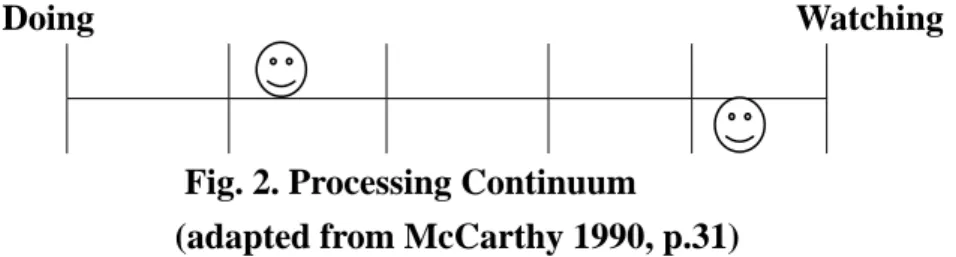
The four quadrants of McCarthy’s 4Mat system shown above are formed when the two dimensions of processing and perceiving are juxtaposed. This theory was based on Kolb’s (1985) work, which described two major differences in how people learn: how people perceive and how they process. In processing, some people are watchers first; others are doers first (Figure 2). Both ways of processing are different but equally valuable In perceiving, some people perceive by sensing; while others
perceive by thinking (Figure 3). The two kinds of perception are different; they complement rather than exclude each other. Thus, the 4Mat system is formed to take care of learners of different ways of processing and perceiving to be comfortable some of the time and stretched and challenged at other times.
Doing Watching
Fig. 2. Processing Continuum
(adapted from McCarthy 1990, p.31)
Sensing/Feeling
Thinking
Fig. 3. Continuum of Perception (adapted from McCarthy 1990, p.31)
Sensing/Feeling
Doing Watching
Dynamic Imaginative Learners Learners
4 1 3 2
Common Analytic Sense Learners Learners
Thinking
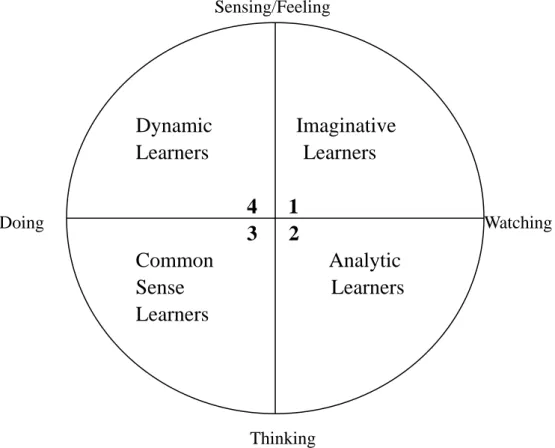
Fig. 4. McCarthy’s Four Major Learning Styles
As what is shown in Fig. 4, McCarthy’s four learning styles are formed after the juxtaposition of the two dimensions of perceiving and processing. Imaginative learners are those who perceive by sensing and processing by watching; analytic learners are those who perceive through thinking and processing by watching;
common sense learners are the ones who perceive through thinking and process by doing; dynamic learners are the ones who perceive by sensing and processing by doing. According to the learning preference of each type of learner, the instruction of
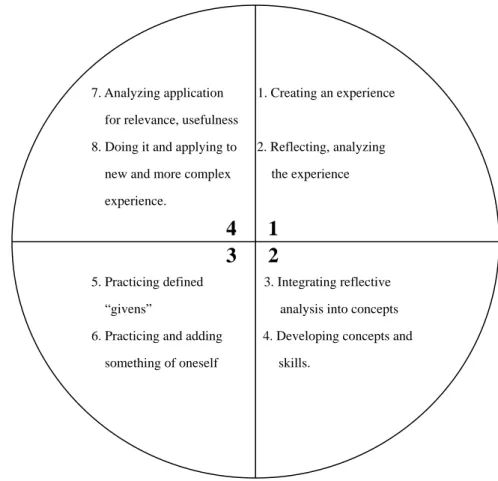
the 4Mat system is formed (Fig.5)
7. Analyzing application 1. Creating an experience for relevance, usefulness
8. Doing it and applying to 2. Reflecting, analyzing new and more complex the experience experience.
4 1
3 2
5. Practicing defined 3. Integrating reflective
“givens” analysis into concepts 6. Practicing and adding 4. Developing concepts and something of oneself skills.
.
Fig. 5. The Complete 4Mat System Model
Figure 5 represents the 4Mat cycle which shows the teacher behaviors appropriate to each stage and style and provides a framework for planning any lesson or unit, for any level or content area (McCarthy, 1990).
According to the analysis of some research, the students taught with the 4Mat system are more interested in the lessons, have a more positive attitude toward what is
taught, and demonstrate more on-task behavior than do the students in the traditional classroom (Wilkerson, 1986).
The 4Mat system is based on two major premises. First, people have major learning styles and hemispheric (right-left-mode) processing preference. Second, designing and using multiple instructional strategies in a systematic framework to teach to these preferences can improve teaching and learning (McCarthy, 1980, 1987).
Results suggest that instructional activities and environments that are compatible with students’ learning styles lead to higher academic achievement (Educational Research Newsletter, 1995).
The different ways people prefer to learn can affect their success in what they do. Therefore, knowing learning preferences can make a significant difference in academic achievement. Using the 4Mat model allows all learners to be comfortable in their preferred learning style and brain processing mode and yet challenges all to learn in new ways (McCarthy, 1990).
According to McCarthy (1980, 1987), when teachers become involved in 4Mat training, they not only initiate change in course design and instruction, but also change their attitude towards learning. They begin to believe in multiple kinds of intelligence, and are more accepting of diversity in students’ learning styles.
Brain hemisphere research further confirms the need for the consideration of
learning styles. The 4Mat System is an instructional model that aids teachers in designing units of study that address the learning styles as well as hemispheric preference of students. Research on right and left brain hemispheres produce the following findings (Wilkerson, 1987):
1. The two halves of the brain process information differently.
2. Both hemispheres are equally important in terms of whole brain functions.
3. Individuals rely more on one information processing mode than the other, especially when they approach new learning (Bogen, 1969, 1975).
McCarthy (1990) incorporates students’ preferences for right-brain or left-brain mode of learning into each quadrant in her 4Mat System model. Although the left and the right sides of the brain are equally important, each side owns its own unique characteristics. Students with a left-brain preference for learning prefer an analytic, systematic, sequential, and looking-at-the-parts approach to learning new material;
students with a right-brain preference for learning prefer a global, visual, intuitive, and whole-picture approach to learning new material. When the left-brain and right-brain preferences are added to the four quadrants (learning types), an eight-step model 4Mat is formed. The 4Mat System Cycle of instruction can guide instructors in planning teaching strategies that will meet the diverse learning needs of most of the students in a classroom. The following eight steps are 4Mat teaching procedures, with
each two consecutive steps emphasizing one of the learning types and changes from right- to-left mode of information processing (McCarthy, 1990).
1. Create an experience or connect to students’ past experiences (Type 1 Learner, Right Brain Mode).
2. Analyze the experience (Type 1 Learner, Left Brain Mode).
3. Integrate reflections into concepts – visualize concepts (Type 2 Learner, Right Brain Mode).
4. Define concepts – traditional lecture (Type 2 Learner, Left Brain Mode).
5. Try out concepts – hands-on experience or supervised practice (Type 3 Learner, Left Brain Mode).
6. Extend learning – students mess around with the concept, practice and add something of their own (Type 3 Learner, Right Brain Mode).
7. Evaluate their own application – students analyze usefulness, relevance, and originality of a final project (Type 4 Learner, Left Brain Mode).
8. Integrate application and experience – students complete a final project and share what they have accomplished in the class (Type 4 Learner, Right Brain Mode) (McCarthy, 1990).
Using this model allows all learners to be comfortable in their preferred learning style and brain processing mode, yet challenges all to learn in new ways
(McCarthy, 1990). Kegan (cited in McCarthy 1980, 1987) stated that when these quadrants (see Fig. 5) are put together, they make up a complete development learning cycle, moving from subjective knowing to objective knowing to integral knowing. It has already been proved in some research that the 4Mat model can aid teachers in meeting individual needs of learners in their classroom and can be used as a guide in the development of their lessons and units of study (Wilkerson, 1986).
In order to find out the participants’ learning styles, some instruments for the researcher to use will be introduced in the next section.
Instruments to Measure Learning Styles
Curry (1987) has advocated a broad definition of learning styles in her model, which has three levels. The innermost level is the level of personality, the traits which Jung (Jung, 1971) described. The second level is cognitive style, the way an individual perceives and processes new information. The outermost level consists of the environment or the time of day when learning occurs.
Hickcox (1995) establishes criteria of judging the overall quality of a learning style instrument for use with an adult population. These criteria include the extent and results of tests of the instrument’s reliability and validity, the extent of revisions of the instrument especially for issues of language relevancy, the extent to which it was
designed specifically for use on adults, and the extent to which it purports to measure the type of learning style (from Curry’s model) as defined in the particular study.
Researchers give some caveats about using learning style instruments. The currently available learning style instruments are generally self-report instruments, which means that they measure individual’s perceptions of themselves as learners rather than observable learning behaviors (Hickcox, 1995). Also, if one accepts Kolb’s contention that learning style is a state rather than a trait, then we can expect a relatively low measure of reliability on instruments which measure learning style as a trait because individuals can be expected to score differently as they develop.
However, Kolb (1984) and Dunn & Dunn (1999) both feel that learning style is due to heredity to some extent (60% of learning style is biological according to Dunn &
Dunn, p.11) and therefore is fairly stable within individuals as they age.
A multitude of instruments are available. The following is the summary of several which are representative of Curry’s (1987) three levels.
1. As Kolb’s Learning Style Inventory (LSI) measures individuals’ preferences for perceiving and processing modes, it deals primarily with the cognitive processing level of Curry’s (1987) model. In this self-report instrument, students rank order word choices resulting in scores on the active experimentation versus reflective observation continuum and on the concrete experience versus abstract conceptualization
perceiving continuum. From the two highest scores, a quadrant is chosen which determines the learning.
2. Since McCarthy developed the Learning Type Measure (LTM) as an instrument similar to the LSI, it also deals primarily with Curry’s cognitive style level.
In addition, it includes a set of questions which determine a watching/doing score, which correlates with introversion and extroversion as formulated in Jung’s theory of personality.
3. The Myers-Briggs Type Indicator (MBTI), a personality instrument, is developed in conformance with Jung’s (1923) model of types. Jung believes the behavior of the individual may seem unpredictable and changeable, it is actually consistent and regular. That is because each individual has his or her own preferred ways of perceiving or judging new information, which results in the differences among individuals. Jung made three distinctions: between thinking and feeling, between sensing and intuition, and between extroverts and introverts. Myers (1985) added a fourth dimension, judging versus perceiving, and developed the Myers-Briggs Type Indicator (MBTI). The instrument is a self-report instrument which rates learners in each of these four dimensions, resulting in sixteen possible types. With this instrument, the individual is able to understand his/her own type of personality and fully utilize his/her strength (Yang, 1999).
Myers and Briggs Type Indicator (MBTI) is divided into three parts: there are 26 questions in the first part; 45 questions in the second, and 55 questions in the third.
The subjects are required to answer all the questions, each of which contains two items, by choosing one of them according to his or her usual behavior or thoughts.
What the test taker chooses represents part of his or her personality type.
According to MBTI, subjects are categorized as (1) Extroversion vs.
Introversion ; (2) Sensing vs. Intuition; (3) Thinking vs. Feeling; and (4) Judging vs.
Perceiving. The details of each category are discussed as follows:
(1) Extroversion vs. Introversion refers to the focuses of the subjects.
Extrovert people (E) are those who focus on people and objects from the outer world, while Introvert people (I) refer to those who focus on concepts and insights existing in the internal world.
(2) Sensing vs. Intuition refers to the process an individual gathers information. Sensing (S) means counting on the process of sensing, by using senses, while Intuition (N) refers to relying on intuition
(3) Thinking vs. Feeling is categorized because of how people make decisions.
Thinking (T) refers to those who make a fair decision according to logical result; Feeling (F) refers to someone who makes a decision according to personal or social values.
(4) Judging vs. Perceiving focuses the way people deal with things. The Judging type person (J) prefers dealing with things through the process of making plans or decisions, while the Perceiving type (P) prefers dealing with things through natural understanding.
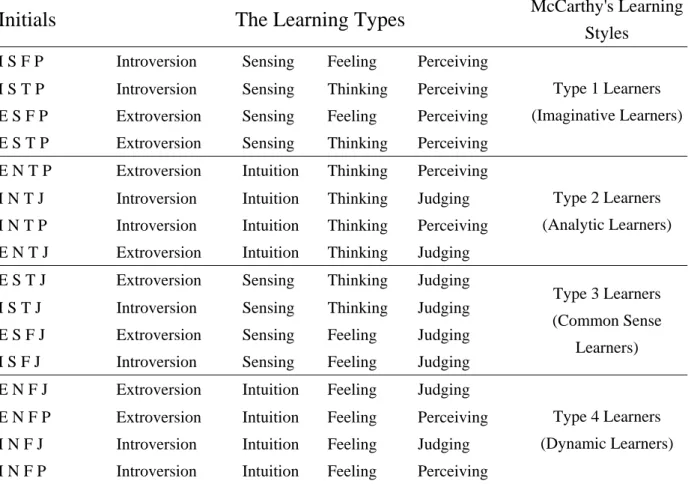
After taking MBTI, the test takers will be classified into one of the personality types according to the total score he or she gets. There are altogether sixteen combinations, which are presented in Table 3.
Table 3 Sixteen Learning Types and Their Initials
Initials The Learning Types McCarthy's Learning Styles
I S F P Introversion Sensing Feeling Perceiving
I S T P Introversion Sensing Thinking Perceiving
E S F P Extroversion Sensing Feeling Perceiving
E S T P Extroversion Sensing Thinking Perceiving
Type 1 Learners (Imaginative Learners)
E N T P Extroversion Intuition Thinking Perceiving
I N T J Introversion Intuition Thinking Judging
I N T P Introversion Intuition Thinking Perceiving
E N T J Extroversion Intuition Thinking Judging
Type 2 Learners (Analytic Learners)
E S T J Extroversion Sensing Thinking Judging
I S T J Introversion Sensing Thinking Judging
E S F J Extroversion Sensing Feeling Judging
I S F J Introversion Sensing Feeling Judging
Type 3 Learners (Common Sense Learners)
E N F J Extroversion Intuition Feeling Judging
E N F P Extroversion Intuition Feeling Perceiving
I N F J Introversion Intuition Feeling Judging
I N F P Introversion Intuition Feeling Perceiving
Type 4 Learners (Dynamic Learners)
be involved in this activity. This temperament is similar to the SP (Sensing/Perceiving) temperament in the MBTI. McCarthy’s Type 2 (Analytic) learners want to know
“Why to learn” and such temperament is similar to that of the NT (Intuition/Thinking).
McCarthy’s Type 3 (Common Sense) learners want to know “How to apply the learning” and this is similar to the temperament of the SJ (Sensing/Judging). Type 4 (Dynamic) learners ask “If this is correct, how can I modify it to make it work for me?” Such temperament is similar to the NF (Intuition/Feeling) temperament.
Ways to Improve Reading Comprehension Ability
In recent years, there have been several studies in Taiwan focusing on how to improve EFL students’ reading comprehension ability. Besides exposing to large amount of reading material, which is the basic requirement to improve students’
reading comprehension, reading strategies or reading skills are also emphasized.
Hsieh’s study (1998) suggested that the instructor should use audio-visual aids, such as novels and video, to boost students’ interest in reading and to help them understand the content. Wang (1998) suggested explicit teaching of text structure, including so-called text-forming devices, such as reference, substitution, ellipsis, conjunction and lexical cohesion as these are words and phrases which enable readers to establish the relationships across sentence or utterance boundaries and which help tie the
sentences in a text together. And it was proved that the students who were taught explicitly of text structure made more improvement than those who were not taught in this way. Another study conducted by Kuo (2003) confirmed that the semantic mapping instruction on reading comprehension can have positive effects on EFL students in Taiwan.
It was also found that the course design should be examined to see whether it covers the four categories of factors: key components of early reading, word recognition, fluency, and text comprehension strategies. Only when the four factors are included can the students’ ability in reading comprehension improved. Key components refer to the skills and knowledge which affect learning to read, such as oral language skills, letter knowledge, knowledge of grapheme-phoneme correspondences, and phonological awareness. These key components of early reading represent the beginning skills and knowledge that a child needs to acquire in order to become literate (Chu, 2006).
The Collaborative Strategic Reading (CSR), which will be employed in this research to improve students’ reading comprehension, is a combination of two instructional approaches that teachers may implement in reading instruction. The two approaches are reading comprehension strategy instruction and cooperative learning. In CSR, students of mixed reading and achievement levels work in small,
cooperative groups to assist one another in applying four reading strategies to facilitate their comprehension of content area text. These strategies are (1) preview, ie, prior to reading a passage, to recall what they already know about the topic and to predict what the passage might be about; (2) click and clunk, ie, to monitor comprehension during reading by identifying difficult words and concepts in the passage and using fix-up strategies when the text does not make sense; (3) get the gist, ie, during reading, to restate the most important idea in a paragraph or section; and (4) wrap-up, ie, after reading, to summarize what has been learned and to generate questions “that a teacher might ask on a test” (Klingner & Vaughn, 1999).
Comprehension strategy instruction has been proved to improve learning opportunities for students, especially for those with learning disabilities (LD) (Pressley, Brown, El-Dinary, & Afflerbach, 1995; Weisberg, 1988) and those with limited English proficiency (LEP) (Anderson & Roit, 1996; Chamot & O’Malley, 1996; Hernandez, 1991; Klingner & Vaughn, 1996). Furthermore, cooperative learning has also produced favorable results for students with LD (Madden & Slavin, 1983; Stevens & Slavin, 1995) and LEP students (Dur’an & Szymanski, 1995; Jacob, Rottenberg, Patrick, & Wheeler, 1996; Long & Porter, 1985). This type of peer interaction increases opportunities for meaningful communication about academic content (Cazden, 1988; Richard-Amato, 1992).
Although quite a few studies have been conducted to explore ways to improve students’ reading comprehension, no research has been conducted on how to achieve the goal in a class with students of mixed learning styles and English proficiencies.
Therefore, it remains a challenge to try to improve students’ reading comprehension ability when the class consists of students of different learning types. And this is what the present research proposes to explore.
Since the achievement and retention of students’ learning have been proved with the use of 4Mat teaching, and some analyses have also indicated that students in the 4MAT group are more interested in class, have a more positive attitude toward the lessons, and demonstrate more on-task behavior than students in the text group, I thus would like to capitalize the characteristics and the effects of the 4Mat system to help the junior high school students in Taiwan to raise their interest in reading and to improve their reading comprehension.
In Chapter Three, more specific descriptions of the activities will be given along with the course design.