Chapter Four
Task-based Writing Curriculum
This chapter presents syllabus design and teaching activities for process paragraph writing and free writing.
According to some research findings (Johnson, 1993; Slavin, 1997), cooperation helps learners perform much better than competition. Besides, students tend to feel a higher level of anxiety in a competitive learning classroom than in a cooperative one.
Salvin defined cooperative learning as “instructional methods”, in which students work together in small groups to help each other learn” (p.284). Johnson and Johnson (1994) defined cooperative learning as “working together to accomplish shared goals”
(p.3). Brown (1994) refers to cooperative learning as “working with one or more peers to obtain feedback, pool information, or model a language activity (p. 117)”.
The essence of cooperative learning is thus for the students to help each other to master the learning task. In a community, there is an active interaction among students;
one can accomplish the learning task only if the others also reach their goals.
Based on these studies, the researcher hypothesizes that to solve the problem of teaching writing in a big class and to help learners to be aware of the learning process as well as construct their learning concepts, the social cognitive approach is the most effective teaching method to adopt in senior high EFL writing classroom. For one thing, those who are faster in learning will help those who are slower in learning so as to achieve their learning goals and at the same time become more confident and have less anxiety in learning. For another, students will learn the lessons from both their teachers and their classmates as well.
In a community-learning environment, the teacher is not the only source of
information and knowledge; learners themselves constitute another source from which they can acquire the information they need. Through peer learning, learners will build up broader worldview by sharing with and also reconstructing their classmates’
worldviews.
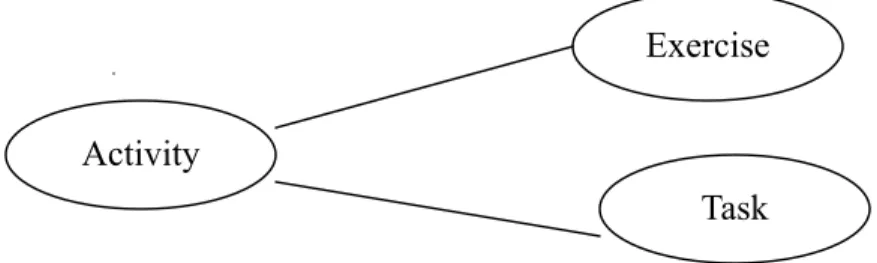
Figure 4. 1 Task-based Writing Curriculum
White R. and V. Arndt (1991) view writing as a complex cognitive process that requires sustained intellectual effort over a considerable period of time. They suggest the following typical sequence of activities for the social, collaborative nature of the composing process.
Step 1: Discussion (class, small group, pair)
Step 2: Brainstorming/making notes/asking questions Step 3: Fast writing/selecting ideas/establishing a viewpoint Step 4: Rough drafting
Step 5: Preliminary self-evaluation
Step 6: Arranging information/structuring the text Step 7: First draft
Step 8: Group/peer evaluation and responding Step 9: Conference
Step 10: Second draft
Step 11: Self-evaluation/editing/proofreading Step 12: Finished draft
Step 13: Final responding to draft
Above steps for writing practice suggests that producing a text involves the first
six-recursive steps. As a whole, these steps can be realized in the classroom in number
of different ways. They further point out that the process approach is aimed at helping
the learner to develop a set of skills. Also, they consider that what we need in the writing classroom are both models and appropriate procedures. We need both process and product.
In the researcher’s view and her teaching experience, if the teacher wants to promote students’ writing proficiency, he or she we must implement a series of steps in order to meet the needs of the teacher and students (Step 1~ 6 from teacher’s perspective, Step 7~8 based on student’s perspective). The steps are listed below and are implemented in each of her free writing workshops:
Step 1: Guided discussion (class, small group, pair) Step 2: Brainstorming/making notes/asking questions Step 3: Fast writing/selecting ideas/establishing a viewpoint Step 4: Arranging information/structuring the text
Step 5: First draft
Step 6: Using sign to correct errors
Step 7: Group/peer evaluation and responding/ teaching reflection Step 8: Revision
And the following are the steps showing how the researcher creates her task-based programs in the action research following Nunan’s (2000) and Richard’s criteria about tasted curriculum design.
Analyze the teaching goals Specify relevant microfunctions Select and sequence the tasks
Create pedagogical tasks, including rehearsal and activation ones
Identify enabling skills in order to create communicative activities and language
exercise.
language exercises.
4.1.1 Cooperation and collaboration, Interaction, and Question
There are no workbooks or step-by-step guidebooks to a perfect literacy program.
In order to facilitate real learning, a teacher must provide a full-immersion environment. From this point of view, the teacher needs to organize the classroom and curriculum so that students can cooperate and collaborate, interact, and raise questions for both classmates and the teacher. Crouse and Davey (1989) researched on what happened in their elementary classroom when they provided collaboration for student.
They found that for their children, friendship was much more important than they ever thought because being able to work with someone else made the children feel confident and secure and enabled them to make and keep new friends. Together they could plan and organize and help each other with the mechanics of writing. Moreover, through mutual help, children made progress in writing. Obviously, the teacher, who encourages their students to collaborate, cooperate, and raise question, needs to create a safe community. In the researches (Heath, 1983; Lindfors, 1987; McLure and French, 1981; Wells, 1986), students asked few questions in a traditional classroom.
Therefore, the teacher in the writing classroom should make a firm commitment to offering appropriate boundaries and dependable structures in order to enhance the potential for learners to work together and to ask their own questions. From learners’
questions, teachers are able to get insight of their teaching because these questions
help instructors understand where learners are to develop into mentally. The questions,
meanwhile, provide another window into how they understand literacy tasks and how
they operate as learners. More significantly, the central tasks of the teacher are
helping students clarify and formulate their questions, helping them state their own
questions so they can be pursued on their level. Likewise, the teacher should help
his/her students in the light of their experience and other knowledge they have generated.
In the present study, the researcher operates “process writing workshops” which are designed as a model and a facilitator to build up a cooperative and collaborative talk through interactive task-based activities.
Mini lessons are a wonderful guiding period. They are about fifteen minutes long and are conducted by the teacher at the beginning of a “writers’ workshop
7”. The function is to give students a strategy they can use. However, during the process, the learners have to experience errors or insufficiencies while organizing their drafts. For example, in the syllabus of “Free Writing—Unit One”, the researcher starts with an interview activity. Learners have to try hard to get information about their classmates and then they have also to try hard to organize it into their writings. The teacher would not help learners unless they asked for it. Mini-lessons provide for those moments when the teacher takes students by the hand and participates in the jointly constructed potential level of performance (Bruner, 1978 and Gambourne, 1988; cited in Bickmore-Brand & Gawned, 1993). Afterwards, the researcher leads some guided activities as a rehearsal.
First, the teacher provides an active response by confirming what students have heard and by asking a few clarifying questions .
Second, the teacher helps the entire class to go through the same procedure during group sharing session. Each writing period ends with three learners sharing their pieces with the group while the group follows the process of confirming, through pointing to what is in the text and then asking questions to learn more about what the learners have written.
7
The responses mentioned above, whether by the teacher or by other classmates, are geared toward helping students learn to listen to their own words, their own ideas, and their own texts.
The perspective of constructivists on writing teaching originates from cognitive theory, yet we teachers may be puzzled as to how we should design a variety of tasks to guide and to construct the skills and knowledge. Perkins (1992a) thought there should be two forms:
BIG (beyond the information given)—students are given some information and experiences by the teacher directly first. Then, the teacher guides students and helps them think and test them to see if they can classify and apply what they have learned to different situations. For beginners, giving some basic structural instructions is necessary. And in this level, it has better to have cooperation as a guided activity.
WIG (without information given)—students are given different situations to experience and build up their knowledge. The teacher gives them support but not the answers. This approach is suitable for the learners of intermediate level. In this level, collaboration is a very suitable activity.
.
4.1.2 Peer Conference
In the study, the researcher tries to foster collaboration between students and has implemented the following scaffolding procedures in her writing classroom.
The writer reads aloud.
The reader responds, or if the piece is confusing, the reader asks questions, then responds.
The reader focuses on the content, perhaps asking questions about it. The writer guides the reader about the subject.
However, as Calkins (1986) points out, teachers must be cautious about
emphasizing the skills of peer conferences. Teachers should try to avoid responses that are canned and mechanical, that is, where students perform on cue and act a part.
Teachers should also keep alert about why they want students to collaborate with one another. The meaning of peer conference is to help learners relate to another peer in order to learn from him or her, to empathize, to hear peers’ work and to understand their writing more fully, to care about another person’s interpretation of the world, and to be able to identify and respond to another person’s perspective.
4.2 Outline of Syllabus
The writing materials in the present study contain two parts—process paragraph writing and free writing. The Experimental Group took both parts, whereas the Control Group took only the free writing part.
The following are the writing syllabus for the Experimental Group and the Control Group.
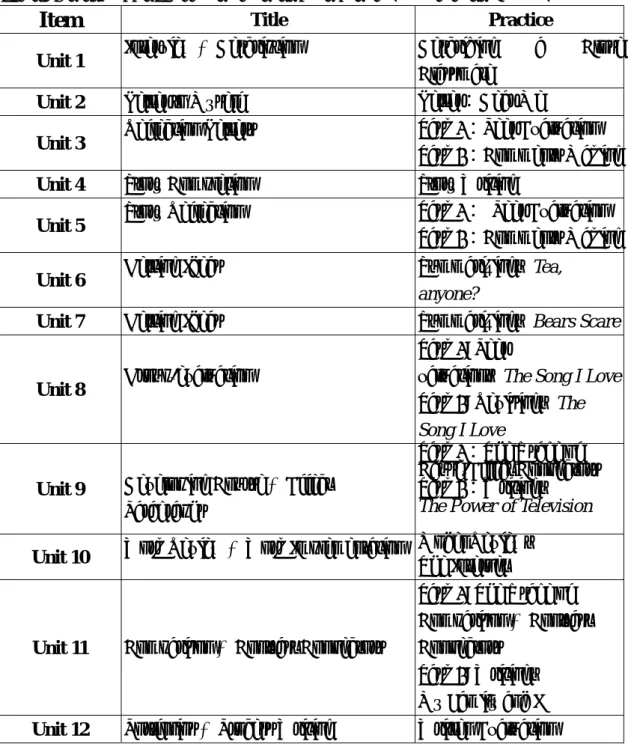
Syllabus for Process Writing Table 4.1 Part I: Process Writing Syllabus for the Experimental Group
Item Title Practice
Unit 1 Topic Sentences & Paragraphs Help! The Advice Column Unit 2 Topic Sentences & Controlling Ideas Sentence Making & Error
Correction
Unit 3 Reading & Summary Paragraph Summary Unit 4 Tense Instruction With a Song Fill the Blank
Unit 5 Sentence Combining Story Lines Combination
Unit 6 Paraphrasing Poem Paraphrasing
Unit 7 Guided Writing & Reading Primary Colors or
Pocahontas
Syllabus for Free Writing
Table 4.2 Free Writing Syllabus for both the Experimental Group and the Control Group
Item Title Practice
Unit 1 Interview & Description Describing a Close Classmate
Unit 2 Letter to Myself Letter:Dear Me
Unit 3 Reflection Letters Task 1:Peer Evaluation Task 2:Comments Making Unit 4 Story Completion Story Writing
Unit 5 Story Reflection Task 1: Peer Evaluation Task 2:Comments Making
Unit 6 Getting Ideas Summarizing—Tea,
anyone?
Unit 7 Getting Ideas Summarizing—Bears Scare
Unit 8 Group-evaluation
Task 1: Peer
valuation—The Song I Love Task 2: Revising—The Song I Love
Unit 9 Developing Course & Effect Paragraphs
Task 1:The Usage of Cause-Effect Connectors Task 2:Writing—
The Power of Television Unit 10 Work Review & Work Implementation Model Review—
The Internet
Unit 11 Comparison & Contrast Connectors
Task 1: The Usage of Comparison & Contrast Connectors
Task 2: Writing—
My Family and I Unit 12 Portfolios & Process Writing Written Evaluation
The following in sections 4.2.1-4.2.3 consist of part of the units excerpted from
process paragraph writing and free writing illustrating the tasks contained in the
writing syllabus. There are four parts in this section: (1) Concept Transferring through
Meaningful Tasks (2) Writing through Reading (3) Writing through Media
4.2.1 Concept Transferring with Exercise
Process Writing—Unit One
Pedagogical Tasks are used for activation and the tasks offer opinion exchange first and then give a situation to precede a communicative activity for paragraph writing.
I. Opinion Exchange Task
Directions: please work with a partner, discuss the questions, and share your opinions
and write down the answers to them.
1. Read the paragraphs A & B below and follow the instructions.
Focus Giving a general idea about paragraph and topic sentence
Form Letter Genre Narration
A narrative paragraph gives the details of an event or
experience in story form or in the order they happened.
Material Transparency and worksheet Teaching the Lesson
First, ask the students to think about the meaning of paragraph,
and then give them a pair of sample paragraphs for comparison
students share their opinion in pairs. Second, they have to find
out the topic sentence. Finally, the teacher leads the discussions
for the students to figure out what a good topic sentence is.
A.
Dear Abby,
My mother is very strict with me. She doesn’t allow me to accept any gift without her permission. She insists that I come home before 10:00 every night. She forbids me from talking too long on the telephone. She punishes me when I make mistakes or get poor grades. She used to be very beautiful so she has never been satisfied with my appearance. I have never been confident of myself because she never praises me. How can I have an agreement with my mother?
Truly, Pearl
B.
Dear Abby,
My mother is very strict with me. She doesn’t allow me to accept any gift without her permission. She insists that I come home before 10:00 every night. She forbids me from talking too long on the telephone. She punishes me when I make mistakes or get poor grades. Maybe she does all these things because I am the oldest child in the family, and she wants me to set a “perfect” example for my younger sister. From this viewpoint, perhaps she is justified in being so exceptionally strict. Please tell me what I am going to do.
Truly,
Pearl
a. Which paragraph is easier to understand? Circle the letter.
A or B b. Why?
2. Finding the Best Topic Sentence, and Marking it with a B (best):
a. _______ My car smells, has flat tires, and won’t start.
b. _______ I have a lot of trouble with my car.
c. _______ So, it is time to get a new car.
My car always smells like exhaust fumes. I’ve had two flat
tires this year. Sometimes it won’t even start in the morning.
a. ___ Apples taste good, too.
b.____ The apple has been a symbol of many things.
c.____ An apple represents forbidden knowledge because of the Bible, school because it is a traditional gift and a computer company because it has the same name.
3. Find out and underline the ideas that are not related to the topic sentence.
4. What is a paragraph?
It should include:
___________________________________________________________________
___________________________________________________________________
___________________________________________________________________
5. Is the above practice helpful to you in identifying a paragraph? Is it interesting?
Why or Why not?
Helpful: 1. 2. 3. 4. 5. Reasons:
Interesting: 1. 2. 3. 4. 5 Reasons:
A long time ago, the apple was a symbol of forbidden knowledge because of the story of the Garden of Eden in the Bible. Later, it becomes a traditional gift for teachers. These days, many people think of the computer with the same name when they hear the world “apple”.
Robert Frost is probably the best-known American poet of the twentieth
century. He lived on his farm most of the time. He won almost every major
literary award and honor in America. He was invited to read his poems at
President Kennedy’s inauguration. He was tall and handsome. For nearly half a
century he was the unofficial poet laureate of America.
II. Communicative Activity In-class Writing Practice
Directions: Write a letter to an advice columnist Dear Abby. Ask for advice.
This is the problem you have:
You have a very good friend that you have known as a freshman in Senior High. You two are very close. Now you have a new friend who does not like your old friend. When the three of you are together, none feels uncomfortable. Your old friend has ever stopped calling you. You need some good advice.
Describe a recent unpleasant incident with your friends and ask Abby what you should do to get the two friends to accept each other. List the who, what, when, where, why, and how of this happening—or at least as many of these six questions as you feel
your reader needs to know. Write briefly, as though you are telling your best friend about this event. Show your reader what makes this event special by including the background, people involved, actions, and overheard comments.
Help! The Advice Column Learner: No.:
Example:
Dear Abby,
My good friend is Jamie that I have known as a freshman in Senior High. But now, we are not in the same class, we all make new friends. One of my new friends doesn’t like Jamie. One day, when the three of us walk together, I didn’t know whom I should talk to. I was afraid to offend anyone of them. Recently, Jamie has stopped calling me.
I don’t know how I can do and what I should do.
Truly,
Judy
Teaching Journal Feedback from the Teacher:
Today is the first day for the Writing Class. Without the help of transparency, the teaching seemed less smooth. I finished Chapter Three of the textbook. Thanks to the well-organized teaching plan, I managed to have the teaching process. I felt more confident with the instruction. The only defect was the examples given were little bit difficult in terms of students’ vocabulary. So, I will have to make adjustments in this respect. Besides, the junior students are green hands in the boat of writing class. They still cannot fully understand the main teaching points. I will have to offer some concrete examples in the next meeting.
Since knowledge of sentence structure is a very important part in writing compositions, therefore, in the reading class, the teacher should make a point that sentence-making can help students to build their sense of what a grammatical sentence is. Regarding with Lesson Two, I will also give a handout for errors correction in words, sentence construction and grammar.
Feedback from the Students:
Students considered the lesson is helpful (average scale 4), but not very interesting (average scale 3).
Positive Comments:
Lala: It not only gives me some ideas but also makes me learn how to get the main idea.
River: It’s very helpful to some kind of clumsy boys such as me.
Echo: I learn a lot of things during this practice, and I think it will be helpful.
Hera: This is the first writing class. In the class I learned something I’ve never
touched. I think it’s helpful.
Shiao Tien: It has many newly examples that help me in writing composition.
Wei-wei: It’s more easily than the textbook we read.
Steven: It is systematical for us to learn writing.
Kelly: I think it’s really helpful, because it trains me how to write a paragraph clearly.
Francs: It can train our ability in writing and thinking. And it is not like the textbook used in our ordinary English class that we have to learn many new words. When I did this activity, I felt relaxed.
Wina: I can learn different knowledge that I never learned before.
Vicky: It will make my English better if I always have chances to do the practice.
Negative Comments:
Steven: I think if it is a story, I’ll feel more interested.
Ellen: I wish we could read some more interesting examples on the worksheets.
There are many words I cannot figure out their meaning.
Winna: It is not interesting because it is serious.
Vicky: There are new words that I don’t understand.
Process Writing—Unit Two Topic Sentence & Controlling Ideas
Pedagogical Tasks are used for rehearsal. Rehearsal tasks and exercises for choosing correct sentences, making sentence and correcting errors. There are three activities in this unit: (1) Pedagogical task for rehearsal, (2) Language exercise for sentence making, and (3) Conference for Error Correction.
I. Pedagogical Task for Rehearsal
Directions: (1) review the teaching materials that students learned last period. (2) Do the practice on sentence patterns.
I have a lot trouble with my car. My car always smells like exhaust fumes. I’ve had two flat tires this year. Sometimes it won’t even start in the morning.
Focus To rehearsal about topic sentences and controlling ideas as well as error correction
Form Letter Genre narration
A narrative paragraph gives the details of an event or experience in story form or in the order they happened.
Material Transparency and worksheet Teaching the Lesson
This unit is a rehearsal for the previous session. First, the
teacher has to review the teaching materials that students
learned last period. Then, the teacher demonstrates the errors
adopter from students’ writing.
1. Do you remember the topic sentence? Please write it down.
T:___________________________________________________________________
2. Can you point out the sentences in the paragraph giving the detail information to support the topic sentence? Please list them out.
S:___________________________________________________________________
S:___________________________________________________________________
S: ___________________________________________________________________
3. General information serves as a topic sentence and specific information serves as supporting sentences.
Example:
G trouble with my car S smells like exhaust S flat tires S out of work in the morning
4. Read the Letter and tell your partner whether its topic sentence and supporting sentences are well-linked. Explain your reasons.
Dear Abby,
My good friend is Jamie that I have known as a freshman in senior high. I like swimming. But
now, we are not in the same class, we all made new friends. One of my new friends doesn’t like
Jamie. One day, when the three of us walked together, I didn’t know whom I should talk to. They
did not do homework together. I was afraid to offend anyone of them. Recently, Jamie has
stopped calling me. I don’t know what I should do.
Truly,
Judy
G: __________________________________________________________________
S: ___________________________________________________________________
S: ___________________________________________________________________
S: ___________________________________________________________________
S: ___________________________________________________________________
Unrelated ideas:
5. Take a look at the following sentences and choose the correct sentence from the items in the columns below.
Example:
__ Henry Ford improvements in the motorcar, but he didn’t really invent.
C It costs over three thousand dollars to buy a recorder.
__ Martin finally gets a job that he liked.
a. _____ I am not getting along with my friends.
_____ When I play with my friend, I had a lot of fun.
_____ I hope all of us can be happy when we are together.
b. _____ I know a new friend in senior high school.
_____ I have known my friend for four years.
_____ I do not know how to do nor how to say.
3. _____ Now something was happening in my life.
_____ I really want to keep our relation as the same as before
_____ He always listens to my complaints.
II. Language Exercise for Sentence-making
1. The sentences below are fragments; please revise them to become a complete sentence.
Example:
Because I had a headache.
Because I had a headache, I couldn’t concentrate on myself in class.
a. As soon as I finished dinner.
b. They said.
c. Caroline elected president of the class last week.
III. Language Exercise for Error Correction
Figure 4. Correct the errors in italic form in the sentences below:
7.1 He scrawled his homework so his teacher asked him write again.
7.2 After his explain, I have already realization the question.
7.3 There are many people go for a stroll at the beach in summer.
7.4 I don’t have much realization from her, ______ I don’t know why she was angry.
7.5 The book was set by me on the desk.
7.6 My country was alter a lot after I left several years ago.
7.7 Stroll in the morning is very comfortable.
7.8 I gave him a big punch in order to let him break the bad habit.
7.9 Because he is going to married, he alters all his bad habits.
7.10 Minutes pasted, he suddenly came to the realization of what I said.
IV. Conference on Errors Correction adopted from students’
writing
Direction: Please correct the bold letters below Dear Abby:
I have two intimate friends who do not like each other. Whenever they see each other, they always become angry and there will be a strange atmosphere surrounding us. First, they stop talking with me and just go away. Next, they have a great argument. After, it is my turn go away because they think I make all faults. Now, our relationship seems hard to maintain, and I am worried about the losing friendship. I try hard to negotiate the thing. I hope we can hold our hands together, sit at the hilltop and talking_sincerely. Moreover, after the thing (_ ___), we can keep a stronger friendship among us. Please tell me what I have to do.
Sincerely your,
Chenyu
Free Writing: Unit Nine Developing Cause-Effect Paragraphs
Pedagogical tasks and Enable Skills exercise are included in this unit for pre-writing practice and In-class writing practice. Totally, there are four activities in this unit: (1) Enable Skills Exercise on Transitions, (2) Review and Implementation, (3) Composition Revision, and (4) In-class writing practice.
Focus To give a general idea about transitional words and their functions
Form A Descriptive Article Genre Expository
An expository paragraph is to give personal ideas or opinion of events.
Material Transparency and worksheet Teaching the Lesson
First, the teacher gives an explanation about the connectors
showing cause and effect. Students form groups of three
should have three persons in the group to discuss the usage of
the connectors listed in the worksheet. In addition, they have
a brainstorming for sentence making practice. Finally, the
teacher asks some students from different groups to present
their answers on the blackboard. After students are familiar
with the usage of these connectors, the teacher has students
put them in their writing.
I. Enable Skills Exercise on Transitions Task 1
Cause-effect paragraphs are often explanation paragraphs, and some of the connectors you have already learned are used in these paragraphs, for example, paragraph connectors like for example and in addition which appear in the middle of a paragraph and connectors such as in conclusion which appears at the end to conclude a paragraph. In addition, some cause or effect paragraphs use comparison-contrast connectors (but, however, although, even though, etc.) to help the readers understand what is and what is not an effect or a cause.
However, some connectors are used specifically with causes and effects. Theses connectors help the reader to tell causes from effects. To write successful cause-effect paragraphs, then, you need be able to use cause-effect connectors correctly and appropriately. Some cause-effect connectors are listed below. Notice the placement and the relationship between causes I and effect (E). Also, be aware of the punctuation used with these connectors.
Making Sentences:
E… so…C Therefore, … Consequently,…E As a result …E For this reason, E E…because…C E…because of C E…be due to…C E…since…C First, C or E Second, C or E
II. Pedagogical Task for Activation
Review & Implementation
Direction: Please check the words underlined and correct them. And there are some
Example:
Why is the Internet getting popular? There are a lot of answers, but I think the most important answer is “convenience.”
In the ancient time or before the Internet --- (was) getting popular, if we want (wanted) to send our regards to our friends or relatives, the only two ways are (were) through the telephone or writing letters. However, when (as) the Internet is (now) popular, we can even talk to our friends on the net or use the e-mail to send letters.
Magically, our friends and relatives can get our regards in a short time. How convenient it is! So, I think that is why the Internet is getting more and more popular.
In my opinion, the Internet is very helpful for students. Because (, because) I can get information more quickly and don’t have to waste a lot of time. Also, for me, through the Internet I can --- (get to) know my favorite things or (the) singers are in Vogue right now. I don’t have to go out but know everything happening in the world. I feel the Internet is good (useful) to me.
Total words: 172 words
III. Rehearsal Activity Composition Revision: The Internet
Directions: This is a take-home assignment. Please revise your composition—The Internet.
IV. Communicative Activity
In-Class Writing Practice
Directions: Television is one of greatest inventions in the 20
thcentury. Television becomes an essential home faculty for people. Please write a composition state why television becomes so popular and your opinion about it within 120-150 words by using at least four connectors listed above.
Teaching Journal
Students do not understand how to use these cause and affect connectors
effectively. So, it is better to put them in a community. The reason for this is that the
students become supporters with each other and the teacher can provide them with
precise instruction when checking their sentence construction.
Free Writing—Unit Ten Comparison/Contrast Connectors
There are four activities in this unit: (1) Language Exercise for Sentence-making, (2) Decision-making Task, (3) Enable Skills Exercise on Transitions, and (4) Communicative Activity for In-class Writing.
I. Language Exercise for Sentence-making Task 1
Proper connectors are necessary for successful comparison/contrast paragraphs.
Below is a chart with some common comparison and contrast connectors. Notice that there is more contrast connectors, perhaps because comparison/contrast paragraphs more often focus on differences than they do on similarities.
Focus To give a general idea about transitional words and their functions
Form An Article for Describing Family Genre Expository
An expositive paragraph gives a single, clear picture of two persons, places, things, or ideas to explain the similarities and differences between them.
Material Transparency and worksheet Teaching the Lesson
First, the teacher gives an explanation about the connectors
showing comparison and contrast. Students should have form
groups of three to discuss the usage of the connectors and fill
the blanks in the two sample writings with proper transitional
words listed in the worksheet. After students are familiar with
the usage of these connectors, the teacher has students put them
to use in their writings.
Common Comparison Connectors
Likewise, Similarly, In like manner, In the same way, …also…, …,too.
…the same… …the same as…
Common Contrast Connectors
However, …but, … yet, In contrast, Although, Even though, On the other hand, Nevertheless, Unlike, Whereas
Direction 1:
1. Read the paragraph below. Choose appropriate comparison or contrast connectors to complete the paragraph.
2. Circle the controlling ideas in the topic sentences. Then tell your partner the lines from which controlling ideas are developed into and supported by the details in the paragraph.
Mary is (1) similar to /the same as my sister—Joan in many ways. First her face is (2) similar to Joan. Joan has brown skin with wide eyes, and she wears glasses.
She (3) also has brown skin and need glasses. Mary and Joan are (4) the same height: 176 centimeters. Mary’s hair is brown; (5) also/likewise, my sister has brown hair. When Mary is walking, her steps are long (6) as/like her sister’s, as my relatives tell me all the time. For these reasons, many people, even their close friends, often think that they are twins when they see her.
II. Pedagogical Task for Decision-making Direction 2:
1. Read the paragraph below. Choose appropriate comparison or contrast connectors to complete the paragraph.
2. What is the purpose of the article? Does it evaluate and/or describe? (Use detail from the paragraph to support your opinion).
3. How did you make the decisions about which connectors to use? (Use specific
details from the paragraph to support your answers).
III. Enable Skills Exercise on Transitions Topic:________________________
There are many differences between my grandfather and me. I think the first and greatest difference is our physical featutre and personality.
First, my grandfather is 75 years old. (1) In contrast, I am only 18. Second, my grandfather has brown eyes; my eyes, (2) however, are green. In addition, my grandfather is very thin. In fact, He weighs about 220 pounds. (3) Whereas, I weigh only 120 pounds. We also have different personalities. My grandfather is always happy, but I am often angry. He smiles all the time, even at people on the street. (4) In comparison to/Compared with/Unlike him, I smile only when I feel very happy.
Finally, my grandfather talks so much. I prefer to think.
(5) Even though/Although my grandfather and I are different, I am fortunate because we are good friends. I love him very much and we enjoy the time when we are together.
IV. Communicative Activity Task 3
Directions:
Step one: Tell your partner about your family.
Step two: Write down the similarities between you and your family.
Similarities Differences My Family (Father, Mother,
sister, brother, and etc.) I
Step three: Choose a Topic on your own and write a composition about your family
and you.
Teaching journal
I like to give students chances to explore their ability. In other words, I like to give different articles for students to try out how far they can go before I give them instructions on the usage of the words. I firmly believe that only through trial and error can make the ability be made muscles stronger in language learning. Most students find it hard to get used to this style because our kids have been accustomed to traditional teaching method. They are passive learners. Therefore, the teacher should have strong language teaching beliefs and have them applied to the teaching process consistently. At the beginning, it may be hard for students.
Later on, they will be amazed to find how far they can go after they get over writing gaps.
4.2.2 Writing Through Reading
Process Writing—Unit 3: Reading & Summary
The purpose of this unit is to train student on summery writing. First, opinion-exchange task is used to help transferring the structure of a summary. In addition, enable skills exercise is a good practice on verb tense. Finally, pedagogical
Focus (1) Writing competence: sentence skills for verb tense
(2) Writing performance: summary writing.
Form Summary Genre Narration
A narrative paragraph gives the details of an event or
experience in story form or in the order they happened.
Material (1) Authentic fable—The Ducks and the Fox, written by Arnold Label
(2) Laptop computer
Teaching the Lesson
Have students read this story aloud to a partner. They may read by turn. The listener retells the story after the read-aloud. After that, students may look up the new words and discuss the story.
Afterwards, they work together to write a summary. Next, they read their summary aloud to another pair or the whole class.
Finally, students write a summary for the story individually.
task for rehearsal is a summary revision.
.
Pedagogical Task for Activation I. Opinion Exchange Task
Directions: Please look at the picture and talk about it with your partner. After you have read the story, please retell the story individually and brainstorm general and specific information for topic and subtopic sentences in developing a paragraph for summarizing a story.
The Ducks and the Fox , written by Arnold Lobel
Two Ducks sisters were waddling down the road to the pond for their morning swim.
“This good road,” said the first sister, “but I think, just for a change, we should find another route. There are many other roads that lead to the pond, “No,” said the second sister, “I do not agree. I do not want to try a new way.
This road makes me feel comfortable. I am accustomed to it.”
One morning the Ducks met a Fox sitting on a fence along the road.
“Good morning, ladies,” said the Fox. “On your way to the pond, I suppose?”
“Oh, yes,” said the sisters, “we come along here every day.”
“Interesting,” said the Fox with a toothy smile.
When the sun came up the next morning, the first sister said, “We are sure to meet the Fox again if we go for our usual way. I did not like his looks. Today is the day that we must find another road!”
“You are just plain silly,” said the second sister. “The Fox smiled at us. He seemed most gentlemanly.”
The two Ducks waddled down the same road to the pond. There was the fox, sitting on the fence. This time he carried a sack.
“Lovely ladies,” said the Fox, “I was expecting you. I am glad that you have not disappointed me.”
Opening his sack, he jumped upon them.
The sisters quacked and screamed. They flapped their wings. They flew home and bolted their door.
The next morning, the two Ducks did not go out. They rested at home to quiet their nerves. On the following day they carefully searched for a new and different road. They found one, and it took them safely to the pond.
1. Choose the sentence that best describes the main idea of the Fable?
a. Even the taking of small risks will add excitement to life.
b. It is always difficult to pose, as something that one is not.
c. At times, a change of routine can be most healthful.
2. Do you know how to write a summary? Discuss it with your partner.
3.Which of the following should be included in a summary? Put a check (V) in the box.
Your topic sentence should be a clear statement of the main idea of the original selection.
Stick to the essential information—names, dates, times, places, and similar facts are usually essential; examples, descriptive details, adjectives are usually not.
Try to state each important idea in one clear order.
Ideas should be arranged into the most logical order.
Use a concluding sentence with ties to an effective end.
A summary should be longer than the original.
4. Give a Summary of the story within one paragraph in 100 words.
Do the exercise below by following the steps as follows:
II. Exercise for enabling skills
Step 1: Find out the parts for General and Specific information
G: _____________________________________________________________ ( ) S: _____________________________________________________________ ( ) S: _____________________________________________________________ ( ) S: _____________________________________________________________ ( ) S: _____________________________________________________________ ( ) S: _____________________________________________________________ ( ) S: _____________________________________________________________ ( ) S: _____________________________________________________________ ( ) S: _____________________________________________________________ ( ) S: _____________________________________________________________ ( )
Step 2: After having written down the main lines of the story in the column above, review again and delete the unnecessary parts for the summary
Step 3: Check the tense by writing (Y)—past tense, (N) — present continuous,
(T)—future, (E)—every day.
Ex: I went to school. (Y)—yesterday He is cleaning the house (N)—now He will be here tomorrow. (T)—tomorrow
They eat dinner at 6:00 in the evening. (E)—every day
Step 4: Put the General Information and Specific Information into one paragraph.
Be sure that if you want to have your writing read smoothly, transitions are necessary. (Referring to the textbook—Far East English Composition for Senior High School)
Pedagogical Task for Rehearsal
Summary: the Ducks and the Fox, written by Arnold Lobel
N-class Writing Practice
____________________________________________________
____________________________________________________
____________________________________________________
____________________________________________________
____________________________________________________
____________________________________________________
____________________________________________________
Teaching Journal
It is hard to have students learn to use different verb tense correctly. After a couple of weeks in teaching writing, I decide to use songs to teach “verbal tense” because the lyrics in the song convey the mood and through them and thus, students are able to build up the sense of “verb tenses” unconsciously. The song sung by Joy Enriquez, With this Love, is a perfect example and I am going to give it a try.
In the class, I used a web as an aid to build up the concept of summary writing. I asked my students to think about what elements should be in a summary before teaching, and then listed the elements out and have the students discuss them.
Summary writing must follow a good course design. The way I taught did help my students get a clear picture as to how to pick out main ideas from the context. Now, they can find the story lines quickly and accurately. And they have learned to put some transitions to rearrange the story lines into a summary.
Summary writing is very helpful in checking students’ reading comprehension, too.
Therefore, I advice teachers to make the best use of it as a pilot unit in the writing class. Then, students are able to pick the right usage of sentence structures and verbal tense. After a period of training, they already got a clear idea of the general concepts of writing and improve themselves a lot in reading.
Except for summary writing, the teacher can also use the lesson as a story creating
session by giving the first line and ask students to give a different ending. That would
be very creative and students will enjoy it because they can stretch their imagination
to the fullest.
Free Writing—Unit Four Story Completion
Teaching Goal : Help students understand the general elements for a composition through cooperative learning and interactive-based tasks.
Teaching Procedure:
Step 1: Have all the students sat in a circle and the teacher tells them a story about a blind mother. During story telling the teacher will have some information gap questions to help students understand the story—Real Vision excerpted from Studio classroom (May., p.
1999).
Step 2: Give students a paper and have them draw a clustering map, which later will be used as guidance for summarizing the story in oral form. Each group should assign a representative to report it, which must be written on the poster with ten sentences.
Step 3: Students should have a clusters mapping for the in-class writing practice-Story Completion.
Step 4: Writings sharing. Students share their works one another. And
then they choose the best one, which will be shown to the public.
Clusters Mapping
Michelle:
___________________________________
___________________________________
___________________________________
___________________________________
Aaron:
___________________
___________________
Sarah:______________
___________________
___________________
Kayla:
___________________________________________
___________________________________________
___________________________________________
___________________________________________
___________________________________________
I. Jigsaw Task
Directions: On hearing the story, you have to map it by drawing clusters to help you dictate what you have heard. Later, follow the lines below or give a new start on you own to create a story and then have a topic and complete the story in your own way.
Topic: ___________________________________________________________
Linda is a blind, but you’d never know it. She makes such good use of her other
senses, including her “six senses” of intuition, that she rarely gives the impression
she’s missing anything.
Free writing
Unit Five: Stories Reflection Peer Evaluation I. Opinion-exchange Task
Directions: Form a group of three. Exchange “Story” with your group members.
Step 1: Rate the following parts of the Story. Check (v) the appropriate boxes.
It is the story written by group ____
Poor Weak Fair Good Excellent
Instruction
Topic sentence Paragraph Content
Conclusion
It is the story written by group ____.
Poor Weak Fair Good Excellent
Instruction
Topic sentence Paragraph Content
Conclusion
It is the story written by group ____.
Poor Weak Fair Good Excellent
Instruction
Topic sentence Paragraph Content
Conclusion
II. Decision-making Task
Step 2: Now read the stories, and decide which one is the best? Why?
We liked ____________________________________________ because _________.
_____________________________________________________________________
_____________________________________________________________________
_____________________________________________________________________.
Step 3: Which paragraph in the story did you like best? Why?
I _____________________________________ because _______________________
4.2.3 Through Media
8to Writing
Process Writing
Unit Four: Tense Instruction with a Song
8