N A N O E X P R E S S
Open Access
Hybrid light-emitting diodes from
anthracene-contained polymer and
CdSe/ZnS core/shell quantum dots
Ming-Lung Tu
1*, Yan-Kuin Su
2and Ruei-Tang Chen
3Abstract
In this paper, we added CdSe/ZnS core/shell quantum dots (QDs) into anthracene-contained polymer. The photoluminescent (PL) characteristic of polymer/QD composite film could identify the energy transitions of anthracene-contained polymer and QDs. Furthermore, the electroluminescent (EL) characteristic of hybrid LED also identifies emission peaks of blue polymer and QDs. The maximum luminescence of the device is 970 cd/m2 with 9.1 wt.% QD hybrid emitter. The maximum luminous efficiency is 2.08 cd/A for the same device.
Keywords: Light-emitting diode; Efficiency; Optical polymer Background
Poly(p-phenyene vinylene) (PPV) for application in opto-electronic fields had attracted great interest [1]. The polymer has certain advantages, such like low-cost, easy procession, and large-area display over light-emitting di-odes (LEDs) made from inorganic material, especially in flexible displays [2]. Somehow, polymer LED (PLED) has one characteristic that its electron-injection is more dif-ficult than its hole-injection due to the high energy bar-rier for electron-injection and low electron mobility in organic polymers. Therefore, one of the most important challenges in PLEDs is to balance the charge carrier in-jection that is essential for high efficiency. One method of adding nanoparticles into emissive material of PLED could be a good solution. Some former study used ZnO nanoparticles to enhance the electroluminescent charac-teristics of green polymer LED [3], or used ZnO nano-rods to improve violet electroluminescence of polymer LED [4]. Moreover, the stable white light electrolumines-cence could be obtained from flexibly polymer/ZnO nanorods hybrid heterojunction [5].
Recently, several kinds of II-VI and III-V group quantum dots (QDs) were reported for different applications, in-cluding bio-sensing, marking and security, energy saving,
and light-emitting [6-9]. The quasi-bound theory was uti-lized to predict about photogeneration efficiency improve-ment on polymer-embedded nanoparticles [10]. A hybrid light-emitting diode which consisted of polymer as well as QDs blending as the emissive layer is proposed for pos-sible optoelectronic device. Following the combination of easy processing and flexibility of polymers and exotic optical properties of QDs, the so-called polymer-quantum-dot light-emitting diodes (PQD-LEDs) with different poly-mer and inorganic QD materials could be a successful candidate for visible displays [11,12].
We had reported blue electroluminescence from organic light-emitting diode with new anthracene-contained poly-mer. The polymer was synthesized through Suzuki coupling reaction. The deficient oxadiazole and electron-rich carbazole derivatives were incorporated into the poly-mer for enhancing charge injection and transport. The good efficiency of LED based on anthracene-contained polymer was proved in the last study [13]. For researching in solid-state-lighting application, we add inorganic CdSe/ ZnS quantum dots into anthracene-contained polymer for fabricating hybrid LED. The LEDs of single hybrid emissive layer have been fabricated and characterized in this study.
Methods
The CdSe/ZnS QDs used in this study, which had an esti-mated diameter of 5.2 nm. The picture of transmission electron microscope (TEM) for QDs is shown in Figure 1.
* Correspondence:[email protected]
1
Department of Electronic Engineering, Fortune Institute of Technology, Kaoshiung City 83160, Taiwan
Full list of author information is available at the end of the article
© 2014 Tu et al.; licensee Springer. This is an Open Access article distributed under the terms of the Creative Commons Attribution License (http://creativecommons.org/licenses/by/4.0), which permits unrestricted use, distribution, and reproduction in any medium, provided the original work is properly credited.
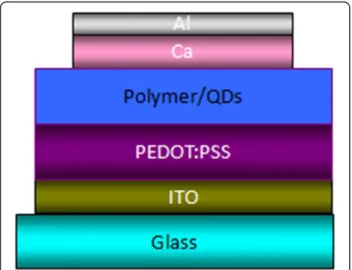
The core/shell QDs were well-dispersed in toluene with a concentration of 10 mg/ml. The polymer powder was solved into toluene for preparing solution of 3 wt.% con-centration. The polymer solution and QD solution were mixed together by the 9.1 wt.% QD ratio. We had tried other QD ratios. The luminance of higher ratios LEDs could not be measured. The LED consists of composite emissive film cast from mixed solution sandwiched be-tween a cathode and an anode. The spin speeds of cast films were 2,000, 3,000, and 4,000 r/min, from which the composited LEDs were denoted as devices 1, 2, and 3. The thicknesses of composite films for these three devices were 573, 374, and 314 nm, respectively. The full device struc-ture is shown in Figure 2. ITO film was used for anode.
The 50-nm-thick poly(3,4-ethylenedioxythiophene)-poly (4-styrene sulfonate) (PEDOT:PSS) film was for hole transport purpose. Ca/Al was deposited as the cathode by thermal evaporation. The Ca/Al films utilized for cathode were 60/120-nm-thick.
Results and discussions
The photoluminescence (PL) measurement could be used to identify energy transition of optoelectronic semi-conductor [14,15]. The PL spectrum of polymer/QD composite film is shown in Figure 3.
There are two separate PL peaks. That is two energy transitions existing in polymer/QD composite film. The first energy transition is at 452-nm wavelength and lies in the region of pure blue emission. This energy transition is owing to blue anthracene-contained polymer. This blue PL peak has 42-nm full width half maximum (FWHM). The sharp FWHM means the polymer is a very high homogeneous structure. It is obviously that QDs have en-ergy transition at 614 nm which lies in red emission re-gion. The PL peak of QDs has 40-nm FWHM.
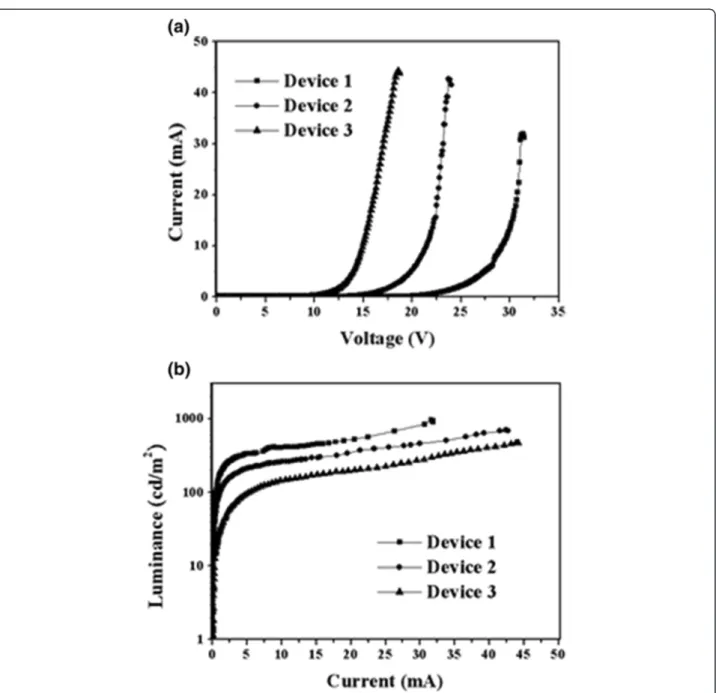
The current-voltage (I-V) and luminance-current (L-I) characteristics are shown in Figure 4.
It should be noticed that the devices were first biased under a moderate range to prevent the luminance deg-radation and voltage drift caused by overstress [16]. The threshold voltages are 26, 18, and 13 for devices, 1, 2, and 3, respectively. The thicknesses (TEMI) of polymer/
QD films with spin speeds of 2,000, 3,000 and 4,000 r/ min were as 573, 374, and 314 nm measured by α-step method, respectively. The polymer/QD film is thicker than pure polymer film in the same spin speed. It can be attributed to the contribution of QDs on viscosity. The threshold voltage is obviously decreased with TEMI
de-creasing. If the threshold voltage divided byTEMI, about
0.41 ~ 0.45 × 10⁸ V/m would be derived. Such a high
Figure 1 Transmission electron microscope (TEM) picture of CdSe/ZnS quantum dots.
Figure 2 The structure of hybrid light-emitting diode.
Figure 3 The photoluminescence spectrum of anthracene-contained blue polymer and CdSe/ZnS quantum dots composite film.
field could generate injecting of carriers into the quantum dots [17]. This field is often observed in PLEDs, and it suggests that the injection current may be limited by space charge effect or tunneling effect within polymer LED [18]. Moreover, the output luminance is also dramatically in-creased with TEMI increasing as seen in Figure 4b. The
PLEDs have a feature of luminance characteristics. The maximum luminance can be obtained at some point of supplied current. Luminance is gradually extinct beyond that point of supplied current. The maximum luminances are 959, 705, and 472 cd/m2at supplied current of 31.6, 42.5, and 44.2 mA for devices 1, 2 and 3, respectively.
The characteristics of luminous efficiency vs. current are shown in Figure 5. It is clearly that the efficiency is grad-ually decreasing beyond some maximum value even though the current injection is increasingly more. Because the polymer/QD layer is a semiconducting material, the excessive current injection turns to heat and damages the device. The maximum luminous efficiencies are 2.08, 1.25, and 0.3 cd/A for device 1, 2, and 3, respectively. The cur-rents for maximum efficiency are 0.044, 0.018, and 0.099 mA for device 1, 2 and 3, respectively. As described before, the thicknesses of composite films for these three devices were 573, 374, and 314 nm, respectively. The
electrical fields on maximum efficiency are 0.0293, 0.0291, and 0.031 V/nm for device 1, 2, and 3, respectively. The luminous efficiencies are changed with varied electrical field. The photo-generation efficiencies of the three LEDs exhibit a strong filed intensity dependency based upon quasi-bound state (QBS) theory [10].
Figure 6 shows the electroluminescent (EL) spectrum of anthracene-contained blue polymer/QD hybrid LED.
In the spectrum, three definite EL peaks can be distin-guished. The peaks appear at wavelengths of 458.2, 479.3, and 615 nm. The major EL peaks, 458.2 and 479.3 nm, are attributed to electroluminescence of anthracene-contained polymer [13]. These both EL peaks belong to blue emis-sion zone. Intensity ratio of the third peak, 615 nm, com-pared with major 458.2 nm is 0.25. And clearly, the third EL peak could be attributed to QD electroluminescence. The luminescence of hybrid LED is mixed by blue (458.2 and 479.3-nm peaks) and red (615-nm peak) light.
The band-diagram of hybrid LED is shown in Figure 7 [19]. Blue chart is for polymer, and red chart is for QDs. As seen in Figure 7, the carriers are injected to polymer/ QD layer. Some carriers cause luminescence of polymer and emit blue light. Some carriers cause luminescence of QDs and emit red light. The luminous efficiencies of hy-brid LEDs decrease as compared with pure polymer LED. Even though, the EL of hybrid LED combines blue and red emissions and could have possibility for using solid-state-lighting application.
Conclusions
In summary, the efficient hybrid LED by using anthracene-contained blue polymer and QD composite emissive film has been demonstrated. The 959 cd/m2of maximum lumi-nance is obtained at supplied 31.6 mA. The maximum lu-minous efficiency is 2.08 cd/A at 0.044 mA of applied current. In the EL spectrum, three definite emissions can be distinguished. The peaks appear at wavelengths of 458.2, 479.3, and 615 nm. All these three EL peaks are at-tributed to emit from anthracene-contained blue polymer and QDs. The hybrid LED could have possibility for using solid-state-lighting application.
Competing interests
The authors declare that they have no competing interests.
Authors’ contributions
M-L-T conceived the study, fabricated some of the samples, and prepared the manuscript draft and analysis. Y-K-S developed a model to describe the experimental results and helped to draft the manuscript. R-T-C helped polymer synthesis and did the discussion of the results. All authors read and approved the final manuscript.
Acknowledgements
We are grateful for the financial support from the National Science Council (NSC) of Taiwan under grant number of NSC 102-2221-E-268-002. Figure 5 The luminous efficiency-current characteristics of
hybrid light-emitting diode.
Figure 6 The electroluminescent spectrum of hybrid light-emitting diode.
Author details
1
Department of Electronic Engineering, Fortune Institute of Technology, Kaoshiung City 83160, Taiwan.2Institute of Microelectronics and Department
of Electrical Engineering, National Cheng Kung University, Tainan City 70101, Taiwan.3Department of Electro-Optical Engineering, Southern Taiwan University
of Science and Technology, Tainan City 710, Taiwan.
Received: 6 June 2014 Accepted: 30 October 2014 Published: 12 November 2014
References
1. Burroughes H, Bradley DDC, Brown AR, Marks RN, Mackay K, Friend RH, Burns PL, Holmes AB: Light-emitting diodes based on conjugated polymers. Nature (London) 1990, 347:539–541.
2. Tu M-L, Su Y-K, Lu W-C, Yang H, Kuo T-F, Wen T-C: Effect of post annealing on per-formance of polymer light-emitting devices. Jap J Appl Phys 2005, 44:7482–7484. 3. Rao MVM, Su Y-K, Huang T-S, Yeh C-H, Tu M-L: Electroluminescent
characteristics of DBPPV-ZnO nanocomposite polymer light emitting devices. Nanoscale Res Let 2009, 4:485–490.
4. Tu M-L, Su Y-K, Wu S-S, Kuo T-F, Wen T-C, Huang C-Y: Violet electroluminescence from poly(N-vinylcarbazole)/ZnO-nanorod composite polymer light-emitting devices. Synth Metals 2011, 161:450–454.
5. Zainelabdin A, Zaman S, Amin G, Nur O, Willander M: Stable white light electroluminescence from highly flexible polymer/ZnO nanorods hybrid heterojunction grown at 50°C. Nanoscale Res Let 2010, 5:1442–1448. 6. Medintz IL, Uyeda HT, Goldman ER, Mattoussi H: Quantum dot bioconjugates
for imaging, labeling and sensing. Nat Mater 2005, 4:435–446.
7. Cui D, Xu J, Xu SY, Paradee G, Lewis BA, Gerhold MD: Infrared photodiode based on colloidal PbSe nanocrystal quantum dots. IEEE Trans Nanotech 2006, 5:362–366.
8. Likovich EM, Jaramillo R, Russell KJ, Ramanathan S, Narayanamurti V: High-current-density monolayer CdSe/ZnS quantum dot light-emitting devices with oxide electrodes. Adv Mater 2011, 23:4521–4525. 9. Yu HJ, Park K, Chung W, Kim J, Kim SH: White light emission from blue
InGaN LED precoated with conjugated copolymer/quantum dots as hybrid phosphor. Synth Metals 2009, 159:2474–2477.
10. Binks DJ: Quasi-bound state theory of field-dependent photogeneration from polymer-embedded nanoparticles. IEEE J Quan Elec 2004, 40:1140–1149. 11. Chen HS, Yeh DM, Lu CF, Huang CF, Shiao WY, Huang JJ, Yang CC, Liu IS,
Su WF: White light generation with CdSe–ZnS nanocrystals coated on an InGaN–GaN quantum-well blue/green two-wavelength light-emitting diode. IEEE Photon Technol Lett 2006, 18:1430–1432.
12. Mattoussi H, Radzilowski LH, Dabbousi BO, Thomas EL, Bawendi MG, Rubner MF: Electroluminescence from heterostructures of poly(phenylene vinylene) and inorganic CdSe nanocrystals. J Appl Phys 1998, 83:7965–7967.
13. Tu M-L, Su Y-K, Wu S-S, Chen R-T: Electroluminescence at pure blue region from a new anthracene-contained polymer. Synth Metals 2013, 175:134–137. 14. Sherriff RE, Reynolds DC, Look DC, Jogai B, Hoelscher JE, Collins TC, Cantwell
G, Harsch WC: Photoluminescence measurements from the two polar faces of ZnO. J Appl Phys 2000, 88:3454–3457.
15. Tu ML, Su YK, Ma CY: Nitrogen-dopedp-type ZnO films prepared from nitrogen gas radiofrequency magnetron sputtering. J Appl Phys 2006, 100:053705-1–053705-3.
16. Silvestre GCM, Johnson MT, Giraldo A, Shannon JM: Light degradation and voltage drift in polymer light-emitting diodes. Appl Phys Lett 2001, 50:1619–1621.
17. Hikmet RAM, Talapin DV, Weller H: Study of conduction mechanism and electroluminescence in CdSe/ZnS quantum dot composites. J Appl Phys 2003, 93:3509–3514.
18. Blom PWM, de Jong MJM: Electrical characterization of polymer light-emitting diodes. IEEE J Sel Top Quan Elec 1998, 4:105–112.
19. Mondal SP, Bera S, Narender G, Ray SK: CdSe quantum dots-poly(3-hexylthio-phene) nanocomposite sensors for selective chloroform vapor detection at roocprm temperature. Appl Phys Lett 2012, 101:173108(1)–173108(3).
doi:10.1186/1556-276X-9-611
Cite this article as: Tu et al.: Hybrid light-emitting diodes from anthracene-contained polymer and CdSe/ZnS core/shell quantum dots. Nanoscale Research Letters 2014 9:611.
Submit your manuscript to a
journal and benefi t from:
7 Convenient online submission 7 Rigorous peer review7 Immediate publication on acceptance 7 Open access: articles freely available online 7 High visibility within the fi eld
7 Retaining the copyright to your article