Circulant Graphs G(n, k) Are k-Hamiltonian When k = 4
Shih-Yan Chen
a, Tung-Yang Ho
b, and Shin-Shin Kao
c∗†a,c
Department of Applied Mathematics Chung Yuan Christian University, Chungli City, Taiwan 320, R.O.C.
a
[email protected],
c[email protected]
b
Department of Industrial Engineering and Management Ta Hwa Institute of Technology,
Hsinchu, Taiwan 307, R.O.C.
[email protected]
Abstract
Let G be a graph. For a positive integer k, the k-th power Gk of G is the graph having the same vertex set as G such that any two ver- tices u and v are adjacent in Gk if and only if the distance between u and v in G is at most k. A graph G is k-hamiltonian if G − S is hamiltonian for any set S ⊂ V (G) ∪ E(G) with |S| = k. The graph G(n, k) is the ((k/2) + 1)-power Cn(k/2)+1 of the cycle Cn of order n if k is even, and is the graph obtained from Cn(k+1)/2 by adding all or part of the di- ameters if k is odd. Sung et al. [1] proved that G(n, k) is k-hamiltonian with k = 2 and 3. In this paper, we show that G(n, k) is k- hamiltonian for k = 4.
Keywords: hamiltonian, hamiltonian con- nected, circulant graph.
∗This research was partially supported by the Na- tional Science Council of the Republic of China under Contract NSC 95-2115-M-033-002.
†Corresponding author.
1 Introduction
In this paper, all graphs are undirected and simple. The sets of vertices and edges of a graph G are denoted by V (G) and E(G), re- spectively. If u, v ∈ V (G) and e = (u, v) ∈ E(G) is an edge between u and v, then we say that the vertices u and v are adjacent in G, the edge e is incident with u and v, and u(or v) is an endvertex of e. A path P be- tween two vertices v0 and vkis represented by P = hv0, v1, . . . , vki, where each pair of con- secutive vertices are connected by an edge.
We also write the path P = hv0, v1, . . . , vki as hv0, v1, . . . , vi, Q, vj, vj+1, . . . , vki, where Q denotes the path hvi, vi+1, . . . , vji. A path in G is called a hamiltonian path of G if it vis- its every vertex of G exactly once. A cycle is a path of at least three vertices such that the first vertex is the same as the last ver- tex. A cycle containing all the vertices of a graph G is said to be a hamiltonian cycle of G. A graph G containing a hamiltonian cycle is called a hamiltonian graph.
G(9,4) G(8,3) G(11,5)
v
10v
1v
1v
1v
0v
0v
0v
2v
2v
2v
3v
3v
3v
4v
4v
4v
5v
5v
5v
6v
6v
6v
7v
7v
7v
8v
8v
9Figure 1: Examples of G(n, k).
A graph G is k-hamiltonian if G − S is hamiltonian for any set S ⊂ V (G) ∪ E(G) with |S| = k. In particular, a graph G is said to be k-vertex hamiltonian (resp. k-edge hamiltonian) if G − S is hamiltonian for any set S ⊂ V (G)(resp. S ⊂ E(G)) with |S| = k.
For a positive integer k, the k-th power Gk of G is the graph having the same vertex set as G such that any two vertices u and v are adjacent in Gk if and only if the distance be- tween u and v in G is at most k. A graph G is a circulant graph with the distance sequence {d1, d2, . . . , dk} if V (G) = {v0, v1, . . . , vn−1} and E(G) = {(vi, vj) | (i − j) mod n = dl , for all 1 ≤ l ≤ k, 0 ≤ i, j ≤ n − 1}.
The graph G(n, k) is the (k2 + 1)-power Cnk2+1 of the cycle Cn of order n if k is even, and is the graph obtained from Cnk+12
by adding all or part of the diameters if k is odd. More precisely, given two positive integers n and k with n > 2k, V (G(n, k))
= {v0, v1, . . . , vn−1} and the vertices vi0s are arranged clockwise with ascending order of the indices. If k is even, G(n, k) is defined as a circulant graph with the distance sequence {1, 2, . . . ,k2 + 1}. If k is odd and n is even, G(n, k) is defined as a circulant graph with the distance sequence {1, 2, . . . ,k+12 ,n2}.
Otherwise, G(n, k) is not a circulant graph but has edge set {(vi, vi+j) |0 ≤ i ≤ n − 1 and 1 ≤ j ≤ k+12 } ∪ {(vi, vi+n+1
2 )|0 ≤ i ≤
n−3
2 } ∪ (v0, vn−1
2 ). Some examples of G(n, k)
are depicted in Figure 1.
There has been a lot of investigation on the hamiltonicity of G(n, k). For example, M. Paoli, C.K. Wong and W.W. Wong [2, 3]
showed that G(n, k) is k-vertex hamiltonian and k-edge hamiltonian for every k. In [1], Sung et al. confirmed the k-hamiltonicity of G(n, k) with k = 2 and 3. They also conjec- tured that G(n, k) is k-hamiltonian for every k. The goal of this paper is to show that G(n, k) is k-hamiltonian for k = 4.
2 Preliminaries
We state some useful results in this sec- tion. Throughout this section, we let Pn = hv0, v1, . . . , vn−1i be a path of order n.
Theorem 1. [3] The graph G(n, k) is k- vertex hamiltonian and k-edge hamiltonian for every k is even.
Theorem 2. [2] The graph G(n, k) is k- vertex hamiltonian and k-edge hamiltonian for every k is odd.
Theorem 3. [1] The graphs G(n, 2) and G(n, 3) are 2-hamiltonian and 3-hamiltonian, respectively.
Theorem 4. [4] If G is a connected graph, then Gk is (k − 2)-edge hamiltonian if k ≥ 3 and |V (G)| ≥ k + 1. Therefore, the cube Pn3 of a path Pn is 1-edge hamiltonian if n ≥ 4.
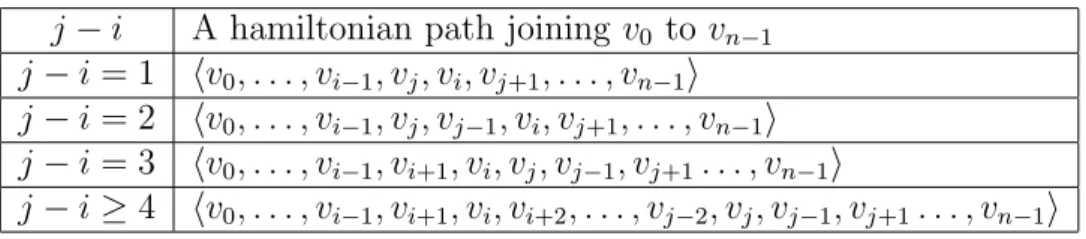
Table 1: Case 3.2 in Theorem 5.
j − i A hamiltonian path joining v0 to vn−1 j − i = 1 hv0, . . . , vi−1, vj, vi, vj+1, . . . , vn−1i j − i = 2 hv0, . . . , vi−1, vj, vj−1, vi, vj+1, . . . , vn−1i j − i = 3 hv0, . . . , vi−1, vi+1, vi, vj, vj−1, vj+1. . . , vn−1i
j − i ≥ 4 hv0, . . . , vi−1, vi+1, vi, vi+2, . . . , vj−2, vj, vj−1, vj+1. . . , vn−1i
Lemma 1. [2] Let n ≥ 3. There exists a hamiltonian path with endvertices v0 and v1 in Pn2.
The following two lemmas are obvious.
Lemma 2. Let n ≥ 5. Then Pn2 − S has a hamiltonian path with endvertices v0 and vn−1 for S ⊂ (V (Pn2) − {v0, vn−1}) ∪ E(Pn2) with |S| ≤ 1.
Lemma 3. Let n ≥ 4. Then Pn3 − S has a hamiltonian path with endvertices v0and vn−1 for S ⊂ (V (Pn3) − {v0, vn−1}) with |S| ≤ 2.
Theorem 5. Let n ≥ 6 and S ⊂ E(Pn3) with
|S| ≤ 2. Then there exists a hamiltonian path of Pn3− S with endvertices v0 and vn−1. Proof. It suffices to prove this theorem for that S ⊂ E(Pn3) with |S| = 2. Let E(Pn3) = A1∪ A2∪ A3, where Al= {(vi, vj) ∈ E(Pn3)|j = i + l}. Let Si = S ∩ Ai for i = 1, 2, 3. If |S3| > 0, by Lemma 2, there ex- ists a hamiltonian path of Pn3−S with endver- tices v0 and vn−1. Thus, we assume |S3| = 0.
There are three cases:
Case 1. |S1| = 0. hv0, v1, . . . , vn−1i is the required path.
Case 2. |S1| = 1. Note that |S2| = 1.
Assume that S1 = {(vi, vi+1)}, where 0 ≤ i ≤ bn−22 c. Therefore, hv0, v3, v4, v1, v2, v5i is the required path when n = 6 and i = 2; hv0, . . . , vi, vi+3, vi+2, vi+1, vi+4, . . . , vn−1i is the required path if otherwise.
Case 3. |S1| = 2. We assume that S1 = {(vi−1, vi), (vj, vj+1)}, where 1 ≤ i ≤ j ≤ n − 2.
Case 3.1. i = j. Without loss of generality, we assume that 1 ≤ i ≤ bn−12 c. Then hv0, . . . , vi−1, vi+1, vi+2, vi, vi+3, . . . , vn−1i is the re- quired path.
Case 3.2. i < j. The hamiltonian paths join- ing v0 to vn−1 are listed in Table 1.
Corollary 1. Let n ≥ 6. Then Pn3 − S has a hamiltonian path with endvertices v0 and vn−1 for S ⊂ (V (Pn3) − {v0, vn−1}) ∪ E(Pn3) with |S| ≤ 2.
Proof. According to Lemma 3 and Theo- rem 5, it suffices to consider the case when S is composed of one vertex and one edge. Let S = {v, e}, where v ∈ (V (Pn3) − {v0, vn−1}) and e ∈ E(Pn3) is not incident to v. Note that Pn−12 is a subgraph of Pn3 − {v}. Therefore, by Lemma 2, Pn3 − {v, e} has a hamiltonian path with endvertices v0 and vn−1.
3 The 4-Hamiltonicity of G(n, 4)
Theorem 6. The graph G(n, 4) is 4-hamilto- nian for n ≥ 9.
Proof. Let S ⊂ V (G(n, 4)) ∪ E(G(n, 4)) with
|S| = 4. We want to prove that there exists a hamiltonian cycle in G(n, 4) − S. According to Theorem 1, G(n, 4) − S is hamiltonian for S ⊂ V (G(n, 4)) or S ⊂ E(G(n, 4)). Hence it suffices to consider the remaining three cases.
Case 1. S is composed of three vertices and one edge. Without loss of generality, we assume that the three removed vertices are
v0, vi, and vj with 0 < i < j and i ≤ j − i
≤ n − j.
Case 1.1. j ≥ 3. Since n − 2 ≥ 7, G(n − 2, 2) is a subgraph of G(n, 4) − {v0, vj}. By Theorem 3, G(n − 2, 2) is a 2-hamiltonian graph. Thus G(n, 4) − S is hamiltonian.
Case 1.2. j = 2. Note that i = 1. The remaining graph after the removal of the vertices v0, v1, and v2 of G(n, 4) is isomorphic to the graph Pn−33 . By Theorem 4, Pn−33 is 1-edge hamiltonian. Thus G(n, 4) − S is hamiltonian.
Case 2. S is composed of two vertices and two edges. Without loss of generality, we assume that {v0, vi} ∈ S, where 1 ≤ i ≤ bn2c.
Case 2.1. i ≥ 3. Note that G(n − 2, 2) is a subgraph of G(n, 4) − {v0, vi}. Since n − 2 ≥ 7 and by Theorem 3, G(n − 2, 2) is a 2-hamiltonian graph. Thus G(n, 4) − S is hamiltonian.
v
3v
n-2v
n-3v
n-4v
4v
1v
5v
6v
n-1Figure 2: G(n, 4) − {v0, v2}.
Case 2.2. i = 2. The remaining graph after the removal of v0 and v2of G(n, 4) is depicted in Figure 2. Let G0 be the subgraph of G induced by {v3, v4, . . . , vn−1}. Obviously, G0 is isomorphic to Pn−33 .
Case 2.2.1. |{(v1, v3), (v1, vn−1)} ∩ S| = 0. By Theorem 5, G0 has a hamiltonian path Q1
with endvertices v3 and vn−1 after removing any two edges. Thus, hv3, Q1, vn−1, v1, v3i is
the hamiltonian cycle of G(n, 4) − S.
Case 2.2.2. |{(v1, v3), (v1, vn−1)} ∩ S| = 2.
hv1, v4, v3, v5, . . . , vn−3, vn−1, vn−2, v1i is the hamiltonian cycle of G(n, 4) − S.
Case 2.2.3. |{(v1, v3), (v1, vn−1)} ∩ S| = 1.
Without loss of generality, we assume that (v1, vn−1) ∈ S. Suppose that {(v1, vn−2), (vn−1, vn−2)} ∩ S = ∅. By Corollary 1, G0− {vn−2} has a hamiltonian path Q2 with endvertices v3 and vn−1 after removing any one edge. Thus hv3, Q2, vn−1, vn−2, v1, v3i is the hamiltonian cycle of G(n, 4)−S. Suppose that (v1, vn−2) ∈ S. Pn−32 is the subgraph of G0. By Lemma 1, there exists a hamiltonian path Q3 of G0 with endvertices v3 and v4. Thus hv4, v1, v3, Q3, v4i is the required cycle.
Suppose that (vn−1, vn−2) ∈ S, hv1, v3, . . . , vn−4, vn−1, vn−3, vn−2, v1i is the required cycle.
v
3v
4v
5v
2v
n-1v
n-2v
n-3v
n-4Figure 3: G(n, 4) − {v0, v1}.
Case 2.3. i = 1. The remaining graph after the removal of v0 and v1 of G(n, 4) is depicted in Figure 3. Suppose that (vn−1, v2) ∈ S.
G(n, 4) − {v0, v1, (vn−1, v2)} is isomorphic to Pn−23 which is 1-edge hamiltonian. Hence, the remaining graph after removing any one edge from G(n, 4) − {v0, v1, (vn−1, v2)}
contains a hamiltonian cycle. Suppose that (vn−1, v2) /∈ S. Since the graph G(n, 4) − {v0, v1, (vn−1, v2)} is isomorphic to Pn−23 , it has a hamiltonian path Q4 with endvertices v2 and vn−1 after removing any two edges. Thus,
hv2, Q4, vn−1, v2i is the required cycle.
v
n-2v
n-3v
4v
3v
2v
1v
0v
n-4Figure 4: G00= G(n, 4) − {vn−1}.
Case 3. S is composed of one vertex and three edges. Without loss of generality, we assume that vn−1 ∈ S. The graph G(n, 4) − {vn−1} is depicted in Figure 4. Let G00 = G(n, 4)−{vn−1}. In this case, all the addition and subtraction are carried with modulo n − 1. Let E(G00) = A1 ∪ A2 ∪ A3, where Al = {(vi, vj) ∈ E(G00)|j = i + l}. Let Si = S ∩ Ai for i = 1, 2, 3.
Suppose that S3 6= ∅. For any edge e ∈ S3, G(n − 1, 2) is a subgraph of G00 − {e}. By Theorem 3, there exists a hamiltonian cycle after removing any two edges. Now, we as- sume that S3 = ∅. We consider the remaining cases in the following:
Case 3.1. |S2| = 3. Cycle hv0, v1, . . . , vn−2, v0i is the required cycle.
Case 3.2. |S1| = 1. Note that |S2| = 2.
If (vn−2, v0) /∈ S1, without loss of general- ity, we suppose that S1 = {(vi, vi+1)}, where 0 ≤ i ≤ bn−32 c. Thus hv0, . . . , vi, vi+3, vi+2, vi+1, vi+4, . . . , vn−2, v0i is a hamiltonian cycle of G(n, 4) − S. Next, we consider the case that (vn−2, v0) ∈ S1 in the following two sub- cases.
Case 3.2.1. |{(vn−3, v0), (vn−2, v1)} ∩ S2| ≥ 1. Note that G00 − {(vn−2, v0), (vn−3, v0), (vn−2, v1)} is isomorphic to Pn−13 and Pn−13 is 1-edge hamiltonian. Thus G(n, 4) − S is
hamiltonian.
Case 3.2.2. |{(vn−3, v0), (vn−2, v1)} ∩ S2| = 0.
If |{(v0, v2), (vn−4, vn−2)} ∩ S2| = 2, then hv0, v3, v2, v4, . . . , vn−2, v1, v0i is the required cycle. Otherwise, |{(v0, v2), (vn−4, vn−2)} ∩ S2| ≤ 1. Without loss of generality, we as- sume that (v0, v2) /∈ S2. Thus hv0, v2, . . . , vn−2, v1, v0i is the required cycle.
Case 3.3. |S1| = 2. Note that |S2| = 1.
Case 3.3.1. The two edges in S1 are adjacent.
Assume that S1 = {(vi−1, vi), (vi, vi+1)}, where 0 ≤ i ≤ bn−22 c. hvi−1, vi+1, vi+2, vi, vi+3, . . . , vi−1i is the required cycle if
|{(vi−1, vi+1), (vi, vi+2)} ∩ S2| = 0; hvi−3, vi−1, vi−2, vi, vi+3, vi+2, vi+1, vi+4, . . . , vi−3i is the required cycle if otherwise.
Case 3.3.2. The two edges in S1 are not ad- jacent.
Case 3.3.2.1. (vn−2, v0) /∈ S1. Without loss of generality, we assume that S1 = {(vi−1, vi), (vj, vj+1) | 1 ≤ i < j ≤ n − 3}.
When j − i = 4, hvi−1, vi+1, vi, vj−1, vj, vj−2, vj+1, . . . , vi−1i is the required cycle if
|{(vi−1, vi+1), (vj−2, vj)} ∩S2| = 0; hvi−1, vi+2, vi, vi+1, vj, vj−1, vj+1, . . . , vi−1i is the required cycle if otherwise. When j − i ≥ 1 and j − i 6= 4, the corresponding hamiltonian cycles listed in Table 2. Note that when j − i = 1, we assume that 1 ≤ i ≤ bn−32 c.
Case 3.3.2.2. (vn−2, v0) ∈ S1. Without loss of generality, we assume that the other edge in S1 is (vi, vi+1), where 1 ≤ i ≤ bn−32 c. When i = 1, hv0, v2, . . . , vn−2, v1, v0i is the required cycle if |{(vn−2, v1), (v0, v2)} ∩ S2| = 0, and hv0, v1, v3, v2, v4, . . . , vn−4, vn−2, vn−3, v0i is the required cycle if otherwise. When 2 ≤ i ≤ bn−32 c, hv0, v2, . . . , vi, vi+3, vi+2, vi+1, vi+4, . . . , vn−2, v1, v0i is the required cycle if |{(vn−2, v1), (v0, v2)} ∩ S2| = 0; hv0, . . . , vi−2, vi+1, vi−1, vi, vi+2, . . . , vn−4, vn−2, vn−3, v0i is the required cycle if otherwise.
Table 2: Case 3.3.2.1 in Theorem 6.
j − i A hamiltonian cycle of G(n, 4) − S j − i = 1 hvi−1, vj+1, vj+2, vi, vj, vj+3, . . . , vi−1i j − i = 2 hvi−1, vj, vj−1, vi, vj+1, . . . , vi−1i j − i = 3 hvi−1, vi+2, vj, vi, vi+1, vj+1. . . , vi−1i
j − i = 5 hvi−1, vi+2, vj, vj−1, vi+1, vi, vi+3, vj+1, . . . , vi−1i
j − i ≥ 6 hvi−1, vi+2, vi+1, vi, vi+3, . . . , vj−3, vj, vj−1, vj−2, vj+1, . . . , vi−1i
Case 3.4. |S1| = 3.
Case 3.4.1. |V (G00)| is odd. hv1, v3, v5, . . . , vn−5, vn−3, v0 v2, v4,. . . , vn−4, vn−2, v1i is the required cycle.
Case 3.4.2. |V (G00)| is even. Since n ≥ 9 and |S1| = 3, there exists an index i such that {(vi, vi+1), (vi+2, vi+3)} ∩ S1 = ∅.
Thus, hvi+2, vi+4, vi+6, . . . , vi−4, vi−2, vi, vi+1, vi−1, vi−3, vi−5, . . . , vi+5, vi+3, vi+2i is the re- quired cycle.
References
[1] T. Y. Sung, T. Y. Ho, C. P. Chang and L.
H. Hsu, “Optimal k-Fault-Tolerant Net- works for Token Rings,” Journal of Infor- mation Science and Engineering, Vol. 16, pp.381-390, 2000.
[2] M. Paoli, W. W. Wong and C. K. Wong,
“Minimum k-Hamiltonian Graphs, II,”
Journal of Graph Theory, Vol. 10, pp.79- 95, 1986.
[3] W. W. Wong and C. K. Wong, “Mini- mum k-Hamiltonian Graphs,” Journal of Graph Theory, Vol. 8, pp.155-165, 1984.
[4] M. Paoli, “Powers of Connected Graphs and Hamiltonicity,” Discrete Mathemat- ics, Vol. 52, No.1, pp.91-99, 2002.
[5] G. Chartrand and S. F. Kapoor, “On Hamiltonian Properties of Powers of Spe- cial Hamiltonian Graphs,” Colloquium Mathematicum, Vol. 29, pp.113-117,1974.