CHAPTER THREE
MORE ON THE MISMATCHES BETWEEN FORM AND MEANING
3.1 Introduction
In Ross (1995: 770-772), the importance of verbal morphology is highlighted, with some future directions for the study on verbal morphology inside and outside Taiwan given. Within Taiwan, he lists as possible points of investigation (1) the drift of forms in *-an from marking Location to Patient, (2) the rise of *-an as the I/BF atemporal form, and (3) the loss of *-um- from *-um-V-a ‘AV projective’. Outside Taiwan, he encourages the search for (1) the rise of maN-, (2) patterns of reduplication, (3) the functions and extent of the reflexes of PAN *maR-, and (4) complex systems of verbal derivational morphology. Related to our interest in the mismatch between form and meaning are patterns of reduplication as well as reciprocality, which according to Ross (1995: 772), is the only function attested in the Formosan reflexes of maR-. In addition, morphological causativization, which also shows a mismatch between form and meaning, is brought to discussion in this chapter.
3.2 Reduplication
Three patterns of reduplication are attested in Saisiyat – Ca-, CV- and CVC-,1 and they not only denote different meanings but also display different interaction with
1 Full reduplication at morphological level such as pongaeh-pongaeh ‘flowers everywhere’ appears to be rare, though it is productive at syntactic level.
focus markers.
3.2.1 Ca-reduplication
Blust (1998: 3) remarks that three functions have been found in PAN *Ca- reduplication – numerals in counting humans, verb forms, and instrumental nouns.
Among the three, Ca- verb forms and Ca- instrumental nouns are attested in Saisiyat.
Besides, Ca- reduplication in Saisiyat can indicate reciprocality.
According to Blust (1998: 3), Ca- reduplication is notably found to derive instrumental nouns, but the function of Ca- reduplication verb forms is less clear. He claims that the two functions (Ca- verb forms and Ca- instrumental nouns) of *Ca- were not more related to each other than they were to Ca- numerals. Note, however, that by using the terms ‘Ca- verb forms’ and ‘Ca- instrumental nouns’, we look only at their functions as verbs or nouns and overlook one important fact that, they both are Ca- reduplication of verb roots. Given that verb forms and instrumental nouns are both Ca- reduplication applied to verbs, it is tempting for us to suspect the claim that there exists no relationship between the two functions. As shown in (1), it is possible that the same form may manifest both the use of Ca- verb form and of Ca- instrumental nouns in Saisiyat.
(1) Saisiyat
a. hini’ ’alaw ta-timae’ ka pazay this fish Ca-eat as a dish Acc rice ‘This fish is what is going to serve as the dish.’
b. ’izi’ kaSkar! mari’ nonak ka ta-timae’!
Neg shy take self Acc Ca-eat as a dish ‘Don’t stand on ceremony! Take the dishes by yourself!’
In (1a) Ca- reduplication indicates I/BF and its future tense, but in (1b), Ca- reduplication of the verb root timae’ produces a noun. Examples (1a-b) show that Ca-
verb form and Ca- instrumental nouns represent different uses of the same form. In other words, they could be ploysemous. Then, what is the relationship between the two uses? In the following sections, the functions of Ca- verb forms, and then its relationship to Ca- instrumental nouns will be discussed.
3.2.1.1 Ca- verb forms
In Chapter One, it is mentioned that Ca- is the future form of I/BF. To refresh our memory of the contrast between si- and Ca- reduplication, the examples are repeated as follows.
(2) Saisiyat
a. hini’ malat si-kilmaeh ka kahoey this knife I/BF-chop Acc wood ‘This knife was used to chop wood.’
b. hini’ malat rim’an ka-kilmaeh ka kahoey this knife tomorrow Ca-chop Acc wood ‘This knife will be used to chop wood tomorrow.’
(3) Saisiyat
a. ni ’ataw ka taew’an si-ba:iw hi hiya’
Gen ’ataw Lig house I/BF-sell Acc who ‘To whom did ’ataw sell his house?’
b. ni ’ataw ka taew’an ba-ba:iw hi hiya’
Gen ’ataw Lig house Ca-sell Acc who ‘To whom will ’ataw sell his house?’
(4) Saisiyat
a. ’an kuy a raro:o’ si-ngo:ip ila ma’an Poss Kuy Poss name I/BF-forget Incpt 1S.Gen ‘As for Kuy’s name, I have forgotten it.’
b. So ’okay wa:i’ So’o, when Neg come 2S.Nom
nga-ngo:ip ila ma’an ka raro:o’ niSo’
Ca-forget Incpt 1S.Gen Nom name 2S.Gen
‘If you do not come any longer, I am going to forget your name.’
In fact, while remarking that the function of Ca- verb forms is less clear, Blust (1998:
34) points out it indicates certain temporal or aspectual meaning. For example, he points out that in Thao, a Ca- verb form generally marks durative or iterative, and he cites the following Tanan Rukai examples from Li (1973: 281) to illustrate that Ca- reduplication marks progressive aspect.
(5) Tanan Rukai (Li 1973: 281)
a. ca-cuLul
Ca-kill ‘be killing.’
b. ma-La-Liw
ma-Ca-touch
‘be touching each other’
In addition, Mayrinax Atayal is cited as an example of Ca- reduplication marking NAF future (Zeiton et al. 1996: 37).
(6) Mayrinax Atayal (Zeitoun et al. 1996: 37) a. ta-tuting-un=cu nku’ ’ulaqi’
Ca-beat-PF=1S.Nom Gen child ‘The child will beat me.’
b. ha-hihip-an ni’ yumin ’i’ limuy Ca-kiss-LF Gen Yumin Nom Limuy ‘Yumin will kiss Limuy.’
c. ba-∅-baiq-ku’ nku’ nabakis ku’ xuil ’i’ limuy Ca-I/BF-give Gen old man Nom dog Acc limuy ‘The old man will give the dog to Limuy.’
The observation that Ca- reduplication marks temporal or aspectual meaning of some sort is on the right track. In fact, Wolff (1973, cited in Ross 1995) has reconstructed
*Ca-V-en and *Ca-V-an as future forms. Ross (1995) reconstructed *Ca-um-V,
*Ca-V-en and *Ca-V-an as durative forms, based on the fact that in the languages
with the durative category, the form attests as Ca- reduplication,2 whereas only two (Seediq and Puyuma) of the six languages that have a future category form their future forms by Ca- reduplication, and the future forms of the other four languages are derived from an auxiliary. Thus he contends that “future is not separately reconstructible in PAN, but rather that the durative pattern has been extended to cover the future (as in English I’m going tomorrow).” In a recent paper, Huang (2001: 57) analyzes Ca- reduplication as the NAF future marker in Mayrinax Atayal. In the following, more data on the function of Ca- reduplication related to tense/aspect from recent publications in Formosan languages will be presented.
First of all, Huang (2000b: 101) remarks that Thao marks the AF habitual or progressive aspect by Ca- reduplication.
(7) Thao (Huang 2000b: 104) a. ’ama m-i-ca-cungqu father AF-Ca-sit ‘Father is sitting.’
b. haya ’azazak m-i-La-LiLi that child AF-Ca-stand ‘That child is standing.’
Secondly, Zeitoun et al. (1996: 37) observe that apart from Mayrinax Atayal, Amis and Puyuma also make use of Ca- reduplication to indicate future. However, unlike the case in Mayrinax Atayal, not only NAF, but also AF constructions express their future by Ca- reduplication.3
2 Ross (1995: 751) remarks that except in Rukai, the durative form is C1a-C1V… However, after checking Li (1973), the reference of Rukai in Ross (1995), we find that it is also Ca- reduplication when the stem begins with CV- (and when the stem begins with V, VC- is reduplicated, as in il-iluk ‘be bring’.
3 Note that Blust (1998: 35) cites such examples as binga ‘to bore, annoy’: ba-bainga ‘will bore, will annoy’, Lekaw ‘to stride’: La-Lekaw ‘will stride’, lisaw ‘to wash utensils’: la-lisaw ‘will wash utensils’
from Cauquelin (1991) to show that Ca- reduplication in Puyuma indicates future.
(8) Changpin Amis (Zeitoun et al. 1996: 38) a. ta-tayra ci aki
Ca-go Nom Aki ‘Aki is about to go.’
b. ma-mi-kilim ci aki ci panay-an Ca-AF-look for Nom Aki Acc1 panay Acc2
‘Aki is going to look for Panay.’
c. ma-ma-tayal ci aki Ca-AF-work Nom Aki ‘Aki is going to work.’
d. pa-palu’-en ni Aki ci panay Ca-beat-PF Nom Aki Nom panay ‘Aki will beat Panay.’
(9) Nanwang Puyuma (Zeitoun et al. 1996: 38) a. Ta-Tekel-ku Da enay
Ca-drink-1S.Nom Obl water ‘I will drink water.’
b. ku-na-niwan-ay iduna ruma 1S.Gen-Ca-sell-PF that house ‘I will/want to sell that house.’
According to Li (2000: 92, Li and Tsuchida 2001: 28), the future of PF in Pazeh can also be marked by reduplication, and from the example sentences provided, it seems that the reduplication belongs to Ca- pattern, with a long vowel a. Consider the following example.
(10) Pazeh (Li 2000: 93)
a. xe’ed-en naki ki nuang tie-PF 1S.Gen Nom cow ‘The cow was tied by me.’
b. xaa-xe’ed-en naki ki nuang Red-tie-PF 1S.Gen Nom cow ‘The cow will be tied by me.’
Pazeh also marks the progressive aspect by Caa- (Li and Tsuchida 2001: 39).4 (11) Pazeh (Li and Tsuchida 2001: 39)
a. yaku kaa-ken dukul 1S.Top Red-eat taro ‘I am eating taro.’
b. yaku daa-daux dalum 1S.Top Red-drink water ‘I am drinking water.’
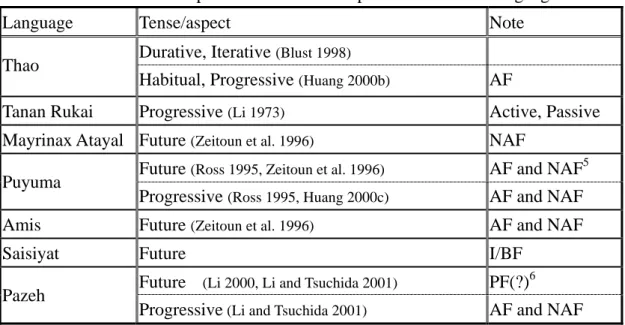
Table 3.1 below summarizes the relationship between tense/aspect and Ca- reduplication in the Formosan languages discussed above.
4 Note that according to Li and Tsuchida (2001: 22 & 39), CV- or CVV- can also mark the progressive aspect, as shown below.
(i) Pazeh (Li and Tsuchida 2001: 22) a. di-diua ‘is scooping’
b. ki-kizu ‘is making a mark’
(ii) Pazeh (Li and Tsuchida 2001: 39) baa-baxa ‘is giving’ (mu-baxa ‘AF-give’)
Table 3.1 Ca- reduplication and Tense/aspect in Formosan Languages
Language Tense/aspect Note
Durative, Iterative (Blust 1998) Thao
Habitual, Progressive (Huang 2000b) AF
Tanan Rukai Progressive (Li 1973) Active, Passive
Mayrinax Atayal Future (Zeitoun et al. 1996) NAF
Future (Ross 1995, Zeitoun et al. 1996) AF and NAF5 Puyuma
Progressive (Ross 1995, Huang 2000c) AF and NAF
Amis Future (Zeitoun et al. 1996) AF and NAF
Saisiyat Future I/BF
Future (Li 2000, Li and Tsuchida 2001) PF(?)6 Pazeh
Progressive (Li and Tsuchida 2001) AF and NAF
3.2.1.2 Ca- verb forms and Ca- instrumental nouns
As shown in Table 3.1, in some languages, the marking of future or durative7 by Ca- reduplication is restricted to certain constructions. For example, in Mayrinax Atayal it is restricted to NAF. In Saisiyat, Ca- marks only I/BF future. It is this restriction that makes the connection between Ca- verb forms and Ca- instrumental nouns possible in Saisiyat – both are related to instruments and they differ in their function as verbs or as nouns. Given this, the relationship between the two can also be
5 According to Huang (2000c: 131-133), the progressive aspect is marked by Ca- reduplication of AF or NAF focus verbs while the future AF is formed by Ca- reduplication of the verb root. Compare:
(i) Puyuma (Huang 2000c: 132)
a. me-la-laub=ku Da enay AF-Ca-scoop=1S.Nom Obl water
‘I am scooping water.’
b. la-laub=ku Da enay Ca-scoop=1S.Nom Obl water
‘I will scoop water.’
6 For Caa- to mark future, only PF constructions are mentioned in Li (2000) and Li and Tsuchida (2001). However, in the table on focus and tense/aspect/mood (Li and Tsuchida 2001: 41), three future forms for the verb baked ‘beat’ are listed: baa-baked-ay (AF), ba-baked-en (PF) and baa-baked-ay (LF). As the first vowel is a, it is not clear whether it is a case of Ca- or CV- reduplication.
7 The reader may find the terminology varies: some linguists use progressive, while some use habitual or iterative.
reduced to the relationship between focus and nominalization.
What, then, is the relationship between future of I/BF and nominalization deriving instrumental nouns? It is postulated that a semantic extension from future to lexical nominalization is involved. This extension is motivated by the metonymic extension of naming an entity by its goal or purpose, which is the feature shared by future I/BF and Ca- instrumental nouns. Note that I/BF forms are usually used to introduce the purpose of a special object, as shown below.
(12) Saisiyat
a. hiza’ Sina’iS noka korkoring ba-botoe’ ka ’ahoe’
that string Gen child Ca-tie Acc dog ‘That string is to be used by the child to tie the dog.’
b. hiza’ tabak ka-kahoes ka ralom that scoop Ca-scoop Acc water ‘That scoop is to be used to scoop water.’
When there is no given name available for the object, a demonstative pronoun like
‘this’ or ‘that’ may be used, followed by the introduction of the function or purpose of the object. Examine the following sentences.
(13) Saisiyat
a. hiza’ ha-hoewal ka hinpetel that Ca-rake Acc weed ‘That is to be used for raking weeds.’
b. hiza’ ha-ha:ep ka Si’Si’
that Ca-sieve Acc millet ‘That is to be used to sieve millet.’
Then it is not hard to imagine that one day, the function or purpose will be used to name the object. Thus, a sifter is referred to as something for sieving or something to
sieve with, and a saw is something for sawing.8 (14) Saisiyat
a. ta-ti:is
Ca-wipe
‘instrument for wiping, wiper’
b. ha-ha:ep
Ca-sieve ‘sift’
c. ha-hiwa:
Ca-saw ‘a saw’
Taking Ca- reduplication as the future I/BF form, we may explain why Ca- nouns do not always designate instruments. As noted in Blust (1998: 37-38), there are non-canonical instruments, such as body parts and results of action. In Saisiyat, Ca- nouns can refer to objects of natural phenomena such as ‘sun’ and ‘rain’, as shown below.
(15) Saisiyat a. ha-hila:
Ca-sun rise/shine ‘the sun; day’
b. ’a-’oral Ca-to rain ‘rain’
8 Note that naming an instrument by its function or purpose is by no means idiosyncratic of Saisiyat. In Mandarin Chinese, instrumental nouns can be formed from the addition of the suffix -zhi to verbs.
(i) Mandarin Chinese a. jia-zhi
pick up with fingers-zhi
‘pincers’
c. kou-zhi button up-zhi
‘button’
c. ha-hoelae’
Ca-to snow/frost ‘snow, frost’
We can interpret these objects as instruments, such as the rain as the instrument for raining.9 However, in the following sentence, Ca- reduplication refers to a kind of manner.
(16) Saisiyat
So s-om-i’ael ka pazay, ’awhay ka sa-si’ael when eat-AF- Acc rice, bad Nom Ca-eat
‘His table manner is bad.’
As mentioned in Chapter Two, besides instrument, I/BF can be extended to mark a variety of thematic roles. Given that Ca- reduplication is the future form of I/BF, we may explain why sometimes the Ca- nouns refer to manner or reason instead of instrument.
Moreover, in Yeh (1991: 58) and Yeh (2000a: 59), ka- is treated as a nominalizing prefix, and the examples given show that ka- derives instrumental nouns.
Examine the following examples from Yeh (1991).10
9 The following sentence seems to show that ’a-’oral could be the Actor in the event.
(i) yao ’ola’-en noka ’a-’oral 1S.Nom rain-PF Gen Ca-rain ‘I was sprinkled wet by rain.’
10 Note that for the instrumental nouns formed by ka- beginning with k, there is a convergence with Ca- reduplication. Consider:
(i)Saisiyat
a. ka-kato: ‘scissors’
ka/Ca-cut
b. ka-ka’i: ‘hooker’
ka/Ca-hook
c. ka-ke:eb ‘razor’
ka/Ca-cut hair (for male) e. ka-ka:at ‘pen’
ka/Ca-write
(17) Saisiyat
a. ka-ko:as
ka-to comb ‘comb’
b. ka-tintin ka-weigh
‘scale’
c. ka-bo:bo:
ka-to fan ‘fan’
Note that it is mentioned in Section 1.7.2.2 that for verbs containing two identical or similar syllables or beginning with pa-, I/BF future is marked by ka- instead. Given this, it is not surprising to find some instrumental nouns marked by ka-. Following is an example showing that verbs beginning with pa- also take ka-.
(18) Saisiyat
So m-patawaw ’awhay ka ka-patawaw when AF-work bad Nom KA-work
‘The way he works is wrong.’
3.2.1.3 Ca- and reciprocality
In addition to marking I/BF future and deriving instrumental nouns, Ca- reduplication can also indicate reciprocality in Saisiyat. Zeitoun (2001: 131) remarks that dynamic verbs undergo Ca- reduplication to form reciprocals.
(19) Saisiyat
a. baki’ ’okik rengreng ka-kita’ ki korkoring grandfather Neg often Ca-see Com child ‘Grandfather and the child do not often see each other.’
b. lasia korkoring ka-ki:-ki:im 3P.Nom child Ca-CVC-look for ‘The children kept looking for each other.’
It is noteworthy that sometimes, the reciprocal implication can get extended to refer to the situation where the participants are plural. For example, the reduplication of ra’oe:
can mean two people drink with each other, as in (20a). It can also mean more than two people drink together and therefore is often used to refer to ‘drinking in a feast’, as in (20b), and in (20c), three parties – mother, wife and children – are involved in the event of crying.11
(20) Saisiyat
a. ’isa’an So ta-ra-ra’oe: ’ita’ roSa’ sa (Good wife)
later when let’s-Ca-drink 1P.Incl two ‘Later let the two of us drink with each other.’
b. rima’ ra-ra’oe: ka tatini’ (Monkey)
go Ca-drink Nom old ‘The elders went drinking in a feast.’
c. hiza’ ’oya’ niya minkoringan niya korkoring that mother 3S.Gen woman 3S.Gen child maymo’ hae-haengih saboeh (Good wife)
cannot help Ca-cry all
‘His mother, his wife and children could not help crying together.’
Is there any relationship between Ca- reciprocality and I/BF future or instrumental nouns? Can we predict when the Ca- verb form will denote reciprocality and when it will designate I/BF future? So far, we are not able to find the connection between them, nor can we find any way to predict which meaning will be obtained. For some
11 We cannot explain why Ca- reduplication appears to change the selection restriction of the verb langoy ‘swim’. The non-reduplicated form of langoy refers to the swimming of fishes and can take AF infix -om-. However, the reduplicated form lalangoy refers to the swimming of human beings and does not take any AF affix. Compare:
(i) CV-reduplication
a. ’alaw kama l-om-angoy ay ba:la’
fish kama swim-AF- Loc river
‘Fishes swim in the river.’
b. hi ’obay ra:am a tomalan la-langoy Nom ’obay know Lig very Ca-swim
‘’obay is very good at swimming.’
words, such as ’apis, the reduplication form ’a-’apis is ambiguous. It can denote reciprocality meaning ‘fight each other in picking up’ or instrumental nouns ‘pincers’.
However, for the word Sebet ‘beat’, instrumental nouns ‘something for beating’
appears to be the preferred reading whereas the reciprocal reading is obtained when co-occurring with ma-, the reflex of PAN *maR- (see the discussion in Section 3.4).
3.2.2 CV- reduplication
Yeh (2000d: 376) claims that CV- reduplication in Saisiyat denotes reciprocality, as shown below.
(21) Saisiyat (Yeh 2000d: 376)
a. ’a-’apis
CV-pick up (with chopsticks)
‘try to beat each other in picking up’
b. pa-panae’
CV-shoot’
‘shoot each other’
c. hae-haezab
CV-stab
‘stab each other’
According to Blust (1998: 35), some uses of CV- reduplication, such as the use of CV- reduplication to mark future or contemplated aspect in Rukai and Tagalog, can be a change from Ca- reduplication. Given the functional overlapping and the similarity in form with Ca- reduplication, it is legitimate to postulate that the Saisiyat CV- reduplication denoting reciprocality is also a change of Ca- reduplication. Examining the examples in (21) carefully, we find that the vowel of the first syllable is /a/ in (21a) and (21b); consequently, there is a convergence with Ca- reduplication in these two examples. Therefore only (21c) can be counted as CV- reduplication. However, given that /a/ is often pronounced as /ae/ when appearing adjacent to glottal consonants, it
can also be a change from Ca- reduplication.12
The function possessed by CV- reduplication alone, arguing for its status as an independent reduplication pattern, appears to be the marking of the progressive aspect exemplified in the following sentences.
(22) Saisiyat
a. yako k-om-ita’ hiza’ ngyaw so-s-om-i’ael ka ’alaw13 1S.Nom see-AF- that cat CV-eat-AF- Acc fish ‘I saw that cat eating fish.’
b. sia kahia:i’ m-wa:i’ hini’ yako to-t-om-alek 3S.Nom yesterday AF-come this 1S.Nom CV-cook-AF- ‘When he came yesterday, I was cooking.’
c. korkoring hita’ ho-h-om-aengih child there CV-cry-AF- ‘The child is crying over there.’
d. lasia so-s-om-ahoel ka kakrangi’an 3P.Nom CV-burn-AF- Acc thing ‘They are burning things.’
Note that different from Ca- reduplication, which applies to verb root, CV- reduplication applies to AF verb forms.
3.2.3 CVC- reduplication
CVC- reduplication is very productive in Saisiyat. According to Yeh (2000d), it indicates a variety of meanings including plurality, diminution, humanness, continuant and totality. According to Yeh (2000d: 378), the first three are related to nouns.14 In
12 The following example where CV- indicates a sense of intensification could be a change from CVC- reduplication (see the discussion in Section 3.2.4).
(i) sa-samohan CV-sharp ‘very sharp’
13 Note that the reduplicated verb so-somi’ael is pronounces as [sosmi’ael].
14 Note that only the three examples in (i) are related to the notion of humanness.
the following, different uses of CVC- reduplication will be introduced and then the relationship between these different uses of will be explored.
3.2.3.1 Increase and decrease
Yeh (2000d: 373) observes that CVC- reduplication of some nouns can denote plurality, as in (23) or diminution, as in (24).
(23) Saisiyat a. ’aeh-’aehael
CVC-sibling ‘relatives’
b. wal-walo’15 CVC-bee ‘bees’
(24) Saisiyat
a. was-wasal
CVC-ocean ‘lake’
b. Sib-Siba:i’
CVC-snake ‘worm’
(i) Saisiyat (Yeh 2000d: 374) a. kar-karang
CVC-crab
‘xie (the last name homophonous with crab)’
b. bot-botol CVC-fox
‘Hu (the last name homophonous with fox)’
c. ba:-ba:i’
CVC-wind
‘Feng (the last name homophonous with wind’)
The three are the last names derived from names for animals or natural objects. Yeh (2000d: 374) takes them as a kind of human notion. However, from another point of view, we can interpret them as simulation, which can be taken as a kind of decrease because they refer to human beings rather than to the real animal or natural object. Like other Formosan languages, Saisiyat makes use of reduplication to refer to something like the object but is not real. For example, the word ma’-ma’iyaeh for ‘doll’ or
‘scarecrow’ is derived from reduplication of the word ma’iyeah ‘people’.
15 Nevertheless, according to some informants, wal-walo’ refers to a kind of small bees.
c. pong-pongaeh CVC-flower ‘bud’
As noted in Yeh (2000d: 373), the function of indicating plurality is especially clear when combined with the suffix -an to form place nouns.
(25) Saisiyat
a. kah-kahoey-an CVC-tree-LF ‘forest’
b. kas-kashaw-an CVC-tea-LF ‘tea garden’
c. bon-bonaz-an
CVC-sand-LF ‘sandy beach’
We find that CVC- reduplication of not only nouns, but also verbs displays contradictory functions. For example, some instances of CVC- reduplicated stative verb (26), or CVC- reduplication of stative verb plus the suffix -an (27) indicates intensification, an increase in the degree of a state.
(26) Saisiyat a. ’al-’alihan
CVC-near ‘very near’
b. ra:-rawaS16 CVC-far ‘very far’
16 Note that compensatory vowel lengthening arises from the lost of flap, and it will be treated as consonant phonemically. For details, please refer to Yeh (1991: 16-21).
(27) Saisiyat a. ’ay-’ayaeh-an
CVC-sick-an
‘very weak; get sick easily’
b. bi’-bi’i:-an CVC-angry-LF
‘very bad tempered; get angry easily’
The first verbs in imperative constructions also undergo CVC- reduplication to signal a kind of intensification sometimes. Consider:
(28) Saisiyat
a. pak-’al-’alihan m-in-a-sa:eng! ’ izi’ pak-ra:-rawaS m-in-a-sa:eng Cau-CVC-near AF-Prf-sit Neg Cau-CVC-far AF-Prf-sit ‘Sit closer! Don’t sit too far way.’
b. ’am-’amoeh t-om-alek CVC-quick cook-AF ‘Cook more quiclky!’
In contrast, the following are examples showing that the reduplication of stative verbs can indicate a sense of attenuation.
(29) Saisiyat a. hin-hinhae’
CVC-the same ‘somewhat like’
b. haS-haSa’-an CVC-not know-LF ‘seemingly understand’
c. hini’ kaShaw ’an-’anhil-an, ’-in-aSkan ka kano’?
this tea CVC-sweet-LF put-Prf Acc what ‘This tea is somewhat sweet. What have you added?’
It is noteworthy that plurality and intensification both involves the notion of increase – while plurality are concerned with the increase of entity, intensification
refers to the increase of degree of a state. In the same vein, what is common to diminution and attenuation is the notion of decrease – diminution is the decrease in size, whereas attenuation involves the decrease in the degree of a state. In sum, we can reduce the four functions: plurality, intensification, diminution and attenuation to two: increase and decrease.
It is also find that some action verbs, CVC- reduplication, like the V-yi-V
‘V-one-V’ reduplication pattern in Mandarin Chinese, denotes tentative activities, which can be treated as a kind of decrease.
(30) Saisiyat
a. bah-bahi’-en ma’ SaSo’ ila CVC-wash-PF new Incpt
‘(The clothes) will become new after a wash.’
b. man-manra:an
CVC-walk ‘take a walk’
c. man-mana’
CVC-shppt
‘practice shooting’
3.2.3.2 Continuation, repetition and distributivity
Yeh (2000d: 375-376) points out that CVC- reduplication may yield the meaning of continuation or of totality depending on the semantic content of the verb root. If the verb is an action verb, CVC- reduplication indicates continuation of the action.17
17 As illustrated in the examples, CVC-verbs take on AF affixes (with the exception kit-kita’ ‘keep looking, examine’, its AF form being k-om-ita’ ‘see’). Note that the order of AF affixation and CVC- reduplication appears to vary in different words. For the four in (31), reduplication appears to apply after AF affixation (e.g. hayap Æ homayap Æ hom-homayap). However, for the other two in (32), the verb gets reduplicated first and then the AF marker -om- is infixed to the CVC- reduplicated part (haengih Æ haeng-hangih Æ h-om-aeng-hangih). Why there exists such a difference remains unclear.
(31) Saisiyat
a. hom-homayap
CVC-fly ‘keep flying’
b. ’om-’omalop CVC-hunt ‘keep hunting’
c. man-manae’
CVC-shoot ‘keep shooting’
d. tom-tomkaw
CVC-jump ‘keep jumping’
(32) Saisiyat
a. h-om-aeng-haengih CVC-AF-cry ‘keep crying’
b. t-om-on-tonbon CVC-AF-bark ‘keep barking’
Besides continuation, sometimes verbs undergo CVC- reduplication to indicate a repetitive sense.
(33) Saisiyat
a. yao ’iS-’iSpi’ hi baki’ ma’an 1S.Nom CVC-dream Acc grandpa 1S.Gen ‘I often dreamed of my grandpa.’
b. ’ay-’ayaeh CVC-sick
‘keep falling sick’
Kiyomi (1993: 32) points out that continuation and repetition can be contributed by the semantics (punctual/non-punctual) of the verb. It is found that, CVC- reduplication with repetitive interpretation is similar to the case in English where
verbs that are bounded may yield a meaning of repetition co-occurring with ‘until’
phrases (cf. Jackendoff 1992, Tenny 1992, among many others). Consider:
(34) English (Jackendoff 1992: 15)
a. The light flashed until dawn. (Repetition) b. The child slept until dawn.
Yeh (2000d: 375-376) claims that when attached to a stative verb (35) or achievement verb (36), CVC- reduplication indicates totality.
(35) Saisiyat (Yeh 2000d: 375-376)
a. hini’ ’aehae’ ’aeyaem kin ’anhil this one plum Cont sweet ‘This plum is sweet.’
b. hini’ ’aeyaem kin ’an-’anhil this plum Cont CVC-sweet ‘Each of these plums is sweet.’
(36) Saisiyat (Yeh 2000d: 376)
a. hini’ tata:a’ ’ampowa’ mas-masay these chicken why CVC-die.AF
‘Why do these chicken die one after another/one by one?’
b. pongah min-pong-pongah ila flower AF-CVC-bloom Incpt ‘Flowers have bloomed one by one.’
However, it needs to be clarified here that the notion indicated by CVC- reduplication in this case should be ‘distributivity’, instead of ‘totality’ or ‘collectivity’ because the meaning ‘each is …’ instead of ‘all are …’ is emphasized. According to Y.-L. Chang (2000c: 2), the distinction between collectivity and distributivity can be illustrated by the following sentence pair.
(37) Mandarin (Chang 2000c: 2)
a. 剛剛他們合台了一部鋼琴上樓 (collectivity)
ganggang tamen he tai le yi bu gangqin shanglou just now they join lift Prf one Cl piano upstairs ‘They collaborated in lifting a piano upstairs just now.’
b. 剛剛他們都台了一部鋼琴上樓 (distributivity)
ganggang tamen dou tai le yi bu gangqin shanglou just now they both lift Prf one Cl piano upstairs ‘They both lifted a piano upstairs just now.’
Besides, Chang (2000c: 2) points out that distributivity is semantically marked. Thus, though (38a) can either have a collective reading ‘chi-mo finally got married with hui-yin’ or a distributive reading ‘chi-mo and hui-yin finally got married, respectively,’ the collective meaning is preferred.
(38) Mandarin (Chang 2000c: 2)
a. 志摩和徽音終於結婚了
zhi-mou he hui-yin zhongyu jiehun le Zhi-mou and Hui-yin finally marry Prf ‘Zhi-mou and Hu-yin finally got married.’
‘Zhi-mou and Hu-yin finally got married, respectively.’
b. 志摩和徽音終於都結婚了
zhi-mou he hui-yin zhongyu dou jiehun le Zhi-mou and Hui-yin finally both marry Prf ‘Zhi-mou and Hu-yin both got married finally.’
Given that distributivity is semantically marked, it is not surprising that an extra marking such as dou in Mandarin Chinese or CVC- reduplication in Saisiyat is employed for the expression of this meaning.18
18 Yeh (2000d: 366) also observes that in Ishbukun Bunun, stative verbs, after undergoing CV- reduplication, denote totality, as shown below.
3.2.3.3 Relationship between different meanings
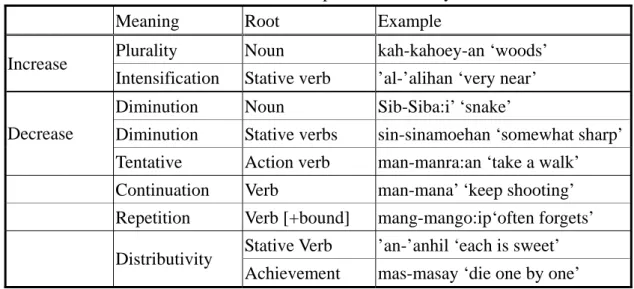
Table 3.2 summarizes various meanings indicated by CVC- reduplication in Saisiyat.
Table 3.2 CVC- reduplication in Saisiyat
Meaning Root Example
Plurality Noun kah-kahoey-an ‘woods’
Increase
Intensification Stative verb ’al-’alihan ‘very near’
Diminution Noun Sib-Siba:i’ ‘snake’
Diminution Stative verbs sin-sinamoehan ‘somewhat sharp’
Decrease
Tentative Action verb man-manra:an ‘take a walk’
Continuation Verb man-mana’ ‘keep shooting’
Repetition Verb [+bound] mang-mango:ip‘often forgets’
Stative Verb ’an-’anhil ‘each is sweet’
Distributivity
Achievement mas-masay ‘die one by one’
Hainman (1980: 530) comments that reduplication is iconically motivated in so far as it expresses intensity, plurality or repetition. In addition, Lakoff and Johnson (1987:
128) point out that reduplication embodies a kind of conduit metaphor – MORE OF FORM stands for MORE OF CONTENT. According to them, repetition (or increase) in form denotes repetition (or increase) in content. Nevertheless, Blust (1998: 29-30) considers that while using reduplicative forms to designate plural, distributive,
(i) Ishbukun Bunun (Yeh 2000d: 366)
a. ma-baliv-ik supah ma-da-dawlu tu sibus AF-buy-1S.Nom many AF-Red-long Lig sugar cane ‘I bought a lot of long sugar canes.’
b. ma-baliv-ik tasa ma-dawlu tu sibus AF-buy-1S.Nom one AF-long Lig sugar cane
‘I bought a long sugar cane.’
c. ?ma-baliv-ik tasa ma-da-dawlu tu sibus
AF-buy-1S.Nom one AF-Red-long Lig sugar cane As shown in the above examples, when many sugar canes are implied, the verb is in reduplicative form,
but when only one sugar cane is implied, the reduplicative form is not accepted.
durative, intensive, iterative or progressive embodies the iconic nature of reduplication, some usages of reduplication are not iconic, such as the use of partial reduplication in Rukai and Tagalog to signal future or contemplated event, the reduplication with color terms to indicate an attenuation of primary values, or a simulative sense denoted by some pattern of reduplication in the Philippine languages.
According to him, Ca- reduplication, which is characteristic of Austronesian languages, also belongs to a kind of non-iconic usage.
Note that as aforementioned, CVC- reduplication in Saisiyat signals plurality, intensification, diminution, continuation, repetition and distributivity. Except for diminution, the others are all among the iconic uses Blust (1998: 29) mentioned. As these concepts are marked with the same form, it is legitimate to postulate that they are related in some way. Here comes the question: What is the relationship between the various usages?
Moravcsik (1978: 317) argues that the most outstanding single concept recurrently expressed by reduplication in various languages is the concept of increased quantity. Lakoff and Johnson (1987: 128) maintain that all the cases of reduplication in the world languages are instances where MORE OF FORM stands for
MORE OF CONTENT. Thus, reduplication applied to nouns indicates plurality because nouns refer to objects, and more of the noun stands for more of the object. A sense of continuation is often obtained when reduplication is applied to verbs since verbs reports action and more of the verb implies more of the action. As for intensification, it comes about when reduplication is applied to adjectives where more of the adjective stands for more of the property.
Assuming that CVC- reduplication signals an iconic meaning of increased quantity, the meaning of plurality for nouns and intensification for stative verbs comes naturally. Besides, as noted in Lakoff and Johnson (1987: 128), continuation and
repetition also embodies a notion of increase. What about distributivity, is it related to increased quantity in any sense? Moravcsik (1978: 319) and Katamba (1993) both point out that reduplication of verbs may express either repeated or continued occurrence of an event performed by the same participant(s) or different participants.
Yeh (2000d: 379), following them, argues that continuation and distributivity come from difference in the projection of increased quantity. For action verbs, which denote processes going on in time and are composed of successive phases following one another in time, the increased quantity is projected to the event and therefore a meaning of continuation is obtained. Yet for stative verbs denoting state or a property, such an interpretation is impossible because they are neither processes going on in time nor do they consist of different phrases. Thus, the reduplicative forms cannot be interpreted as events repeated or continued by the same participants. Consequently, the increase in quantity expressed by reduplication is projected to different participants, and thus a distributive reading is produced.
If continuation, repetition and distributivity can all be regarded as manifestation of the iconic meaning of increase, then the meanings denoted by CVC- reduplication can be reduced to two – increase and decrease. The question is: How come it also goes towards the opposite direction to indicate diminution? According to Lakoff and Johnson (1987: 128), diminution comes about when reduplication is applied to words for something small. However, the Saisiyat words where a diminutive meaning is obtained, such as wasal ‘see’ or Siba:i’ ‘snake’ do not appear to refer to something small. Instead, they appear to refer to something big.
It is postulated that co-existence of opposite meanings signaled by the same reduplication pattern arises from the difference in perspective, just as across languages, some spatial words are found to mark both source and goal, which are opposite in direction. For example, in Mandarin Chinese, the word chian (前) literally
means ‘front’ can refers to ‘front’ or ‘future’ (39a), but it can also refer to ‘back’ or
‘past’ (20539b).
(39) Mandarin
a. 忘掉背後,努力面前,向著標竿直跑 wangdiao bei-hou nuli mian-qian
forget back-behand strive face-front xiangzhe biaogan zhi pao
toward marking pole straight run
‘Forget the past and strive for the future by running straight toward the marking pole.’
b. 前人種樹後人乘涼
qian ren zhong shu hou ren chengliang front people plant tree back people enjoy cool air
‘The people of the past planted trees and the people of the future enjoy the shade.’
Similarly, the word xiang (向) ‘toward’ marks a direction or goal, but when combined with jie (借) ‘borrow, lend’, it marks the source of the transactional event.19
(40) Mandarin
a. 向右轉
xiang you zhun toward right turn ‘turn right’
b. 向他點頭
xiang ta diantou toward he nod ‘nod to him’
c. 向他借錢
xiang ta jie qian toward he borrow/lend money ‘borrow money from him’
19 The co-existence of opposite directions in xiang was brought to me by Y.-L. Chang (2003, p.c.).
Yu (1998: 107) argues that the contradictory uses manifested by some spatial terms in Mandarin Chinese such as lai (來) ‘come’ and chian (前) ‘front; ahead’ result from a parametric difference in the selection of point of reference. For example, lai ‘come’
can refer to the future, as in (41) and past, as in (42).
(41) Mandarin (Yu 1998: 104) a. jiang-lai
will-come ‘future’
b. we-lai
haven’t (yet)-come ‘future
c. lai-ri
coming-day ‘days to come’
d. lai-nian
coming-year ‘the coming year’
(42) Mandarin (Yu 1998: 104-105) a. yi-jiu-wu-yi nian yi lai 1951 year Part come ‘since 1951’
b. wu-shi niandai yi lai 50’s decade Part come ‘since the 50’s’
c. wu-shi-wu nian lai 55 year come ‘in the past/last fifty-five years’
He argues that when using lai ‘come’ to refer to the future, speakers are taking themselves as the reference and therefore future is viewed as COMING to them. If instead time is perceived as the reference, then the expression containing lai will be interpreted as “I’ve COME all the way from the past”; consequently a past reading is obtained.
In light of this, the co-existence of both increase and decrease in CVC- reduplication may result from the difference in perspective. Such kind of analysis has been advanced by Kiyomi (1993: 297-298), who points out that we can look at reduplicated forms via two ways – to focus on the whole structure or on the original form. Focusing on the whole structure, we recognize the formal expansion, which lead us presuppose the existence of semantic expansion and get the meaning of intensity. When the original form is highlighted, the meaning of diminution is obtained because the stem is smaller compared with the whole reduplicated structure.
However, we may still be puzzled about why speakers choose to highlight the original form or the whole structure. Y.-L. Chang (2003, p.c.) points out that this seeming contradiction may result from the difference in perspectives towards the root, which is taken as the reference point. If the root is taken as the source, what gets increased is the content denoted by the root. For example, when the root ‘person or people’ is taken as the source, what gets increase is ‘people or person’ denoted by the root, and therefore a sense of plurality ‘many people’ is rendered, as in Pazeh saw-saw ‘many people’ (Li and Tsuchida 2001: 270).
Figure 3.1 Source as the Reference Point
By contrast, a sense of decrease comes about when the root is taken as the goal because the increase, although is directed towards the goal, never reaches the presumed goal and therefore compared with the goal, is still small or not enough.
Consequently, a diminutive or simulative implication comes about. Thus, such meaning as ‘doll’ or ‘scarecrow’ is obtained for the reduplication of the word ‘people’, as in Saisiyat ma’-ma’iyeah ‘doll; scarecrow; something like human’.
Something like human, but not real human
Figure 3.2 Taking Root as the Goal
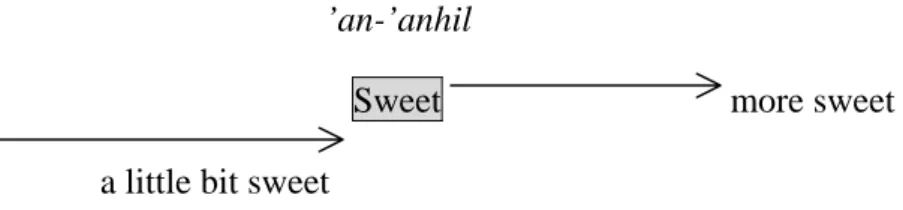
In fact, both possibilities are found in the reduplication of the word walo’ ‘bee’. Some speakers interpret wal-walo’ as a kind of small bees while others take it as referring to many bees. Next, let us see how this model can apply to the reduplication of other concepts such as property or action. For property concept, if we take the root as the source, reduplication indicates an increase of the property and therefore a sense of intensification is obtained. On the other hand, if we take it as the goal, a meaning of attenuation comes about.
’an-’anhil
Sweet more sweet a little bit sweet
Figure 3.3 Increases of Property Concepts
For actions or events, continuation and repetition result from taking the root as the source, whereas tentative reading comes from taking the root as the goal.
man-manae’
Shoot keep shooting practice shooting
Figure 3.4 Increases of Action or Events
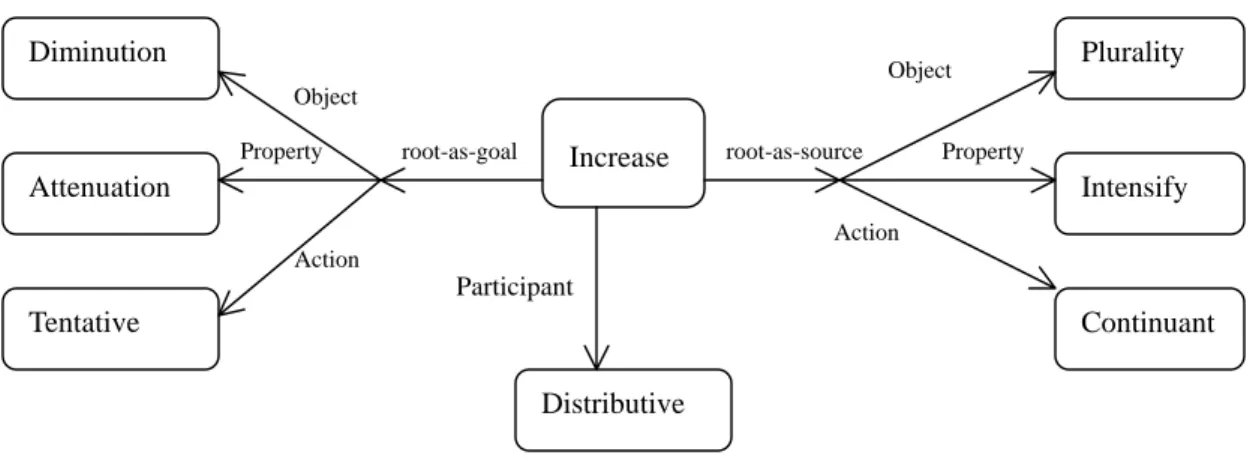
The following figure summarizes different projections of increase in CVC- reduplication.
FIGURE 3.1 MEANINGS OF CVC- REDUPLICATION
In sum, CVC- reduplication signals a kind of iconic meaning increase, and various meanings marked by CVC- reduplication result from the difference in whether the root is taken as the source or the goal.
3.2.4 Summary
The meanings or functions of the three reduplication patterns are summarized as Table 3.3 below.
Table 3.3 Forms and Meanings of Reduplication in Saisiyat Reduplication pattern Meaning Root
Future Verb roots Instrumental nouns Verb roots Ca-
Reciprocal Verb roots
CV- Progressive AF verbs
Plurality Nouns, stative verbs Intensification Stative verbs Continuation Action verbs
Repetition Action verbs [+bound]
Increase
Distributivity Stative verbs, achievement verb Diminution Nouns
Attenuation Stative verbs CVC-
Decrease
Tentative Action verbs
Increase
Diminution Plurality
Distributive Participant
Intensify
Continuant
Object
Property
Action
Attenuation
Tentative
root-as-source root-as-goal
Object
Action Property
As shown in Table 3.3, the three reduplication patterns convey different meanings or carry different functions. In fact, they are also divergent in the interaction with focus system. Ca- reduplication is the irrealis form of I/BF si- and therefore can be counted as a kind of NAF affix, CV- is only found applied to AF verbs, while CVC- reduplication can be applied to both AF and PF verbs. In addition, different reduplication patterns may be applied to the same verb to yield different semantic contents. In the following examples, CVC- reduplication signals continuation whereas CV- reduplication indicates a reciprocal meaning. Besides, as shown in the examples, the two reduplicative forms are attached to different bases: while CVC- is prefixed to an focus marked verb, CV- is prefixed to a verb root. Compare:
(43) Saisiyat
a. man-manae’
CVC-shoot (AF) ‘keep shooting’
b. pa-panae’
CV-shoot
‘shoot each other’
(44) Saisiyat
a. hom-h-om-aezab
CVC-stab-AF- ‘keep stabbing’
b. hae-haezab
CV-stab
‘stab each other’
3.3 Morphological causativization
3.3.1 Introduction
Morphological causativization is a pervasive phenomenon in Formosan languages. According to Starosta (1974: 283), many Formosan languages have morphological causative verbs marked by a prefix pa-, and five Saisiyat prefixes
related to pa-, including pa-, pae-, pa’-, pak-, and pas- are recognized (Starosta 1974:
328). We do not find the two prefixes pae- and pa’- in our field notes. In Starosta (1974) neither discussion on the function or use of pae- nor any example with pae- is provided. Given that /a/ adjacent to glottal sounds is usually pronounced as /ae/, it is legitimate to postulate that pae’- is an allomorph of pa-. As for pa’-, only the following example is given (with gloss added by the author).
(45) Saisiyat (Starosta 1974: 328)
a. kaheya’ minahaw ila ralom yesterday boil Incpt water ‘Yesterday the water boiled.’
b. koko’ pa’-inaewaeh ka ralom old woman Cau-boil Acc water ‘The old woman made the water boil more.’
Nevertheless, it is possible that the glottal stop in pa’- belongs to the root of the verb
‘boil’ given that verbs beginning with glottal stop take m- as their AF marker. Among the other three causative prefixes, pas- is taken as a lexical prefix in this dissertation because it denote a process in most cases, as in (46a-b), and the meaning of causativization is rendered only when combined with kayzaeh ‘good’, as in (46c).
(46) Saisiyat a. pas-korkoring
make-child
‘give birth to a baby (derogative)’
b. pas-kilkilo’
make-baby beast
‘give birth to a baby (animal)’
c. pas-kayzaeh make-good
‘make something good, prepare’
Consequently, only pa- and pak- are treated as causative morphemes in this
dissertation. As aforementioned, action verbs take the former (47) while stative verbs take the latter (48).
(47) Saisiyat
a. ’oma sopaloy kahoey m-karbon ila Rel big tree AF-fall Incpt ‘The big tree fell.’
b. ba:i’ pa-karbon ila ka kahoey wind Cau-fall Incpt Acc tree ‘The wind blew down th tree.’
(48) Saisiyat
a. baki’ bi’e: ’iniSo’
grandpa angry 2S.Dat ‘Grandpa is angry with you.’
b. hini’ ’owaw pak-bi’e: yakin this matter Cau-angry 1S.Acc ‘This matter made me angry.’
Blust (1999: 349) points out in Pazeh and many other Formosan or non-Formosan languages, there are two forms of causative prefix: pa- and paka-. The former pa- derives causative verbs from action/dynamic verbs, while the latter paka- forms causative verbs from stative verbs. Blust (1999: 354) argues that the two should have been grammatical variants in PAN. However, Zeitoun and Huang (2000: 391) advance that paka- should better be analyzed as bi-morphemic, with pa- indicating causativity and ka- stativity. Although the prefix for forming causative verbs from stative verbs in Saisiyat is mono-syllabic, by comparing such pairs of morphemes as pa-/pak-, ka-/kak-, ’i/’ik that go with action and stative verbs respectively in causative, nominalization, and negative constructions (see Section 2.3.3), we may find that their difference lies in the existence of k, and therefore k should be isolated as a marker for stative verbs in certain constructions.