Chapter 2
Counterfactual Conditionals in Chinese and English
Conditionals are defined as the syntactic construction “if p, then q.” “Counterfactual
conditionals”, as the name suggests, semantically refers to situations, which are not assumed
to happen in the real world. In sections 2.1 and 2.2, properties of counterfactual conditionals in
English and Chinese will be reviewed in detail, including the linguistic devices, the role of
contexts and some research results from psycholinguistic studies. And, finally, a summary will
be given in section 2.3.
2.1 Counterfactual Conditionals in English
In this section, the conception of the term “counterfactuals” will be further elaborated. Sub
sequentially, in section 2.1.1, the counterfactual conditions, which are also called hypothetical
conditions in traditional EFL classifications, will be contrasted with the “open conditions”
(conditions assumed likely to occur). In section 2.1.2, account of the differences between”
subjunctive” and “counterfactual” will be given. Next, the introduction of the backshifted
tense principle in counterfactual conditionals will be given in section 2.1.3. And, finally, two
problems in the generalization of the application contexts and one new context in which the
backshifted tense principle will be proposed in section 2.1.4.
2.1.1 Traditional EFL Classification
Conditionals can be divided into two conditions: open conditions and hypothetical
conditions, according to Quirk, Greenbaum, Leech & Svartvik (1985). Open conditions are
semantically neutral: they leave unresolved the question of the fulfillment or non fulfillment of
the conditionals. An example is as follows:
(1) If Colin is in London, he is undoubtedly staying at the Hilton. (Quirk et al., 1985,
p.1091)
This sentence leaves open whether Colin is in London and hence it leaves open whether
he is staying at the Hilton. In other words, based on this sentence alone, there is no way to
tell whether Colin is in London, or whether he is staying at the Hilton.
A hypothetical condition, also called a “closed,” “unreal,” “nonfactual,”
or ”counterfactual” condition, on the other hand, conveys the speaker’s belief that the
condition will not be fulfilled (contrary to expectation), is not fulfilled (contrary to
assumption), or was not fulfilled (contrary to fact) (Quirk et al., 1985, p.1091). Examples1 of
these kinds of conditions are as follows:
1 According to Quirk et al., sentence (2) refers to future events while sentence (3) refers to present events. But all of them are contrary to the fact regardless of the time references.
(2) If he changed his opinion, he’d be a more likable person.
Implicature: (He very probably won’t change his opinion.)
(3) They would be here with us if they had the time.
Implicature: (They presumably don’t have the time.)
(4) If you had listened to me, you wouldn’t have made so many mistakes.
Implicature: (You certainly did not listen to me.) (Quirk et al., 1985, p.1091)
2.1.2 The Differences between “Subjunctive” and “Counterfactual”
Nearly with the same meaning as hypothetical conditions, two terms more familiar in EFL
and linguistic studies are “counterfactual” and “subjunctive.” The term “counterfactual”,
according to Wu (1994), was first used in philosophical studies. But now we can find it is
widely used in the studies of Cognitive Psychology (e.g., Harris, German & Mills, 1996;
Quelhas & Byrne, 2003) and linguistics. As for the term “subjunctive,” it is more restricted in
meaning, referring to the verb form change. For example, Huddleston (1984) uses
“subjunctive mood” to contrast with “indicative mood” when he discusses the different verb
forms used in these two moods.
From the discussion above, we know that “counterfactual” makes a more suitable term in
this study2 based on two reasons. First, the term “counterfactual” is more generally accepted
in EFL and linguistic studies. Second, “subjunctive” refers to the form of verbs. Therefore, in
this study, the conditions which are not likely to happen are termed “counterfactuals” and the
sentence construction “if p, then q” of this semantic category is termed “counterfactual
conditionals.3”
2.1.3 The Backshifted Tense Principle in Counterfactual Conditionals
Despite the semantic differences between counterfactual and non-counterfactual
conditionals, the most striking difference between the two types of conditionals lies at the
syntactical level. Syntactically, non-counterfactual conditionals are expressed in the indicative
mood with finite verb forms. Counterfactual conditions are expressed in the subjunctive mood
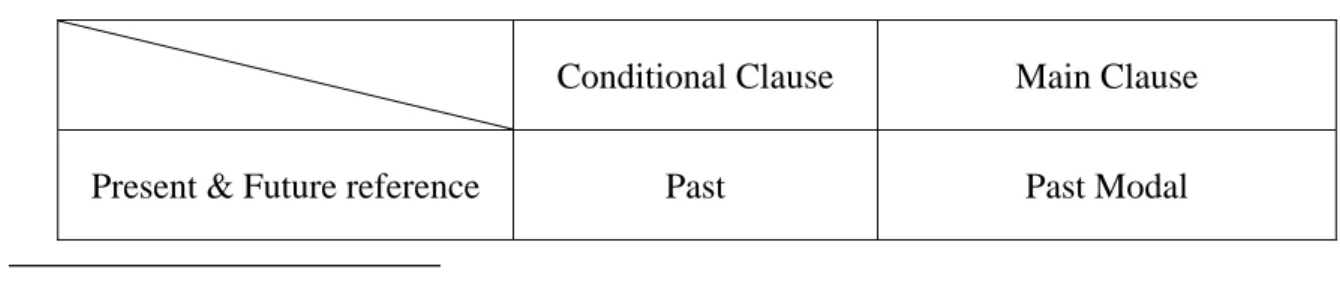
with the tenses “backshifted” (Huddleston, 1984; Direven, 1997). That is to say, the past tense
forms being used for the present & the future references, and the past perfective form for the
past tense reference (See Table 1 below).
Table 2-1: Verb forms in counterfactual conditionals (Quirk et al., 1985, p.1092)
Conditional Clause Main Clause
Present & Future reference Past Past Modal
2 Wu (2003) uses the term “subjunctive” to refer to the hypothetic conditionals in her study. While Wang &
Chang (1999) use the term “counterfactual expression” for the same purpose.
3 The term “non-counterfactual” is an approximate equivalent of “open condition” mentioned above. In the subsequent parts, this term will be used to contrast with “counterfactual.”
If I were younger, I would study Classical
Greek.
Past reference
Past Perfective
If I had seen you,
Past Perfective Modal
I would have invited you.
The backshfited tense principle in counterfactuals is echoed by the view “past as unreal “in
Comrie (1986).
2.1.4 Generalizing the Application Contexts of the Backshifted Tense Principle
Even though the backshifted tense principle has been regarded as a clear indicator of
English counterfactual conditionals, it has been found that the application context of this
principle has to be re-generalized. Problems concerning the generalization of the principle will
be discussed in sections 2.1.4.1 and 2.1.4.2 where the view that backshifted tenses are not
limited to counterfactual conditionals will be supported with examples.
2.1.4.1 Two Problems in the Generalization of the Application Contexts
It may not be safe to claim that the backshifting of tenses equals counterfactuals because
there are at least two problems in the generalization of the application context. The most
obvious problem of the backshifted tense principle is the exceptional form of the copula: the
“were-subjunctive”, as in the first example in Table 2-1: If I were younger, I would study
Classical Greek. One can easily find that the “were-subjunctive” rather than the regular finite
form was is used. Even though the finite form of the copula may also be considered acceptable
as in if I was younger, I would study Classical Greek (Tyler & Vyvyan, 2001), the use of the
“were -subjunctive” is by far the most common usage in the making of counterfactual
interpretation.
The second problem is the occurrence of modals in the main clause. It is found that, in the
main clause, the backshifted tense principle is applied and can only be applied to the modals.
For example, the modal would is required in the sentence If I were younger, I would study
Classical Greek. If not, the sentence If I were younger, I studied Classic Greek would be
considered ungrammatical (Dahl, 1997, p.99). This seems to suggest that the backshifted tense
principle is applied both to the finite verbs in the if-clauses and the modals in the main clauses.
2.1.4.2 The Backshifted Tense Principle Applied in Non-counterfactual Conditionals
So far, the discussion of the backshifted tense principle is limited to counterfactual
conditionals. In fact, the backshifted tense principle can also be extended to the
non-counterfactual conditionals. In the following sentence, we find that the backshifted tense
principle is also applied in non-counterfactual conditionals but the application context is
limited to the if-clauses, not to the modals in the main clause.
(5) If the weather is fine tomorrow, I will go on picnicking.
(6) * If the weather will be fine tomorrow, I will go on picnicking4.
At this point, we seem to be able to conclude that counterfactuals are expressed through
backshifted tenses but backshifted tenses do not equal counterfactuals.
2.1.4.3 Summary of Counterfactual Constructions in English
From related literature, the backshifted tense principle has been identified to denote the
counterfactual conditionals and various explanations have been proposed (Tedeschi, 19815;
Dancygier, 19986;Tyler & Vyvyan, 20017). But it is important to point out that the principle
has various forms. For example, if a copula is needed in if-clauses, the “were-subjunctive” can
also be used. Furthermore, the application context of this principle can also be extended to the
non-counterfactual conditionals.
4 The asterisk * signifies that the sentence is ungrammatical.
5 Tedeschi (1981) proposes the branching-futures model to account for the past tense reference. Under this model, it is assumed we returned to the past and looked at possible futures with respect to that past.
6 According to Dancygier (1998), the backshifting of tenses in the counterfactual conditionals is used to
“distance.” Distancing is used to mean the isolating of the counterfactuals from reality.
7 According to Tyler & Vyvyan (2001), “Actuality” is one of the four categories of “Pragmatics Strengthening”
in which tense morphology has become associated with the additional meaning. “Actuality” here means that tense is used to signal the extent to which the speaker believes the event described corresponds to the actual world state. For example, the Past tense signals that the speaker does not believe that your house burned down refers to a situation that really occurs.
In summary, two generalizations have been proposed about the backshifted tense principle
application:
(1) For counterfactual conditional constructions, this principle is applied to the finite verbs
in the if-clause, while in the main clause, it is applied and can only be applied to modals.
(2) For non-counterfactual conditional constructions, this principle is applied but can only
be applied to the finite verbs in the if-clause.
2.2 Counterfactual Conditionals in Chinese
In this section, first of all, the basic classification and components of conditionals will be
presented in section 2.2.1. Then the related literature on the view that Chinese depends on
contexts to express counterfactuals will be reviewed in section 2.2.2 and the opposing views
will be discussed in section 2.2.3. Finally, in section 2.2.4 it is proposed that in order to
effectively separate counterfactuals from non-counterfactual conditionals in Chinese, the use
of time temporal and the internal semantic logic of the meaning may be indispensable.
2.2.1 The Classification of Chinese Counterfactuals
The classification of Chinese counterfactuals will be presented from the presentation of
teaching Chinese as a foreign language and from formal linguistic analyses in the next two
sub-sections.
2.2.1.1 Analyses of Chinese Counterfactual Conditionals for Second Language Learners
From the perspective of Western linguists, Chinese counterfactual conditionals can be
divided
into two broad categories as follows:
(I) Imaginative hypothetical:
(7)如果你有機會看到我妹妹的話,你就一定會知道她懷孕了。
ru guo ni you ji huei kan dao who mei mie de hua,ni jiou yi ding huei jhij dao tan huao
yua le。
If you saw my younger sister, you’d know that she was pregnant
(I imagine your seeing her.)
(II) Imaginative counterfactual:
(8)如果當時(那時候)你看到我妹妹的話,你就一定會知道她懷孕了。
Ru guo dang shih (na shih hou) ni kan dao wo mei mei de hua,ni jiou yi ding nuei jhih
dao ta huai yun le。
If you had seen my younger sister, you would have known that she was pregnant.
(You did not see her.) (Li & Thompson, 1981, p. 647)
The distinction between these two categories actually lies in whether they are
counterfactual or not. Li & Thompson (1981) posit that while Chinese counterfactuals are not
marked, for the native speakers of Chinese” there is no confusion in using different types of
conditionals because what is meant is clear from the context” (p.647). The view that Chinese
counterfactuals are not clearly indicated is also shared by Comrie (1986). He mentions, “It
should be noticed that there are some languages which make no distinction in terms of degrees
of hypotheticality.” Clearly, the hypotheticality that Comrie (1986) mentions also includes
counterfactual conditionals (Athanasiasdou & Dirven, 1997).
2.2.1.2 Formal Linguistic Analyses of Chinese Counterfactual Expressions
As for the studies about Chinese counterfactual conditionals conducted by Chinese
linguists, they usually focus on modals used in conditionals (e.g., Jhang, 1984;Cheng & Tian,
1992) and the objects of study are limited to classical literature texts prior to Wu’s study in
1994. Wu (1997) analyzes modern Chinese-language newspapers and identifies three main
different linguistic mechanisms. They are semantically-based, grammatically-based and
structurally-based mechanisms. In order to express counterfactuals, Chinese must use three
mechanisms cooperatively. The following table displays the three mechanisms in Chinese.
Table 2-2 Wu’s (1997) mechanisms used to express Chinese Counterfactuals
(1) Semantic From contexts
(2) Grammatical (1) Deictic tense references 「早知道」(zaozhdao)
(2) If-words Variation of “if” 「 要 是 」
(yaoshi) 、「 假 如 」、「 假 使 」
(jiashi)、「要不是」(yaobushi)
(3) The use of “以為”(iwe)
(4) Optative mood markers 句首的「希望」(xyiwuang)「但
願」(danyuan)
句尾的「就好了」(kejiu)
(5) Aspect markers 「了」(le)、「還」(hai)
(6)Rhetorical/conditional
question
「要是」(yaoshi)
(3) Structural Typical “if-then”
The significance of Wu (1997) is that she provides detailed analyses of the counterfactuals
of Chinese, in addition to the important role of contexts emphasized by Li & Thompson
(1981).
2.2.2 The View that Chinese Counterfactuals Depend on Contexts
As we have mentioned in section 2.2.1.1, Li & Thompson posit that the differences
between Chinese counterfactuals and non-counterfactuals are indicated by contexts (Li &
Thompson, 1981)8. Wu (1997)9 further analyzes the role of contexts. The relation between
contexts and explicit & implicit counterfactual markers in Chinese is displayed in table 2-3. In
this table, it is indicated that the context will play a greater role, if there are implicit markers or
no markers of counterfactual expressions at all. In contrast, if explicit markers are presented,
the importance of contexts will be downplayed.
Table 2-3: The relation between contexts and explicit & implicit counterfactual markers in Chinese
2.2.3 Opposing Views of the Claim that Chinese Makes No Distinction in Counterfactuals
The view that Chinese makes no distinction between non-counterfactual conditionals and
counterfactual conditionals and that Chinese is considered a context-dependent language in
terms of counterfactuality does not go without any challenges. Thus, section 2.2.3.1 will
describe the origin of the view and then in section 2.2.3.2, it will be shown that Chinese can be
considered context-independent if counterfactuals co-occur with two linguistic devices.
8 Besides the two types of conditionals, “reality conditional” is also identified by Li & Thompson (1981) as one type of conditionals but this type does not fall into the category of counterfactual conditionals. For example, 如果你看到我妹妹跟她打一個招呼 ru guo ni kan dao wo mei mei,gen tad a I ge jhao hu (if you see my younger sister, say hello to her).Therefore, I do not include it in our study.
9 In her early opinion, contexts are regarded as one of three levels of counterfactual interpretation. Here the importance of context is discussed in relation to the occurrence of implicit and explicit counterfactual markers.
Implicit markers or no markers---with context ---counterfactual expression Explicit Markers---with or without context----counterfactual interpretation
2.2.3.1 The Origin of the Claim that Chinese Makes No Distinction between Non-counterfactuals and Counterfactuals
Bloom (1981) argues that Chinese makes no distinction between non-counterfactual
conditionals and counterfactual conditionals. The sentences he uses are like the following one:
(9)假如所有的圓圈都很大,如果這個小三角形 ”△”是一個圓圈,那麼這個三角形是不是很大?
Jia ru suo you de yuan cyuan dou hen da,ru guo jhe ge ge siao san jiao sing shih yi ge yuan cyuan
na me jhe ge san jiao sing shih bu shih heh da?
“If all circles were large and this small triangle ”△” were a circle, would it be large?”
According to Bloom, since Chinese does not clearly distinguish counterfactual from
non-counterfactual conditionals, most Chinese respondents found it difficult to understand the
meaning of this sentence and asked how a small triangle could be a circle. Their responses
indicate that they fail to identify the described situation as counterfactual.
His conclusion is that the lack of counterfactual devices in Chinese will result in the lack
of counterfactual ways of thinking of Chinese speakers. However, it turns out that both the
assumption and the conclusion have attracted a lot of criticism (e.g., Au, 1983; Liu, 1985).
As a matter of fact, when Bloom (1981) claims that Chinese makes no distinction between
counterfactual and non-counterfactual conditionals, he only refers to independent sentences.
But in the next sub-section, independent sentences that clearly indicate counterfactuals will be
presented.
2.2.3.2 Counterexamples for the Claim that Chinese is a Context-Dependent Language in
Terms of Counterfactuals
Bloom’s claim that Chinese makes no distinction between non-counterfactuals and
counterfactuals has been proven to be not completely correct. In the two following examples
from Wierzbicka (1997), the counterfactual condition in (10) and the non-counterfactual
condition in (11) can be made quite clear:
(10) Jiaru nashihou X mei fasheng dehua, ye jiu meiyou Y le
If that time (in past) X neg happen, sub cause part, also then neg exist Y part.
“If X hadn’t happened at that time, there wouldn’t be Y”
“如果那時候,x 沒有發生的話,也就沒有 y 了。”
(11) Jiaru jianglai X bu fasheng dehua, jie bushi you Y
If in the future X not happen sub part case,then neg able exist Y
“If X does not happen, there won’t be Y.”
“如果將來,x 不發生的話,將不會有 y。”
These two sentences suggest that the expression of counterfactuality can be partly
denoted through the time temporal and internal semantic logic in the sentences. The reasoning
process is that since what has happened in the past cannot be changed, therefore the
proposition must be counterfactual. On the other hand, no one can be sure what will happen in
the future, therefore, the propositional content remains undetermined and therefore, there is no
doubt about whether it is a counterfactual or not10.
2.3 Summary
In this chapter, we have addressed three important issues to gain a more comprehensive
understanding of the counterfactuals in English and Chinese. First, the linguistic categories in
the two languages have been reviewed. Then studies about the relation between contexts and
counterfactual expression in Chinese have been summarized. Finally, some solutions have
10 Following Wu’s analysis of the relation between contexts and explicit and implicit counterfactual markers, we seem to be able to posit that the use of time temporal and internal semantic logic fall into the category of explicit counterfactual markers.
been offered to solve the controversy: whether independent Chinese sentences can express
counterfactuals or not.
With regard to the linguistic devices to express counterfactuals, English is found to
mainly depend on syntactical structures, namely the backshifted tenses, and thus is more likely
to avoid ambiguity. In contrast, Chinese, due to its lack of overt distinctions of tenses, relies on
multilevel linguistic categories for the same purpose, but still leaves room for speculation of
whether the described situations are possible in the future or are counterfactual.
As for the role of contexts, it seems safer to conclude that besides contexts, time temporal
and internal semantic logic have jointly served as indicators to enhance the interpretation of
counterfactual ideas and we argue counterfactual conditionals (the past reference) usually
co-occur with these two linguistic devices and therefore tend to more clearly convey
counterfactual expression than the present reference ones.