Evidence of oxygen vacancy enhanced room-temperature ferromagnetism in Co-doped ZnO
H. S. Hsu and J. C. A. Huanga兲
Department of Physics, National Cheng Kung University, Tainan 701, Taiwan, Republic of China, Department of Applied Physics, National University of Kaohsiung, Kaohsiung 811, Taiwan, Republic of China, and Center for Micro/Nano Technology Research, National Cheng Kung University, Tainan 701, Taiwan, Republic of China
Y. H. Huang, Y. F. Liao, M. Z. Lin, and C. H. Lee
Department of Engineering and System Science, National Tsing-Hua University, Hsinchu 30013, Taiwan, Republic of China
J. F. Lee
National Synchrotron Radiation Research Center, Hsinchu 30076, Taiwan, Republic of China S. F. Chen, L. Y. Lai, and C. P. Liu
Department of Materials Science and Engineering, National Cheng Kung University, Tainan 701, Taiwan, Republic of China
共Received 9 December 2005; accepted 1 May 2006; published online 16 June 2006兲
The annealing effects on structure and magnetism for Co-doped ZnO films under air, Ar, and Ar/ H2 atmospheres at 250 ° C have been systematically investigated. Room-temperature ferromagnetism has been observed for the as-deposited and annealed films. However, the saturation magnetization 共Ms兲 varied drastically for different annealing processes with Ms⬃0.5, 0.2, 0.9, and 1.5B/ Co for the as-deposited, air-annealed, Ar-annealed, and Ar/ H2-annealed films, respectively. The x-ray absorption spectra indicate all these samples show good diluted magnetic semiconductor structures.
By comparison of the x-ray near edge spectra with the simulation on Zn K edge, an additional preedge peak appears due likely to the formation of oxygen vacancies. The results show that enhancement共suppression兲 of ferromagnetism is strongly correlated with the increase 共decrease兲 of oxygen vacancies in ZnO. The upper limit of the oxygen vacancy density of the Ar/ H2-annealed film can be estimated by simulation to be about 1⫻1021cm−3. © 2006 American Institute of Physics. 关DOI:10.1063/1.2212277兴
Transition metal 共TM兲-doped oxides have been investi- gated as a promising class of diluted magnetic semiconduc- tors共DMSs兲 to bring out advanced spintronic devices since the discovery of room-temperature 共RT兲 ferromagnetism in these systems. However, a number of studies1 indicate that the RT ferromagnetism in TM-doped oxides may come from precipitation of magnetic clusters or from secondary mag- netic phases. On the other hand, there are reports that suggest the absence of magnetic clusters or secondary phases and support intrinsic ferromagnetic origin.2Even so, the origin of ferromagnetism in oxide DMSs remains a very controversial topic. For example, a carrier-mediated mechanism has been proposed to explain the ferromagnetism in oxide DMSs.
However, the TM-doped oxide films with ferromagnetic properties are sometimes poor in conducting or even highly insulating.3,4The sp-d exchange mechanism between the sp free carriers and the d states of the TM doping elements is therefore inapplicable in these cases. Double exchange mechanism between d states of TM elements is another pos- sible candidate to induce ferromagnetism in magnetic oxide.
However, in many cases the low doping concentration and single valence state of magnetic elements have been ob- served to exclude the double exchange mechanism.
In addition to the magnetic doping effect, oxygen vacan- cies have been proposed to play an important role in the magnetic origin for oxide DMSs. For example, theoretical
studies suggest that oxygen vacancies can cause a marked change of the band structure of host oxides and make a sig- nificant contribution to the ferromagnetism.5,6The formation of bound magnetic polarons 共BMPs兲, which include elec- trons locally trapped by oxygen vacancies, with the trapped electron occupying an orbital overlapping with the d shells of TM neighbors, has also been proposed to explain the origin of RT ferromagnetism for some insulating oxide DMSs.7Ex- perimentally, oxygen vacancies might easily be generated during various thin film growth processes owing to the vacuum environments. Many controversial results of oxide DMSs could possibly be related to the variation of their oxy- gen vacancies.8,9However, oxygen vacancies are difficult to measure. In this letter, we study the correlation of electronic structure, local structure, and magnetic properties of Co- doped ZnO thin films. We show that x-ray near edge spec- troscopy共XANES兲 on Zn K edge is sensitive to the forma- tion of oxygen vacancies in ZnO modulated by annealing processes. The change in preedge feature of XANES spectra is likely associated with the concentration variation of oxy- gen vacancy as revealed by the scattering calculation. Evi- dence of oxygen vacancy enhanced magnetization is pro- vided by comparison of the magnetic and XANES results.
Several Co-doped ZnO films of about 550 Å were simul- taneously grown on␣-Al2O3 共0001兲 substrates at RT by ion beam sputtering using a multilayer doping technique. Details of similar sample preparation procedures have been de- scribed elsewhere.10After the growth, these films were sepa- rately annealed under air, 1 atm of pure Ar, and 1 atm of
a兲Electronic mail: [email protected]
APPLIED PHYSICS LETTERS 88, 242507共2006兲
0003-6951/2006/88共24兲/242507/3/$23.00 88, 242507-1 © 2006 American Institute of Physics
Downloaded 16 Nov 2008 to 140.116.208.44. Redistribution subject to AIP license or copyright; see http://apl.aip.org/apl/copyright.jsp
Ar共90%兲/H2共10%兲, each at 250 °C for 1 h, respectively.
Samples studied here are all textured films with the c axis directed out of the plane, as evidenced by x-ray diffraction.
The Co to Zn ratio extracted from the energy dispersive x-ray共EDX兲 spectra is about 6±1%.
The magnetic properties of these samples were per- formed by a commercial superconducting quantum interface device共SQUID兲. RT ferromagnetism has been observed for the as-deposited and annealed films, as shown in Fig. 1. For this series of films, the Ar-annealed and Ar/ H2-annealed films show saturation magnetization共Ms兲 of about 0.9 and 1.5B/ Co, respectively, the latter about triple of the as- deposited film共0.5B/ Co兲. On the other hand, the Msof the air-annealed film 共0.2B/ Co兲 is less than half of the as- deposited film. Similar annealing effect on magnetism for oxide DMSs has also been reported by other research groups.8,9 However, in some cases the enhanced ferromag- netism may come from the precipitation of magnetic clusters.11 Therefore, it is essential to realize the annealing effect on the local structure in the first place in order to disclose the origin of ferromagnetism in oxide DMSs.
The x-ray absorption spectroscopy共XAS兲 technique has been demonstrated as a powerful tool to understand the local structure of DMSs.1,10 The XAS experiments were carried out in the wiggler-C beamline of the Taiwan Light Source in Hsinchu, Taiwan. XANES is a fingerprint of the electronic state共particularly of the valence state兲 of TM elements, and is extremely sensitive to inspect the presence of Co clusters in host oxides.12 The XANES spectra on Co K edge of the as-deposited, air-, Ar-, and Ar/ H2-annealed Co:ZnO samples are displayed in Fig. 2. XANES from a standard Co foil and CoO and Co2O3powders are also provided as reference. It is noticed that the preedge feature for the as-deposited and an- nealed samples resembles much as the CoO reference, in marked contrast with the characteristic of metallic Co with a significant shoulder around 7712 eV. The XANES measure- ments revel that most of the Co atoms in all of these samples are in the +2 state. Besides, extended x-ray absorption fine structure共EXAFS兲 spectra on Co K edge of these films have been used to clarify the local structures surrounding Co. In- set共a兲 of Fig. 2 shows the Fourier transform 共FT兲 amplitude of EXAFS on Co K edge for these samples, together with the Zn K edge of ZnO film 共500 Å兲 as reference. For the as- deposited and annealed Co:ZnO samples, the Co K edge FT spectra are very similar to the undoped ZnO film as viewed from a specific Zn atom. The results reveal that most of the Co atoms substitute for Zn atoms for all the Co:ZnO samples studied here.
The magnetic and XAS results suggest that the observed RT ferromagnetism for the as-deposited and annealed
samples is in accordance with Co cluster-free structures, which is consistent with the high resolution transmission electron microscopy共HRTEM兲 results shown, for example, in the inset共b兲 of Fig. 2. Note that if the ferromagnetic sig- nal, for example, in the Ar/ H2-annealed sample, were due to precipitation of Co clusters, the measured moment of 1.5B/ Co indicates that about 90% of the Co atoms exists in the form of metallic Co clusters共1.7B/ Co for bulk Co兲, and such a high concentration of metallic Co clusters would be easily detected by XAS or TEM.
In addition, the RT resistivity of the Ar/ H2-annealed sample 共⬃2⫻10−2 ⍀ cm兲 is lower than the Ar-annealed sample 共⬃6⫻10−2⍀ cm兲 and the as-deposited one 共⬃7
⫻10−1⍀ cm兲. The resistivity trend seems to support the model of carrier-mediated ferromagnetism. However, the air- annealed film is highly insulating 共⬃6⫻103⍀ cm兲, yet it still displays robust ferromagnetism. This case makes carrier- mediated mechanism invalid.
Our systematic studies show that oxygen vacancy con- stituted BMPs are a promising candidate for the origin of RT ferromagnetism in this system. Within the BMP model, the greater density of oxygen vacancies yields a greater overall volume occupied by BMPs, thus increasing their probability of overlapping more Co ions into the ferromagnetic domains and enhancing ferromagnetism.7To further probe the role of the oxygen vacancies on magnetic behavior, we therefore carry out the XANES measurements on Zn K edge. In con- trast with the similar Co K-edge results for the as-deposited and annealed Co:ZnO samples, the Zn K-edge results of these samples show some variation in the preedge region.
Figure 3 presents the Zn K-edge XANES spectra for the ZnO film, the as-deposited, and the annealed Co:ZnO samples.
The characteristic peaks “A” and “B” were observed for all of these films and can be referred to as the Zn 1s-4p transi- tions. The integrated area of the Zn K-edge XANES spectra, which is proportional to the unfilled p density of states 共DOSs兲 in Zn, is much smaller for the as-deposited and Ar- and Ar/ H2-annealed samples compared with the air-annealed sample; the latter is almost equivalent to the ZnO film. This means that either the moderate doping or annealing pro- cesses increase the carriers, and therefore, decrease the un- filled p DOSs. But for the air-annealed sample, the annealing
FIG. 1.共Color online兲 The magnetization vs magnetic field curves for the as-deposited and annealed Co:ZnO films measured at room temperature.
FIG. 2.共Color online兲 The Co K-edge XANES for the as-deposited sample and annealed films. The XANES of Co foil and Co oxides are also provided for reference. Inset共a兲 shows the FT amplitudes of Co K-edge EXAFS for the as-deposited and annealed films together with the Zn K edge of ZnO 共500 Å兲 for reference. Inset 共b兲 shows the HRTEM image for the Ar/ H2-annealed sample.
242507-2 Hsu et al. Appl. Phys. Lett. 88, 242507共2006兲
Downloaded 16 Nov 2008 to 140.116.208.44. Redistribution subject to AIP license or copyright; see http://apl.aip.org/apl/copyright.jsp
process causes oxygen to rediffuse into the film, thus remov- ing the oxygen vacancies and increasing the unfilled p DOSs.
These results are consistent with the electrical measurements mentioned above. Besides, it is noticed that an additional preedge peak labeled “C” can be observed in the XANES spectra for the Ar- and Ar/ H2-annealed samples and it be- comes more manifest in its first derivative, as shown in the inset of Fig. 3. Note that the intensity of the preedge peak C is much pronounced for the Ar/ H2-annealed sample. In gen- eral, the preedge feature is a characteristic only for TM due to 1s-3d transitions, such as for Co discussed above. For ZnO with a completely filled 3d orbital共i.e., Zn 3d10兲, the preedge peak can be considered as defect-induced local in- terference effect around the Zn absorber rather than bound state transitions.13
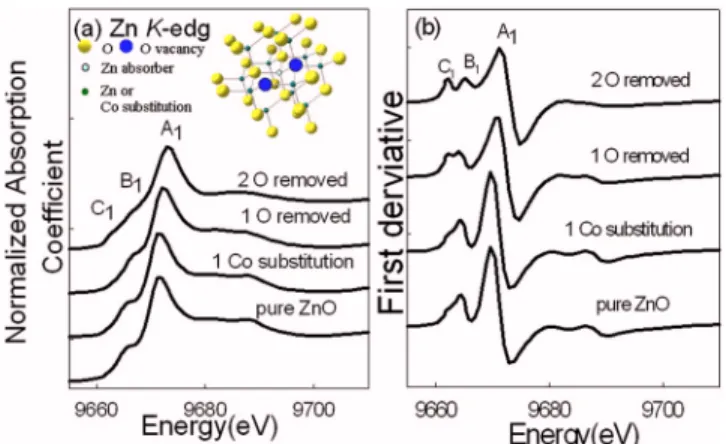
To verify the influence of Co substitution for Zn and the formation of oxygen 共O兲 vacancies on the preedge feature, we carry out the XANES simulation taking account of sev- eral structural variants. The modeled spectra were calculated by the real-space multiple-scattering approach usingFEFF 8.2
code14 operating on Zn K edge. The scattering potentials were calculated self-consistently in a cell cluster of 27 atoms 共up to three coordination shells兲. Hedin-Lundquist exchange correlation potential was used in this simulation. The FEFF
input file was generated by theATOMSpackage for the lattice constants a = 3.249 Å and c = 5.206 Å. As shown in Fig. 4共a兲, the calculated spectra for a cell cluster with three coordina- tion shells are already in reasonably good agreement with the experimental curves and reproduce the main features共A1and B1兲. It is also noted that the increase of more coordination
shells does not lead to significant change in the line shape of the simulated spectra. For clarity, the derivative XANES spectra are provided in Fig. 4共b兲.
For the case of one Co substitution 共⬃6% Co doping兲, the simulated XANES results on Zn K edge resemble much of that of a pure ZnO due to similar photoelectron scattering function for Co and Zn in the studied energy region.15 For the case of O vacancies, on the other hand, the simulation results indicate that Zn K-edge XANES shows some varia- tion from a pure ZnO. This is reasonable because low atomic number共Z兲 element such as oxygen has stronger scattering factor in the XANES energy region. For example, by remov- ing one of the O atoms in the first coordination, an additional preedge peak “C1” appears, as shown in Fig. 4. By removing two O atoms 共one in the first and another in the second coordination shell of O, for example兲, the C1 peak intensity becomes more pronounced.
The amount of oxygen vacancies among these DMS films can be qualitatively understood by comparison of the experimental共Fig. 3兲 and theoretical 共Fig. 4兲 XANES spectra on Zn K edge. The Ar/ H2-annealed film with the most pronounced preedge peak possesses more oxygen vacancies than the Ar-annealed and as-deposited samples. Oxygen vacancies are largely reduced for the air-annealed film.
Within the simulation model, the upper limit of the density of oxygen vacancies 共of the Ar/H2-annealed film兲 can be estimated to be about 1⫻1021 cm−3. More quantitative analysis of the oxygen vacancies in Co:ZnO film are under intensive studies. We conclude that the variation of oxygen vacancies in Co:ZnO is strongly correlated with observed RT ferromagnetism.
This work has been supported by the National Science Council of the ROC under Grant No. NSC 94-2120- M-006-008.
1Jung H. Park, Min G. Kim, Hyun M. Jang, Sangwoo Ryu, and Young M.
Kim, Appl. Phys. Lett. 84, 1338共2004兲.
2S. Ramachandran, Ashutosh Tiwari, and J. Narayan, Appl. Phys. Lett. 84, 5255共2004兲.
3K. A. Griffin, A. B. Pakhomov, C. M. Wang, S. M. Heald, and Kannan M.
Krishnan, Phys. Rev. Lett. 94, 157204共2005兲.
4Zhigang Yin, Nuofu Chen, Chunlin Chai, and Fei Yang, J. Appl. Phys. 96, 5093共2004兲.
5John E. Jaffe, Timothy C. Droubay, and Scott A. Chambers, J. Appl. Phys.
97, 073908共2005兲.
6Hongming Weng, Xiaoping Yang, Jinming Dong, H. Mizuseki, M.
Kawasaki, and Y. Kawazoe, Phys. Rev. B 69, 125219共2004兲.
7J. M. D. Coey, M. Venkatesan, and C. B. Fitzgerald, Nat. Mater. 4, 173 共2005兲.
8Nguyen Hoa Hong, Joe Sakai, Ngo Thu Huong, Nathalie Poirot, and Antoine Ruyter, Phys. Rev. B 72, 045336共2005兲.
9A. Manivannan, G. Glaspell, P. Dutta, and M. S. Seehra, J. Appl. Phys.
97, 10D325共2005兲.
10J. C. A. Huang, H. S. Hsu, Y. M. Hu, C. H. Lee, Y. H. Huang, and M. Z.
Lin, Appl. Phys. Lett. 85, 3815共2004兲.
110.D. H. Kim, J. S. Yang, Y. S. Kim, T. W. Noh, S. D. Bu, S. I. Baik, Y. W.
Kim, Y. D. Park, S. J. Pearton, J. Y. Kim, J. H. Park, H. J. Lin, C. T. Chen, and Y. J. Song, Phys. Rev. B 71, 014440共2005兲.
12T. C. Kaspar, T. Droubay, C. M. Wang, S. M. Heald, A. S. Lea, and S. A.
Chambers, J. Appl. Phys. 97, 073511共2005兲.
13David A. McKeown, Phys. Rev. B 45, 2648共1992兲.
14A. L. Ankundinov, B. Ravel, J. J. Rehr, and S. D. Conradson, Phys. Rev.
B 58, 756共1998兲.
15Handbook of Synchrotron Radiation, edited by E. A. Stern, S. M. Heald, and E. E. Koch共North-Holland, New York, 1983兲, pp. 995–1014.
FIG. 3. 共Color online兲 The Zn K-edge XANES for the ZnO 共500 Å兲, as- deposited, and annealed films. The inset shows the first derivative of XANES for these films.
FIG. 4.共Color online兲 Theoretical XANES 共a兲 and their first derivative 共b兲 on Zn K edge fromFEFFsimulation for a ZnO cell cluster共27 atoms兲 and several structural variants, including the influence of Co substitution and oxygen vacancies.
242507-3 Hsu et al. Appl. Phys. Lett. 88, 242507共2006兲
Downloaded 16 Nov 2008 to 140.116.208.44. Redistribution subject to AIP license or copyright; see http://apl.aip.org/apl/copyright.jsp